
Timeline: Science & Technology
Peter Goes
Gecko Press
If you’re looking for a book that presents the scientific accomplishments of humankind, from Paleolithic times to the present day, then this large format offering should fit the bill. Concisely written, it’s absolutely packed with exciting information starting right back in the Stone Ages when mankind learned how to make fire, moving on to the Copper or Chalcolithic Age (copper being the first metal humans made use of) when people were starting to develop farming techniques such as crop-growing, and when towns began.
Then come the first civilisations and Peter Goes shows the contribution of each to the evolution of technology and science. There’s Mesopotamia with a medical manual from ancient Babylon,

the Americas, the Indus Valley civilisation or Harrapan Culture – when there were some large cities with brick houses and sophisticated sanitation and drainage systems. (I was pleased to see this having once visited and written about, the Lothal site in India’s Gujarat state.)

There’s a look at Ancient Egypt, the first Chinese, Greek, Roman and Byzantine empires with both general information and some closer detail about each era.
By now some readers might be thinking, surely technology is about computers, mobile phones and satellites? But the roots of all these technological wonders lies way back in the Stone Age.
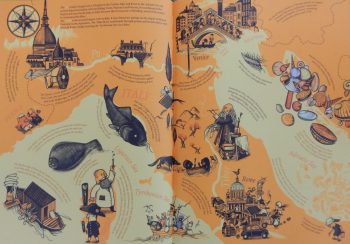
Each double spread displays an era, century or, once we get to the 20th/21st centuries, a decade,

ending up with a look at the development of artificial intelligence (AI).
With each spread having a different colour background, Peter Goes’ graphic art is alluring and playfully immersive, making it overall more of a visual history presentation. It’s good to see a fair number of women included such as German astronomer Maria Margaretha Kirch (18th C), mathematician and first computer programmer Ada Lovelace (early 19th C), Rachel Carson, Rosalind Franklin (1950s) and Stephanie Kwolek (1960s). (Wish there’d been an index.)
Recommended for home and school use. Browse for hours: You’re sure to learn something wherever, whenever you stop.

 Red Reading Hub - Jillrbennett's Reviews of Children's Books