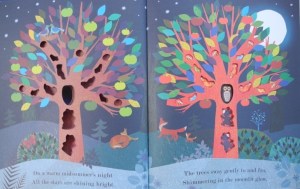
Minibeasts / What Can You See? In the Garden / We Love Fruit!

There are all new board books from Little Tiger – thanks to the publishers for sending them for review.
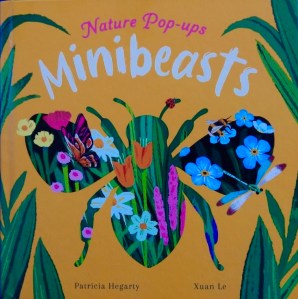
The first of a nature new series where the featured creatures almost leap out from among the plants growing in the flowerbeds. First comes a bumblebee that is busily collecting pollen from a composite flower; then there’s a ladybird that opens up its scarlet wing cases as though to take flight. Next not just one but – well maybe your little one can try counting them – the beautiful butterflies that, wings spread wide, take to the skies and flutter on the breeze. Meanwhile much closer to the ground, a shiny shelled snail climbs slowly, steadily amongst the grasses and ferns while, down by the pond darting among the lily pads, transparent wings shimmering is a dragonfly and finally, peeking from the foliage of blooming wisteria is a chirping grasshopper; but if you look very closely, there’s also one unnamed minibeast making its way along the branch.

Little ones will love watching all these small creatures as they peruse Xuan Le’s vibrant settings for Yoojin Kim’s cleverly engineered scenes.

More minibeasts appear in
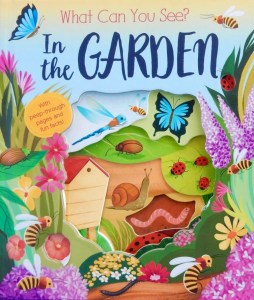
At Rosamund Lloyd’s suggestion, young children take a walk in the garden and discover minibeasts in flight, follow a butterfly through its various stages of metamorphosis, watch honey bees at work, see camouflage and other ways minibeasts keep themselves save from predators. If you take time to forage in the plant litter there are woodlice, millipedes and snails to discover whilst beneath the ground earthworms burrow and ants create colonies. Little humans will delight in such facts as “some millipedes eat their own poo’ and that unlike themselves who have a backbone, insects have a skeleton on the outside called an exoskeleton .
The cutaway pages are cleverly positioned to allow readers to peep through and see what awaits.

Spring is here so share the book and then see what awaits outside your front door.
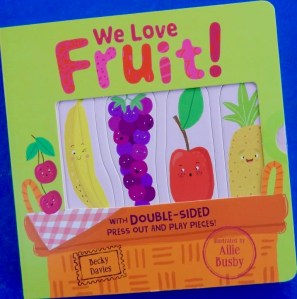
Don’t play with your tasty food. This is frequently said to little ones by parents or carers but now this book gives toddlers permission to do just that. Indeed they will love pulling out the double-sided fruit characters from the sliding tray inside the front cover and meeting the eight different fruity personalities. From these, little humans must follow the clues given on each page and choose the matching cardboard piece. Can they discover which fruit grows in bunches and when dried is called a raisin or which one might take as long as three years to grow?

A clever interactive guessing game, playfully illustrated by Ailie Busby with words by Becky Davies that offers opportunities for adult sharers of the book to talk about the importance of fruit in a healthy diet. I suspect several helpings will be desired by toddlers.
For Baby’s Bookshelf

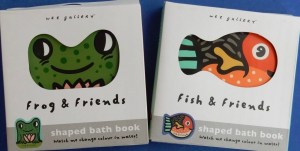
These bath books cleverly change colour when wet.
The first introduces a little green frog on the lookout for friends to leap with: there’s a dragonfly, a duck and an otter each of which will come to life on the squishy tactile pages as an adult speaks the dozen words of the text, possibly then adding some croaky sounds.
The second is a fishy shaped sub-marine offering wherein the titular fish and friends starfish, turtle, whale and seahorse assume their colour when immersed by tiny human hands.
Both books offer splishy, splashy tactile fun learning for the very youngest humans at bath time: peekaboo with a difference.

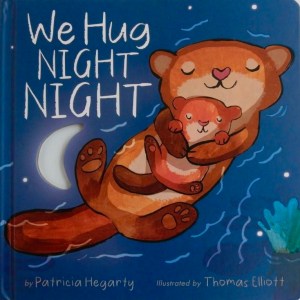
A loving father gently prepares a little child for sleep and in so doing, introduces listeners to parent and infant creatures – bears, possums, otters, cats, giraffes and birds all safe in their respective abodes also snuggling up in readiness for slumbering. Patricia Hegarty’s soothing rhyming words and Thomas Elliot’s endearing illustrations combine to lull little ones as an adult turns the cutaway pages of this goodnight charmer that is likely to become a bedtime favourite.

There’s parental love aplenty too in

Don’t Mix Up My Farm / What’s Scarier than a Spider? / I’m Not Scared, You Are!

These are three brand new board books from Little Tiger – thanks to the publisher for sending them for review.

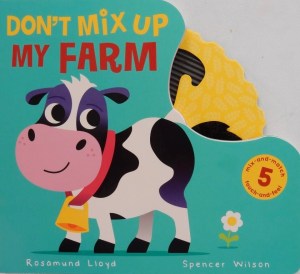
Don’t Mix Up My Farm
Rosamund Lloyd and Spencer Wilson

Five farm animals – a sheep, a donkey, a cockerel, a pig and a duck offer tactile fun in this matching game of a book. Little ones will enjoy creating strange-looking creatures by mismatching one of their features using the wheel. Although none of the creatures will be impressed to be given wrong horn, beak, tail or comb, so they should make sure they also match each with the small pictures on the back cover; otherwise a lot of braying, bleating, crowing, grunting and quacking might break out down on the farm.

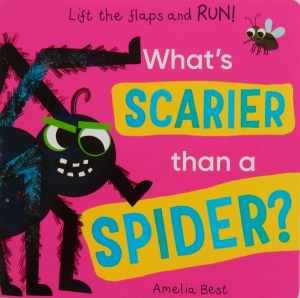
What’s Scarier than a Spider?
Amelia Best and Becky Davies

The scorpion, wasp, cockroach, mosquito, and spider more than meet their match in this altogether different peekaboo game. The aforementioned creatures are anticipating in turn, dinner, a fight, a tasty treat, being the boss

and upsetting something or someone. However as the fly on each spread delights in announcing, each one has an unexpected confrontation of the alarming kind.
There’s some delicious alliteration – ‘massive mantis’ and ‘biting beetle’ for little ones to try getting their tongues around, along with the delightfully shocking creepy crawly surprises revealed by lifting the flaps, especially the final extra large one to revel in. Amelia Best has portrayed some terrifying minibeasts in her arresting illustrations.

I’m Not Scared, You Are!
Patricia Hegarty and Thomas Elliott

With a plethora of scary sounds waiting to spook your little ones at the press of a button, we join two child characters on a foray out into the night. Their journey takes them deep into a forest wherein bats and owls are ready to alarm with their flaps and yowls. They board a passing ghost train that drops them off outside a cottage wherein a witch is busy stirring something that’s bubbling in her enormous cauldron. Hearts thumping, on they go over the bridge, under which lurk not one but three growling, grunting trolls, as they head towards a huge haunted house. Inside they are met by rattling skeletal sounds, followed by clangs and clanks sending them hurtling towards the door once more. After a frantic dash our adventurers arrive back home safely and of course, they confirm “No, we’re not afraid!’ But are they? …
Patricia Hegarty’s rhyming text reads aloud really well offering lots of opportunities for action as well as noise making and Elliott’s scenes are jocular rather than of the shivers-down-the-spine- sending scary.

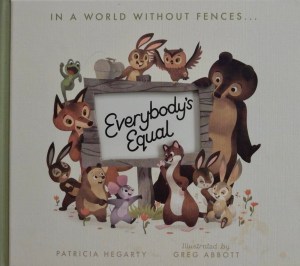
Everybody’s Equal

Everybody’s Equal
Patricia Hegarty and Greg Abbott
Little Tiger

This is a follow-up to Everybody’s Welcome by the same author and illustrator team.

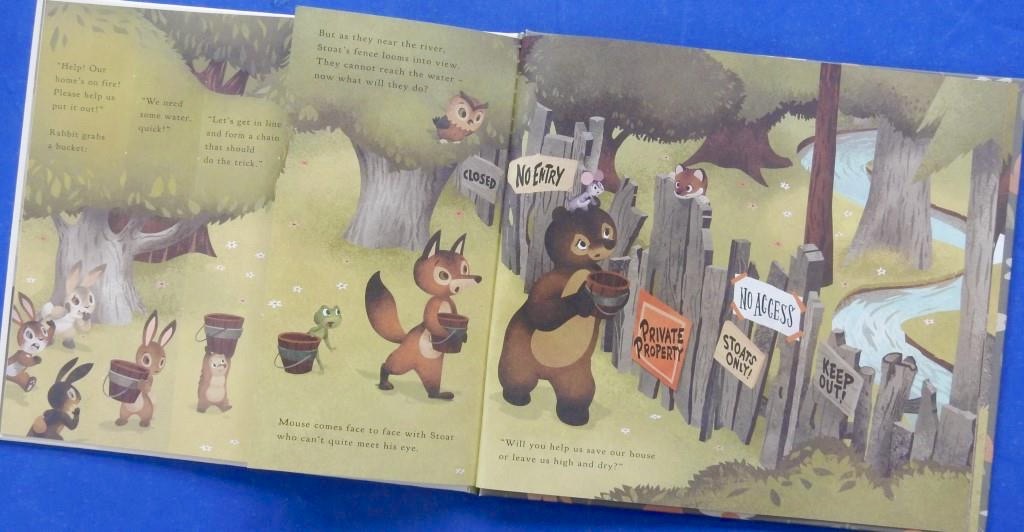
Mouse is standing in the forest clearing near his home when he hears a lot of banging and crashing. It’s Stoat building a tall sturdy fence designed to keep Mouse out -“because you don’t belong” he tells the little creature.

Mouse doesn’t just accept this; he responds “Everybody’s equal, / I’m sure you will agree. / I’m as good as you / and you’re as good as me.” – a verse he repeats several times during the story.

He calls all his friends together to try and form a plan to make Stoat change his mind. This causes a squabble about electing a leader but Mouse knows just what to say to move things forward. Then suddenly as Stoat puts the finishing touches to his fence, he hears a cry for help. The house in which Mouse and his pals live, having built it together, has caught fire and the animals desperately need water.

However Stoat’s fence is blocking access to the river. Will he do the right thing so the other animals can get to the water that can put out the flames?

Happily yes; seemingly Stoat has seen the error of his ways and realised that as Mouse has been saying all along, everybody’s equal.

Patricia’s rhyming text reads aloud well and together with Greg Abbot’s woodland scenes in muted hues that use split pages to build up layers of the story, and that crucial die-cut , show that life is much more enjoyable when everybody is included in the fun.

Adult readers aloud will likely see some parallels with current events that are happening in the UK and other parts of the world. Young listeners will understand the importance of Mouse’s words about equality and inclusivity and one hopes apply them to their own lives.

Counting in Green / Bee Activity Book

Counting in Green
Hollis Kurman and Barroux
Otter-Barry Books

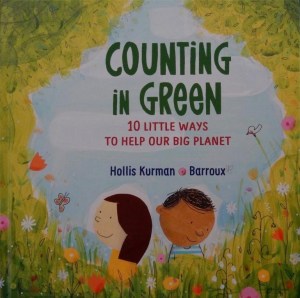
So much more than a mere counting book: this collaboration between Hollis Kurman, a climate activist and Barroux, an award winning illustrator presents as the subtitle says, ’10 little ways to help our big planet’. Little ways they may be; but if everyone followed all ten or even most of them, what a BIG difference that would make to our precious Mother Earth.

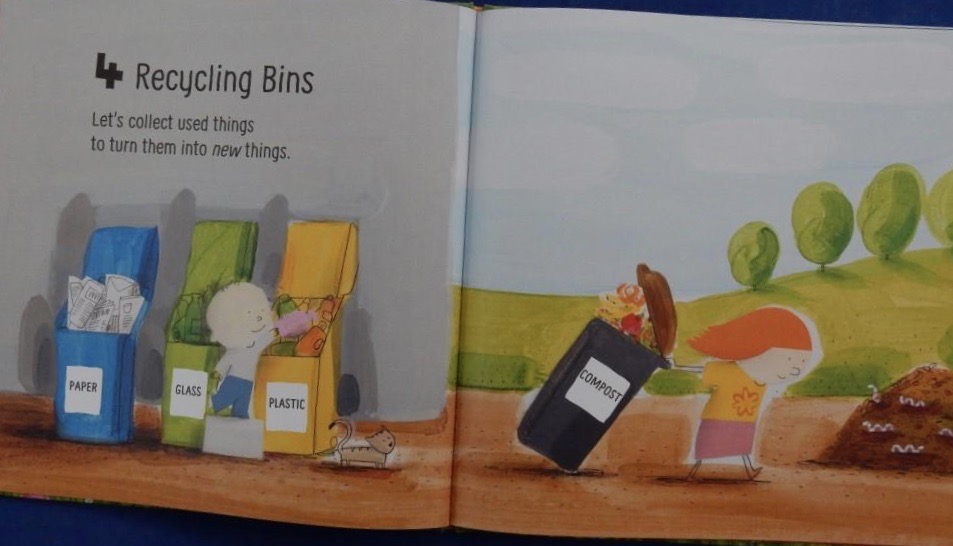
The actions include planting a new tree, eating meat free meals, recycling and reusing, 

taking our own bags when we go shopping so as to avoid plastic, getting involved in a beach clean-up, 

cultivating a garden that encourages bees and butterflies.

Barroux’s gently humorous illustrations are inclusive and work well with the straightforward text; and the final spread concludes with this challenge to young readers: How many ways can you think of to go green? That would make an excellent starting point to get a class of primary children thinking about this vital topic.

The final endpapers offer some relevant websites as well as a paragraph about the interconnectedness of everything on earth, which’s why getting involved is so vital.

Bee Activity Book
Patricia Hegarty and Britta Teckentrup
Little Tiger

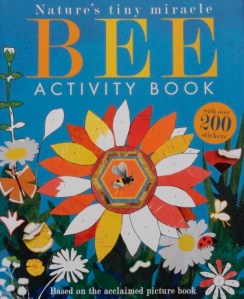
This activity book is based on Patricia Hegarty’s text and Britta Teckentrup’s illustrations for the buzz-ingly bee-utiful original picture book Bee:Nature’s tiny miracle published a few years back.

Herein several settings are used – a meadow full of wild flowers, a pond, a riverside, a woodland clearing – as backdrops for the wealth of bee-related activities. You will find word searches, bee parts to label, mazes, spot the difference, things to count, scenes to colour, and others to complete using the stickers at the back of the book, as well as mosaics that also require colouring and the placing of stickers.

There’s a wealth of fun learning between this book’s covers – an ideal way for youngsters to enjoy some nature-related, screen-free time.

We Are Love / Don’t Mix Up My Dinosaur

These are two new titles from Little Tiger – thanks to the publisher for sending them for review

We Are Love
Patricia Hegarty and Thomas Elliott

Animal parents furry, wrinkly, scaly and feathery invite little humans to watch their demonstrations of love for their offspring. Whether it’s leaping squirrels, plodding pachyderms, diving dolphins, waddling penguins or whatever, we can find loving care in a multitude of places. Young children will be reassured to see that the final pages show a mother and her small child showing their heartfelt love for one another.

A clever cutaway design feature enables the second of the two spreads allocated to each loving parent and little one, to show them coming together to form a heart shape. 

A simple rhyming text that flows nicely and Elliott’s textured illustrations of the featured creatures make for a reassuring lap book or bedtime book to share with the very youngest, some of whom may notice that there are other unnamed animal pairs in the background also forming heart shapes and even some minibeasts forming hearts with their wings.

Don’t Mix Up My Dinosaur
Rosamund Lloyd and Spencer Wilson

Five dinosaurs provide tactile fun in this matching game of a book. By turning the wheel little ones can help Triceratops find her missing horn; enable Ankylosaurus to get back his lumpy, bumpy club, make sure Velociraptor and her fluffy tail are reunited, 

put Parasaurolophus’s crest where it should be and put Spinosaurus and her scaly tail together again.

The wheel is easily moved by little hands and young children will enjoy meeting the various brightly coloured dinosaurs – in their correct or mixed-up forms. They’ll also enjoy learning (and trying to get their tongues around) their correct names; these are provided on the back cover though not in the simple repetitive text. Interactive, inventive and appealing.

Where’s My Santa? / My Little World: Christmas

Here are two Christmassy board books from Little Tiger – thanks to the publishers for sending them for review

Where’s My Santa?
Becky Davies, illustrated by Kate McLelland

When Santa goes missing, it’s up to little fingers (and eyes) to track him down in this touchy-feely book. Guided by the simple text with its repeat refrain and with boot prints, a snowman’s hat, sparkly boots belonging to Elf,

Reindeer’s warm coat providing different tactile experiences and the trail of colourful prints traversing the pages towards a final fold-down flap that reveals the object of the search, very young children will delight in exploring Kate McLelland’s brightly coloured festive pages to discover Father Christmas’s whereabouts.

My Little World: Christmas
Patricia Hegarty, illustrated by Fhiona Galloway

There’s seasonal counting fun for the very young as Patricia Hegarty’s rhyming narrative takes listeners and readers from ‘One little Christmas tree’ through to ‘ten presents to find on Christmas Day’.

On the way they’ll encounter a host of characters – polar bears, bunny rabbits, owls, snowmen, carol singers, penguins,

elves and reindeer, all in one way or another busy around the central die-cut Christmas tree, until those reindeer take Santa on his delivery round and the tree is adorned with baubles and lights. All this is shown in Fiona Galloway’s bright, jolly scenes of snowy fun and frolics.

Britannica’s Baby Encyclopedia / Night-Night Animals

Britannica’s Baby Encyclopedia
Sally Symes, illustrated by Hanako Clulow
Britannica Books

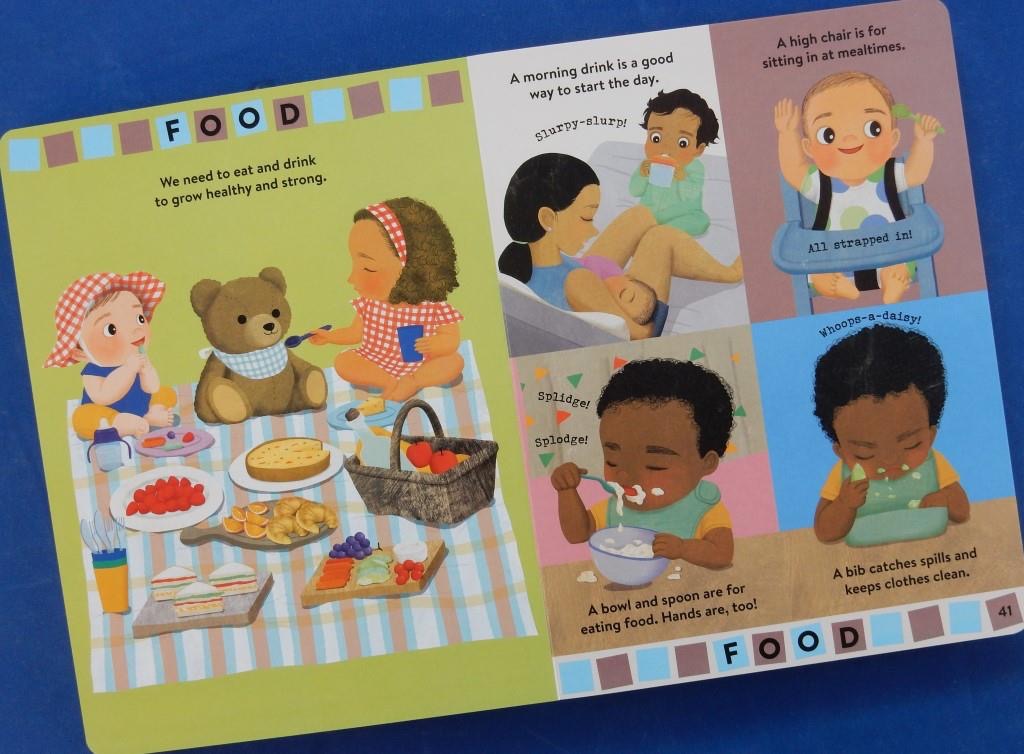
With just over seventy pages in all, this board book first encyclopaedia is divided into sections: our world, animals, plants, body, food, machines, art & music, shapes and numbers, every one of which is beautifully illustrated in bold colours. Each section begins and ends with a full page picture and the accompanying suitably simple text is thoughtfully worded to read like an opening and finale. 
For example Our World starts thus: ‘Our world is a place called Earth. In the morning, the sun comes up and the day begins.’ and concludes, ‘At the end of the day, the moon and stars light up the night sky.’ So, it would work well if an adult and child shared the book, one section per sitting. Little ones will love joining in with all the ‘sound’ words: this section has ‘Plip-plop!’ ‘Flitter! Flutter!’, ‘Gurgle! Burble!, ‘Crash! Smash!’ and several farm animal noises. 
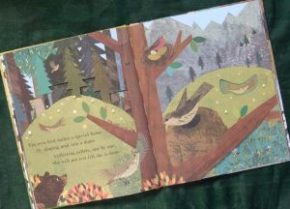
Just the right amount of information is included in each section to engage small children, while also enhancing their vocabulary and knowledge.(A consultant Dr Amanda Gummer was used to this end.) It’s good to see that care has been taken to include a diverse range of humans in every topic presented.
A book to add to family collections if there is a very young child.

Night-Night Animals
Patricia Hegarty and Thomas Elliott
Little Tiger

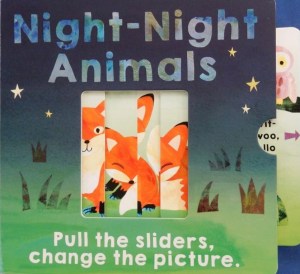
This ‘pull the sliders, change the picture’ title takes little ones to various natural locations where it’s time for the fauna to go to sleep. First visit is the forest wherein there are rabbits, deer, a fox, a mouse and a nesting bird. Which one is nocturnal and needs waking with the help of the slider?
The savannah animals all seem to have shut their eyes already except for one; he needs help to get to sleep. The deep sea has lots of sleepy creatures large and small but one with eight limbs needs the reader’s help. After helping whichever of the rainforest animals is wide awake, it’s the turn of little humans including one very bouncy person who has to stop all those boings.

A fun, interactive bedtime book for the very youngest children who will enjoy assisting the animals before nodding off themselves.

Ganesha’s Sweet Tooth / What’s in the Box? / Halloween

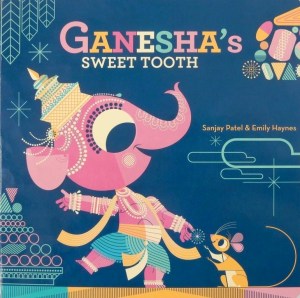
Ganesha’ Sweet Tooth
Sanjay Patel and Emily Haynes
Chronicle Books

Just in time for Ganesh Chaturthi in a few days is this lovely board book edition of a modern version of one of the most popular Hindu legends – the episode in which Ganesha got his broken tusk. It tells how when young, Ganesha liked nothing better than eating sweet things, especially the Indian confection, laddoos. This results in tragedy during Ganesha and his ‘friend’ Mr Mouse’s search for sweets when they come upon a new kind of laddoo, The Super Jumbo Jawbreaker Laddoo.

Despite warnings from Mr Mouse, Ganesha just can’t resist chomping down on the thing – “I’m invincible.” he reassures his friend – and snap! Off comes one of his tusks. Furious at being unable to repair himself, young Ganesha hurls the broken tusk at the moon.

It misses, landing at the feet of the ancient sage and poet, Vyasa who happens to have a special task for the tusk thrower and thus Ganesha lands the job of scribing the great epic of Hindu literature, the Mahabharata.

This little book is a riot of dayglo colour with Sanjay Patel’s brilliant ultra-modern visuals, some of which are reminiscent of what you might see in a temple in South India. Others are decidedly closer to some of the contemporary Pixar animations he has worked on.

By adding their own embellishments and playing slightly with the original plot, Patel and Haynes have created a wonderfully playful rendering of a classic legend that will appeal widely .

The next two are published by Little Tiger:

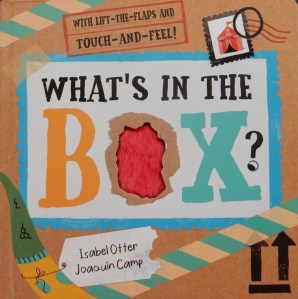
What’s in the Box?
Isabel Otter and Jaoquin Camp

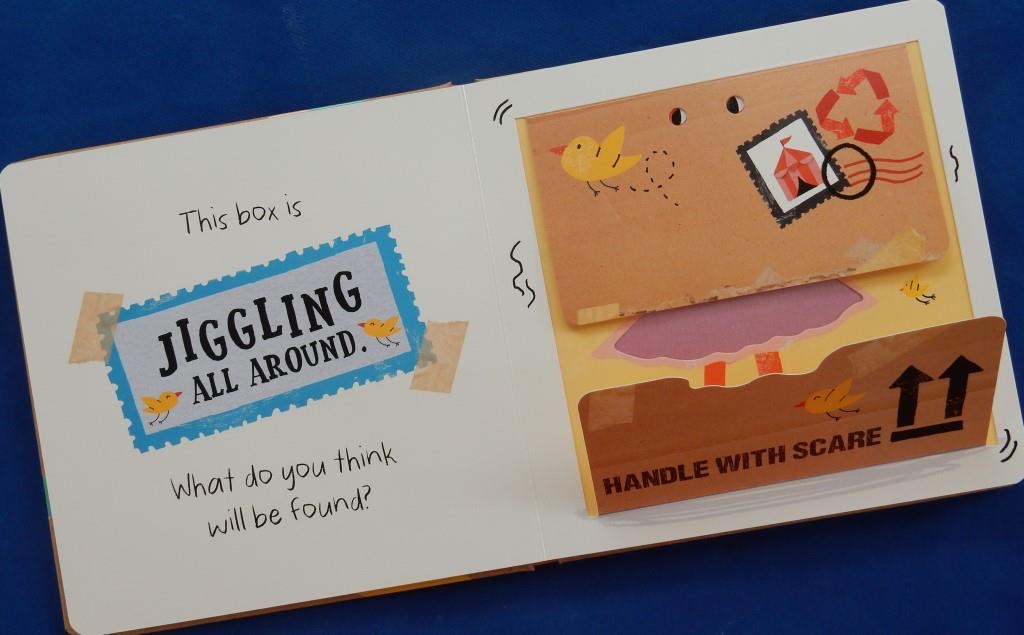
How exciting: a pile of parcels has just arrived waiting to be investigated. What could be packed away inside? That’s what youngsters are invited to discover in this chunky tactile, lift-the-flap book.

Box one looks as though it’s rather fiery but what has made those scorch marks? There’s a hint in the cut-away shiny, scaly shape just visible.

The second box seems to have the fidgets and there’s a warning on the wrapping … A tricky one this. I wonder what it holds …

Next is a beribboned container but strangely some wool has escaped from within. “Fragile” says the label on the fourth box wherein so we read, is something noisy – hmmm? 

However, the best has been kept till last – it’s a veritable treasure trove of … Can you guess what?

With Isabel Otter’s brief rhyming text andJoaquin Camp’s alluring surprise containers to explore, there’s sufficient to engage little ones during several book sharing sessions.

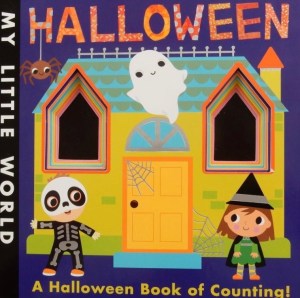
Halloween
Patricia Hegarty and Fhiona Galloway

With Halloween coming up next month (I can’t believe I’m saying that), adults might want to reinforce counting skills with this mock-scary book that introduces in turn, one little skeleton that’s found a hiding place, two slightly anxious little trick-or-treaters, three glowing jack o’lanterns, four hoppy toads, five family portraits, one about to take a tumble, six sleepy bats, seven ghosts, eight spiders of the hirsute kind, nine snoozing moggies, or rather they were before being disturbed by the ten small, appropriately attired party goers.

The rhyming text and Fhionna Galloway’s cute, colourful illustrations offer plenty for preschoolers to enjoy herein.

Action and Reaction: Fish / Yawn

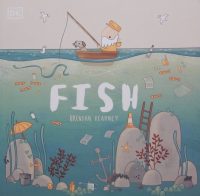
Fish
Brendan Kearney
Dorling Kindersley Penguin Random House

Softly spoken yes, but, inspired by personal experience, Brendan Kearney’s picture book about the perils of polluting the ocean with plastic, and how we can all help to improve the situation for the endangered fish and other marine flora and fauna is clear and to the point.

Finn and his dog Skip set out one morning in their little boat, hoping to catch a tasty fish or two for their supper.

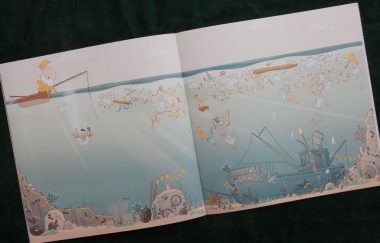
After a while when not a single fish has given so much as a tug at Finn’s line, Skip spies something in the waves. Down to the depths he swims and the sight that meets his eyes is horrifying.

Rubbish, rubbish and more rubbish. Back to show Finn with some evidence he goes.

Equally concerned, the man goes on fishing for a while but before long all he has on board is a collection of weird objects.

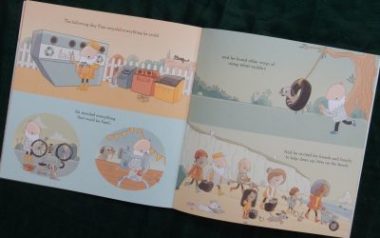
Fortunately, once back on dry land the two encounter a group of young beach cleaners who are equally alarmed at the load of rubbish brought out of the sea.

Finn explains how he came by it and about the complete lack of fish. What follows are a number of pertinent comments from the young eco-warriors and the following day Finn heeds their words – re-use and recycle – and goes on to join the beach cleaners.

With his engaging narrative, visual and verbal – Brendan Kearney focuses on the crucial environmental issues in the hope – his, mine and countless others – that young children will become part of the movement to clean up our polluted oceans and beaches and of course, it’s never to soon to teach them about the importance of recycling.

Yawn
Patricia Hegarty and Teresa Bellón
Little Tiger

A yawn can be highly infectious as this fun story shows.
Starting with a single feeling from deep inside the little boy narrator, a single yawn quickly becomes unstoppable, passing from the boy to all – every neighbourhood inhabitant, human and animal, until the entire street have gaping mouths.

From here it moves to the countryside and eventually all over the world, not content until every single person and every single creature has the yawns. It even heads off out into space

– it’s ‘gone viral ‘we read. Does that remind you of anything?

Fortunately though, on this occasion the outcome is that when bedtime comes, so does a great big YAAAAAAWN! to send us off into the land of slumbers.
Happy dreams.

It’s is definitely a book to share at bedtime unless that is you want to induce sleepiness at some other time in your home or classroom. Patricia’s rhyming narrative has that soporific feel to it, and if you happen to pause just a little too long on any of Teresa Bellon’s spreads (love those cutaway pages) to enjoy all the funky details, you might just find yourself the next recipient of that repeat refrain ‘YAAAAAAWN! Pass it on!’ Snore …

Nature in Focus – Home / Seasons

Here are two books from Little Tiger that focus on nature and the changing seasons

Home
Patricia Hegarty and Britta Teckentrup

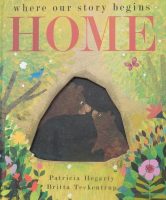
‘All of us need a place to rest – / A cave, a warren, a pond, a nest … // Wherever we may choose to roam, / We need a place to call our home.” So says Patricia Hegarty’s introduction to this look at the forest that is home to all kinds of creatures large and small.
In the company of little bear, we visit a variety of animal homes starting with the cub and her family’s cave, dark and deep.

With the advent of spring, the cub ventures out watched by an owl in her tree. He visits the place where squirrels are gathering leaves for their drey; beavers are also building a shelter; a bird is busy nest building.

Further afield salmon spawn in the glistening river, multitudes of minibeasts are hard at work, and underground rabbits are safe in their warren.

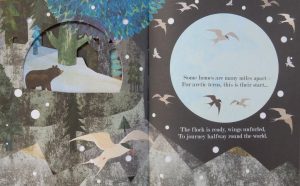
As night begins to fall, a pack of wolves begin to prowl, hunting for food; while a flock of arctic terns make ready to begin their long journey before another winter sets in.

Finally as the cold arrives, it’s time for little bear and his family to hibernate ‘til spring comes round once more.

In her lyrical text Patricia takes us through the changing seasons and to the various animal homes. Britta Teckentrup’s signature style collage scenes, with their die-cut pages, follow the action and the bear cub, highlighting the importance of each home mentioned in the narrative as well as showing the seasonal changes in the forest.

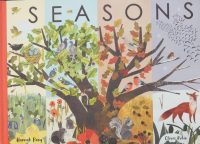
Seasons
Hannah Pang and Clover Robin

Author Hannah and illustrator Clover take us to half a dozen different locations in the world to experience the natural world in all its glory through the seasons.

We observe the changes that each season brings, starting with a focus on a mighty European oak tree that stands majestically in a meadow, its spreading branches and roots providing shelter and food for countless creatures – birds, insects and other minibeasts, small mammals and some larger ones too.

Spring, summer and autumn with their flowers, fruits and fungi are times of abundance for the various animals. Come winter, the branches are bare and it’s a hard time for animals, many of which hide themselves away in order to survive. Indeed, change through every season is vital for survival of the tree and the associated wildlife.

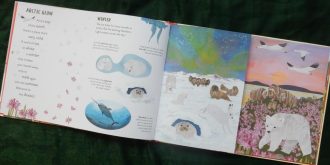
The other natural habitats are the chilly Arctic where the change in length of day and night is dramatic,

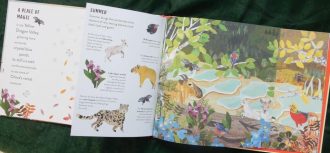
the wilds of Alaska where rivers freeze in the coldest months; a boggy mangrove in northern Australia – one season teeming with land animals, another with fish; then comes the Yellow Dragon Valley, home to some of China’s rarest animals including the giant panda.

The last stop is on the grasslands of the Kenyan Maasai Mara with its wonderful richness of awesome animals and plant life.

As in the oak tree’s location so it is with all the others: change is vital for survival and the Great Migration of the animals of the final location is, so we read, ‘one of the most dramatic events on Earth. For the animals, … a journey of life and death.’

Since the pandemic struck, I think huge numbers of us have become much more aware of the importance of nature in our lives: this book, with Clover Robin’s richly detailed illustrations and Hannah Pang’s factual text, sings that song loud and clear.

A Trio of Little Tiger Board Books

Kindness makes us Strong
Sophie Beer

What is kindness? Sophie Beer provides some examples in this little book beginning each double-page spread with “Kindness is …’ following it with illustrations of children who show care and consideration towards their peers, grown-ups and animals.

It might be something as simple as saying hello, or cheering on participants in a race, giving a warm hug or taking turns.

The bright, enormously attractive illustrations show how much difference acts of kindness make in creating  a happier world.

With its brief, simple repetitive but empowering text, this little book can be shared with the very youngest but equally slightly older children might enjoy reading it for themselves.

A lovely introduction to kindness.

Owl Always Love You
Patricia Hegarty and Bryony Clarkson
Caterpillar Books (Little Tiger)

It’s bedtime for the little forest animals: time that baby rabbit snuggled down in the burrow, time for tiny dormouse and hedgehog to curl up; and up in the tree, for baby squirrel to close its eyes.

The tree is also the place where new chicks in their nest await their mother songbird’s return before they too can sleep.

With die-cut holes to peep through, raised images to feel and adorable little creatures to enjoy in Bryony Clarkson’s nocturnal scenes, sleepy little humans can listen to Patricia Hegarty’s gentle reassuring rhyming narrative before they too succumb to the call of sleep.

Also with a night-time theme is

What Can You See? At Night
illustrated by Maria Perera

With the emphasis on facts, little ones are introduced to a host of nocturnal feeders such as squirrels, owls and foxes in the town.

Moving on to a more rural setting we meet creatures around a pond including singing frogs, bats on the hunt for insects, while in the field rabbits, mice and foxes forage and fireflies flit above them.

It’s not only wild creatures that are out and about at night: postal workers, delivery drivers and sometimes farmers, are at work when most of us are fast asleep.

There’s plenty to interest toddlers on every spread including some humorous items and die cuts.

Now You See Me, Now You Don’t

Now You See Me, Now You Don’t
Patricia Hegarty and Jonny Lambert
Little Tiger

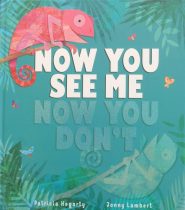
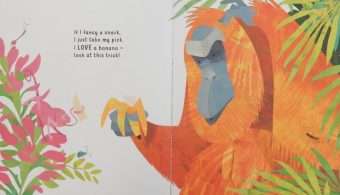
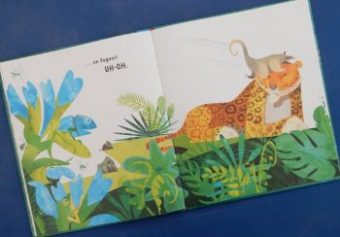
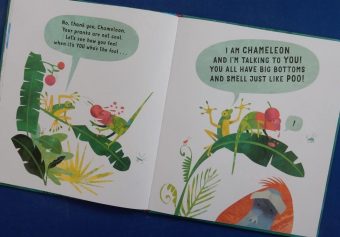
The chameleon narrator of this rhyming story is a trickster and proud so to be. There’s nothing the creature likes better than to use its ability to change colour to have fun at the expense of the other jungle dwelling animals  as it teases first elephant, then orang-utan, followed by a pair of toucans and a sloth.

Not only that, but playing the colour switch trick is also a great way to avoid chores, evade bedtime or help yourself to another creature’s tasty meal.

However, Chameleon’s tickling of Sloth triggers a chain reaction that has the potential to end unhappily for Anteater;

but hidden away watching events is Frog.

Instead of the praise Chameleon anticipates from the creature, Frog strikes back

and then hastily merges back into the surroundings leaving Chameleon to show contrition, fess up, apologise to all the other animals and promise to end his mischief.

Peace is restored to the jungle – well most of the time. Perhaps changing one’s colour is less easy than changing one’s ways …

Jonny’s vibrant collage style illustrations set against stark white backgrounds immediately grab the attention drawing the eye into the action and there are myriads of minibeasts to spot too.

Purists might baulk at the inhabitants of the fictional jungle, which hail from both the new and the old worlds. Nevertheless it’s a visual and verbal treat that provides an opportunity to talk about the kind of behaviour Chameleon exhibited.

Superhero Baby!

Superhero Baby!
Patricia Hegarty and Alex Willmore
Little Tiger

Here’s a fun story that takes sibling rivalry to a whole new level.

In the dead of night, long past bedtime for little ones, there’s one of their number who’s still wide awake and ready to launch herself into action; and so she does when there’s a burst pipe in town.

With job duly done she’s back in her cot alongside her twin brother’s long before mum wakes her next morning.

She then spends the day putting her ‘baby power’ to good use as she performs one heroic act after another never pausing to take a nap.

There’s somebody though, who is far from happy about all the attention this diminutive superhero is receiving as she whizzes around with her seemingly inexhaustible supply of energy, testing her powers to their limits.

Would-be superhero little ones will surely delight at watching the drama unfold through Patricia Hegarty’s rhyming romp that has an unexpected twist in its tail, and Alex Willmore’s instantly appealing, telling pictures where one pair of eyes in particular speak volumes.

Fun, Facts and More in Boardbook Format

Here’s a handful of board books to entertain your little ones courtesy of the Little Tiger Group:

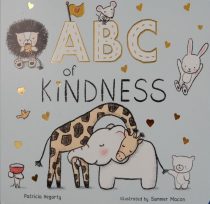
ABC of Kindness
Patricia Hegarty and Summer Macon
Caterpillar Books

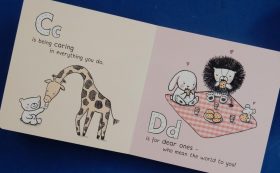
Rhyming couplets by Patricia Hegarty together with Summer Macon’s small scenes of super cute animal characters showing the way make for a lovely reminder of the important things in life.

For instance, there’s ‘Cc is being caring in everything you do. / Dd is for dear ones – who mean the world to you!’

The pastel backgrounds to the kindnesses illustrated complement the softly spoken text in a lovely introduction to the behaviours we’d all like to see in little humans. Perfect for sharing and talking about.

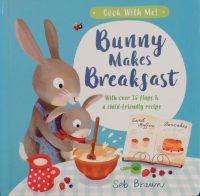
Cook with Me: Bunny Makes Breakfast
Kathryn Smith and Seb Braun
Little Tiger

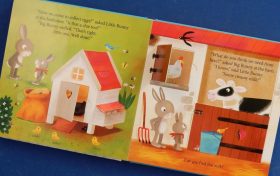
Big Mummy invites her Little Bunny to share in the creation of a ‘yummy breakfast’ but what are they going to cook? They already have butter, flour and maple syrup, but that’s not all they need.

Out they go and pick juicy berries, collect eggs from the hens, and creamy milk from the cow.

Back in the kitchen comes the fun, messy part of mixing all the ingredients and by the time the delicious aroma comes wafting from the cooker, Little Bunny has worked out what their surprise meal will be. Hmmm!

Kathryn Smith’s is a story with a bonus – the final spread includes a recipe book – Bunny Oliver’s Breakfast for Bunnies.

With flaps to explore on every one of Seb Braun’s engaging spreads, this is a tasty little book for sharing with small humans – preferably not at breakfast time though in case of sticky fingers.

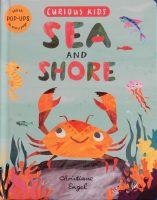
Curious Kids: Sea and Shore
Jonny Marx and Christine Engel
Caterpillar Books

From early morning to sunset, there’s a wealth of wildlife to enjoy at the seaside.

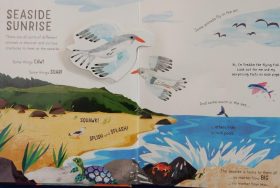
This board book format non-fiction title presents in eight spreads, snippets of factual information about some of the marine creatures to be found in and around our seas from seagulls

to seahorses, octopuses to turtles.

There’s a pop-up feature on each bold, bright spread and observant eyes can also look for marine flora both in the sea and on the shore.

With the seaside likely to be off-limits for some time, maybe one way to remind little ones of its delights is with Christiane Engle’s sturdy book.

Also out in boardbook format now is:

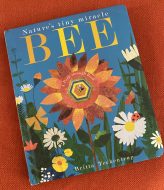
Bee: Nature’s Tiny Miracle
Patricia Hegarty and Britta Teckentrup
Little Tiger

I reviewed the original hard cover edition of this smashing book that absolutely buzzes with bee-uty almost 4 years ago and it’s great to see it in a sturdy format for tinies: Britta’s illustrations are stunning.

Board Books Matter

Board books form the bedrock of children’s reading – or rather one hopes they do; but not all new parents appreciate their potential and their importance. Thanks to Little Tiger, here are some new titles. The first is already published the others will be early in February.

Where’s My Unicorn?
Kate McLelland and Becky Davies
Little Tiger
Right from a very young age, there seems to be a magnetic attraction between young children, (girls mostly) and unicorns, so I’m sure this textured book will please.

Its first spread shows the rear end of a hoofed animal that has left a trail of footprints as clues to follow through the pages until the missing unicorn is found on the final spread hiding in plain sight.

On the way little ones encounter a mermaid with a colourful tail, a flamingo with soft fluffy plumage and a narwhal with a magical horn.

Tactile hide-and-seek fun for tinies who can enjoy the search as well as joining in with the repeat refrain, ‘Where’s my unicorn?’ Becky Davies provides the words, giving a sentence about each creature; Kate McLelland has created the alluring visuals.

What Can You See: On the Farm?
Kate Ware and Maria Perera
Little Tiger

As well as providing an introduction to what might be seen on a farm, and something to count on each spread, this, the first of a new ‘spot and count’ series provides plenty to interest little ones in Maria Perera’s jolly scenes of farm life.

First we visit the farm shop where different kinds of delicious-looking vegetables are on sale. Lunchtime is an opportunity to watch the sheep being fed; the pigs too need feeding and fruit trees near their sty supply a wealth of apples when they’re ready for eating.

The farm also has a duck pond alongside which is a weeping willow; there are several different kinds of birds to see in that scene.

Later in the year, the combine harvester gathers the wheat from a field where lots of small creatures have made their homes; and finally it’s teatime and the farmer collects eggs from the barn where there are hens, cows while other animals scamper along the rafters.

Toddlers can by means of the die-cut visuals, acquire some facts, do some counting and develop their observation skills, using Kate Ware’s words as guidance.

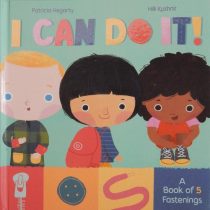
I Can Do It!
Patricia Hegarty and Hilli Kushnir
Caterpillar Books

Try teaching preschool and reception age children and you’d be amazed how many 4/5 year olds start school unable to dress themselves properly. I know parents find it easier when they’re rushed in the mornings to dress their youngsters but essentially this is deskilling children. Much better to set time aside to help them learn in a playful manner to cope with zips, buttons, poppers, laces and Velcro type fastenings themselves.

This robust board book with Patricia’s text and Hilli Kushnir’s enticing illustrations will be a boon in this respect.

Using five little children as models, the narrative provides an introduction to each fastening with instructions on how to work it, and asks each time ‘Can you fasten the …? alongside a bold, bright illustration of a child wearing the item needing to be done up.

One boy fastens shirt buttons, a little girl zips up her hoodie,

another boy does up the hooks and loops fastening on his coat; a child closes the popper on a backpack and finally a little girl has lace-up shoes to tie up on her trainers.

Fun, instructive and I assure you, early years teachers will be truly thankful if your child can manage all the five fastenings.

Little Bird Lost

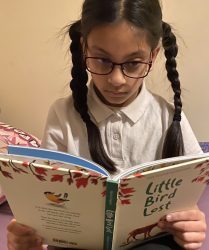
Alesha enjoying reading the story    for herself

Little Bird Lost
Patricia Hegarty, illustrated by Sebastiaan Van Doninck
Stripes Books

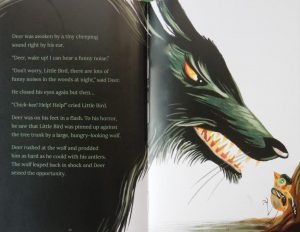
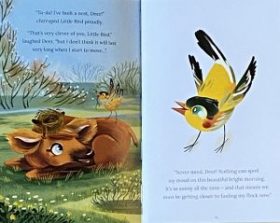
Many possible interpretations spring to mind on reading Patricia Hegarty’s tale of Little Bird and the kind hearted Deer that comes to his aid when he hears a plaintive “Chick-kee!” coming from a pile of leaves and discovers a small injured bird that has crash landed on the forest floor.

Little Bird has become separated from his flock, and having consulted his forest friends, Deer undertakes to ‘follow the sun’ towards the warmer place they think the flock is heading to.

Thus begins an adventurous, sometimes hazardous journey

that takes them through the forest and through the seasons

to spring.

By then much has happened: Little Bird’s wing has healed, a strong friendship has been formed between the two travellers and with spring – a time of hope – other things too are evolving …

Now though, it’s time to bid farewell to a very special friend, safe in the knowledge that a friendship such as that is forever …

Poignant and immersive, this is the latest in Stripes Publishing’s full-colour fiction series– especially aptly with this story, for those readers just flying solo. How powerful it is to discover a book that you can almost read unaided and that’s what happened with one such reader, Alesha.
As much as the story, she loved Sebastiaan Van Doninck’s splendidly expressive illustrations and stopped several times to comment on how both they and the narrative made her feel. Spring was her favourite section: “I was excited when Little Bird found he could fly; it made me so happy.

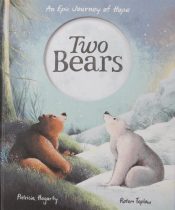
Two Bears

Two Bears
Patricia Hegarty and Rotem Teplow
Caterpillar Books

As simplistic as Patricia Hegarty’s story may at first seem on the surface, Two Bears is a picture book with important themes that can be appreciated and discussed on many levels.

It’s a story of two very different bears from very different worlds, far apart … until they are displaced by the consequences of human actions.

Grizzly Bear’s northern forest home is ravaged by fires caused by man’s selfish actions.

Polar Bear’s Arctic home is also in dire trouble as the ice cap starts to melt on account of global warming.

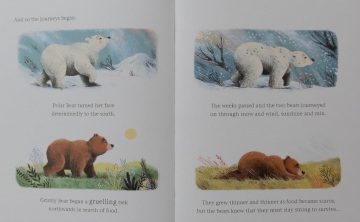
Consequently each bear embarks on a long journey, Polar Bear moving south; Grizzly Bear going in a northerly direction to find food.

Their travels are arduous, the weather testing and food scarce, causing the bears to get thinner and thinner; still though, they remain strong in order to stay alive.

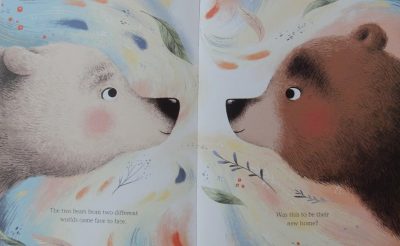
Just before they lose hope the two bears meet.

Yes, they have some superficial differences but what they have in common allows them to transcend all else and thus begin a peaceful life of understanding and togetherness ; and come spring, something very exciting takes place …

Rotem Teplow’s captivating illustrations show the bears’ physical and mental journeys as they seek safety far from their homes, helping to make the book one that successfully combines storytelling with information about the predicament of the bears. The inside cover gives brief details about this and explains how both species are attempting to cope with being under continuing threat.

On Sleepy Hill / I Love You Brighter than the Stars

On Sleepy Hill
Patricia Hegarty and Xuan Le
Caterpillar Books

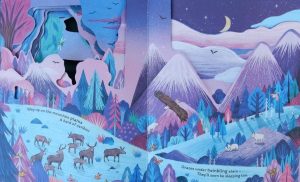
Layered scenes of the natural world as the day draws to a close and accompanying rhyming couplets give sleepy humans the opportunity to view and bid goodnight to the inhabitants of first a woodland where baby rabbits return to their burrows and a little wolf peers from a hollow. Then, the bank of a mountain stream whereon a black bear watches his cubs while otters take a last look at the evening and a mother duck gathers up her ducklings.

Further up, in a mountain clearing, deer and foxes make for home and the geese fly back to their nest, and even higher while caribou and boars are almost ready for sleep,

the owl swoops, watching and waiting.

The soporific narrative and cutaway pages of the fauna and flora of Sleepy Hill should work their magic on little humans when they too are almost ready for their slumbers.

I Love You Brighter than the Stars
Owen Hart and Sean Julian
Little Tiger

Books that celebrate the forever love between parent and child seem, like the sentiment they express, never ending. Indeed this is the second from Owen Hart and Sean Julian and rather than polar bears this one features a brown bear and its cub.

While they walk together as the evening sun gives way to moonlight and stars, the adult’s gentle heartfelt words to the cub promise lifelong guidance, companionship, support and the kind of love that is there no matter what, no matter where.

As they climb the hill, the two pause to gaze at the wonders of the natural world and at the star-filled sky

before taking a moonlit dip in the mountain stream.

Then it’s time to head home and sleep, the cub safe in the knowledge that as the wind sings a gentle lullaby it is loved ‘more than all the stars that sparkle through the night.’ Who could wish for more than that?

Soft spoken, rhyming reassurance and beautiful land- and sky-scapes make for a book that is ideal bedtime sharing for adults and their little ones.

Sea: A World Beneath the Waves / Dolphins

Sea: A World Beneath the Waves
Britta Teckentrup and Patricia Hegarty
Little Tiger

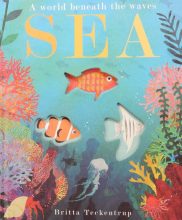
In her latest non-fiction, die-cut peep-through picture book, in a series of wondrous scenes Britta Teckentrup plunges us beneath the ocean waves, way, way down to view the wonders of the deep.

Amid the corals and seaweed fronds we see small fish, sponges, tiny graceful sea horses; a baby dolphin and its mother chirping and clicking in communication, a Lionfish with its poison spines ready to use should it be attacked.

Suddenly there’s a feeling of fear: the fish sense danger as a great white shark casts its shadow. The other sea creatures though, employ their defence mechanisms while the tropical fish swim in formation and all is well.

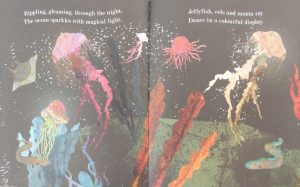
Night comes and the ocean is a-glow with light;

his song echoing far the humpback whale sings for all to hear, the manatee glides through sea grasses and the corals provide safe spaces for small ocean creatures.

Patricia Hegarty’s lyrical text ends with a plea to protect ocean life by keeping the oceans clean and free from rubbish.

Dolphins!
Laurence Pringle and Meryl Henderson
Boyds Mills Press

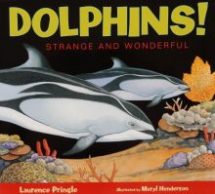
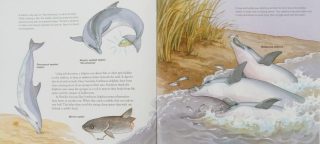
Pringle immediately grabs readers’ attention with his introductory ‘If you were a young dolphin, your mother would keep you close, feed you milk and teach you’ that could almost be referring to a human mother. The remainder of the paragraph however negates that with its ‘Soon you would learn to swim fast and catch fish to eat. And sometimes you would leap from the water, high into the air!’ while his final statement on the first page “People would be very curious about the secrets of your life beneath the surface’ sets the scene for the remainder of this fascinating book.

It covers many aspects of the thirty or so dolphin species including classification, morphology and physiology. There’s a fascinating account of dolphins’ use of echolocation;

another of feeding – dolphins are predators, consuming huge amounts of food daily –

and communication. I learned that in addition to sounds, dolphins send messages with their bodies, sometimes by rubbing skins, at others, by touching flippers.

All this and more is related in the author’s highly readable prose that is superbly illustrated by Meryl Hendersen in watercolour and pencil.

Although it’s likely that this will be read by individuals, this book also works really well if read aloud – a testament to the quality of the author’s writing.

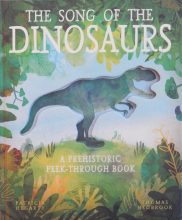
The Song of the Dinosaurs

The Song of the Dinosaurs
Patricia Hegarty and Thomas Hegbrook
Caterpillar Books

Dinosaurs are endlessly fascinating to young children and for every book on the topic published there’s a new audience ready to lap it up.

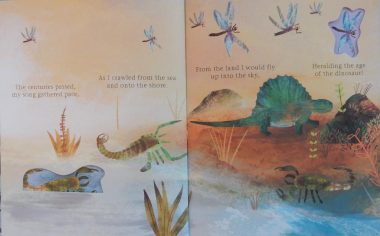
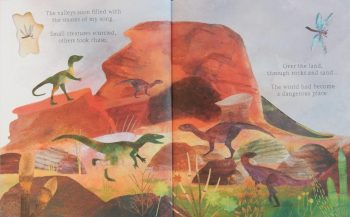
This one with its rhyming narrative and alluring die-cut illustrations immediately transports readers back to the prehistoric world with Patricia Hegarty’s opening lines, ‘I am the song of the dinosaurs, / For millions of years my tune filled the air … / In the whisper of leaves, caught up on the breeze, / Travelling unseen, but I was still there.’

They are introduced to a line-up of dinosaurs set against richly coloured landscapes and the cleverly placed die-cuts on each spread invite the reader to turn the page forwards.

Thomas Hegbrook’s vibrant scenes are a visual treat for your little dino. enthusiasts as they follow the evolutionary story from the depths of the sea, up into the skies and over land, ‘through rocks and sand.’

The back endpapers show an illustrated time line.

Patricia’s lyrical text is both atmospheric and factual; and in combination with Thomas’ illustrations, creates an exciting educational adventure to share at home, nursery or school.

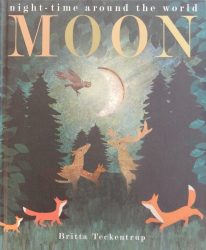
Moon

Moon
Britta Teckentrup
Little Tiger Press

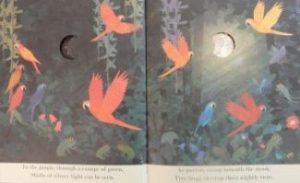
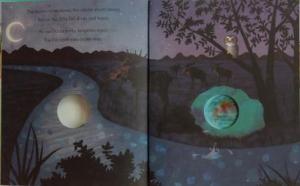
Gorgeous collage style moonlit scenes grace every spread of Britta Teckentrup’s latest ‘peek-through the pages’ book wherein we travel the globe following the moon through one complete cycle.

As it waxes, we visit a woodland, a desert landscape, a snowy puffin rookery; sea birds using the moon to migrate to warmer climes, and a tropical jungle.

The full moon shines upon a southern beach where turtles have arrived to lay their eggs.

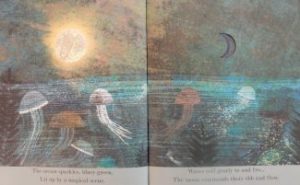
Under the waning moon, field mice hunt for food and ‘The ocean ‘sparkles, bluey- green, / Lit up by a magical scene,‘ – an ocean whose waves are influenced by the lunar cycle.

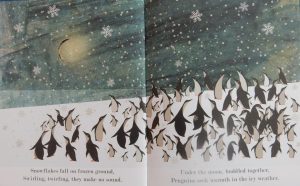
Bears standing on a mountainside; giraffes and elephants resting in the cool nocturnal grasslands; penguins huddling together for extra warmth beneath a snowy sky …

and finally, a row of houses, complete the waning moon landscapes.

Patricia Hegarty’s lilting rhyming couplets provide a gently soporific, textual accompaniment to Teckentrup’s nocturnal homage to the natural world.

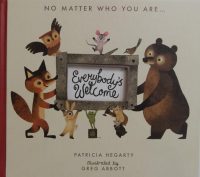
Everybody’s Welcome

Everybody’s Welcome
Patricia Hegarty and Greg Abbott
Caterpillar Books
In our increasingly troubled times, picture books such as this, with its strong inclusivity message, are more important than ever.
It came about as the result of a strong desire on the part of Tom Truong of Caterpillar Books in reaction to the shattering news that the UK had voted to leave the EU, to produce a book for parents like himself to share with young children that embodied ‘ideals of refuge, inclusivity and friendship’.
Currently living in Stroud, a town that since the Syrian crisis, has adopted the catchphrase ‘Everyone welcome in Stroud’ I felt immediately drawn to this poignant, political tale of empathy, acceptance and collaboration.
We start the story with mouse standing in a forest clearing, dreaming of building ‘a great big happy house’.

It’s not long before mouse is joined by a frog who has lost his pond and has nowhere to go. Together they start constructing and before long are joined by some runaway rabbits fleeing from an eagle; they are only too willing to help with the project. Next to come is a misunderstood brown bear; he has much to offer the enterprise and is welcomed with open arms.

Building continues apace with more and more animals coming to join in and a spirit of co-operation rules throughout.
What this allegorical rhyming story shows so clearly is that despite superficial differences, we all have much to offer one another. With open arms, open minds and open hearts we can embrace our fellow humans in a spirit of co-operation and unity.

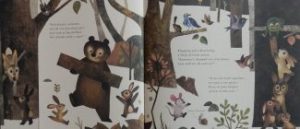
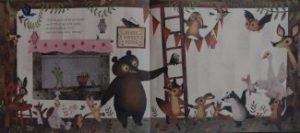
Greg Abbott’s animal illustrations, with his use of cut down pages, really do bring out both the woefulness of the displaced animals, and the spirit of collaborative bonhomie as each one is welcomed, accepted and a new open community is formed.

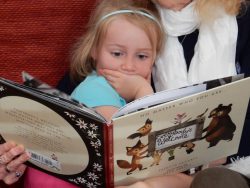
A thoughtful Emmanuelle whose final comment on Everybody’s Welcome was  “We all need to be kind.”

I’ve signed the charter  

We Are Family

                              I’m excited to be part of Caterpillar Books blog tour for We Are Family.

dscn9902

We Are Family
Patricia Hegarty and Ryan Wheatcroft
Caterpillar Books
This all-inclusive rhyming celebration of family life really does offer each and every child the possibility of seeing him or herself in a picture book: Ryan Wheacroft’s multitude of vignettes ensure that.
Whoever we are and whatever we do, / Our families hold us together like glue.
These opening words of Patricia’s text caused me to reflect on my concept of family and I concluded that it means many things and includes many more people than those I’m related to by blood.
Our family comes / From round the world: / Our hair is straight / Our hair is curled, / Our eyes are brown, / Our eyes are blue, / Our skins are different/
Colours too.

So begins a poem by Mary Anne Hoberman that I included in my compilation, Family Album published some 20 years ago and it resonates with my own view of family. At that time, I’d been given a six-month sabbatical from my job as deputy head of an outer London Primary School. I was to look at primary education in India in order to try and understand why the parental expectations of the majority of families from the Indian subcontinent whose children were attending the school I worked in, and others in the borough, were so very different from those of our teachers.
I stayed in Udaipur, Rajasthan in a small hotel – owned and run by a Rajput Indian family I very soon felt I had become a part of. At the time there were two brothers – one managing the hotel, the other a tour guide, both residing in the haveli (large family home) with their parents and downstairs, grandparents as well as various other people employed to help with the latter.
From the outset, the grandmother would send to my room at suppertime, dishes she thought I’d enjoy. Soon though, I was invited to share evening meals in the haveli: “You’re family now” I was told.

%0a

During those months I went to Navratri celebratory Garba Dandiya dances with female members of the family and shared in the family celebrations of Diwali.
That was the start of a family bond that has deepened, although altered (the grandparents and father are dead now) over the subsequent 24 years. Both brothers, (one of whom, Ajay, now truly is like my blood brother), have children of their own, two apiece. I hesitate to say they have their own families as, like many Indian families, they tend to grow into a larger extended family, rather that separate ones. And that’s due in part the to the fact that they still live in the same complex.
I also feel very close to Anu. Ajay’s wife and in particular, their two daughters, whom I’ve watched grow up. I saw both of them as tiny babies and one is now at university and the other at school and training, she hopes, to become part of the Indian shooting team for the next Olympics.

%0a

We visit them at least once a year, usually during the Christmas holidays; it’s more tricky during the summer now as even the two girls’ holidays don’t coincide, let alone Indian school holidays and English ones. They have stayed with us in the UK several times too.
During that same period of time I became involved with another Indian family too, more by chance this time. It started with a visit to an art gallery run by one member of an artist family, also in Udaipur. This family too took me into their home and hearts and the bond is still very strong. I visit the galleries of both brothers frequently when staying in the city as well as sharing meals and much more. For instance, I tie a raki around the wrist of the brothers at the festival of Raksha Bandhan (a festival of brothers and sisters), as well as being a source of books for both Shariq and Shahid’s children.
Sometimes we go on holidays or happy fun days out,
Doing things together is what families are about.

%0a
img_20161218_170229_hdr

Both brothers have stayed at our home in the UK several times for recreation and more. One visit that sticks in my mind is when Shahid, (who was to have some of his paintings exhibited in the UK) his wife and young son came one Christmas time and we had frost and a scattering of snow. Their little boy was around 4 (he’s now 17) and had never experienced such cold. Stepping outside he said, “Papa, I’m smoking” as the freezing breath came from his mouth.
In addition to being an artist, Shariq, who while visiting us in UK, did some art workshops in my own school and several others I was connected with, is also a musician and has invented and crafted, an amazing instrument

20170104_144136-2 4-5

and his two young sons are pretty awesome tabla players.
One thing that struck me almost immediately is the great respect accorded to older generations of a family in the Indian culture. Both Ajay’s and Shahid’s families found it strange that our parents did not live with us though my partner’s mother had her own house just ten minutes drive away. She invited them to tea and she shared meals with them at our home. On subsequent visits it was always obligatory for them to meet Marjorie to pay their respects. When, in her 80s, she accepted an invitation to Udaipur, she was treated like royalty with a party in her honour at Ajay’s hotel and requests to go for lunch, dinner and, in order to fit them all in, even breakfast at the homes of members of a cricket team Ajay had previously brought to play in the UK. All this very much echoes Patricia Hegarty’s final words of We Are Family:

Each family is different, it may be large or small.
We may look like each other – or not alike at all.
Money doesn’t matter, nor colour, creed, nor name –
In each and every family, the love we feel’s the same.

The River / Wilderness: Nature’s Wonders

%0A

The River
Hanako Clulow and Patricia Hegarty
Caterpillar Books
‘In snow-capped mountains among the firs/ The north wind blows; something stirs./ Through icy water, a small fish darts -/ This is where her journey starts …
We join that shimmering, glimmering fish as she journeys down river starting from the snow-capped mountain peaks, swishing past dense mountain woods …

%0A

and pine forests, through ever-changing landscapes as she travels by day and night …

DSCN8410

and through the seasons, on her epic swim to the vast, deep open sea ‘where she’s meant to be!’ – a sea populated by a shoal of sparkly fish.

DSCN8390

Readers delight in joining the fish on her journey, making her swim faster or slower by tilting and angling the book, viewing her as an ever-in-motion hologram (set inside the back cover) through a die-cut hole that keeps her, mid-stream, on every spread. Read it first to play with the fish and then turn back and re-read the whole, savouring Patricia Hegarty’s lyrical rhyming text and being spell-bound by the wonderful wildlife scenes rendered in soft, matte textured, illustrations. The richly detailed, painterly style shows feathers and fur as if close up …
%0A

as well as the gorgeous hues of the surrounding flora of the landscapes.
What a superb testament to one particular river, and to the rich abundance of flora and fauna through which it flows and of course, to one little fish on its migratory journey. SO much to see, SO much to think about, SO much to relish.

DSCN8411

Wilderness
Hannah Pang and Jenny Wren
360 Degrees (a Little Tiger imprint)
Subtitled ‘An Interactive Atlas of Animals’ this has visual appeal in bucket loads and it’s highly informative too. It introduces readers to a variety of habitats in both Eastern and Western Hemispheres and then focuses on different habitats in turn allocating a double spread to each one. We embark on a tropical rainforest ramble (visiting various locations as not all the animals featured are found in the same part of the world),

DSCN8383

a safari in the hot grassy savannahs of Africa, join an ocean dive and search, visit a freshwater location, the desert dunes, polar regions and high mountain pastures and forests, complete with pop-up mountain …

DSCN8381

Snippets of information abound on every location spread and there are flaps to lift enabling readers to discover more about the various animals resting upon them; there are even mini booklets on Bugs, Creatures of the Deep, the Honeybee and the salmon life-cycle.

DSCN8384

There’s a tiny life-cycle book on the left …

So, we have some desert dunes populated by Arabian camels, Addax (rare creatures also called Screwhorn antelopes), a vulture, a Namib Dune Gecko, a rattlesnake that leaves tell-tale tracks in the sand, hairy, scary giant scorpions and tarantulas; and there’s a side wheel which when turned shows the enormous range of temperatures of the habitat. (sub zero at night and 45 degrees C at mid-day).

%0A

Rotating wheel top left …

Chock-full of details, rich in the colours of mother nature’s palette, and sturdily designed and built to withstand frequent handling, this is one to engender a sense of awe and wonder about the natural world, and highly recommended for the family bookshelf and a must-buy for early years and primary school classroom.

WNDB_Button localbookshops_NameImage-2

Bee: Nature’s Tiny Miracle

%0A

Bee: Nature’s Tiny Miracle
Britta Teckentrup and Patricia Hegarty
Little Tiger Kids
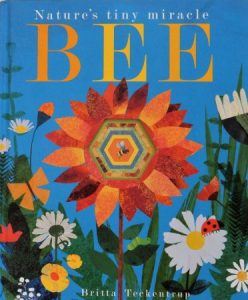
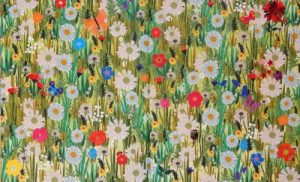
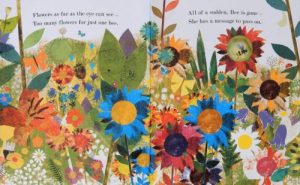
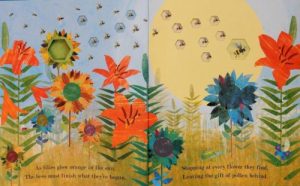
Buzzing with bee-u-ty, this sent shivers all through me; right from that arresting die-cut front cover with its centrally placed sunflower, through spread after spread of exquisite collage-style scenes linked by strategically-placed, die-cut hexagons, to the glowing endpapers: it’s just SOO breath-takingly gorgeous.

%0A

Stunningly beautiful endpapers

With each new book from the inimitable Britta Teckentrup, I think, she won’t better this; but, she’s done it again here in this glorious collaboration with Patricia Hegarty whose rhythmic rhyming text transports readers and listeners, accompanying a single bee as she travels here and there, flitting from flower to flower on a vital, life-giving journey –

%0A
    Gathering nectar as she goes,
From every foxglove, every rose.
Dusty with pollen, the little bee
Buzzes, buzzes, busily.

It’s almost as though you can smell the sweet-scented flowers …

%0A

and hear the sounds of that bee and of those back at the hive. For they in turn hear bee’s crucial message – with the vast numbers of flowers, it’s too huge a job for a solo bee- and join her in that all-important role of pollination …

%0A

until:
‘ … A tiny miracle occurs.
For every plant and flower you see
Was given life by one small bee.

What a testament to one crucially important little insect and its symbiotic relationship with plants. The author gently imparts nuggets of scientific information into her poetic text as she tells of pollen harvesting and transporting; that bees use the sun to navigate by; that bees communicate one to another and crucially, that the life of most flowering plants is dependent upon them.
Bees have become almost an endangered species, yet not everyone is aware of either the contribution they make to our precious planet, or the magnitude of the crisis of their dwindling numbers. I’m currently living in Stroud, which claims to be ‘Britain’s First Bee Friendly Town‘. May there soon be many others that follow suit. There is a snag though, this ‘bee friendliness’ seems to give my partner tacit license to allow bees to build a nest right above my front door; and to let a large area of our front garden become a wild ie ‘bee welcoming’ space!
This book may well start a small revolution. It’s certainly a MUST have for every family bookshelf, early years establishment and primary school.
Now try this: Sit comfortably, close your eyes, and imagine yourself into one of those stunning scenes from the book; place your lips close together, inhale through your nostrils, place your finger tips gently just inside your ears, then slowly exhale, also through the nostrils, making a deep buzzing sound in your throat like a bee: you will hear a ‘swarm’ of bees in your throat. That’s brahmari or bee breath and it has a wonderfully calming effect. Just like this book, although that’s exciting too.

WNDB_Button localbookshops_NameImage-2

Tree

DSCN5178 (800x600)

Tree
Britta Teckentrup and Patricia Hegarty
Little Tiger Press
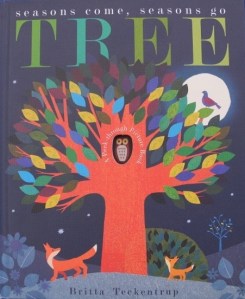
This glorious celebration of nature and the seasonal changes it brings is presented through the focus of a single apple tree standing in a forest.
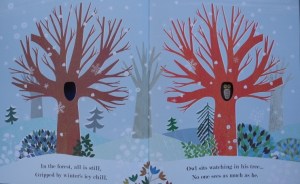
I’m a huge fan of Britta Teckentrup’s work and in this instance she makes ingenious use of die-cuts that increase in number as we move towards midsummer and then decrease to the single owl’s look-out as midwinter comes around once more, disappearing completely in the final two spreads.
The story begins as the forest is gripped by the icy chill of midwinter; no animals are visible save the single owl peeping from its hole in the tree trunk and watching …

DSCN5179 (800x600)

As winter gradually gives way to spring, shoots begin to peep through, leaves unfurl and bear cubs frolic. Then slowly more animals appear, nesting birds and more can be seen in the tree’s branches:

DSCN5181 (800x600)

birdsong fills the air showing summer’s on its way with its bees, butterflies and ripening fruit.

DSCN5183 (800x600)

Then come the glowing colours of autumn and the animals start to prepare for the coming of another winter when once again it’s time to take shelter.
Not only do we follow scenes of the changing seasons but also the changes as day turns to night

DSCN5182 (800x600)

in this superbly crafted book.
Patricia Hegarty’s lyrical text takes the form of rhyming couplets that are a real pleasure to read aloud and have the effect of making the reader slow down to allow for listeners to savour not only the gorgeous scenes as they subtly change, but the words themselves.
One thing is certain, no matter what the season, this is a book to treasure.
Use your local bookshop   localbookshops_NameImage-2