Evolution

Botanist Sarah Darwin, the great, great granddaughter of Charles Darwin and paleobotanist Eva-Marie Sadowski, in association with The Natural History Museum, London, take readers on an enthralling journey through Earth’s history going right back to its formation around 4.5 billion years ago. This journey is aided by a timeline of the geological eras that stretches (along the bottom of some of the pages of the book) through time until the present.

Guided by the authors and the superb, detailed illustrations, we meet a number of pioneering people – adventurers and thinkers, some of whom in turn influenced the thinking of Darwin and Wallace, people who made vital discoveries about the world around them and shared their theories on topics such as natural selection, the movement of land masses, variation and the changing climate.

Illustrations of some of the flora and fauna which were to be found during each relevant era are included.

A ‘Human-Made’ spread introduces Ugur Sahin and Oziem Tureci who invented one the the first COVID-19 vaccinations and draws attention to the human-made climate crisis. This leads neatly to a reflective spread on the future where we meet several current pioneers who are working to help save the natural world and guide us all towards a more sustainable future.

The book ends with a tree of life, a world map showing almost all the species mentioned, as well as a glossary and index. A fascinating, beautifully presented book for KS2 readers and beyond.

Sticker Art: Woodland; Savannah; Jungle; Ocean

Sticker Art: Woodland
Sticker Art: Savannah
Sticker Art: Jungle
Sticker Art Ocean

Craig & Karl
Frances Lincoln Children’s Books

These four innovative books are published in collaboration with the Natural History Museum: and the illustrations are provided by Craig Redman and Karl Maier, who work in transatlantic partnership.
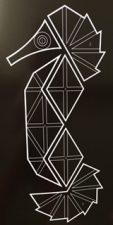
Each book features eight animals and users are invited to create their own ‘sticker-by-number’ portraits of say, for Ocean, a starfish, an octopus, an angelfish, a blue whale, a turtle, a walrus, a dolphin and a seahorse …

by using Craig and Karl’s designs as guidelines.
In addition to the animal images and stickers, each of the books has eight interesting facts per animal relating to lifespan, habitat, family, survival, diet, identification, special skill and behaviour.
Did you know for instance, that African elephants can use sticks and branches to swat insects and scratch itches? You’ll find that in Savannah.
Or that a pit viper can have as many as thirty snakes born at once? (This creature is featured in Jungle.)
An enjoyable, absorbing and satisfying way to introduce children to a wide range of creatures, especially during the holidays.
In addition, each book could be the starting point to a whole lot more investigation and creativity.


Towering Tree Puzzle / Lift-the-Flap and Colour:Jungle & Ocean

The Towering Tree Puzzle
illustrated by Teagan White
Chronicle Books
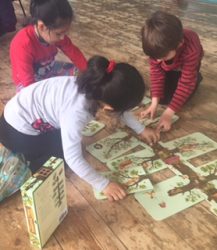
Essentially this is a sturdy box containing 17 large, easily manipulated, double-sided pieces depicting Spring/Summer scenes on one side and Autumn/Winter ones on the reverse. Each piece shows various woodland animals playing and working together; a whole tree community indeed and the puzzle when complete is over 130 centimetres long. Nothing special about that, you might be thinking but, the language potential is enormous, especially as there is no one right way of fitting the pieces together: this open-endedness also means that if more than one child plays with the pieces, there is a co-operative element too.

The artwork is splendid: each detailed piece, a delight.
Every branch of the tree generates a different story, or rather, many possibilities; ditto the completed tree. Some children like to story about the pieces as they put them into place, others prefer to complete the puzzle and then tell one or several stories which may or may not be connected. You could try a completely open-ended ‘take it in turns tell me about’ game with children sitting in a circle for starters, or perhaps choose a focus, say animals, plants or perhaps, events: the possibilities are many.
I’ve used this marvellous resource in several different settings and each time it’s been received with enormous enthusiasm and the users have shown great reluctance to part with it afterwards.

Lift-the-Flap and Colour Jungle
Lift-the-Flap and Colour Ocean

Alice Bowsher
Frances Lincoln Children’s Books/ Natural History Museum
In this collaborative publishing enterprise, children can choose from one of two locations to start their colouring in experience. The first is the South American Amazon jungle wherein jaguars hunt, slow sloths dangle, alligators lie in wait for a tasty meal, stick insects and parrots share the lush foliage, and swinging monkeys abound.
In the Ocean they can encounter diving dolphins, and shoals of fish, visit a coral reef with its abundance of sea creatures, notice the seaweed fronds that provide a safe hiding place for fish; and dive right down to the deepest dark depths.
A brief, rhyming text accompanies each adventure gently informing and guiding the young user as s/he explores the location, lifts the flaps and adds colour to the black and white pages – five spreads per book. And the final page of each book has an information paragraph that focuses on the importance of protecting the specific environment.
These will I’m sure be seized on by young enthusiasts, particularly those with an interest in wild life and will one hopes, leave them wanting to discover more about the inhabitants of each location.

If I Were a Whale
Shelley Gill and Erik Brooks
Little Bigfoot
This contemplative, charmer of a board book successfully mixes rhyme and science facts. It imagines the possibilities of being a minke, a beluga playing with icebergs, a pilot whale and then these beauties …

If those don’t suit there’s a tusked narwhal, a blue whale, or a humpback perhaps? There are eleven possibilities in all, each one beautifully illustrated by Erik Brooks who manages to capture the essence of each one in those watery worlds of his.
Yes, it’s a small introduction to a huge topic but this is a pleasure to read aloud, is likely to be demanded over and over, and to inspire tinies to want to know more about these amazing mammals.

I’ve signed the charter  

The Ladybird / Make and Move Minibeasts / Build a Butterfly

The Ladybird
Bernadette Gervais
Laurence King Publishing
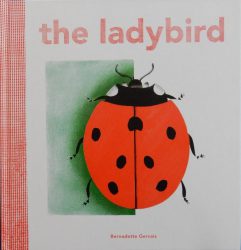
I knew that the ladybird season was about to burst upon us when I noticed several that had emerged, and died on a window-sill of one of the spare bedrooms of my house a few days back. Before disposing of them I took a close look: I think they were a variant of the invasive Harlequin species from Asia. My first go-to was this little book waiting for me to write a review. It’s a wonderful introduction to the little insects, beautifully produced and illustrated, biologically accurate with parts properly labelled; and with judiciously used flaps that add to the effectiveness of the information given.

Topics covered include the insect’s anatomy, defence, nutrition, hibernation and reproduction. The latter takes readers through the entire life-cycle from mating, via the larval stage to the emergence of the new spotless ladybird; the spots and red colour develop fully after about an hour.

There are also spreads devoted to the variety of ladybirds; and a ‘spot the difference’ observation game. The whole thing is printed on thick matt paper, which further adds to the quality of the whole. Altogether a class act; add it to your early years topic box or KS1 collection.

Make and Move Minibeasts
Sato Hisao
Laurence King Publishing
I’m not generally a great fan of ‘pop-out, create a whatever’ kind of books; they generally require way more manual dexterity and know how than the target age group indicated, but this one is definitely worth a look.
It’s the most recent of a Make and Move series by this artist and contains nine pre-coloured creatures; and a butterfly, a stag beetle and a dragonfly to which users of the book can add their own designs and colours. The coloured images are textured, and although texturing the uncoloured ones, while not impossible, might be something of a challenge that’s no bad thing and certainly something a six or seven year old could do.

Bee

They might need a little help with putting the animals together though and the projects increase in difficulty from first to last.
When completed the minibeasts do move easily, partly due to their being printed on thin card. Now while I don’t suggest buying a whole lot of these books, I know that many schools have a focus on minibeasts at some time during the summer term and a copy of this in the classroom could well prove inspiring for children to perhaps use as a source book, with an adult creating an example or two from the book itself. There’s a whole lot of mathematical learning potential as well as biological (and technological) learning herein.
Alternatively, it’s an interesting way to spend a few hours at the weekend or during say, a half term holiday.

Build a Butterfly
illustrated by Kiki Ljung
Frances Lincoln Children’s Books
Published in collaboration with the Natural History Museum, this is a board book and activity book combined.
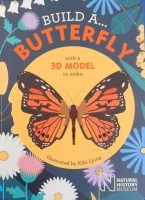
Young readers are invited to find out about the Painted Lady butterfly (Vanessa cardui) and to use the press-out pieces, following the step-by-step instructions to build a card model of the butterfly. Starting with its life-cycle, information is given about finding food including the role of the eyes in locating same, as well as finding a mate; the butterfly’s diet;

emergence from its chrysalis; habits; and how it migrates.
The names of the insect’s various body parts are supplied – these are crucial when constructing the butterfly model – as well as a simple explanation of the function of each part. Young fingers may require the assistance of an adult in fitting the eleven pieces together.
My knowledge of this butterfly species is that there’s a slight inaccuracy in the portrayal of the adult, which here has been given white markings to the upper surface of the hind-wings making it look like a Monarch butterfly. A curious slip considering the endorsement given by the Natural History Museum; ditto the use of a capital C in the specific name; the paragraph about the butterfly’s emergence from its chrysalis has inaccuracies too. These factors will not however detract from the enjoyment of creating the insect. This book, I suggest, is best seen as helping readers to understand the basic anatomy of the butterfly.

I’ve signed the charter  

Amazing Information Books

DSCN4886 (800x600)

Nina (who does like snakes) enjoying the book.

I Don’t Like Snakes
Nicola Davies and Luciano Lozano
Walker Books
On a visit to Kerala (India) a couple of years back I was beguiled by the resident naturalist into showing the local housekeeping staff that there was nothing to fear from the snakes that were found in the grounds and occasionally found their way into the guest cottages. There I was inwardly quaking and having what looked to me a huge snake dangled about my person.
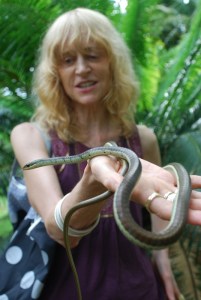
shibu bhaskar (115) - Copy (536x800)

So, the girl narrator of this wonderful orphidiological extravaganza has my sympathies when she declares, “I really, really, REALLY don’t like snakes!” to her incredulous family members who immediately counter her statement with “WHY?
Every reason she proffers is met with an informative rejoinder that serves to weaken her case; and it isn’t long before her protestations about slithering, icky, slimy skin or flicky tongue have fueled her interest in their sidewinding, twining or flying methods of locomotion, their wonderful mosaic patterned, renewable skins

DSCN4874 (800x600)

and the scent-smelling organ used in locating their prey. Oh and those staring eyes are so informative about their hunting habits too.

DSCN4875 (800x600)

We really know she’s been won over however, when having turned to a large book, our narrator informs her brother about the reproductive habits of snakes
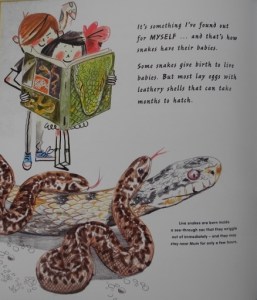
DSCN4876 (800x600)

and finally says – well what do you think?
My subsequent real-life experiences with snakes certainly haven’t won me round but I have to admit that the book has gone some way towards so doing. Davies’ chatty, gently humorous narrative style and Luciano Lozano’s superb illustrations of both human and reptilian characters work so well together. The combination of almost cartoon-like humans and zoologically accurate snake drawings together with the differing type-faces used for the text is enormously effective.A must buy for budding zoologists and for the primary school library.

DSCN4827 (800x600)

Surprising Sharks
Nicola Davies and James Croft
Walker Books pbk
Sharks come in all shapes and sizes, the smallest being not much larger than a bar of chocolate and comparatively few of them have attacked humans. And, did you know that ‘Sand tiger sharks give birth to just two live young— which is all that’s left after those two have eaten the other six babies in their mother’s belly.’
These are just a few of the interesting facts youngsters can discover between the covers of this highly readable, gently humorous re-issue.

DSCN4825 (800x600)

Dino-Dinners
Mick Manning and Brita Granström
Frances Lincoln Children’s Books pbk
This inviting book, published in association with the Natural History Museum, features ten dinosaurs, each having a double spread within which the creature – illustrated in watercolour- introduces itself with a rhyme telling of its dietary habits alongside which is an inset of additional information including name pronunciation, size and geological dating. One of the Brachiosaurus spreads (it has two because it’s so long) includes details about its poo too;

DSCN4824 (800x600)

I didn’t know that fossil poos are called coprolites before I read it here. The book also includes a time line and glossary. A fascinating book for young addicts and one that will likely kindle an interest in those new to the subject.
Equally fascinating and informative and from the same team is
DSCN4826 (800x600)

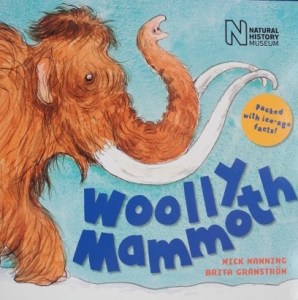
Woolly Mammoth
In this one, mammoth narrator, gentle giant and ‘veggie warrior with bull-neck power’ takes readers back to the ice-age when these huge shaggy beasts roamed free, sometimes hunted by hungry wolves, bears or hyenas and sometimes by humans.
Both titles would make excellent additions to a family or primary school collection.

Use your local bookshop   localbookshops_NameImage-2