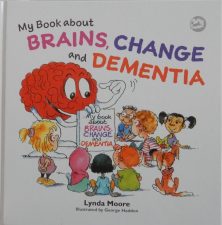
My Book about Brains, Change and Dementia

My Book about Brains, Change and Dementia
Lynda Moore and George Haddon
Jessica Kingsley Publishers

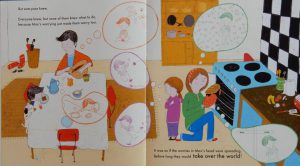
In picture book form, author Lynda Moore (a family counsellor who works with children impacted by dementia in Australia) and illustrator/cartoonist George Haddon, deliver an explanation in straightforward terms that will help young children understand something of the sensitive subject of dementia.

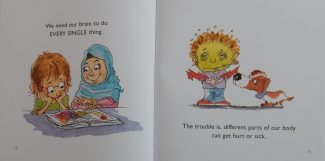
Starting generally, there’s an explanation of brain function; how it is a vital organ involved in everything we do.

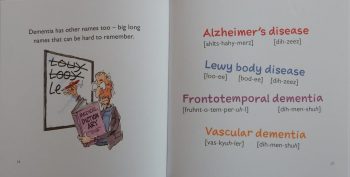
The author then moves on to say that like other parts of the body, a person’s brain can also get sick and we generally call the disease dementia.

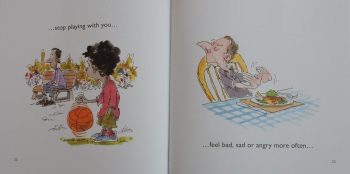
Youngsters are reassured that the changes that may happen to someone with dementia, (a relative perhaps)

are not their fault or indeed that of anybody else.
The importance of care and kindness are stated, as is the fact that dementia is incurable.

Readers/listeners are then given the option to skip the next few pages, which explain that ultimately, dementia can end in death.

Finally and also reassuringly, the book concludes by saying that if you know someone with dementia it is acceptable to feel happy, sad, scared or angry (mad) but it’s important and helpful to share your feelings.

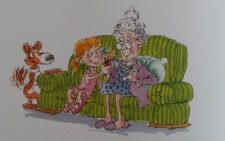
Concise, compassionate and young-child friendly, with amusing illustrations, this is an excellent book that should be in  all early years settings, every school, nursing home and when appropriate, a family library.

Rafi’s Red Racing Car

dscn9806

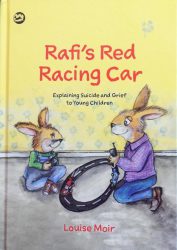
Rafi’s Red Racing Car
Louise Moir
Jessica Kingsley Publishers
Subtitled ‘Explaining Suicide and Grief to Young Children’, the author/illustrator of this book, art psychotherapist Louise Moir, lost her own husband to suicide a few years ago.
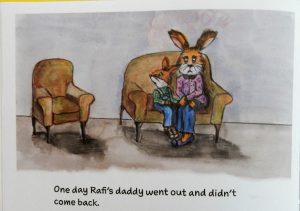
Rafi’s daddy had been suffering from depression, so much so that he’d stopped playing Rafi’s favourite racing car game with him. Desperate to put an end to ‘all the muddle and all the worry and sadness in his head’ there seemed only one thing to do: Rafi’s daddy took his own life.

dscn9807

Inevitably this leaves young Rafi confused and scared; what if his mummy became similarly ill too? Rafi deals with his grief in his own way by showing anger towards his toys and his friends which, inevitably, make things worse.
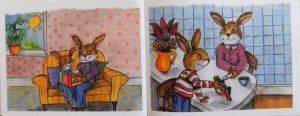
Enter a therapist who works with Rafi, gradually helping him to start coming to terms with what has happened and slowly, slowly Rafi begins to heal. Of course, his mummy plays a very important role in his healing process too.

dscn9808

Aimed at adults, the ‘Helping Children Heal’ final pages of the book offer a supportive guide to parents and professionals.
With its expressive watercolour illustrations …,

dscn9809

this little book takes a disturbing experience and its aftermath, showing that ultimately, transcendence can happen. In addition it should help young sufferers develop the all-important emotional language to cope with their experience.
A very useful resource for families and those who work with bereaved youngsters.

bookgivingdayblogbadge-1localbookshops_nameimage-2

Thank Goodness for Bob / The Healthy Coping Colouring Book & Journal

dscn9789

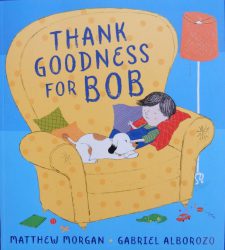
Thank Goodness for Bob
Matthew Morgan and Gabriel Alborozo
Egmont Publishing
‘A problem shared is a problem halved’ goes the well-known adage. The trouble is, Max an inveterate worrier doesn’t share any of his with family or friends for fear of troubling already busy people or looking foolish: he just stores them all up inside and it leaves him feeling overwhelmed …

dscn9790

Despite this, everyone knows about this and seemingly, his worries are infectious.

dscn9791

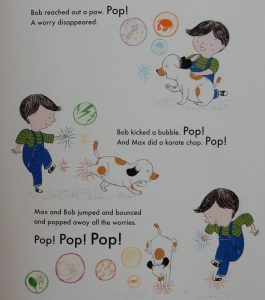
Thank goodness then for Bob. Bob the dog offers a listening ear and Max talks and talks; gradually his worries come bubbling out and drift around the room and then the two of them find the perfect way of dealing with them.

%0a

Gabriel Alborozo’s gently humorous illustrations are perfect for this sensitively told, empowering story that will help children deal with their anxieties.

Also aimed at helping children – albeit slightly older ones than the previous book – and subtitledCreative Activities to Help Manage Stress, Anxiety and Other Big Feelings’ is

dscn9803

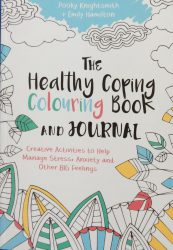
The Healthy Coping Colouring Book and Journal
Pooky Knightsmith and Emily Hamilton
Jessica Kingsley Publishers
Mental health ambassador, Pooky Knightsmith, has joined forces with illustrator, Emily Hamilton, to produce a book full of activities to help develop and enhance the well-being of children between eight and fourteen. It might well be equally used by adults. The aim is not only to help in reduction of stress but is also a tool for managing feelings and could be used at any time, whether one is feeling bad or good.
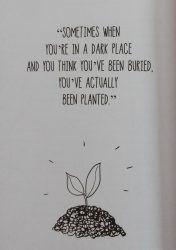
There are plenty of pages to colour, spaces for reflection and writing as well as a plethora of wise words to guide, inspire and motivate.

%0a

There are lots of diary format pages for recording ones personal experiences, preoccupations and feelings.
Buy to use or buy to give.

bookgivingdayblogbadge-1 localbookshops_nameimage-2

Night Shift

%0a

Night Shift
Debi Gliori
Hot Key Books
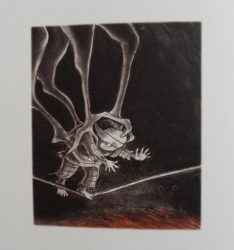
This eloquent exploration of depression is so achingly beautiful and all the more poignant as it’s grown out of the author’s experience. Yes, there have been picture books dealing with this sensitive subject before but nothing quite so awesomely affecting as this one of Debi’s.

%0a

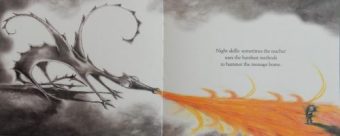
Everything about it, the striking cover, the spare first person narrative monologue, the arrangement of words on the page, those grainy black and white illustrations of the girl narrator and the ever-present, sometimes all pervasive, overwhelming, oh so dark dragon used as a metaphor for the illness are just perfect.

%0a

Embracing the whole gamut of emotions from despair –‘Words left me. There was no language for this feeling.’ to, -ultimately – hope: ‘And something shifted.

%0a

It’s uniquely personal, but equally, speaks to all – whether or nor they’ve ever found themselves in thrall to this terrible illness.
Most of us know somebody, be they family member or friend, who has suffered from depression; indeed several of my teacher friends have had bouts. Moreover, depression among children is on the rise, partly, but not entirely due to increased curriculum pressures. Despite this, with the decline of funding, there are fewer and fewer human resources available to help. So, as well as being a book for individual readers, this is a must have for use in schools, either with individuals or shared and discussed with a class or group. It deserves the widest possible audience: all power to Debi for being so brave in creating it. Her words on the final page are so moving and revealing.

localbookshops_nameimage-2

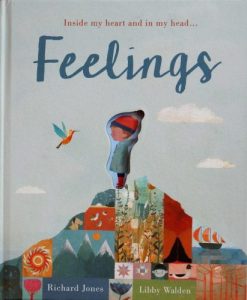
Feelings

Red Reading Hub is Happy that Caterpillar Books invited me to be part of the FEELINGS blog tour and thanks too, to the book’s creators, Richard and Libby for …
%0A

Feelings
Richard Jones and Libby Walden
Caterpillar Books
Emotional literacy and well-being are at the heart of the Early Years Foundation Stage and Every Child Matters, and yet still, as we’re told in the PR for this book, ‘One in ten children aged between 5 and 16 (have) a mental health problem.’
So what happens once children move into primary school at age five? Here is not the place to discuss this issue although I have strong views on what I see to be some of the contributory factors: rather, I welcome anything that can help children to explore their own feelings and emotions openly and within a safe context. Many picture book stories offer this possibility; now here we have a lovely, specially written and illustrated book to this end.
Richard Jones, the illustrator, places the child right where he or she should be: at the heart of this book …

DSCN8777

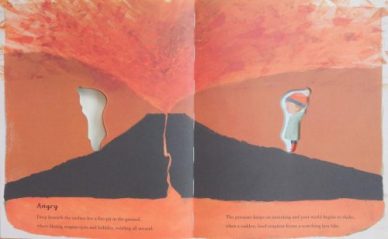
and then, after the introduction, assigns a double spread to the exploration of ten different feelings/emotions: Brave, Sad, Angry, Happy, Jealous, Alone, Embarrassed, Excited, Afraid and Calm. Each one is beautifully atmospheric.
Vitally important as personal feelings are, it is also essential, in order to function well in society, to be able to see things from other people’s viewpoints. So after acknowledging that we’re all different and that this is mirrored in our own personal feelings, Libby Walden (or rather her child narrator) makes this final suggestion: ‘Try to walk in someone’s shoes to see how they might feel, /For though you cannot see them, their feelings are still strong and real.’ How many times a day or week do those of us who teach in the foundation stage or spend time in Early Years settings say to individuals after an incident, something like “Now how do you think so and so feels about that?”
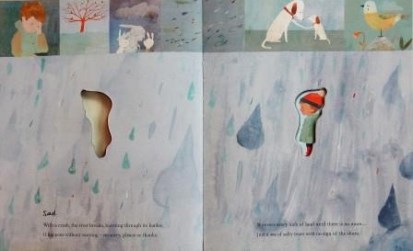
The rhyming text makes use of metaphor to look at what happens when one is overwhelmed by a particular emotion: Sad is a ‘river … bursting through its banks’ covering the land and creating a ‘sea of salty tears with no sign of the shore.”
%0A

Angry is ‘a fire-pit in the ground ‘blazing, spitting, bubbling and swirling and finally, erupting …
%0A

Jealousy, in contrast, is a rolling ‘emerald mist’, churning, seething and eating away at you from inside, blurring your vision and fixing your mind on something you don’t have.
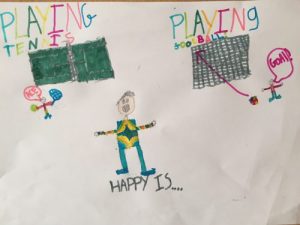
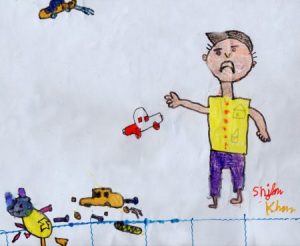
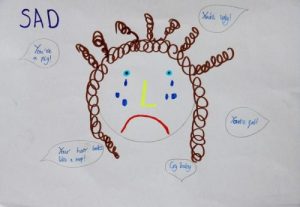
For many children, particularly younger ones, pictorial representation is the easiest (and for them, safest) way to explore their feelings. With this in mind, I shared the book and asked some children to talk, reflect and respond in their own way: here are a few of their pictures.
Angry seemed to be the one feeling that was all-engulfing: Gracie has become an enormous bear with jagged teeth and claws …
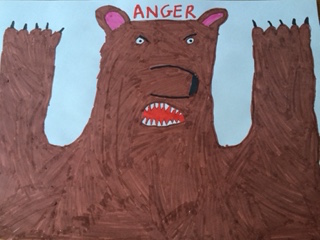
IMG_2261

Interestingly Richard himself mentions jagged shapes and fiery colours in his discussion of illustrating Angry for the book. Saba too has jagged lightning in her Angry scene …
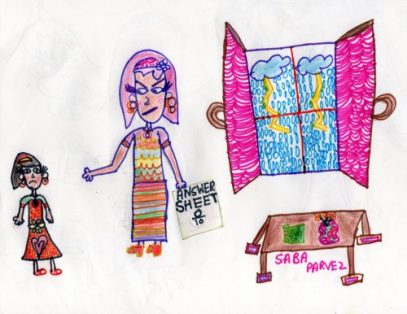
saba- angry

Happy for Daniel is doing sport …

image1

for Shahan lots of sweets to eat, especially his favourite gulab jamun …
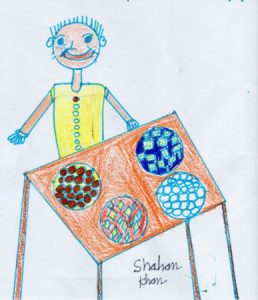
shahan-Happy

For Lexi, it’s celebrating a birthday …

DSCN8775

Sad, for Shifan is broken toys …

shifan - sad

for Frankie it’s bullying …

DSCN8774

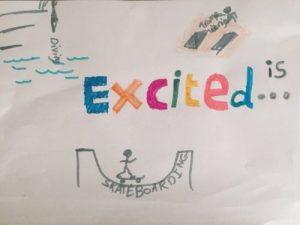
Excited for James is activities that allow him to release his boundless energy …
2016-08-29-PHOTO-00000030

If these responses are anything to go by, Feelings should certainly prove to be a very valuable resource for teachers and other working with children.