Mermaids Rock: The Midnight Realm / The Kitten Next Door

Two new titles kindly sent for review by Little Tiger’s Stripes imprint, both from authors popular with young solo readers:

Mermaids Rock: The Midnight Realm
Linda Chapman, illustrated by Mirelle Ortega
Little Tiger
The Midnight Realm referred to in the title in this, the fourth of the Mermaids Rock series, is that region of the ocean around 1,000 metres below sea level that is in constant darkness as no sunlight ever penetrates to that depth. A place where, on account of its extreme pressure and freezing temperatures, humans have only recently developed the technology that makes it possible for them to explore. Not so merpeople however and in particular those merchildren, resident around Mermaids Rock – Marina, Kai, Naya, Coralie and Luna. As the book opens these friends are busy working on the design of a poster for their latest project, corals reefs. And as those who’ve read previous books might expect, Glenda is showing off while being full of negativity towards their efforts.

Excitement rises when their teacher announces a three-day field trip that involves camping on a deserted atoll in the South Pacific.

When Marina says that her father has been researching the disappearance of strawberry squid down in the Midnight Zone, the area that the friends want to know more about for their project, it’s a case of Save the Sea Creatures Club to the rescue once again. And that’s despite being warned how dangerous a place this totally dark region is. A plan is formed: can they solve the mystery of the flashing light that Naya has noticed, (the light that then appears in the tunnel) and discover what is happening to the strawberry squid? Perhaps, but a fair bit of problem solving and creativity will be needed if they embark on such a mission.

And even more when they discover a glowing cave wherein lurks a tentacled monster – a monster that entraps Luna. Now Naya’s creative skill is required if she’s to succeed in rescuing her friend.

With black and white illustrations by Mirelle Ortega to enjoy, this story has exciting moments aplenty, strong friendship, and kindness even towards Glenda despite her misdeeds, this will be lapped up by established fans and other young readers with an interest in marine life and environmental issues.

The Kitten Next Door
Holly Webb, illustrated by Sophy Williams

In this latest story in Holly Webb’s Animal Stories we meet young cat lover Sophia. She longs for a cat of her own but her parents say she must wait until her little sister is a bit older. Then, just after Christmas Sophia spies a tiny, hungry-looking calico kitten Willow appears in the next-door neighbours’ garden and falls under its charm straightaway. She tries to spend some time with the kitten every day but as the holidays come to an end, the people next door move away, taking Willow with them, so Sophia assumes.

But shortly after Sophia notices the kitten again. Has she run away from her new home? Sophia is determined to find out. And so she does, but she finds out a whole lot more too and that’s one of the essential qualities of Holly Webb’s animal stories. Here we are reminded of just how scary fireworks can be to small creatures such as Willow, as well as how showing loving care and kindness towards animals can be hugely rewarding, sometimes in unexpected ways.

With its pencil sketches by Sophy Williams wherein she captivates even this cat phobic reviewer, this book is just right for new solo readers, especially animal lovers like young Sophia.

Deep in the Ocean / The Big Sticker Book of Birds

Deep in the Ocean
Lucie Brunellière
Abrams Appleseed

In this large format board book, readers follow Oceanos, a shiny silver submarine, as it takes an exploratory voyage into the depths of the oceans.
From the first opening, we’re immersed in the ocean’s waters along with the submarine’s scientific crew

but as their craft dives deep and travels through a deep abyss, a fierce storm blows up, whisking the little shiny submarine right off its intended course.

Instead, eddying whirlpools cause it to journey to the polar waters of the Arctic; then it’s pulled by a blue whale towards tropical waters of a coral reef, travelling on until one imagines, it resurfaces, with the crew having collected a wealth of information.

There is a free accompanying 10-minute, atmospheric sound track available to download, though to get the most out of the dual experience, you need to synchronise the track timings with page turns.

It’s easy to get lost in the colourful ecosystems with their standout bright flora and fauna depicted in Brunellière’s multi-layered, finely detailed spreads that do a splendid job of capturing the awe and immensity of our ocean ecosystems.

Dive in and be amazed at the riches therein.

The Big Sticker Book of Birds
Yuval Zommer
Thames & Hudson

Following Yuval’s wonderful The Big Book of Birds comes an activity book on the same theme.

Readers are in the company of Polly the Pigeon. She guides us through as we’re told, ‘the feathery world of birds’ and all that’s needed for the journey is a pencil, some colouring pens and ‘a flighty imagination’. Some of the latter might be used in deciding how to adorn the pages with the 200+ stickers provided at the end of the book.

There’s a wealth of fascinating facts embedded within the spreads that are allocated either to specific kinds of birds such as albatrosses or puffins, or to avian topics including feathers, nesting, and migration.

Children might accept Yuval’s invitation to complete a maze,

design a feather for a new bird species, spot the difference, design a bird box, imagine and draw what a dozen magpies might have picked up in their beaks and more. Or what about playing a game of Blackbird bingo or adding foliage to a tree for wild birds to hide among?

I love the way all Yuval’s creatures be they birds or other, have a slightly mischievous look in their eyes, which adds to the allure of the already engaging pages.

Immersive and fun while unobtrusively educating the user(s).

Sea: A World Beneath the Waves / Dolphins

Sea: A World Beneath the Waves
Britta Teckentrup and Patricia Hegarty
Little Tiger

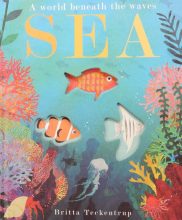
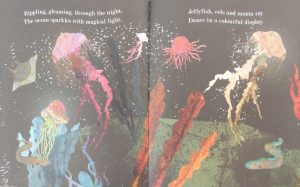
In her latest non-fiction, die-cut peep-through picture book, in a series of wondrous scenes Britta Teckentrup plunges us beneath the ocean waves, way, way down to view the wonders of the deep.

Amid the corals and seaweed fronds we see small fish, sponges, tiny graceful sea horses; a baby dolphin and its mother chirping and clicking in communication, a Lionfish with its poison spines ready to use should it be attacked.

Suddenly there’s a feeling of fear: the fish sense danger as a great white shark casts its shadow. The other sea creatures though, employ their defence mechanisms while the tropical fish swim in formation and all is well.

Night comes and the ocean is a-glow with light;

his song echoing far the humpback whale sings for all to hear, the manatee glides through sea grasses and the corals provide safe spaces for small ocean creatures.

Patricia Hegarty’s lyrical text ends with a plea to protect ocean life by keeping the oceans clean and free from rubbish.

Dolphins!
Laurence Pringle and Meryl Henderson
Boyds Mills Press

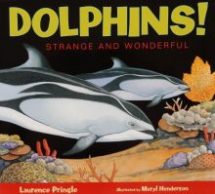
Pringle immediately grabs readers’ attention with his introductory ‘If you were a young dolphin, your mother would keep you close, feed you milk and teach you’ that could almost be referring to a human mother. The remainder of the paragraph however negates that with its ‘Soon you would learn to swim fast and catch fish to eat. And sometimes you would leap from the water, high into the air!’ while his final statement on the first page “People would be very curious about the secrets of your life beneath the surface’ sets the scene for the remainder of this fascinating book.

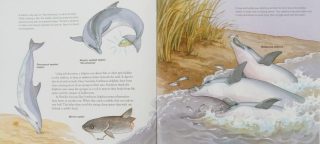
It covers many aspects of the thirty or so dolphin species including classification, morphology and physiology. There’s a fascinating account of dolphins’ use of echolocation;

another of feeding – dolphins are predators, consuming huge amounts of food daily –

and communication. I learned that in addition to sounds, dolphins send messages with their bodies, sometimes by rubbing skins, at others, by touching flippers.

All this and more is related in the author’s highly readable prose that is superbly illustrated by Meryl Hendersen in watercolour and pencil.

Although it’s likely that this will be read by individuals, this book also works really well if read aloud – a testament to the quality of the author’s writing.

My Pet Star / Little Fish

My Pet Star
Corrinne Averiss and Rosalind Beardshaw
Orchard Books

Beneath a tree one night, a little girl discovers a star. The star has been hurt by its fall and its glow has gone, so she takes him home.

There she acts as a ‘cosmic super vet’ tenderly nurturing her ‘pet’ star, sharing books with him

and cuddling up with him at bedtime.

The days go by and the young narrator finds out a great deal about her star and his habits and all the while, the star glows brighter. She misses him during the day when he sleeps a lot; and he eschews her games merely looking on silently and benevolently.

At night though, he comes to life, his sparkle preventing the girl from sleeping as he twinkles above her bed – until she makes a decision.

Leaping from her bed she opens wide her window and … whoosh! Away flies her astral friend, fully restored, back into the dark sky where he belongs, from there to brighten up the sky and his new friend’s life from afar.

Corrinne’s magical story demonstrates the importance of kindness, altruism and friendship; it’s beautifully illuminated by Ros. Beardshaw in her mixed media scenes. Her narrator is shown as an adorable child who seems to live alone in a shepherd’s hut or travellers’ caravan.

Little Fish
Emily Rand
Thames & Hudson

Five vibrant, layered neon scenes of life beneath the ocean waves pop out of this book, the covers of which can be tied back to create a standing carousel.

A short rhyming narrative introduces two orange goby fish playing among the corals. The duo become separated when a large shoal swims past sweeping one of them with it, into a dark patch of kelp in which rests a friendly-looking turtle.

Less friendly though is the hungry grouper that lurks in the cave nearby eyeing the little goby. Then, even more scarifying are the white teeth of a marauding shark that appears on the scene snapping its jaws threateningly.

Happily though, the little fish finally makes it back home where it re-joins its playmate on the reef.

A lovely way to introduce your little ones to marine life, but equally this would be great as part of an early years display for a sea-related theme.

Trucks and Rock Pools

William Bee’s Wonderful World of Trucks
William Bee
Pavilion Books
This is truly a vehicular delight and who better to introduce it than Bee himself. First he shows off the fuel tanker which, we’re told, holds sufficient fuel to fill 2500 motorbikes, or if you prefer, 650 cars or 40 of the fanatic’s largest trucks. It’s fuel is pretty indispensable unless you happen to have one of these beauties: watch out for soot.

Mr Bee however, has a truck to take care of that eventuality too – his amphibious one.
As construction is a frequent activity at the William Bee’s Garage, there are all kinds of trucks to help with the various building-related tasks; there’s the one that carries supplies, a cement mixer, a café truck – building makes one hungry after all. William also has a rescue truck, which here, has been called out to aid a snow-scooper.

Racing cars, and a truck to carry them complete with spare wheels, tool boxes and more, are also kept at the garage, as is William’s amazing jet-powered truck; fire engines and more. Mr Bee though is off to the seaside in yet another of his amazing vehicles and there he goes … leaving readers with a few final spreads of truck facts and some adverts for all his trucks’ needs.
What more could a truck-crazy pre-schooler want that these wonderfully bright, detailed illustrations (eye candy for truck fanatics) and William Bee’s running commentary on same.

Rock Pool Secrets
Narelle Oliver
Walker Books
As a child on summer holidays in Devon, Cornwall or further afield in the Mediterranean, apart from swimming, my favourite activity was poking around in rock pools accompanied often by my sister and Dad. I’d catch various things in my net, pop them into a bucket, observe and attempt to identify them; and then put them back into the water. This ‘lift-the-flap’ book takes me right back to those days with a close look at many of the creatures and plants I most certainly found: sea anemones with their sticky tentacles – endlessly fascinating; hermit crabs residing in empty mollusc shells, other crustacea – crab species, shrimps shooting rocket-like into the tangled seaweed; and various fish including gobies.

Most starfish I found were dried up on the seashore; herein though we see one cleverly camouflaged on the surface of a rock.
Each creature is given a double spread and almost all have a large, appropriately shaped flap that open to reveal further details about the particular animal. The final spread with an invitation to discover its secrets, opens up on both sides revealing an entire rock pool.
With awe-inspiring lino print illustrations, a fairly short narrative text and a pictorial glossary at the back giving extra information, this is perfect for preschool children and KS1 audiences.

I’ve signed the pledge  

Line, Colour, Shape and Contrasts: Some Explorations

dscn9121

Free the Lines
Clayton Junior
Words & Pictures
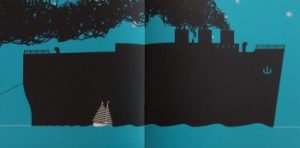
It’s amazing how much you can say in a picture book without a single word of text. Clayton Junior does it all with lines – straight lines, curvy lines, thick lines and thin lines, lines close together and lines far apart; white lines and black lines. Using all these and the occasional bit of blocking, he tells a story of a small cat in a small boat sailing out into a large ocean to catch fish.

%0a

Into that same water comes a huge, smoke-belching trawler,

%0a

a trawler that casts an enormous net, an enormous net that scoops up everything in its path.

%0a

Fortunately- for the trapped, though not the trawler’s crew – an outstretched paw with a large pair of scissors puts paid to the marine life devastation and cat sails serenely into port over an ocean once more teeming with life.
This thought-provoking tale poses questions about the ethics of fishing and the fishing industry, as well as offering lessons in visual literacy and opportunities to explore and experiment Clayton Junior’s minimalist techniques of creating shape and form. It has something to offer all ages from around four to adult.
From the same artist is

%0a

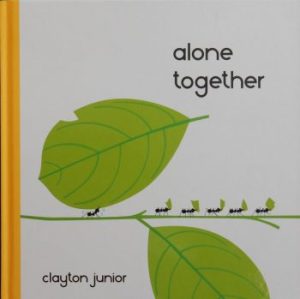
Alone Together
Herein all manner of animals are shown as a means of exploring a wide range of opposites and contrasts. Each one of the stylish spreads could well be a storying starting point in addition to demonstrating the concepts chosen. This one really made me smile:

%0a

Also worth adding to your early years collection are:

dscn9118

Blue and Other Colours with Henri Matisse
Squares and Other Shapes with Josef Albers

Phaidon
These are two of the ‘First Concepts with Fine Artists’ series, beautifully produced board books that use the work of famous artists to introduce very young children to everyday concepts.
In the first, coloured cutouts from Matisse’s collages are the basis for teaching not only about colour, but also about shape and form, and how various colours can work when juxtaposed. Although blue crops up on most spreads, here’s one where it doesn’t …

%0a

Both inside covers are used to provide information: at the back is a brief introduction to the artist and some of his works, in particular the cutouts; and at the front, in tiny print, is a key to the works featured with their dates.
An unusual way to introduce colours and the notion of ‘painting with scissors’ and more important, especially if like me, you believe most children do not actually learn colours from books but from life experience, a springboard to creativity.
Equally fascinating and also essentially about colour juxtaposition and perception too, but this time introducing basic 2D shapes is an introduction to the 20th century artist Josef Albers’ work, in particular, Homage to the Square.