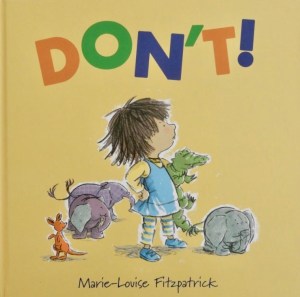
Don’t!

Don’t!
Marie-Louise Fitzpatrick
Otter-Barry Books

Geraldine has a new baby brother and she’s experiencing the turbulent feelings that many elder siblings go through when it’s no longer the case of ‘there was Daddy and Mummy and me.’

Baby Boo is, let’s say, demanding and forceful; he can roar, he can kick and he can bite. Now Geraldine can do all these things too and she’s certainly not going to be overlooked. Consequently she roars at her toys – very loudly, she demonstrates her kicking skills with Mummy instead of a football
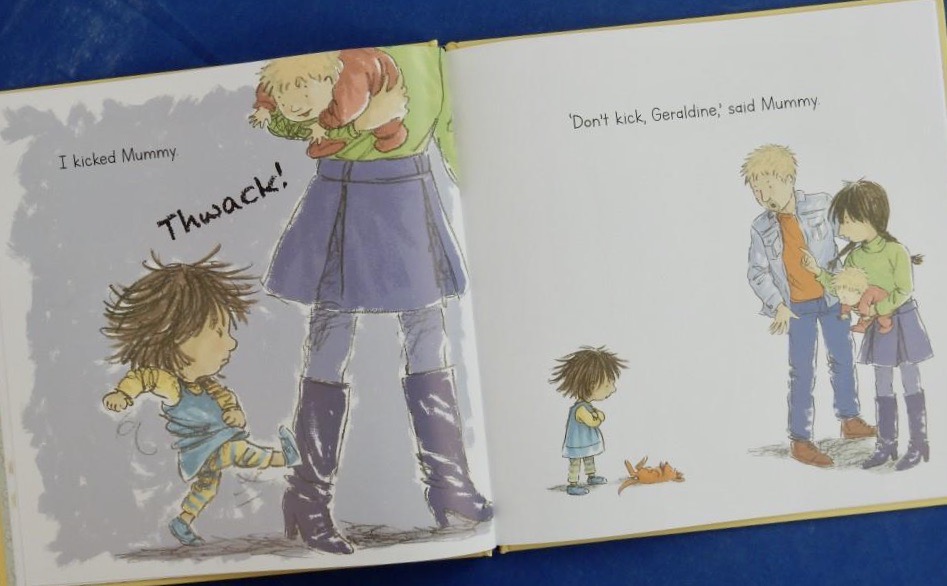
and she bites her Daddy on the leg. Her parents are not pleased; only her toys appear empathetic towards young Geraldine
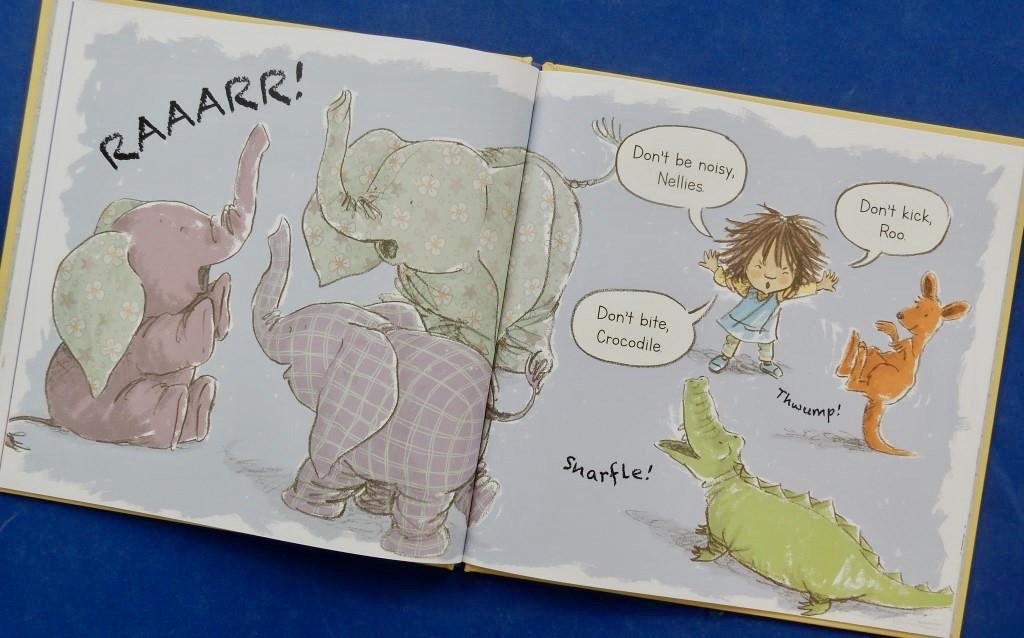
and soon there’s a tearful huddle of little girl and three cuddly elephants, a crocodile and a kangaroo.

Then suddenly baby Boo cries too and this changes things completely: “Don’t cry baby Boo,” says big sister reaching out to him. Now there is Daddy and Mummy, Geraldine and Boo, a happy family and they all love each other.

Sensitively written and illustrated, Marie-Louise beautifully captures the feelings of a young child adapting to a new baby in the family. I’d strongly recommend families in a similar situation to the family in the story to get hold of a copy of this lovely book and share it with the big brother or sister. It’s a good one to add to foundation stage collections too.

Owl Bat Bat Owl

Owl Bat Bat Owl
Marie Louise Fitzpatrick
Walker Books
I’m a big fan of wordless picture books and this one is a cracker. It features two families one of owls, one of bats.
As the story opens, the owls are happily settled on their roomy branch enjoying some shut-eye when all of a sudden along comes a family of bats. They too decide to make their home on that self same branch so we then have …

Unsurprisingly the two families are circumspect: after all owls and bats don’t really make the best of friends.
After a fair bit of positional adjustment, the families both prepare to sleep but baby animals, like humans are inquisitive and so you can probably guess what happens after this …

Now we know that human children are much more ready to accept newcomers than are most adults. The same is true of owls …

though mother owl soon has her youngest offspring back where she wants, beside her and all is peace and quiet. But when the chips are down and disaster strikes in the shape of a storm,

differences don’t seem to matter – co-operation is now the name of the game.
This book works on so many levels and is open to a multitude of interpretations. We often talk about the power of words: here, picture power rules.
What a wonderful demonstration that reading is about so much more than getting words off the page.

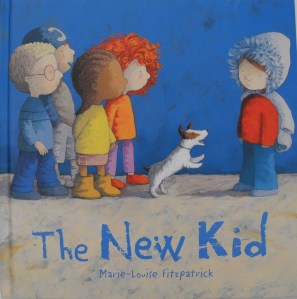
The New Kid (coping with bullies)

DSCN2224

The New Kid
Marie-Louise Fitzpatrick
Hodder Children’s Books
Ellie is a girl with inner strength, most definitely. So, when she moves into the purple house in a new neighbourhood she resolutely wears her grey coat (at her mum’s behest), despite the fact that the other children on her street aren’t wearing theirs when they knock asking her to play (at their mums’ behest). As a result she comes in for some unkind taunting from the others, “Ellie-in-the-grey-coat,” they all chant.
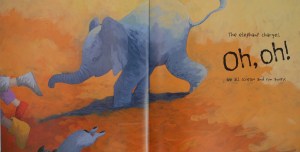
ELLIE-ELEPHANT!” No reply from Ellie. But then she begins, courtesy of that grey coat, to transform herself into an elephant and CHARGE …

DSCN2227

right at the bullies.
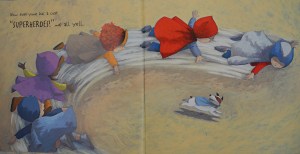
Next Ellie, morphs into a seal. The gang members applaud, all except their leader who is the book’s narrator. He feels his position as games-maker-upper is threatened by this newcomer, whose next transformation is into superhero. Time for some quick thinking and action now, boy narrator … there go two superheroes, coats a flying; but then …

DSCN2229

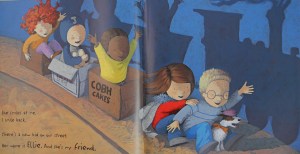
A new friendship is born.
Vibrant, sensitively rendered paintings cover every centimetre of this thought-provoking book that demonstrates the power of the imagination in adversity.
Great endpapers too; I particularly like that there’s a bookshop on what appears to be the main street and the hair of every one of those children is just so tactile in appearance.

DSCN2230

The boy narrator’s voice sounds somewhat detached; for much of the time he appears as an almost passive observer, perhaps reluctantly joining in with the bullying chants. This is an effective vehicle through which to present the way children can at times, all too easily, be cruel to one another, especially to those they view as outsiders. At the same time that same voice talks about positions of power and roles among peers.
Buy from Amazon
Find and buy from your local bookshop: http://www.booksellers.org.uk/bookshopsearch