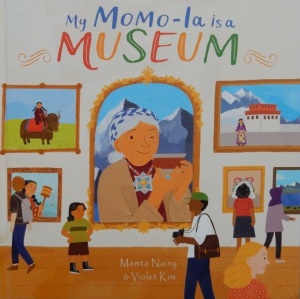
My Momo-la is a Museum
Mamta Nainy and Violet Kim
Lantana
When Momo-la comes to visit every summer, she shares her precious mementoes and her life stories, one every night, with her granddaughter, the narrator of the book. When she asks Momo-la where all her stories come from, she responds, “Stories are everywhere,” and offers to show her granddaughter.
The following morning they head out into the city noticing such things as wildflowers and wormholes, things the child mostly misses. They visit first the Museum of Ancient History, which is full of artefacts, followed by the Museum of Art. There the girl points out that a painting depicts a woman wearing a jacket with a design like the one on Momo-la’s chuba (a traditional Tibetan apron).

In fact wherever they visit, the girl sees something that reminds her of Momo-la, who has a special story from her own experiences to tell about each one.
After a tiring but wonderful day the two return to the child’s home, where she stands her grandmother before a mirror and makes an announcement: the most important museum of all is there right before her eyes. …”A museum that will always feel like home.” And what a wonderful storyteller she is.
A memorable, heartwarming story of intergenerational love, family, culture, memories, treasures and most importantly, stories. It’s a powerful reminder that grandparents, parents and other family members are treasure chests of stories, stories that they love to share if we give them time to do so.
Indeed each of our lives is a story, or perhaps stories within a story. At the back of the book, the author, Mamta Nainy, has written a letter telling how her grandmother had a wooden box full of special objects that went everywhere with her; objects that told stories about her family and their migration to India after partition. She also talks of ways Tibetan refugees in a settlement in New Delhi try to keep stories of their home alive.
The book is beautifully illustrated by Violet Kim who brings the story of the girl and her Momo-la to life in densely coloured, detailed scenes. If you share this with a primary class, perhaps some of the children might ask their own grandparents in to share objects and associated stories from their lives.


 Red Reading Hub - Jillrbennett's Reviews of Children's Books