Albert’s Bubble Bath / Bert and the Bubble

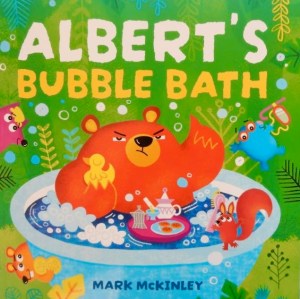
Albert the bear is a grumpy character but there’s one thing that makes him feel good. No it’s not picnics, nor fishing, and definitely not singing around a campfire: it’s relaxing in a bubble bath. However, Albert’s bubble bath is the envy of the forest creatures and they’re keen to try it too. Albert though, is certainly not going to allow this and makes it quite clear with the signs he puts up around his home. When they have no effect he hires top security, again with no effect. The subterranean relocation of the bath fails too. Time to don those thinking specs Albert. After much hard thinking he has an idea of the constructive kind: surely this must work.
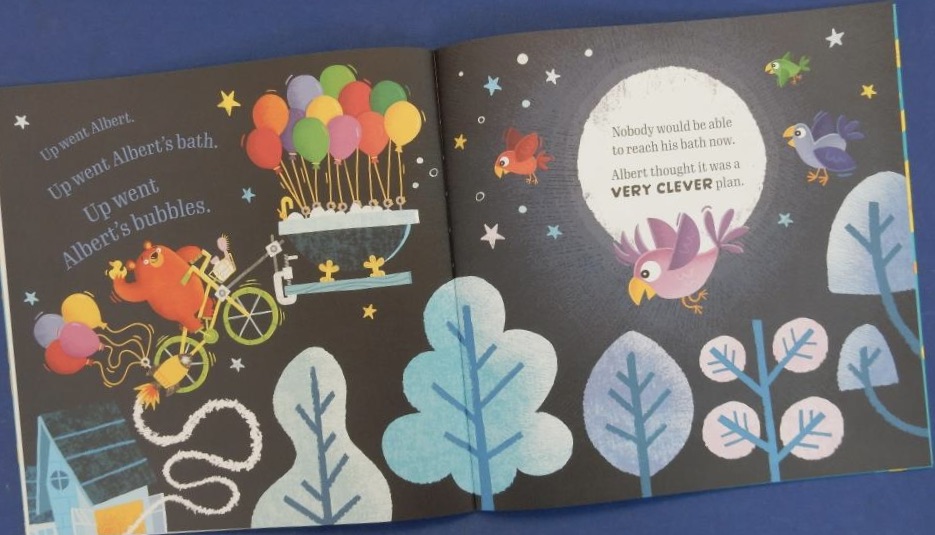
Oops! He hadn’t factored in sharp-beaked birds. POP! Albert plus his beloved bath tumble earthwards but the bath gets stuck before reaching the ground. Reluctantly Albert asks for ideas and up steps a beaver. Maybe he and his family can help … Seemingly they do so in more than one way.
With it’s fun finale this is a dramatic story with plenty of giggle-inducing moments that ensure that the learning to share message is imparted lightly.
It makes a satisfying read aloud and should definitely go down well with foundation stage/ KS1 children.

Also about sharing is:
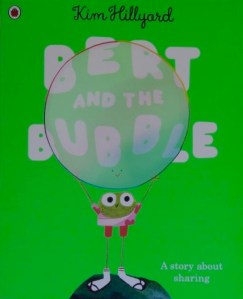
When Bert the frog finds a beautiful shiny bubble he shows it excitedly to his friend, Sandra. Sandra is eager to hold the bubble; Ben agrees but asks she treat it carefully. Pop! That’s the end of the bubble: clearly Sandra wasn’t careful enough. The following day Bert finds another bubble, a bouncy one that Norman wants to play with. ‘Yes”, Bert says, “But please bring it back.” But Norman fails to do so. Poor Bert is starting to think his bubble luck has run out when down floats the biggest bubble in the world.

So eager is Bert to keep this one safe that he goes to great lengths to protect it. Determined not to share this time, he builds a fort and locks himself and the bubble inside. It’s a tight squeeze but Ben remains shut away pondering upon the terrible consequences should he come out.
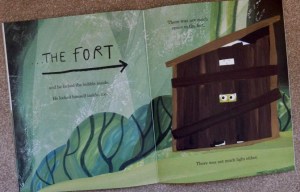
Suddenly there’s a tapping on the door accompanied by voices calling him to come out, apologising and promising to be more careful in future: it’s his friends. Out comes Bert and out comes the bubble looking bigger than ever. The three frogs have great fun playing with it all afternoon and just as Bert is thinking he’s having the best time ever …

However now Bert’s reaction is somewhat different. He’s clearly learned that when it comes to friendship and bubbles, one is definitely way more important than the other.
An amusing, learning to share story with funny froggy scenes at every turn of the page.

Ten Whizzy Racers: Chaos at Crackling Creek

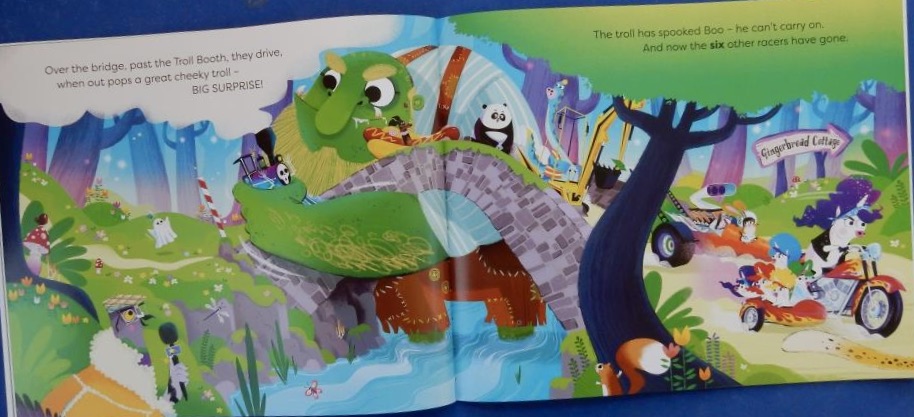
This is the first in a new countdown series with a racing theme. The whizzy racers are Boo, Bolt, Bounce, Dash, Drift, Glint, Scoop, Speedy, Tricks and Zip. As the book begins they’ve all assembled in their vehicles at the start line in Fairytale Forest ready for the great Beanstalk Cup race to begin. The starting gun pops and off they go, but almost immediately there’s some thieving, out goes Drift and on go nine whizzy racers. Zip’s a kindly character and he pulls out of the race to pick up Red Riding Hood and deliver her safely to her Grandma’s house. And so the number of whizzers diminishes as all manner of accidents, alarming incidents

and other reasons for pulling out occur until only Bolt and Bounce remain in the running. Who will be first to cross the line and take the cup? One very happy racer. However, there’s another racer that is anything but happy and that, despite his shenanigans.

Timothy Knapman weaves a host of fairytale characters into his bouncy rhyming narrative including infuriated fairies, a terribly large troll and a mischievous unicorn. Each of these and lots more appear in Richard Merritt’s vibrant, action-packed scenes of the event. There’s so much to look at on each spread that little humans will be reluctant to whizz through the pages, rather they’ll want to take it slower and savour all the details.

Frida the Rock-and-Roll Moth

Frida is a moth: with her prowess at playing loud music on her purple guitar and her pointy boots she exudes funkiness. Despite constant encouragement from Auntie Edna, her number one fan, there comes a day when Frida feels anything but shiny. She even begins to think of giving up playing her purple guitar,

then suddenly there appears a big bright light and she sees a host of rock-and-roll moths that are dancing, singing and rocking. Eager to join them, Frida begins to approach them but as she gets closer, she starts to feel smaller. They all seem so much sparklier than her. Why can’t I be more like them, she thinks to herself.

Back in her room, Frida decides change is needed: boots, songs and purple guitar are all replaced. The following night at the Big Bright Light, Frida moves forwards again, but the same feelings start to worry her until she hears Auntie Edna’s words, “Go, Frida! You can do it! Your best self is always inside you!” So, she begins to play but to no avail: still nothing feels right. Alone again in the dark, she feels inadequate once more.

Returning to her bedroom, she is determined to change again and gives several possibilities careful consideration. Along comes Auntie Edna with a hug and some vital words of wisdom. Are those what is needed to empower Frida next time she visits the Big Bright Light?

With it’s delightfully quirky illustrations that show so well Frida’s feelings, and vital message about believing in yourself, Kim Hillyard’s tale will surely encourage young children to find their inner light and let it shine forth no matter what challenges they face: self belief is key.

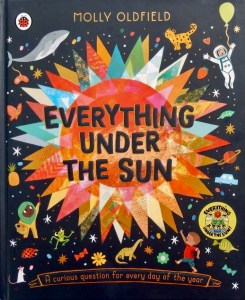
Everything Under the Sun

Everything Under the Sun
Molly Oldfield
Ladybird Books

This is an exciting compendium of 366 questions (one for every day of the year plus 1 for a leap year) posed by inquisitive children from all over the world, that has its origins in the podcast from Molly Oldfield aka QI Elf.

Written contributions, some factual responses others opinion-based, come from a wealth of experts such as scientists, authors, poets, politicians, conservationists and the twelve illustrators who provided the visuals. Interestingly Rob Biddulph gives an answer (as does author Abi Eplhinstone) to “Where do ideas come from?” but he isn’t among those illustrators (Laurie Stansfield did the art for that one); neither is Oliver Jeffers who responds to “Why do people make art?” I particularly love this part of Rob’s reply, probably because he endorses my feelings: “… My children are a really good source for my ideas. They are big readers, and they have really vivid imaginations! And no idea is too silly!”

Some of the spreads have a theme, for instance there’s one with four wild animal questions, three relating to big cats, the other being “What noise does a zebra make?” Another has three penguin questions.

Others devote a double spread to a single question “Why do butterflies have patterns on their wings” being one for August.

There’s a splendid illustration of an owl around which a question of head rotation is discussed.

On a completely different topic, Nick Ross explains why the Tower of Pisa is leaning.

Not something this reviewer has ever considered but I was interested to learn why nonetheless. That’s another way this book works. You can just dip in randomly and discover something that perhaps you didn’t know before and no matter your particular interests, you’re pretty sure to come upon something illuminating.

Or you might have a question binge and spend hours browsing and you could formulate a few questions of your own. I wondered why there are relatively few ‘where?’ questions compared with those asking ‘why’ and ‘what’ and it’s great to see such a wide age range of inquiring children (2-18) included as the source of the questions.

I’d strongly recommend both families and primary schools adding this engrossing book to their shelves.

Bees, Trees and Planet Earth

Bees
Trees

illustrated by Carmen Saldaña
Please Help Planet Earth!
illustrated by Paulina Morgan
Ladybird Books

It’s never too soon to introduce young children to the environment protection cause and these sturdy books offer a good starting point.

Devoting each of its six spreads to a different aspect of Bees, young children are introduced to the vital role these little insects play in keeping the planet healthy; explains the role of bees in pollination; takes readers inside a honeybee hive; looks at honey and beekeepers; explains why the number of bees is in decline and finally suggests some ways in which everyone can help save these important little creatures.

Trees is similar in structure. First is an explanation if their importance to all life on earth. Second is a simple look at the various parts of a tree and their interconnectedness. There’s a spread on seasonal changes; another presenting some of the thousands of different kinds of tree and deforestation and its consequences is briefly discussed while the final spread is again ‘How can you help?’. Carmen Saldana’s illustrations are child-friendly and in both books there are flaps to explore on every page.

In Paulina Morgan’s diverse, alluring scenes Planet Earth itself takes the narrative role in the third book, issuing an earnest plea for help to protect its various ecosystems and their flora and fauna by making small but crucial changes to the way we live.

In keeping with their ‘protecting our planet!’ theme, all three books are made from recycled board and printed with plant-based inks.

Baby Touch: Playbook Baby Touch: Animals / Little World: In the City Little World: To the Moon

Baby Touch: Playbook
Baby Touch: Animals

illustrated by Lemon Ribbon Studio

Little World: In the City
Little World: To the Moon

illustrated by Allison Black
Ladybird Books

I’ve always advocated that adults should share books with babies almost from the time they’re born so it was good to receive these samples of two new series from Ladybird Books.
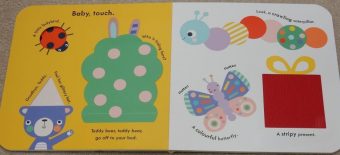
With their simple, colourful images, differently textured objects to feel, and texts that are baby appropriate, the Baby Touch books are ideal for the very youngest.

The Playbook even introduces lines from such classic nursery rhymes as ‘Twinkle, twinkle, little star’ and “Teddybear, teddybear’.

In the Animals book the focus is on the animal names and their sounds. Both offer lots of sensory stimulation for babies from around 3 months although it very much depends on the child.

The Little World books are smaller in format and have a simple narrative running right through; and there’s an alternate push-and-pull element or slider on each of the four double spreads.

In the City keeps feet firmly on the ground – almost – as two very young children in the company of what could be grandparents encounter the hustle and bustle of urban life. There’s lots of traffic, a square to relax in for a while and perhaps watch some performers, an exciting museum to visit and the trip is rounded off by a boat trip down the river.

To the Moon blasts listeners off into space and thence to the Moon and is billed as being ‘based on the Apollo Moon landings’.

There’s a final fold-out vertical flap to add to the fun, as the explorers fire up the engines ready to lift off back home to Earth.

Both have lively illustrations that keep toddlers engaged and extend the potential beyond the basic narrative.

Oh! and there’s also a ladybird to find on every spread of all four books.

Builders & Breakers / A Bare Bear / In A Minute

Here are some picture books suggestions for your early years book collection:

Builders & Breakers
Steve Light
Walker Books

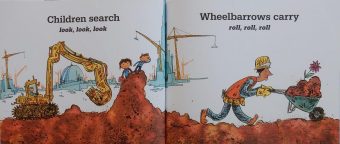
Two small children, whose father has left behind his lunch box, are sent by their mum to give it to him. They run to his place of work, an urban construction site.

There they see the employees hard at work banging and jackhammering, digging

and welding, operating cranes and pushing wheelbarrows. – the entire structure creating process no less.

So noisy is the site and so intent on his work is their dad, that it takes a while for the children to attract his attention amid the bangs, rat-a-tat-tat-tats

and sparks, but eventually they do.

And then (sans hard hats), they’re hauled up to join him for a well-earned break perched precariously on a horizontal construction beam.

With its onomatopoeia, alliteration and other wordplay, Light’s minimal text is perfect for little ones to join in with during a storytime, and for beginning readers to try for themselves. No matter which, they’ll absolutely love Steve Light’s scribbly-seeming, intricately detailed scenes of the construction workers and the impressive machines they operate.

Don’t miss the endpapers or the author’s final note wherein he talks of his fascination with and love of, classical, Gothic and art deco architectural styles.

A Bare Bear
Caz Hildebrand and Ashlea O’Neill
In A Minute
Clare Lowther and Ashlea O’Neill
Ladybird Books

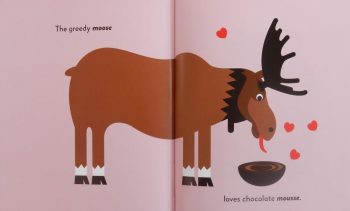
Subtitled ‘A book of words that sound the same’, A Bare Bear will certainly transmit the ‘language is fun’ message to little ones as well as demonstrating to adults the importance of word and language play in young children’s development.
It contains bright, attractive, humorous spreads depicting examples of homonyms

or homophones.

With the book’s contemporary feel and subtle language lessons, young children will have a good laugh at the same time as being gently educated into the delights and vagaries of the English language.

In a Minute invites readers/listeners to ‘Take the 60-second challenge!’ as it first makes a statement and then issues a related challenge on the opposite side of the spread.

Have lots of fun joining your early years children in such inviting activities as a minute’s competitive sticking your tongue out and in

or hopping on one foot.

Great attention has been paid to the design of each spread: I particularly like the one of two woodpeckers attacking opposite sides of a tree trunk, that of the star-jumping girl and … actually, they’re all immediately arresting and invite longer engagement.

Get counting, get active – what are you waiting for?

Rosa Loves Cars / Looking Good! / Matchstick Monkey: Colours

Rosa Loves Cars
Jessica Spanyol
Child’s Play

This is one of a new board book series that celebrates the uniqueness of every child; it stars car loving Rosa. She likes nothing better than to do stunts and act out scenarios with her vehicles small and large.

Using her imagination along with some small world toys. she plays with them and her pals in a variety of places such as in the sandpit and on the car mat.
Finally Rosa and friend Samira use a large cardboard box to build a car themselves; it’s a great place for having a snack.
Rosa is a delight and it’s great to see books for the very youngest that promote gender equality.

Looking Good!
Ailie Busby
Child’s Play

We meet five adorable babies who have a characteristic- floppy ears, big eyes, pointy nose, sharp teeth and little toes and fingers – similar to in turn, Elephant, Bush baby,

Fox, Crocodile and Lizard.

Infants beginning to talk will soon enjoy being able to join in the repeat ‘So do I!’ hidden beneath the flap on each spread.
With their various expressions, the babes show off their particular feature that is similar to the animal flap beneath which they hide.

Fun, interactive and great for promoting early language.

Matchstick Monkey: Colours
Ladybird Books

Some people tend to show off and brag about their talents, confident in their ability to be the best no matter what. Others just quietly get on with the job and surprise everyone.
So it is with the simian inhabitants of Matchstick Jungle. Red monkey with his dazzling spins is convinced he’s the quickest and certain to win the race; the swaying blue monkeys think otherwise.

So do the zigzagging yellow and pink monkeys, while loop the looping green monkey thinks he’s the speediest and bouncing orange monkey announces that he’s fastest of all.
But what about quiet, unassuming grey Matchstick Monkey, could it be that he has something to show the others …

As well as enjoying the simple story, toddlers will have great fun using a finger and following the trails of each of the competitors in this Matchstick Monkey teether-toy inspired board book and develop their fine motor skills and hand-eye co-ordination at the same time. They might also enlarge their understanding of some colour names along the way.

100 Dogs / Hey Duggee Sticky Stick Sticker Book

100 Dogs
Michael Whaite
Puffin Books

No this isn’t 101 Dalmations, it’s a mere one hundred pooches all packed between the pages of this romping, racing, rhymer of a book.

Herein you’ll meet dogs of every kind you can imagine and some you probably can’t: dogs big and small, bad and sad, dogs shaggy, baggy and wag-wag-waggy, fluffy ones and scruffy ones. Watch out for whiffy and sniffy ones, or those that might drool all over your best shoes.

There are dogs of the expected hues -with or without spots – but also a red one, a pink one and a yellow one.
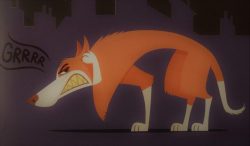
Some look friendly (even to dog-phobic me); others appear decidedly vicious

or just downright weird.

One has even had the audacity to leave its calling card right there on the page.

Each and every one of these canine beauties has been lovingly portrayed by Michael Whaite especially for the delight of readers, canine lovers of all ages in particular.

There’s just one dog in:

Hey Duggee Sticky Stick Sticker Book
Ladybird Books (Penguin Random House Children’s Books)

Young children who are familiar with the CBeebies series featuring Duggee and his pals, and in particular his Hey Duggee Stick Song will not be surprised that sticks feature large in this activity book. It is after all a sticker book but the first activity is to greet all the members of the Squirrel Club and shout ‘Woof’. Only then can you proceed.

What follows are ten stick-related activity pages and a centre spread of stickers to use in some of the activities. These include a stick-collecting route to follow in order to build a campfire; a find two the same game; a spot the difference spread, a word search, a maze and a game of ‘sticks and ladders’.

Just right to entertain little ones over the school holidays, especially on a journey or should the warm sunny days disappear.

Ten Minutes to Bed Little Unicorn

Ten Minutes to Bed Little Unicorn
Rhiannon Fielding and Chris Chatterton
Ladybird Books (Penguin Random House)

I must admit having seen it’s sparkly cover with that pink hued unicorn I didn’t want to like this book but having had children’s responses to it, and shared it one to one with several individuals, I’ve changed my mind.

Essentially it’s a tale about a spirited little unicorn named Twinkle who, like many young humans, does all she can to resist her dad’s “Ten minutes to bed!” warning.

Thus begins a countdown as the lively, far from tired unicorn, begins frisking through the forest, dancing and prancing, chasing the little creatures in the first three minutes and then she discovers a trail of footprints. Footprints that lead first to the sighting of a huge hairy troll,

then this being flashing across the sky, as well as the star.

Be honest, what would you do in that situation?

The problem is with four minutes left, Twinkle is, she realises, lost. There’s just one thing to do to get herself back in time, but will it work? Will she get home and if so, will she do so before the ten minutes expire? Remember, this is a magical story so …

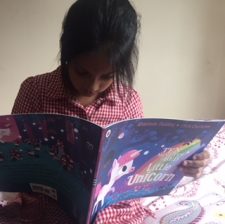
With its rhyming text that reads aloud well, Rhiannon Fielding’s story works nicely as a bedtime tale, but equally as a shared read with a nursery group, or as an individual supported read for someone just gaining confidence as a reader of texts other than the boring schemes schools offer. Its predictable, patterned counting down nature and Chris Chatterton’s child-appealing, other worldly illustrations that also help when it comes to predicting the words coming next, contribute to its relative ease of reading. How magical is it for a six year old to be able to say, “I read that myself” like the little girl in the photo.

Alesha was over the moon to be  able to read this story herself.

.
Don’t forget to explore the Land of Nod maps back and front, one is a daytime landscape,

the other shows the same panorama at night. There’s a great deal of potential in those alone for further exploration and perhaps 3D map making, especially if you happen to have a little toy unicorn.