Butterfly Skies / Fletcher and the Seasons

Readers can enjoy creating their own 3D butterflies – twenty in all – using the thick cardboard press-outs at the front of this book, which is published in collaboration with the National Trust.
The second section contains beautifully illustrated spreads of in turn, the Orange-tip, the Camberwell Beauty, the Clouded Yellow, the Comma with those wonderful patterns on the upper surface of its wings,. Then come the Swallowtail, the Peacock with its startling eyed wings, the Chalkhill Blue, (one of my favourite butterflies)

the Purple Emperor, the Pearl-bordered Fritillary and the Green Hairstreak. All these are European species, some being rarer than others, the Green Hairstreak, the UK’s only green butterfly, for instance.

The caterpillars of each species are also included in Kate Reid’s illustrations, as well as the flora – often the food plant – on which they are frequently found.

My only slight criticism of the art is the use of ‘googly eyes’ for the butterflies and caterpillars.
Give this to a child and you may well spark a life long interest in butterflies.

As little fox Fletcher journeys through the four seasons accompanied by his friends, he enjoys what each one has to offer and what makes it different from the other seasons. Spring brings woods with blossom on the trees; summer is warm and a great opportunity to play in the sun; autumn is the time when the leaves come fluttering down from the trees and winter often brings snow and ‘cosy lights aglow’.

With Tiphanie Beeke’s softly glowing illustrations evoking each different time of year and featuring the characters from the Fletcher picture books, and a brief accompanying text, this board book offers a good opportunity to introduce them to younger children, as well as to talk about what they enjoy about each season.

The Big Bad Bug

The Big Bad Bug
Kate Read
Two Hoots

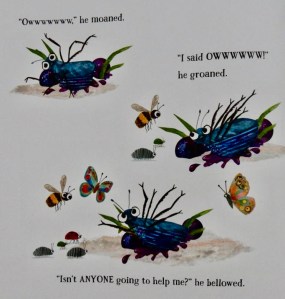
The Big Bad Bug is a self important beetle and on the beautiful morning when this story unfolds, he’s in a big bad mood that upsets all the other minibeasts in the garden. They’re especially aggrieved when the Big Bad Bug claims ownership of the splendid bug house intended for them all.

But then they come upon a ginormous, absolutely deliciously juicy-looking berry big enough for everyone. You can guess who wants it all for himself.

Now the other minibeasts stand their ground, demanding they all have a share. A tussle ensues and the outcome is one stuck bug, seemingly with more than merely his pride hurt.

Just when it looks as though the BBB is about to meet his doom with a dark shadow looming above, the caterpillar has a change of heart, so to speak, and the Big Baddie has a narrow escape. Instead of being squished out of existence, he is seized by a delighted child who lavishes kindness and care upon him for the rest of the morning.

Come lunchtime though, she releases the “sweet little bug’’ to find his friends and off he goes grumbling to himself till he comes face to face with the other bugs. A new one among their number might just be the one to stand up to selfish, bullying Big Bad Bug.
Will he never learn to share though? What do you think?

Kate Read’s richly coloured, detailed illustrations of all manner of minibeasts in their natural environment are infused with humour. Her text includes lots of dialogue, which allows adult readers aloud to create plenty of drama as they share the book with young children.

The Tiger Who Came For Dinner / The Littlest Elephant

The Tiger Who Came For Dinner
Steve Smallman and Joëlle Dreidemy
Little Tiger

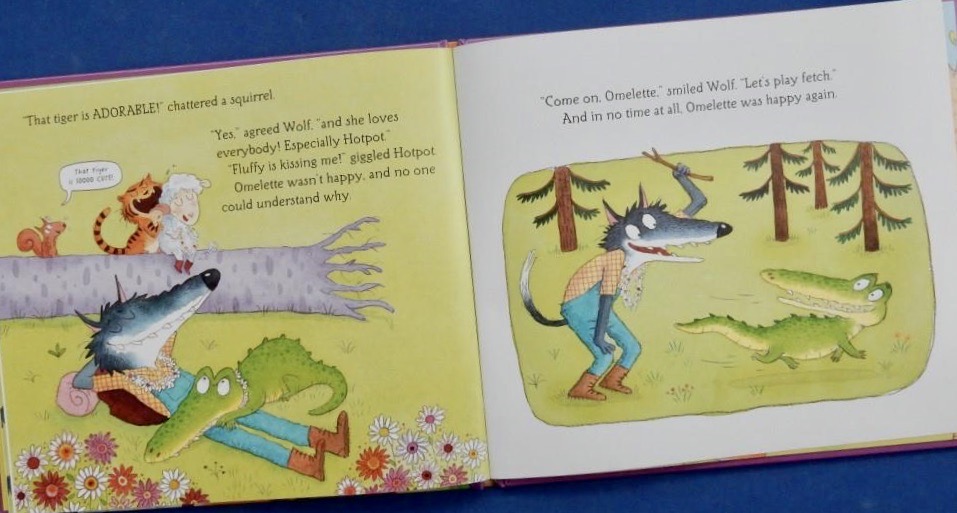
In this fourth story to feature Wolf, Hotpot the lamb and their crocodile, Omelette, the friends are playing their favourite game of fetch when instead of a stick, Omelette brings back a tiny, soggy lost tiger. Hotpot is keen to keep the little thing but Wolf shakes his head “ … little tiger’s family must live further up the river. We have to take her home,” he says.
Next day off they go and on the way they encounter other animals, all of which think the little cub is a delight.

Omelette however, is not sure and becomes even less so as their journey continues; moreover he is able to recognise crocodile tears.

The following morning the group reaches a cottage – it’s the tiger cub’s home at last – and the little cub had a tricky plan tucked in his fur all the time. Can anybody save the day?

As with previous titles in the series, the importance of friendship is key. Steve and Joelle imbue the characters with warmth and oodles of personality and those already familiar with the other books will gobble up this one; however it matters little if you start here: this witty tale still works as a smashing read aloud.

The Littlest Elephant
Kate Read
Two Hoots

Having just learned to swim, such is Ellie the littlest elephant’s enthusiasm that in her haste to demonstrate her new skill, she charges off to the pool to be first in the water. On the way though, she dislodges chameleon, frightens the frogs, disturbs the monkeys’ mangoes scattering them far and wide, upsets the minibeasts and the birds,

stamps on the tiger’s tail and almost squishes a little mouse. Only then does she stop and pay heed to their warning cries to slow down and watch where she’s going. Time for some apologies realises Ellie, and with them duly accepted, all the animals head off to the swim together, with the littlest pachyderm being mindful of the wise words her new friends have spoken, until they eventually reach the pool.

Now to make the biggest splash EVER!

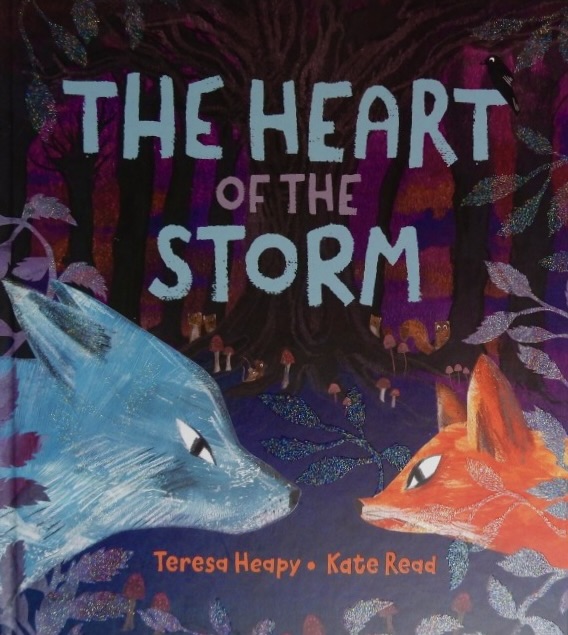
Kate Read captures Ellie elephant’s excitement beautifully in her bold, bright mixed media illustrations while at the same time portraying the feelings of creatures she encounters on her charge through the jungle equally well. Her story reminds youngsters – indeed all of us – of the the need to slow down sometimes, to be mindful of others , and to show empathy, consideration and kindness towards them; important lessons delivered unobtrusively in a fun picturebook.

One Fox / The Button Book

Just right for an early years collection are:

One Fox
Kate Read
Two Hoots

One moonlit night down on the farm, with his two sly eyes, one famished fox is on the prowl. Lots of lovely alliteration describes the happenings:

The three plump hens need to keep their ears and beady eyes open.
However that fox is in for a big surprise when he takes six silent steps towards the hencoop and taps seven times upon the outside …

In a dramatic and satisfying climax (although not for the fox), debut author/illustrator Kate Read takes us right up close to the action in her counting story.

With an economy of words she creates a visual comedy that is both exciting and gently educational; but It’s her superb visuals that carry the power – bright, textured art combining paint and collage – that build up expectations of the outcome

and then turn the tale right over on itself.

The Button Book
Sally Nicholls and Bethan Woollvin
Andersen Press

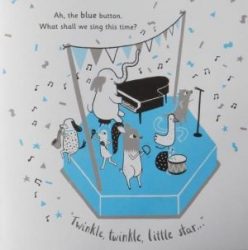
Take a group of inquisitive animals and an assortment of ‘pressable’ buttons of different shapes and colours; add several generous spoonfuls of imagination and stir. The result is this playful interactive picture book for little ones.

Squirrel starts the whole thing off by prodding at the red button with his stick and wondering what will happen. It beeps, and that sets off the button investigation.

To discover which is the clapping button, which one sings songs;

which blows a raspberry;

what joys the yellow button delivers, and the pink and purple ones, you need the fingers of a child or so, and the willingness to indulge in some pretend play.

This is children’s / YA author Sally Nicholls debut picture book and it appears she’s had as much fun creating it as will its intended preschool audience. The latter will take great delight in all the noisy, occasional mischievous activities offered at the mere touch of a button. Adult sharers on the other hand might well be relieved to learn what the white button does.

Seemingly too Bethan Woollvin had fun creating the illustrations; she’s certainly done a cracking job showing the seven characters having a thoroughly good time as investigators and participants in their own comedic performance.