Over and Under the Rainforest

Over and Under the Rainforest
Kate Messner and Christopher Silas Neal
Chronicle Books

This beautiful book immerses readers deep in the South American rainforest in the company of an adult (Tito) and a child narrator as they trek the entire day, from early morning to evening.

They observe with all their senses enjoying the ‘symphony of sounds! Chatters and chirps and a howling roar’ of monkeys, insects and birds in the treetops.

As they continue hiking along the trail we share the sights and sounds of particular animals, ‘Up in the trees’ and ‘Down in the forest’. There are toucans that ‘croak and bicker over breakfast’; a row of bats ‘sleeps away the daylight’;

… ‘A poison dart frog makes his way up a trunk with a tadpole on his back and they find themselves ‘eye to eye with capuchin monkeys as they cross a hanging bridge.

With the afternoon comes the rain, time to snack on dried fruits alongside snacking monkeys. The rain falls more heavily causing a blue morpho butterfly to fold her wings and tuck herself away close to a sleeping mother sloth and her baby.

When evening comes, the rain lets up and the darkness falls all around, there are lots of silent hunting animals such as a parrot snake and an eyelash palm pit viper, and some new sounds too, as up in the trees howler monkeys “Rrrowf! … Rroooooaaaahhhhhh!” in response to Tito’s roar.

Night is the time for jaguars to be on the prowl so perhaps the sudden scary snap is a sign one’s on the move.

It’s also the time for the two trekkers to cross that last bridge and, with thoughts of Abuelita’s supper awaiting, to head for home to the sounds of a choir of insects and raindrops.

Kate Messner’s poetic text really does capture the atmosphere of the rainforest and the changes that happen over a day, while Christopher Silas Neal’s mixed media, matt illustrations, with their alternating views of ground level, the sky and the treetops showing the rich variety of the flora and fauna, imbue this particular ecosystem with a magic of its own.

If you want to discover more about the fauna, Kate has included notes on twenty creatures at the back of the book, along with some paragraphs about her own Costa Rican rainforest forays.
Together / Insect Superpowers

Red Reading Hub looks at two interesting, unusual and very different ways of presenting non-fiction:

Together
Isabel Otter and Clover Robin
Caterpillar Books

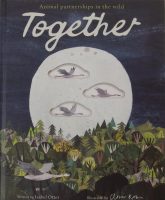
By means of gorgeous collage style, die cut illustrations and a series of haiku accompanied by factual paragraphs, illustrator Clover Robin and writer Isabel Otter present a nonfiction nature book that looks at animal partnerships in the wild.

Beginning thus: ‘ A vast migration. / Cranes take turns to lead their flock: / The feathered arrow.’ and explaining that when cranes migrate and the leader of the group becomes tired, another takes its turn to lead and so on.

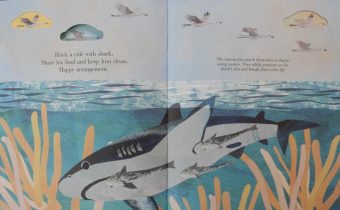
The migrating cranes fly above in turn, a pack of wolves; a herd of chamois deer; and a pod of pilot whales. They then pass above a shark that has its skin kept parasite free by remora fish that get a free lift;

anemones kept clean by goby fish; a badger that works with a honey guide bird; a crocodile that has its teeth cleaned by plovers; a herd of loyal elephants; giraffes with oxpecker birds that help keep down their fleas,

and finally, zebras and ostriches that use their complementary sense organs to alert each other to danger.

At last the cranes reach their winter feeding grounds and their journey is over – for the time being.

A fascinating way of presenting non-fiction that offers youngsters an introduction to an intriguing aspect of animal life.

Insect Superpowers
Kate Messner, illustrated by Jillian Nickell
Chronicle Books

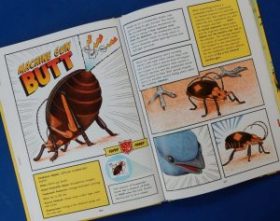
Taking advantage of the seemingly never-ending popularity of superheroes, author Kate Messner and illustrator Jillian Nickell present in action-packed, graphic novel format, an alluring array of eighteen insects with extraordinary abilities.

Before plunging readers into the specifics of the various insects’ superpowers, Messner provides an introduction to insect orders and using the Monarch butterfly as her example, shows how biological classification works.

Dramatic illustrations immediately snare the reader’s attention as they confront the bugs one by one starting with in the first FAST & FIERCE chapter, ‘Supersonic Assassin Giant robber fly – more like a supervillian – that uses its venomous spit to paralyse its prey.

Also in this chapter are The Decapitator aka the Asian giant hornet with its painful sting and fierce jaws that often rip bees apart before stealing their larvae and feeding them to their own hornet larvae.

Other chapters feature insects that use mimicry (the ‘Great Imposters’); the ‘Big & Tough’ bugs some of which are among the strongest creatures on earth; then come the ‘Masters of Chemical Weaponry’. I definitely wouldn’t fancy being sprayed by the hot noxious mist that the African bombardier beetle can emit from its abdomen when something bothers it. Yikes!

Further chapters are devoted to ‘Engineers & Architects’ and ‘Amazing Ants’ (although some of the insects in the previous chapter are also ants).

For each insect included there are facts about habitat, size, diet, allies and enemies, and of course, its superpower.

If you have or know children who are into superheroes but have yet to discover the delights of insects, this book that’s all a-buzz with superpowered bugs might just fire up their enthusiasm.

The Brilliant Deep

The Brilliant Deep
Kate Messner and Matthew Forsythe
Chronicle Books

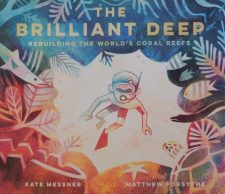
‘It starts with one.’ So begins the inspiring true story of Ken Nedimeyer, who as a boy was fascinated by the underwater world of Florida Keys, in particular the coral reefs. He became troubled when he discovered that those reefs were fading and dying, seemingly there was nothing he could do to save them.

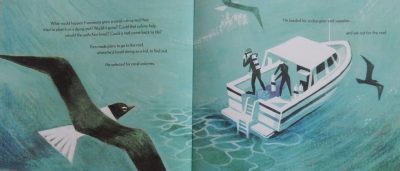
Then as an adult he had one of those ‘what if …?’ moments relating to the staghorn corals he’d grown on his rock farm. His brilliant idea was to transplant the staghorn coral colony he’d grown onto that reef he’d loved as a child: could that colony be brought back to life?

It was surely worth a try and so Ken went back to his beloved reef and glued six small coral colonies onto the limestone surface of the erstwhile reef.

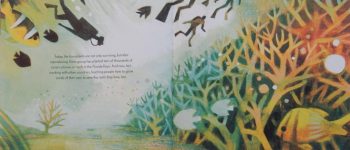
Month by month these transplants grew and became the catalyst for the Coral Restoration Foundation, which now has international links.

Kate Messner pitches her telling of this inspiring story perfectly for primary school age audiences, telling of Ken’s passion, of staghorn corals grown on the rock farm, of his successful experiments and of the volunteers his inspirational work has recruited, finishing as she began with the upbeat, ‘It starts with one.’

A love of wildlife shines through Matthew Forsythe’s exhilarating illustrations. Using a rich colour palette to portray the undersea world and the divers he takes us right up close to the action making this a great book to share with a class or group and who knows, it might just inspire budding marine biologists.
To that end, the final spread provides details of further reading, websites to visit, ways to help and explanations of some of the terms used in the narrative.

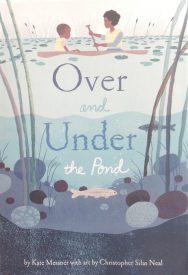
Over and Under the Pond

%0a

Over and Under the Pond
Kate Messner and Christopher Silas Neal
Chronicle Books
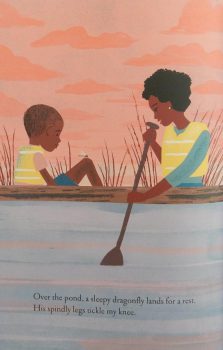
In this follow-up to Up in the Garden and Down in the Dirt we join a mother and child as they take an evening row across the pond :‘Over the pond we slide, splashing through lily pads, sweeping through reeds.’ The boy narrates using a beautifully attentive, almost meditative voice that immediately connects us to the watery setting: ‘The water’s a mirror, reflecting the sky, /Sunshine and clouds – then a shadow below.
Unhurriedly, the pond reveals its riches, both hidden and more clearly visible, as the two people in their craft skim, ‘lift and dart and pull past a row of painted turtles on a waterlogged tree‘ …

dscn0237

On they go, with occasional help from the wind, passing a great blue heron about to dive for minnows, a woodpecker clinging to a ‘teetering pine, digging for ants.’;

%0a

dragonflies skim the water’s surface below which dragonfly larvae seize passing minnows in their jaws. How skilfully, occasionally using onomatopoeic phrases such as ‘splash – gurgle – splosh!’ ‘to heighten the dramatic effect, author, Kate Messner, reflects that way young children can be ‘in the moment’ excluding all else as they immerse themselves in the here and now.

%0a

Gradually the shadows engulf the scene as dusky darkness falls over the pond and it’s time to return ‘swish – bump!’ to the shore and home, leaving nature still watching and waiting …
Neal’s richly hued, mixed media illustrations show us the pond from every possible perspective both above and below causing readers, like the rowers, to pause and linger over every scene, taking in its stark beauty.
In the final spreads, the author provides notes about some of the fauna inhabiting the pond, especially useful for readers in the UK who may not be familiar with all of them. A book to inspire, enthuse and send readers (accompanied by an adult) out into the wonderful natural world to find out for themselves what lies Over and Under the Pond.

Charter logo FINAL.indd

Tree of Wonder

DSCN5034 (800x600)

Tree of Wonder
Kate Messner and Simona Mulazzani
Chronicle Books
I loved the author’s Up in the Garden, Down in the Dirt. Now for her latest narrative information book she takes readers to a more exotic habitat, the tropical rainforest  and in particular one Almendro tree.
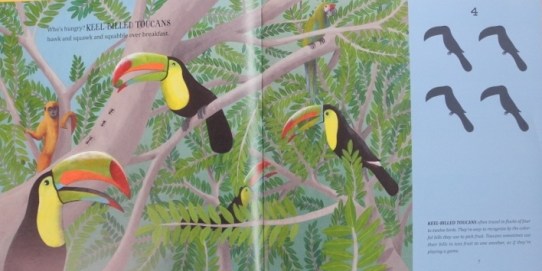
This tree, which we are told, is able to produce over a 1,000,000 flowers when it blooms, is in fact the centre of an ecosystem of its own with over 1,000 different living things depending on it.  Among those creatures that rely upon it for shelter and/or food are brightly coloured birds – Great Green Macaws and Keel-Billed Toucans,

DSCN5033 (800x600)

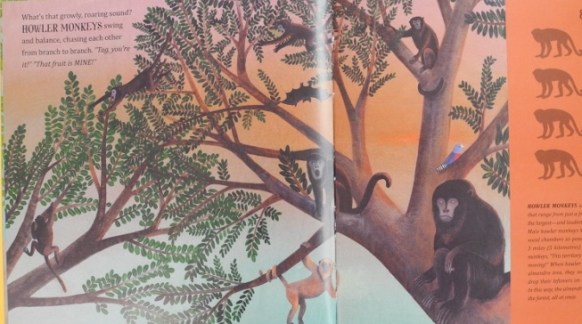
both of which feast on the ripe fruits, and Howler Monkeys (they help disperse the seeds of the fruits. Then there are the nocturnal fruit bats that also help in seed dispersal as do the Agoutis, which snuffle around the tree’s base gorging on the fallen fruits. The Blue Morpho butterflies sip the juice of the rotting fruits, roosting in groups to deter predators. For further protection, they flash their brightly coloured wings …

DSCN5031 (800x600)

then fold them up with the brown undersides against the trunk, the spots thereon giving their wing undersides a hawk- or owl-like resemblance.
Among the residents of the Almendro are tadpoles of Poison Dart frogs carried by their parents for safety into the tree where there are small pools of water; and spiders, and leafcutter ants.
Maths is also embedded within this fascinating book. The number doubles as the page is turned and a new species is featured: thus we are shown for instance 4 toucans, 8 Howler Monkeys,

DSCN5032 (800x600)

16 Fruit Bats and so on until we reach 1,024 – that’s the number of Leafcutter ants symbolically represented. And if readers want more maths, then there are, at the end, ten problems, some more challenging than others, just waiting to be solved.
Simona Mulazzani’s detailed scenes of the rainforest fauna and flora are beautiful. Every turn of the page offers a new and glorious painting to linger over.
Engagingly written and superbly illustrated, this book has much to offer primary schools using a topic-based approach to the curriculum. (I came upon several classes using the tropical rainforest as part of their investigative studies recently.)

Use your local bookshop    localbookshops_NameImage-2

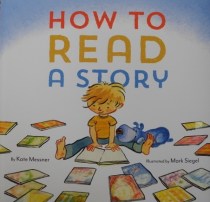
How to Read a Story

DSCN4259 (800x600)

How to Read a Story
Kate Messner and Mark Siegel
Chronicle Books
‘In my beginning is my end.’ – that profound, oft quoted line from T.S.Eliot’s East Coker is the essence of this amusing look at readers’ joys of discovering a love of reading, which is of course, the beginning of – one hopes – a lifelong journey of, explorations and enchantment, delight and endless discoveries.
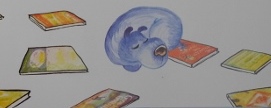
I am somebody who wants all children to begin their learning to read journey with picture books (along with lots of talking, rhymes and poems) and this book nurtures that notion being essentially, a 10-step lesson on how to read a picture book. So, to Step 1 ‘FIND A GOOD STORY.’ Seemingly the dog has already made the choice – tick.


DSCN4260 (800x600)

STEP 2 ‘FIND A READING BUDDY.’ – the book’s finder is sufficiently snuggly. Job done.
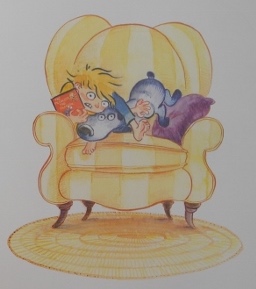
On to STEP 3 ‘FIND A COSY READING SPOT.’ – plenty of options there, but …

DSCN4261 (800x600)

Back to the book – or rather the front (cover). Lots can be gleaned from this. That’s STEP 4 taken care of … now for the really exciting part:
STEP 5 ‘OPEN THE BOOK’ and essentially, begin reading (or should that be, making meaning?) Hang on, it’s not my book … let’s begin then, “Once upon a time …” – yippee! We’re off into another world peopled with amazing characters.

DSCN4262 (800x600)

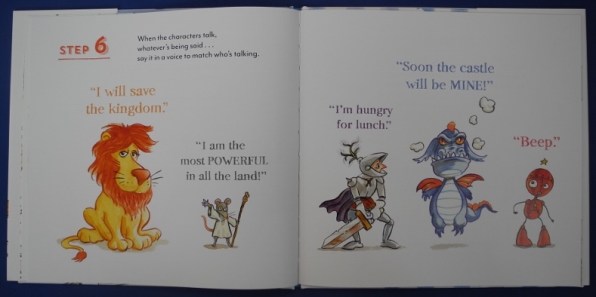
(How cleverly the makers of the book orchestrate the reading with character snaps and different fonts. – STEP 6).
STEP 7 – make sure your partner can see the pictures – definitely important if it’s a picture book of course.
STEP 8’s about tricky words. Use picture cues – agreed. Sounding them out – that’s the words – OK but as a last resort.
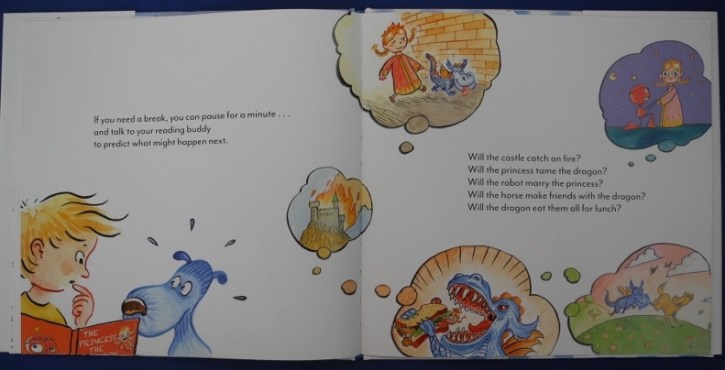
The next bit’s really important Not actually a step, rather a kind of time out and concerns anticipation and prediction of what might come.

DSCN4263 (800x600)

– Love it!
Vocalisation is the crux of STEP 9 – make exciting parts sound exciting.
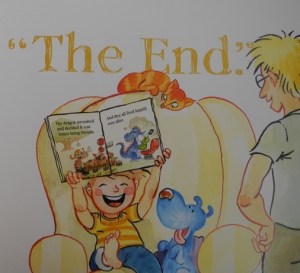
Oh no, we’re nearly there: quick keep turning the pages and find out how the story ends … and STEP 10 – we’re there … say,

DSCN4264 (800x600)

Well, not quite for as I said, that’s really only the beginning. You can … go back and start again (if it was a good story – like this one surely is) or find another. Well, that too, But, do the former, I’d suggest. It’s such fun and more … and …
From cover to cover, this is a delight. I love the playful nature of the whole thing – so important in any learner experience. (Oops! the teacher bit of me needs to shut up again.) I love the way the silent cast of characters (all engaged elsewhere at the outset) is gradually drawn in and become participants in the whole shared reading experience. I love the way those characters, and all the others, are portrayed in those watercolour and ink illustrations of Siegel; and how they and their roles serve to further engage and delight readers and listeners. A book to celebrate.

Use your local bookshop localbookshops_NameImage-2

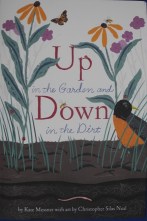
Up in the Garden and Down in the Dirt

DSCN4190 (600x800)

Up in the Garden and Down in the Dirt
Kate Messner and Christopher Silas Neal
Chronicle Books
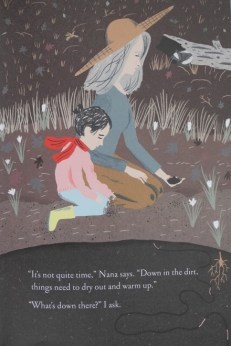
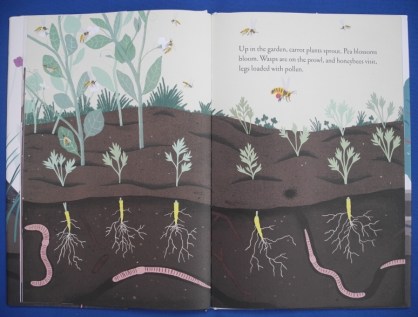
A little girl narrator shares with readers a season in the garden. Beginning in the springtime and with her hands clutching seeds, the girl is eager to start planting. Her Nana however cautions her to wait for the ground to warm and dry out.

DSCN4191 (600x800)

Meanwhile there’s much to learn about happenings under the ground. “Down in the dirt is a whole busy world of earthworms and insects, digging and building and stirring up soil.” she is told and more. Above ground too there is work to be done – human work, weeding and composting until it’s time to plant.
As spring turns to summer, tiny shoots appear and pea blossoms bloom – a boon for honeybees and wasps, while down below there’s more activity, plant and animal.

DSCN4192 (800x600)

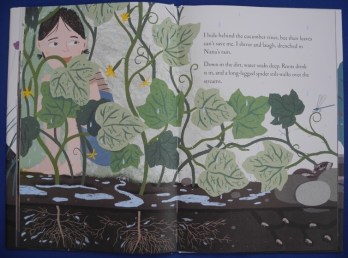
Gardening can be hot work so it’s a good job Nana has a sense of humour and the hose …

DSCN4193 (800x600)

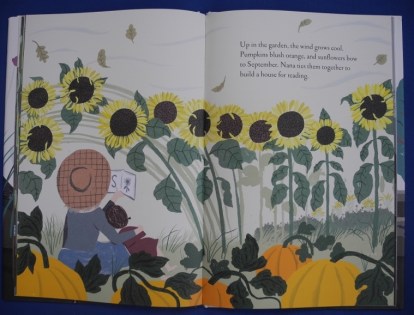
Through the summer there is food in abundance for both humans and small animals and soon it’s time to harvest the squash and cucumbers. Come September the sunflowers are in their full daytime glory

DSCN4194 (800x600)

and at night the orb web spider is busy spinning to catch her night-time prey.
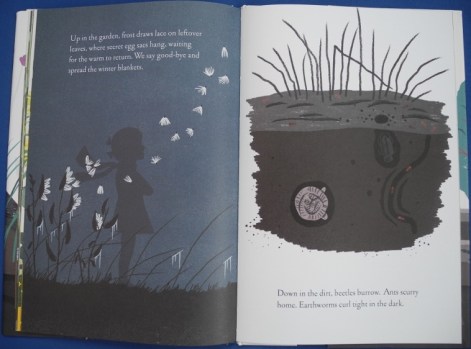
With that autumn chill in the air, the two need to finish collecting the harvest overground while the ants are busy beneath them storing food against the winter cold. Before long the garden has its first frost and down in the dirt beetles burrow, ants scurry and earthworms curl themselves up to sleep.

DSCN4195 (800x600)

In wonderfully poetic words, Messner proceeds to remind us that, even though ‘the wind smells like winter … the ripe days of summer still rest in the garden beds’ and the insects ‘dream of sunshine and blossoms and sprouts.’ : a new garden awaits the spring under the bare trees and down in the dirt.
There is just so much to celebrate about this beautiful book: the manner in which the two artists – one verbal, the other visual have worked in harmony with one another and nature to create this garden in a book: a garden that one wants to share, to visit and to reproduce. It’s a celebration too of the relationship between old and young, the peace to be found in a garden through the changing seasons and much more.
Both author and artist show such amazing attention to detail: the whole thing is just a joy to have and to share. The colours of the mixed media illustrations are gorgeous, the language lyrical, the production and design excellent and there is also an author’s note about the communal nature of any garden, suggestions for further reading and the final pages are devoted to short paragraphs giving details about the garden animals – residents and visitors.
Celebrate words, celebrate pictures; celebrate nature, celebrate life – that’s what this book so subtly teaches us. As Robert Frost says, ‘I shan’t be gone long. – You come too’.

Use your local bookshop localbookshops_NameImage-2