Lilly & Myles: The Torch

Lilly & Myles: The Torch
Jon Roberts and Hannah Rounding
Graffeg

Set during the summer holidays, this story features Lilly and Myles, her assistance dog. The two are staying with Lilly’s Grandma who lives at the seaside. Lilly has autism and experiences the world differently; she often finds it hard to communicate too.

One night she finds a torch and while enjoying exploring the clicking sounds it can make, discovers her Grandma standing there. Together the two of them embark on an adventure that takes her to the seashore. Lilly’s acute sense of hearing makes the sounds of frogs in the pond especially exciting; she also enjoys the feel of the long grass as she runs seaward, and counting the spots on the ladybird.
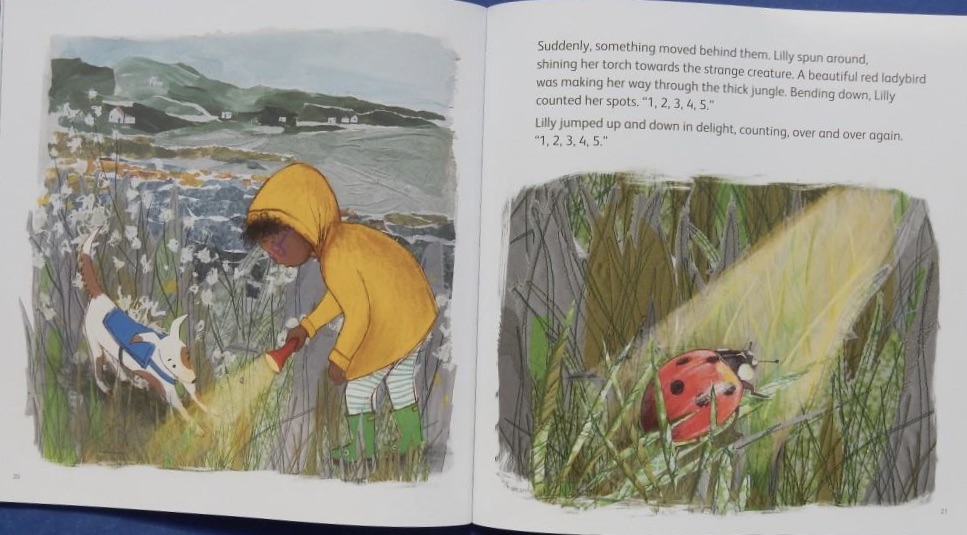
In her excitement, when Lilly reaches the mouth of a cave Grandma had mentioned in stories, she decides to explore, failing to notice some other children petting Myles. Venturing further inside the cave, she accidentally drops her torch and is beset by fear. The sound of dripping water is just too much and having regained her braver feeling, and retrieved the torch, Lilly moves on, all the while imagining monsters lurking and waiting to catch her.

Happily the only thing waiting for Lilly is Myles, ready to calm her and guide her back to her gran’s house.

Throughout this heartwarming story, both Jon Roberts the author who has a child with autism, and Hannah Rounding, whose mixed media art is rich in detail, gently and beautifully convey the emotions children with sensory challenges might face, while highlighting the importance of friendship and showing the vital role played by assistance dogs in giving support and comfort. (Their role with those with autism is new to me.)
Both the book’s creators show how vital it is that in our wonderfully diverse world, we all, adults and children, accept and understand that every neurodivergent person is different, and celebrate that neurodiversity. A copy of this insightful book should be in every primary classroom.

(10% of royalties go to Dogs for Good and 10% to Dogs for Autism).

See What I Can Do!

See What I Can Do!
Jon Roberts and Hannah Rounding
Graffeg

Everybody is different: we all have our individual strengths and weaknesses and that’s part of what makes our world such an exciting place.

Here’s a picture book that embraces difference in an entirely positive way showing how, as one of the characters, Molly, says on the first spread, ”being different doesn’t mean you can’t do anything you want!”

The author goes on to introduce three children with autism who communicate in a variety of ways including in one case, by using Makaton; and then two boys who have dyslexia who explain how this affects them.

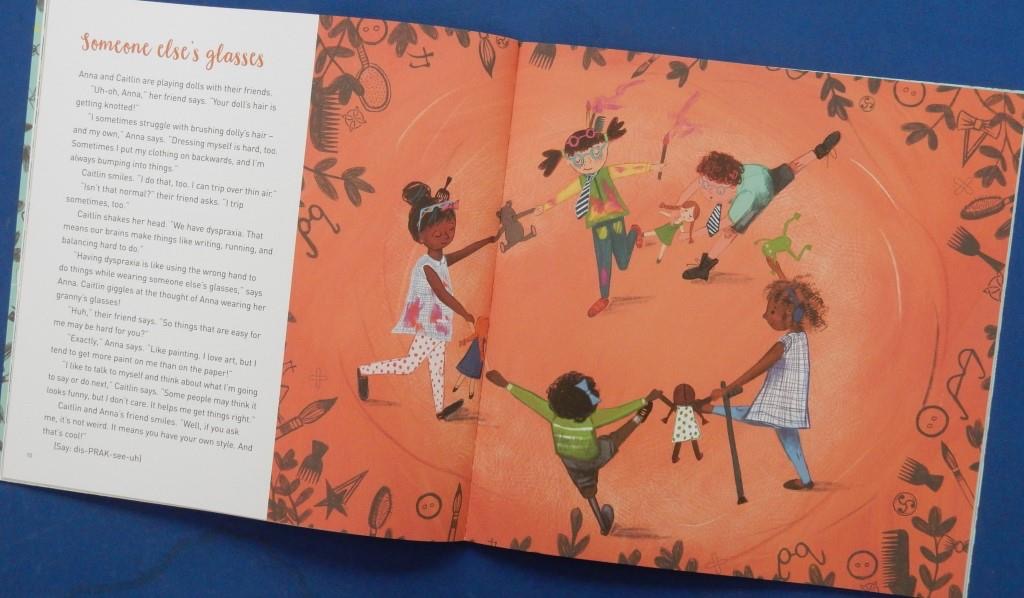
I loved what Caitlin and Anna’s friend says in response to the two girls telling her they have dyspraxia and what this means to each one them: “ Well if you ask me, it’s not weird. It means you have your own style. And that’s cool!”

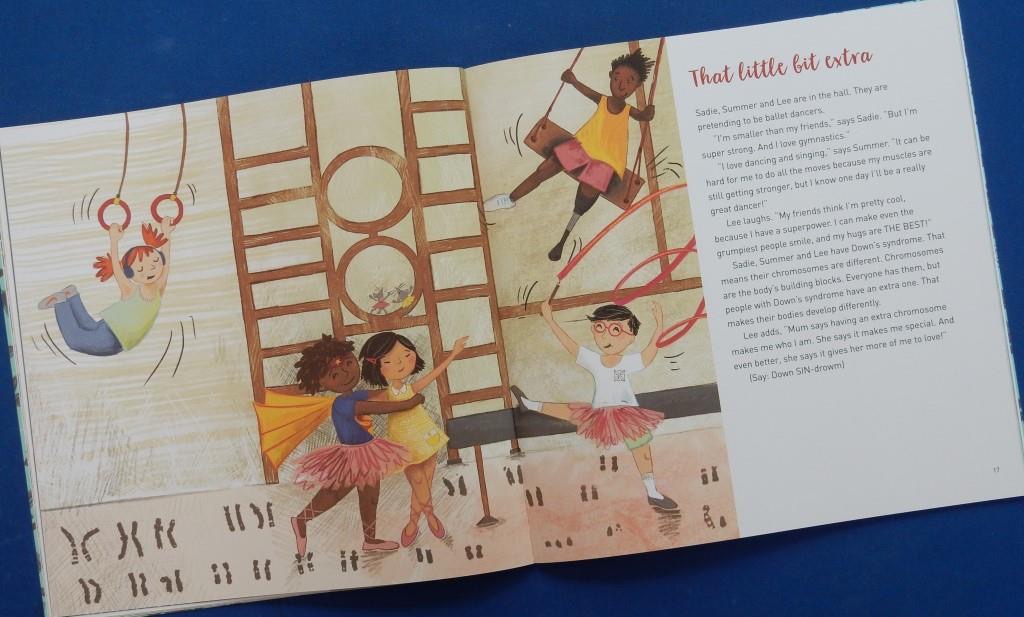
We also hear accounts from children with dyscalculia, ADHD, Down’s syndrome,

Cystic fibrosis, muscular dystrophy, cerebral palsy; others have hearing loss, low vision, spina bifida, epilepsy, brittle bone disease or asthma.

One thing they all have in common is a ‘can do’ approach to life that while acknowledging they face some challenges, emphasises what they have achieved and hope to do in the future.

Inclusive and inspiring, this beautifully illustrated picture book ought to be in every primary classroom and on family bookshelves.

Through the Eyes of Us / In Every House, on Every Street

Through the Eyes of Us
Jon Roberts and Hannah Rounding
Graffeg

This is the second book written by the father of a child on the autism spectrum.

Herein as well as Kya from Through the Eyes of Me, we meet her best friend Martha.

Kya, now at school, talks about her experiences there, sometimes contrasting her thoughts, behaviour and preferences with Martha’s.

I know from experience of children I’ve taught that school can be a very confusing place for neurodiverse children, but both girls have their own ways of navigating through lessons, playtimes and lunchtimes, all of which are illustrated in colourful, detailed, sometimes funny scenes.

Kya also describes how she and Martha enjoy different tactile experiences,

and activities in their free time; and their routines are also different.

Martha knows when she feels tired, unlike our narrator whose energy seems boundless; although once asleep after a soothing bath and massage, she sleeps soundly.

Enlivened by Hannah Rounding’s expressive illustrations, this is a smashing celebration of every child’s uniqueness as well as providing an insightful picture of the world of an autistic child.

The book concludes with a list of relevant websites.

Put Through the Eyes of Us in your class collection and whether or not you have children on the autism spectrum therein, read it together, talk about it and lend it to individuals for home sharing too.

In Every House, on Every Street
Jess Hitchman and Lili La Baleine
Little Tiger

The girl narrator of this book invites readers into her house to see what goes on in its various rooms.

What we discover is a happy family engaging in seemingly ordinary everyday activities, but nothing they do is dull or mundane.

The cake baking in the kitchen becomes an opportunity for the family to dance and sing together.

The dining room might be the place for eating a meal, but that meal can turn into a fun piratical party,

while the living room is a great spot for rest and relaxation but also for dancing and singing, mulling things over and talking about feelings.

Yes the bathroom is for getting clean but there are opportunities for some artistic endeavours too.

And the bedroom? Yes sleep happens therein, but so too does play.

Full of warmth, this is a lovely demonstration of what makes a house a home delivered through Jess Hitchman’s upbeat rhyming narrative and Lili La Baleine’s views of the everyday incidents of family life that make it special but different for everyone in the street, as the final fold out spread reveals.