Poet / writer James Carter and illustrator James Munro have again joined forces on a natural history book, this time on the topic of animal migrations.
Through the former’s rhyming narrative and the latter’s bold, bright illustrations readers are introduced to nine migrating species. First though, there is an introduction to the concept that all creatures may undertake migration.
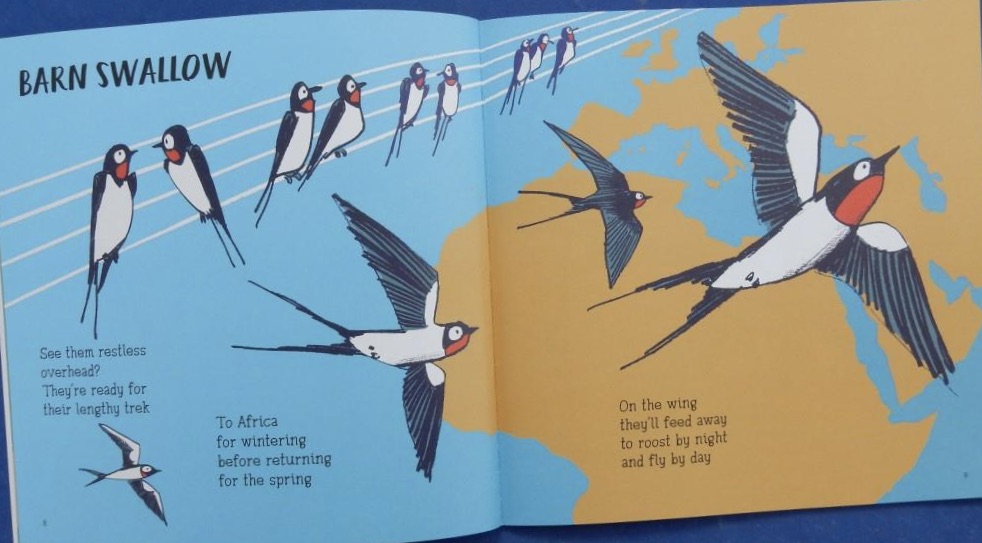
Whether they travel over land, through water or the sky, the selected animals undertake long, often difficult journeys. From Barn Swallows
to Monarch Butterflies, salmon to humpback whales or Christmas Island Red Crabs to humans, we learn more about the different animals and the reasons for their migrating.
Did you know that the globe skimmer dragonfly can journey up to 6,000 kilometres, travelling from India to Africa, island hopping en route to lay eggs and their offspring making the return journey? Some feat.
Included in the final narrative section, is information about animal navigations and unusual migrations making this an ideal introduction to the whole topic.
Boing! James Carter, illustrated by Neal Layton Otter-Barry Books
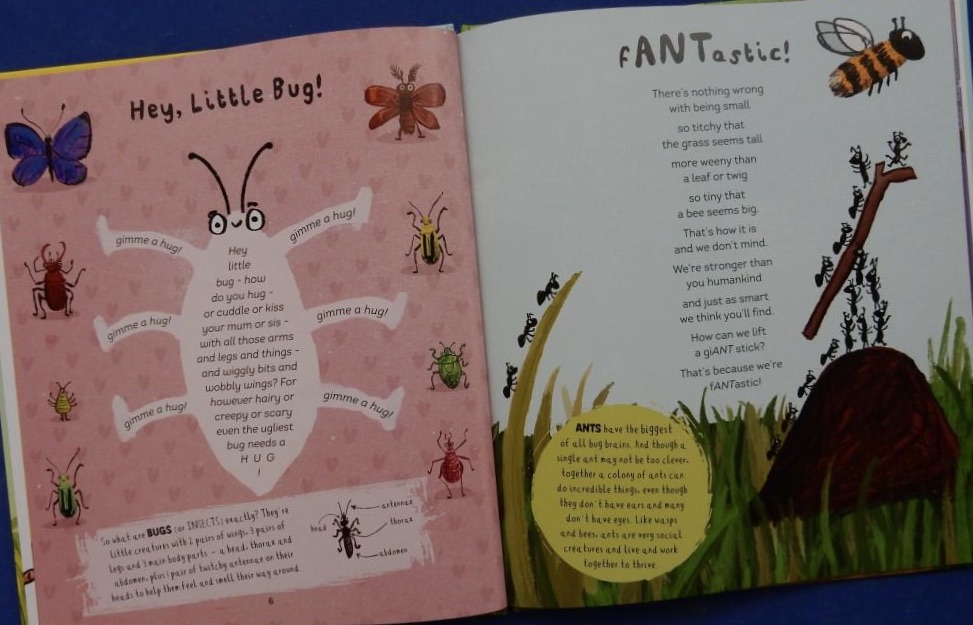
James Carter has penned twenty four poems on the topic of bugs and minibeasts, each one bugtastiically and playfully illustrated by Neal Layton. First come the bugs, or insects if you prefer to be more scientific. This larger section of the book comprises a few general, inclusive bug poems and then moves on to specific insects. On this occasion, two that particularly tickled my fancy are fANTastic wherein the titchy, tiny ants speak for themselves, asserting, ‘We’re stronger than / you humankind // and just as smart / we think you’ll find. // How can we lift / a giANT stick? // That’s because we’re // fANTastic!’
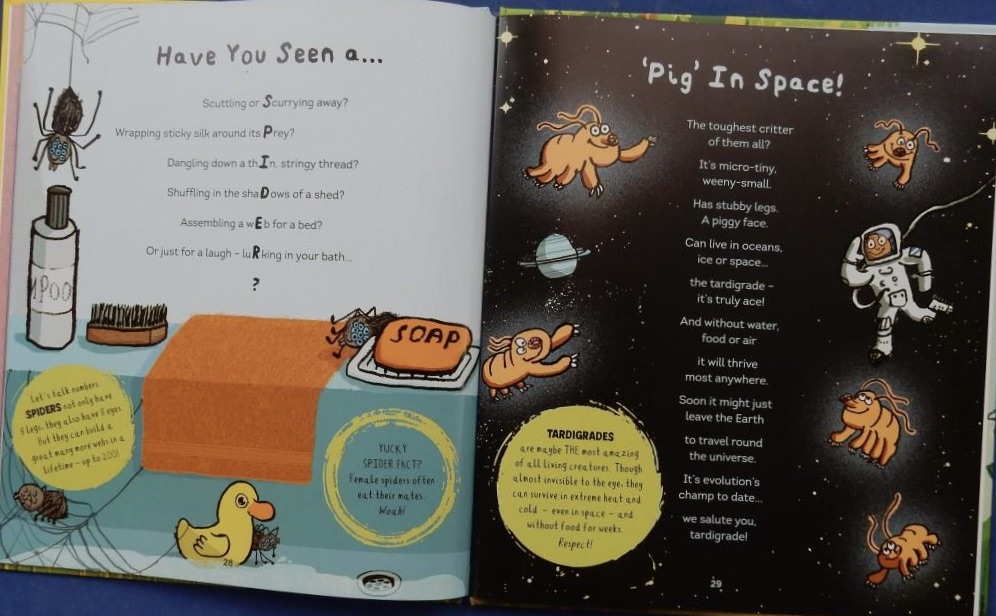
I have to admit that I’m a bee supporter and so was immediately was drawn to What Can It Be …? where we read of the insect bee-ing among other things, a ‘flower-lover’ , … ‘planet-aider, pollinator, super stinger, syrup-bringer’. (The super-stinger is only true of the female bees, so we read in the ‘fab fact time’ note beneath the poem. There are also poems featuring a grasshopper, a flea (or several), a butterfly, a caterpillar, a moth, a wasp, a ladybird, a firefly; we share the details of a day in the life of a dung beetle, hear from a dragonfly, eavesdrop on a conversation between a spider and a fly, start itching as we read of bed bugs, followed by a mosquito. (Keep your insect repellant handy.) The second section has six ‘minibeasts’poems: herein we encounter a silvery trail leaving, ‘sticky riddle’ writing snail, a millipede, a spider
and finally a ‘micro-tiny, / weeny small’ tardigrade. A collection that’s full of fun poems, sprinkled with facts, exuberantly illustrated and well worth adding to a classroom collection or home bookshelves. I’m sure if you start reading one or two aloud, there’ll be requests for ‘MORE PLEASE!’
Betsy Buglove and the Brave Butterfly Catherine Jacob and Lucy Fleming Scholastic
Nature lover Betsy Buglove, she who saved the bees, returns for a new adventure. It begins as she and her best friend Stan are in the garden and a bee buzzes along with an urgent message about a butterfly that needs their help. They follow the bee next door and there discover the juice cups they left on the grass earlier and inside one a butterfly is trapped in the sticky dregs.
Having successfully extricated the butterfly, its wings soon dry and off it flies.
Shortly after a cry comes from Betsy’s dad. The leaves of his vegetables and flowers have been badly nibbled. Off goes Dad to get his bug spray leaving Betsy examining a thistle plant in the grass. Thereon, with the aid of her magnifying glass, she sees lots of caterpillars munching away its leaves. Caterpillars she and Stan soon find out, belong to the butterfly they’d rescued earlier on.
Can they persuade Betsy’s dad to leave a patch of thistle and other weeds for the caterpillars? Fortunately they can; but what happens thereafter?
Will it be another case of mission accomplished for team Betsy and Stan?
With Catherine’s jaunty rhythmic text where the rhyme doesn’t falter and Lucy’s scenes containing an abundance of flora and minibeasts, this is a book that’s just right for sharing with young nature enthusiasts, as well as to encourage those less keen (happily I’ve only ever encountered a few,) to find out what they’re missing. Everyone can do their bit to help insects. At both ends of the book are fact pages about butterflies.
Watch Them Grow! James Carter and James Munro Graffeg
Author James Carter and artist James Munro have joined forces to present the life cycles of nine different animals starting with the Emperor Dragonfly and concluding with a human. Before these is an introductory poem inviting readers to ‘Watch them grow!’. Following the featured animals are a spread about baby animals names – young children will be amused to learn that it’s not only cows whose babies are called calves: so too are those of six other animals. And, the term hatchling can be applied to baby crocodiles, turtles, tadpoles and newts in addition to baby birds. Then comes some straightforward information about axolotls; (these, unlike other amphibians never become adult; instead they retain their gills and remain in the water); and a paragraph explaining that male seahorses give birth to babies (fries, hundreds of them)
as well as some facts about parenting in emperor penguins, Australian marsupials and others. All this James Munro has captured in his playful illustrations, each of which is a combination of reality and fun.
These are all new Little Tiger interactive board books: thank you to the publishers for sending them for review.
Number Garden Sophie Ledesma
A group of animal friends are shown around the number garden by Marigold the tortoise. With a fold-out to explore on every spread, small children will enjoy accompanying them and in so doing they can practise their counting skills to ten and respond to the other questions too. First stop is the orchard, followed in turn by a hot-house and a rockery, then it’s off to the pond, a vegetable patch and the tour finishes in the meadow with a picnic. Vibrant art work with just the right amount of detail for the very young (including minibeasts to spot), together with the interactive nature of the words make for a fun book to share with tinies. There’s a final spread whereon Marigold gives some extra facts about the six locations visited.
Noisy Construction text by Lauren Crisp
It’s time to visit the construction site and meet some of the large machines at work in this touchy-feely textured sound book. There’s an excavator, a backhoe, a chug, chugging digger, a dumper truck that makes a crashing noise, a very tall crane lifting and cranking a heavy load. Then little ears can listen out for the smash, smash of the bulldozer blade as it moves along on its clanking track, enjoy the rumbling sound of the road roller drum as it carries out its flattening work. The final spread presents all the vehicles at the site and invites little humans to press the button in the corner to hear all the sounds again.
All the Things a River Can Be James Carter and Nathalia Takeyama
A rather unlikely subject for a board book but when shared with young children, this one, with its moving pieces and flaps, will likely lead to lots of learning. In its half dozen spreads little ones can find out what makes a river special. People sometimes think of a river as a road, an inland waterway whereon they can travel in various kinds of boat. It also provides a watery habitat for lots of animals including many kinds of birds, fish, mammals and amphibians as well as plants, some aquatic, others that grow along the river banks. Some humans too make their home on rivers, choosing to live in houseboats. On its journey from source to mouth a river moves at different speeds, sometimes a slow trickle, at other times fast flowing and fierce. People who explore river beds can find all manner of interesting things such as coins, jewels and possibly even ancient remains. The final spread brings together many of the activities people might do on a river visit, things that give them pleasure including boating, swimming and watching wildlife.
Twenty poets and four illustrators have contributed to the latest Little Tiger collection, this one being a celebration of mindfulness. Mindfulness I see as the state of being wholly in the present, completely awake and aware of each moment, fully engaged in one’s surroundings and accepting that experience without judgement.
The range of poets here is contemporary and interesting, and included are new poems and some previously published ones. such as Michael Rosen’s The Rhythm of Life and, Zero Weil’s Hide and Seek. Therein she describes looking for quiet and after going to the woods and the sea, concludes ‘I found quiet / it must have been hiding / the whole time / inside my words / inside of me’.
I’ve loved that one since discovering it in Cherry Moon.
Each poet in their own way takes an everyday object or occurrence and transforms it into something memorable and in so doing is asking the reader to look anew at the world. Two poets call on readers to put pen to paper, to preserve (Carter) or let go of (Wakeling) their thoughts. In James Carter’s How Easily, he reminds us how special ’moments disappear like sand.’ Moments such as the sight of raindrops sparkling on a lake and ‘The night / you tried to count the stars.’
Kate Wakeling suggests if you’re feeling down or troubled by your thoughts, settling wherever you are, taking a pen and without stopping or thinking, allowing it to explore, in words or pictures, squiggles even. In so doing you may well find ‘some bright new / thoughts begin to / grow.’ It’s certainly worth trying The Ink Cure next time you feel your brain knotting up.
So too is Nikita Gill’s A Lesson from the Trees. Offering not words or thoughts but a reassurance ‘they will listen to you too, / and show you that the answer / to all life’s storms / is to be patient / and stand strong.’
Each double spread is beautifully presented and the four illustrators have been mindful of not overwhelming the words with their images.
Add to your poetry collection be that at home or in the classroom.
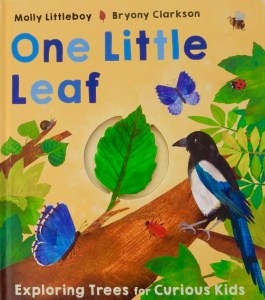
One Little Leaf Molly Littleboy and Bryony Clarkson Little Tiger
Trees are my favourite thing in nature and I think it’s never too early to introduce young children to their delights. This chunky, large format board book does just that, starting with a spread showing fifteen named leaves from different trees.Four are depicted on flaps, which when lifted reveal a brief paragraph of information about the respective trees on which they grow
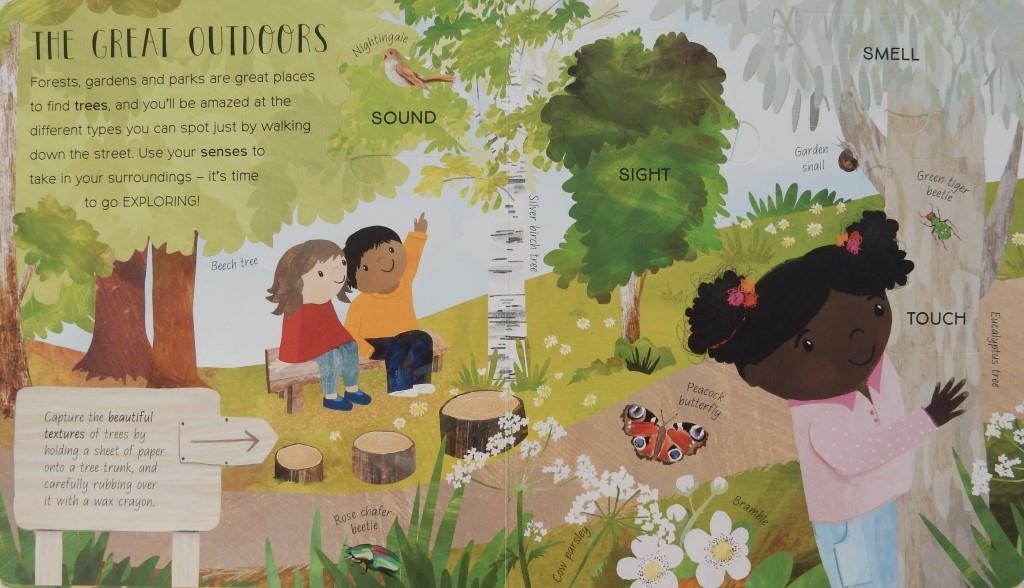
Other spreads are devoted to in turn, sensory exploration of the surroundings,
the growth of a tree, the tree as habitat for other wildlife, some of the uses of tree parts, seasonal changes of a tree and finally, on ‘Happily Ever After’ readers are encouraged to plant a new tree and to explore the themes included further.
A chatty, engaging narrative runs through the whole book, comprising on each page an introductory paragraph and a suggestion encouraging children to become actively involved with the natural world. With clear, naturalistic illustrations this is a good starting point on things arboreal, to share with children in their early years.
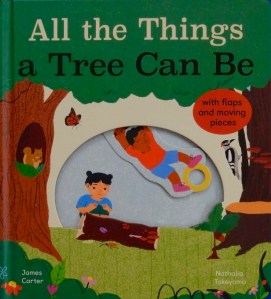
All the Things a Tree Can Be James Carter and Nathalia Takeyama Little Tiger
Presenting the wonderful things about trees is difficult in just six double spreads, but author James Carter includes the essentials in this little book. I love the description on the opening page, ‘Trees are ground-hugging / sky-nudging wonders!’ Indeed they are ,be they of the deciduous or evergreen kind, both of which are depicted in Nathalia Takeyama’s first illustration that also includes some woodland birds and animals, and humans. Deciduous trees change with the seasons and this is the theme of the next spread, which has two flaps for little hands to lift and reveal simple sentences and a different visual. The third spread takes us to visit a tropical rainforest, rich in both flora and fauna.
‘They are like nature’s tallest hotels!’ so we read on the spread depicting some of the animals that make their homes in trees, some of which benefit the trees in return. Continuing this idea, the final pages present some ways trees are vital to all manner of Earth’s life forms in that they provide food, shelter, warmth, wood, shade and most importantly, they clean the air that we all breathe. With its integral moving parts, this is a simple introduction to a vast subject for adults and little ones to share.
The Odd One Out Britta Teckentrup Big Picture Press
This book offers a great opportunity for young children to develop their observation skills as they peruse the pages of this ‘spotting book’. The first fourteen spreads present all kinds of interesting animals, a different kind on each, including camels, bats, seals, tortoises, ostriches, pandas, monkeys, rhinos, flamingos, fish, lemurs, penguins and butterflies. In addition a pair of rhyming verses invite the reader to spot the difference on each spread, for example among the camel train, one of their number has a single hump, whereas all the others have two. Another spread asks, ‘Who gets the first fish? Can you spot the winner?’ and depicts a pod of hungry seals, ‘calling out for their dinner’, one of which depicted in the print-like pattern already has a fish in its mouth.
Some of the puzzles are much harder to spot than others; this reviewer found herself going cross-eyed trying to find the cross-eyed lemur looking at its own nose. Young children will certainly be challenged and entertained by most of the spreads.
On the final spread, a new animal is hidden among the melee comprising several representatives from each of the previous spreads.
Once Upon a Big Idea James Carter and Margaux Carpentier Little Tiger
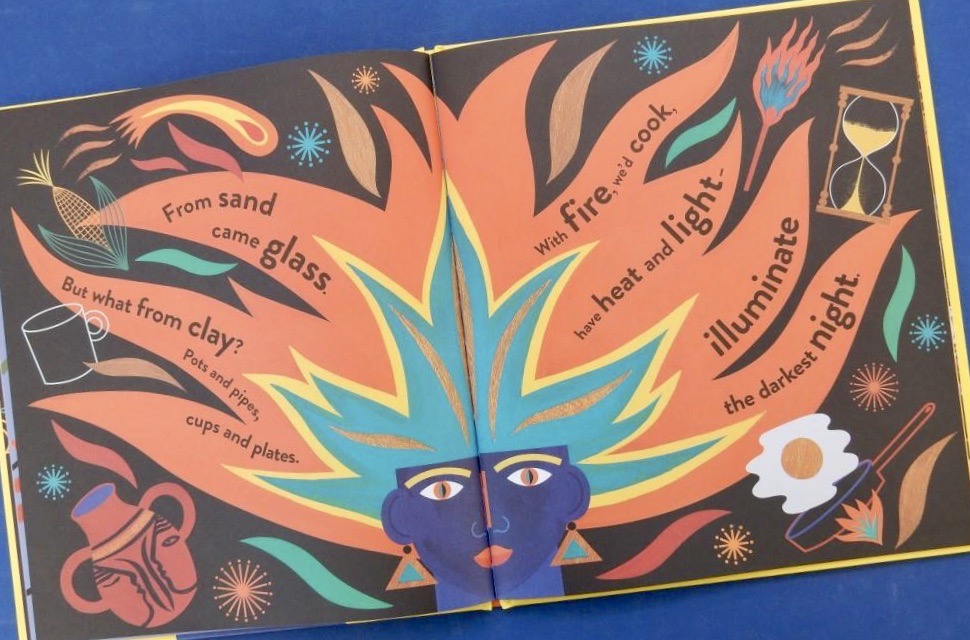
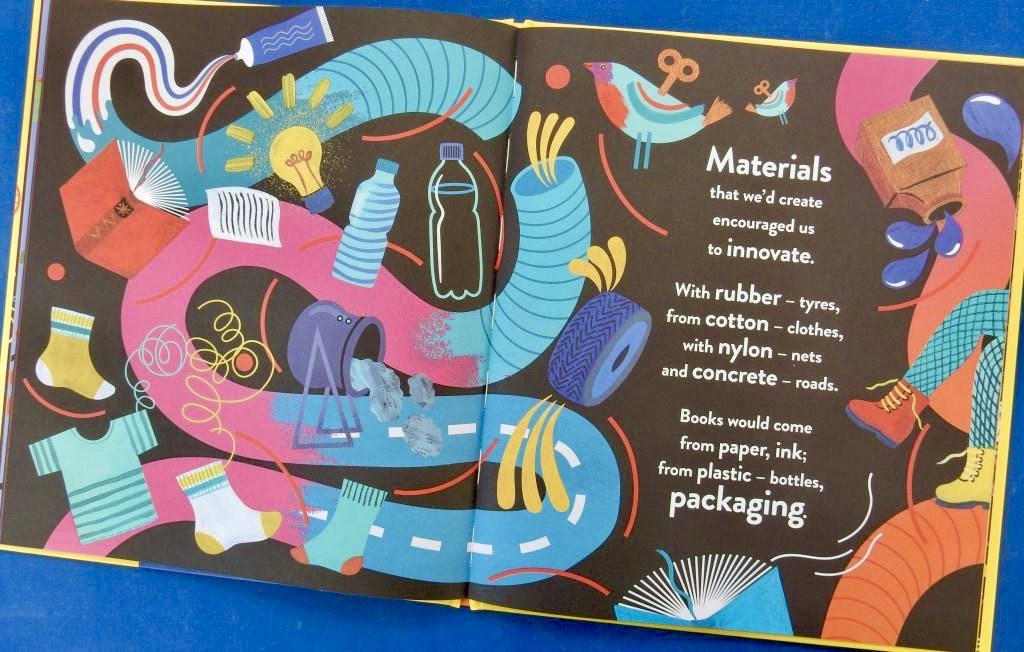
What a wealth of playful language poet James Carter uses in his story of inventions large and small., all the outcomes of bright ideas generated by human brains. he tells how for example the plentiful supply of rocks and stones beneath the ground have been used to create tools, bricks and walls with which the pyramids were built. Animals too are a rich source of materials; they provide meat for some, wool to make into clothing and much more, and their bones were also used in the fashioning of more tools. Homes, bridges and boats often have wood in their construction but what invention has had the biggest impact on lives ever? James suggests it’s the wheel and I’d probably go along with that. I wonder how many things you can think of that include wheels in their design: if you’re a primary teacher you might try asking your class that question when you share the book. What a wealth of creativity came as a result of sand, clay and fire …
‘Fire we learnt, was elemental – / heating working, smelting metal.’ we read; while modern materials – rubber, concrete, nylon and plastic have changed our lives, not always for the better.
Finally, readers are reminded of the importance of recycling and reusing in James’ text as well as through Margaux Carpentier’s arresting visuals. Don’t forget to read the concluding four-letter acrostic. Rich in STEAM classroom potential, this is a picture book to inspire young inventors of the future.
The Beasts Beneath Our Feet James Carter and Alisa Kosareva Little Tiger
‘Beneath our feet / way deep and down / are beasts asleep / in the cold, dark ground … / They’re skeletons now … they’re fossils, bones. / They’re silent, still; / in a prison of stone.’ Poet James Carter then invites us to dig down deep, visit the various layers of the Earth while also being a time traveller able to meet all kinds of exciting creatures on our prehistoric adventure.
First come the trilobites, erstwhile crawlers on the ocean floor. Next come the scary-looking pointy-toothed metoposaurus, a fish-eater somewhat resembling a crocodile. None the less, I wouldn’t fancy a face-to-face encounter. More to my liking is the Meganeuropsis, the biggest ever bug, buzzing around – an early giant dragonfly this.
Next are the dinosaurs be they the herbivores such as Diplodocus; the bones crunchers such as T.Rex and the winged Archaeopteryx that may have been able to take to the air on its feathery appendages. Moving north to chilly climes of everlasting winter lived herds of wooly mammoths with heir super-thick coats and ginormous tusks.
All these beasties have become extinct, wiped out on account of earthquakes, floods, disease, comets maybe, or even the poisonous lava of volcanoes.
All this information has been unearthed thanks to the work of palaeontologists investigating fossil evidence and now as James reminds us in the final part of his rhyming narrative, we can see some of these fossils in a museum; or perhaps find our own by taking a spade and digging deep.
The last spread is a kind of visual timeline of our prehistoric adventure showing all the creatures mentioned in the text.
The countless young dinosaur lovers will relish this time-travelling foray into Earth’s ancient past with James’ lyrical descriptions that really bring the creatures back to life, and illustrations by Alisa Kosareva, whose magical, dramatic scenes of all those mentioned in the text and more, are superbly imagined.
Weird Wild & Wonderful James Carter, illustrated by Neal Layton Otter-Barry Books
James Carter’s selection of his own works might be divided into the three sections of its title, but for me, every one of the fifty herein is, in its own way, wonderful.
The first part – ‘Weird’ – contains those poems that their author calls daft or cheeky, or perhaps both. My favourite is Spot the Fairytales (aka Ten Tiny Senryū) or 17 syllable present tense haiku. Here are some examples: Enter if you dare – / three breakfasts; one broken chair. / Off to bed? / Beware … // A cute bird calling / an urgent word of warning – / ‘THE SKY IS FALLING!!’ // … She’s poshed up in bling – / grooving with the future king. / Slipper fits. KERCHING!
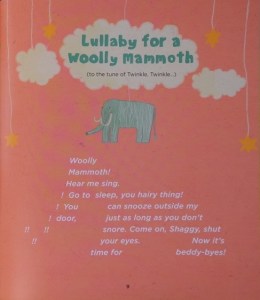
Among the daft is a clever shape poem (one of several ) called Lullaby for a Woolly Mammoth that you can sing to the tune of Twinkle, twinkle …
Among the entirely new poems and included in the ‘Wild’ section is The Elephant’s ODE to the DUNG BEETLE. That one really made me laugh and I love Neal Layton’s illustration of same.
Not all the poems are light-hearted though. Anything but is another shape poem Who Cares? … a stark warning against the thoughtless and selfish ways people are harming our precious wildlife.
In the final ‘Wonderful’ part are some of James’ science poems and quiet poems. One of the latter that spoke to me immediately is another new, and timely one – It’s … Kindness. On this particular day I’m also drawn to That’s Poetry,Where Do You Get Your Ideas From? and, School Library!. Here are its first and last verses: Where are doorways made of words? / That open into other worlds? / Welcoming all boys and girls. // SCHOOL LIBRARY // … Tempted? Go on, have a look. / You never know, you might get hooked. / Your whole life changed by just one book … // SCHOOL LIBRARY! Who knows? It just might be this smashing book of poems – there’s something for all tastes therein: it most definitely hooked this reviewer. The book fairy in another of Neal’s terrific illustrations awaits to lure you in.
Once Upon an Atom
James Carter, illustrated by William Santiago
Little Tiger
James Carter successfully wears several hats: he’s a much loved, award-winning poet, a musician and a non-fiction writer; how he manages to fit in all his performances at schools and festivals too, is pretty amazing.
In this latest book, James fuses his poetry and non-fiction writing, this time to explore some of the really BIG questions that fascinate both children and adults alike; and they’re all of a scientific nature.
Starting with a mention of the Big Bang and tiny atoms, the poet wonders, ‘WHY do leaves turn red and gold? / WHY do fireworks explode. // WHAT are whizzes, bangs expansions? / They’re all CHEMICAL REACTIONS!’
That assertion certainly makes chemistry begin to sound exciting.
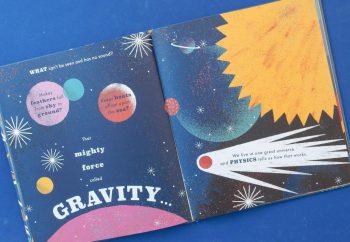
Next on the scientific agenda are electricity, followed by gravity,
both aspects of physics – for as we hear, ‘We live on one great universe / and PHYSICS tells us how that works.’
Evolution, medicine come next, followed by my favourite of the sciences – botany, all of which are aspects of BIOLOGY.
The final stanzas talk of the work of scientists, their experimenting and inventing, ending with the exciting thoughts: ‘Now WHO knows what / the FUTURE is? // Find out … / become a SCIENTIST!’ Now there’s a possibility.
On the last spread is one of James’ acrostics entitled It’s all a question of SCIENCE.
A fizzingly, zinging addition to James’ non-fiction poetry series, this one is a clever fusion of playful entertainment and STEM information. With each spread being embellished with William Santiago’s arresting, zippy art, the book becomes a STEAM title that is great to share in the classroom or at home.
Once Upon a Rhythm
James Carter and Valerio Vidali
Caterpillar Books
In this booming, stomping, chanting, magical look at music and its origins, poet James Carter engages not just our ears and eyes but our voices, our limbs, our hearts, and indeed our whole bodies, as we follow his lead that takes us back to the rhythmic sounds of tools on stone, to the chants of Africa,
to the songs of communities, to the voices of different instruments be they blown, plucked, shaken, banged, bowed or stroked.
First came the making of music and then came the notation – the lines and signs – indicating the pitch and the rhythm, enabling us to preserve it and pass it on through time and space.
We celebrate the emergence of new forms and styles,
new places to ramp up the sound and most of all, the notion that music is for everyone and each of us has the capacity to make music of one kind or another.
He concludes with an acrostic RHYTHM invitation to ‘Listen to life’s music’.
This latest of James Carter’s non-fiction poetic writing has Italian illustrator Valerio Vidali’s arresting artwork to complement it. His music makers appear to have picked up the rhythm of Carter’s poetry making it all the more vivid and powerful.
The Big Beyond
James Carter and Aaron Cushley
Caterpillar Books
Using rhyming couplets, Poet James Carter blasts readers off in a rocket and whizzes them into deep space and backwards into history, to early stargazers and their telescopes.
We read of early attempts at flight in kites, balloons, gliders and aeroplanes, pausing in 1957 to watch Sputnik 1 orbiting, and in 1969 to see ‘Saturn Five’ rocket blast off and the lunar module from which two men emerged onto the moon’s surface.
We’re reminded of the various roles of satellites, spacecraft (sending home information), probes (exploring Mars), and crafts to land (air testing, soil sampling and more).
James’ final future suggestion is likely to tempt young readers’ rockets … will head through the atmosphere. We’ll need an astronaut (or two_ / so what do you think? / Could it be YOU?
In like fashion to his previous Once upon a Star the author concludes his whistle-stop historic foray with an acrostic – ROCKETS this time – that provides additional pointers for possible investigation by small space enthusiasts.
Cool endpapers and some enticing art by Aaron Cushley complete this package tour of the cosmos.
Once Upon a Raindrop
James Carter and Nomoco
Caterpillar Books
With his opening lines, ‘Do you know why the Moon’s so dry / and yet our world is wet?’ poet, James Carter invites readers to dive into a watery world of oceans, rivers, streams, snow and ice, clouds and steam.
How did it all begin, this wet stuff: was it a single raindrop, or flake of snow; or perhaps an enormous wave braking on the shore? Nobody can be certain, we’re told.
It might perhaps have come as huge blocks of ice from distant outer space, born by meteorites that crashed down to Earth …
and became liquid, then gas, then clouds that sent forth rain to form the oceans that preceded the land that contained rivers and lakes.
As in Earth’s eternal dance around the Sun, so it is with the endless water cycles:
it’s those that produce that amazing life-supporting, life giving element we all rely upon for keeping ourselves and our clothes clean, for cooking, to swim in, sail on and refesh ourselves; so it is too for plants and other creatures.
Our very survival depends on it as it drips, drops, gushes and pours, endless shape-shifting, sometimes flooding, sometimes a trickle, but always on the move.
Our planet Earth, so James reminds us, is the wettest of all and we all are a part of that “WORLD WIDE WET!’
Wellies on everyone. I’m just off to India to catch the tail end of the monsoon.
This verbal celebration of water and its story is made all the more wonderful by Japanese artist, Nomoco’s watercolour washes, swirls, meanders, blobs, drips, drops and splashes.
A beautiful seamless amalgam of words and watery inks, it’s a must have if you’re going to explore any water-related topic with a class, as well as for individual readers who will find the book immersive and informative.
Once Upon a Star
James Carter and Mar Hernández
Caterpillar Books
Here’s an opportunity to go on an amazing journey without moving from the comfort of your own sofa, courtesy of poet James Carter and illustrator Mar Hernández who take us on an awesome ‘poetry and art meet science’ trip through time and space with a focus on our Sun.
First we head back through history before this happened …
And after a long slow cooling period: ‘A sea of stars at last were born / gradually they fired and formed / out of clouds of dust and gas / each a mighty sparky mass / and one of these became our Sun / our solar system had begun!’
Thereafter Carter’s compelling narrative verse touches upon the growth of our planets, in particular the Earth with its oceans and amazing life forms that rely upon the sun for their continuing existence. His final focus is each one of us, unique individuals – stars and stardust every one.
James Carter’s lucid poetic account of these awesome events, when integrated with Mar Hernández’s dramatic artwork, makes an exciting and impactful book.
Much more down to earth is:
Nature’s Lullaby Fills the Night
Dee Leone and Bali Engel
Sterling
The sun is gone; the moon is out: bedtime is nigh.
The author draws listeners into a nocturnal world of fluttering moths, spinning spiders, chirping crickets, flowers closing their petals, floating seeds and swaying willow branches;
past moonlit lakes,
and down to the sea where dolphins cease their leaping and oysters shimmer from the depths, towards farmlands where the animals are beginning to slumber; through a forest and finally into a child’s bedroom with the repeated refrain, ‘Nature’s lullaby fills the night’ punctuating every sequence.
With her gentle, soporific verses Dee Leone transports little ones towards sleep. In tandem with Bali Engel’s tranquil scenes of the bedtime rituals of parent animals, large and small in their natural settings executed in a colour palette of dark blues, purples and greens creates, we have an engaging, calm-inducing bedtime book for little ones.
Zim Zam Zoom
James Carter and Nicola Colton
Otter-Barry Books
This corker of a book arrived during the holidays and I had to restrain myself from dashing out into the road, grabbing any child I could find and saying, ‘Come with me and listen.’ ‘Zappy poems to read aloud’ announces the cover by line; and every one of the sixteen included truly is a treat to do so. From fireworks to a farmyard Hullabaloo (do I detect a touch of Charley Causely here?)
bedtime (with a teddy) to Billy Goats there’s something for all tastes; but I suspect re-reads of them all will be the order of the day. From a performance point of view, I think my favourite has to be Grump, Grump, Grump! (or … The Three Billy Goats Get Rough Rap), with verses such as this:
‘Says Goat, “Ohh, Trev – you don’t scare me- cos my bruv’s tough, as you’ll soon see!” So Goat number 1 trots off to the grass As Goat number two pops up so fast. “Yells, Oi, Goatie – off you squeal, or I’m gonna scoff you as my meal!” Grump, grump, grump! ‘
If you’re in the mood for something altogether quieter then try this lullaby…
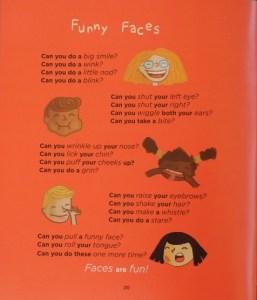
Or, for maximum audience participation of the silent kind share this …
I also love Hey, Let’s Go, a once upon a time invitation to participate in some fairytale frolics such as ’Let’s dress up in a riding hood./ Let’s take that shortcut though the wood.// let’s race that wolf to Granny’s door./ Let’s huff and puff that house of straw.’
Assuredly, this is a book if ever there was one, to turn children on to poetry. It leads on perfectly from nursery rhymes and deserves a place in every early years setting and on every family bookshelf. So, do what James Carter suggests in his final offering and Take a Poem …
Nicola Colton ‘s spirited illustrations allow the poems to take centre stage right where they should be – a tricky undertaking, deftly done.
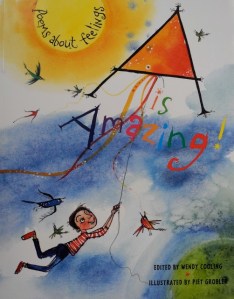
A is Amazing
ed. Wendy Cooling, illustrated by Piet Grobler
Frances Lincoln Children’s Books pbk
There is so much variety in this collection of poems loosely about feelings and moods arranged alphabetically. The good thing – or one of them -about this lovely book is that the arrangement does not serve as it straightjacket, rather it is an imaginative way of presenting and organizing an exciting compilation. Thus we have a traditional Polish rhyme FiZzy to represent Z, Lemn Sissay’s rap-style, The Emperor’s Cat is eXtraordinary for X and Puddle-Wonderful for P. (Oops! Why have they used capitals for its author, e e cummings?) There are poems from all over the world and from a wide range of poets (almost another A to Z – anon to Zephaniah) in a range of styles and voices, mostly contemporary –among them Carol Ann Duffy, Roger McGough, and Wendy Cope, but also Keats and Robert Louis Stevenson. I particularly love the opening poem ‘Unfolding Bud’ showing how a poem gradually unfolds the richness at its heart. And richness there is a-plenty between the covers of this book. Assuredly it’s one to return to over and over, to ponder, to laugh (try Michael Rosen’s GHEAUGHTEIGHPTOUGH Spells Potato), to wonder over and to thrill. There’s something for everyone here and for all times. I can see it being oft used in schools but I hope it’s riches are not confined to PSHE sessions; this small treasure trove deserves much wider celebration than that.
The mainly watercolour illustrations complement but never overwhelm the poetry allowing the words to speak for themselves.
Buy from Amazon
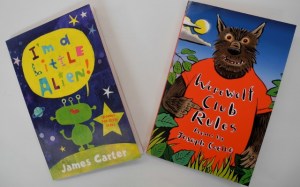
Interestingly one of the contributors to the above has a brand new collection of his own: I’m a Little Alien
James Carter
Frances Lincoln Children’s Books pbk
Cleverly arranged, the almost fifty poems herein take readers out into space for encounters with robots, aliens, rockets, the moon, stars and planets and back to earth to meet all manner of creatures large and small as well as other representatives of the natural world and much more, from hats and shoes to mums and friends.
A fun-filled little book to have on hand in infant classrooms and at home, for those odd moments when only a poem will do and it’s a great opportunity to begin to listen to the voice of an individual poet.
Buy from Amazon
So too, though for a slightly older audience, is the first solo collection from performance poet James Coelho Werewolf Club Rules
Frances Lincoln Children’s Books pbk
Coelho takes the familiar primary school world and turns it into a place to generate a love of language and a delight in words for their own sake as he presents poems centering on teachers and lessons, pupils, parents and the numerous other items and small events that comprise the school day from getting there to going home. A few are very short – just three or four lines, others such as If all the world were paper, considerably longer and one or two such as Weights on a pole need to be seen on the page but I think it fair to say that all are best served by reading them aloud and there’s not a single dud among them.
The sensations brought out by Halloween’s crumble, the stifling of a child’s creativity in An A* from Miss Coo, the sights, sounds and speed of Skateboarding
are just some of the delights to savour in this exciting debut collection. If the poet continues thus, I can envisage his books becoming firm favourites alongside those of Michael Rosen, Kit Wright, Roger McGough, John Agard and Allan Ahlberg.
Buy from Amazon
Another book that will foster a love of words and language is:
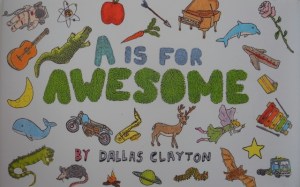
A is for Awesome
Dallas Clayton
Walker Books
Though not strictly a poetry book this is a rhyming alphabet packed with alliteration and, as the author/artist says, ‘a book about possibilties’. Thus we have for instance: C is for CONFIDENT, COOL and COLLECTED
D is for DREAMING things never EXPECTED
It’s also about positiveness G is For GREATNESS You’re Well on Your Way, L is for Living Life up to its fullest,
P is For PASSION PURSUING what’s Right
Others I really like are: I is IMAGINE IDEAS all your own
K is for KIDS being Kids (that’s the coolest)
Q is For QUIET to Escape From the Madness
R is For READING But Also For Radness
V is For VALUES And Keeping Them True
W is For WISDOM Both Spoken and Written
Many of the items representing each letter not the ordinary, run-of-the-mill objects found in alphabet books, indeed some had me puzzling over them; and there are lots for every letter each depicted in Clayton’s quirky style. This is definitely not a first ABC but one full of talk potential in school or at home.
Buy from Amazon











 Red Reading Hub - Jillrbennett's Reviews of Children's Books