Amazing Rivers

Amazing Rivers
Julie Vosburgh Agnone and Kerry Hyndman
What on Earth Books

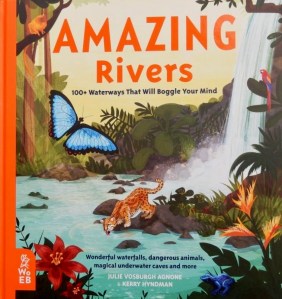
Author Julie Vosburgh Agnone starts by giving a general description of a river and then takes readers on an exploration of freshwater waterways all around the world. She and illustrator Kerry Hyndman then present more than a hundred rivers explaining as they go subjects including measurement, source and flow,

as well as what is to be found in and also around rivers, and the humans living and working in their vicinity.

Crop growing has long been an important activity with dates and other fruits, grains and vegetables having been watered by water from the Tigris and Euphrates Rivers since ancient times when Sumerian farmers designed irrigation methods to divert the river water.

Many rivers, we’re told, contain fish species in abundance including perch, catfish and trout while others yield freshwater crabs and shrimps that can make a tasty meal.
I was fascinated to read about pancakes – not the edible variety but ones made of ice that are occasionally formed in the River Dee in Scotland.

In contrast the Boiling River in Peru has water hot enough to cook an egg.

Some rivers – the Amazon, the Yangtze and another Chinese river, the Li – are allocated a spread each while other spreads are topical including treasures found in rivers, industry, feats of engineering and threats to divers with short titled paragraphs presenting the facts set into or around stylised illustrations.

Kerry Hyndman uses a variety of visual layouts that include vignettes,

close-ups, arial views and broad river scenes as well as making good use of texture and shadow to help maintain readers’ interest throughout. There’s also a central foldout map showing the location of each river mentioned as well as giving some fun river-related lists. A glossary, index and resource list comprise the four final pages.

Altogether a fascinating and informative resource book for individual browsing and KS2/3 school collections.

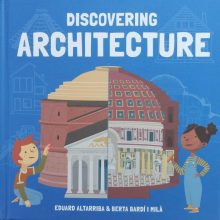
Discovering Architecture

Discovering Architecture
Eduard Altarriba and Berta Bardí I Milà
Button Books

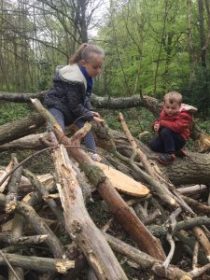
The urge to build structures is seemingly, a universal human trait. I spent some of the Easter break constructing a den in a quiet woodland glade in Bushy Park, from a fallen tree trunk and branches, with 6-year old Emmanuelle and her soon to be 4, brother Samuel.

When they are ready to discover more about the build environment, this tremendous introduction should prove invaluable.

The graphic designer and illustrator Eduard Altarriba has already introduced young readers to Quantum Physics and now in a similarly engaging manner presents a look at iconic buildings through history, their creators and some of the items that might be found inside such buildings.

Starting with the earliest known building projects, the pyramids of Egypt, Iraq and Mexico, Classical Greek, Roman and Byzantine places of worship, domestic and vernacular architecture from many parts of the world, information on architects such as Antoni Gaudí, Le Corbusier, Ludwig Mies van der Rohe and Zaha Hadid …

readers are given a superb presentation of things and people architectural.

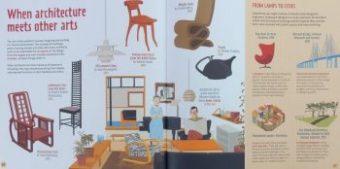
The final spreads focus on architecture’s basic elements – there’s a cut-away diagram of the principal parts of a building; what being an architect entails and lastly a look at what buildings might be like in the future (it’s good to see sustainability given a paragraph here).

University lecturer at the School of Architecture, UPC, Barcelona, Berta Bardí I Milá packs a wealth of absorbing information into the uncluttered spreads, so finely designed and illustrated by Altarriba.

Perfect for KS2 readers and perhaps adults wanting a starting point for the topic.

Beetles, Butterflies and other British Minibeasts / Look and Say: What You See at the Seaside / Queen Victoria

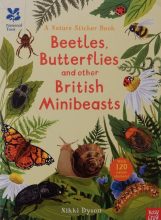
Beetles, Butterflies and other British Minibeasts
Nikki Dyson
Nosy Crow & the National Trust

In all my time teaching under 7s, I’ve probably never come across a child, however lively or challenging who, when outside (or sometimes in) failed to become engrossed in watching such minibeasts as woodlice, ants, ladybird larva or caterpillars.

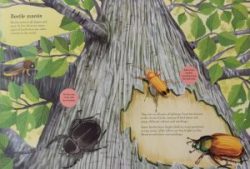
This beautifully illustrated Nature Sticker book takes users to several locations where minibeasts are likely to abound: the vegetable patch – several, but not all of the minibeasts therein are likely to be pests.

Anything but pests are bees, hugely important garden visitors that have a vital role in pollination, as do some butterflies like the beauties shown herein.

The shed is a likely place to find spiders and their webs in abundance as well as daddy-long-legs and perhaps other less desirable kinds of flies.
You’ll probably hear grasshoppers and crickets before you see them as they’re often camouflaged in the long grass they like to frequent.
Tree trunks like this one are good spots for discovering and observing beetles.

What better time that now to get outside, look for small creatures and then come back and enjoy hours of learning and fun with this beautifully illustrated book?

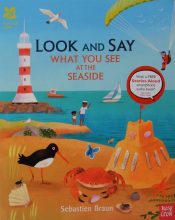
Look and Say: What You See at the Seaside
Sebastien Braun
Nosy Crow & the National Trust

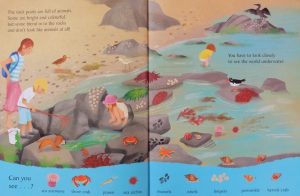
Whether you’re building sandcastles at the water’s edge, swimming in the sea, looking at the boats in the harbour, walking on the cliffs, rock-pooling, fishing, exploring the estuary, strolling on the sand-dunes, or perhaps diving down beneath the waves, there’s always plenty of interesting things to see. when you visit the seaside.

This is what Sebastien Braun shows in his engaging scenes of the various locations, each of which has an introductory sentence and another pointing out a particular feature of note. At the bottom of each spread is a row of named objects to find in the large illustration and say together, if sharing the book as intended with an adult (or older child).

A fun way to develop vocabulary and observational skills with little ones.

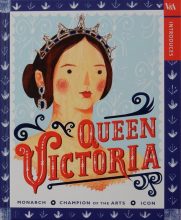
Queen Victoria
Illustrated by Nina Cosford
Puffin / V&A

Readers with an interest in the past will enjoy this mini-hardback book that looks at the life of Victoria and her legacy.
It tells how, when the young Victoria became queen she was determined to break free from the controlling influences of her mother and her courtiers and rule Britain on her own, even if she didn’t always get things right. It was against royal protocol for her cousin Albert, with whom she fell in love, to propose marriage to her; instead she did the honours and was accepted.

As well as information about the Queen, there are spreads about the industrial revolution; the Great Exhibition at the Crystal Palace, the royal couple’s work in support of the arts and science,

their interest in the latest technological developments as well as Albert’s popularising of the Christmas tree and Victoria’s golden and diamond jubilees.

Illustrated with a mix of photographs and finely detailed illustrations by Nina Cosford this is one to add to primary school classroom shelves, or for young readers wanting an introduction to a fascinating period of great change.

Three Cheers For Women!

Three Cheers for Women!
Marcia Williams
Walker Books

Richly detailed, funny illustrations and accompanying information on seventy remarkable women from all over the world is presented in comic strip format in Marcia Williams’ (Dot) signature style.

The amazing achievements of these women are diverse and presented, with their stories, chronologically. We start in ancient times with Cleopatra V11 Queen of Egypt and warrior queen Boudicca, ending with the 2014 Nobel Peace Prize winner, Malala Yousafzai, children’s and women’s rights activist.

Along the way we are introduced to among others, Mary Wollstonecraft (radical feminist and writer),

Marie Curie, human rights activist Eleanor Roosevelt, Amelia Earhart,

artist Frida Kahlo,

environmentalist and peace activist Wangari Maathai, Mae C. Jemison the first African-American woman in space, and Olympic athlete Cathy Freeman.

Look out for the wonderful tiny animal and bird characters that drift around the margins of the spreads along with narrator Dot and her friend Abe, adding to the fun and biographical information given in the main frames – love that narrative device.

There are also three final spreads – ‘Leaders and World-Changers’, ‘Sportswomen & Creatives’, and ‘Scientists, Pioneers & Adventurers’, containing paragraphs on around sixty other amazing women.

Memorable, inspirational, accessible and enormously enjoyable.
Children reading this, in addition to celebrating these awesome women, will surely come to know that where world changing achievements are concerned, there are, if you have a passion and self-belief, and think beyond the limits, no holds barred.

Treasure Hunt House

Treasure Hunt House
Kate Davies and Becca Stadtlander
Lincoln Children’s Books

When a brother and sister receive a letter from their Great Aunt Martha inviting them to go and stay at her incredible house their mother urges them to accept.
They pack a weekend bag and off they go only to discover on arrival that their aunt isn’t there. She’s been unexpectedly called away but in her stead is her kindly looking housekeeper who introduces herself as Jo. She informs the children that their aunt has planned a treasure hunt to occupy their time until her return.

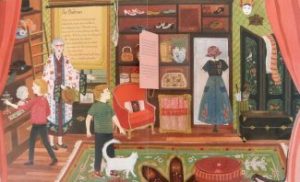
We join them in the hallway as they attempt to solve the first clue, ‘I have a heart of stone. And a head of stone, too’ and lifting the various flaps on the spread will reveal the solution along with further instructions, as well as cultural and historical information about some of the objects therein.

Thereafter we follow them around as, accompanied by Jo, they visit the rest of the rooms: the kitchen; the bedroom, where we read of the making of the first denim jeans;

the bathroom (this has a trickier riddle and a famous painting reproduction on the wall);

the living room – the cat introduces itself there); the library with its floor to ceiling bookshelves (Aunt Martha is evidently a Shakespeare enthusiast); the olde-worlde dining room; the sub-tropical  conservatory wherein butterflies flittered around the flowers;

the enormously fascinating Cabinet of curiosities packed with biological specimens including a velociraptor skeleton and a shelf of corals; a wonderful art gallery; a hall of inventions (Aunt Martha is an avid collector of incredible inventions, we learn); a music room packed with instruments of all kinds; and finally, a child’s paradise of a toy room. Therein too the final clue is solved and the secret of Jo’s real identity revealed.

Each room is exciting, packed with history and in all there are over 50 flaps to explore.

This is a fascinating and magical book that is likely to engender an interest in both history and art; it’s perfect for all who enjoy playing with or collecting doll’s houses, or have an interest in old houses, and would make a super present.

Spot the Mistake: Journeys of Discovery

Spot the Mistake: Journeys of Discovery
Amanda Wood, Mike Jolley and Frances Castle
Wide Eyed Editions

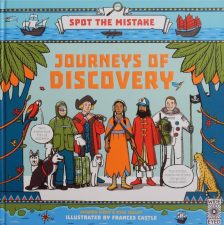
If my experience with the previous Spot the Mistake title, Lands of Long Ago, is anything to go by, children will eagerly seize upon this follow up that encompasses ten explorative expeditions with famous travellers from Marco Polo to the NASA Apollo moon mission.

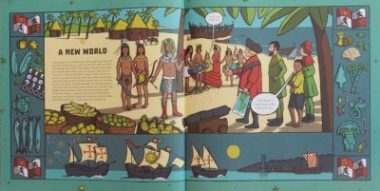
Each of the journeys is allocated two double spreads, the first being a large scene featuring the explorer and aspects of the journey undertaken, and contains 20 visual incongruities for spotters to discover.
The subsequent spread identifies the ‘anachronisms’ (some are much more easily spotted than others,) in a smaller annotated scene and provides some explanation; and there’s also a paragraph about the particular journey and the explorer(s) involved.

With explorers as diverse as Zheng He from China who, in the 15th C, led voyages that took him and his fleet to Africa, the Middle East and parts of Asia, and Edmund Hillary who, with his trusty guide, Sherpa Tenzing Norgay reached the top of Mount Everest, the world’s highest mountain in 1953.

Young eagle-eyed spotters will definitely enjoy finding the Elvis picture among those displayed on the Zheng He spread; the basket of apples and incomplete lunar calendar in Columbus’ ‘New World’ scene;

and the laptop lurking in the early 20C South Pole scene that features Captain Scott.

Frances Castle’s diorama style scenes are both engaging and contain just the right amount of detail to be inviting but not overwhelming.

Between the covers of this book there’s a wealth of learning potential in the form of a game.

Anthology of Amazing Women / Amazing Women: 101 lives to inspire you

Anthology of Amazing Women
Sandra Lawrence, illustrated by Nathan Collins
20 Watt

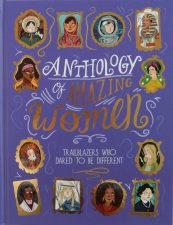
The author has selected fifty amazing women from various walks of life and from all over the world, who have made significant contributions to society through their ground breaking achievements in art and design, history, politics, science, sport, entertainment, literature and business.
The choice must have been an incredibly difficult task, so as well as the fifty who are each allocated a full double spread, Lawrence manages to squeeze in almost another fifty by including thumbnail sketches of an additional half dozen woman at the start of each section. I’m somewhat ashamed to say that a few of the names are new to me so I am particularly indebted to Sandra Lawrence for drawing my attention to these wonderful women.

One such is the sculptor Edmonia Lewis who created a series of sculptures based on Longfellow’s The Song of Hiawatha, but of whose work very little has survived, although her The Marriage of Hiawatha and Minnehaha sculpture was discovered in 1991 and is now on display at the Kalmazoo Institute of Arts in Michigan.
Equally inspiring and previously unknown to me is Elena Cornaro Piscopia, who studied at the University of Padua in the seventeenth century and became the first ever woman to receive a Ph.D. So too is Stephanie Kwolek, the chemical researcher who invented Kevlar, the super-strong plastic material.

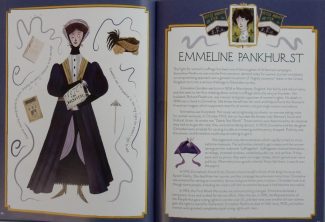
No book about the achievements of women would be complete without Emmeline Pankhurst, political activist and leader of the British suffragette movement whose 40 year campaign for women to have equal voting rights with men, finally achieved complete success shortly after her death in 1928.
Other women who have made their mark in politics featured herein include Eleanor of Aquitaine, the Rani of Jhansi, Lakshmi Bai, who dressed as a man, led her army in an attack against General Hugh Rose but was sadly killed in battle and even Rose himself was mightily impressed by her bravery and cleverness.
The politics section concludes with Malala Yousafzai, winner of the 2014 Nobel Peace Prize and now a UN Messenger of Peace, who in her struggle for the rights of girls to have an education was seriously wounded by the Taliban in 2012.

Another young woman who stood up against the oppressive rule of the Taliban, this time from Kabul, is the athlete Robina Muqimyar who twice represented Afghanistan in the Olympics.
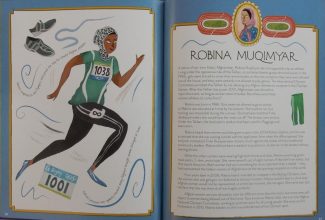
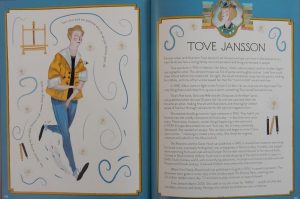
Several of my favourite authors are featured in the Literature section including Chimamanda Ngozi Adichie who wrote Purple Hibiscus and Half a Yellow Sun; and the Finnish writer and illustrator Tove Jansson, creator of the wonderful Moomins books.
I could go on at length but must quickly mention Anita Roddick creator of the The Body Shop chain, champion of ‘natural ethically sourced products in reusable bottles’ and much more.

Striking illustrations by Nathan Collins of each of the featured women accompany the pen portraits and every spread has a coloured frame giving the whole book an inviting, stylish appearance. All schools, both primary and secondary should buy this.

Also celebrating great women is
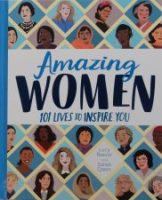
Amazing Women: 101 lives to inspire you
Lucy Beevor and Sarah Green
Stripes Publishing

Of the one hundred and one women featured herein, the majority are British and the earliest such as political activist Constance Markievicz, author and illustrator Beatrix Potter, scientist Marie Curie, nurse Edith Cavell and women’s right activist Emmeline Pankhurst were born in the 1850 and 60s.

The youngest woman included is Kiara Nirghin, born in 2000, who as a 16 year old schoolgirl in South Africa, invented a polymer, SAP which is made from cheap recycled and biodegradable materials that is able to store water and, it is hoped, can be used to feed crops particularly in times of drought – truly amazing, and what an inspiration for the cause of girls in science.
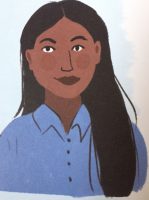
Sarah Green’s portrait of Kiara Nirghin

Interestingly in their press release, the publisher  says this,  ‘… following recent political developments and resulting conversation, Stripes has taken the decision to replace Aung San Suu Kyi with Mithali Raj, captain of the Indian Women’s cricket team in the Leaders section in future reprints’.

Published in the year of the centenary of the Representation of the People Act, this beautifully illustrated collection of women’s achievements is another worthwhile addition to both primary and secondary school libraries and one I suspect will be much borrowed and discussed.
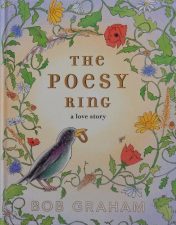
The Poesy Ring

The Poesy Ring
Bob Graham
Walker Books

Subtitled ‘a love story’ this truly is, visual poetry.
It tells of a poesy ring engraved with the message ‘Love never dies’. (Such objects have been given since the Middle Ages as symbols of love and friendship.)

We follow the ring from 1830 when it’s tossed away into a meadow by a tearful young horsewoman in County Kerry, on the west coast of Ireland.

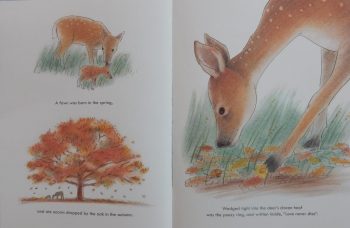
Seasons come and go, and the years pass as the ring is once again tossed, by a deer this time.
It gets reburied and eventually picked up by a starling, becomes airborne and then dropped into the ocean depths where a fish swallows it.

Trawlermen retrieve it from the fish’s belly and it’s sold for cash.

We’re now in New York City 1967 where, after a day’s work, two subway buskers with love in their hearts and a pocket full of money, make a very special purchase …

There’s symbolism aplenty in this exquisitely crafted story – a story of history, of life and most importantly, of love.
Graham shows the passing of time masterfully: an acorn becomes a vast oak tree shedding its own acorns, for example;

and through all the changing decades – almost two centuries – one thing remains constant: the ring never loses its shine, for true to its message, ‘Love never dies’; it’s always there if you know how to look for it.
Each of his illustrations is simply exquisite and is worth careful attention to appreciate the fine detail; indeed there’s a whole story in each spread.

A book to return to over and over, to share, to discuss and most of all, to treasure.

Meet the Ancient Romans

Meet the … Ancient Romans
James Davies
Big Picture Press

This is one of a new history series. It’s an engaging look at the Ancient Romans, presented with an exuberance that young readers will find both highly entertaining and illuminating.

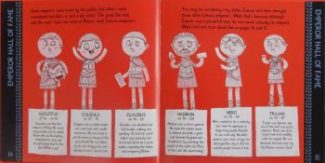
Small chunks of information are delivered with a gentle wit, on almost thirty topics. These range from The Birth of the Roman Empire (a comic strip rendering of the Romulus and Remus myth), through emperors …

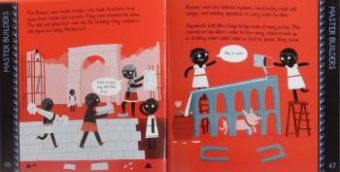
writing and number systems, home life, clothing, inventions, food and farming, bathing, theatre, building (the Romans were superb builders and engineers) …

medicine (herbs and healing baths were prescribed for most illnesses);

entertainment, (the Romans pitted animals against animals as well as humans; and entry to the Colosseum was free, sometimes even the food came gratis), and ending with the fall of the empire, and a spread on Rome Today.

Throughout, the emphasis is on the visuals: Davies has an off-beat style, uses limited colour to great effect and peppers his illustrations with amusing speech bubbles.

All in all a great introduction for a younger audience, to a fascinating ancient civilisation, the legacy of which is still evident today.

Check out the companion volume ‘Meet the Ancient Egyptians’ too.

Spot the Mistake : Lands of Long Ago

Spot the Mistake: Lands of Long Ago
Amanda Wood, Mike Jolley and Frances Castle
Wide Eyed Editions
Many children love to point out the mistakes made by adults. This large book capitalises on this, giving them the opportunity to search Frances Castle’s ten historic scenes to identify the 20 impossible elements that have found their way into each one, as they accompany two young detectives who are on the hunt for those visual errors.
Their first visit is right back to the Stone Age or more precisely around 12,000 years back to the Late Stone Age when humans started living in communities, building permanent homes, growing crops and keeping animals.
From there the questers move forward to 5,000 years back and the Land of the Pharaohs.

The double page scene is followed by another about the same location and provides reasons for the 20 visual anomalies as well as facts about what the ancient Egyptians would have had instead. This pattern, spot the mistakes followed by information spread, is used for each stop throughout the entire time travelling adventure.
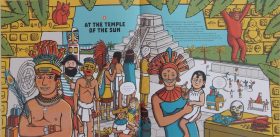
Other scenarios are ‘An Outing to the Acropolis’, ‘The Emperor’s Palace’ in ancient China; ‘Life in Ancient Rome’; ‘At the Temple of the Sun’ – the Mayan Empire;

Sailing with the Vikings’; ‘Jousting with the Knights’; ‘The (Mughal) Emperor’s Parade’; and finally, there’s a beach location for ‘Pirates Ahoy!’.
Frances Castle’s aptly bordered, alluring scenes have an ironical, lightheartedness about them that is just right for this time-travelling investigation. I envisage groups of children captivated as they play visual detective together.

I’ve signed the charter  

For Your Information Shelf: Books Books Books / Taking Flight

Books Books Books
Mick Manning and Brita Granström
Otter-Barry Books
Award-winning team, Mick Manning and Brita Grandström takes readers on an exploratory journey around London’s British Library, a library that holds over 150 million items in all, going right back to the earliest printed books and coming bang up to date with some printed this year.
First stop is the St Cuthbert Gospel, an ancient hand-made volume that was found in the saint’s coffin at Lindisfarne Priory some time after he died in the 7th century and which was sold to the British Library in 2011 for £9,000,000.
We’re also shown the Lindisfarne Gospels; a copy of Beowulf written in Old English …

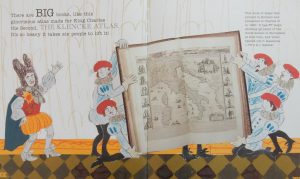
and eighteen other landmark publications from the Hound of the Baskervilles to Alice in Wonderland, including the gigantic Klencke Atlas, dating back to the time of Charles 11, that needs six people to lift it …

handwritten sheet music and newspapers.
Mick makes the whole place sound absolutely fascinating and Brita’s visuals really bring each and every entry to life. I haven’t visited this enormous library for many years but reading their book sent me first to its website, http://www.bl.uk and from there to planning my next visit in the near future.

Taking Flight
Adam Hancher
Frances Lincoln Children’s Books
Adam Hancher tells in words and pictures , the amazing story of the Wright Brothers and how through determination and fearlessness, they brought their childhood dream to fruition.
From humble beginnings in Ohio, the boys, inspired by the gift of a toy helicopter from their father, worked tirelessly on project glider. Starting with observations of birds in flight, then working on designing and making, they built their first glider, which they then tested in one of the wildest parts of the US. The machine was a failure, so it was back to the drawing board to work on Mark 2.
Finally a powered machine was ready for testing and … yes, the first journey of a Wright flying machine took place.

It still needed perfecting however and patience was needed until in 1908, everything was ready but …

‘ … something was wrong.’

Fortunately the brothers had kept the promise they’d made to their sister never to fly together, so although Orville was badly injured, he recovered and meanwhile Wilbur had been hard at work flying and breaking records. Fame at last for the Wright Brothers and thoroughly deserved it was.
A mix of superb double page spreads of key scenes, single pages and small scenarios, Hancher’s illustrations really do evoke a sense of their late 19th century settings.
An inspiring, beautiful book for KS1/2 readers at school or at home.

I’ve signed the charter