Scarlet Morning

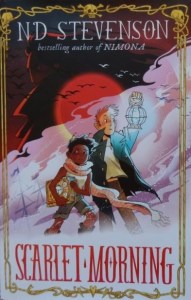
Since their bad-tempered caretaker, Hestur, disappeared, Viola (fourteen) and Wilmur (fifteen) have lived alone, scavenging, reading The Book and making up games on a dead island in Dickerson’s Sea. Hestur told the children about how the land was ravaged by salt after a terrible event – the Great Blow. This happened after Scarlet Morning, a bloodthirsty pirate had murdered the much-loved queen, Hail Meridian and taken her crown, so it was said.

When a pirate ship, the Calamary Rose arrives, its Captain, Cadence Chase, is searching for The Book that Viola and Wilmur have, they offer it in exchange for being allowed to go along with her.
Thus begins an epic, enormously dramatic adventure involving secret puzzles, revelry with a crew of pirates; possibly even the appearance of the aforementioned Scarlet Morning, and most challenging for the two youngsters, separation from one another.

The author’s cleverly constructed world building is superb and the story highly entertaining and sometimes creepy, made all the more so by his black and white illustrations, the diverse characters, and the cliff-hanger ending that leaves readers eager for what’s to follow.

Highly recommended for older readers who love enthralling magical fantasy adventures. Buy for individuals and for school collections.

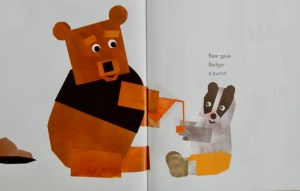
Punch!

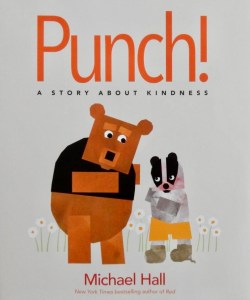
‘GRRRRRR!’ goes Badger showing that he’s on the lookout for trouble as he sets off for the forest.
Before long he’s tripped Frog, shoved Moose, kicked Elephant, and given Bear a poke with a shovel.
Bear draws up a plan to teach their friend a lesson. Badger is to receive a punch from Bear,

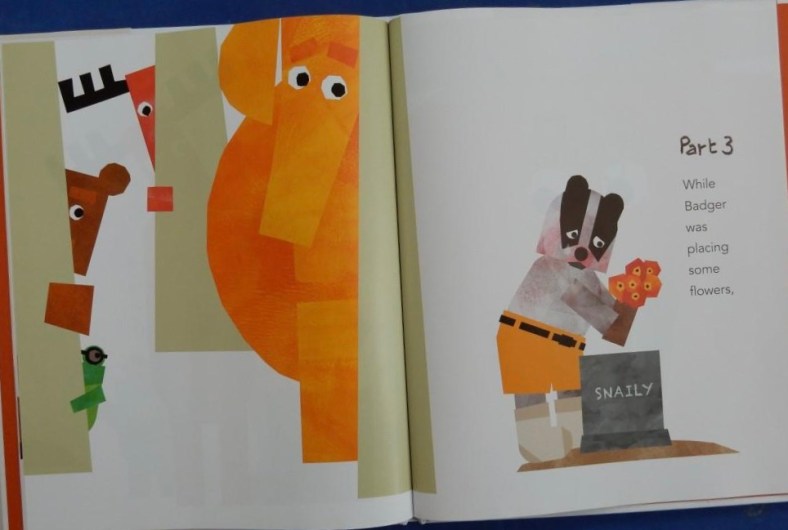
a belt from Frog and not one but two socks from Moose and as he plants some flowers,

a slug from Elephant.

Then, all of a sudden Badger plants a smack right on the pachyderm’s nose.

The following day when Bear is stung on the paw by a bee, and is in need of some comfort, Badger reciprocates showing that he’s back to his normal self.

What we’re shown but is never mentioned in the words, is the reason for Badger’s behaviour: he’s grieving for his pet, Snaily. Fortunately he has friends that realise he’s upset and in need of support. What we’re also shown is that words can be deceptive; in this story their true meaning is conveyed in Michael Hall’s blocky collage constructed visuals.

With its message about the need to show kindness towards someone who is hurting, this book is a fine demonstration of how important it is for children to develop visual literacy.

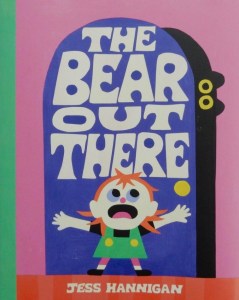
The Bear Out There

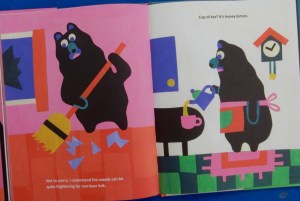
Of fractured fairytale versions of Goldilocks and the Three Bears there have been a fair few. Now Jess Hannigan gives a child voice as she speaks directly to we readers, who have come knocking at the door of a cottaage. Straightway the child informs us that outside lurks a scary thing of an ursine nature. She reveals the three signs indicating the Bear’s proximity – ‘The hair on your arms stands straight up. You feel a pair of great big eyes watching the back of your head. Your feet get suuuuper itchy’. and even goes so far as to draw a picture of said bear.

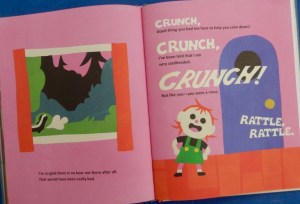
The girl then invites readers to a game of cards during which something disturbs her; they continue playing with various other noises outside until there’s a crunching followed by a rattling at the front door.

This, the young ‘host’ insists on answering. The result is the throwing into question everything the host has said thus far, is and the throwing of herself through the window.

The rest of the narrative is delivered by the real owner of the house who offers tea like a good host

and makes it clear in an accommodating fashion that this isn’t a one time occurrence. “Believe it or not, break-ins happen all the time . Not to worry. I understand the woods can be quite frightening for non-bear folk…”

Frightfully and frighteningly good fun is this subversive rendition illustrated in bold cut paper scenes of the drama as it unfolds: I love the somewhat sardonic manner of the loquacious child narrator energetically portrayed. Making the entire thing even more subversive are the final endpapers showing that the original narrator hopes to make a mint out of her encounter, with her best selling memoir, ‘I Survived a Real Bear.’

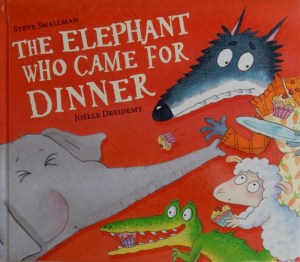
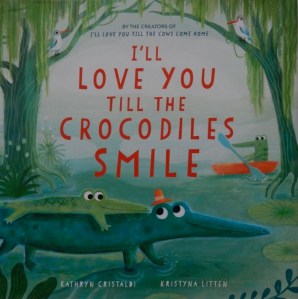
The Elephant Who Came For Dinner / I’ll Love You Till The Crocodiles Smile

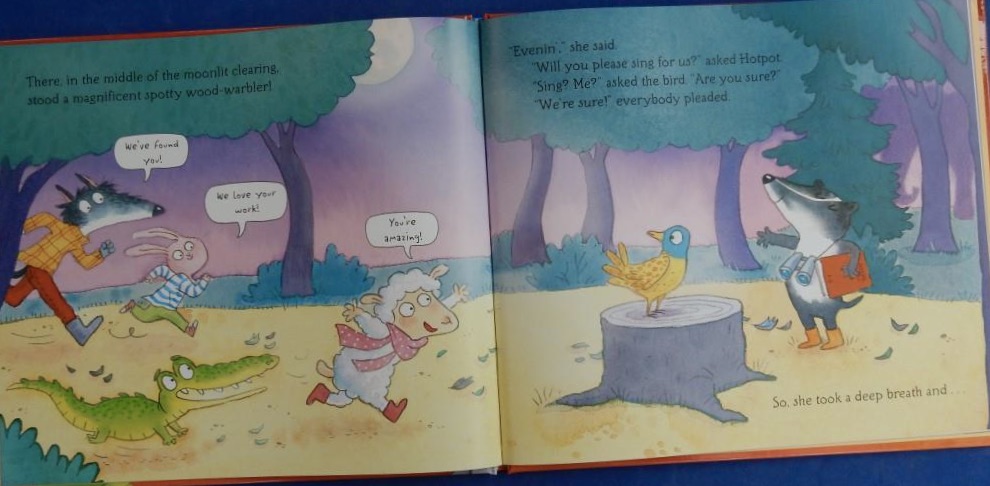
The latest of this fun series starts with the three friends, Wolf, Hotpot and Omelette strolling out one starry night when suddenly beautiful music fills the air above the woods. The three follow the spellbinding sounds further into the woods where the trees and bushes have been transformed into all sorts of animal shapes: but who was the maker? Badger (something of a know-all) insists the work was done by a spotty wood-warbler. The friends accompany Badger on a search for the mystery topiarist that Hotpot calls a ‘wobbler’.

However as the evidence emerges, it isn’t at all like smarty-boots Badger has led them to believe – far from it. Despite the confidence with which he asserted his ‘facts’ it was completely false information.

A great way to show children how important it is to interrogate whatever information they receive, no matter the source. Young audiences will love discovering the identity of the creative creature responsible for the singing and the shapes, who joins Hotpot, Wolf and Omelette for a post prandial sing-song that sends the friends off to sleep in the moonlight.

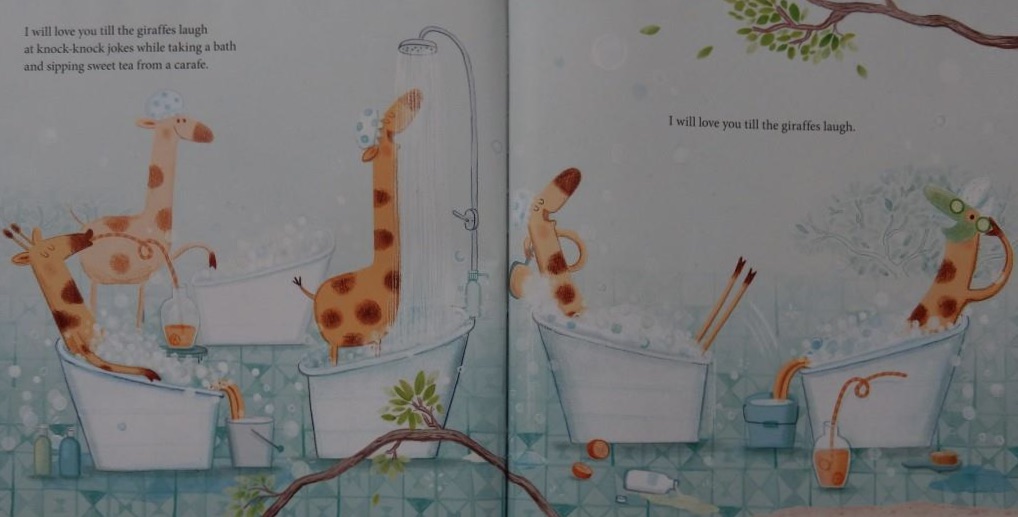
A bedtime tale with a difference. Jungle animals adult and offspring – kayaking crocs, shaking snakes on zip-wires, slow-crawling sloths sporting yoga pants and chimps sneezing because of clouds of globe-trotting fleas are among those featured in the gentle rhythms of Cristaldi’s gently rhyming text and Kristina Litten’s suitably humorous, mixed-media, digitally created scenes of the creatures preparing for the night. I love the giraffes that might ‘laugh at knock-knock jokes while taking a bath / and sipping sweet tea from a carafe.’

as well as the sneezing chimps – some holding tissues – attempting to extricate the fleas from each other’s backs.

Finally, silly antics over all is peace and quite in the forest with gentle snores emanating from the slumbering animals.

Young children will delight in exploring the various silly antics the animals are engaged in be they featured in the foreground or lurking in the background unmentioned in the words. Whether the story works as a pre-bedtime read rather depends on how much time little humans spend poring over the pictures: maybe two or three slow recitations of the text will do the trick.

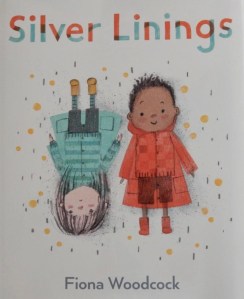
Silver Linings

Silver Linings
Fiona Woodcock
Harper 360

Close neighbours Pip and Parker are best friends, so in tune with one another that sometimes they don’t need to speak.
However, when Pip feels down Parker always manages to find just the right words, like the time when her crayon broke: “It’s okay, Pip … Now we can both use yellow,” he says.

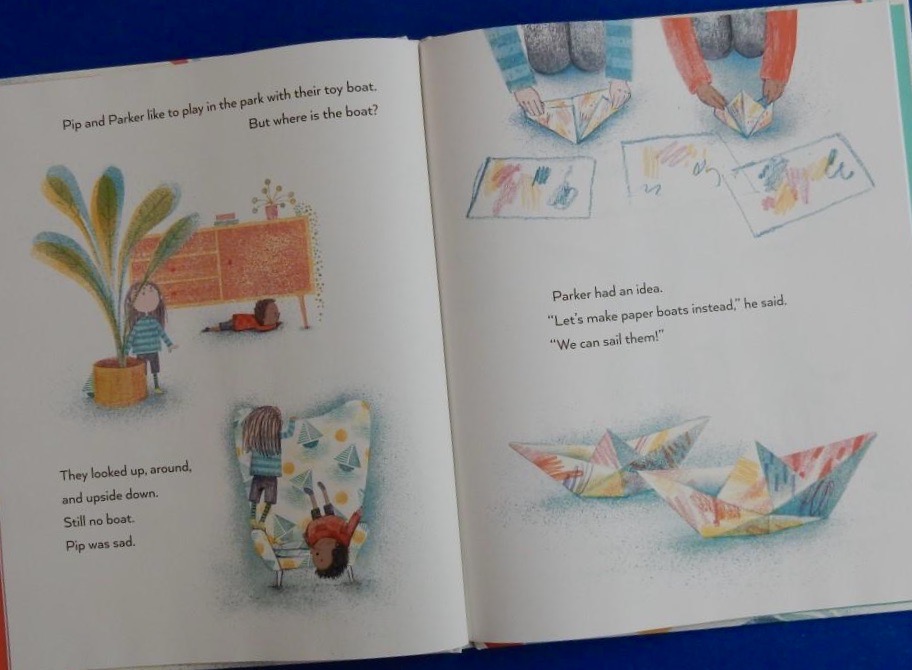
When they can’t find their toy boat to sail in the park, Parker suggests making paper ones instead.

Then when Parker’s boat is swept away by the wind, he suggests playing with kites and when an approaching storm makes the sky cloudy upsetting Pip, Parker sees it as a chance to look for shapes in the clouds. Parker has a gift for seeing the bright side—the silver lining – in any situation. How better to deal with rain than to splash in the puddles.

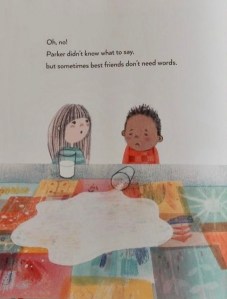
Then their need for a snack sends them back inside. Now it’s Parker who is responsible for a mishap – a very messy one that spoils their work of art.

What will Pip do? With such a good role model, she knows to make the most of the situation – to find that silver lining – and not a single word is necessary.

The story ends on such a sweet note that it’s bound to bring a big smile to the faces of readers, young and not so young.

Softly coloured, Fiona’s patterned, mixed media illustrations are full of charming details and her portrayal of the best friends is a delight; in fact the entire book from cover to cover is delightful.

This lovely lesson about the rewards of optimism and having a good friend is one to add to foundation stage and KS1 class collections and to family bookshelves.

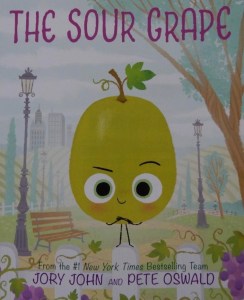
The Sour Grape

The Sour Grape
Jory John and Pete Oswald
Harper

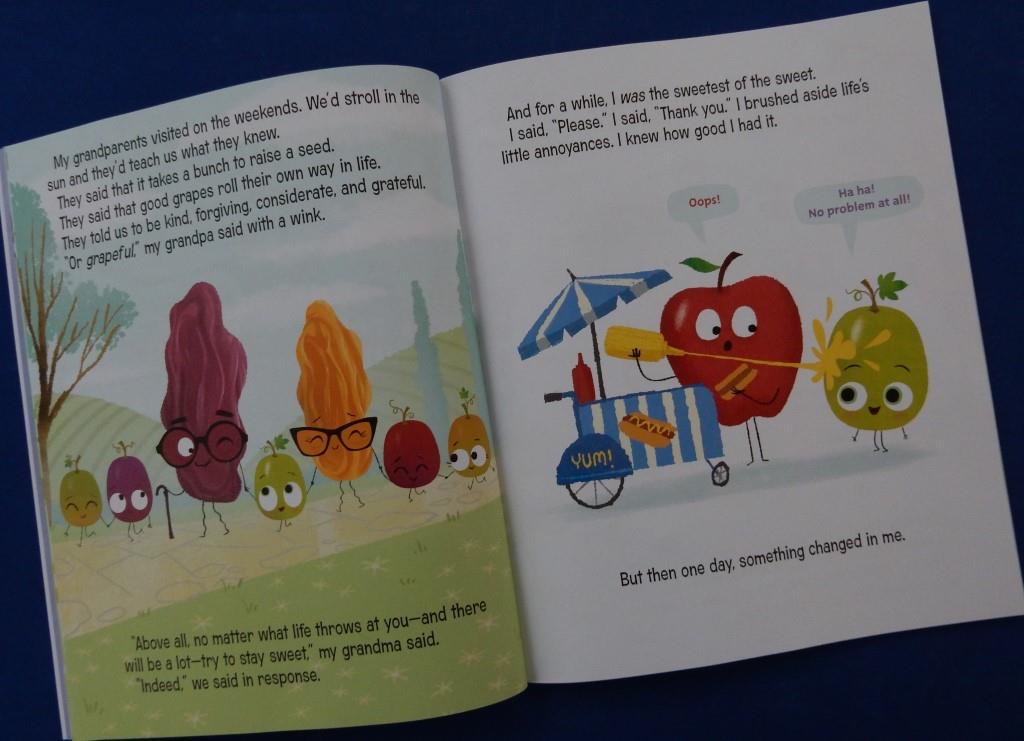
A fault finding fruit if ever there was one – that’s Grape when first we encounter our narrator in this latest addition to the Food Group series. But the grape wasn’t always so, as we hear. Indeed Grape had a pretty perfect childhood growing up in a “close-knit bunch” – a community of about three thousand.

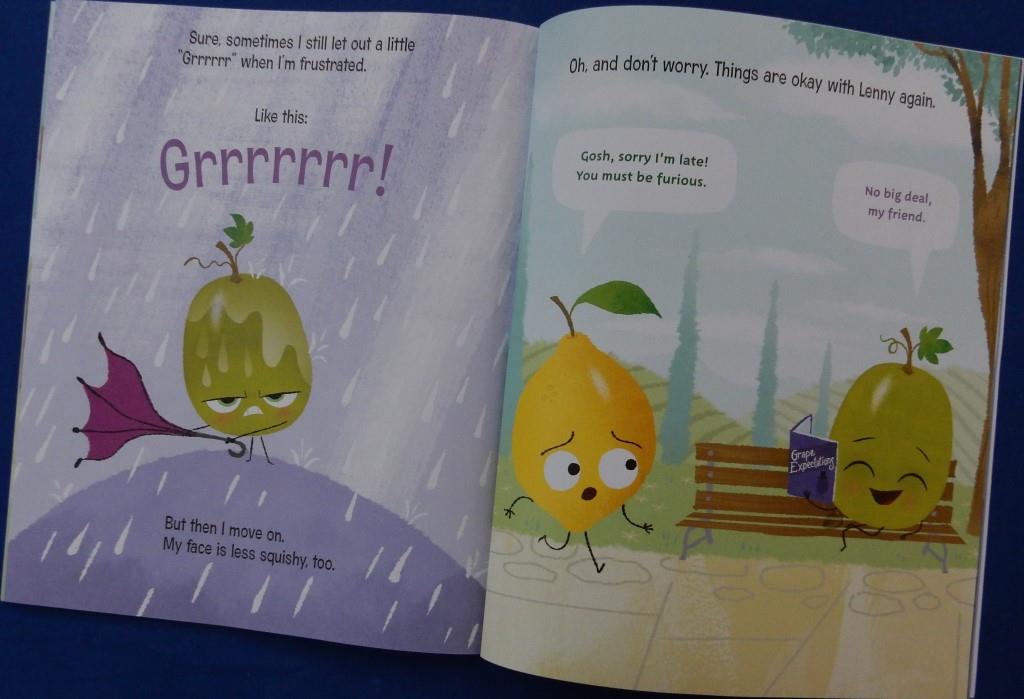
The transition from sweet to sour started when Grape planned a big birthday party to which nobody at all turned up. Thereafter began the personality change, first to a bitter grape, then a snappy one that would hold a grudge at the slightest little thing. This would manifest itself as a scowl that turned Grape’s face ‘all squishy’. Gradually the grudges built until one day, Grape is due to meet his only friend, sour Lenny, for one of their regular ranting sessions. But a sequence of mishaps result in Grape arriving at the venue three hours late. Guess who how holds a great big grudge.

A disbelieving Grape ponders on the situation and then leaves his friend to grumble alone. As Grape enjoys the surrounding nature, there follows a light bulb moment and off home goes the fruit to find and browse through a box of keepsakes. Goodness me! Grape discovers that old party invitation and the date written thereon was ten days after the birthday date. “It was all my fault. I realised nobody’s perfect. Not even me.”

Thus begins a change in the attitude of our narrator who finds that talking, listening to others and working things out calmly is the way to go.

What an important life lesson, and delivered in Jory John’s punny prose and Pete Oswald’s signature style illustrations, make it great fun. A book that adults, as well as youngsters should read; after all as Grape concludes, ‘If you look at things in the right sort of way – and if you remember to be kind, considerate, forgiving and grateful – life really can be pretty sweet.’

Snow White and other Grimms’ Fairytales / A Fairytale for Everyone

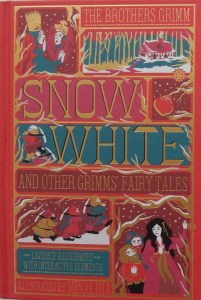
Snow White and other Grimms’ Fairytales
Jacob and Wilhelm Grimm, illustrated by MinaLima
Harper 360

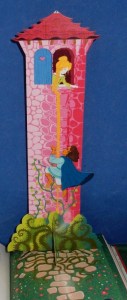
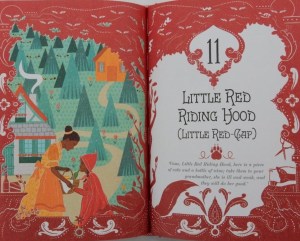
Twenty fairy tales are given the design team, MinaLima (Miraphora Mina and Eduardo Lima) treatment in this glorious collection. What this means in short is wonderfully imaginative artwork exquisitely detailed and engaging design with interactive elements (nine herein), bring to life timeless stories including, Sleeping Beauty, Rapunzel, Rumpelstiltskin, Hansel and Gretel, Little Red Riding Hood (Little Red-Cap),The Frog Prince and The Elves and the Shoemaker.

You will delight in such surprises as the awesomely intricate thicket surrounding the castle the prince must deal with to release Sleeping Beauty from her slumbers, a pop up tower that climbs right out of the book in Rapunzel, with a prince you can make climb up her golden hair – possibly my favourite.

A close contender though, is the pop-out house in Hansel and Gretel that opens into a diorama of the interior with a kitchen and a wicked witch waiting to lure the two children inside.
It’s good to see that ethnicity has also been a consideration in the portrayal of the characters, some of whom have brown or black skin: Red Riding Hood is shown as black, for example.

With vividly coloured illustrations, both large and small throughout, this book is one for keeping and for giving. With the festive season fast approaching, it would make a magical Christmas present.

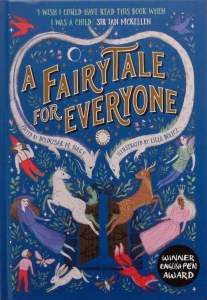
A Fairytale for Everyone
edited by Boldizsár M. Nagy, illustrated by Lilla Bölecz
Farshore

This groundbreaking collection of seventeen re-imagined traditional stories was highly controversial when originally published in Hungary on account of its inclusive nature. However because LGBTQ+ characters are featured it rapidly became a symbol in the fight for equality and against discrimination in Hungary and received a great deal of support both in the country and outside.

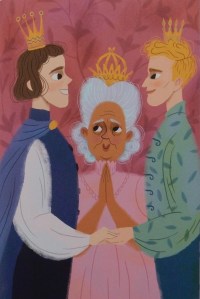
You’ll find stories that push back the boundaries of traditional gender roles showing how heroes can be any shape or size, princesses enormously powerful such as Margaret the Giant Slayer. In the final story written in rhyme, a prince finds true love, not with the blonde princess presented to him, but with her equally fair brother.

I loved the reworking of the Thumbelina tale of Little Lina who discovers what being big really means when she meets a fairy prince, small in stature like herself.

A true celebration of diversity that will likely appeal most to those with an interest in traditional tales.

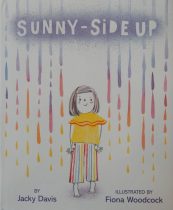
Sunny-Side Up

Sunny-Side Up
Jacky Davis and Fiona Woodcock
Harper Collins (Harper 360)

The little girl protagonist always looks on the bright side of life, but after breakfast (sunnyside-up eggs) when the blind is lifted to reveal a grey rainy day, her reaction is to throw a tantrum at the prospect of being stuck indoors all day – perish the thought.
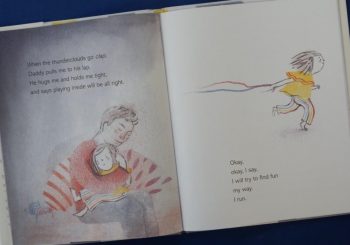
After a mollifying hug from dad

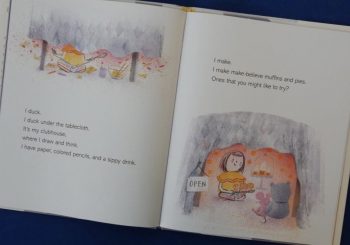
she decides to make the best of things with imaginative play, block building and some creative pursuits; she even opens a cafe for her soft toys serving muffins and pies.

And all the while the rain ‘drip, drip drops’. Lunch follows and then another paddy, again placated by dad following which the girl agrees to have a rest.

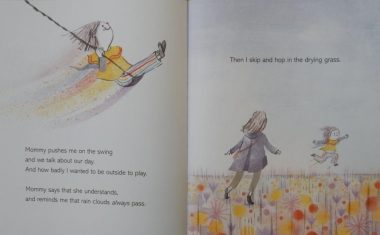
By the time Mum comes home, thanks to some painting and lots of calming reading, her daughter’s inner sunshine has returned just in time for the clouds to part and reveal something bright peeking through the clouds. At last, with the rain gone mother and child visit the park for some fresh air and a reminder ‘that rainclouds always pass.”

Jacky Davis’ first person rhyming narration conveys the little girl’s desire to be in control and find her own way through a difficult day ‘I found fun inside when it was grey’ she tells us as she snuggles down in bed after stories and warm milk.

Equally perfectly, Fiona Woodcock’s mixed media spattered illustrations executed in warm pastel shades portray to perfection the changes in the protagonist’s mood, as well as her irrepressible energy both indoors and out. 

Ideal for sharing with little ones and not just on rainy days.