Who Owns the Woods? / Above and Below: Sea and Shore

Here are two recent picture books about the natural world from Little Tiger – thanks to the publishers for sending them for review.
Who Owns the Woods?
Emily Hibbs and Jess Mason

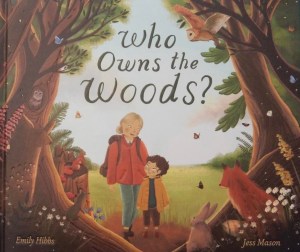
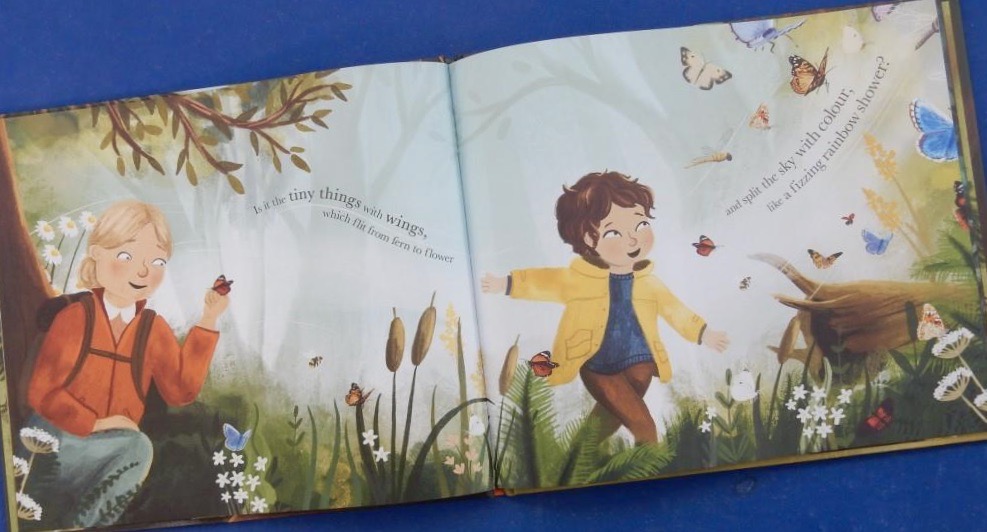
A boy and his grandma go exploring in the woods and as they walk, the child asks ‘who owns’ various natural things. Could it be one of the tiny animals they stop to observe – the spiders spinning their webs perhaps, or the butterflies with their beautifully patterned wings. 
Perhaps the woods belong to the magnificent stag, a fox or … maybe the boy himself is the owner of all those magnificent trees.

Not so, says his wise grandma; nobody can claim ownership of this particular area of woodland forest with its wealth of awe-inspiring flora and fauna; it is there for the enjoyment of every single person and moreover, as the boy himself confirms, it needs to be shown respect and treated with care.

What is needed is stewardship not ownership; that is the key message in this book beautifully illustrated by Jess Mason. Her scenes truly evoke the magic and tranquility of these special places. I really like the way the branches of the trees speak to readers serving to re-inforce the all important theme of Emily’s Hibb’s text.
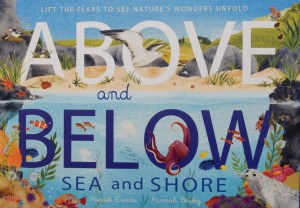
Above and Below: Sea and Shore
Harriet Evans and Hannah Bailey

Now published in paperback, this is one of an excellent spilt page, lift-the-flap natural history series; it explores ocean habitats below and above the waves taking readers to such locations as the coastline, a sub-aquatic kelp forest, polar oceans and an estuary. There’s a visit to a tropical shore, a coral reef, a mangrove swamp and more.

The information comes in bite-sized portions making it accessible to EYFS and KS1 audiences. Children will be fascinated to discover that for instance, a lobster tastes with its legs and has teeth in its stomach and that in the forests of a mangrove swamp is a grey-headed flying fox with a wingspan of 1.5 metres, making it one of the world’s largest bat species.
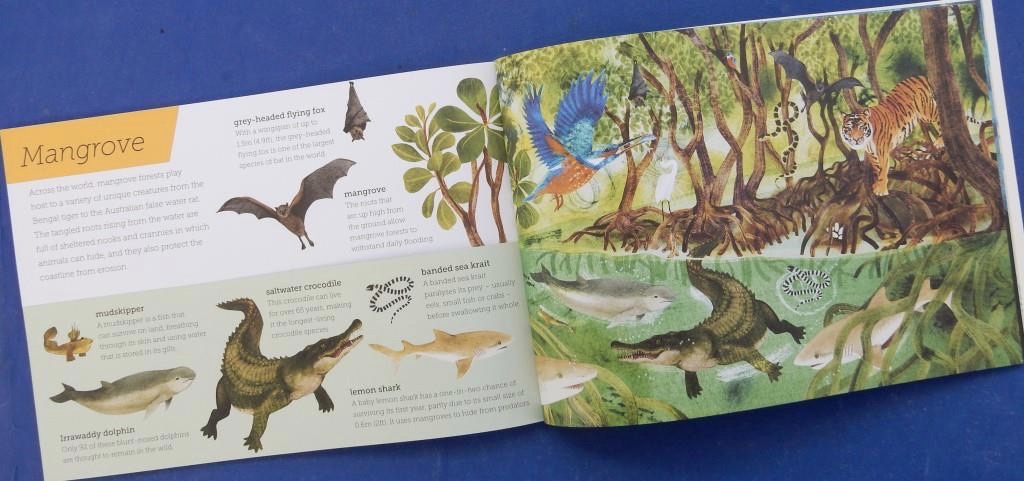
The spilt pages work well providing as the title indicates, above and below views of the locations featured, each being beautifully illustrated with lots of detail: there’s so much to see.

This is a book that celebrates the natural world and gives a real sense of the sheer diversity of life in our oceans and rivers and on our shores.

When We Became Humans

When We Became Humans
Michael Bright, illustrated by Hannah Bailey
Words & Pictures

Here’s a large format, illustrated book that provides an accessible overview of human evolution from our earliest primate ancestors right through to Homo sapiens.

Having explained such terms as hominids, hominins and haplorhins, the author takes readers back to our earliest primate ancestors – tiny rodent-like mammals – of some 65 millions years back; then moves on 35 million years to the monkey-like ape ancestors that were starting to bear a greater resemblance to the apes we know today. (Here, I was fascinated to read of the theory of the parallel evolution of primates and fruit trees).

Then comes a spread on how scientists study fossil evidence and the kind of information this can yield.

Next is a look at the move to bipedalism and how this enabled early hominins both to see further across the plains and to grasp and carry tools, food and even babies.

Bright presents the theory that a number of different hominid species lived at the same time, as well as stating that as DNA analysis shows, Neanderthals and modern humans interbred.

There is just so much absorbing information packed between the covers. In addition to exploring physical changes,

the author includes a look at the stages of cultural development, tool use and its modification.

I was particularly fascinated by the cultural spreads such as the look at health care, and jewellery, (Neanderthals and humans both wore it),

trinkets and charms.

The book ends with the question of whether or not humans are still evolving, plus a visual presentation of chronology and migration routes.

Hannah Bailey’s plentiful illustrations are excellent, making the considerable amount of information feel much less challenging to primary school readers.

A book I’d thoroughly recommend adding to family shelves or a KS2 collection for supporting both the history and the science curriculum, as well as for interested individuals.

When the Whales Walked / Rivers


When the Whales Walked
Dougal Dixon and Hannah Bailey
Words & Pictures

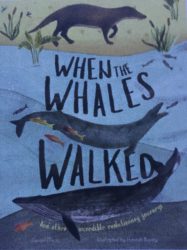
By means of thirteen case studies, readers can discover how for example, dinosaurs evolved into birds and how whales were once four-legged creatures that walked on the land. These are just two of the fascinating evolutionary journeys told through a mix of annotated illustrations by Hanna Bailey, superbly illustrated scenes and family trees.

Did you know that way back in time snakes too had legs and crocodiles were warm blooded?

Written by evolution and earth sciences specialist, Dougal Dixon, this is a book that will broaden the horizons of dinosaur mad readers and, with evolution now a topic in the KS2 science curriculum, it’s one to add to primary school collections.

Rivers
Peter Goes
Gecko Press

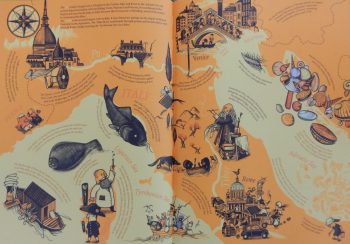
In his follow up to Timeline, Belgian illustrator Peter Goes takes readers by means of a series of large size maps, on a continent-by-continent tour of all the world’s great rivers.

Those featured flow across  predominantly monochromic double spreads that are illustrated with images of iconic structures – bridges and buildings, vehicles, people, deities, monsters, wildlife and physical features.

Factual information – historical, geographical, biological, mythical, cultural – is provided in snippets (the book is translated from the original text by Bill Nagelkerke) through and around which each river meanders from source to sea.

I’ve visited relatively few of the rivers featured (though various parts the River Thames have always been part and parcel of my life and I’ve visited locations along the Ganges). Some including the River Onxy in Antarctica that flows only in summer, I’d never heard of.

This super-sized book has made me want to do some more river exploring; perhaps, like its creator I’ll start closest to home, in Europe.

A fascinating book for young would-be travellers and school libraries in particular.