Twigs and Stones

Snake and Lizard live in a hole under a rock and like all friends they have their ups and downs with one another.

One day Lizard decides it would be good to collect twigs with which to put both their names above the entrance to their home. Off he goes to the river in search of sticks and mud. On his return he sets to work carefully arranging the sticks to form the letters; Snake is unable to assist on account of her bad eyesight. However Snake listens dozily to Lizard’s comments,
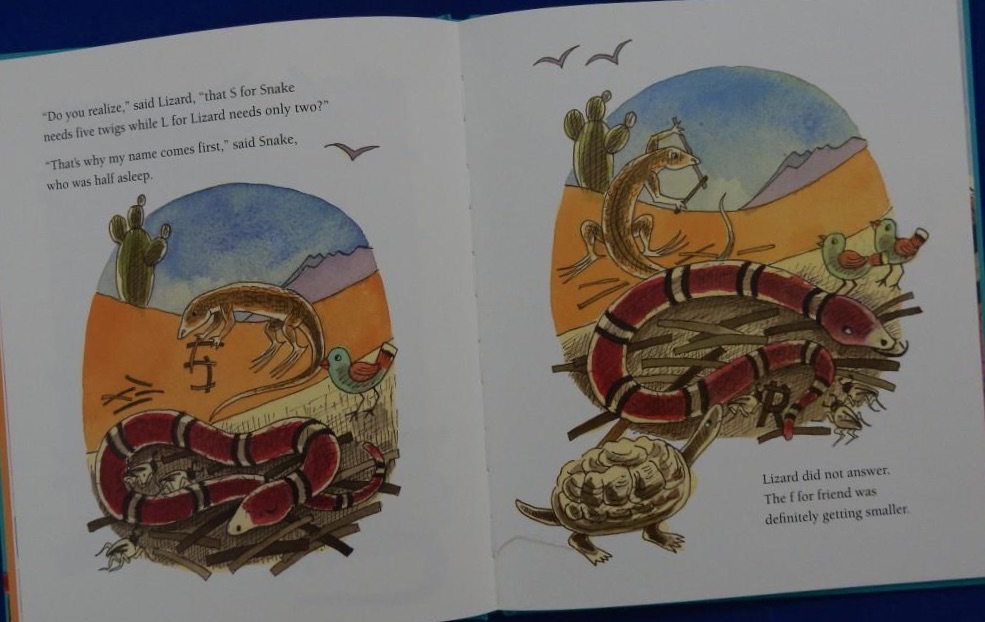
the task is completed and the names written large stand on the ledge until along come Tortoise.and Owl warning of the likely consequences of a desert wind. The wind comes, blowing down Snake’s name but then out of their hole comes Lizard to retrieve the fallen letters after which he returns to bed.

Next morning though, Snake emerges first and is furious to see that his friend has accidentally misspelt Snake.

Lizard’s way of dealing with things only makes his friend angrier and both have a most unsatisfactory day in silence.

That night it’s Snake’s turn to go out and check the names: now is her chance to teach Lizard a lesson. Fortunately though all ends well: the letters are removed and the friendship is restored.

There’s a gentle humour in both Joy Cowley’s telling and Gavin Bishop’s pen and ink and watercolour illustrations . The expressions on the faces of both Snake and Lizard are splendidly done heightening the drama throughout the squabbles, making this a great read aloud story with lots of potential for class discussion. It should certainly reassure children that friendships are important and silly incidents should be forgotten quickly.

Lionel is just like Dad / Look / Friend

These are recent Gecko Press publications – thanks to the publisher for sending them for review.

This celebrates the relationship between a father and small child, lion style.

Little Lionel closely watches his father’s every move, copying his actions carefully.
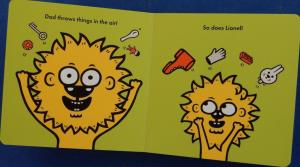
When Dad combs his hair. so too does Lionel, Dad taps his teeth, Lionel does the same, Dad scratches an itch, ditto Lionel, Dad sings a song very loud, Lionel reciprocates. Then after a brief break, Dad throws things into the air, Lionel does likewise; 

however something that Lionel throws falls on Dad’s head. with a THUNK! causing the parent to cry out in alarm, as does Lionel. Now Dad is not so impressed with his little one’s copying behaviour and they turn away from one another. After a think on Dad’s part and on Lionel’s the two go and hide themselves. Not for long though for all ends happily with forgiveness from Dad and hugs all round.

Charming, reassuring and a fun portrayal of a parent’s unconditional love. Ville’s seemingly simple illustrations show so clearly the emotional changes of both characters.

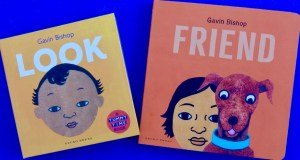
Essentially Look , a wordless concertina fold out, opens one way to reveal a sequence of ten faces, nine human and one a dog. Opened the other way, you find a series of seemingly random objects likely to be familiar to an infant – a bird, a bunch of keys, a doll, a ball, a pair of spectacles, a toy bear, a snail, a ship, a dog, a rabbit and a truck – each one simply depicted centre stage in bold bright colours.
Unfolding to almost 2 metres this simple ‘tummy time’ book is sturdily built to withstand the frequent use it might well get.

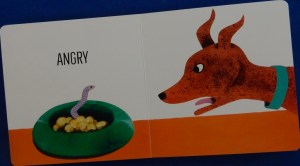
Friend features a child narrator – the owner of a dog – who clearly loves the animal , calling her ‘My best friend’ on the final spread. Words are kept to a minimum with four being the most on a spread, and several have just a single descriptive word: happy, angry, rowdy, sad, shy, each of which is mirrored in an expressive picture of the pooch.
Little ones will enjoy the sequence relating what unfolds when the dog discovers an unwanted visitor in her food bowl, 

expresses how she feels about it by howling at an adult, receives a ticking off from the girl causing the creature to tuck herself under the table for a while.

An opportunity for small humans to learn new vocabulary as they follow the action and interactions. showing that real friends don’t always need to say much; their expressions speak volumes.

Pops / Make Tracks: Trucks

Pops
Gavin Bishop
Gecko Press

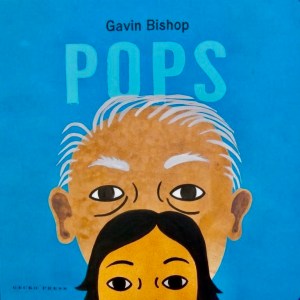
With a straightforward, minimal text and close up illustrations, Gavin Bishop zooms right in to the important elements of an activity while highlighting too, the close bond between a child and grandfather (Pops). We see clasped hands – one large one small, as they meet; a single boot and two small bare feet walking, and so on as the two gather together the essentials (some from the garden), for making their sandwiches – one each. They then tell stories to one another and fall asleep side by side. The love they share is palpable in such actions as the tender manner in which Pops extends a supportive hand just in case the little child drops the egg.

Interestingly we are never shown the whole body of either person as they engage in life’s simple pleasures made all the more enjoyable by their close connection. Full of warmth, this is a lovely book for a grandfather to share with a very young child and a good starting point for conversations about special times shared with individual’s own grandparents.

Make Tracks: Trucks
Johnny Dyrander
Nosy Crow

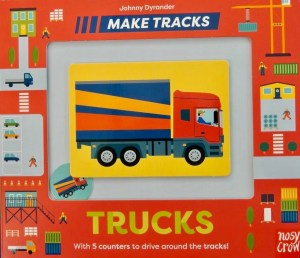
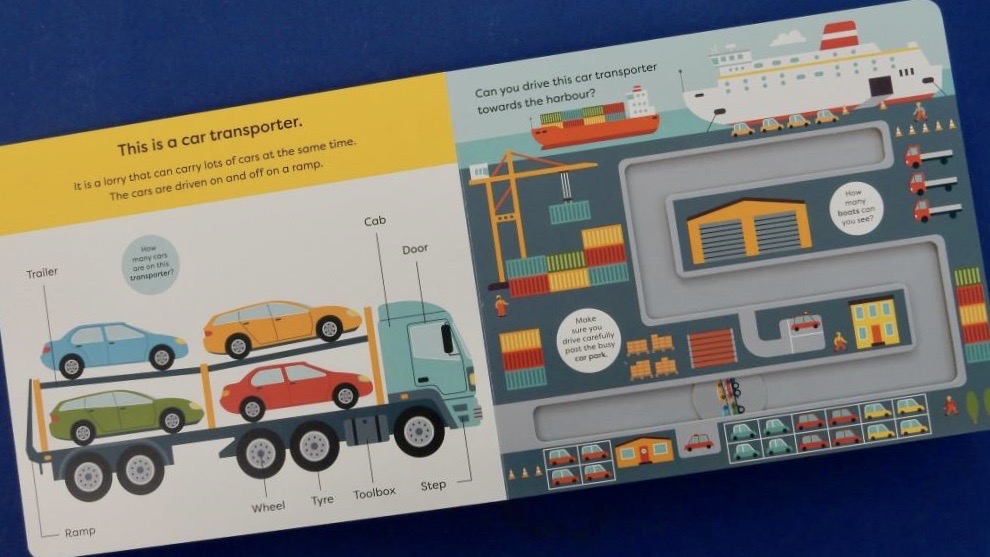
This is a real treat for truck loving young children. In addition to the cover, it introduces five kinds of truck: a forklift, a lorry, a car transporter,

a ‘monster’ truck and a dustbin lorry. The parts of each one are clearly labelled in a large illustration on the verso beneath a two sentence introduction. On each recto is a more detailed scene around which little fingers can manipulate the counter bearing a tiny illustration matching the one opposite. So, for instance in response to ‘Can you drive this forklift around the warehouse?’ children can follow the instruction “Drive up and down the aisles in straight lines.’ and in so doing develop their fine motor skills. On this particular spread there’s also the question “How many lorries are waiting to be loaded?’

Each of the other spreads is equally interactive with a simple counting activity and another question set into the scene. Bright and alluring with the potential for hours of fun learning, what more can one ask from a non fiction board book?

Cooks’s Cook: The Cook Who Cooked for Captain Cook

Cooks’s Cook: The Cook Who Cooked for Captain Cook
Gavin Bishop
Gecko Press

In 1768 Captain Cook and his crew set forth on a journey aboard H.M.S. Endeavour. In this wonderful book, published to coincide with the 250th anniversary of Endeavour’s voyage to Australia and New Zealand, the New Zealand author/illustrator Gavin Bishop takes readers along with the crew of 94 aboard, on an amazingly tough voyage full of hardships telling the story from the viewpoint of one-handed cook, John Thomson, a rather parsimonious chap.

He uses a chronological diary form along with recipes including some pretty unpleasant ones (especially if like me you’re a vegetarian,) such as stewed albatross with prune sauce.

Unsurprisingly, bad-health and such afflictions as scurvy in addition to the perils on the high seas are regaled with lots of grim details from one below deck, make for a truly fascinating and at times witty read.

We also learn something of the way the gentlemen explorers spent their time and of their encounters with the people whose lands they travelled to.

Clearly Bishop has researched his topic thoroughly, and no matter how one views historic colonisation, the delectable, sometimes troubling, tale of adventure he tells, is totally absorbing.

So too are his splendid painterly watercolour illustrations. Don’t miss the longitudinal section of the Endeavour on the front endpapers along with all who sailed; and a map (plus ‘Tidbits’) of its voyage, at the back.