Welcome to the Mysteryverse / Secret Stories of Nature

These are both Wide Eyed Editions: thanks to Quarto Kids for sending them for review
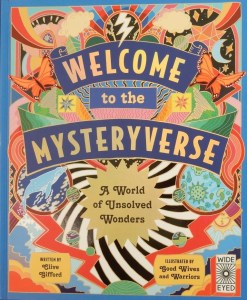
Contained within the covers of this large format book are some of the as yet, unsolved mysteries about the workings of Earth, its human inhabitants and the universe. It’s divided into five parts each given an alliterative title: People Puzzlers, Earth Enigmas, Natural Niggles, Cosmic Conundrums and Miscellaneous Mysteries, concluding with a couple of spreads telling of some mysteries that science has helped to solve.

Clive Gifford explores in a straightforward manner everything from yawning and the appendix to optical illusions, from what makes tornados and causes earthquakes to where has all Earth’s water come from, why millipedes and centipedes have so many legs to why cats purr, and what is the overall shape of the universe, and, how will it end.
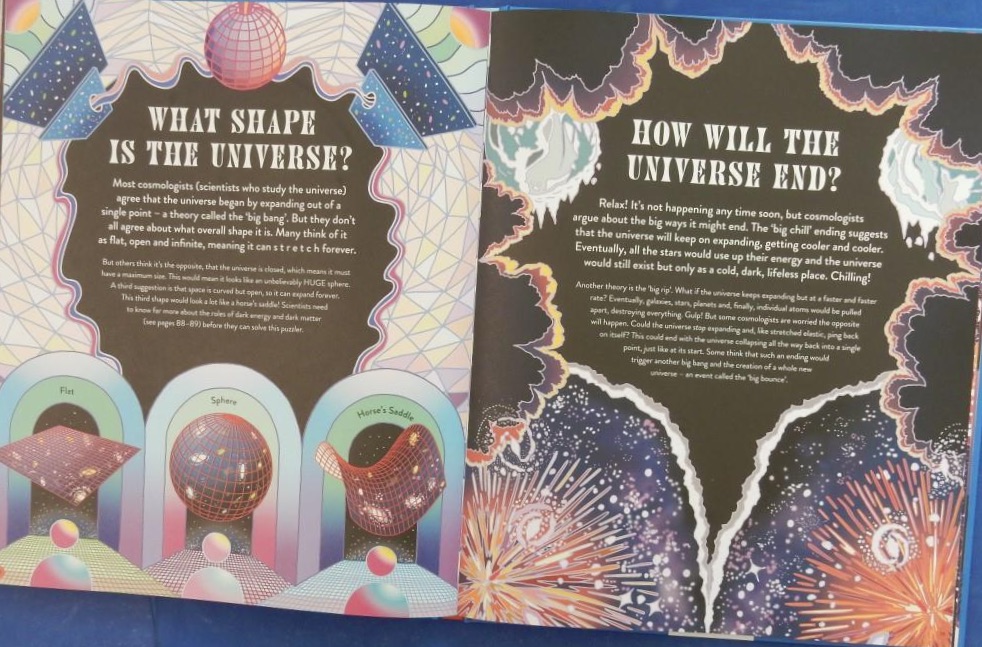
For each mystery readers are encouraged to think both scientifically and creatively as they peruse the spreads and ponder the questions posed.

An absolutely fascinating compendium of scientific puzzles, made all the more exciting by the detailed, sometimes psychedelic illustrations by Good Wives and Warriors, whose work I’ve not encountered before.
A book for KS2 classrooms and families where there are curious-minded children.
Presenting the biological information in this book as secret stories that nature wants to share with readers is an engaging means of sharing the facts relating to the flora and fauna featured. The sea, the ice, forests, jungles and mountains all have secrets, as do the sky, the night and the ground beneath our feet.

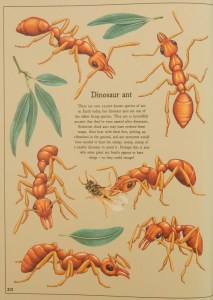
Did you know for instance that there are more than 12,000 known species of ants on Earth today? Or that ants hear with their feet, or rather, they sense the vibrations in the ground around them.
I was fascinated to read that horned tree frogs have bony spikes hidden inside their skulls for defence purposes and that dragonfly ancestors had a wingspan of around seventy centimetres rather than the maximum of twenty in some of those of today.

You may well be surprised to read that rodents including rats and mice share their DNA with humans – now there’s a thought. It might also come as a surprise the fur of polar bears is not white. Rather it’s translucent and appears white because it reflects visible light.

Towards the end of the book is a ‘searching for secrets’ section encouraging readers to stop and look closely at the nature around them to find the hidden treasures that are all around.

With superb illustrations by Vasilisa Romanenko, this is a treasure trove of ‘secrets’ relating to the natural world.
Powered By Plants

Powered by Plants
Clive Gifford and Gosia Herba
Wide Eyed Editions

How many people I wonder are aware of the wealth of cutting edge science and technology of yesterday, today and the future, that involves members of the diverse plant world found in the many ecosystems on our planet? Some of this rich diversity is being increasingly studied and copied, inspiring innovations in design, science, engineering and technology. This third book about biomimicry introduces some awesome plant inventors. Prepare to be awed for as Tumbleweed says in the book’s introduction, plants are the experts and you’ll likely never look at flowers, trees or seaweed in the same way again.

There are six main sections: Structures, Robotics, Energy, Health, Sustainability and Materials and a final look to the future. Each plant is allowed to speak for itself and informs readers about such things as how it grows and why its particular structure is or was, so useful to humans. All this fascinating information is broken up into bite-sized chunks placed in fact boxes and embedded in a funky, colourful illustration by Gosia Herba.

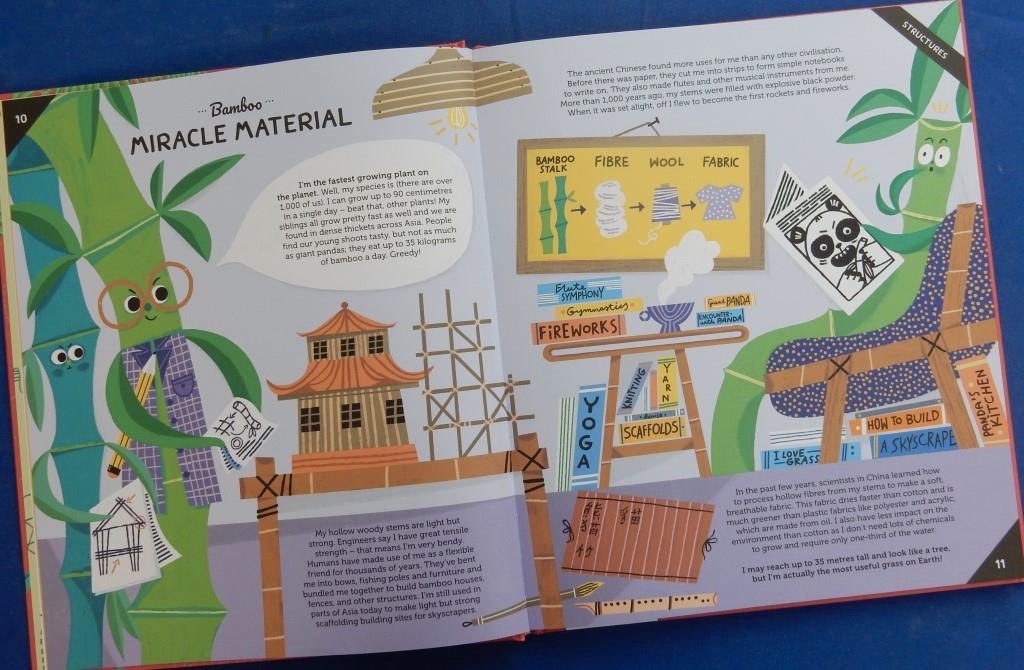
If you’ve ever wondered what the fastest growing plant on the planet is, no it isn’t dandelions or that pesky Himalayan balsam that seems to be choking up so many of the UK’s waterways, it’s actually bamboo and there are more than 1,000 different bamboo species. With its high tensile strength bamboo has been used to build houses in Asia and is still used to make scaffolding. Perhaps more exciting though is that some scientists in China now know how to process the hollow fibres from its stems to make a soft, breathable, very fast drying fabric that is much more environmentally friendly than acrylic, polyester and even cotton.

Five other plants present their super powers in the Structures section including the ‘earthquake proof’ coconut palm, the fruit of which has a multitude of uses including in the production coir, a mosquito repellent, coconut milk and of course, coconut water.

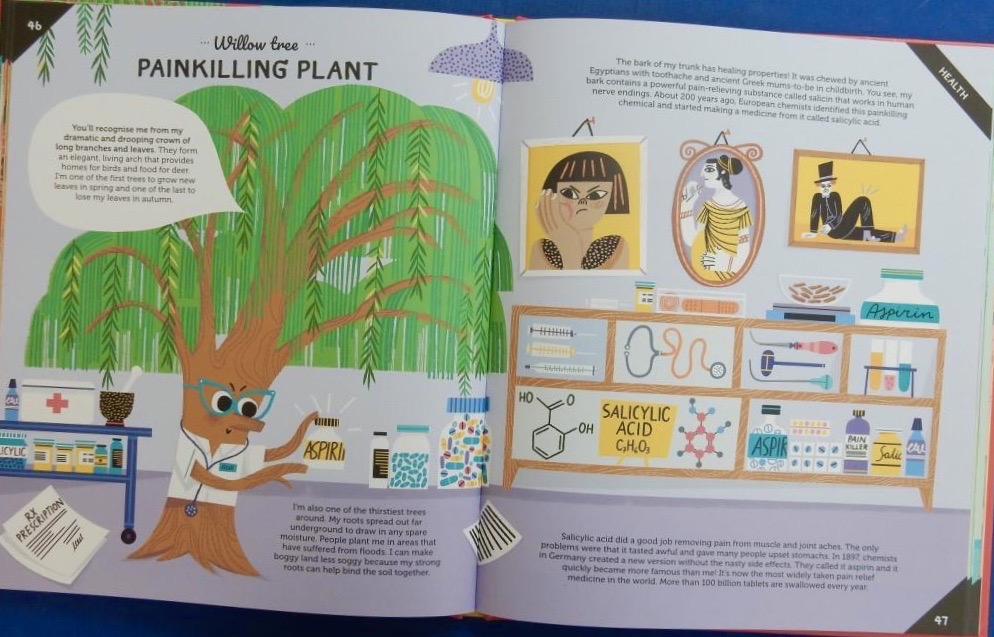
No matter which section you choose to dip into you’re sure to be excited: from the fast-growing cottonwood trees with wind power potential, to the slick, slippery carnivores like the pitcher plant and the super-thirsty willow tree, the bark of which has healing properties thanks to salicin – a powerful pain-relieving substance, it will be a case of WOW! that is truly amazing.

An absolute treasure of a book for both home and school use.

If You Had Your Birthday Party on the Moon / The Race to Space

If You Had Your Birthday Party on the Moon
Joyce Lapin and Simona Ceccarelli
Sterling

Hold on to your helmets, it’s blast off time, destination a birthday party in a place you never expected it to be. Moreover, there’d be a lot more celebration time on your lunar destination for it has a 709-hour day.

On the way to the moon you’ll discover what it feels like to be weightless and your party paraphernalia and pals will also float around inside your spaceship.

Once on the moon’s surface you’ll feel a lot lighter than on Earth and the Moon’s low gravity will keep you safe.
You won’t be able to fly any party balloons on account of the Moon being airless but you can have enormous fun doing one-handed push-ups,

exploring the lunar craters, trying a game of freeze tag and making moondust angels.

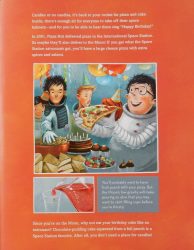
Perhaps you will have to eat your birthday cake astronaut style squeezed out of a foil pouch. Don’t think I’d be so keen on that idea.

Then on the return journey and there’ll be bags of time to open your presents, a whole three days in fact during which you could also open those party bags and sample some of the Moon pies therein.

Woven into all this partying is a great deal of STEM information on exciting topics both astronomical and cosmonautical. Why for instance is the sky black rather than blue; why your birthday will last almost 30 days, and why there wouldn’t be any point in playing musical statues on the moon.

With Simona Ceccarelli’s lively, playful digital illustrations and Joyce Lapin’s enormously engaging narrative that speaks straight to the reader, this is a sure fire winner for younger readers/listeners.

(Included at the back are a glossary, bibliography and suggestions for further reading).

For somewhat older readers is:

The Race to Space
Clive Gifford and Paul Daviz
Words & Pictures

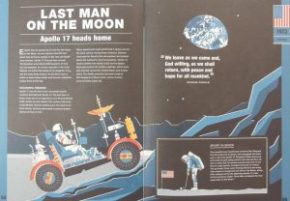
With the 50th anniversary of mankind’s first moon landing fast approaching, here’s a book that traces the history of the space race between two super powers, the U.S. and the Soviet Union, from the launch of Russia’s Sputnik to Neil Armstrong’s planting of a U.S. flag on the moon’s surface and those oft quoted words, “That’s one small step for a man, one giant leap for mankind.” That must be etched into the brains of all who saw that landing broadcast live.

From then on the relationship between the U.S. and the Soviet Union became more one of co-operation and collaboration than competition and the book documents the ‘handshake across space’ in the 1975 joint Apollo-Soyuz mission.

It concludes with more on the co-operation including the establishment of the International Space Station.

Illustrated, retro style by Paul Cadiz, in shades of red, yellow, blue plus black and white,

the book has clear explanations together with a liberal scattering of quotes from significant participants in the whole endeavour.

Recommended for individual reading at home and for KS2 class collections.

Raise the Flag

Raise the Flag
Clive Gifford and Tim Bradford
QED

Traveller Clive Gifford and nature enthusiast Tim Bradford have created a fascinating books absolutely jam-packed with information, stories and other tidbits.

Herein you can find out about the history of flags including their use in heraldry.

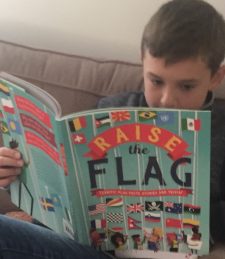
Then comes a look at the national flag of every country in the world.
These are grouped under regions, first the Americas and Canada, then a glance at local and regional ones. Thereafter it’s on to Asia, the continent with the largest human population, where we find out about frags from Afghanistan, Bangladesh and Bhutan to Uzbekistan, Vietnam and Yemen. Some countries such as India, have a whole spread devoted to its flag.

There’s a look at flag usage – in sport,

to commemorate amazing feats such as the conquest of Everest,

the Apollo moon landing, pirate flags, flags in semaphore and much more.

In total 268 flags are explored including that of New Guinea, designed by a 15 year old schoolgirl; at one time, and until it was discovered at the Olympic Games of 1936, two countries Liechtenstein and Haiti, had exactly the same flag design. Now Monaco and Indonesia share a design; these fascinating facts I learned from the book.

Comprehensive and totally absorbing; I certainly never imagined that vexillology could be so interesting. My only issue is that I’d have liked to see the ‘Union Jack’ called the Union Flag.

This book is very well written and the visual presentation excellent; no spread looks like another and none will overwhelm primary age readers. There’s even a quiz and a final glossary and index.

Well worth adding to a school or family bookshelves.

The Colours of History / So You Think Yo’ve Got It Bad? A Kid’s Life in Ancient Egypt

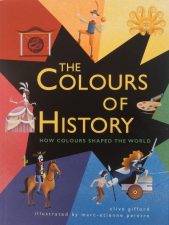
The Colours of History
Clive Gifford and Marc-Etienne Peintre
QED

There have been several books on the theme of colour recently: now here is one that takes a historical approach with the subtitle ‘How Colours Shaped the World’.

After an introduction to the world of colour, there are five main sections: Yellows (which includes orange), Reds, taking in ‘Mummy Brown’), Purples, Blues, Greens and then a spread on ‘Colours that made their mark’ that looks at
kohl black, graphite, lime and lead wash.

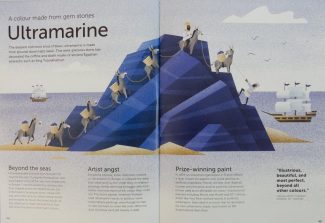
Over twenty colours – divided into shades – are explored with each different shade being allocated a double spread that includes an arresting illustration by Marc-Etienne Peintre, related historical facts, associated symbolism and often, a relevant quote. There is also an introductory paragraph for each colour group supplying connotative meanings.

Did you know that the predominant colour of the prehistoric Lascaux Cave paintings was yellow ochre,

or that saffron comes from a particular crocus species grown mainly in Spain and Iran?
Or that cochineal, still used in some lipsticks, is actually a tiny insect that when crushed, yields a scarlet colour due to the carminic acid it carries to protect itself from predatory ants?

One of my favourite blues, ultramarine, is made by grinding one of my favourite semi-precious gemstones lapis lazuli – a fact I knew, but I was intrigued to learn that the artist Vermeer’s heavy use of the colour in his paintings left him heavily in debt when he died.

This inviting and rewarding book will be of particular interest to those with a liking for art or history and is well worth adding to a primary school library.

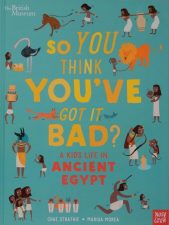
So You Think You’ve Got It Bad? A Kid’s life in Ancient Egypt
Chae Strathie and Marisa Morea
Nosy Crow

Guaranteed to bring on giggles galore is this look at ancient history Egyptian style published in collaboration with the British Museum. It presents history like you’ve never seen or even imagined it before – from the children’s viewpoint.

A variety of topics is covered – clothing and hairstyles, family life, the home, work – parents introduced the idea of work to their offspring at an early age.

There are sections on education – formal school outside the home was mostly only for boys and rich ones at that, and  diet – raw cabbage was a popular starter and pigeons were often served (along with geese, ducks and oxen if you were well off)

and even children drank beer back in those days.

Medicine and health – apparently the mother of a sick child might eat a mouse and then put its bones in a bag and dangle it around the child’s neck to effect a cure; protection and gods, and fun and games are also explored. Popular pastimes for the young included swimming, boating and games by the river, although, you had to keep a watch out for hungry crocs or hippos. Ball games were often played too, though not football, and the balls were made from papyrus or leather stuffed with straw.

Humorously illustrated with a multitude of labels and speech bubbles, and packed with fascinating facts, yes it’s light-hearted, but children will absorb a lot of information from this unashamedly zany book.