Mermaid Kenzie

Mermaid Kenzie
Charlotte Watson Sherman and Geneva Bowers
Boyds Mills Press

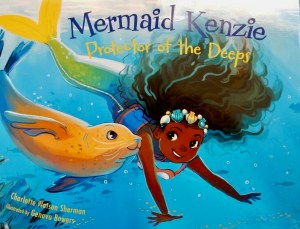
Mermaid Kenzie as she prefers to be called, is a lover of everything sea-related. She creates sea scenes in her bedroom and goes onto the beach whenever she can. “Mermaids don’t clean up,” she insists when her Mama tells her to tidy her imaginary sea world away before venturing out. “Then this mermaid don’t go to the beach,” she retaliates. Mother and child visit the seashore by day and by night, digging for treasure, building sandcastles, venturing into echoing caves and rowing out on the ocean to look for marine wildlife.


Mermaid Kenzie loves to don her mermaid tail when they take their boat out and sometimes wearing her mask and snorkel, she dives beneath the waves playing with her seal pal named Cocoa. On one occasion, she’s horrified to discover the plastic bags causing pollution to the ocean’s ecosystem.

Mama tells her that during her own childhood, the ocean was alive with ‘squishy, squashy sea creatures’ – a veritable underwater zoo. Now is definitely time to revise her “Mermaids don’t clean up” rule. “This mermaid cleans up for my sea pals,” she announces.

Back on the shore she begins the task, urging friends to join her and so they do at the behest of “Mermaid Kenzie, Protector of the Deeps.”

Author Charlotte Watson Sherman’s narrative effectively mixes rich lyrical description – ‘Mist silver the water, / briny taste on our tongue. / Seaweed perfume the air. / Grey, the heron, drift past, / wing almost blocking the sun.’ – and dialogue. ending her story on an upbeat note that will surely inspire youngsters to take similar action for the ocean-protecting cause. Geneva Bowers digital illustrations rendered predominantly in blue, yellow and green hues present some vivid underwater scenes with a swimming Kenzie’s hair floating out behind her, adding to her ‘mermaid-ness’.

Octopants: The Missing Pirate Pants / Rita Wants a Ninja / Little Scoot

Octopants: The Missing Pirate Pants
Suzy Senior and Claire Powell
Little Tiger

There’s definitely a plethora of pants in this new story about Octopants (narrator) and his ocean pals Turtle and Pufferfish. It’s the latter who has lost his favourite pirate pants and to make him feel less glum Octopants organises an undersea search. Having drawn a blank in the usual places in town, the friends brave the wreck and there they come upon a pirate crew with a pirate party in full swing with pants simply everywhere.

But then who should show up unexpectedly out of the blue sporting a funky hat and asking to join the pirate crew …
This is a jaunty rhyming text that flows well, and vibrant illustrations with plenty of humorous details to make little humans laugh, but Suzy Senior’s tale contains a serious message too: appearances can be deceptive so don’t be too hasty to make a judgement. With young children, you really can’t go wrong with a story about underpants.

Rita Wants a Ninja
Máire Zeph and Mr Ando (Andrew Whitson)
Graffeg

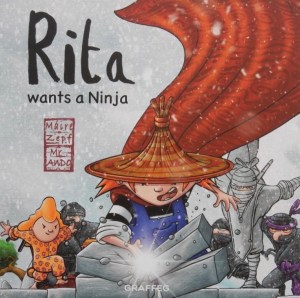
Is there no end to Rita’s demands? Seemingly not for now a game of hide-and-seek with her smaller sibling fuels a desire for her very own martial arts expert in the form of a ninja. How wonderful to have someone to instruct her in the art of stealth and invisibility. She’d learn how to control both mind and body as well as those shouts used when on the attack. However invincibility ninja style seemingly comes at a price –

a very big price and one she definitely isn’t prepared to pay after all. So it’s a resounding NO! for a ninja master …
Andrew Whitson’s expansive, action-packed scenes of Rita’s imaginings take readers along with the two children, into verdant Japanese bamboo forests and snowy landscapes wherein lurk fighting ninja clans.

Little Scoot
Rebecca Kai Dotlich and Edson Ikê
Boyds Mills Press

Perseverance no matter how difficult the situation, is key in this vibrantly illustrated American import.
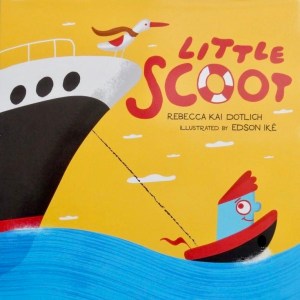
I was itching to tweak the beginning part of the rhyming text but like its little tugboat protagonist, I kept going, and happily it improved. Keeping going and not giving up is the essence of the tale of Little Scoot. Suddenly she receives an alarm call: a large barge is aground on a sandbank and in need of her help. With a gathering storm the tiny tugboat has to force herself forward, pushing through her fears and the splashing, sploshing waves, as she tries her level best to be brave. Eventually, there before her is the stranded Big Barge.
Will the tiny craft succeed in her rescue mission? Even in the most difficult situations, she certainly isn’t a quitter …

Catastrophe! / Noni the Pony Counts to a Million

These two picture books offer fun ways to introduce mathematical ideas to young children:

Catastrophe!
Anne Marie Stephens and Jenn Harney
Boyds Mills Press

This is a clever book about a crew of cats sporting either green or orange lifejackets that embark on a dinner-catching fishing trip. They begin well enough as they line up beside the lake with all their gear intact but then some of their lines become entangled and they’ve paid no regard for the colour of their jackets. ‘This is a CATastrophe!’ declares their leader, ‘We need a pattern.’ With the core pattern duly discovered the cats reorganise themselves ‘green, orange, green, orange and so on and climb aboard the canoe.
Captain Cat now calls the rowing pattern ’Row, row, meow’ to synchronise their paddle strokes but the kitties make a mistake which sends them into a spin. And so it goes on till the bait is dropped, but the fish have a trick under their fins and that leads to another CATastrophe …

Will this crew end up going hungry perhaps?

Author Anne Marie Stephens and illustrator Jenn Harney have created a simple, fun learning tale: youngsters will love to join with chanting the patterns, while also enjoying the playful scenes of the comedic crew.

Noni the Pony Counts to a Million
Alison Lester
Allen & Unwin Children’s Books

If you are looking for a number/ counting book that goes beyond ten, then join the lovable Noni for a whole day of counting fun that begins when she stops one morning beside one tree to watch her two friends Dave the dog and Coco the cat as they dance beside the sea.

From there Noni gives a ride to a trio of speckled hens, races with cows, then come encounters with some wallabies, the watching of swooping swallows (six), a game of puppy hide-and-seek (seven), followed by fluttering butterflies (eight) and nine spotty fish swimming through the reeds.
That takes us through to ten.


Unlike many counting books though, this one doesn’t stop there; rather it introduces ‘dozens’, ‘hundreds’, ‘thousands’ and finally, we see the three friends fast asleep beneath ‘millions of stars’.

Not only is this a delightful book about numbers, but with an interesting, short rhyming text well matched to Alison Lester’s playful scenes, it’s also great for beginning readers.

Hello Friend! / Bunny Braves the Day

Hello Friend!
Rebecca Cobb
Macmillan Children’s Books

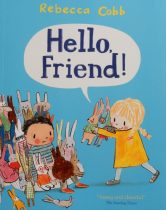
It’s the mismatch between what is said by the small girl narrator and what is shown in Rebecca Cobb’s enchanting, warm illustrations that make this book such a winner.

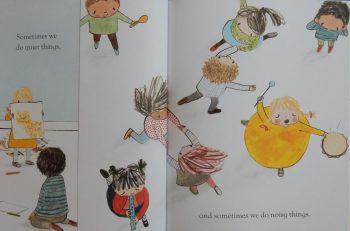
From the start the girl enthusiastically shares everything during playtime both indoors and out, at lunchtime, during quiet times and noisy ones.

What is evident though is that the boy on whom she focuses all this sharing attention is going to take much longer to feel ready to share in the well-intentioned advances of the little girl.
However, a friendship does develop …

and it’s one where both parties are equally enthusiastic about their togetherness.

This is a gorgeous story to share with youngsters especially those starting school; it offers plenty to reflect on and talk about, both at home and in the classroom.

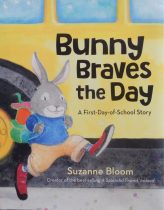
Bunny Braves the Day
Suzanne Bloom
Boyds Mills Press

It’s Bunny’s first day of school but he wants nothing of it: he doesn’t know anybody, supposes nobody likes him; his socks are too short, his shorts too long and he can’t tie his shoes. Oh woe!

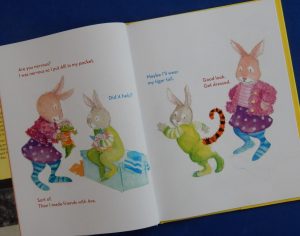
Big sister cajoles him with plenty of empathy and ideas,

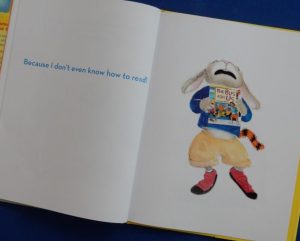
but with a hurting tummy, it’s decided … ‘I’d better not go … Because I don’t even know how to read!’

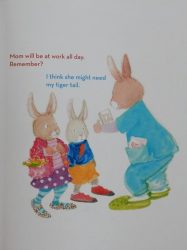
After more loving comments, ‘Sometimes you just feel like crying before you feel like trying. You’ll find a friend. Not all shoes use laces. And teachers love to teach reading…’ and listing things little bro. CAN do, he’s almost ready to surrender but not before one last try, ‘Mom will miss me.’ (Said parent has uttered not a word in all this, though she does take a photo).

Finally, it’s time to face up to the inevitable and once more it’s down to big sis. to deliver the final upbeat reassurance at the classroom entrance.

The entire text takes the form of the dialogue between the bunny siblings –blue for the new boy and red for older sister; while Suzanne Bloom’s watercolour and pencil illustrations highlight the feelings of the two characters beautifully.

Just right to share with little ones, especially in families where there’s likely to be starting school nerves; or with children in a nursery setting.

Animal vs Animal Who’s the Strongest? / Like a Lizard

Animal vs Animal Who’s the Strongest?
Kirsty Holmes
BookLife

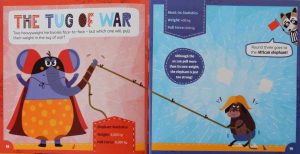
Welcome to the ‘Great and Small Games’. Essentially this show (it’s one of a series) comprises three strength events: The Tree Trunk Lift; Strong Bug Circus and Tug of War, each of which is refereed by a flag-waving racoon.
The participants are, for the bug event, dung beetle and leafcutter ant; silverback gorilla and grizzly Bear are the tree lifters;


while in the third round, an African elephant and a musk ox tug it out.

Two spreads are devoted to each pair of contenders and as the animals are introduced and perform, snippets of factual information surrounds them on banners or in bubbles,

but it’s never overwhelming thanks to the design of the pages.

A fun way to learn some animal facts, this book should pack a powerful punch with younger readers.

Like a Lizard
April Pulley Sayre and Stephanie Laberis
Boyds Mills Press

Let’s get physical and in so doing, through Sayre’s playful rhythmic text and Laberis’ expressive digital art, learn about more than 25 different lizards and some of the things they do.

So, for instance, ‘Could you drape like a lizard? / Gape like a lizard? / Do a push-up like a lizard? Scale sticks? / Curl in like a lizard?’

Each of the lizards featured is labelled with its common name and described after the main text, in a paragraph below the named behaviour illustrated in the narrative. Every paragraph provides factual information – Latin name, where in the world it’s usually found, length and other interesting details specific to the creature.

So, after an initial read aloud, can your little ones behave like lizards as you share this engaging book? They’ll certainly have fun trying and learn some herpetological facts in so doing. I wonder what they might do in response to this  …

Where’s My Jumper? / You Nest Here With Me / Let’s Count Vehicles / ABC Town

Where’s My Jumper?
Nicola Slater
Simon & Schuster Children’s Books

Meet Rudy: he’s lost his jumper – a pink one and a tad on the short side, but his favourite nonetheless.
The adorable little creature has searched everywhere, upstairs and downstairs, indoors and outdoors and round about. He’s looked in the bedroom, the kitchen, the bathroom, even underground. Where can it be? In his search he encounters a host of quirky creatures – tumbling cats, jiving llamas, prima pigerinas, ski-dogs, soapy blackbirds, jibber-jabbering sea creatures, muttering mice, three crocs,

and passing foxes but of his missing garment there is no sign.

Will your little ones find Rudy’s jumper before the end of the story.

With its die-cuts pages, flaps and lots of funky animals to count, it’s terrific fun and delivered through an enormously engaging text and equally frolicsome, bright, bold illustrations.

Hours of pleasure guaranteed with this sturdy board book that is bound to be read over and over …

You Nest Here With Me
Jane Yolen, Heidi E.Y. Stemple and Melissa Sweet
Boyds Mills Press

Making use of real scientific facts in the form of a narrative rhyming text, a mother and daughter team, Jane and Heidi, have written a delightful board book to share with your little ones at bedtime.

A human mother nestles her sleepy little daughter in for the night and then goes on to share with her the many ways birds bed down to sleep.
‘ … Terns all nest in colonies / Upon high cliffs, above rough seas. // But you nest here with me. // Some owls nest on oak tree boles, / Some down in abandoned holes, … ‘

Lilting and loving, the mother’s words are very easy on the ear, informing gently while helping to induce a safe soporific effect for the listener through the repeated use of ‘But you nest here with me.’

Working beautifully in tandem with the text are Melissa Sweet’s mixed media, gouache and watercolour illustrations executed predominantly in soft hues of green and blue.

As it originated in the USA, the names of some birds will be unfamiliar to UK readers but I’d still recommend this to share with the very young both at bedtime and as an introduction to birds and their nests and other elements of the natural world, at any time – perhaps before a nap or a snuggle together.

Let’s Count Vehicles
illustrated by Josh Cleland
ABC Town
illustrated by Tamara Petrosino
Highlights

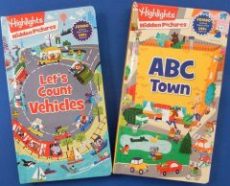
There’s plenty to interest pre-schoolers in these two ‘Hidden Pictures’ titles both of which have gatefold flaps beneath which are large busy illustrations of scenes within which spotters have to locate the items pictured on the outsides of the flaps as well as those mentioned in the question, for example ‘Can you find 9 trains and 10 cars?’

The various locations, which include in the counting book, a funfair in the park; urban sights, a building site and a harbour, are populated by anthropomorphic animals.

So too are the town scenes in the ABC, which depict shops of all kinds – including I’m happy to say, a bookshop; a hospital, garden centre and fire station. A library and museum and a karate centre dominate a double spread; there’s an urban park square complete with bathing pool; and a railway line traverses another spread.

Engaging, fun and educative too, both these sturdy board books are great for developing vocabulary and visual skills in addition to the mathematical and alphabetic elements of the titles.

Sea: A World Beneath the Waves / Dolphins

Sea: A World Beneath the Waves
Britta Teckentrup and Patricia Hegarty
Little Tiger

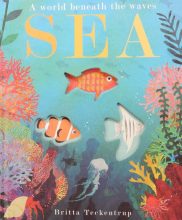
In her latest non-fiction, die-cut peep-through picture book, in a series of wondrous scenes Britta Teckentrup plunges us beneath the ocean waves, way, way down to view the wonders of the deep.

Amid the corals and seaweed fronds we see small fish, sponges, tiny graceful sea horses; a baby dolphin and its mother chirping and clicking in communication, a Lionfish with its poison spines ready to use should it be attacked.

Suddenly there’s a feeling of fear: the fish sense danger as a great white shark casts its shadow. The other sea creatures though, employ their defence mechanisms while the tropical fish swim in formation and all is well.

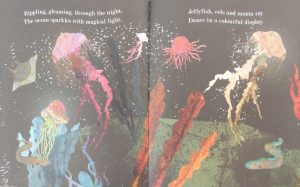
Night comes and the ocean is a-glow with light;

his song echoing far the humpback whale sings for all to hear, the manatee glides through sea grasses and the corals provide safe spaces for small ocean creatures.

Patricia Hegarty’s lyrical text ends with a plea to protect ocean life by keeping the oceans clean and free from rubbish.

Dolphins!
Laurence Pringle and Meryl Henderson
Boyds Mills Press

Pringle immediately grabs readers’ attention with his introductory ‘If you were a young dolphin, your mother would keep you close, feed you milk and teach you’ that could almost be referring to a human mother. The remainder of the paragraph however negates that with its ‘Soon you would learn to swim fast and catch fish to eat. And sometimes you would leap from the water, high into the air!’ while his final statement on the first page “People would be very curious about the secrets of your life beneath the surface’ sets the scene for the remainder of this fascinating book.

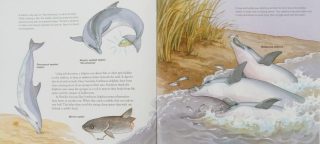
It covers many aspects of the thirty or so dolphin species including classification, morphology and physiology. There’s a fascinating account of dolphins’ use of echolocation;

another of feeding – dolphins are predators, consuming huge amounts of food daily –

and communication. I learned that in addition to sounds, dolphins send messages with their bodies, sometimes by rubbing skins, at others, by touching flippers.

All this and more is related in the author’s highly readable prose that is superbly illustrated by Meryl Hendersen in watercolour and pencil.

Although it’s likely that this will be read by individuals, this book also works really well if read aloud – a testament to the quality of the author’s writing.

Alone Together / A Number Slumber / The Bus For Us

Alone Together
A Number Slumber
The Bus For Us
Suzanne Bloom
Boyds Mills Press

Suzanne Bloom knows just what works for beginning readers; but much more important she knows what will help foster a love of books and reading in young children as these three books demonstrate.

Of the three my favourite is Alone Together, a Bear, Fox and Goose story wherein Bear endeavours to have some solitude.
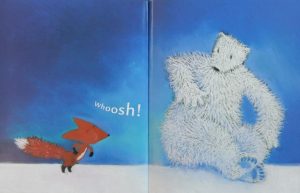
Fox however doesn’t seem to appreciate what this means as he bounces up to bear demanding to know, ‘Why are you all by yourself, bear? /Are you sad? / Are you mad? ? Are you lonely?’

The humour mounts when, following Bear’s ‘Occasionally, I like some quiet time.’ response, Fox agrees and proceeds to Hmmmmmm repeatedly, twirl and whoosh! around an increasingly agitated Bear who looks as though he’s about to tear his fur out.

But covered ears and eyes and other signs of his ursine friend’s increasing agitation have no effect on Fox, so Bear has to spell it out explaining that hush means ‘No noise! Quiet! Please.’

It now appears as though Fox might have worn himself out as open-mouthed, he topples back into Bear’s snuggly fur just before Goose reappears. With a seeming truce between Bear and Fox now in place, Goose demands to know if Bear has had sufficient alone time.
Perhaps that truce was a little short-lived after all …

A smashing piece of picture book comic theatre, this delightful tale unravels rather like a silent movie.

A Number Slumber is a lovely count down to bedtime animal style that begins by asking readers, ‘What do you do to get ready for bed?’

It goes on to posit a series of likely pre-bed activities – tooth brushing, listening to a story and more before turning the focus to other sleepyhead creatures.
There follows a series of lovely alliterative examples as ‘Ten terribly tired tigers tiptoe to their beds. Nine normally nimble newts rest their sleepy heads.’ And so on …

until ‘One really weary wombat yawns …’ and the final page shows a sleeping bundle … ‘just like you.’ Now who might that be?

Readers will have to turn back to the title page to confirm if their guess is correct.

You can count on this soporific delight to help send your little humans off into slumberland, thanks to Suzanne Bloom’s soft focus scenes rendered in gorgeous dreamy colours that accompany her rhyming text.

For vehicle enthusiasts especially is The Bus For Us that introduces a variety of vehicles. By means of a question and answer text and accompanying sightings of the traffic that passes the bus-stop at which a brother Gus, and his questioning sister Tess wait. (Watch that bus-stop as you turn the pages).

There’s much more to it than that though: plenty of action, involving both humans and animals, takes place as the queue for the bus increases …

until at last a yellow school bus arrives to pick up all the waiting passengers.