Which Food Will You Choose?

Which Food Will You Choose?
Claire Potter and Ailie Busby
Bloomsbury Education (Featherstone)

When Mum opens up the fridge one Monday and sees nothing but beige food items she decides to take the two small narrators straight off to the supermarket to find something more enticing, telling them they’re going to play a game. “But we can’t play games in the supermarket” comes their immediate response.
On arrival she invites her little ones to choose three foods but they have to be red.

Off they go selecting pepperoni, watermelon and a tin of tomato soup. ‘Which three of these RED foods would YOU choose?’ asks the author.

Back home they use the pepperoni as topping for the pizzas they make, chomp into slices of the watermelon (planting the seeds afterwards) and put the soup in a flask to drink when they visit the park .
The narrative then asks, ‘What would YOU do with the three red foods you chose?

A similar thing happens on Tuesday, Wednesday, Thursday and Friday with the children being asked select in turn three yellow, green, orange

and then purple foods.

Come Saturday Mum is caught beige-handed,

so on Sunday the children take things into their own hands …

This is a fun, non-judgemental approach to ‘picky eating’ that should definitely encourage youngsters to try some new foods and Claire Potter, the author includes two sets of notes to help adult sharers to ‘get the most out of ‘ the book.

To add to the enjoyment of the text, she uses some playful alliterative descriptions such as “Gorgeous, glorious, groovy green “ and ‘gazillions of green foods’ and ‘Zingy, zesty, zippy orange !’ … ‘oodles of orange foods’. and adults might like to extend the word play by asking youngsters to make up their own alliterative phrases for others of the foods labelled in Ailie Busby’s enticing spreads. The brother and sister certainly appear to be making the most out of their choices – its good to see wonky carrots and using the celery leaves to feed the rabbit – no food taste there.

There’s a wealth of potential between the covers of this little book, not only for – parents/carers but for foundation stage teachers too.
What’s Going On Inside My Head? / Step Into Your Power

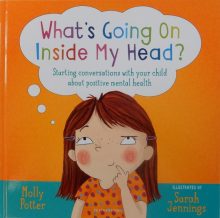
What’s Going On Inside My Head?
Molly Potter and Sarah Jennings
Bloomsbury Featherstone

Developing and supporting emotional literacy is, or should be, a crucial part of young children’s education in school and most teachers consider it so.

However, parents/carers can at times feel inadequate when it comes to talking to and supporting their children’s mental health, and at an increasingly younger age children come under enormous pressure be that through the education system (I could rant at length about that) or out of school in clubs and activities in which they participate, as well as through social media and advertising. What parents need to do is to love and support children not for what they can achieve but for who and what they are.

To this end Molly Potter, a teacher who specialises in PSHE has written a very helpful book to share with young children.

By means of twelve questions she explores a range of topics: how to think about oneself; the relationship between a healthy body and a healthy mind (how the former feeds into the latter);

the notion of happiness; dealing with emotions; coping with feelings of anger, sadness and fear; coping with negative thoughts that seem overwhelming (suggestions to prevent ‘ruminating’ and instead focusing on being in the moment); dealing with upsets triggered by another person (forgiving is important here).

There’s also a spread on meditation and its potential benefits;

another on who to ask for help when it’s needed; the role of family and friends as a supportive network; being a better friend and finally, improving one’s own thinking habits – being proactive when something is upsetting you.

Many of the topics includes a ‘top tip’ or ‘It’s good (or important) to know that …’ paragraph and I particularly like the coping plan

and the invitation to hold up a mirror to oneself and think about which behaviours ‘you like’, ‘don’t mind’ and ‘really do not like’.
The book concludes with three pages of guidance for parents and carers.

Throughout Sarah Jennings’ inclusive illustrations both support and extend Molly’s straightforward, sensible, practical words.

For an older age group is:

Step Into Your Power
Jamia Wilson and Andrea Pippins
Wide Eyed Editions

Here’s a book I wish I’d had when I was growing up. Both author Jamia Wilson (executive director of the Feminist Press) and illustrator/designer Andrea Pippins act as mentors in this, their guide to helping girls to grow into confident young women, cognisant of their strengths (and the areas they need to work at), and sufficiently empowered to step out and follow their dreams.

Subtitled ‘23 lessons on how to live your best life’, the book offers exactly that and made me want to go immediately and seek out some young females to share it with.

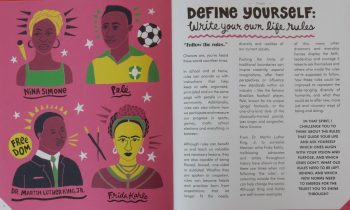
After an inspiring introduction, said lessons are organised into five sections entitled: Power, Community, Choices, Act! and Self-Care and all sections comprise several key elements each of which is allocated a double spread (or two) illustrated in vibrant colour by Andrea.

Thinking outside the box, abandoning old habits that are no longer appropriate in today’s richly diverse society, and not always following the rules, are explored and the author mentions as examples some visionary rule-challenging individuals.

Each topic has an encouraging and uplifting ‘Step into your power’ section.

Thoroughly recommended for upper primary readers and beyond.