STEMville: The Bee Connection

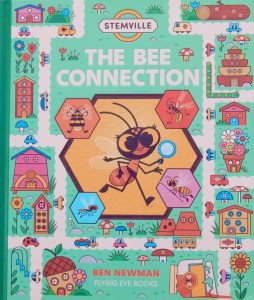
STEMville town is populated by creatures of all kinds, though there are no humans, and this story unfolds in Bug Borough where a solitary bee, Mason B. Chandler (love the name) has recently set up her new private detective agency. She is eagerly awaiting a case when she hears a loud CRASH! outside. There she discovers that the Bug Borough traffic – vehicular and pedestrian – has come to a halt; everything is stuck in a golden sticky goo. Mason tastes the stuff – it’s sweet and immediately she feels an energy boost. Honey, she thinks, but how has it got all over town?

Using the device of a private eye investigation, Ben Newman imparts a great deal of information about insects and the apian world in particular. We learn that there are three kinds of bees – solitary bees like Mason, bumblebees and the social honey bees (the ones that make honey). Bee anatomy is illustrated,
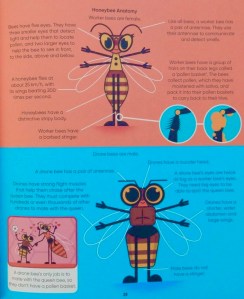
and how bees differ from wasps and hoverflies. The secrets of the hive are revealed, its architecture, layout, the various different roles of its occupants

and the intricacies of the waggle dance whereby bees communicate where to find the best nectar sources, as well as just how important they and other insects are in the pollination of the plants that provide us with the food we eat.

Mason solves the mystery of the honey spill: it was all down to that careless bee-keeper bear who eventually confesses to dropping the jar.

In Flying Eye tradition, Ben Newman’s book is all a-buzz with information presented through explanatory panels, lively cartoon style illustrations and diagrams. A smashing way to introduce children to a vital topic; it concludes with some brief bee friendly suggestions for readers.

Professor Astro Cat’s Frontiers of Space

Professor Astro Cat’s Frontiers of Space
Dr Dominic Walliman and Ben Newman
Flying Eye Books

Space suits on? Professor Astro Cat, along with his sidekick Astro Mouse is ready to take us on a journey through space: it’s a skyrocket tour of the solar system and plenty else too.
First he informs us about the Big Bang and the birth of the universe, and then with a spread each, goes on to explain the formation of stars and how they collected together to form galaxies.

Next we whizz past the sun, after which our feline prof. presents in turn, all eight planets of our solar system, Earth and the Moon.

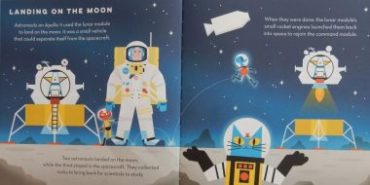
The practical aspects of space travel are covered in spreads on the early astronauts – animal and human. We meet the first moon-walkers, Buzz Aldrin and Neil Armstrong, as well their colleague Michael Collins who remained in the command module, while the others explored the moon’s surface. There’s a pause to discover some lunar information – did you know that due to lack of a wind and hence no erosion, the footprints those astronauts left will remain there for millions of years – wow!

There’s a chance to take a look at their Apollo spacesuits and some more modern ones, see some modern rockets, pay a visit to the International Space Station (ISS).

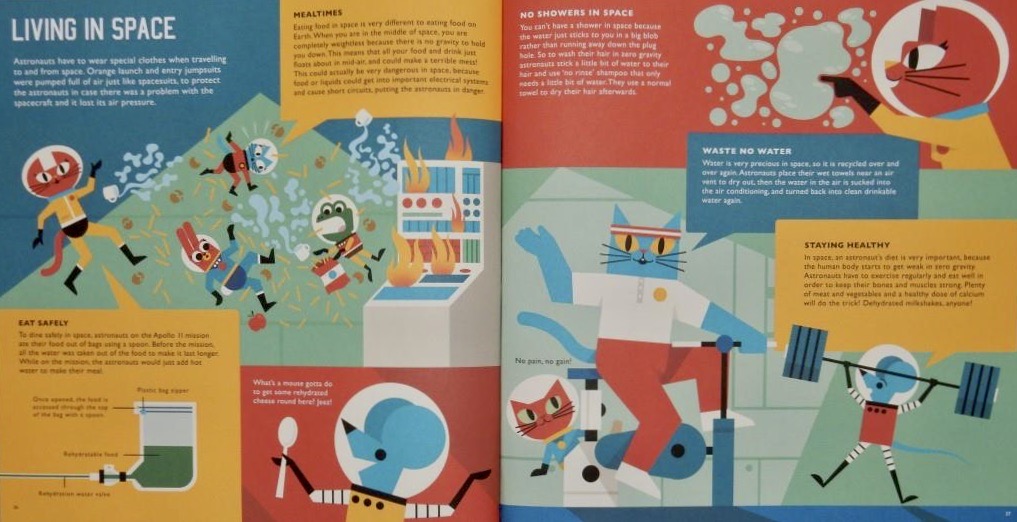
Then comes a consideration of what life in space might be like

and a whirlwind visit to each planet in turn starting nearest to the sun with Mercury and working outwards

and much, much more.

There’s also some speculation about possible ways the end of the universe might come about, the future of space and on the possibilities of alien life. Finally we have a fascinating factoids spread, followed by a glossary and index.

A whirlwind exploration indeed but it’s hugely informative and thanks to the Professor’s gently humorous, yet authoritative voice, accessible to young readers. Made all the more so by Ben Newman’s retro-style illustrations and the scattering of jokes throughout.

Professor Astro Cat’s Space Rockets

Professor Astro Cat’s Space Rockets
Dr Dominic Walliman and Ben Newman
Flying Eye Books

With Brian Cox-like charisma, Walliman and Newman’s Professor Astro Cat blasts off on a new adventure, launching us into space courtesy of the prof. It’s he that describes first, in easily comprehendible terms for young readers, the workings of rockets.

Next comes a brief (and selective) ‘History of Space Travel’ that begins in 1947 with fruit flies, and is followed by Laika (her reportedly ‘painless’ death in orbit is not mentioned), monkey Albert and then in 1961, Yuri Gagarin, the first human space traveller who managed to orbit the earth.

The huge Appollo 11 features thereafter with the famous first moon landing of two of the crew’s three astronauts in 1969.

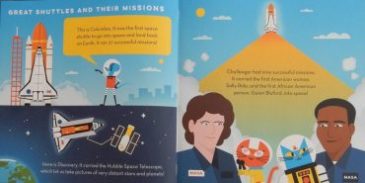
Readers also hear of ‘Modern Space Shuttles’: Columbia, Discovery (that carried the Hubble Space telescope), Challenger that was especially memorable for carrying Sally Ride the first American woman, in space and the first African American, Guion Bluford.

Looking to the future, the final spreads are devoted to NASA’s work in progress, Orion and the Space Launch System; the possibilities of space tourism for ordinary mortals, a brief mention of star travel and on the last page, a short glossary.

In all this, the Prof. is accompanied in Ben Newman’s characteristically stylish retro looking illustrations, by his two pals, the similarly clad feline and sidekick mouse.

Sufficiently powerful to send the youngest of primary children rocketing on their way towards becoming ardent space enthusiasts, and into potential science careers I suspect.

Professor Astro Cat’s Human Body Odyssey

Professor Astro Cat’s Human Body Odyssey
Dominic Walliman and Ben Newman
Flying Eye Books

It’s time to join Professor Astro Cat and his crew on another amazing journey, no not a blast into the depths of outer space, rather a dive into a much more confined space, our very own bodies. Pretty awesome machines they are too; and one body in particular, that of test subject Dr Dominic Walliman. We join him and of course, Professor Astro Cat and his pals in a close up look at human biology.

First off they remind us of the seven characteristics of living things and we discover why we’re not robots!

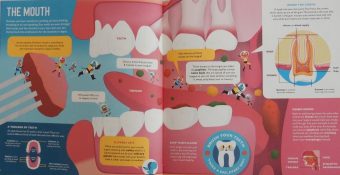
Thereafter comes a look at our cellular structure, our skeleton, our muscles – did you know we have more than 640 intricately arranged skeletal muscles. Further investigations require the gang to become microscopic to check out our skin, our sensory organs; (our teeth as well as our tongue are inspected within the mouth).

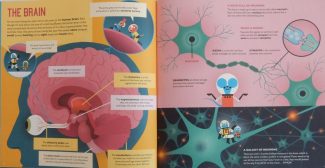
Of course, without our brains we’d be pretty much unable to function, so next we take a look at that complex supercomputer-like mass– its composition, its functioning and how it operates in conjunction with the nervous system.

Other vital organs we learn about are the lungs, blood – not an organ but vital nonetheless, the heart, and those dealing with digestion and excretion.

There’s a page each on the lymphatic system,

the endocrine system and the immune system, all of which are crucial for a fully functioning body.

Reproduction, human development and genetics have a double spread each and since it’s vital to keep healthy, the Prof provides info. on that topic too, as well as touching upon medicine and what to do if we’re poorly.

The concluding topics are ‘Impairments’, which shows how incredibly adaptable both our bodies and minds are, and we even get a glimpse into how future technologies might change humankind – wow!

All this is presented in a splendidly visual format similar to Walliman and Newman’s previous Astro Cat science offerings. It’s packed with information, enormous fun and with a final index, this is altogether a terrific book on a topic that fascinates almost every child I’ve ever come across.

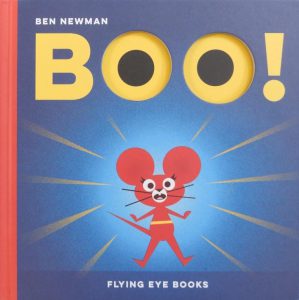
Boo!

%0a

Boo!
Ben Newman
Flying Eye Books
No one is as brave as me and nothing scares me … you’ll see!” That’s the claim of the tiny stick-wielding character on the first spread of Ben Newman’s latest offering. (If you’re familiar with the awesome Professor Astro Cat books you’ll recognise him as their illustrator.)

%0a

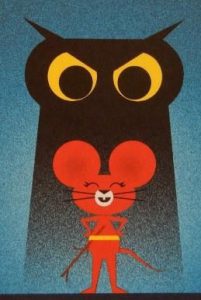
Turn the page and you’ll immediately see this is far from true …

%0a

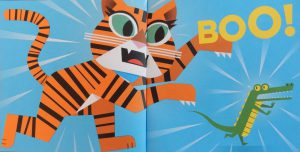
and then it’s a case of a series of claims to be the wearer of the ‘bravest’ mantle as an owl, a mischievous monkey, a toothsome, jaw -snapping croc, a leaping tiger …

%0a

and finally, a stampeding elephant all BOO! the previous pretender clean off the page.
Abolutely no one is as brave as me and nothing scares me!” asserts the latter super-confidently. Make no mistake about it; he does NOT have the final word …
Such a satisfying circularity herein and part of the fun is in the anticipation of the next BOO and the hooting, giggling, growling, snorting opportunities presented as each animal introduces itself. Oh, and that ‘nothing scares me … you’ll see!’ is repeated by each claimant, making it ideal for beginning readers to join in with on subsequent sharings of which, I foresee, there will be many.
Stylish and oodles of fun!

Professor Astro Cat’s Atomic Adventure

DSCN0809 (800x600)

Professor Astro Cat’s Atomic Adventure
Dr Dominic Walliman and Ben Newman
Flying Eye Books
Professor Astro Cat is one cool guy; if only he’d been around when I was learning physics. His “join me” invitation is one not to be ignored as he takes his readers on an amazing journey of discovery.
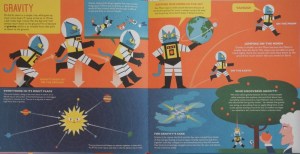
First stop, Gravity. Very important – if it weren’t for that invisible force, we wouldn’t be on planet earth at all, we’d all be floating around in space.

DSCN6815 (800x411)

It’s also the reason the Earth and the Sun – this exerts a massive gravitational force keeping the planets in orbit – were created. Awesome!
Next is an explanation of the Scientific Method; key here is making a hypothesis. Plug for the imagination for without it, no hypothesis; and as we know, the biggest fueller of the imagination is literature. Of course one needs to test that hypothesis (scientific guess), observe, record results and compare hypothesis and results. A vital element of experimentation is Measurement be it of length/distance, time, temperature, weight and mass. Our Prof. sums it all up here …

DSCN6816 (800x410)

Next tricky question: What is everything made of? Atoms – yes but those break down into …

DSCN6817 (662x800)

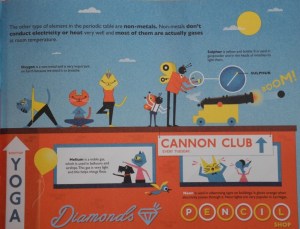
Moreover, they exist in three forms (at room temperature that is) solid, liquid and gas and the different kinds of atoms are called elements; they’re what are organised on that chart you’re likely to find in a school science lab. the Periodic Table. Professor Astro Cat explains the significance of this nifty piece of documentation and much more in A World of Atoms before going on to discuss Metals, which is what most elements in that periodic table are, the others being mostly gases. Don’t you just love the playful juxtapositioning here:

DSCN6818 (800x613)

But then playfulness is the essence of this whole mind-boggling book. It would be impossible in a short review to mention all the exciting areas the Prof. explores but crucially he makes the world of physics so accessible and understandable. Of course, the explanations themselves are only one half of the equation. Ben Newman’s busy, retro style illustrations are bounties of graphic genius and it’s the amalgam of words and pictures that really makes this one such a cracker.
(One small mistake I noticed is that we’re told ‘A clover has 3 petals … ‘ It has 5; 3 is the number of leaves, strictly speaking, leaflets.) All in all though, a real blast, you might say.
But let’s give the Prof. himself the final say:

DSCN6819 (800x435)

Use your local bookshop    localbookshops_NameImage-2