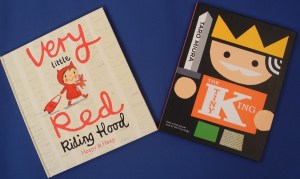
Very Little Red Riding Hood
Teresa Heapy and Sue Heap
David Fickling Books
With Red Teddy in hand and blanket, tea-set and a box of cakes safely stowed in her pull along bag, Very Little Red Riding Hood sets out to her Grandmama’s for a sleepover. Before long, what should she meet but a Wolf. “A Foxie!” she cries in delight giving him a big hug. More than a little put out at her lack of fear and her refusal to give him a cake, the Wolf suggests gathering a bouquet for Grandmama. Red – insists our feisty young heroine, inviting ‘Foxie’ to a game of chase all the way to Grandmama’s and a ‘cuppatea’ when they get there. But is this a step too far? Well, there’s a rib-tickling ending but if you want to find out what happens, then get your hands on this sweetly funny variation of the traditional story.
With her toddler talk and winning smile, Very Little Red Riding Hood is an absolute charmer.
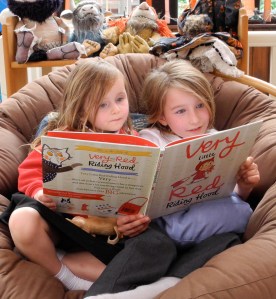
Rosa and Nina sharing Little Red’s exploits
The end papers show the route she took to her Grandmama’s house but also a number of other homes occupied by ‘Very Little’ fairy tale characters. Is this then the start of a series? I do hope so. Certainly this first time collaboration between Heapy and Heap is a whole heap of fun.
Buy from Amazon
The Tiny King
Taro Miura
Walker Books
In a castle far away lived a king. But the castle was very, very big and the king was a very, very Tiny King. The Tiny King had a big army and a big, big table for his meals but delicious food isn’t much fun if you’re all alone. It’s a good thing then, that the Tiny King fell head over heels in love with a princess, albeit a Big Princess and she agreed to be his wife. Before long, the Tiny King and the Big Queen had lots of children and what seemed like a very big castle for one Tiny King now felt just right with ten children playing and laughing the whole day.
Of course, big families mean lots of sharing: sharing meals, sharing the space on the big white horse’s back and sharing a riotous bath time; and what comes of sharing? Happiness; certainly that’s so in the case of the Tiny King.
Japanese artist and author, Taro Muira uses precision, patterned cut-outs in bold, bright colours and white, to construct simple shaped collage scenes, which stand out dramatically against flat black backgrounds. These scenes remind me of scenes from young children’s small world and construction play.

Told in a straightforward manner, this simple neo fairy tale is a delight to share with under fives.
(Quite apart from the story, there is a wealth of learning opportunities here: talking about sharing, counting, identifying shapes, mathematical language and concepts relating to size, pattern making, block play, collage and small world castle play.)
Buy from Amazon
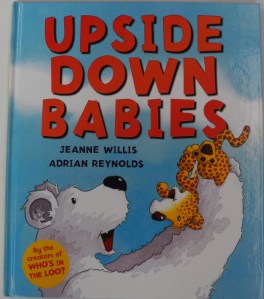
Upside Down Babies
Jeanne Willis and Adrian Reynolds
Andersen Press
There is a lovely twist at the end of this funny rhyming tale of a world turned upside down when ‘the earth went blue and the sky went brown.’ On this fateful topsy-turvy day, all the baby animals find themselves with the wrong mothers. What is Mummy Camel to do when confronted with a baby Polar Bear in the middle of the desert and baby Rooster’s dawn greeting of “Cock-a doodle-dee” definitely does not go down well with a sleepy Mummy Owl trying to get some shut eye in her tree.
With its bold, bright, wonderfully expressive pictures of the consternation all round, and a text that trips off the tongue, this is one to share with the under sixes and will prompt many an encore to the huge enjoyment of readers and listeners alike.
Buy from Amazon
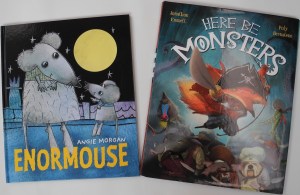
Enormouse
Angie Morgan
Frances Lincoln Children’s Books
Enormouse was big; much, much bigger than all the other mice in Mouse House. But being big had its advantages. Enormouse could lift REALLY heavy cheese, reach high up things and give lifts to tired-legged little mice. One day while out exploring he and his best friend Tinymouse find a large book with pictures of furry animals. That’s when Tinymouse concludes that his pal is actually A RAT. How the other mice laugh at poor Enormouse. Off he goes to find a new home with the rats but, what a shock he gets on arriving at ‘Rats’ House’; there’s mess everywhere. His offer to clean up is laughed at and once again Enormouse feels at odds with his housemates. In the meantime, his mouse friends have seen the error of their ways and set off in the hope of bringing their absent friend back home. But it’s now dark and they don’t know where to go…
From the mouse photo portrait endpapers, every turn of the page brings much to talk about and explore in the mixed media illustrations. The squalor of the rats’ house is truly disgusting with the grubby rodents lolling amongst half eaten fruit, discarded chips, over-turned cans, fish bones, filth and flies. You can almost smell the pong.
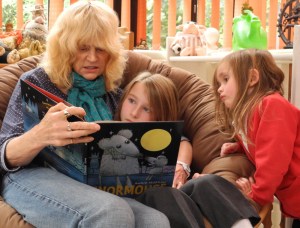
Rosa couldn’t resist coming to see what we were so disgusted at.
The story too offers plenty of food for thought with its themes of not judging by appearances, self-belief, friendship and finding ones place in the world.
Buy from Amazon
Here Be Monsters
Jonathan Emmett and Poly Bernatene
Macmillan Children’s Books
With the fiercest pirate crew and the fastest pirate ship, fearless Captain Cut-Throat is the meanest pirate to sail the seas. So, when he hears of an island strewn with giant gemstones he is determined to set sail straight away. His crew members though are far from happy; monsters are hiding in the mist, so the legend tells. At first all goes well but then they reach the MIST from which emanates all manner of alarming sounds. “Sail on!” commands the Captain and they do – into the swirling white. ‘ “Here be monsters!” cried the lookout…
‘ “Nonsense!” growled the Captain. “Monsters simply don’t exist.” ‘
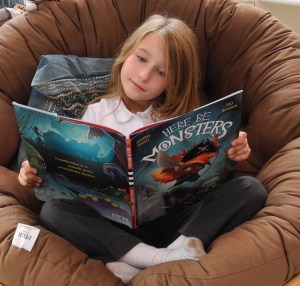
And so he maintains, heading on, unaware of the diminishing crew numbers, until an island comes into view. Once ashore, the penny finally drops but undaunted, the greedy Captain has his mind only on those giant jewels littering the shore. Oh foolish one!
Emmett’s riotous rollicking rhyme rattles along apace and when read aloud, it will have delighted audiences joining in with the repeated refrain of the fearless captain, as they see what he does not – his crew disappearing one by one.
Poly Bernatene draws his inspiration for the dastardly crew from the less attractive members of the animal kingdom with crow, rat, crocodile and blue-bottomed baboon all featuring. The almost filmic quality of his arresting illustrations adds to the dramatic impact of the story.
Buy from Amazon


 Red Reading Hub - Jillrbennett's Reviews of Children's Books