Gordon in the City / Huxley and Flapjack Wild West Escape

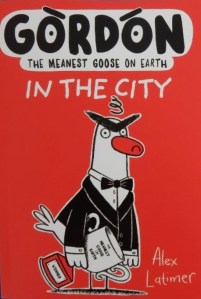
Gordon the erstwhile ‘meanest Goose on Earth’ is now, thanks to Anthony the Piglet, a reformed character. Indeed it’s been almost twelve months since he started trying to be good.
One day as he walks home feeling happy with his new self, he sees a letter pinned to his door. It’s an invitation to present the trophy for the Meanest Goose on Earth to this year’s winner. Hmm!
Being the great friend that he is, Anthony says he’ll disguise himself as a goose and accompany Gordon to the City for the presentation.

This he does and the two arrive expecting one of the four previous runners-up to receive the award. That however, is not what happens. Big surprise or rather, shock horror for Gordon when he discovers the winner. Moreover he and Anthony are invited to stay with her. Not a good idea at all as Gordon rapidly discovers.

Next morning Anthony has disappeared and Gordon starts reverting to his old wicked ways under his host’s influence. Fortunately he comes to his senses and having been told that something dangerous has happened to his friend, Gordon knows he must save him. Is there anyone or any goose, he can call upon to help and if so, what will be the outcome?

I know lots of young solo readers who will be honking their loudest for Gordon and Anthony in this their 4th adventure and looking forward to the next one.
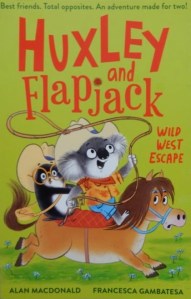
Best friends Huxley the koala and Flapjack the penguin return in a third story and what an adventure they have when they sign up for a job as cowhands at Daisy Bank Farm. This is because Huxley wants a new guitar and has spent all his money. He even goes so far as to tell Dolly the farmer that they can horse ride but on their very first day things start going wrong. However they make it through to sundown when the cows are returned to their pen at Daisy Bank, safely behind a shut gate, so Huxley assures his friend.

Next morning, shock horror! The cattle pen is empty and after looking all over the farm, off they set to search further afield. Eventually they reach Bull Bottom Farm owned by Big Bull. The curmudgeonly fellow insists that all the cows on his land belong to him and are marked with a letter B. But is he telling the truth and if not can Huxley and Flapjack work out which are Dolly’s and get them back to their rightful owner? Could music be the solution?

With an abundance of daftness, this foray into the world of cattle farming is full of action, a bit of guitar strumming and Francesca Gambatesa’s fun colour illustrations. It’s just right for those ready for first fiction books.
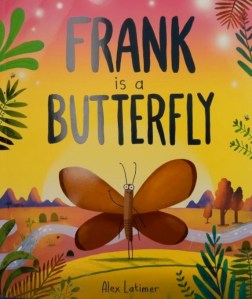
Frank is a Butterfly

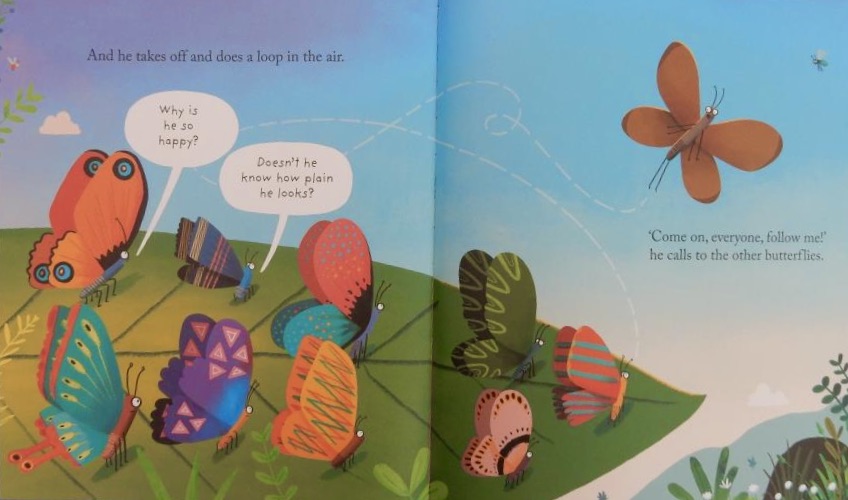
The story starts with ten caterpillars of various shapes and sizes all munching on a leaf for breakfast. There are caterpillars small, caterpillars large, caterpillars short, caterpillars long, hairy caterpillars and hairless ones and nine have a spotty and stripy pattern of some kind. The tenth one, Frank is brown and bears no distinctive marks. In between nibbles the nine talk of the kind of butterfly they will morph into. One says ‘magnificent’, another ‘handsome’, a third the prettiest … on Earth’, the fourth ‘fabulous’ and so on. Frank, in contrast says nothing; he’s ‘happy to be a plain, medium-sized caterpillar on a leaf in the sunshine.’it’s not long before the caterpillars turn into chrysalises to await their transformation.
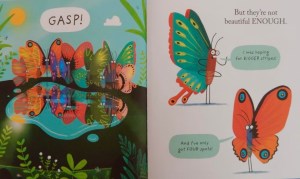
When they emerge from their chrysalises, despite looking gorgeous, nine of the butterflies are thoroughly dissatisfied with their appearance: they definitely do not live up to their expectations.

Finally Frank appears and he’s elated with his plain strong brown wings that will enable him to take to the air: he anticipates a world of flowers.

After some time, thanks to Frank’s positive example,

the other butterflies realise that what is more important than appearance is being free to explore the beauty around them without that nagging feeling that you’re not enough.

Alex’s richly hued scenes have a gentle humour about them that ensures that the important messages about self-acceptance and self-possession in his words don’t weigh heavy.
(After the story there’s a page showing Frank’s life cycle from egg to butterfly.)

A book for family bookshelves and KS1 class collections.

Gordon Wins It All

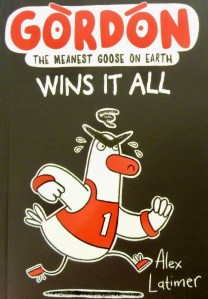
Another honker of a tale about a goose – the meanest goose on earth – who continues with his endeavours to be a good goose. The trouble is he starts to fantasise about being so good that he becomes Mayor of Grover Gardens. As a result it only takes a kind deed by Mrs Elephant, followed by the unexpected appearance of one of his old cronies from the Meaneest Goose Society to make him start to regress. He organises the first ever Grand Tournament for Grover Gardens residents, planning to win every single event and maybe, just maybe, helped by Anthony’s training schedule, if things go as he hopes, he’ll soon have that mayoral chain of office round his neck. The trouble is the other contestants in the events are rather better at their respective sports than Gordon anticipated.

Has the goose got the prowess at long jump, sprinting and javelin throwing to win, or will he fall victim to temptation and cheat his way success?

With a vital message about honesty, this is a very funny story with Alex Latimer’s superb illustrations adding greatly to the humour: Gordon’s facial expressions and laugh-out loud eyebrows are simply splendid.

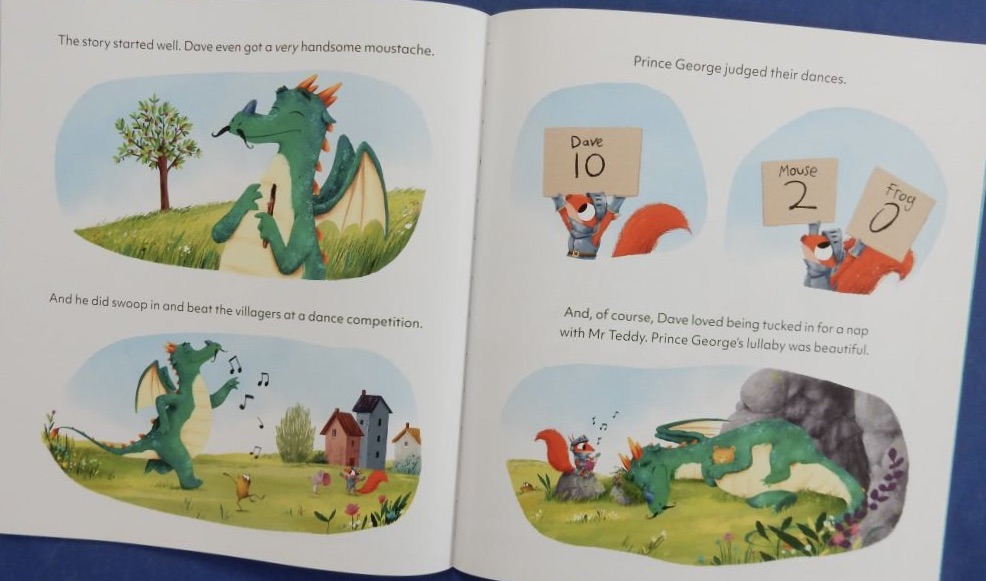
Dragon Dave The Not So Brave

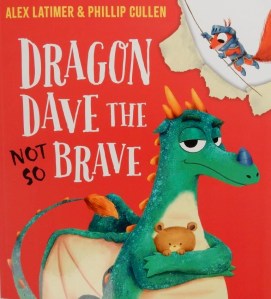
Stuck in a storybook with an ending he really dislikes, dragon Dave the Brave desperately wants to get out.

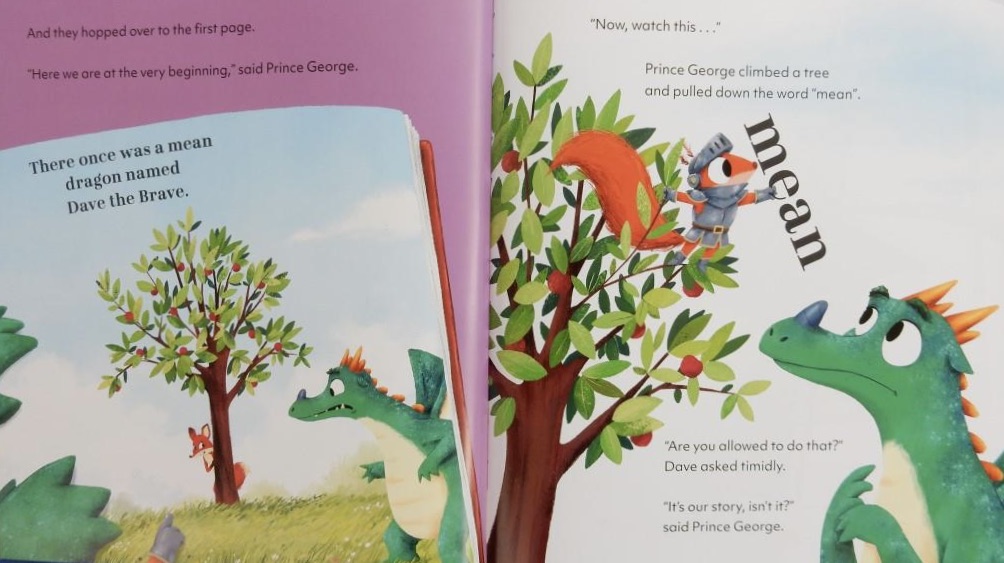
One day as he sits beneath a bridge tinkering with some of the letters from the title page, along comes Prince George. The prince notices that Dave looks sad and on learning the reason, he shows Dave that his story words can be rewritten. Starting from the first page, they identity the unsatisfactory parts

and proceed to make substitutes till they reach the end.

Then back to the start they hurry

and the dragon in particular is thrilled with “the Best ending Dave had ever had.’ As you might expect, Dragon Dave is hugely thankful to the prince. He offers him a turn with the writing stick but it’s already in use …

An empowering story that shows we can all rewrite our own stories and that it’s fine to ask for and accept help – Dave and Prince George are both endearing characters and the witty final twist is great fun.
Captivating too are Philip Cullen’s bold, bright scenes and the expressions on Dave’s face especially show so much about his changing feelings.

Daring to be different is the way to go: let these two protagonists show young children the way.

Gordon Starts a Band / Marv and the Alien Invasion

Both these are additions to series ideal for newly independent readers – thanks to the publishers Oxford Children’s Books for sending them for review.

Gordon the goose is back and despite being dubbed the meanest goose on earth, he’s still trying to be good: that’s thanks to his now best friend, piglet Anthony. However to say Gordon is a totally reformed character is perhaps over-stating things, despite his best intentions. After a day of kind deeds Gordon cannot sleep, so when he meets up with Anthony the following morning he’s in a honkingly bad mood thanks in no small part to the terrible noise that kept him awake all night. A noise so bad Gordon feels that unless he discovers what’s making the sound and can put a stop to it, he’ll revert to his former mean self.

So he and Anthony start to follow the noise until they reach the darkest part of the forest and in a nearby clearing there is the perpetrator. It’s Edgar the Moose and what he reveals to Gordon and Anthony shocks both the friends. However the former thinks he should try to put things right but this proves much more challenging than Gordon could ever have imagined. It even involves a rendezvous with members of the Meanest Goose Society so Gordon can enlist their help in a scheme he has. With a considerable amount of thumping and banging, la-la-ing strumming and singing, all ends on a high with Gordon slightly further along the road to redemption.

Alex Latimer serves up another slice of delightful wry silliness that will have young solo readers backing Gordon all the way to the final page whereon we see a blissfully sleeping goose – err?

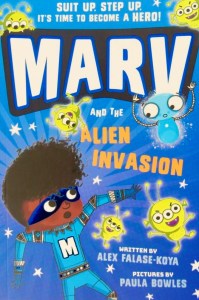
Marvin’s seventh adventure is set in a Space Centre that his class visits; it’s a trip involving an overnight stay. On arrival their tour guide Jessie greets the group and shows them where to leave their bags. This means that Pixel, Marvin’s tiny robot, will have to remain stashed in his backpack until all his classmates are asleep. First they go to the planet room where a display of the solar system’s planets hangs from the ceiling. Suddenly Jupiter falls from its fixing almost crashing onto Marvin’s friend Joe: was it mere accident or something else?

Next comes the rocket room wherein there stands a gigantic replica of a space rocket, alongside which is a life-sized replica of a control room. Unexpectedly the control panel lights up and starts beeping loudly -a loose connection? The final surprise before bedtime is when their guide dims the lights and projected onto the ceiling are the constellations. As they gaze upwards a potato hits Joe on the head and shortly after there appears the figure of supervillain Cosmic, and his little alien friends. Chaos ensues in the form of a food fight.

Time for Marvin to don his super-suit and morph into Marv the superhero. Out of Marvin’s bag too comes Pixel. But then Cosmic snatches up Pixel saying he’s going to take her to robot planet where she belongs and hauls her into the centre’s rocket. Can Marv do something before the rocket blasts off into space?

Another episode of MARVellous fun for those just taking off as solo readers from team Alex and Paula.

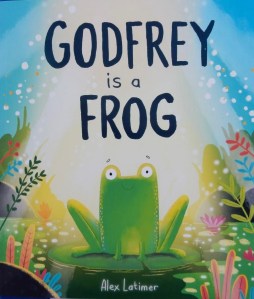
Godfrey is a Frog

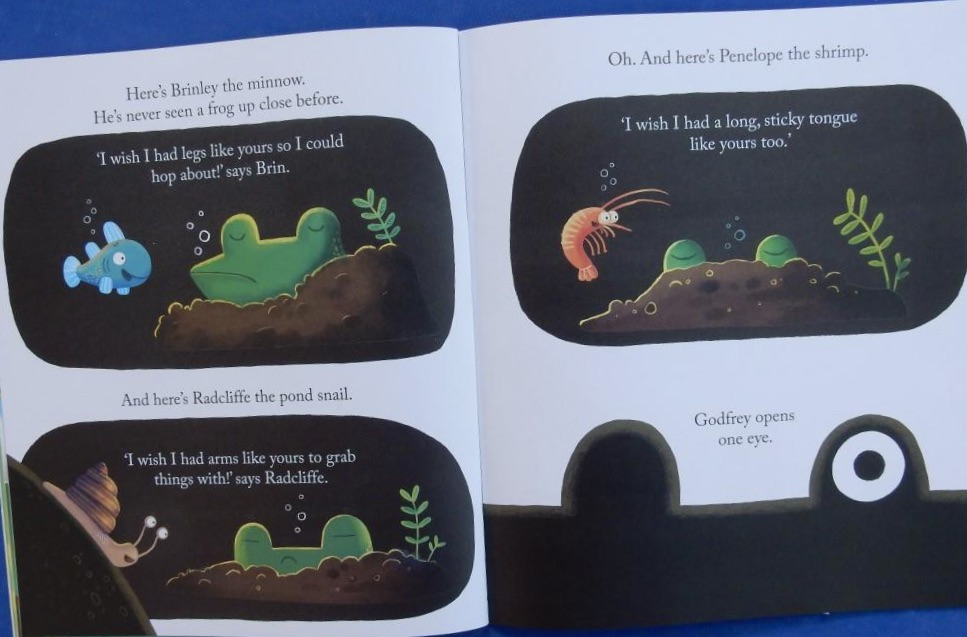
After undergoing the usual changes from tiny egg floating in a pond, Godfrey has become a frog. He sits atop a lily pad eagerly anticipating the next change but weeks pass, then months and he’s still the same two armed, two legged, long, sticky tongued frog.

As he looks around at the other creatures he decides they’re all way more exciting than he is. Then having made a final inspection in the hope he might have missed a new development. Godfrey plunges into the pond, right to the bottom, where he immerses himself in the mud. Up swims minnow, Brinley. “I wish I had legs like yours so I could hop about!” says the fish. Other pond creatures also express a wish to possess features like Godfrey’s.

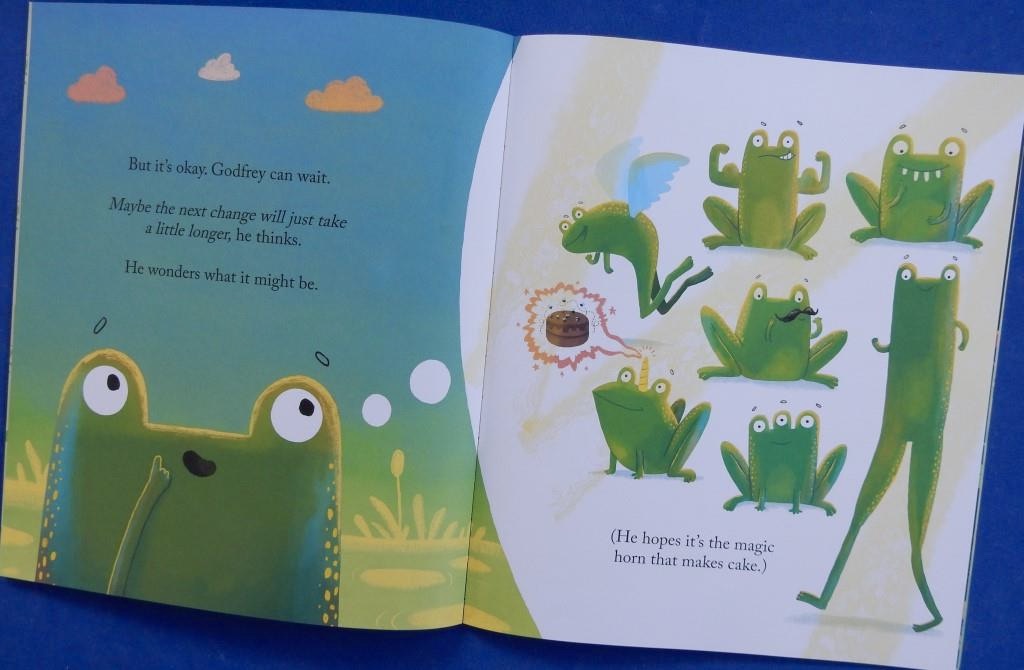
The frog ponders upon their words for a while. Maybe now something else is changing – something within. Is Godfrey finally ready to accept and appreciate himself and his fabulous frogginess.

Alex Latimer’s fabulously funky portrayal of Godfrey will ensure he endears himself to young audiences who will love being in the know about a frog’s life cycle. (Just in case any have yet to learn this, there’s a pictorial spread showing how it happens after the story).

Listeners will love the alliterative phrases in the text and Alex’s playful scenes, especially those showing Godfrey’s protruding tongue and imaginings about possible changes.

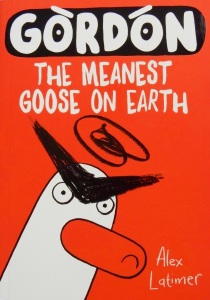
Gordon the Meanest Goose on Earth

Gordon the goose is thoroughly mean, way more mean than any of the other geese on the entire planet biting and snapping, shouting and imposing impossible tasks on his fellow geese and any other creature unlucky enough to encounter him. He even goes so far as to make lists of mean things to do before setting out each day to make life miserable for anyone and everyone in the seaside town of Grover Gardens.

On this particular day he heads first to the zoo where, having donned a zoo-keeper’s hat and shirt, sets about his mean activities. These he continues throughout the day until having departed the zoo, he makes for the promenade, there to scare the wits out of a baby. As he rehearses his nasty words he finds his path blocked by Anthony the Piglet, the very same piglet that he’d directed towards an open tiger’s cage earlier. In his trotter Anthony holds a flower; this he hands to a surprised Gordon.

With his chance at shouting at the baby gone, Gordon heads for home and having placed the flower in water, lies awake all night pondering upon having been given a kind gift.

Next morning he sallies forth determined to forget the flower and resume his mean acts, in particular punching a shark in the belly from within. The result is utter failure: could Anthony and that flower be the cause? Maybe a consultation with fellow members of the Meanest Goose Society will help. A plan is made and Gordon confronts Anthony demanding to know why he gave him the flower. How the piglet responds causes Gordon to set out for the beach again the following day, where a startling understanding suddenly dawns as he chats with Anthony.

Another day goes by with the writing of an invitation, another meeting with Anthony and the utterance of some words that the goose finds very difficult to say. Could saying ‘I’m sorry’ be the bravest thing Gordon has ever done in his entire life.? And could it mean a very different way of being for a certain goose?

This is picture book creator Alex Latimer’s first foray into books for new solo readers and with its numerous laugh-out-loud moments and comical, cartoon-style illustrations made with a few deft strokes of his pen, he’s got a winner here.

Ray

Ray
Alex Latimer
Oxford Children’s Books

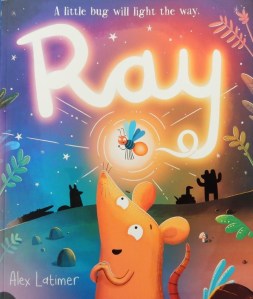
Such were the delights of Mouse’s walk that the little rodent failed to notice the lateness of the day.
After the sun has disappeared he sits alone frightened at the prospect of going home in the dark. Then from within a flower, there comes a glow and from it emerges a firefly; she introduces herself as Ray and offers to light Mouse’s way home. A grateful Mouse accepts but denies being afraid of the dark and off they go.

Mouse follows his guiding light but suddenly stops at the sight of a shadowy shape – ‘a snake’ coiled ready to strike, he thinks. Fortunately he’s mistaken and Meerkat, also not afraid of the dark, joins the travellers. After a while there’s a cry of “A bear! We’re done for!’ Ray investigates and informs her followers, it’s a pair of hens roosting . As you might expect said hens are not afraid of the dark either and off they go again, Mouse, Meerkat and two hens led by Ray until …


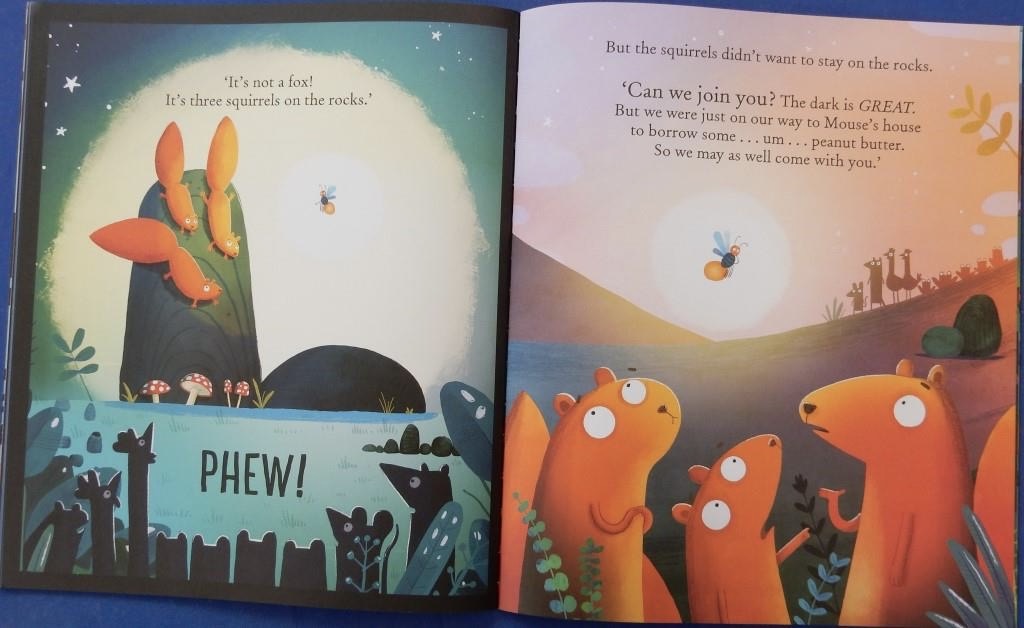
The journey continues with the addition of five green frogs and three squirrels, all of which have ‘reasons’ for joining the entourage, and each being welcomed by the words “Of course, … I’m Ray and I’ll light your way.’

Eventually in front of them a lion shadow looms large. Now Mouse, well used to being bamboozled by shadow shapes says, “ … that’s not a lion at all! That’s my home.’ He tells Ray to illuminate the shape, which she does.

Here our story takes a sudden dramatic turn … confessions re the dark are forthcoming and then a certain firefly proffers her oft repeated promise once more.

Deliciously tongue-in-cheek, Alex Latimer’s travellers’ tale will de-light young listeners, as well as adult readers aloud who will be amused at the excuses given by various animals for wanting to be led by Ray’s light. I have no doubt Alex Latimer had great fun creating his shadow shapes and he might well inspire children to experiment with a black crayon, paint, oil pastel or even play around cutting black paper.

Food Fight

Food Fight
Alex Latimer
Oxford Children’s Books

Brimming over with wit and humour is this story of young friends Grape and Mushroom. These two have a problem though. Since way, way back in time and for reasons completely forgotten the Vegetables and the Fruits have been bitterly at odds, hurling insults at each other and attempting to put paid to the friendship between Grape and Mushroom. 

Now things have escalated so much that the two young ones hide themselves away during the fighting to discuss what, if anything can be done about this constant warfare.

They decide to ask the advice of the Wise Old Cheese – if such a being even exists – said to live, if the legend is correct, on the Top Shelf of the fridge. This entails scaling the heights on a perilous journey through blizzards and quicksands, each encouraging the other through the worst parts. (Beware of the puns). Finally, utterly exhausted Grape and Mushroom reach the object of their search. 

Wise Old Cheese, exceedingly old, stinky and a tad mouldy, is fast asleep on that Top Shelf. Having explained their plight, the wedge promises through its moustache to think about the problem, but then promptly falls fast asleep once more.
Very disappointed, the friends return, find the Fruits and Vegetables still battling and are about to part company when they become aware of a ‘mysterious milky light’ accompanied by ‘a familiar pungent pong’. 

All squabbling ceases as there before them is the wise Old Cheese. The mouldy wedge announces the purpose of his visit and draws their attention to Mushroom and Grape, wonderful examples of cooperation united in a single purpose.

And so it is that the two factions, impressed at what they’ve heard, decide they have rather a lot in common and resolve to try peaceable living.

With a plenitude of wordplay, speech bubbles, splendidly expressive garden produce and instantly recognisable kitchen equipment, this is a delicious story demonstrating the all-conquering power of friendship and the importance of focussing on similarities not differences.

Pip & Egg

Pip & Egg
Alex Latimer and David Litchfield
Scholastic

This week for the first time in many months I’ve been able to spend time with some of my very close friends and I know just how important strong bonds of friendship are. This poignant story is a demonstration of what true friendship really means.

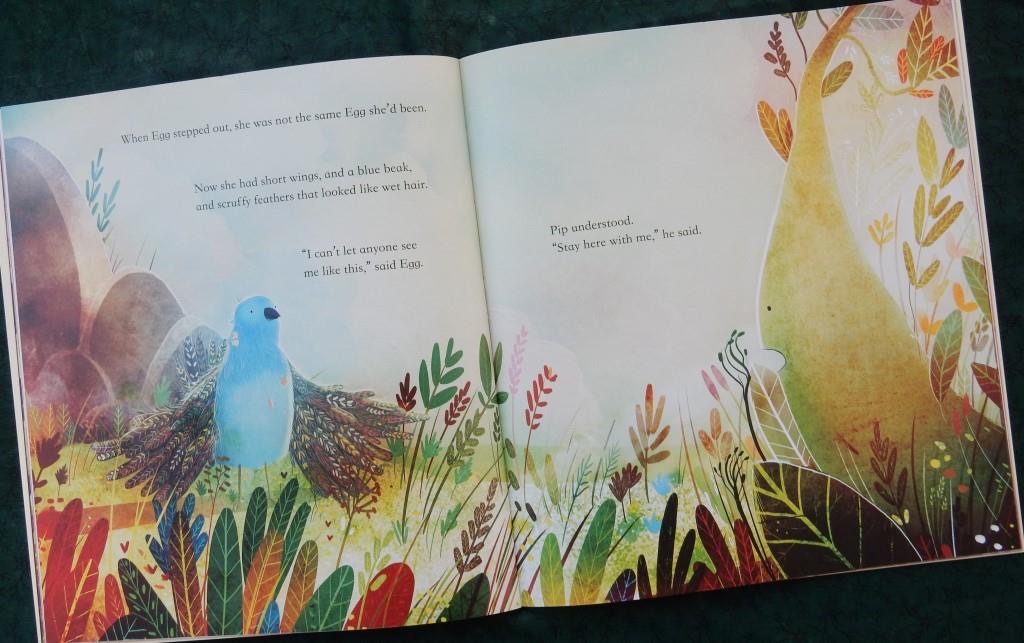
When Pip and Egg meet, there’s an instant attraction on account of the similarity in their shape and size. Their friendship grows but so too do they: Pip grows roots that hold him in one place, which means that for the friendship to continue, change is necessary: Egg makes daily visits to see sapling Pip. Over the weeks though Egg is transformed with a beak, feathers and wings –

wings that grow so strong she eventually takes to the air.

With Pip’s blessing, Egg decides that it’s time to explore the big wide world. Off she flies leaving a broken hearted Pip rooted to his spot, where he’ll always remain should she ever return.

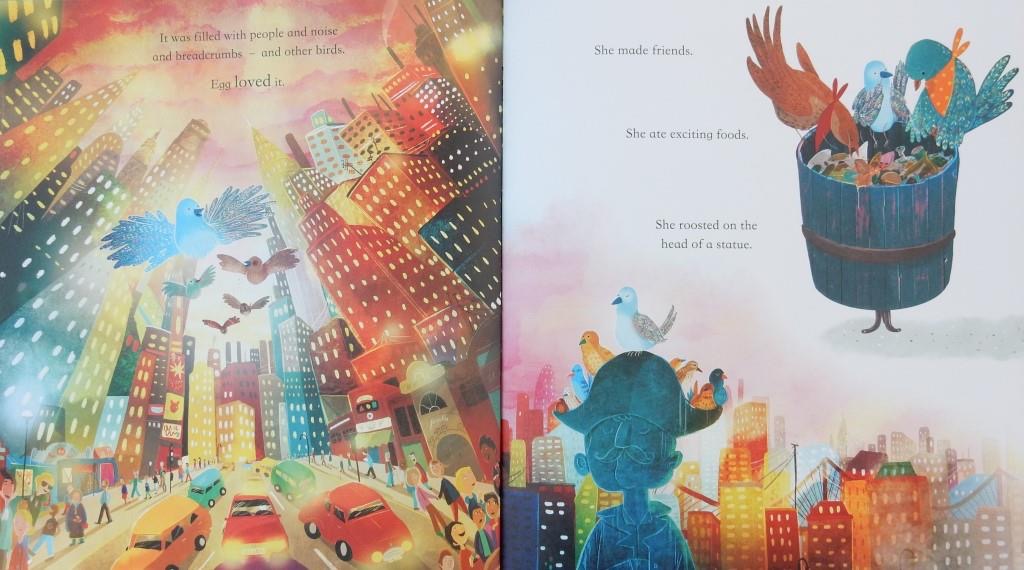
From the air Egg is amazed at the sights – the forests, lakes, mountains and most of all the city where she stops, forming new attachments.

Eventually though, she knows it’s time to return to the valley from whence she came …

Like everything he does, David Litchfield’s illustrations for this story are stunningly beautiful: rich in fine detail and texture, and the way he uses light and shade creating atmosphere and focus on Egg in the city especially, is truly magical.

Mole Hill

Mole Hill
Alex Latimer
Oxford University Press

Alex Latimer has brilliantly combined two of young children’s favourite picture book topics into one splendid rhyming tale – Mole Hill.

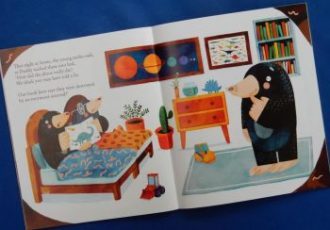
Mole and his two children live happily in their cosy subterranean home until one morning the foul stench of diesel fumes pervades their molehill.

Mole surfaces to investigate and what he sees fills him with horror. There before him are three enormous trucks, Dozer grim and yellow, even larger, bright orange Excavator and a smaller red toughie, Loader.

As they move towards Mole’s mound with their scary sound Mole surprises the machines by taking a stand.

He issues a challenge to the threatening threesome

following it with some quick thinking and an instruction to dig for the bones of his last adversary.

What they unearth scares the daylights out of them

causing them to beat a very hasty retreat.

Safely back home Daddy Mole regales the event to the little moles. They however armed with some bedtime reading, are ready to challenge the veracity of his machine-scaring story.

The scale of Mole’s task is highlighted in Alex’s bright, bold images of the huge machines towering over the diminutive hero and I love too the sprinkling of minibeast onlookers that adorn every spread.

Lula and the Sea Monster

Lula and the Sea Monster
Alex Latimer
Oxford University Press

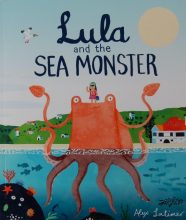
A new highway is due to be constructed and as a result, despite their protestations, Lula and her family are soon to be forced out of their family home, an old house on the beach.
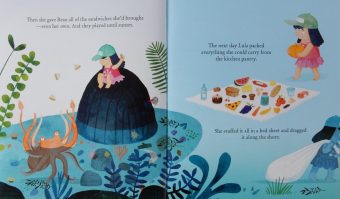
One morning just before their move out date, Lula takes a walk along the beach armed with sandwiches and her bucket and spade. Suddenly she comes upon a tiny creature that looks as though it’s about to become a seagull’s tasty breakfast snack.

Lula however sees off the seagull, scoops up the little creature in her bucket and decides – on account of its size – to name it Bean.

She takes him to a suitable sized rock pool and frees him there, feeding him a sandwich, which the creature soon demolishes.
Promising to return next day, she goes home and in the morning makes extra sandwiches for her new friend, Bean.

Overnight however, Bean has grown considerably and now won’t fit in the rock pool. Lula takes him to a larger one, feeds him generous amounts of sandwiches and they spend some time playing together.

The following day she returns with a veritable Bean feast.

Bean meanwhile has grown enormously and using the food as bait, she lures him to a very large pool where he gobbles up everything.

By now Lula’s attachment to Bean is considerable, so much so that she cannot bear to visit him next morning. Come lunchtime though, she’s feeling braver and off she goes again but there’s no sign of Bean in the rock pool.

All too soon it’s moving day and as the bulldozers arrive, Lula stages one final protest. Can she possibly prevent the demolition squad from getting to work?

Perhaps not single handed, or even with the help of her human friends; but what about Bean? …

I could see little Luna becoming a member of the young guardians of the environment movement that has been so much in the news recently with their protests and marches. Good on her and on them. In Alex’s magical, heart-warming story, as in life, it’s down to children to make a difference and his portrayal of little Lula as a determined, don’t mess with me character is terrific.

With its seaside setting, this is a great book to share and discuss with youngsters especially during the summer time, but its message is an important one no matter the season.

Wild Violet!

Wild Violet!
Alex Latimer and Patrick Latimer
Pavilion Children’s Books

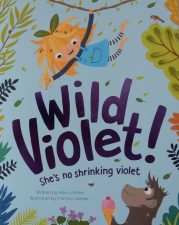
Following on from Woolf, the brothers Latimer return with their second collaboration and it’s young Violet who is star of the show. That’s not quite how others see this extremely spirited little miss however.
By all accounts she was born wild and despite predictions, has failed to outgrow this wildness on reaching four years old.

Washing isn’t on her agenda, nor is anything that might vaguely resemble good table manners; her hair is disgusting – full of all manner of undesirable bits and pieces; wall art and nocturnal shrieking are more her thing.

Imagine how tiring all this is for her parents. One day as exhaustion overwhelms them, they decide to call on her grandmother, begging for an afternoon’s respite.

Gran obliges and decides the zoo with its calming fresh air and plethora of birds is a good place. However the animals are not good role models for the little miss and by the time they reach the Monkey House gran is shattered.
So shattered, that come home time, she catches hold of the wrong hand,

delivering a rather different looking ‘Violet’ back to her parents.They too fail to notice; after all the new Violet’s habits are almost the same as those of the old.

Violet herself meanwhile is having the time of her life in her new abode, until that is, night comes and with it insomnia. Now there’s nobody to clear up her mess or read her a bedtime story; there’s no morning bath or tasty breakfast, let alone warm parental embraces.

A quick phone call by the zoo-keeper soon has the switch sorted out, but it’s a rather different little girl who greets her parents when they come to collect her.

Is Violet now a reformed character? Well yes and no. Mostly it’s the former but on the days when her mum takes her to visit her simian pals, that’s the time her wild side manifests itself.

We adults all know a Violet-type character and I’ve certainly taught a few children who could give her a good run for her money. This makes Alex Latimer’s story all the more enjoyable for readers aloud; children on the other hand will simply revel in Violet’s utter irrepressibility so wonderfully portrayed in Patrick Latimer’s scenes of mischief and mayhem.

Another winner for the Latimer partnership.

Am I Yours?

Am I Yours?
Alex Latimer
Oxford University Press

Alex Latimer certainly keeps his audience guessing in this rhyming tale concerning an identity issue.
If you’ve never heard of an egg that speaks, you’re about to in this review.
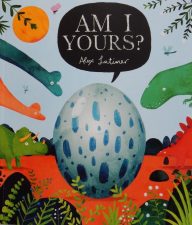
Said egg, having been blown from a nest and spent a cold dark night at the foot of a hill emits a gentle ‘Excuse me, please, but am I yours? I’m sure I am a dinosaur’s.’
Yes it’s another dinosaur tale with lots of children’s favourites making an appearance.
First to come  along is Stegosaurus but the egg doesn’t fit its specifications, says so, but remains upbeat.
Nor does it fit those of Brachiosaurus, Triceratops, Corythosaurus

or Tyrannosaurus, by which time an entire day has passed and the egg, feeling lonely begins to cry out ‘… I can’t stay out in wind and storm! / I’ll freeze alone! I must stay warm!
The sun sinks and in so doing renders the eggshell translucent allowing the five concerned adult dinosaurs a view within.

Now they know what to do with the lost egg: back it’s rolled up the hill from whence it came, and there, to the sound of heavy feet, it makes a final plea:
One last time – I must be sure – / Are you the ones I’m looking for?’ …
In addition to the enjoyment of meeting some of their favourite prehistoric creatures in the story, with its invitation to join in the telling through the rhyming repeat refrain, ‘What do you look like inside that shell? / I can’t see in so I can’t tell.’ children will love becoming co-inquisitors of the egg,
(There’s lots of potential for small world play here once you’ve shared the story.)

For dinosaur enthusiasts who like to colour:

Fuzzy Dinosaurs & Prehistoric Creatures
illustrated by Papio Press

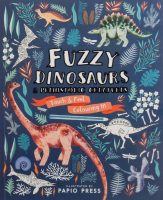
This is a touch-and-feel book with 7 spreads to add colour to, featuring animals of the prehistoric land, sea and sky, set out in chart-like form with brief snippets of information relating to each featured (numbered) animal one side of the spread, opposite which is the colouring page on a dramatic black background with the numbered creatures and other flora and fauna.
The book is written in association with, and fact-checked by, the National History Museum.

Woolf

Woolf
Alex Latimer and Patrick Latimer
Pavilion Children’s Books
The trials and tribulations of pretending to be something you aren’t are sensitively and humorously explored in this collaboration between Alex Latimer and his illustrator brother, Patrick.
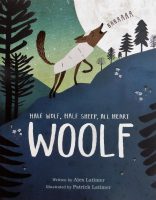
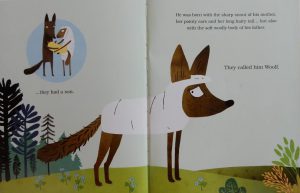
Part wolf, part sheep, Woolf is the offspring of an unlikely and much frowned upon marriage between a sheep and a she-wolf.

Woolf has both sheep and wolfish characteristics but as he grows older, he experiences an identity crisis. Out exploring one day, he encounters a pack of wolves and as a result decides to rid himself of his woolly coat.
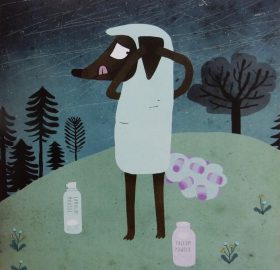
Thus the pretence begins; but inevitably as the wool starts sprouting again, maintaining the disguise becomes tedious and Woolf leaves for pastures new.

Over the hill he comes upon a flock of sheep: again Woolf isn’t true to himself, lying about his wolfish characteristics and then adopting a new ovine look …

Once again, pretence proves unsatisfactory for Woolf and his stay with the flock short-lived.
Convinced he doesn’t belong anywhere, the little creature is distraught and that’s when his parents step in with some timely words of wisdom, pointing out that trying to be something other than your real self can never make you truly happy. Much better to accept and celebrate all that makes you truly special and unique.
Patrick Latimer’s illustrations executed in an unusual colour palette of black, greys, browns, greens, teal, cream and biscuit with occasional pops of purple, blue and pink are delectably droll.
Like me you may well find yourself howling with laughter at Woolf’s attempts to fit in but there is a serious and important life-lesson at the heart of the book: true friends accept and love you for being you.

I’ve signed the charter  

Stay!


DSCN5103 (800x600)

STAY!
Alex Latimer
Picture Corgi
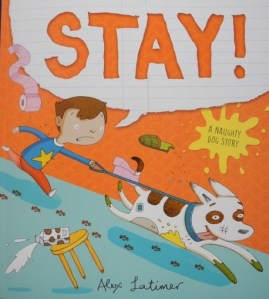
Buster is the best dog in the whole world: that’s Ben’s opinion at any rate though his parents might not endorse that …

DSCN5104 (800x600)

And that is why when it’s time for the family holiday Buster will be left in the care of Grampa.
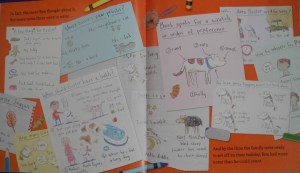
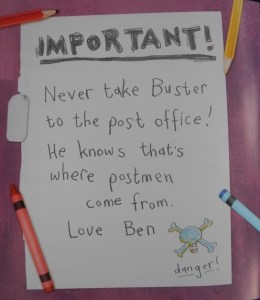
Ben, like the majority of pet owners is worried about leaving his pet for others to care for so, he acts on Mum’s suggestion to write instructions for Grampa. He doesn’t write just one note though, he creates a whole host of them with detailed instructions and information on every ‘Buster’ topic you could imagine and some you probably couldn’t …

DSCN5105 (800x600)

And not only that but once he reaches his holiday destination, Ben continues to send further instructions – on postcards this time, dozens of the things.
There’s one vital communication though, that fails to arrive on time because Grampa and Buster have
gone for a walk to collect a parcel …

DSCN5184 (800x600)

and the result, as you might expect is disaster – from the postman’s point of view certainly.
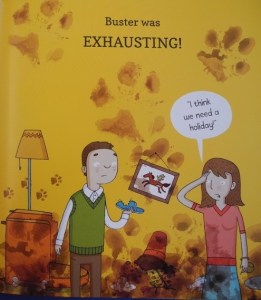
Grampa’s too, so he decides it’s time to take matters into his own hands: a bad behaviour cure is the order of the day, or rather, many orders of some pretty exhausting days I suspect. It’s time well spent however and by the time the family returns Grampa has Buster pretty well trained and is himself ready with some notes for Ben.
And future holidays? Well that would be telling …
Love that ending!
Alex Latimer’s illustrations are chock-full of witty details that should amuse adult readers aloud as much as children. I love the way he incorporates scraps of paper torn from notepads, postcards and various other bits and pieces of mark-making paraphernalia into his artwork. And, the sight of Buster hurtling down the middle of the road after that departing car is hilarious.

DSCN5161 (800x600)

Use your local bookshop

localbookshops_NameImage-2