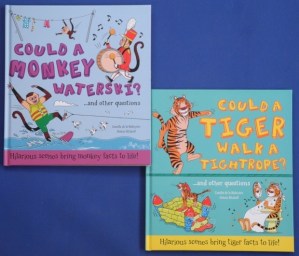
Could a Monkey Waterski? Could a Tiger Walk a Tightrope?

DSCN6661 (800x600)

Could a Monkey Waterski?
Could a Tiger Walk a Tightrope?
Camilla de la Bédoyère and Aleksei Bitskoff
QED
The title questions and a whole host of other unlikely possibilities are considered in the latest additions to this series, a double spread being devoted to the explorations of each ‘What if …’, ‘Could a tiger… ?’ or ‘Would a monkey… ?’ put forward.
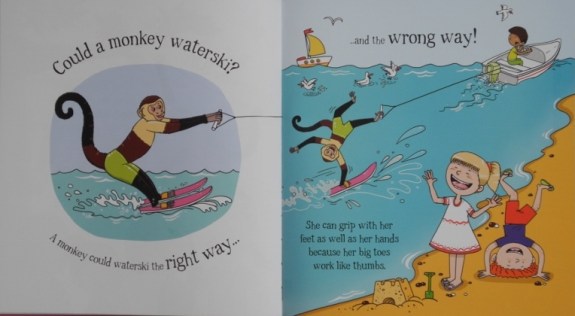
These books aren’t all crazy imaginings though; lots of fascinating information about the animals is provided as each scenario is focused upon. So, yes a capuchin monkey could waterski – both right way up and upside down; that’s on account of having big toes that work like thumbs …
DSCN6660 (800x600)

Said monkey would enjoy a visit to a noodle bar too – those opposable thumbs again; but there would have to be some garnishing of the noodles for real capuchin contentment in this instance.
And the tiger? Well, we all know the one who came to tea so why not dinner, just as long as you have one hundred tins of cat food stashed away in your cupboards. That would be sufficient to keep your visitor going for three days; and don’t expect anyone/anything else to get a look in – tigers hate sharing food.
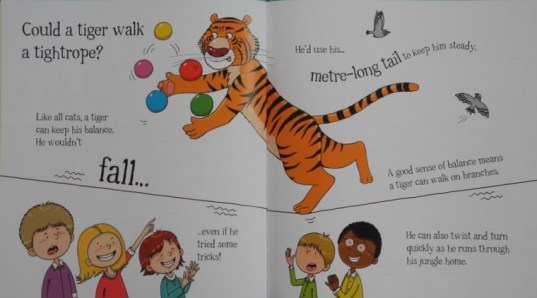
A tightrope walking tiger? Seems, like all cats, tigers are ace balancers,
DSCN6659 (800x600)

assisted by their tails which contribute towards super steadiness.
In addition to all this fun stuff, there are in each book, a straightforward “More about …’ fact file double spread and a final postcard from their respective South American/Asian habitats.
If you like information mixed with entertainment (and I know a fair number of children who do) then these are worth seeking out for the lower primary classroom.

Use your local bookshop       localbookshops_NameImage-2

Fabulous Frogs, Elephants and other creatures

DSCN5724 (800x600)

Fabulous Frogs
Martin Jenkins and Tim Hopgood
Walker Books
I’ll never forget an experience I had in Udaipur, Rajasthan a few years back: during the monsoon time I was caught in a downpour and suddenly hundreds of tiny frogs about the size of a finger nail (and those tiny New Guineas frogs depicted herein) came raining (seemingly) down from the sky. I never knew from where they had really originated – drainpipes and gullies perhaps – but it sparked an interest in these fascinating creatures. I’ve since seen many different kinds in other parts of India, especially the Kerala coast where I had a resident frog that performed acrobatics on my washing line; and every evening also in the monsoon we would be serenaded by a mesmerising frogs’ chorus from the trees and bushes …

DSCN5726 (800x600)

Then there were the tree frogs whose foam nests we saw on branches overhanging the pond very similar to these African ones …

DSCN5727 (800x600)

None of the frog species featured in this lovely picture book is Indian but each one the conservation biologist Martin Jenkins has selected is strange and wonderful in its own way, not least being the Darwin’s Frog. The male puts the soon-to-be hatched eggs in its throat, keeping them and later, the tadpoles, safe therein.
Then there’s the world’s largest, enormous (for a frog) Goliath Frog from West Africa that eats other frogs on occasion.
Illustrator, Tim Hopgood has done these and the other frogs proud in his cracking pictures. A frogilicious book!

DSCN5719 (800x600)

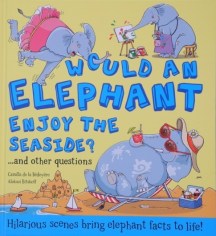
Would an Elephant Enjoy the Seaside?
Camilla de la Bédoyère and Aleksei Bitskoff
QED Publishing
The title of the book is just one of the amusing scenarios explored in this attractive book. Others include
‘Could an elephant join an art class?’ …

DSCN5720 (800x600)

and “How would an elephant say “hello”? Certainly the library would be an ideal place – elephants raise their trunks and trumpet … They also talk quietly … ‘by making low rumbling sounds that pass down their legs

DSCN5721 (800x600)

and into the ground.’ This is picked up by the feet of elephants far away.
Fascinating information such as this is conveyed in a manner that is likely to stay with the reader who is one hopes, then motivated to go on to find out more. Equally importantly this book and others in the series will foster that crucial ‘What if …’ notion in young children.
Also in the series and equally entertaining and informative is:

DSCN5722 (800x600)

Could a Crocodile Play Basketball?
Camilla de la Bédoyère and Aleksei Bitskoff
QED Publishing

DSCN5723 (800x600)

Just imagine one of those jaw snappers in your early years classroom …

DSCN5672 (800x600)

Children’s Animal Atlas
Barbara Tylor, Katrin Wiehle and Martin Sanders
QED
More than a mere atlas, this book has a pocket inside the front cover containing a fold-out poster map, half a dozen postcards to write from various animal locations, a spotter’s guide with facts and a quiz and pages of stickers, that can be used as the reader chooses.

DSCN5728 (800x600)

Find and Colour
illustrated by Joel Dreidemy
QED
For those youngsters around 5ish who like colouring with a few facts thrown in, is this pack of eight books (almost all with an animal theme) complete with pens. As it says on every cover: ‘things to colour and facts to discover’. Just the thing for rainy days and long journeys.

Use your local bookshop         localbookshops_NameImage-2