A Boy Called Book / Reading Together

When a mother and father decide to call their newborn baby Book, it bothers a variety of people and puzzles the little boy he becomes. One day he asks his mum, “Why am I Book?” “Because your life is a story … You can write it however you want,” comes the reply.

First Book decides to become an adventure story, full of exciting chapters. When he turns four, Book starts school but for him, this feels like being part of a scary story. Until that is, his mum’s mention of heroes and being brave leads to Book making his very first friend.
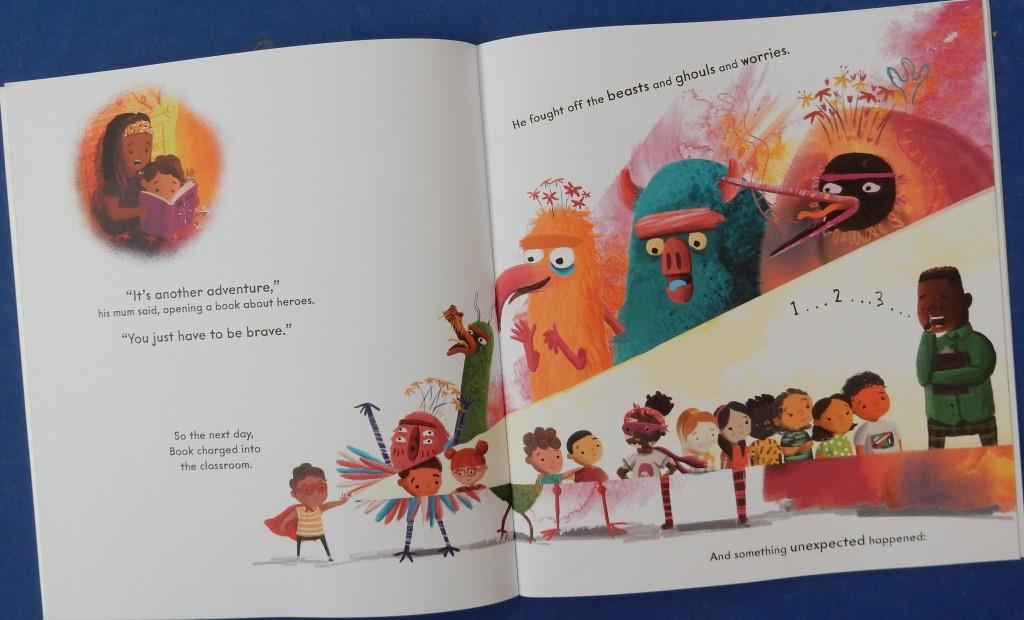
A friend who loves to have fun and laugh a lot – a joke book.

Gradually Book learns such a lot that he aspires to become an encyclopaedia but not all his book types bring him happiness; he also faces sadness, loss (an emptiness inside) but then he receives a special something in the post that makes him forget his sad feelings for a while. So too do pictures of different kinds and gradually back come Book’s smiles. Eventually Book sees that his life is much more than a book; it’s an entire library and one that will keep on growing and growing …
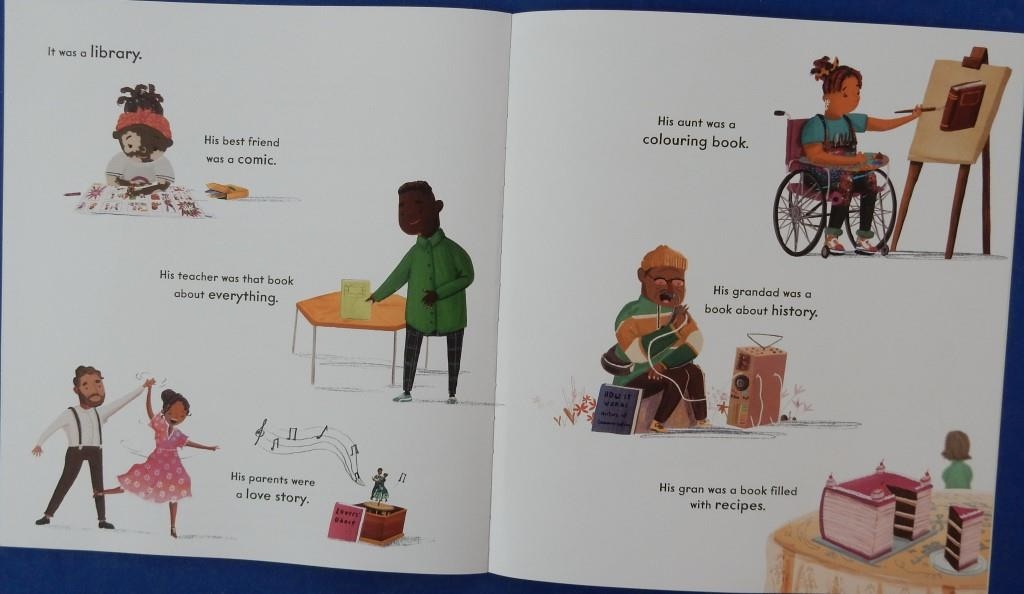
Vincent Ralph’s picture book author debut is an unusual and powerful one that shows the power of story to shape us, inspire us and also to heal us. Powerful too are Aaron Cushley’s scenes of the boy’s developing competences and supportive family life.
On a similar theme is

Having an adult or two in your life who are passionate about reading and share books with their baby from the outset, will likely set that infant on the road to becoming a reader and lover of books and stories too. So it is for the mother and father narrators of this book who read to their little one from birth. We are party to various developmental stages such as sitting up and eating solid food, alongside various kinds of books – an abc, flap books the child can manipulate independently, books of nursery rhymes. We see how stories come to life on the page with their elements seemingly becoming a part of the home environment too.

We see too the joys of visiting a bookshop and coming out with arms full of new picture books to enjoy together at every opportunity, so much so that after reading and loving them so much they needed to be mended; books such as wordless ones, rhyming ones and fairy tales. Sometimes no book at all was needed, instead a story would be co-created using family members’ imaginations.

Such was the power of all this book/story experience that eventually two readers in the family become three as the child grows up to be an independent reader herself. Job done, you might say; hopefully not, for confident solo readers too should have stories read to them and I suspect it was so in this family.

Melissa Larson’s portrayal of family life in this household certainly shows how memories are created and emphasises the importance of sharing books together right from the start. What a wealth of connections are created by so doing.
If the World were 100 Animals

If the World were 100 Animals
Miranda Smith and Aaron Cushley
Red Shed

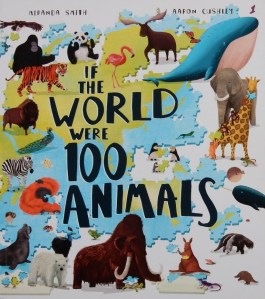
The total number of individual animals on Earth is around 20 billion billion. So says Miranda Smith, author of this book; but it’s exceedingly difficult to visualise such a number, so instead let’s use just one hundred: how does that look? Well, there are many ways of looking at that number; for instance how many are vertebrates and how many invertebrates; how do they differ?

What about mammals? It appears that of the 100, 94 are placental ( I was fascinated to learnt that baby dolphins are born with a moustache), 5 are marsupial and just one is a monotreme -an egg laying mammal) with all five species living in Australia and New Guinea. We’re also shown – by means of a pictorial map – the distribution of wild mammals across the continents.

I was astonished that when considering 100 marine animal species, a mere 9 are already known, the rest have yet to be discovered. I guess that’s not really surprising as we also read that 95% of our oceans haven’t been explored.

Flighted animals, mammals living in the wild,

pets, the animals most deadly to humans, extinct animals and those endangered are the remaining explorations based on that one hundred supposition, and this hugely thought-provoking exploration of biodiversity concludes with some key questions relating to human actions and how these endanger the world of animals, to consider, discuss and one hopes, act upon to ensure the survival of the creatures threatened.

With Aaron Cushley’s bright, eye-catching illustrations on each of the eleven double-page spreads, what is quite a difficult overall concept (that of percentage), with a fair number of biological terms used in Miranda Smith’s text, becomes much more approachable. However, parents of children under seven (the publishers state 5+ in their PR) who haven’t studied biology beyond the basics may well find it tricky to help youngsters grasp some of the content..

The Mystery of the Golden Pyramid / Wide Awake Wolf

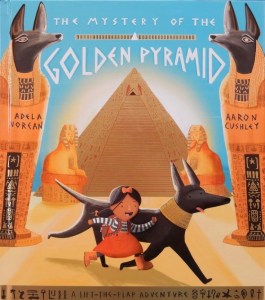
The Mystery of the Golden Pyramid
Adela Norean and Aaron Cushley
Little Tiger

When Sophie moves into a new house, the last thing she expects to find sitting in her bedroom is a talking dog. The creature introduces himself as Ari and tells her that within the casket before her is the first piece of a puzzle that only she can solve. She also learns that she’s the descendant of one of the pharaohs.

That’s the start of a magical mystery adventure that takes Sophie and readers back in time on an exciting quest to search for stolen treasures belonging to King Nebra.

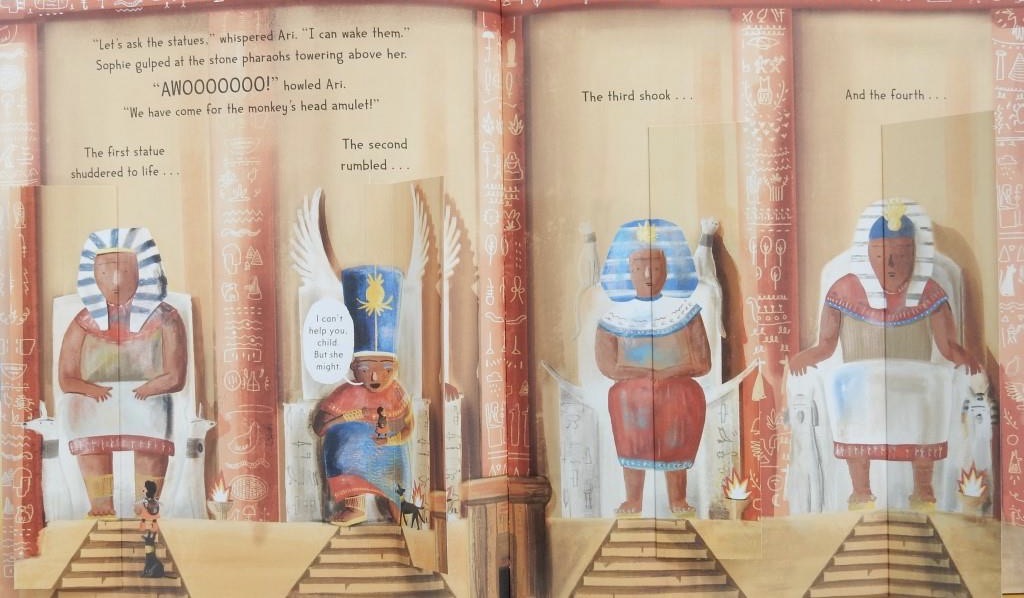
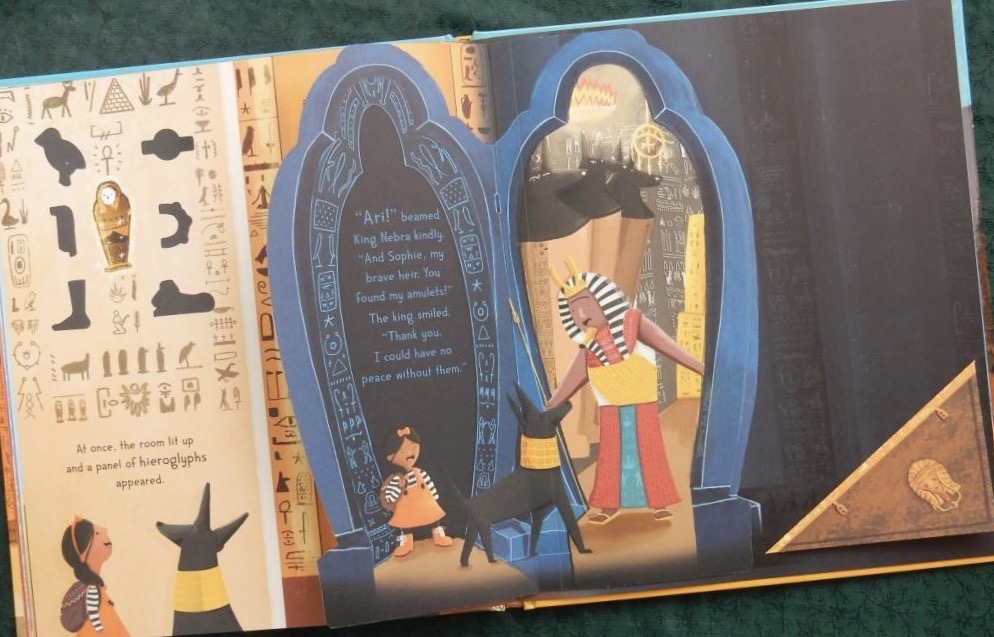
There are flaps to lift and die-cuts to peep through as Sophie, accompanied by Ari travel over land and sea and across the desert to an ancient temple,

a palace and thence, once they have three of the four missing items, to the golden pyramid.
Can they find the last amulet and bring peace to their true owner?

With Adela Norean’s exciting action-packed narrative, the wealth of interactive features and Aaron Cushley’s richly detailed illustrations, this is a highly engaging read; and, if Ancient Egypt happens to be on the curriculum for your early KS2 class, this is a fun book to share with them.

Wide Awake Wolf
Georgiana Deutsch and Megan Tadden
Little Tiger

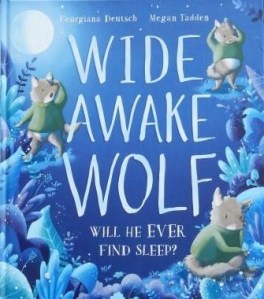
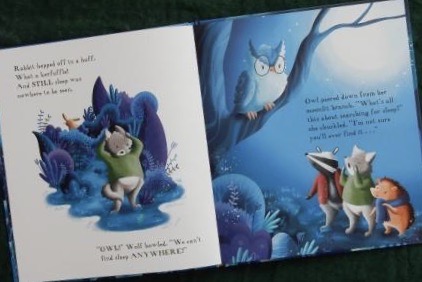
Suffering from insomnia and having tried all the usual remedies, Wolf decides that sleep is hiding somewhere in the forest and sets out to find it. His loud cries arouse slumbering Badger who joins the search as does lullaby singing Hedgehog.

After having no success, they decide to seek out Owl. As they near her tree, Wolf makes a suggestion as to where sleep might be hiding, but the three only succeed in upsetting Rabbit with a sneeze-inducing tickle on the nose.

Having finally located the branch bearing the wise one, they learn that sleep is not something to be found; rather it finds you under the right circumstances.

Happily, Owl knows just the right way to provide those … zzzzzz

A gently humorous, comforting bedtime read to share with little ones who will enjoy pointing out the similarity between the book being read to them and that shown in Megan Tadden’s penultimate moonlit scene.

In Focus: Forests

In Focus: Forests
Libby Walden et al
360 Degrees (Little Tiger Group)

Ten exciting illustrators showcase some of the world’s most famous forests in this smashing book that’s been put together under the stewardship of Libby Walden.

Herein is a wealth of information about the natural flora and fauna of these stunning green places as well as associated facts on such things as, in the first and hugely biodiverse location – The Black Forest – things to do, the Brothers Grimm and more. Grace Easton is the illustrator of this place.

Gate fold flaps are employed by each artist, the second being Julie Colombet who explores The Anatomy of Trees;

Suzanne Washington takes us to the Rainforests; with the artistic work of Sol Linereo we visit National Parks.

Stephanie Fizer Coleman dives deep to the Kelp Forests to show us the sea otter and many more amazing inhabitants.

Forest Mythology is the next focus, illustrated by Irene Montano;

the Amazon Rainforest wherein we ‘meet two famous British naturalists, is illustrated by Marc Pattenden;

Alfred Wallace & Henry Bates

Alessandra Santelli portrays peoples of the Forest; Aaron Cushley, Mangrove Forests and the final topic is Produce and Preservation (including the tree hugging, Chipko movement) illustrated by Jenny Wren.

Each spread is totally absorbing and the entire chunky volume is sure to draw you in to what are probably my favourite places – forests – and hold you there for a considerable time.

The Big Beyond

The Big Beyond
James Carter and Aaron Cushley
Caterpillar Books

Using rhyming couplets, Poet James Carter blasts readers off in a rocket and whizzes them into deep space and backwards into history, to early stargazers and their telescopes.

We read of early attempts at flight in kites, balloons, gliders and aeroplanes, pausing in 1957 to watch Sputnik 1 orbiting, and in 1969  to see ‘Saturn Five’ rocket blast off and the lunar module from which two men emerged onto the moon’s surface.

We’re reminded of the various roles of satellites, spacecraft (sending home information), probes (exploring Mars), and crafts to land (air testing, soil sampling and more).
James’ final future suggestion is likely to tempt young readers’ rockets … will head through the atmosphere. We’ll need an astronaut (or two_ / so what do you think? / Could it be YOU?

In like fashion to his previous Once upon a Star the author concludes his whistle-stop historic foray with an acrostic – ROCKETS this time – that provides additional pointers for possible investigation by small space enthusiasts.

Cool endpapers and some enticing art by Aaron Cushley complete this package tour of the cosmos.