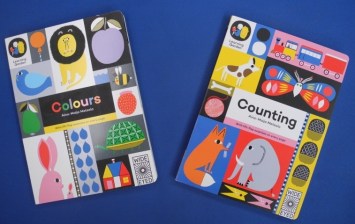
Wild World, The Coral Kingdom and Who’s Hiding on the River? / Who’s Hiding on the Farm?

Wild World
Angela McAllister, Hvass & Hannibal
Wide Eyed Editions

The author has chosen thirteen natural habitats – Rainforest, Arctic, Prairie, Woodland, Coral reef, Desert, Rock pool, Mountain, The Outback, Moorland, Deep sea, Mangrove and Savannah – that are under threat due to human activity, and captures the essence of each one in a series of free verses.
Here’s the opening to Mountain:
‘I am the highest mountain, / Born in a collision of continents. / All is beneath me, except the sun, moon and stars. / I am rock, / Crag, cliff and ledge, draped in veils of white. / I am snow-maker, with glaciers in my arms, / Whose meltwater swells great rivers below.’

In stark contrast is the quieter sounding Savannah, which opens like this: ‘Savannah speaks in whispering grasses, / In the chatter of cicadas across an endless plain. / Spacious homeland of swift cheetah / And gazelle, with the horizon in her eye.’

Using matte colours, the illustrators Hvass and Hannibal showcase the flora and fauna of each location in a series of eye-catching paintings that incorporate the text within them.

Human use, climate change and pollution are responsible for the damage to the environment and after her introductory poem, it’s not until the final pages that the author enlarges upon her conservation message citing the specific damage within the thumbnail sketch of each of the places portrayed. Thereafter she implores readers to use less energy, to recycle and to buy with care.

We’d all do well to keep in mind her final words about our precious planet: ‘Explore it, protect it, love it. / Our Earth is a wonderful wild world. ‘

Also with an ecological message is:

The Coral Kingdom
Laura Knowles and Jennie Webber
Words & Pictures

Our coral reefs, with their gorgeous colours: crimson, red, rose, yellow,

turquoise, emerald, jade, purple, even black, that have taken 1000s of years to grow and give home to a myriad of creatures large and small are under threat.

When the coral is bleached white due to acidity caused by climate change, and stays white for too long, then the reef dies.

Laura Knowles has written a rhyming narrative that outlines the life cycle of a reef and includes a caution that unless we humans take action these amazing ecosystems will be lost forever.

Jennie Webber’s detailed watercolour illustrations show the beauty of the undersea habitat and a final fold-out page gives additional information about coral reef conservation.

A useful addition to a primary school conservation topic box, or, for a child interested in ocean life or ecosystems.

Who’s Hiding on the River? / Who’s Hiding on the Farm?
Katharine McEwen
Nosy Crow

It’s never too early to start learning about nature and here are two board books just right for introducing animals, some wild and some domesticated, to the very young.

Both are beautifully illustrated by Katharine McEwen and there are lots of animals to find in both locations.

Toddlers can spend a day by the river, from a busy morning through to night-time as they explore the pages, manipulate the sturdy flaps in response to the ‘Who’s hiding here?’ on every right hand page to discover tadpoles, cygnets, fish, dragonflies, a stoat, a beaver and more as they swim, wriggle, wade, leap, build and paddle.
The farm book also moves through the day in similar fashion and McEwen’s text is carefully worded to introduce new vocabulary including ‘pecking,’ ‘trotting’, ‘snoozing’ ‘prowling’, munching’ and ‘diving’ along the way.

Published in collaboration with the National Trust these are fun and at the same time, gently educational.

Kaya’s Heart Song

Kaya’s Heart Song
Diwa Tharan Sanders and Nerina Canzi
Lantana Publishing

From the cover illustration it’s evident that the little girl – her name is Kaya and she lives in the Malaysian rainforest– is truly savouring the moment.

As the story begins Kaya observes her mother sitting yoga style and humming. “Mama, what are you singing?” Kaya wants to know.

Her mother explains that it’s her heart song and that having a heart song makes anything possible. Kaya’s response is that she doesn’t know hers: her Mama encourages her to learn to listen for it and sends her daughter off to play outdoors.

Maya follows a butterfly into the jungle and it leads her to an unfamiliar spot but there she discovers someone who is familiar – her friend Pak.

Pak is the guardian of a gate behind which, nestling among thick foliage, is a broken elephant carousel.

Intrigued, Kaya decides to investigate and as she untangles the vines from around one of the elephants her mind begins to quieten and become still. A soft rhythmic beat sounds in her ear as with a Boom taktak boom taktak boom / Shick shak shook / Boom taktak boom taktak boom / Shick shack shook’ the carousel begins to rotate and the elephants move in time with the music.

Suddenly Kaya understands that she has found her own heart song and then, just as her mama had told her, magic happens …

Grounded in the practice of mindfulness – being fully in the present moment – this is a truly mesmerising picture book.

With a lush colour palette Nerina Canzi depicts Kaya’s magical world, creating a truly immersive place both for the main protagonist and for the reader. Her spreads work in perfect harmony with the author’s words and to lose yourself between the covers of the book is to be, like Kaya, in the here and now throughout the experience.

The final page explains simply the practice of mindfulness, linking it with yoga and meditation, and also reminding the reader what brought Kaya to a mindful state.

From the time they start school children today live in an ever more pressurised and often stressful world and this beautiful book demonstrates to both children and adults the benefits of cultivating the mindfulness habit. It can help them change their own world and perhaps that of others. Just a few minutes a day: no distractions; just being fully present in the here and now.

It’s a state of being that young children absorbed in their play (especially with creative materials) reach when adults stand back and watch without interrupting or trying to guide what they’re doing: watch that total concentration, nothing else matters – that’s mindfulness. When I taught 4 and 5 year olds I saw it many times every day; it wan’t taught to them, it’s just how they were.

Surprising Birds / Big Dog, Little Dog

Surprising Birds
Big Dog, Little Dog

Elodie Jarret (élo)
Walker Studio

Here’s a pair of super chic, lift-the-flap concept books created by designer and illustrator Elodie Jarret to share with the very young: they’re in a different league altogether from the usual toddler concept books.

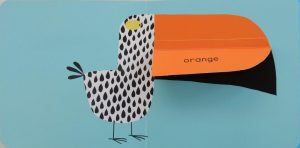
Surprising Birds features a whole host of wonderfully shaped avians that the artist has, with deft touches of colour and distinctive black and white patterns managed to make into enchanting feathered characters.

Part and parcel of each one is a flap – a wing, a tail, a head, a beak –

which when lifted reveals a flash of bright colour and the colour name (eleven in all).

Each bird is set against a pastel coloured background making it stand out starkly, and every one has an element of delight be it the chick sheltering under its mother’s wing or the hide-and-seek owl on the final spread.

With striking images, sturdy flaps and cover, and a perfect size for small hands, this is a super little book to have fun with and perhaps learn some colour names along the way.

Equally enchanting and playful is the assortment of canine characters in Big Dog, Little Dog that features ‘opposites’ (and also introduces some positional vocabulary) including  above/below, long/short, awake/asleep and spots/no spots. Here again flaps and fold-outs are used to effect and every animal has a real personality.

Books for Tiny Hands

A Tiny Little Story: Farm
Lisa Jones and Edward Underwood
Nosy Crow
In the third title of the series the adorable Baby Boo and his mum pay a visit to the farm. They meet the farmer in his tractor,

a mother hen and her baby chicks, the cow, the sheep, some pigs and a cockerel, each of which greets the visitors with its characteristic sound; and then it’s time to leave.
With its soft, squidgy pages, simple, bold, patterned images and a Velcro buggy strap, this boxed book, like its predecessors, is just perfect for giving to a new mum and her baby.

Animal ABC
Jannie Ho
Nosy Crow
Having explored Halloween and Christmas, Jannie Ho’s third ABC book for babies and toddlers features animals large and small, some familiar, others less so, from elephant to narwhal and iguana and owl. One fantasy animal – a unicorn – puts in an appearance too.
Boldly illustrated with just the single word and corresponding letter as text per page, there are talk opportunities aplenty in this sturdily designed little board book. Which ones have long tails? Which have horns? Can your infant think of what noise each animal might produce?
Full of animal fun for sure.

Little Truck
Taro Gomi
Chronicle Books
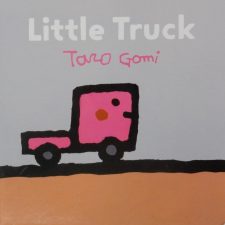
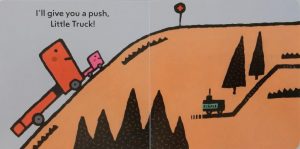
In this lovely little board book toddlers share a day in the life of a little pink truck. He’s a fast mover and determined hill climber and is accompanied on his travels by a larger (parent) truck.
The latter is available to give a gentle push up the steep slope …

and when Little Truck enters a dark tunnel, is right behind to ensure he’s not completely lost and is ready to carry the little one when he falls fast asleep.
With a simple text, some of which is addressed to the Little Truck by the larger one, Taro Gomi uses his wonderful minimalist style to imbue both trucks with distinct personalities as well as creating stylised background scenes in contrasting greys, browns and tans.
I love that Little Truck is pink and identified as male in the narrative.

Where’s Mrs Zebra?
Where’s Mr Dog?

Ingela P.Arrhenuis
Nosy Crow
Just right for some playful book sharing time with your baby are these two hide-and-seek board books.
Each one contains five scenes with bold, bright images and an animal that has hidden itself behind an appropriately shaped, brightly coloured felt flap on the spread.
In the first title Mr Rhino, Mrs Gorilla,

Mr Flamingo, Mrs Zebra are hidden or almost so and the final spread has a hidden mirror and asks ‘And where are you?’
The same question concludes the second book wherein Mr Dog, along with Mrs Cat, Mr Mouse, and Mrs Rabbit have tucked themselves away behind various objects all waiting to be discovered by tiny hands.
Award winning Swedish illustrator Ingela P. Arrhenius has illustrated both with just the right amount of detail for the very youngest infant.

Guess Which Hand?
Hans Wilhelm and Ilaria Guarducci
Chronicle Books
Here’s a little board book based on the ever popular guessing game after which the book is titled.
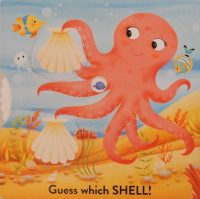
On each of eight pages toddlers are invited to guess the location of the item be it a ladybird or frog, a bone or ball, flower or feather, pink fish or blue, banana or peanut, carrot or clover leaves, star or moth, hidden under one or other of the flaps on each animal’s page. Paws, ears, scallop shells,

hats, fluffy tails, wings and eggs are in turn used as hiding places. The objects are moved by turning the interactive wheel at the side of each page so you can play the game over and over with a toddler.
Each bold bright scene offers more to talk about than the guessing game though but that depends on the users.

Search-and-Find Bonanza – The Walkabout Orchestra, Mice in the City London and Cycle City

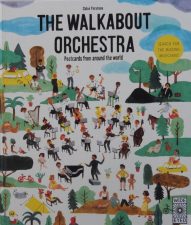
The Walkabout Orchestra
Chloé Perarnau
Wide Eyed

What has happened to the members of the orchestra? They’ve all gone missing and there’s an important concert coming up in a few days. Seemingly they’ve dispersed to locations all over the world from where they’ve sent the maestro postcards telling of their various activities. These appear in the top left-hand corner of each locale spread.
In a desperate effort to locate the musicians, the maestro, together with his side- kick, sets off in search of them. Their journey takes them to such diverse places as a fishing village in Iceland, Tokyo, a campsite in France, the pyramids of Egypt, carnival in Brazil and a football field in Abidjan.
In addition to finding the missing musicians, almost every place has a little yellow bird whose speech bubble provides something additional to search for in the lively scenes of the musicians’ sojourns.
Each one is packed with amusing details so that finding the musicians is often no easy matter. However they do all appear within a large arena ready for the concert with their maestro ready to conduct, bird atop his head.
Don’t start reading this if you are short of time, unless you are happy to cheat and look at the answers on the two final spreads.

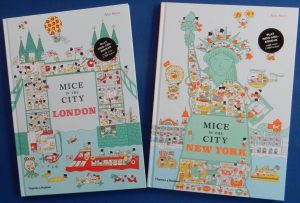
Mice in the City London
Ami Shin
Thames & Hudson

It’s a mouse takeover: London had been invaded by an army of tiny rodents; some – The Mouses of Parliament for instance, – have jobs to do, others are there to enjoy the sights and some are turning Tate Modern into complete disarray. One daring mouse has even installed herself as Queen Mouse in Buckingham Palace.
A verse introduces each location, opposite which is a detailed whole page pastel coloured illustration of the particular tourist attraction under mouse occupation: every one is full of things to delight and entertain.
The purpose of the book, in addition to enjoying what the mice are up to, is a game of ‘hide-and-squeak’ that entails finding eight things – Inspector Mouse, a stripy tailed cat, Bumble-mouse, a mouse in a bin, a teddy, a Union Jack top hat, a mouse hiding in a top hat and a balloon seller.
Happy Hunting! You’re in for some fun with Ami Shin’s mice.
In the same series is Mice in the City New York. Oh my goodness! Think of the chaos the little creatures might cause in The Strand Bookstore!

Cycle City
Alison Farrell
Chronicle Books

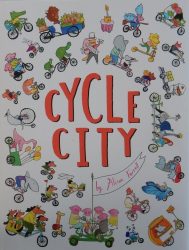
It’s the morning of the Starlight Parade in Cycle City but the parade committee has yet to send out the invitations so they decide to call on the assistance of Mayor Snail.
Can he get all those invites delivered in time for the evening? Perhaps, with the help of Little Ella Elephant who has come to visit one of the city’s residents, her Aunt Ellen. If so, who will play the important role of Grand Marshal at the big event?

A captivating search-and-find for slightly younger readers: this one has a clear storyline and a plethora of speech bubbles and is populated by a vast array of anthropomorphic animals. The spreads are less densely packed than some of its ilk, but have plenty of lovely details, and the endpapers are a visual glossary of all the different bicycles included.

I’ve signed the charter  

Stomp! Stomp! / Count on Goz / Night and Day

Stomp! Stomp!
Sebastien Braun
Nosy Crow
In this new addition to the ‘Can you say it too?’ board book series, a handful of dinosaurs have hidden, or rather attempted to hide themselves, in Sebastien Braun’s brightly illustrated spreads.
Very young children will get lots of pleasure manipulating the flaps (plants, a cloud and a rock) to discover what’s hiding beneath them, as well as getting their tongues around the names and noises.

Children beginning to read often find words such as ‘triceratops’, ‘diplodocus’, ‘stegosaurus’, ‘pterodactyl’ and ‘tyrannosaurus’ easy to recognise especially in a meaningful context, so why shouldn’t infants just starting to talk encounter them early on too, perhaps even with that older sibling reading the book with its short, predictable text, with them.

Count on Goz
Steve Weatherill
Steve Weatherill Books
Goz the baby goose has just taken his early morning swim but now he’s managed to lose the other geese. In his search he encounters in turn a cow and her calf, a sheep and 2 lambs, a mother cat and her 3 kittens and a dog with 4 lively puppies. To each he says, “Hello. Are the geese here?” but is greeted with “No, only me and my …” followed by a “Moo!”, “Baa, baa!” and so on …

until finally beside the big pond we spy …
Guess what is tucked in the nest beneath that large wing.
In addition to the baby animals revealed by opening the flap on each spread, the final page has 6 swallows, 7 sheep, 8 eggs, 9 newts and 10 tadpoles for those who want to continue their counting.
First published over 25 years ago, Goz has certainly stood the test of time. In addition to being a first counting book, this re-issue is, with its brief, predictable text, just right for beginning readers and far better than the rubbishy reading schemes offered to children starting to read in schools nowadays.
Equally it’s perfect to share with a small group of listeners in a nursery setting or an adult or older child to read to a younger sibling.

Night and Day
Julie Safirstein
Princeton Architectural Press
In ‘A Big Book of Opposites’, as the subtitle says, Safirstein uses simple shapes, clever design and bold colours together with flaps of various sizes, pop-ups, fold-outs and other interactive devices to help demonstrate opposing relationships such as tiny/ huge (and sizes in between); left/right – which has a secondary numerical element …

high/low; night/day – in this instance a large tree unfolds to illustrate both.
Circular sliders can be manipulated to demonstrate alone/together and next to/far (with ‘in the middle’ also included for good measure).
The whole thing is a handsome and inventive production …

and even the finale is ingenious; a gatefold is lifted to ‘open’ a bright red flower after which the book is ‘closed’ as printed on the back cover.
Once in their clutches, young users will I suspect spend a considerable amount of time with the book ‘open’, being reluctant to ‘close’ it, thoroughly enjoy playing with the various moveable parts so it’s as well the whole thing is sturdily constructed. It might even help them develop a few concepts while so doing.

Towering Tree Puzzle / Lift-the-Flap and Colour:Jungle & Ocean

The Towering Tree Puzzle
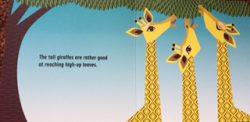
illustrated by Teagan White
Chronicle Books
Essentially this is a sturdy box containing 17 large, easily manipulated, double-sided pieces depicting Spring/Summer scenes on one side and Autumn/Winter ones on the reverse. Each piece shows various woodland animals playing and working together; a whole tree community indeed and the puzzle when complete is over 130 centimetres long. Nothing special about that, you might be thinking but, the language potential is enormous, especially as there is no one right way of fitting the pieces together: this open-endedness also means that if more than one child plays with the pieces, there is a co-operative element too.

The artwork is splendid: each detailed piece, a delight.
Every branch of the tree generates a different story, or rather, many possibilities; ditto the completed tree. Some children like to story about the pieces as they put them into place, others prefer to complete the puzzle and then tell one or several stories which may or may not be connected. You could try a completely open-ended ‘take it in turns tell me about’ game with children sitting in a circle for starters, or perhaps choose a focus, say animals, plants or perhaps, events: the possibilities are many.
I’ve used this marvellous resource in several different settings and each time it’s been received with enormous enthusiasm and the users have shown great reluctance to part with it afterwards.

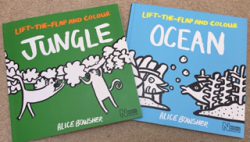
Lift-the-Flap and Colour Jungle
Lift-the-Flap and Colour Ocean

Alice Bowsher
Frances Lincoln Children’s Books/ Natural History Museum
In this collaborative publishing enterprise, children can choose from one of two locations to start their colouring in experience. The first is the South American Amazon jungle wherein jaguars hunt, slow sloths dangle, alligators lie in wait for a tasty meal, stick insects and parrots share the lush foliage, and swinging monkeys abound.
In the Ocean they can encounter diving dolphins, and shoals of fish, visit a coral reef with its abundance of sea creatures, notice the seaweed fronds that provide a safe hiding place for fish; and dive right down to the deepest dark depths.
A brief, rhyming text accompanies each adventure gently informing and guiding the young user as s/he explores the location, lifts the flaps and adds colour to the black and white pages – five spreads per book. And the final page of each book has an information paragraph that focuses on the importance of protecting the specific environment.
These will I’m sure be seized on by young enthusiasts, particularly those with an interest in wild life and will one hopes, leave them wanting to discover more about the inhabitants of each location.

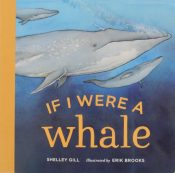
If I Were a Whale
Shelley Gill and Erik Brooks
Little Bigfoot
This contemplative, charmer of a board book successfully mixes rhyme and science facts. It imagines the possibilities of being a minke, a beluga playing with icebergs, a pilot whale and then these beauties …

If those don’t suit there’s a tusked narwhal, a blue whale, or a humpback perhaps? There are eleven possibilities in all, each one beautifully illustrated by Erik Brooks who manages to capture the essence of each one in those watery worlds of his.
Yes, it’s a small introduction to a huge topic but this is a pleasure to read aloud, is likely to be demanded over and over, and to inspire tinies to want to know more about these amazing mammals.

I’ve signed the charter  

Mouse’s Big Day / All Birds Have Anxiety / Mouse and the Storm

Mouse’s Big Day
Lydia Monks
Macmillan Children’s Books
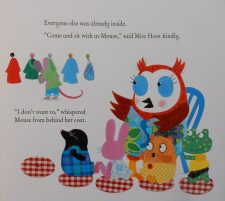
Mouse is going to school for the very first time and even before leaving home, she’s decided it’s not for her. Her dawdling tactics don’t work, nor does her “I don’t want to” response to all Mummy mouse’s encouraging remarks; finally she’s left at Twit Twoo School in the safe hands of teacher, Miss Hoot.

She has an exciting project for her class: “… go out and find something. Something special. Maybe something only you can find.
Mouse reluctantly joins her classmates all of whom thoroughly enjoy rummaging, upturning rocks, digging and pond peering, although she’s too shy to be anything but an onlooker. While the others are busy contemplating their findings …

Mouse vanishes. Miss Hoot knows just where to look for her though, and eventually a kindly paw proffered by Mole encourages Mouse to emerge from her hiding place and follow the others back indoors.
There she makes a series of discoveries that ultimately lead her to a very important realisation. School is an exciting place after all and she cannot wait for tomorrow.
Populated by adorable animal characters, Mouse’s school is an inviting place and Lydia Monks’ heart-warming story of her first day gets right to the heart of how the less outgoing among 4 year olds are likely to feel on their ‘Big Day’. This is just right to share with a nursery and preschool groups, or individuals, in the lead up to starting school.
Further reassurance about coping with tricky situations comes in:

All Birds Have Anxiety
Kathy Hoopman
Jessica Kingsley Publishers
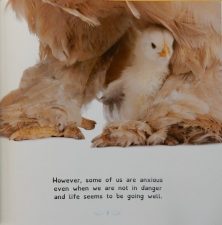
Statistics show that more and more children have anxiety problems, often starting at a young age. I’ve talked about educational issues that I feel are to a large degree responsible in other reviews so will just say that here is a photographic picture book that will help children of all ages better understand the condition.
By populating it with birds of all kinds with appealing faces,

and in amusing poses,

the author gives a serious topic just the right degree of lightness and gentle humour.
Anxiety in all its forms is discussed including how stress can effect everyday activities – ‘Everyday jobs, like combing hair, changing clothes or making decisions are too much to think about ’; its possible causes – ‘it often runs in families’; how to deal with it: ‘Being with those who listen to us and accept us makes a world of difference.’ and ‘Exercise, plenty of sunshine and a healthy diet are all a huge help.’ for instance.
Unthreatening, fun and enormously helpful for children of all ages, whether they suffer from anxiety or just want to understand it better in others.
For educators and those they have dealings with, be that in school, at home or in another setting.
Anxiety prone youngsters will benefit from some therapeutic reflexology as in:

Mouse and the Storm
Susan Quayle, illustrated by Melissa Muldoon
Singing Dragon
Reflexologist, complementary therapist and developer of The Children’s Reflexology Programme follows The Mouse’s House with a third story intended, this time for reflexology on a child’s hands.
Using Mouse and the five other animal characters to represent reflex areas of the hand, Quayle weaves a charming rhyming story to accompany the sessions of hand reflexology. It’s especially designed for use with young children, in particular those who have anxieties be they associated with ASD, new experiences, or another condition where calming treatments are required.
With hand instructions at the top of each left hand page and a charmingly quirky illustration on the right, adults can read the story of what happens when the animals awake to discover a storm scattered them far from the comfort of their own homes

while applying the gentle movements to the young recipient’s hands.
Since no prior reflexology experience is needed, this is a book for any parent of an anxious young child to add to the family bookshelf.

I’ve signed the charter  

A Handful of Animal Board Books

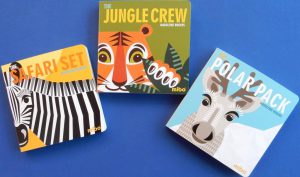
The Safari Set
The Jungle Crew
The Polar Pack

Madeleine Rogers
Button Books
Here we have the first three board books to be added to the Mibo series and they’re some of the best board books I’ve seen in a long while. Each one features a different natural location and all have rhyming texts and some brief, attractively presented snippets of information inside the back cover.
The Safari Set takes us to the dusty, sun-scorched African plains where lions laze, giraffes graze

on high-up leaves, elephants roam, zebras flash past and hippos wallow for hours in the cool water.
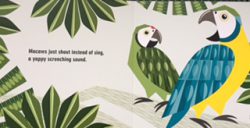
In the dappled, leafy jungle we encounter members of The Jungle Crew: a troop of lively monkeys, screeching macaws with their dazzling plumage,

a fearsome-looking tiger stalks, toucans chomp on tasty fruits and tree frogs hop, and drop (when it’s time to lay eggs).
Members of The Polar Pack live in either the far north or far south; many are under threat and need protection. The South Pole is home to Emperor penguins: mighty-tusked walruses, polar bears,

huge-hooved reindeer and snowy owls reside in the North Pole.
Superb, beautifully patterned illustrations and rhyming texts that are a pleasure to read aloud make these top quality little books for the very youngest.

Really Feely Baby Animals
Really Feely Farm

Polly Appleton and Dawn Sirett
DK
A host of animals (5 per book) introduce themselves and invite toddlers to participate in a variety of sensory experiences such as ‘Rub my tufty fur. Then choose a shiny red apple for me to eat.’ or …

Feel my fuzzy feathers. And touch my smooth, pointy beak.

A kitten, a playful puppy and a baby rabbit also want to be similarly explored in Baby Animals.
In Farm Animals we meet first a chicken, and go on to encounter a sheep, a piglet, a duckling …

Feel my soft, fluffy tummy. And touch my smooth, shiny beak.

and a calf.
In both books the photographic images on each recto really seem to leap out from the page, heightening the whole visual experience. On the baby rabbit page for instance, its whiskers glisten as the light catches them. However it isn’t only the animals that are tactile; every item on the page provides a lovely feely experience and a whole lot of language learning possibilities.

A Farm Visit, An Egg Hunt Activity Book & Masha and her Sisters

%0a

Look and Say What You See in the Farm
Sebastien Braun
Nosy Crow
Published in partnership with the National Trust, this book with its thick pages presents us with thirteen farm scenes going right through the year from early spring when there’s an abundance of lambs in the fields, little chicks have been born and there are calves needing their share of milk …

%0a

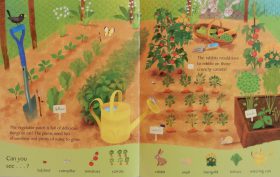
Back outside at the pond, ducklings and goslings are learning to swim and tadpoles wiggle and waggle their tails. In summer, there is an abundance of insects, wild animals and wild flowers; their presence enriches the farm and some weeks later, it is time for the collecting of yummy vegetables .

%0a

Autumn brings the wheat harvest, pumpkins aplenty and in the orchard, the apples are ripe and ready for picking, so too the pears.. Mmm!
Winter sees the animals snuggling in the warm barn with the door firmly shut against the cold.
Every spread has a strip along the bottom asking readers, ‘What can you see … ? with nine items to search for in the large scene above. Perfect for developing visual literacy, for encouraging storying; and, it’s lots of fun.
fullsizerender-63

We’re going on an Egg Hunt Activity Book
illustrated by Laura Hughes
Bloomsbury Children’s Books
The bunnies from last year’s We’re Going on an Egg Hunt picture book return inviting youngsters to participate in a variety of activities including matching shadows to images, egg decorating, spot the difference, a word search and much more. The centre spread has beautiful stickers with which to adorn the pages as instructed – or otherwise if you’re divergent. I suspect some children won’t want to cut out the triangular shapes to make the bunting, especially as there’s a game of hide and seek with the bunnies and a follow the path game on the reverse sides; if so, I’d suggest copying the spread or drawing your own triangles to decorate. These are just some of the games in this attractive book, made all the more delightful by Laura Hughes’ cute bunnies. Just right for Easter.

%0a

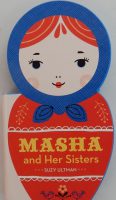
Masha and Her Sisters
Suzy Ultman
Chronicle Books
This is a retro delight: a maryoshka doll-shaped board book that, once the cover is lifted, opens downwards to reveal, one by one, five dolls, the first being the smallest. Flip that page down and a slightly larger sister is revealed and so on. First we meet Natasha, the storyteller, then nature lover, Galya; Olya is the chef, Larisa, the performer and finally, Masha who is the collector. The body of each is decorated – front and back – with objects related to their special interest. Thus for instance, Galya has fauna, trees and a tent;

dscn0284

Olya the chef has herbs, mixing bowls and kitchen tools. Innovative, charming and near enough egg-shaped to make an Easter treat for a small child.

Charter logo FINAL.indd

100 First Words / Animal Sounds & Things That Go / My First Wildlife Sticker Activity Book

dscn0211

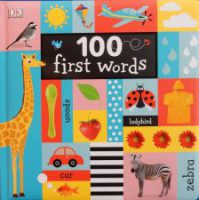
100 First Words
Dawn Sirett and Charlotte Milner
DK
This large format book is definitely a lap style board book not a ‘clutch in the pram’ kind. It encompasses fourteen topics, one per page; and those on opposite pages are related, so we have for instance: My body and My clothes; My toys and Colours, Pets and Wild animals and …

dscn0212

Naming is an important element of a very young child’s language learning but essentially the language learning potential in this book is far greater than that: focussing on a single image could furnish so much language learning, and that is where it comes down to the skill of the person sharing the book with a baby or young infant, (or equally, a person just starting to learn English as an additional language).

dscn0213

The labelled photographic images are clear, uncluttered, and pattern is very much part of the whole look of the book.
Definitely a worthwhile investment if you have dealings with tinies

dscn0228

Animal Sounds
Things That Go
Jane Foster
Templar Publishing
Rich in pattern and colour, and rich in language potential, are the two new board books from fabric designer, Jane Foster. Animal sounds include the ‘meow meow’ of a ginger cat and the ‘woof woof’ of an endearing spotty dog, the gentle ‘flitter flutter’ of a butterfly’s wonderful wings and the contrasting ‘ROAR’ of a lion; and these two delectable creatures …

%0a

The final spread comprises 22 named portraits of all the animals, taking a break from sound-making.
The layout of Things That Go is slightly different. We have eleven items represented: some that move through the air, some through water and others across land. I love the inclusion of this …

dscn0231

Each ‘mover’ has a double spread, its name is given against a subtly patterned page opposite which is the object and an associated sound, I can’t imagine any toddler not enjoying sharing these beauties with an enthusiastic parent or carer.

%0a

I foresee hours of fun and language learning where the three (or four) come together. Both books are a clever, winning mix of simplicity and sophistication.
fullsizerender-63

My First Wildlife Sticker Activity Book
illustrated by Gina Maldonado
Bloomsbury Activity Books
Published in conjunction with the rspb, this attractively illustrated book asks young children to look closely at what is on the printed page: to search for particular fauna and flora, to find matching pairs, to locate minibeasts, add stickers to scenes, find the odd one out and so on. There’s no substitute for seeing the real thing, but one hopes having done the activities herein, youngsters will be inspired to go out and look at the natural world for real.

Charter logo FINAL.indd

The Painting-In Book / Happy, Sad, Feeling Glad

fullsizerender-63

The Painting-In Book
Anna Rumsby
Laurence King Publishing
All young children have the potential to be creative; they just need a supportive adult, some basic resources and opportunities to experiment.
Early years teachers will be familiar with the techniques herein (and have offered similar kinds of activities); parents may not be; and they I think, will welcome this large format, bumper book of thirty activities for budding young artists. All that’s needed to get going are: an apron, water-based paints, a mixing dish, paint brushes of various sizes, a sponge, an old toothbrush, some bubble wrap, cotton buds and a container for water. (I’d add to this, a plastic sheet or old newspapers). Activities – and they’re all exciting, fun and educative in the art sense, – range from colour mixing, hand-printing …

img_1597

printing with cotton buds, bubble wrap printing, toothbrush paint flicking (a favourite with nursery age children), painting with a sponge, and adding lines to wet paint with the end of an inverted paintbrush.

fullsizerender-64

The paper used is high quality and the sheets easily removable. Perfect for wet days and holidays when you can’t get outside – or if you can, then move outdoors and do a spot of painting there.

dscn0245

Happy, Sad, Feeling Glad
Yasmeen Ismail
Laurence King Publishing
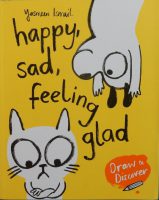
Whoppee! Donkey, Cat and Dog come together for the third in the fabulous Draw & Discover series by the super-talented artist, Yasmeen Ismail. Twenty five emotions/feelings from curious to cranky, (where Dog’s hunger is ‘making him cranky’ and the reader/co-creator is asked to put some food on his plate); annoyed to afraid, guilty to gloomy and startled to scared, are presented through delightfully silly situations such as this: what could it be that has scared Dog and Cat? …

%0a

Every single scenario is truly funny; it’s hard to pick a favourite, but I can imagine many children would go for this embarrassing situation for Dog who has had a slight accident and now needs some dry pants …

dscn0249

Charter logo FINAL.indd

A Clutch of Activity Books

dscn9768

inside, outside, upside down
push, pull, empty, full

Yasmeen Ismail
Laurence King Publishing
As a big fan of Yasmeen Ismail’s work I was thrilled to see these new Draw and Discover activity books. Herein children can, having grabbed their pens and pencils, join Rabbit and Duck and have lots of fun responding to the instructions on every page.
Those who work with young children know that concepts such as ‘tall and short’ …

dscn9766

‘short/long’, ‘small/ big’ and ‘empty/full’ are learned gradually through experience: inside, outside, upside down will add to such experience. In addition opposites such as outside/ inside, top/ bottom, left/ right …

dscn9767

are also playfully presented.
Push, pull, empty, full adds scientific concepts – push/ pull …

dscn9765

and warm/ cool as well as ‘beginning/ middle/ end’ which invites readers to ‘draw the middle’ and colour the rainbow created by so doing.
Draw Colour Discover’ says the message on the back cover: I’d add, Enjoy.

dscn9769

Woodland Hedgehugs Activity Book
Lucy Tapper and Steve Wilson
Maverick Arts Publishing
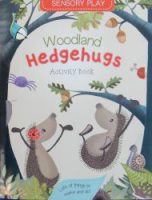
Spring’s not far away; already catkins are appearing on the hazel trees so it’s a great time to get out into the countryside or park with Horace and Hattie hedgehog (not forgetting Sid the Snail – he pops up on every page) and take up their invitation to engage in some sensory play. They suggest you wear wellies and wet weather gear and take along ‘A pot or box and a spoon, paper, chalk, glue, sticky-tape and ( most important I think), your imagination.’
Suggested outdoor activities include observations of colours in nature, looking for animal tracks, a scavenger hunt, some woodland challenges …

%0a

an exploration of woodland textures, and taking rubbings of bark and leaves.
There’s a page of tree leaves to search for; and an invitation to listen out for natural sounds can be followed by drawing what was heard on the related page,
These are just some of the in-the-field suggestions but there are plenty of indoor ideas too. Why not try making a shaker from a Y-shaped stick, do some messy leaf printing, or creating some tasty ladybird treats starting with an apple.
I like the way the outdoors is brought to the indoors through activities such as these and the woodland map making. The pictorial map outlined in the book can be coloured, but I’d suggest children make their own, either in two or three dimensions, perhaps with the help of photos taken on a walk.

dscn9965

8 Ways to Draw a Fish
Luisa Martelo
Tara Books
The author of this thoroughly engaging and instructive activity book has enlisted the help of artists from various regions of India. There are eight different art styles in all including Rajasthani Meena work from artist Sunita, Gond art from Madhya Pradesh from Bhajju Shyam, and Subhash Vyam, Madhubani style from Bihari artist, Rambharos Jha, Bhil art from Subhash Amaliyar and Patua style from West Bengali artist, Swarna Chitrakar.
As with all Tara publications, the whole thing is of top quality: the paper itself is beautifully thick (card almost) and each spread is a combination of grey outlines – thick or thin – and colourful design/pattern.

dscn9966

The suggestion is that users trace the fish outlines and then be creative in how they add their own details and colours. The guidance is subtle rather than overly instructive and accompanying it are snippets of basic scientific information about the fish and their environments.
And of course, the book proves lots of fun, both for its intended child audience and for the many adults who enjoy such books as a means of relaxation. Make sure you read the author’s ‘What is Art?’ on the inside front cover flap too.
Buy to give and buy to keep. I intend to give my copy but first I’ll do some sneaky tracing so I don’t miss out on the creative opportunities.

bookgivingdayblogbadge-1 localbookshops_nameimage-2

Picken / Animal Counting

dscn9612

Picken
Mary Murphy
Walker Books
What a clever title for this ‘mix and match’ farm animal book. Here youngsters surely can ‘pick ‘n mix’ the opposite sides of this split page board book to create a host of crazy animals. Thus for instance, a Calf can become a Camb, a Cacken, a Catten, a Caglet, a Case …

dscn9613

(I’ll leave you to work out what animal the rear end belongs to) and a Cappy.
A kitten on the other hand, might be a Kilf or a Kimb …

dscn9614

or four other strange creatures.
Essentially this is a game in a book and with Mary Murphy’s bold, bright illustrations, a delightful one at that. In addition, it’s a wonderfully playful way to develop some sound/symbol associations.

dscn9609

Animal Counting
Petr Horáček
Walker Books
This lift-the flap animal book is just the thing to encourage the very young to participate in the development of their counting skills. Brightly coloured images of a giraffe, zebras, cheetahs …

dscn9610

snakes, crocodiles, chameleons, toucans, pandas, lemurs and finally fish are presented alongside the appropriate numeral and when the half-page flap on the right-hand side of each double spread is lifted, it reveals both a number symbol fashioned from the featured animal and the corresponding number word.

dscn9611

To add further interest, each animal is described in an adjectival phrase such as-‘Seven Screeching toucans‘ or ‘Nine leaping lemurs‘.

First Snow / Brrr! Brrr!

%0a

First Snow
Bomi Park
Chronicle Books
With impactful minimal text and a limited colour palette, debut picture book artist Park creates the magic of a first snowfall as experienced by a toddler. Said toddler dons warm outdoor gear (good on her) and creeps out into the white world beyond her front door, there to discover the joys of building a snowman. First though it seems, she must roll her ball of snow down urban streets, across a moonlit field, beside an elevated railway track – ‘Fast, fast fast’ –

%0a

into the woods where she joins a throng of other snowman-building children. A magically uplifting moment occurs

dscn9228

after which reality reasserts itself and we, and the little girl, are returned once more to her back garden and another kind of enchantment.
Go back and look once more at the details in Park’s captivating snow-filled scenes. Notice: the snowflake patterns on the child’s mits, the activities of the pup accompanying her the whole time, and the animals emerging and watching in the dark woods.

dscn9227

Gorgeous! And as an added bonus, the spare text, with its built-in repetition, is such that beginning readers can, once the story’s been read to them, read those fifty odd words for themselves.
For even younger children is

dscn9253

Brrr! Brrr!
Sebastien Braun
Nosy Crow
This is one of the series of lift-the-flap books for those ‘just beginning to talk’ and it certainly has a chilly feel to it. Peeking out from behind five objects –an iceberg, a boat, a cave entrance, an igloo and a clump of fir trees, each of which forms the flap, are five animals. Youngsters can enjoy a game of hide and seek in response to the sequence of ‘Who’s that … ?’ questions

dscn9254

and then join in with the animal sound once it’s revealed. Sebastien Braun’s snowy scenes are a delight: I particularly like the woodland one.

dscn9256

With the repeat pattern of the simple text, beginning readers can enjoy sharing this with a toddler sibling too.

Fun and Games / Migloo’s Weekend

dscn8754

Fun and Games
Alain Grée
Button Books
This is chock-full of playful activities –over 50 altogether – all devised and illustrated by artist Alain Grée. There is something that should appeal to a wide age range from around 3 up to 6 or 7. Each activity is given a single page printed only on one side and glued so that it can be removed for use. There’s a variety of matching games, find the odd one out, true or false games, calendar cubes, spot the differences pages …

dscn8756

and other games to develop visual perception as well as activities that entail cutting, folding and creating objects including a tiny puppet theatre

dscn8757

and a sentry box. You can even make a stand-up Santa chain.
All the pages are attractively presented and full of details that are the hallmark of Alain Grée’s illustrative style. It’s just perfect for indoor days and likely to keep a child or two engaged for hours at a time. An ideal diversion from endless screens too.

dscn8930

Migloo’s Weekend
William Bee
Walker Books
A day spent in the company of dog, Migloo and his Sunnytown friends is tiring: a whole weekend is totally exhausting, from an adult perspective as least. Youngsters tend to delight in rushing from one venue to another and there’s plenty of that herein. We join Migloo as he accepts a lift in Noah’s fish van and head for the market where Mrs Luigi has just opened a new café but it doesn’t look as though he’s going to be served any time soon judging by the queue, so off they dash to the farm instead. That too is very busy, but Farmer Tom has plenty on offer: Migloo’s spoilt for choice.

%0a

Appetite sated, the next stop is the museum, followed by the cinema to watch the latest movie, and guess what – that too is action packed. After all the fun, it’s bedtime for Migloo and all his pals. Phew!
Sunday is equally busy and Migloo manages to pack in a visit to the car races and a funfair extravaganza where he gets involved in an exciting rescue of a film star.
There are fold-out pages and things to spot aplenty; there’s even a spread called ‘Busy Page’, though I thought every page was pretty busy .
If you have or know children who like to be involved in a picture book that isn’t (despite what we’re told) a story, this could be just the thing. With plenty to explore and discuss, it’s likely to will keep youngsters amused for hours.

Animals, One Cheetah One Cherry & Flip Flap Pets

%0A

Animals
Ingela P Arrhenius
Walker Studio
This over-sized picture book by Swedish illustrator/designer Arrhenius is sure to have youngsters poring over its gigantic retro-style pages. It features thirty two animals large and small from grasshopper …

%0A

to gorilla, and hippo to frog …

%0A

Every one of the pages would make a lovely poster and it’s hard to choose a favourite animal: I love the muted, matt colours used and the careful placing of pattern; and the lettering fonts and colours seem to reflect the essence of each animal portrayed.

%0A

If you’re looking for something impressive to generate language in youngsters, try putting this book on the floor in your book area and see what happens.
It might also be put to good use in an art lesson for older children.

%0A

One Cheetah, One Cherry
Jackie Morris
Otter-Barry Books
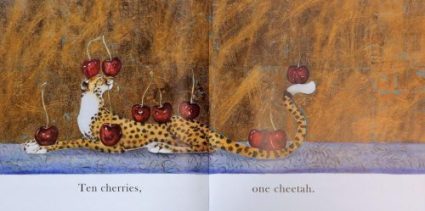
Absolutely stunning paintings of wild animals grace the pages of this stylish, smallish counting book. We start with ‘One cherry, one cheetah’ showing a graceful beast with a luscious-looking cherry between its paws and continue, encountering two dogs, three bears, four foxes …

%0A

five elephants, six tigers, seven pandas, eight otters, nine mice, ten cherries – all carefully poised, thus :

DSCN8682

which takes us back (numberwise) to None. The cheetah has feasted on those ten delicious cherries and looks mighty pleased about it.
What a wonderful array of animals and activities. The language too is so carefully chosen: alliteration abounds as here: ’Four fine foxes/ sharing strawberries.’
or, try getting your tongue around this one: ‘Seven giant pandas, with pretty painted parasols.’

%0A

Such delicate patterning on those parasols and lantern. Indeed pattern is part and parcel of every painting, so too is gold-leaf; but that’s not all. The end papers are equally gorgeous, the front being a dance of numerals, orchestrated by the cheetah and the back shows the number symbols in order with animals/cherries alongside.

DSCN8591

Flip Flap Pets
Axel Scheffler
Nosy Crow
Axel Scheffler offers a multitude of opportunities to create quirky creatures in his latest Flip Flap rhyming extravaganza. Youngsters can turn the basic ten or so popular pets into a whole host of crazy combinations of feather, fur, scale, shell and more. What happens for instance when you cross a stick insect with a budgerigar? You get a STICKERIGAR of course …

DSCN8593

Try crossing a goldfish with a tortoise – that results in a GOLDFOISE:

%0A

and a snake crossed with a cat gives something pretty irresistible – a cake!
It’s possible to make – so that butterfly on the back cover of this bonkers book informs us – 121 combinations. What are you waiting for? If my experience of previous titles in this series is anything to go by, this new addition to the series is likely to inspire children to set about making their own flip flap books.

WNDB_Buttonlocalbookshops_NameImage-2

We Love Dinosaurs / Touch & Explore Dinosaurs

DSCN8544

We Love Dinosaurs
Lucy Volpin
Nosy Crow
Debut picture book artist, Lucy Volpin celebrates her passion for dinosaurs with a rhyming litany to these extinct creatures be they tall or small, fleet of foot or plodders, herbivores or carnivores, those with enormous roars or snuffly snores …

DSCN8545

No matter whether they are spiny, spikey or something other,

DSCN8546

these are probably some of the most talked about, most loved by children, of all animals ever.
Rendered in watercolour and pencil, the dinosaurs herein are sure to delight young addicts and should also create some new enthusiasts among pre-schoolers who will enjoy pointing out their various attributes and finding the descriptive words in the brief text.

DSCN8547

Indeed slightly older children will likely want to have a go at reading the whole thing for themselves once they’ve heard it read aloud a couple of times.

%0A

Touch & Explore Dinosaurs
Illustrated by Ninie
Twirl Books
Dinosaur loving seems to start at a very early age and here’s a board book catering for pre-schoolers who can explore its contents and enjoy a multisensory experience by using their fingers (to feel the numerous textures inset into the die-cut shapes of various parts of the dinosaurs’ anatomies) – even the title is touchy-feely; by looking closely at the details in some of the illustrations or merely, by enjoying the bright colours of these little beauties;

DSCN8302

(I like the playful hues used here accompanying the ‘… today no one knows what colours our skins were.’) and perhaps even creating ROARS and dinosaur shapes with their own bodies.
They can also find out about the smallest known dinosaurs,

DSCN8304

learn something about dinosaur diet, how dinosaurs reproduced, how they came to an end, as well as meeting one or two species close up: Diplodocus the gentle giant – (did you know this plant eater was larger than three elephants?); Triceratops with its frilled neck and small-headed Stegosaurus, and Microraptor with large wings that were used for gliding.
There’s a fair bit of information embedded in this book, much of which will be absorbed with little effort by those ‘littles’ who peruse its pages Did you know a Maiasaurus makes a small crater in which to lay its eggs? I certainly didn’t.
First person, direct language is used to convey the facts so that it appears readers are being addressed by the various dinosaurs, adding to the fun. And Ninie’s digitally rendered artwork with those die-cut touchy-feely bodies almost jumps off the pages. It’s fortunate this board book is sturdily bound to stand up to the heavy handling it’s likely to receive from enthusiastic early years readers.

WNDB_Buttonlocalbookshops_NameImage-2

Toddler Delights

DSCN8585

City Block
Christopher Franceschelli and Peskimo
Abrams Appleseed
In this exploration of city life, through clever use of alternating shaped and whole pages we are shown city life from subway to high rise level and everything between. The book is divided into three parts: ways of getting around, places of interest …

DSCN8588

and finally, things to eat. The die cut shape on the first spread suggests its fuller context when the page is turned (or opened) and this pattern is used throughout and in all, two dozen aspects of city life are featured in a whacking 96 pages. Perfectly sized for small hands, we are treated to a series of linked illustrations of what makes a city: its transport systems …

%0A

the multitude of places to visit, food to sample …

DSCN8589

and all – if you really go for it – in a day …

%0A

Goodnight, City!

I really like the way we are gradually shown smaller aspects of this sprawling metropolis – the very different places that all contribute to its fascination and excitement. What are you waiting for, go exploring …

DSCN8628

Hey Diddle Diddle
Happy Birthday
illustrated by Yu-hsuan Huang
Nosy Crow
Littles will delight in moving the sliders and bringing to life the favourite songs in these two chunky ‘Sing Along With Me’ board books. In the first, the illustrator uses a fairground setting adding a whole cast of characters to those from the rhyme and there is plenty to talk about in the jolly scenes.

%0A

The cow jumped over the moon.

In the second book, it’s a little rabbit that shares his birthday celebration with readers and of course, his party guests.
Because of the repetition and simple rhyming pattern, reading familiar songs (in addition to singing them) is a very good way to teach beginning reading; and the young child gradually starts to match the words on the page with those in his or her head. By scanning the QR code on the inside cover of each book, users can download an audio version to keep and sing/read along with. (Instructions are provided,)

%0A

Eek! A Mouse Seek-and-Peek
Anne-Sophie Baumann and Anne-Kathrin Behl
Twirl Books
Talk about flap extravaganza – this surely is it – as we join a mischief of mice as they rummage, room after room, through a house, seeking paraphernalia for a party. Starting in the basement they search containers large and small. Next stop is the bedroom – ooh! some secrets here –

DSCN8652

then the kitchen, the bathroom, the attic and …

DSCN8653

What a well-organised household these mice have found. And what fun to explore it with them, opening all those boxes, cans, cabinets, tins and cases listening to their comments as they collect all manner of exciting items and have a few surprises and the odd tasty morsel too.
Comic scenes abound and this is certain to get a lot of enthusiastic handling, not to mention squeals of delight: I only hope it can stand up to the multiple readings I envisage.

WNDB_Buttonlocalbookshops_NameImage-2

Animal Magic, Cuddly Cow, Portly Pig, Baby Elephant & Baby Reindeer

%0A

Animal Magic
Phil Allcock and Gina Maldonado
Maverick Arts Publishing
Delightfully playful is Phil Allcock’s nonsense rhyme featuring what starts out as a hedgehog – a funny one – and morphs into eight other animals – small and smaller. There’s a hopping one, a wiggler…

%0A

a strutting clucker, a quacking swimmer, a jogger, a hopper (furry this time) and slimy slitherer and finally …

%0A

Toddlers will have enormous fun guessing what each new disguise will be before the page is turned to reveal it in one of Gina Maldonado’s enchanting dayglow spreads.

DSCN8087

Cuddly Cow/ Portly Pig
Axel Scheffler
Nosy Crow
Another two lovable animals star in the latest ‘Sound Button’ farmyard stories from the inimitable Axel Scheffler. The first features a very dozy Cuddly Cow intent on finding a quiet peaceful spot for some shut-eye. Her own meadow’s no good because the other cows make too much of a din: surely there’s somewhere else though, after all it is past sundown.
The chicken shed’s full of clucking hens, the horse is inhospitable, there’s a right old row in the pig pen – thank you ducks – but what about the sheep field? Maybe a spot of counting might help …

DSCN8088

Portly Pig’s troubled on account of his clean, pinkness. He’s against green grass, yucky flowers and trees as he describes them, and sets off in search of a mucky place. Soon he discovers just the thing: a cool, muddy pool; and a delightful day of splashing and sploshing follows. Until that is, the sky changes colour …

%0A

Pig, like most young children is a real mud lover but unlike them, he can keep on getting muddy, letting the rain wash him off and immediately getting mucky all over again – in an instant. Youngsters will delight in Portly’s mucky, messy coat and might well be tempted to emulate his actions – adults beware!

DSCN8265

Baby Elephant / Baby Reindeer
illustrated by Yu-Hsuan Huang
Chronicle Books
In the first of two new offerings in the ‘Finger Puppet’ series we discover how Baby Elephant greets her Mama, finds food, keeps cool and communicates with fellow baby elephants.
Baby Reindeer lives in a contrastingly cold tundra climate and to find food, has to use his hooves to dig in the snow and uncover tasty lichen. Like Baby Elephant, he too swims in a river – albeit a very icy feeling one and snuggles against Mama Reindeer for warmth at the end of the day.
Both board books provide a lovely way for human adult and baby to interact with a book.

WNDB_Button localbookshops_NameImage-2

The World-Famous Magical Numbers & Peekaboo Wild

DSCN8379

The World-Famous Book of Magical Numbers
Sarah Goodreau
Big Picture Press
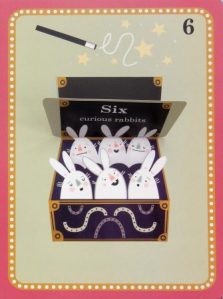
Wow! This is a bobby-dazzler. Superbly designed in a gloriously retro, vintage style, it’s a truly magical presentation of numbers (0 to 0), with opportunities for counting aplenty, rendered in bold, bright colours and a myriad of patterns, by 1 master magician …

DSCN8374

(and, of course, Sarah Goodreau) You’ll be astounded for sure!
There’s excitement on every page: prestidigitation abounds as we see sleights of hand, grand illusions and out-of-this world wizardry all done through ingenious paper-engineering that employs flaps …

%0A

tab-pulls, pop-ups …

DSCN8375

and a truly splendiferous grand finale …

DSCN8372

which is followed by a farewell from our magician extraordinaire. – when he makes an appearance that is …

%0A

It’s as well this whole performance is sturdily constructed to stand up to the enthusiastic handling and countless re-reads it’s absolutely bound to receive: oh yes – youngsters may well improve their counting skills too, thanks to this show-stopping treat of a book.

%0A

Peekaboo WILD
Walker Entertainment
The very young can delight in a playful Peekaboo game (based on The Peekaboo Wild app.) First stop is the jungle, where we’re asked who lives therein and by lifting the flap we discover two of the inhabitants. The question and answer format continues with ‘Who else lives there?’ and two more animals hide beneath the flaps.
The second destination is the bush wherein kangaroos, a platypus, an emu and a koala have hidden themselves among the foliage. We move on to the sunny savannah, which has two spreads and herein are lions, a giraffe and a zebra …

%0A

Jagged ice peaks greet us in the Arctic, home to all these beauties …

%0A

Then it’s on to a bamboo forest home to two species of panda: the black and white one and a red panda as well as a tiger and a pangolin.
The two final spreads show first, a pictorial world map setting the animals in their continents and on the second, each habitat has a flap under which its respective inhabitants are hidden.
Through an enjoyable shared experience babies can learn so much about the animals in this board book; but even more important is the ‘books are fun’ message this will convey. In addition older siblings just starting to read can demonstrate their developing skill by reading it to a baby brother or sister.

WNDB_Button localbookshops_NameImage-2

15 things NOT to do with a Granny/ Big Bug Log

DSCN8045

15 things NOT to do with a Granny
Margaret McAllister and Holly Sterling
Frances Lincoln Children’s Books
The young children in this latest “Not to do’ guide have the whole topic of grannies pretty much sorted and they’ve drawn up a set of ‘simple rules’ for us all, a kind of ways to keep granny happy list. Now the teacher part of me might want to argue with the fact that they start with a whole lot of Don’ts rather than stating at the outset, the kinds of behaviours that are desirable; but then these littles have not, I suspect, begun attending nursery let alone school as yet, so instant forgiveness is the order of the day. And anyway, this small girl and her even smaller brother are just so adorable –tiny charmers no less. I’m sure their two grannies savour every moment they spend with their grandchildren. So what do the children suggest: First, no hiding an elephant in your granny’s bed – as if!
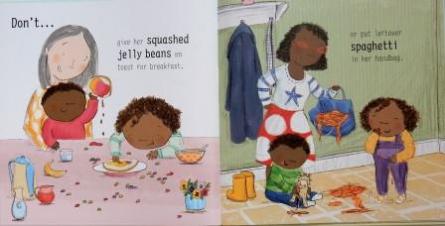
Second is food related: jelly beans on toast for breakfast are a definite no no and putting leftover spaghetti into a gran’s handbag is totally unthinkable …

DSCN8046

The same goes for using her pants as head gear or giving your ted. a makeover with the contents of her make-up bag.
They strongly advise against taking her on in a skateboard race; certain birthday presents are off the agenda as is interrupting her karate practice.

%0A

Grannies tend to hate loud noises, particularly when they’re lost in a good book; and when it’s your turn for a story, don’t completely overwhelm her …

%0A

Grans are to be shared, but never swapped. That pretty much deals with the NO NOs but what about the Do’s?
Walking together is good, listening – definitely, playing ditto, singing, hugging, helping – likewise. But most important of all …

DSCN8050

A wonderfully playful little book: Holly Sterling’s scenes of grans and grandchildren bring delight at every turn of the page. It’s perfect for littles to give their grans and vice-versa. A must for families with young children and for all early years settings. Grans do so much in the way of child-care and many families have come to rely on their goodwill in order to survive Grans deserve celebrating.: so, let’s hear it for all grans everywhere and for the book’s creators, Margaret and Holly – a great team.

DSCN8090

Big Bug Log
Sebastian Braun
Nosy Crow
This is a log-shaped board book that’s absolutely crammed with details and brimming over with humour. It stars young Bugsy Bug who is endeavouring to visit his gran who lives somewhere within the log, but he doesn’t know the right way. Young listeners can help Bugsy on his journey to her home by some puzzle-solving, maze following and clue solving. There are numerous doors to open, speech bubbles to act out, and even a wonderful library to visit – full of bookworms – as you might expect.

DSCN8092

It’s a good thing that there are so many helpful bugs on hand to assist Bugsy too, by giving him instructions and directions. After a lot of twists and turns, the little creature does eventually track down his Granny and a delicious surprise awaits him after all that effort.
This little book is superbly interactive and sure to keep littles involved and absorbed for ages. My only quibble is the bee’s assertion on the back cover: “We think this book is perfect for 3 to 5 year-olds!” I’d put it down to 2s and above.

WNDB_Button localbookshops_NameImage-2

One Is Not A Pair & Who’s Hungry?

%0A

One Is Not A Pair
Britta Teckentrup
Big Picture Press
This is the third of Britta Teckentrup’s ‘spotting’ series that encourage and develop visual perception in a playful way that children (and many adults) delight in. Here she takes fourteen objects and presents them in spreads where everyone has a pair except one – the odd one out. All interests are catered for: there’s food  – yummy-looking ice-cream cones, sweet shiny cherries –

DSCN8361

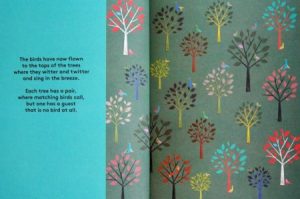
machines are represented by huffing puffing tractors and a ‘squadron of planes’, wild life has strutting magpies, spotted toadstools upon which spotty ladybirds crawl; there are birds in bird houses and in trees: ‘Each tree has a pair/ where matching birds call, / but one has a guest/ that is no bird at all.’ Can you find it?’

%0A

There are wonderfully coloured autumn leaves upon which insects crawl. We visit a toy shop with a host of cuddly bears …

%0A

and there are wooden blocks, built into towers and houses, a cacophony of yowling black cats, a richly hued pack of colouring pencils and last but definitely no least, washing lines of socks …

DSCN8366

And the final spread is a mix of all the things to pair up and find the odd one.
Characteristically stylish, bold bright graphics grace every page and Britta’s rhyming text trips off the tongue nicely.
Look, look and keep looking: it’s such fun.
There’s also a set of Where’s The Pair? spotting postcards from Britta:

DSCN8402

every one a diverting visual charmer and like the book, beautifully patterned in Britta’s inimitable style.

%0A

Who’s Hungry!
Dean Hacohen and Sherry Scharschmidt
Walker Books
The split page format is cleverly used to put young readers in control of feeding some hungry animals. By turning the half pages they can bring the food right to the animal’s mouth each time. The book starts with the straightforward, all-important ‘Time to eat. Who’s hungry?’ to which seven animals respond in the affirmative, starting with a rabbit who declares, “I am! I’m hungry.” A quick flip of the flap delivers a crunchy carrot almost straight into Bunny’s mouth. This is followed by ‘Glad you like it, Bunny. Who else is hungry?’ And thus the refrain is repeated and responded to, next by Seal who hastily slurps up a fish leaving only the bones behind.

%0A

Monkey unsurprisingly, snatches up a banana, dropping the peel; Horse chomps through a pile of hay, Squirrel consumes a large acorn, Panda some scrummy bamboo shoots, and lastly Mouse politely requests and nibbles on a chunk of cheese.
The off-screen narrator is always on hand to make certain each animal is duly satisfied: ‘There’s plenty more, Panda!’ he says …

%0A

And, the final spread offers a plate to the reader – I’d certainly relish the vegetables particularly that broccoli.
The eyes of each animal have that ‘come on’ appeal that seems to be directed straight at the reader (or listener) who will take great delight in responding by delivering the food to each member of this alluring-looking menagerie.
In addition to providing opportunities to discuss healthy eating, asking and receiving politely, caring for animals, and animal habitats with the very young, this is a great ‘have a go yourself’ book for those in the early stages of becoming a reader. All in all, it’s cleverly conceived, all-involving enjoyment for children and adults.

WNDB_Button localbookshops_NameImage-2

Knock! Knock!

DSCN7823
Knock! Knock!
Kaori Takahashi
Tara Books
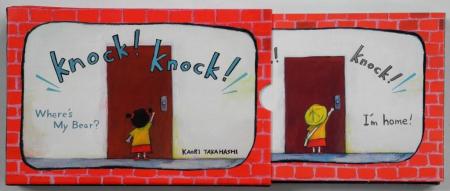
Ever heard the expression, ‘That’s how the story unfolds?’ Well nothing could be more true than a reading of this particular highly innovative title, which quite literally unfolds to reveal each episode of the story and finally, the whole …
The small ‘book’ comes in a slipcase and this adds to the enjoyment of the total experience, which begins with the small child returning home to discover that her bear is not there.

DSCN7824

A search ensues; a search that takes the little girl, and readers, on a bear hunt through the entire apartment block climbing up stairs, knocking on the doors of the various inhabitants which, when opened reveal all manner of fascinating interiors …

DSCN7827

unusual, sometimes surreal, happenings …

%0A

and unexpected characters …

%0A

Eventually the little girl reaches the top and there is a bird flying and guess what  …

DSCN7831

Then follows a joyful dash downstairs for a celebratory snuggly cuddle …

%0A

This is ingenious : there is a pattern to the unfolding, physical and literal: the upward climb always folds alternately right and up, left and up. The descent is much more rapid – an eight-page descending staircase unfolds before the wonderfully satisfying, grand finale in the child’s bedroom. Again, an ingenious way of controlling the pacing of the story and a delight for youngsters who revel in the whole constructing and deconstructing opportunity: satisfyingly brilliant circularity. one hundred per cent interactive and unique. Clever too, is the way in which the outside knocking scenes are rendered in black and white whereas the interiors open up in full colour.
If you have, or know a young child or children, make sure they have an opportunity to participate in this wonderful! Knock! Knock! experience.
A-MAZ-ING!
DSCN7799 (1)DSCN7800 (1)%0AHere’s Elena, 3 enjoying herself: she seemed to know intuitively how the whole thing worked.
localbookshops_NameImage-2

Get into Art

DSCN7758 (1)
8 Ways to Draw an Elephant
Paola Ferrarotti & various artists
Tara Books
Before even opening this unusual book I suspect I was predisposed to like it. I’m a huge fan of Indian art and elephants, and over numerous visits have collected a fair number of both two and three dimensional representations, several of which I’ve actually watched being created.
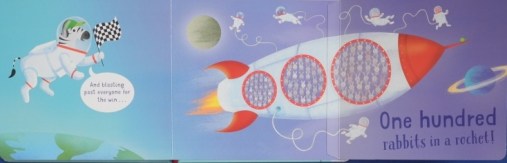
Now here’s an opportunity to introduce children to Indian art from a number of different traditions, with artistic representation from eight artists being showcased, each in a double spread.
Before that though, the book begins with a vital question: What it art? This is followed by four images of elephants: a photo, a drawing, an outline and a creative representation and Paulo Ferrarotti goes on to encourage readers to think about each medium and the similarities and differences between the resulting images. Indeed the narrative throughout the entire book is not about giving answers, rather, its concern is with getting children to do their own thinking – education in the true sense i.e. opening up.
The book provides blank outline templates for children to try out their own ideas having looked closely at the example of each style; those included being Rajasthani Meena …

DSCN7764 (1)

Patua from West Bengal, Saora from Orissa/Odisha and Madhubani from Bihar.

DSCN7765 (1)

Interestingly though, the elephants themselves are both Indian and African. At the back on the cover flap is a brief outline of each of the artistic traditions represented and opposite is an almost completely blank page, with a few words inviting children to draw and decorate their own elephant, asking ‘What is the elephant eating? Is it raining or sunny? Day or night?
All in all, this is a fascinating and exciting, creative learning opportunity for the young (and not so young).
What next? Sun representations? Or if you want to stick to animals: Camels? Horses? Peacocks? There’s plenty of scope where Indian art is concerned.

%0A

The Little Caillebotte
Catherine de Duve
Kate ‘Art Editions
In this unassuming little book, Catherine De Duve, art historian and painter who worked at the Royal Museum of Fine Arts of Belgium, introduces readers to impressionist painter Gustave Caillebotte. The artist spent some of his time in Yerres, (some 20 km from Paris) and this is featured in many of his paintings, some of which are shown herein. Art however was only one of his many passions and talents:

DSCN7763

he also loved sailing, gardening and naval architecture, and was a philanthropist. Information about all of this is included; and we learn too, of his friendships with other impressionist painters Monet and Renoir.
I knew very little about this artist save for some of his paintings until I read this fascinating introduction. It’s a book to get children thinking about art – Caillebotte’s of course, but also about impressionism, their own art, the countryside, the town and more: I really like the way that the narrative draws in and engages young readers.

Use your local bookshop   localbookshops_NameImage-2        WNDB_Button

Joys of the Countryside

DSCN7636

1 2 3 A Walk in the Countryside
Rosalind Beardshaw
Nosy Crow
This is a companion volume to ABC A Walk in the Countryside also published in association with the National Trust. Here the two small friends, plus dog are taking an autumnal walk by the river, over the hedgerow stile, pausing to look at falling leaves and scudding clouds, squirrels busy collecting acorns.

%0A

Then over the stepping stones to the other side of the river where rabbits play; and on into the pine woods. Next it’s time to pause for a tasty snack – thank you apple tree …

%0A

before stopping again for a spot of fish watching, blackberry picking – yum yum –

%0A

and, as the sun sinks the youngsters take delight in the flock of geese overhead 19 in all. But there’s still more to count – 100 stars, as they make their way homewards ready for snuggling up in a cosy bed.
With a delightful visual narrative accompanied by named items to count, this is a super little book to share with tinies either as a prelude to, or after, their own country counting walk. It’s as well it’s sturdily built to stand up to all the frequent re-readings I forsee for this enchanting country foray. Those illustrations would make a cracking number frieze for an early years setting or small child’s bedtoom.

%0A

Hedgehogs, Hares and other British Animals
Nikki Dyson
Nosy Crow
This ‘Nature Sticker Book’ goes right through the seasons visiting various habitats from the garden, the forest – underground and above in the spring;

%0A

to the river and open countryside at night. We’re then taken closer up into tall grassland that provides a home for harvest mice, rabbits, grouse and hares, and many wild flowers too can be found. The marine life and the seashore spreads focus mainly on large mammals – whales, dolphins, porpoises and seals although one of the activity spots on this spread invites readers to choose a position for the lighthouse (one is included among the 2 pages of stickers in the “On the beach’ section).
Seasonal changes are evident in the ‘Busy in the autumn’ woodland spread that shows ripened fruits and animals foraging for food to store for winter; and there’s a snowy woodland scene too …

DSCN7632

The final focus is on the reintroduction of some animal species such as beavers, and a playful mention of the possibility of wolves roaming once more. The last spread is a checklist of 28 different species that can be filled in over time.
Nikki Dyson, who illustrated Zippo the Super Hippo, provides 11 gorgeous natural scenes into which she places a plethora of wild animals that, with a touch of playfulness, she imbues with real character. One can imagine children, once they’ve added the appropriate stickers and completed entire scenes, creating their own stories relating to these creatures.

%0A

They might even want to include some of the factual information gleaned from the scientific material provided for each spread.
‘This book is all about mammals …’ says the introduction but it’s about much more: the flora are equally wonderful, as are the birds, insects and other small animals that have found their way into Nikki’s natural locations.

Use your local bookshop   localbookshops_NameImage-2

WNDB_Button 

Story Box

DSCN7054 (800x600)

Story Box
Anne Laval
Laurence King Publishing
Open up Story Box and you will find a set of twenty double-sided jigsaw pieces – a mix of beginnings, middles and endings – that can be arranged and rearranged to tell a whole host of different stories. In her engaging illustrations, Anne Laval has provided details that allow for users to take the story in a variety of directions depending on the way their imagination works at any particular time.
You might choose to start with a king standing with a princess in a castle turret: the king is waving but to whom? And what about the young princess; she’s gazing in another direction – what are her thoughts?
Turn the piece over and there are three characters – a man, a woman (holding a hen) and a boy: are they parents and a son? Farm workers? The boy is smiling? Why might that be?
Take another piece – an inbetween one, maybe this … Ahh! Might it be an alternative version of Jack and the Beanstalk perhaps …

DSCN7023 (800x600)

or you might choose to send the boy off on his horse on a quest of some kind.

DSCN7027 (800x600)

There are all manner of fairytale characters he could encounter – a witch, dwarves (seven of them), a wolf clutching what one child thought was a shuttlecock but on closer investigation decided it’s a pepper pot (but could it be a sprinkler with something else inside?)

DSCN7026 (800x600)

Oh! and there’s this pink rabbit – large here …

DSCN7024 (800x600)

but not in other scenes: again he offers all manner of possibilities …
The witch’s house, the castle, the woods, a cave, an ice-ream van even, supply background for scenes to unfold as a story progresses.

DSCN7021 (800x600)

With such fairy tale motifs as a sword, a beanstalk, a basket of rosy apples users may want to stay close to the familiar or alternatively, let their imaginations run riot before finishing up with one of the half dozen endings available. Here are three of them …

DSCN7022 (800x600)

This is a great classroom resource that can be used across a wide age range from nursery up. Its potential depends only on the setting and of course to a certain extent, the creativity of the teacher and children using it. It is absolutely brilliant for developing speaking and listening skills, for building co-operative skills, for storytelling and writing, (maybe with an adult scribing) for drama, as starting points for art and craft in two or three dimensions – the possibilities are enormous.
If there are children learning English as an additional language in the group, an adult could tell a story pausing to ask the children to look for the appropriate card piece, gradually building a chain as the narrative progresses.
Alternatively a small group could be given several pieces each and sitting in a semi-circle, take turns to add a piece to the tale supplying the narrative to accompany it.
I could go on, but suffice it to say, the contents of this box cries out to be played with. ‘Narrative’ says Barbara Hardy, ‘is a primary act of mind’; here is a resource to get started with.

Use your local bookshop       localbookshops_NameImage-2

Playing the Game

DSCN7101 (800x600)

The Very Cold, Freezing, No-Number Day
Ashley N. Sorenson and David Miles
Familius
Talking numbers are certainly an innovative device for reader engagement, particularly when they send out a desperate-sounding cry across what looks like a snowy landscape. Who can resist that plaintive H -E-E-E-E–L-L-L-P-P-P-P! plea as the numbers fall from the clocks and are scattered across the ground?

DSCN7102 (800x600)

We’re NUMB. B-B-B-BRRRRR!” they continue from the blocks of ice surrounding them … “Unless we warm up, time stops.” With such things as birthdays at stake, young children are unlikely to ignore the warning. Fuelled by their motivation to participate in the rescue, children free the numerals and with the thaw, the colours change from chilly blues and purples to warmer hues: greens, yellows, oranges …

DSCN7103 (800x600)

and tiger striped. Here they’re hiding among thick foliage, so counting, tracing and even soft blowing are required to further warm them up …

DSCN7104 (800x600)

until finally success – 20 is reached and it’s time to celebrate …

DSCN7105 (800x600)

David Miles’ clever use of colour transports readers from chilly climes to ferociously hot ones, as they’re swept along by their textually-driven actions.

DSCN7121 (800x600)

Let’s Play!
Hervé Tullet
Chronicle Books
Readers will find it hard to resist the invitation issued by the sunny yellow dot – a dot that enjoys exercise moreover – to join it on a journey filled with fun, feelings and a sense of freedom as it leaps, loops, lurches, hides, …

DSCN7122 (800x600)

hops and hurtles its way through, and on one occasion off – the book’s pages, encountering thrills, hazards and horrors in so doing.

DSCN7123 (800x600)

What makes this one work is the tacit pact made at the outset between painter Tullet and player, the reader, whose head even becomes a landing place for the errant dot at one point. Crazy but lots of fun nevertheless and a wonderful demonstration of creativity unbound.

Use your local bookshop         localbookshops_NameImage-2

WNDB_Button

Flipping and Sliding

DSCN6593 (800x600)

Peekaboo A to Z
Peekaboo 123
Gareth Lucas
Little Tiger Press
We meet all kinds of animals large and small between the covers of these two lift-the-flap board books; and there’s one particular creature that makes multiple appearances in both; more of him later.
The alphabet book has an animal introducing each letter on the flap; lift this to reveal an alliterative sentence …

DSCN6588 (800x600)

Did you spot the intruder?
Some double spreads manage to feature three animals, or should that be four? We seem to have a persistent ‘other’ here too.
DSCN6594 (800x600)

And he’s getting rather impatient …

DSCN6589 (800x600)

When we finally reach the relevant page for the grand appearance – guess what, all our friend can do is …

DSCN6587 (800x600)

There’s alliteration too in the counting book. The whole thing takes the form of a race, the Animal Antics that has a line-up which includes ‘Two turkeys on a tandem’, ‘Three gorillas in a gondola’ … ‘ten seals on a surfboard’ and look who else has found himself a special commentator’s role …

DSCN6590 (800x600)

After 20 the numbers per vehicle increases in tens until 50 and then there’s a victorious leap by …

DSCN6592 (800x600)

For me, these books are really all about having fun and enjoying the playful language; the educational alphabet and counting aspects very much take second place to the excitement generated as young children investigate what’s hidden beneath each of the flaps (it’s a good job they are fairly sturdy as I envisage heavy use by enthusiastic little hands).

DSCN6586 (800x600)

Safari
Surya Pinto
QED
In this ‘slide and play’ book four wild animals introduce themselves through three statements relating to their particular characteristics and then ask, ‘Who am I?’ The answer being found or confirmed by manipulating the three sliding parts on each spread …

DSCN6585 (800x600)

to complete the picture of the animal in question – elephant, lion, giraffe or rhino.
With the exception of occasional touches of a single bright orange colour, the whole experience is in bold black and white graphics.
Finger fun for pre-schoolers and an inspiration for older siblings to try creating sliders for themselves.

Use your local bookshop         localbookshops_NameImage-2

Playful Books for Little Ones

DSCN6339 (800x600)

Peek-a-Boo You!
Jane Cabrera
Templar Publishing
A frisky cat plays peek-a-boo with a small girl and her ted as it frolics through the peep holes in the pages of this delightful rhyming book. Kitty delights in activities such as jumping into a shoebox

DSCN6341 (800x600)

and overturning a beaker, although perhaps she isn’t quite so delighted by this …

DSCN6342 (800x600)

However, the playful puss has a surprise for the little girl …

DSCN6343 (800x600)

and there’s a surprise finale for readers too.
Great fun to share with the very young. Equally, with its predictable patterned text, this book is ideal for beginning readers and so much more fun that dull reading scheme fodder.

DSCN6344 (800x600)

One Lonely Fish
Andy Mansfield and Thomas Flintham
Templar Publishing
‘A counting book with bite!’ announces the cover of this playful book as we begin with one very tiny fish swimming through the sea watched only, or so it seems, by a couple of crabs from the ocean floor.
Flip the fin-like page and a second fish is revealed now swimming behind the first.

DSCN6345 (800x600)

Continue in similar fashion until nine fish of increasing size swim one behind the other, still watched by that pair of crabs that are now looking decidedly alarmed and turning over one more time will reveal the reason why.

DSCN6346 (800x600)

What follows is a satisfying finale? – Err, that all depends on your viewpoint.
Great fun and full of mathematical potential within and beyond the pages of the book.

DSCN6327 (800x600)

Brown Bear Colour Book
Jane Foster
Templar Publishing
This charming concept book is also an invitation to play hide and seek with Brown Bear – he peeps through the increasingly large die-cut circle on every colour spread. The three primary colours plus orange, green and purple each have a double spread which follows the same form: text on the left-hand side; seven small pictures, plus bear peeping through, on the right. The text too, keeps to a repeating pattern: here is Red …

DSCN6328 (800x600)

In fact pattern is key to the whole thing. The individual objects are beautifully patterned

DSCN6329 (800x600)

and often set against a patterned background in a shade of the featured colour.
As the pages are turned the previous colours are visible through the increasingly large hole on the left hand die-cut circle until the surprise grand finale …

DSCN6330 (800x600)

Those of us who have taught young children /and or/ are parents, will know that the very young do not generally acquire colour concepts from books, rather they develop them through experiences of the real world and interactions with adults. However, this book will certainly help to reinforce ideas relating to colour and is a delight in itself. There is so much to talk about on every spread; and the predictable, repeating pattern of the whole thing makes it a book that beginning readers can enjoy trying for themselves.

DSCN6366 (800x600)

Gobbly Goat
Axel Scheffler
Nosy Crow
It’s lunchtime and Gobbly Goat has a rumbly tum. He wanders around the farmyard in search of something tasty to munch. Ugh! That straw hat tastes pretty disgusting, the rosy apples are way too high and Horse isn’t keen on sharing his hay so what can Gobbly gobble? …

DSCN6367 (800x600)

Told with a rhyming text and with deliciously funny farmyard scenes, this is a tasty treat for toddlers who will delight in pressing that sound button and making Gobbly bleat.

In similarly delightful Scheffler style and also in boardbook format is

DSCN6364 (800x600)

Higgly Hen
Nosy Crow
Here, although Higgly is hungry as the story begins, food is not the main object of her search. No sooner has she begun her food finding walk than her eggs hatch – six in all –

DSCN6365 (800x600)

and it’s those she wanders around the farm in search of. Silly hen; it’s a good thing that the cat, horse, pigs and other farmyard animals are on hand to help with her hunt.

Use your local bookshop      localbookshops_NameImage-2

Talking Points

DSCN5771 (800x600)

Animal Rescue
Patrick George
Creators of books for young children use a variety of ways to engage their audience. A particularly effective one – acetate overlays – is employed by Patrick George. A double-sided printed acetate page is sandwiched between two ordinary brightly printed wordless pages and when flipped, this allows the child to change the story completely.
This one however, has an added dimension in the form of an environmental message in that it draws attention to the difference between each animal in its natural habitat or being cared for/and in captivity or being mistreated for human purposes such as entertainment:
Thus we have an elephant roaming free …

DSCN5773 (800x600)

Flip the acetate sheet to the right and you have …

DSCN5772 (800x600)

Fashion purposes – exotic skins,

DSCN5775 (800x600)


DSCN5774 (800x600)
factory farming – chickens, trophy hunting and abandoned pets are some of the topics included.
Virtually wordless apart from the final question, this delightful book is rich in potential for talk and storying as well as offering those opportunities for discussing issues of animal welfare.
50p from sales of each book goes to the Born Free Foundation.
Conversation creator – assuredly: Conservation/animal welfare promoter – one truly hopes so.

Equally playful and similar basic design, but without the serious underlying message, is

DSCN5767 (800x600)

Opposites
Patrick George
Herein basic concepts such as Big/Small, Left/Right, Empty/Full, Up/Down, First/Last, Hot/Cold, In/Out are presented …DSCN5769 (800x600)and …

DSCN5768 (800x600)

along with Sun/Rain, Hit/Miss, Land/Sea, Boy/Girl. The latter are rather more questionable in terms of mere ‘opposites’, but will certainly engender a lot of interactive talk and creative thought and learning. Eye-catching art in vibrant colours with single word labels complete the ingredients of this one.

DSCN5602 (800x600)

Colours
Susan Steggall
Frances Lincoln Children’s Books
Tractors, tippers, trucks, rollers, mixers, vans and cars are among those featured in the twenty different types of vehicle, (two for each of the ten colours) presented in the bright collage style,

DSCN5603 (800x600)

captioned illustrations of this book for very young lovers of all things mechanical. The final spread shows all the vehicles.

DSCN5604 (800x600)

There’s lots of potential for talk and I envisage ‘littles’ with their own collections of toy cars getting them out and lining them up along with those presented herein. And there’s a wheel attached to the back cover which when turned, makes the vehicles change colour –

DSCN5605 (800x600)

more talk potential!

DSCN5762 (800x600)

Whose Truck?
Toni Buzzeo and Jim Datz
Abrams Appleseed
Featuring half a dozen different trucks and their operators, this cleverly designed board book is bound to appeal to all young machine lovers. Readers are invited in Toni Buzzeo’s rhyming text, to guess: Whose truck is this? in relation to a utilities truck, a fire-engine, a snow-plough, an ambulance, a crane, an outside broadcast vehicle.
Thus we have …

DSCN5763 (800x600)

Open the gate-fold to reveal …

DSCN5764 (800x600)

The end pages showcase all the vehicles and a surprise finale unfolds …

DSCN5766 (800x600)

Full of potential for interaction and playful learning – with the book and beyond.

Use your local bookshop       localbookshops_NameImage-2

A Clutch of Activity Books

I’ll be honest, I’m not a huge fan of activity type books; the teacher part of me would much prefer to provide children sheets of paper, large and small and a variety of materials, some encouragement and let them create. However that’s not for everyone and I know there are some children (and definitely lots of parents) who want something much more self-contained on occasion. So, here’s a clutch of stand-out books that might be just the thing to turn to on a rainy day or when the children seem at a loss for what to do next…


DSCN5101 (800x600)

Let’s Go Find a Tiger!
Yasmeen Ismail
Macmillan Children’s Books
In the company of two explorers we foray deep into the jungle seeking a tiger. Tigers however are far from the only inhabitants of this lush environment: there are brightly coloured birds – particularly if you draw some as well as using the stickers provided at the back of the book, a variety of minibeasts, a snake or so …

DSCN5092 (800x600)

a lone monkey that needs feeding (you draw or stick the food and additional monkeys), and some more friends to play with (you decide what).
Further in are some animals already engaged in playful activity; they too need others to join them.
Watch out for that pond: what scary thing lives there? – It’s pretty much up to the reader …
And so the search continues: there’s an encounter with a large, friendly pachyderm, some leopards partying, birds among the branches …

DSCN5091 (800x600)

and finally or almost so – that sought-after tiger.
At the end of the book, the reader has become the co-creator of his or her own jungle story, or that’s the intention. Very young children will need an adult to read the rhythmic, sometimes rhyming text aloud before embarking on the artistic endeavours offered herein.
As always Yasmeen Ismail’s own illustrations are a delight – exuberant and playful. I suspect any youngster offered this book would delight in personalizing it in his or her unique way.

DSCN5093 (800x600)

You Are an Artist
Marta Altés
Macmillan Children’s Books
This book takes the form of a series of ‘lessons’ from an artist, THE artist from Marta Altés’ I Am An Artist picture book. The art teacher provides a drawing lesson, a lesson in looking at things creatively wherein you have to find the 10 faces, an opportunity to get colourful, another to use sticker shapes in imaginative ways (I’ve seen foundation stage children engaging in using real objects – leaves,

14th Nov. 498 (800x600)
flower petals, shells, pebbles, pencil shavings, scraps of paper, wood offcuts etc. in a similar fashion,

14th Nov. 139 (800x600)

rather than the stickers provided at the end of the narrative). Then there is a lesson on using line, another about looking for and using pattern …

DSCN5094 (800x600)

and some other fairly open-ended activities.
Not only does this book offer hours of fun but also provides the opportunity to think about, and talk about being an artist and what it entails.
I love the assertive message inherent in the title.

DSCN5095 (800x600)

Atlas of Adventure Activity Fun Pack
illustrated by Lucy Letherland
Wide Eyed Publications
Even if you’re not going far afield this holiday, you can visit all kinds of locations near and far courtesy of a companion to Lucy Letherland’s splendid Atlas of Adventure. Essentially it comprises a fair bit of colouring in (this seems to be in vogue at present), things to spot and snippets of information that are scattered throughout the various spreads. So, pens and crayons at the ready, you can ‘Go Wild in Africa’, ‘Party Around the World’, go deep sea diving and more.

DSCN5096 (800x600)

There’s also a flags of the world poster a the back of the book and stickers to embellish the map of the world on the reverse side.

DSCN5097 (800x600)

Pop this into a bag before you embark on a journey with youngsters, no matter what your destination.

DSCN5099 (800x600)

Making Faces!
Jacky Bahbout and Momoko Kudo
Thames & Hudson
With a large die-cut circle through each of the 32 tear-out pages of this book/pad children are provided with a whole host of possibilities to be inventive with mark-making materials, offcuts of paper/fabric, wool, glue and other bits and pieces. Then by peering through the central hole, they can become the star (human or animal) of their own playful scenarios

DSCN5098 (800x600)

with sound effects as suggested on some of the pages, though there isn’t always much room for embellishment around the face hole.
The paper used feels like artists’ paper and the wide variety of topics such as ‘Let’s Space Walk’ or ‘I Love Spiders’ included should offer something to interest most young children.

Use your local bookshop   localbookshops_NameImage-2

Flips, Flaps and Dots

DSCN4871 (800x600)

Find the Dots
Andy Mansfield
Templar Publishing
This dotty book is truly amazing. Herein it’s creator – paper-engineer extraordinaire, Andy Mansfield employs every trick imaginable and then some. The set of instructions: PUSH, PULL, LIFT, TURN, TWIST, FOLD, LOOK, PEEK should also include GASP (in awe) as one reaches the grand finale …

DSCN4872 (800x600)

There’s even a mirror discretely tucked under the invitation to ‘Find 6 blue dots’.
Hours of absorbing manipulating, some frustration and lots of delight are guaranteed.
I’m putting chains on my copy…


DSCN4966 (800x600)

Flip Flap Jungle
Axel Scheffler
Nosy Crow
What crazy creatures will you meet today?’ asks the butterfly on the title page of Scheffler’s latest Flip Flap book in which he features eleven jungle inhabitants. What’s crazy about jungle animals, you might ask; well nothing really if you mean the tiger, frog, monkey, toucan, armadillo, leopard, gorilla, parakeet, porcupine, chameleon and anteater; but that’s because you haven’t tried any of the numerous combinations possible in this highly amusing split page book.
I randomly opened the book and found myself confronting a Toucadillo,

DSCN4965 (800x600)

followed by a Frey (poisonous, blue with clever hands for climbing, fruit picking or maybe checking Mum for fleas.) Ribbit! Ribbit! Ooo! Ooo!

DSCN4964 (800x600)

Each animal has two descriptive verses, one on the top half of the page, the other at the bottom so these two get mixed along with the animal tops and bottoms, adding to the fun.
Guaranteed hours of enjoyment from this one and, children will most likely be paying close attention to how the animal names, real and invented, are put together – an added bonus.

Use your local bookshop   localbookshops_NameImage-2

A Box to Delight

DSCN4472 (800x600)

Animal Flash Cards: ABC
Camilla de la Bédoyère
QED Publishing
When I first became a classroom teacher, the use of flash cards was prevalent in the teaching of reading. I hated them (almost as much as I hate the current phonics obsession). So, I was not predisposed to think positively about this set of 20 cards. However, I am pleasantly surprised at what is within this inviting-looking box. Each card is a work of art, and in addition to allowing children to enjoy them for their own sake – I can assure you they will – I can think of a good many playful ways of using them.
One that comes immediately to mind is to ask users (a small group) to create a branching tree diagram. Indeed, there are many animal classification possibilities that may or may not involve reading the sentences on the reverse of the cards,

DSCN4476 (800x600)


DSCN4475 (800x600)

which can be used with children from around three. Having introduced them, try leaving a set strategically placed in an early years classroom, stand aside and see what ideas the children come up with. Assuredly there will be a lot of learning going on.
Back to the cards themselves. Most letters have a single card but Mm/Nn share one and are represented by mantis and newt. Similarly Qq/Rr – quetzal

DSCN4474 (800x600)

DSCN4473 (800x600)

now there’s a lovely name to add to your zoological vocabulary and racoon; Ss/Tt, Uu/Vv, Ww/Xx and Yy/Zz also have half a card each.
Animals great include dolphin, giraffe, panda, orangutan and yak, with frog and hedgehog among the small. Then there’s the spiny echidna – a fascinating egg laying, ant-eating mammal from Australia and New Guinea – and another exciting word to acquire perhaps.
Definitely an exciting resource to add to your early years or primary classroom and equally, fun to use at home.

Use your local bookshop localbookshops_NameImage-2

Look, Do, Discover

DSCN4501 (800x600)

How Things Work
Thames and Hudson
This large-sized book is a veritable treasure trove of ideas scientific, all using things that are likely to be found in the immediate environment as a starting point for investigation.
We join friends Koko and Alex – the former a deconstructionist fascinated by how things work, the latter a would-be machine builder. We also meet a trio of explorers who act as commentator, questioner and thought provoker, throughout. Starting with How to build a house, our explorers take readers through the process step by step introducing the various materials used. Then we move on to a spread that looks at all kinds of homes and there’s an invitation to play I Spy.

DSCN4502 (800x600)

Back we go next to learn about water and electricity and how not to waste these vital resources in the home.
There’s a materials game to play followed by some playful ‘Can you?’ scenarios to consider such as a paper hammer or wooden specs.

DSCN4504 (800x600)

There’s also a great “How is it made? section about book making from author’s ideas to finished product, followed by instructions on making a concertina book – budding authors/illustrators take note. I could go on but suffice it to say other topics include ‘What is a machine?’ and spin off activities, shadow play and other light-related activities, a look at other power sources and …

As a teacher I’m always encouraging children to ask ‘how?’, ‘why? And ‘what?’ questions and equally they love to do so and then discover answers to their queries. Billed as ‘Facts and fun/Questions and answers/ Things to make and do’,

DSCN4506 (800x600)

this volume, in addition to being a fun introduction to a host of science concepts, is an ideal starting point for enquiring minds.
The illustrations – a mix of seemingly, simple child-like art and photographs –

DSCN4505 (800x600)

are plentiful, amusing, involving and show great attention to detail.
A stonkingly good book all round either for home enjoyment or the primary classroom.

DSCN4563 (800x600)

Creatures Great and Small
Lucy Engelman illustrator
Wide Eyed Editions
Is it a colouring book? Is it a field guide? Actually, this one is more like a sketchpad with thick card backboard and tear-out pages containing thirty five prints of members of the animal kingdom from all over the world is both. Some 250 species in all are featured and these are divided into groups, each one having a page print to colour. So for example there are pages of large mammals, Marine Mammals for instance or Primates as well as Frogs, Toads or Bugs, Beetles and Bees.
The limited space available dictates that only a snippet of information can be given about each creature on the colouring page,

DSCN4561 (800x600)

DSCN4562 (800x600)

with further details provided (by Valerie Davies) on the back key page. This includes information on the colour and pattern of each animal drawn.
This is certainly not a book for the very young; rather it will appeal to older readers (child and adult) who like information rendered visually rather in lots of words. There is assuredly plenty to keep anyone gainfully occupied and may very well send readers off to research and find other sources of information although completing the pictures can equally well be an end in itself.

Use your local bookshop  localbookshops_NameImage-2


Play and Learn

DSCN4539 (800x600)

Colours/Counting
Aino-Maija Metsola
Wide Eyed Editions
Young children acquire concepts relating to colour and numbers from their life experiences, not from books, but if these experiences include encounters with this pair of super-stylish, sophisticated concept board books with flaps to lift on every page, so much the better. They will certainly help to develop those all important concepts in a playful, interactive way.
Colours has spreads for the three primary colours plus orange, green, pink and purple with the images cleverly placed on backgrounds of black, white or grey thus adding another three to the total palette. And, each captioned colour page has an interloper in the form of a different coloured object that has somehow found its way there, along with a question inviting readers to spot say, ‘Which thing isn’t orange?

DSCN4532 (800x600)

The range of objects goes from the familiar such as hat to the less likely ‘hummingbird, aubergine and lavender or from ball and bird to blue whale.

DSCN4531 (800x600)

Numbers 1 to 10 are included in Counting but this is no straightforward counting book with the numeral and simply the appropriate number of items on the page. Rather we have something more complex such as


DSCN4535 (800x600)

And, from 4 on each number has its own spread …
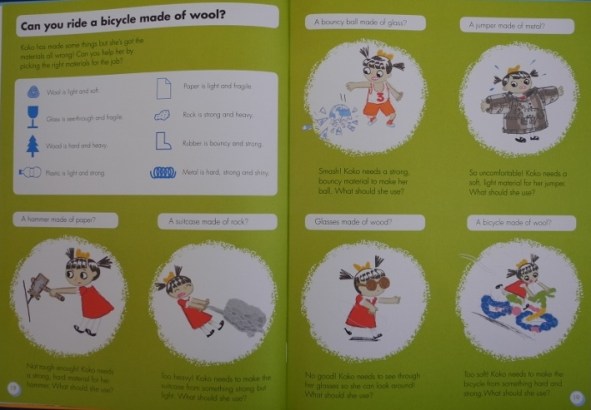
DSCN4534 (800x600)

Totally involving books whether or not the user is at the stage of beginning to develop the particular concepts presented.

DSCN4538 (800x600)

My First Colours
illustrated by Maxine Davenport and Cindy Roberts
Autumn Publishing
This is one of the new ‘Bilingual Baby’ series for the very youngest that takes a basic concept and presents it in two languages and bold, bright images.
Ten objects are attractively illustrated and captioned and each is positioned on a flap, which, when opened, reveals – in this case – French caption and pronunciation.

DSCN4537 (800x600)

Certainly this little book invites interaction and exploration though I’m not completely convinced the board book format is appropriate for the content.

Use your local bookshop localbookshops_NameImage-2