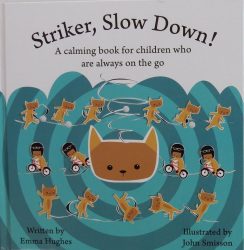
Striker, Slow Down!

How often do we ask children to ‘calm down’ or ‘slow down’? Fairly frequently I suggest. Now here’s a little book to help subtitled “A calming book for children who are always on the go‘:

dscn9421

Striker, Slow Down!
Emma Hughes and John Smisson
Singing Dragon
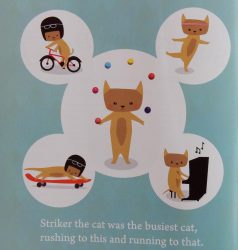
Striker the kitten, like many young children, leads a frenetic life, dashing from one activity to the next, never stopping or slowing down, despite frequent pleas from his mum and dad.

%0a

Seemingly the only times he stays put are mealtimes and when he’s fast asleep. Now if you’re the parent of a whirlwind-type youngster, this will surely resonate.
One day though, the inevitable happens: Striker’s rushing results in a bumped head. Only then is he ready to sit down quietly with his mum, and start to relax.

%0a

Those of us who work with young children know it’s not as simple as that. I do know however, that regular short sessions, be they of yoga, breathing, listening to a meditative story or whatever, do lead to calmer youngsters who can spend short spells being relaxed and peaceful in mind and body.
This little book is written in rhyme (creaking slightly once or twice) and Emma Hughes, the author, is herself a yoga teacher so obviously knows things don’t happen overnight as the book might suggest. However, if it does nothing more than set adults and young children off on the calming path, then it will have served its purpose.
For a start, take time to sit quietly together, share the book and enjoy the bright, bold, appropriately uncluttered illustrations.

Danny McGee Drinks the Sea

dscn9511

Danny McGee Drinks the Sea
Andy Stanton and Neal Layton
Hodder Children’s Books
Authors often talk about getting inside a character’s head but I’ve never heard of one getting inside a character’s stomach before. Andy Stanton did just that though: he wrote, so he’d have us believe, this entire book from within one, Danny McGee; and it certainly didn’t have an adverse effect on his wicked sense of humour.
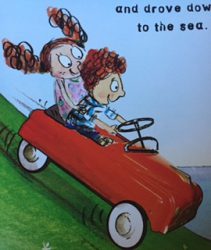
How did he get therein, you might well be wondering so let’s start at the beginning and meet young Danny and his sister Frannie McGee as they head towards the beach in their little red car.

fullsizerender-10

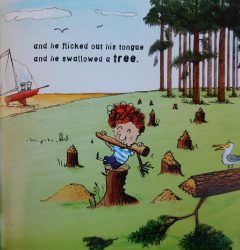
Once there, Danny, for some reason known only to himself, announces that he can drink the sea – all of it – and within ten minutes, he has. This however is not enough for the lad who turns his attention to a tree …

%0a

followed by pretty much everything you can think of and some you can’t.
Before long, young Danny has gleefully consumed virtually the whole of humankind (hence the author),

dscn9515

not to mention the whole Roman alphabet and goodness knows how much of our number system.
And he just keeps going until there’s nothing left but himself, or so he thinks …
The denouement to Stanton’s wonderfully anarchic rhyming tale is something of a jaw dropper and one young listeners will relish.
The combination of Stanton’s supreme verbal silliness and Neal Layton’s brilliantly bizarre visuals,

dscn9517

combining comic cartoon and photo-collage, is an unforgettable nonsense tale that will be requested over and over.

As Nice As Pie

%0a

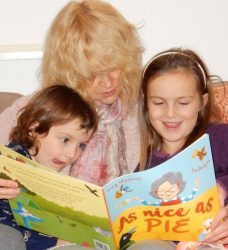
Dolci and Ellena relishing the story …

As Nice as Pie
Gary Sheppard and Tim Budgen
Maverick Arts Publishing
When Mavis Manewaring decides to share her freshly baked loaf with a bird one day, little does she expect that within a week she’ll be catering for twenty, all enthusiastically stuffing themselves with her delicious pasties and pastries …

%0a

A couple of weeks later, her hungry throng has reached hundreds: birds of all shapes and sizes– great greedy gannets, a plump parakeet, chubby-cheeked crows, potbellied pigeons and the like have heard the news of the tasty fare Mavis has been dishing up to the avian throng. What’s more it’s not merely bread, but biscuits, buns and bacon baps she’s feeding  her winged visitors. Mavis’s shopping bill must have gone through the roof and now it seems she’s no time for anything else but satisfying the ever-increasing throng.

dscn9485-2

Enough is enough decides the long-suffering cook and having baked a giant flan case, she issues an ultimatum to the hungry hoards: either join her in a co-operative venture or become the filling for that “Birdie Surprise” flan.

dscn9486-2

For her guests, blind-folded at her request and already knee-deep in gravy, it’s a no brainer and before long there’s a new co-operative enterprise operating in the village …
Rhyming stories seem to be all the rage at the moment but unless they’re well written, the rhyme works against them. This one of Gary Sheppard’s, with its sprinklings of alliteration and jaunty rhythm works a treat. Add to that Tim Budgen’s chirpy, chucklesome illustrations and the outcome is an altogether tasty read aloud. And then there are those counting opportunities and potential for discussions on teamwork and sharing.

WNDB_Buttonlocalbookshops_NameImage-2

An Animal ABC

dscn9448

An Animal ABC
Alice Pattullo
Pavilion Books
Print-maker and illustrator Alice Pattullo’s animal screen prints are used as the basis of an awesome ABC book. This is so much more than a mere alphabet book though. We’re introduced to a veritable treasure trove of creatures large and small but these are not for the most part the normal go-to animals one finds in a child’s alphabet.

dscn9453

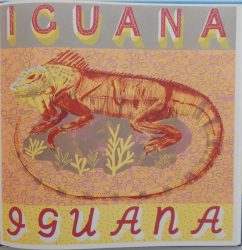
Each creature is given a double spread with a multi-layered screen print picture of the animal on the right hand side named above in capitals, with (as a rule) a lower case Latin name beneath the illustration.
For her menagerie, rather than the strictly naturalistic colours one would expect for each animal, Pattullo has used hues of the earth, sea and sky to build up her images.
The left hand page has the initial letter as a capital with two lines below which form part of a rhyming couplet: ‘S/ is for sloth/ who smiles while asleep 

dscn9450

followed by: T/ is for turtle/ who swims waters deep.’ …

dscn9452

Below the rhyme in smaller print are two or three lines of information about the featured animal. Clearly this will be more of interest to adults or older siblings sharing the book with a young child.
There’s a final treat at the end in the form of twenty six vignettes – one per animal – and each is a small detail taken from the whole image, to be matched with the full sized picture earlier in the book: excellent for developing visual literacy.
Altogether a classy book to look at, discuss and linger over.

Sleeping Beauty

dscn9454

Sleeping Beauty: A mid-century fairy tale
David Roberts and Lynn Roberts-Maloney
Pavilion Books
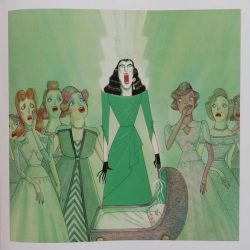
The super-talented brother and sister team, David Roberts (illustrator) and Lynn Roberts-Maloney have created another in their classy series of classic fairy tales, setting it in the 1950s initially, and then one thousand years in the future.
Now I’m hugely enthusiastic about re-workings/reinventions of fairy tales and traditional tales and had high expectations of this one – expectations that were more than met.
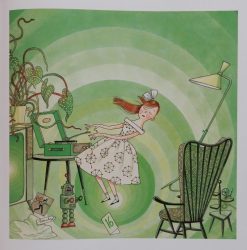
We first see Annabel in the 1950s as a science fiction loving young girl with a fascination about the future, living with her two aunts Flora and Rosalind, completely oblivious to the curse that had been placed upon her during her first birthday celebrations by a jealous and malicious witch, Morwenna.

%0a

The curse – that she will be pricked by a needle and die before her sixteenth birthday – is kept at bay by her aunts with the death sentence commuted to a thousand year sleep.
We then return to the time leading up to the all-important birthday when a mysterious visitor leaves a present for Annabel on the doorstep: a present that results in a pricked finger as foretold by Morwenna,

%0a

who indeed has delivered the gift, whereupon the young girl falls into a deep sleep.
Both Rosalind and Flora take transformative action; the former becoming an ever-growing rose bush …

%0a

which forms a protective shield around the house; the latter (having written down her ward’s story and calling it Sleeping Beauty) becomes an ever-shining light that guards Annabel while she sleeps.
Fast forward one thousand years to another young girl, Zoe, with an interest in all things past and in particular the history of the giant rose tree. Researching in the library (hooray they still exist!) she comes upon a copy of Sleeping Beauty …

dscn9458

and discovers its publication date – exactly 1000 years ago to the very day.
Can she finally break that dark spell and release the Sleeping Beauty?
Elegant design and superbly detailed illustrations grace every page of this wonderful book and the story itself is a brilliantly clever fusion of old and new.
A splendid gift to give on a birthday, at Christmas or indeed any time of the year: it’s a book to return to again and again.

A Letter for Bear

dscn9477

A Letter for Bear
David Lucas
Flying Eye Books
I make no apologies for reviewing this book again having first done so (as part of a seasonal roundup) when it was first published three years ago. That however didn’t really do justice to such a terrific book: I love it even more now, coming to it afresh.
Meet postman, Bear, meticulous in his delivery of other people’s mail but never himself the receiver of any letters. After each day’s work he’d retreat to his cave home, drink soup and ponder on the possibility of getting some mail of his own.

%0a

One windy day while out on his round, his mailbag is whisked skywards and its contents are scattered all over the snowy ground.

%0a

Bear collects every single letter but the addresses are smudged so he has to knock on all the doors to ensure correct delivery and thus gets to know the names of all the other animals. As expected every recipient appreciates his efforts but seeing all those families together only makes Bear feel more lonely than ever.

%0a

Back in his cave that night, Bear decides he must take the initiative and gets busy writing Christmas party invitations and next morning he delivers ‘a whole snowstorm of letters’ to his new acquaintances. The same evening he decorates his cave and waits … and waits …
The disconsolate creature is on the point of giving up when he hears voices outside asking to come in. Then, after all, it’s a case of ‘let’s party’; but even better, the following morning all the letters in his sack are for a certain ursine postman. Hurray!

%0a

An altogether uplifting seasonal story but for me, the book’s real strength lies in David Lucas’s intricately patterned illustrations. All but one of the double spreads has a geometric border of patterned triangles, rectangles, diamonds or scallops; and set into some of the scenes, we view Bear’s lonely world through circular peephole vignettes. His limited colour palette – – shades of blue, orange, purple, russet, pink and orange – and his use of geometric shapes for, or to pattern, trees, buildings, flowers and more, add to the impact. Add to all this angled viewpoints, interrupted borders, beautiful snowscapes and delectable endpapers, and what do you have? A small gem of a book, and a pattern-tastic treasure that is a masterpiece of design. The perfect present to tuck into the branches of a Christmas tree or to pop in the post.
If you work in a school and want to inspire some letter writing, sharing this story is a perfect starting point, and then you can set up a special “Bear Mail’ post box or perhaps let the writers peg their letters onto a Christmas tree.

The Land of Nod

%0a

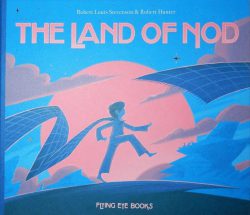
The Land of Nod
Robert Louis Stevenson and Robert Hunter
Flying Eye Books
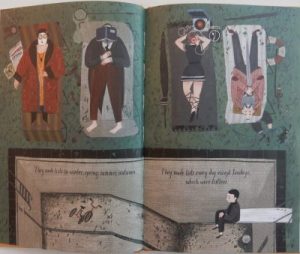
An altogether contemporary feel has been given to a classic Robert Louis Stevenson children’s poem through the fantastical artistry of illustrator Robert Hunter.
Herein we meet an injured boy who spends his days indoors at home with nothing but his toys for companions.

%0a

Come night though, he’s transported beyond the confines of his room to a dream world, illuminated in eerie hues, predominantly of pinks and blues, where the familiar objects of the day – his toys, books and other ephemera from his bedroom- are transmogrified into the surreal.

%0a

Every illustration provokes curiosity and speculation, and could lead to much additional storying

%0a

from a new generation of young listeners whose parents will know the poem only by its words, or perhaps through Brian Wildsmith’s interpretation in A Child’s Garden of Verses.

WNDB_Buttonlocalbookshops_NameImage-2

Walking in a Winter Wonderland

Walking in a Winter Wonderland
illustrated by Tim Hopgood
Oxford University Press
Sleigh bells ring, are you listening?’ It’s almost impossible not to break into song on seeing those opening words to the seasonal favourite written down, and now illustrator Tim Hopgood has taken that ever-popular Christmas song (with some slight alterations) and turned it into an enchanting and truly joyful, snow-filled picture book experience for children and adults to share together.
As musical notes drift across every spread, we join a family of five walking …

fullsizerender-10

and playing …

in a woodland landscape populated by wild animals (foxes, deer, a squirrel and rabbits) and birds …

fullsizerender-10

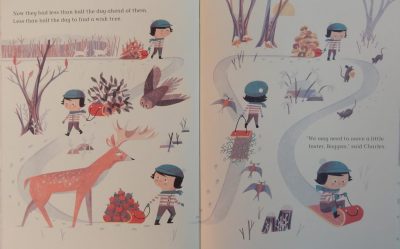
Hopgood’s pastel and crayon scenes capture the magic of idyllic winter countryside with newly fallen snow, sledging, snowman building, and then the family snuggling up together in the warmth from a fire. I particularly love that musical note tree …

fullsizerender-10

and the endpapers too are lovely – so simple and SO effective.
To add to the delights, the book comes with a three track CD. The first track is the wonderfully jazzy rendition of the song performed by Peggy Lee, the second is a reading of the book with tinkling sounds to let you know when to turn the page, and the third a (somewhat superfluous) listening game.
A Christmas cracker.

Classic Christmas Briefing

%0a

The Twelve Days of Christmas
William Morris and Liz Catchpole
Penguin Random House V&A
With a gorgeously tactile cover, this is a super-stylish rendition of the ever popular classic seasonal song. It’s illustrated with a mix of patterns chosen from the V&A’s William Morris archive and glorious new artwork by illustrator Liz Catchpole inspired by the work of Morris who was associated with the Arts and Crafts movement.
Best-loved designs such as ‘Cray’ furnishing fabric …

dscn9394

and ‘Pimpernel’ wallpaper are included …

dscn9395

but every turn of the page brings fresh delight.
Just the thing to give to a loved one especially a book-lover, or to anyone who likes art and design of the classic kind.

%0a

The Newborn Child
Jackie Morris
Otter-Barry Books
Jackie Morris has created her own text as an accompaniment to her gorgeous illustrations for this new edition of a book previously published a decade ago as Little One We Knew You’d Come. This is very much a feelings-centred telling of the nativity story with much of the focus being on how the mother herself feels before …

%0a

and after the birth. There’s beauty on every page: into Jackie Morris’ richly coloured scenes are woven symbols from the natural world – butterflies and moths, birds and their feathers …

%0a

flowers, fruits and shells, making them truly memorable, especially that final mother and child spread with the thumb-sucking infant.

%0a

Little Grey Rabbit’s Christmas
Alison Uttley and Margaret Tempest
Templar Publishing
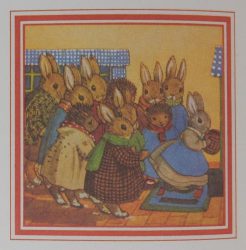
A classic Christmas read if ever there was one. I can still recall, as a small child laughing over Hare standing outside in the snow “catching cold, and eating it too,” as my dad read it to me. First published in 1939, but still offering lots to savour and talk about, it’s deliciously nostalgic and full of Christmas kindness. Imagine inviting carol singers in, to pass round a mug of wine and hot mince pies …

%0a

Sproutzilla vs.Christmas / Santa Claude

dscn9403

Sproutzilla vs. Christmas
Tom Jamieson and Mike Byrne
Macmillan Children’s Books
Young Jack’s abhorrence of Brussels sprouts is about to result in the ruination of Christmas and not just for the lad himself when his parents come back from a shopping expedition with the most enormous one of the green veggies he’s ever set eyes on. He’s called Sproutzilla and he’s the meanest, greenest Christmas ruining vegetable ever. What’s more, he (and his army of Sproutlings) have their sights set on Santa; and Sproutzilla is exceedingly hungry.

dscn9404

Seemingly, if the mums and dads, the angry dinner ladies and the furious chefs can’t save Christmas, there’s only one person who can and there’s only one way he can do it. Jack will have to EAT SPROUTS!

dscn9405

This is a totally ridiculous story over which you cannot help but have a good giggle, as will young children, especially at the final PAAAAAAARRRRRRRRRRRP-powered delivery, not to mention the tasty final twist.
Sprout lover or not, I suspect you’ll never look at your Christmas veggies in quite the same way again.
More bonkers fun in:

%0a

Santa Claude

Alex T.Smith
Hodder Children’s Books
It’s Christmas Eve night and Mr and Mrs Shinyshoes have left Claude and best pal Sir Bobblysock alone in the house while they go out partying. A super-excited Claude has tucked himself up in bed and is just settling down to read his new Cops and Robbers book when he hears a loud THUD! followed by what sound like a series of heavy footsteps. Convinced whoever has whooshed down the chimney is a burglar, and already anticipating catching same red-handed, off he goes armed with his handcuffs to apprehend the intruder.
Having secured the ‘burglar’ to the arm of a chair in the pitch-dark living room, Claude switches on the light to find himself face to face with none other than Santa. Easy enough to release the handcuffs you might think but oh dear me, no! The key is nowhere to be found.
With Santa out of action there’s only one thing to be done; Claude and Sir Bobblysock will have to make the rest of the deliveries instead. But can they – even with Claude decked out in Santa’s seasonal costume –

%0a

make it round all those hundreds of homes, delivering an absolutely enormous sack of presents and be safely back by midnight when the Shinyshoes return?
Needless to say, things won’t be plain sailing no matter what: let the festivities begin …
With Claude and Sir Bobblysock you’re guaranteed a whole load of gigglesome delight and this fast-paced festive romp is no different. It’s perfect to tuck into a Christmas stocking, or for an excited youngster to hide away with for a pre-Christmas chortle.

The Mouse that Cancelled Christmas

dscn9363

The Mouse That Cancelled Christmas
Madeleine Cook and Samara Hardy
Oxford University Press
This is certainly a Christmas story with a difference: the story of Mouse for whom Christmas means danger, danger because, as a baby, he’d been biffed on the head by a flying bauble. Now, he seems to have assumed the role of health and safety officer with a vengeance. Donning fluorescent jacket and hard hat Mouse dashes around the clearing in Jingle Bell Forest inspecting the animals’ preparations and finding fault with everything. The pine needles are far too sharp, the lights too dazzling and the star way too pointy.

dscn9364

The Rabbit Chorus seems to be breaking every rule in the book – Mouse’s book that is. In fact nothing passes muster where he is concerned: he wants the entire celebration called off …

dscn9367

But then Mole and Owl quietly mention the ‘p’ word and suddenly events take a turn for the better. Maybe, just maybe, that cancellation of Mouse’s might be reversed after all …
There are so many things to love about this book, not least the delightfully unexpected grand finale. Then there’s that tiny robin who offers his own mini narrative at almost every turn of the page …

%0a

and the thoughtful placing of certain elements of the text; all that’s in addition to the wonderful fanaticism of health-and-safety ‘jobsworth’ Mouse and the growing concern of the other forest animals as they hear him passing judgement on their various activities All are brilliantly portrayed in Samara Hardy’s splendidly funny illustrations for this amusing (for adults, tongue-in-cheek) tale. I bet there’s not one reader aloud out there who hasn’t been on the receiving end of a human version of Mouse on occasion; it’s certainly so in schools and usually the ‘mouse’ person has no idea of the ridiculousness of their pronouncements. Madeleine Cook and Samara Hardy will assuredly make many youngsters and adults laugh this festive season.

Festive Fun and Frolics

dscn9378

Nuddy Ned’s Christmas
Kes Gray and Garry Parsons
Bloomsbury Children’s Books
Nuddy Ned likes nothing better than to dash around in the altogether and yes, he’s super excited it being Christmas Eve; but dashing outside into the snowy evening chill is nothing short of crackers. There’s no stopping the little fellow though; he’s on a mission to meet Santa and he’s perfectly prepared to charge down the street and around the town completely starkers, parents in hot pursuit, in order to do so. Only some strategically placed flaps and other judiciously positioned items including a bird, a glove …

%0a

and a bauble preserve his modesty.
Does this madcap streak finally get Ned what he wants – that Santa encounter, you’ll probably be wondering. Yes he does and Santa’s none too impressed at Ned’s lack of clothing but in the end it seems like a question of beat’em or join’em: what will Santa do? That would be telling wouldn’t it!
Kes Gray’s cracking rhyming text combined with equally giggle-inducing illustrations from Garry Parsons makes for some delightfully silly festive fun.

dscn9351

The Queen’s Present
Steve Antony
Hodder Children’s Books
Imagine being able to call on Father Christmas himself for a spot of last minute emergency present buying, but that is exactly what the Queen does in her desire to find the perfect gift for her great grandchildren. Down he comes and off they go on a whistle stop flight with a whole host of hangers-on in the form of Santa’s little helpers who have much work to do in the way of festooning the various landmarks – the Eiffel Tower, the Leaning Tower of Pisa, the Great Pyramids of Egypt, the Great Wall of China, Himeji Castle, Sydney Opera House …

dscn9352

and the Statue of Liberty over which they fly before finally landing in the North Pole. Even there though, Her Majesty is unable to find the perfect present. With Christmas Day almost upon them, there seems to be only one thing to do …

%0a

This whole crazy romp is executed using an appropriately seasonal colour palette. It’s not my favourite Steve Antony but it’s full of things to make you smile; and those elves really do earn their keep as well as having a terrific time adorning all those iconic landmarks.

%0a

Winnie and Wilbur Meet Santa
Valerie Thomas and Korky Paul
Oxford University Press
The excitement is palpable in Winnie and Wilbur’s house as they bake, write cards and festoon the place with decorations. Then it’s time for writing those all important letters to Santa …

%0a

Christmas Eve comes at last and just as the pair drop off to sleep, they hear a cry for help: something has gone drastically wrong with Santa’s chimney descent. It’s fortunate that Winnie just happens to have her wand right there on the bedside table and with a quick wave and a magical utterance, she soon has their visitor back on his feet and they’re off on an amazing adventure.

%0a

Full of seasonal magic and excitement, this is sure to delight, especially that final pop-out surprise …

dscn9389

For the very youngest:

dscn9333

We Wish You a Merry Christmas
illustrated by Yu-hsuan Huang
Nosy Crow
This song on which this chunky board book is based is probably one of the most frequently sung in primary schools and nurseries in the run up to Christmas.
Here we join a host of warmly clad, cute animal friends celebrating the seasonal joys together as they sleigh, skate, ski and deliver presents before gathering together in a warm cosy room to share some gifts.

dscn9334

In addition to the moving parts, you can further add to toddlers’ enjoyment by scanning the QR code inside the front cover and getting an audio version to sing along with.
The Princess and the Christmas Rescue

dscn9374

The Princess and the Christmas Rescue
Caryl Hart and Sarah Warburton
Nosy Crow
On top of the world where the icy winds blow,
A beautiful palace grows out of the snow.

This palace is home to Princess Eliza, a bright child with a passion for making things of a technological nature, though not for making friends, largely because she never sets foot outside the palace walls.
One day as she stands gazing out across the valley after abortive friend-making efforts within, she sees some smoke and decides to follow it and discover its source. Off she goes into the forest and is soon lost. What should loom up out of the snowy mist but a friendly reindeer who offers to take her to a place of safety.

%0a

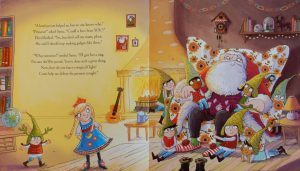
This turns out to be Santa’s Workshop where she discovers that the elves are in desperate need of some assistance and before long Eliza has set herself to work designing and creating some new machines.

%0a

Can the problem-solving princess and her inventions speed things up sufficiently; and will she succeed in her friend-finding quest?
Just the thing for sharing at the start of the build-up to Christmas: this rhyming tale reads aloud beautifully. Children will doubtless enjoy the fact that Eliza’s kindness and problem-solving skills are both rewarding and rewarded.

%0a

Sarah Warburton’s North Pole scenes are full of humour, wonderful details and seasonal warmth; and those elves with their crazy headgear are terrific fun.

A Visit to City Farm

dscn9492

A Visit to City Farm
Verna Wilkins and Karin Littlewood
Firetree books
This is the first book from a new publisher whose aim is to produce ‘books with engaging, enjoyable and exciting stories that celebrate our interconnected and culturally-diverse world, putting all children in the picture’ and this story of a school visit certainly does just that.
From the list of children’s names in the front of the book, it seems that the role of Chalkhill Primary School (the book’s co-publishers) is similar to that of the schools I’d always taught in before moving out of London a few years ago. The lack of this rich diversity was one of the huge culture shocks I’ve had to cope with since, and that diversity is something I still miss enormously: this book is, in part a celebration of that richness.
The story tells of a class visit to a city farm. Now I know from experience that children absolutely delight in being featured in their own books – albeit school published ones (it’s an empowering part of seeing themselves as writers) – so I can imagine how thrilled those Chalkhill Primary children must have been to become characters (more accurately almost recognisable versions of themselves) in , and co-writers of, a real book.
We join Rainbow Class as they prepare for the off, with their teacher, Miss Jama checking they know the safety code, watch the group as they walk to the station, travel on the tube and finally, arrive at City Farm.
Of course, the highlight of the visit is seeing  all the different animals …

dscn9493

maybe not all the animals for all the children though …

%0a

Verna Wilkins’ prose (written in collaboration with Y5 pupils) and the children’s rhyming descriptions of the animals are seamlessly woven together into a single narrative that also gives voice to individual children’s thoughts as they move around the farm. And, there’s so much to look at, enjoy and talk about in Karin Littlewood’s lovely pen, crayon and watercolour illustrations.

%0a

All in all this is a wonderful celebration of our interconnectedness and I look forward to seeing more from Firetree books.

WNDB_Buttonlocalbookshops_NameImage-2


Ollie’s Christmas Reindeer / The Christmas Fairy

%0a

Ollie’s Christmas Reindeer
Nicola Killen
Simon & Schuster Children’s Books
It’s Christmas Eve; Ollie is suddenly awoken by a jingly sound. What could it be? She creeps to the window seeing nothing but a snowy landscape. Determined to discover the source of the sound, she boards her sledge and off she goes down the hill and into the dark wood.

dscn9330

It’s there she comes upon a collar studded with silver bells caught on a tree branch. Then from the darkness emerges a reindeer, a collarless reindeer.

%0a

With its collar safely back on, the reindeer takes Ollie on a magical ride through the starry skies…

%0a

Saying farewell to a new friend is hard for Ollie but she knows that there’s important work awaiting him; and then there’s Christmas morning to look forward to …
Judiciously placed splashes of red and silver are used sparingly to enhance the dramatic effect of the otherwise black and white scenes of all the activity that fills this quiet, snowy night. A gentle, simple and magical story.

%0a

The Christmas Fairy
Anne Booth and Rosalind Beardshaw
Nosy Crow
When Clara hears that ‘Christmas fairy’ lessons are on the curriculum she’s thrilled; being a ‘proper’ Christmas fairy is exactly what she’s been wishing for. The trouble is this involves standing statue-still on tiptoes and staying absolutely silent: in other words no giggling, absolutely no wriggling and positively no singing. As show day draws nearer, it looks as though this whole Christmas fairy thing is just way too demanding for Clara.

dscn9326

The big day arrives and Clara is distraught. Suddenly though events take a turn. Santa’s there in front of her and seemingly he has not just one, but three roles that need filling, and he thinks Clara fits the bill perfectly. Can she step in and save the show?

%0a

And what about that Christmas wish of hers …
Cute, seasonal rhyming fun for tinies. A lovely demonstration of the idea that everyone has something to offer, especially those who are slightly divergent; it’s just a matter of finding what that special something is.

The Winter Fox / Presents Through the Window

%0a

The Winter Fox
Timothy Knapman and Rebecca Harry
Nosy Crow
As summer gives way to autumn, a little fox is too busy enjoying himself romping in the flowers and chasing butterflies to pay heed to his friends, Rabbit, Owl and Squirrel as they prepare for the long winter that’s to come. He plays through the autumn too …

dscn9323

and come winter when the other animals are all snuggled cosily in their nests, Fox is alone out in the forest.
Cold and hungry, he makes a wish beneath a star. What happens then changes the course of events not only for Fox but for the other forest creatures too.

%0a

Full of wintry warm-heartedness and friendship, and just enough seasonal sparkle, this is a story to share with young listeners in the weeks leading up to Christmas. They’ll need to look carefully at the sky to discover where that surprise parcel came from.

%0a

Presents Through the Window
Taro Gomi
Chronicle Books
It’s Christmas Eve and Santa is out on his present delivery round. He has an unconventional mode of transport and seems in rather a rush. So much so that his quick peep through the (die-cut) window of each house before dropping off a gift will result in some rather inappropriate offerings being received come Christmas morning.

%0a

Part of the fun is that by turning the page, readers will discover the identities of the gifts recipients and relish each mis-match.

%0a

Santa in contrast never does learn the outcome of his hasty choices: another part of the fun is imagining the reactions of the recipients. However the most fun of all is seeing how everything works out just fine come Christmas morning.
The entire text is composed of Santa’s utterances presented in speech bubbles as a running commentary – literally – directed to his audience as he moves from one home to the next. Simple, clever and highly effective.

A Dot in the Snow / Bunny Slopes

%0a

A Dot in the Snow
Corrine Averiss and Fiona Woodcock
Oxford University Press
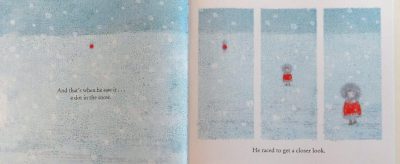
Polar bear cub Miki would much rather play with his mother in the soft snow than fish in the icy Arctic waters. Off he goes up the ridge presumably in search of a playmate. That’s when he sees it – a red dot in the snow. Then from out of the blizzard emerges a figure – one that looks, smells and sounds friendly.

dscn9223

And, joy of joys, it wants to play  at first anyway…

dscn9224

Suddenly though, the dot isn’t so smiley and playful; something has gone missing. One of the child’s mittens: can Miki rescue it and save the day? He can; the ice breaks, the two continue playing; more snow falls blotting out almost everything. Two infants bid each other farewell, return to their respective mothers and doubtless each will have much to talk about.
Gorgeous texturing in the illustrations and a suitably spare text combine to create a warm-hearted wintry read with themes of friendship, determination and parental love, albeit with a bit of stereotyping. Snuggle and share.

%0a

Bunny Slopes
Claudia Rueda
Chronicle Books
Following in the footsteps of Hervé Tullet (Press Here, The Dot), Claudia Rueda has created a metabook with a wintry theme – a wintry theme that is, if readers play along. Bunny is ready for a ski day and invites us to join him; but snow is decidedly lacking. Readers have to create it by shaking the book – hard. Oops!

dscn9234

Then tap the top of the book to extricate Bunny but that ground looks rather flat. The book needs a right tilt to set our would-be skier in motion, and again. Yeah! He’s off … but all of a sudden …

dscn9235

(ingenious precipice-gutter moment). A  hasty 180 degree book turn and a page flip will, sort things. Now what?
More manipulating will see a battered Bunny up on his skis again and ready for another run at that cliff. Whoppee! He’s made it right to the opposite side but can he clear that hole? Phew! Just about, but surely not another one; the little fellow’s getting just a tad too big for his boots now but there he goes again …

%0a

Fortunately this leap leads to his very own den where Mummy Bunny is ready and waiting with a warming treat …
Love those rabbitty expressions and the minimal colour palette: with its simple text this is a good bet for those in the early stages of reading as well as individual listeners and book manipulators.

Hooray for Independent Thinkers: Little Monkey & Larry Lemming

dscn9415

Little Monkey
Marta Altés
Macmillan Children’s Books
Size, or rather lack of it, is a big issue for one particular little Monkey, so much so that one day, she comes to a decision – a BIG decision. She won’t be left out any longer; “I will climb to the top of the tallest tree,” she announces and off she goes through the jungle to prove herself.

%0a

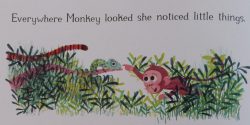
What she’s blissfully unaware of as she navigates the deep dangerous river and the tricky path is that although she notices lots of little things doing lots of amazing things …

%0a

she’s not the only one undertaking this journey …
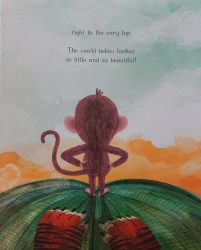
Eventually Monkey reaches her destination: that tallest tree in the jungle and up she goes, higher and higher, until finally she can see the world stretching out below her. By now you’ll have your audience wriggling on their bums crying out to the gallant little creature and even more so, as she stands atop that palm viewing all that’s before her.

%0a

Without being a total story-spoiler I won’t reveal what happens thereafter, but suffice it to say a certain small Monkey feels very proud of herself, after all, ‘ … the smaller you are, the larger your adventures can be.’
It’s definitely a case of showing, not telling being the essence of this deliciously funny tale. Altés comic choreography means that every turn of the page brings something new to giggle over; and the synergy between words and illustrations is terrific.

%0a

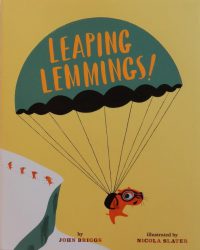
Leaping Lemmings!
John Briggs and Nicola Slater
Sterling Children’s Books
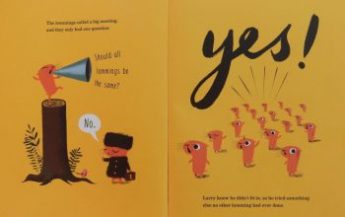
Can you tell these lemmings apart?’ Readers are drawn in from the start by Briggs’ opening question to this story. He continues, ‘No? That’s because all lemmings look alike, sound alike, and act alike.’ Not one hundred per cent accurate: meet the wonderfully divergent Larry. Larry is a thinker: he knows he doesn’t fit in with the lemmings crowd …

%0a

and he certainly has no intention of following his fellow lemmings off the edge of a cliff.
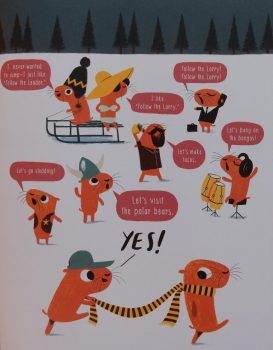
Can he avert disaster though, when after abortive attempts to live with the seals, the puffins and the polar bears, he returns home to find the lemmings about to make that fateful leap? Fortunately yes, and as for becoming independent thinkers … job done!

%0a

Wonderfully whimsical and with important themes of thinking for yourself and daring to be different, this book deserves to be shared widely; it certainly offers teachers a great opportunity for discussion, as well as food for thought, not only among the children.
Nicola Slater’s deliciously witty, minimalist artwork is a terrific complement to Briggs’ gently humorous text. As a divergent thinker myself, I whole-heartedly applaud the independently-minded Larry, and of course, his creators.

Being in the Present: One Minute / Love You Hoo

%0a

One Minute
Somin Ahn
Chronicle Books
Have you ever thought about what you can do in a minute? If you’re a teacher of young children, you may well have done some playful activities on that theme: How many times can you write your name? How many cubes can you join together? How many times can you bounce a ball? and so on.
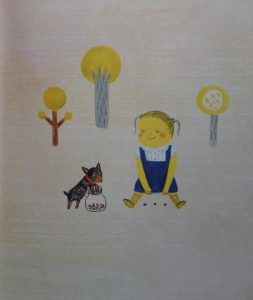
Here, after providing a few basic snippets of information: ‘In one minute, the second hand moves sixty times while the long hand moves once.’ Or ‘In one minute, you can blink your eyes 20 times …’ artist Somin Ahn offers some ideas for filling that unforgiving minute: hugging your dog; saying hi to a neighbour or planting seeds …

%0a

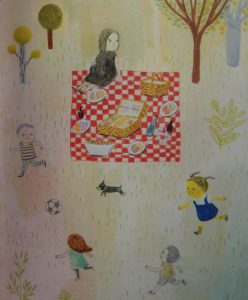
She then goes on to explore the way time can apparently expand or contract according to the particular situation: a roundabout ride makes a minute feel very short, as does playing in the park with your friends …

%0a

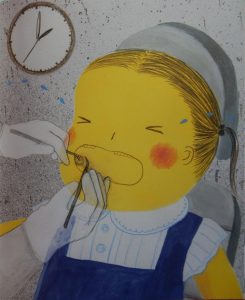
whereas that same time spent in the dentist’s chair feels like a long time …

%0a

We also discover that in one single minute a life can be saved, a train can be missed.
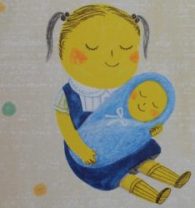
Observant listeners and readers will have noticed that the little girl’s mother is pregnant and this fact is used in the final two spreads: ‘In one minute, someone can leave’ shows the child tearfully hugging her mum farewell. Turning over, we have ‘And someone can arrive.’ – presumably a new sibling for the little girl.

%0a

Sensitive and thought-provoking, this small book offers much to ponder and discuss with nursery and infant children.

%0a

Love You Hoo
Rachel Bright
Orchard Books
Woo-hoo-hoo! It’s snuggle time for little ones; but first, one particular Big Owl wants to share some very important thoughts with Little Owl, thoughts about the wonderful times the two have shared together and the wonderful times that are yet to come. Parent and offspring are alternately teacher and learner in this relationship,

%0a

a relationship that is always sunny no matter what the weather; a relationship full of promise …

%0a

and the occasional mishaps …

%0a

The most important part of the message though is the final one and something every infant needs to hear: “Whoever you are going to be … Whatever you may do … Wherever you may choose to fly … I’ll always love you – hooooooo!
With a tenderly composed rhyming text and amusing scenes of the totally delightful owls, this is one to share with the very young. I’d suggest reading the text aloud to yourself first though as the phrasing of the rhyme is a little tricky on occasion.

First Snow / Brrr! Brrr!

%0a

First Snow
Bomi Park
Chronicle Books
With impactful minimal text and a limited colour palette, debut picture book artist Park creates the magic of a first snowfall as experienced by a toddler. Said toddler dons warm outdoor gear (good on her) and creeps out into the white world beyond her front door, there to discover the joys of building a snowman. First though it seems, she must roll her ball of snow down urban streets, across a moonlit field, beside an elevated railway track – ‘Fast, fast fast’ –

%0a

into the woods where she joins a throng of other snowman-building children. A magically uplifting moment occurs

dscn9228

after which reality reasserts itself and we, and the little girl, are returned once more to her back garden and another kind of enchantment.
Go back and look once more at the details in Park’s captivating snow-filled scenes. Notice: the snowflake patterns on the child’s mits, the activities of the pup accompanying her the whole time, and the animals emerging and watching in the dark woods.

dscn9227

Gorgeous! And as an added bonus, the spare text, with its built-in repetition, is such that beginning readers can, once the story’s been read to them, read those fifty odd words for themselves.
For even younger children is

dscn9253

Brrr! Brrr!
Sebastien Braun
Nosy Crow
This is one of the series of lift-the-flap books for those ‘just beginning to talk’ and it certainly has a chilly feel to it. Peeking out from behind five objects –an iceberg, a boat, a cave entrance, an igloo and a clump of fir trees, each of which forms the flap, are five animals. Youngsters can enjoy a game of hide and seek in response to the sequence of ‘Who’s that … ?’ questions

dscn9254

and then join in with the animal sound once it’s revealed. Sebastien Braun’s snowy scenes are a delight: I particularly like the woodland one.

dscn9256

With the repeat pattern of the simple text, beginning readers can enjoy sharing this with a toddler sibling too.

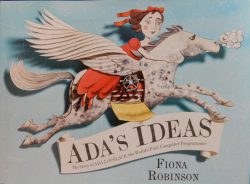
Ada’s Ideas

dscn9382

Ada’s Ideas
Fiona Robinson
Abrams Books for Young Readers
It may come a surprise to young readers of this biographical picture book that Ada Lovelace was the daughter of the poet, Lord Byron and Anne Milbanke a mathematician, and lived in the 19th century. Her parents separated soon after Ada was born and she was never to see her father again. To stop her from becoming anything like her father, Ada’s mother made her follow a strictly structured timetable of lessons: anything imaginative was strongly discouraged.
Despite this however, the young Ada developed a powerful, imaginative streak, partly fuelled by seeing some of the steam-powered machines her mother took her to see in factories …

dscn9383

She even thought of inventing a mechanical flying horse.
After a period of sickness, at age sixteen Ada found herself thrust into society and that’s how she met the inventor, Charles Babbage who was in the process of inventing the Difference Engine, a machine that would never make mathematical errors.

%0a

A friendship developed and Ada maintained it despite being married shortly after, and thus Babbage told Ada about his new project, The Analytical Engine – the world’s first computer design. It was Ada herself who used her mathematical mind to create the program that would have made Charles’ machine work. She also foresaw the machine’s potential beyond maths believing it could be programed to create music, pictures and words. Although it never was made because of costs, eventually many years later, people came to realise how forward thinking Ada and Babbage were.
With its 3D effect, Fiona Robinson’s collage style artwork is amazing and the whole book is a great tribute to the life of a young woman who refused to be bound by society’s expectations and strictures. What I like most is the way in which it demonstrates so compellingly that no matter what, imagination is behind all scientific and technological discoveries: that, and of course the fact that being a women is not a bar to great scientific achievement.

dscn9385

Imagination rules: dream high, aim high, believe in yourself; let your mind run free: that’s Ada’s legacy.
An inspirational read and a must for all primary schools.

Stone Underpants / The Great Sock Secret

%0a

Stone Underpants
Rebecca Lisle and Richard Watson
Maverick Arts Publishing
Stone underpants? Have you ever heard of anything more preposterous? Back in the Stone Age though, when young Pod lived there wasn’t an awful lot around to make bottom warmers from when your rear end felt decidedly chilly, so a pair of stone underpants is what he makes himself. Needless to say however, they’re not the best things for running around in, and as for swimming, well …

%0a

Pod decides to try another material, but wood proves equally unsuitable …

dscn9372

as do several others he tries. Is he destined to have a chilly rump for ever or is there something else he could try…

%0a

The very mention of underpants and bottoms frequently reduces young listeners to fits of giggles and I suspect this one will do just that. The whole scenario is totally crazy: beetles demolishing his wooden underpants overnight for instance; and what was wrong with using an animal skin, there are certainly wild beasts evident in some of the scenes; but this madcap romp requires total suspension of disbelief so, why worry. It’s assuredly something youngsters will raise anyhow and they’ll also more than likely ask about the material used for that football too, and perhaps question why Pod didn’t just try making leafy underpants But all this could lead very nicely into some investigative work on materials if you happen to work with young children. Alternatively you might just enjoy the ridiculous story as told by the aptly named Rebecca Lisle, and have a good giggle over the equally crazy pictorial rendition of same from Richard Wilson.

%0a

The Great Sock Secret
Susan Whelan and Gwynneth Jones
EK Books
My alternative uses for socks have been restricted to a resource for making puppets in the classroom; and when teaching yoga, as props for those needing a little bit of help in certain stretches.
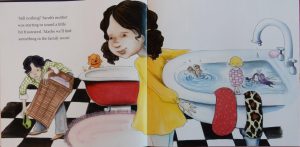
In Sarah’s house though, the socks are put to all manner of imaginative uses by the fairies who share her home. When Sarah’s mum initiates a hunt for the socks that have mysteriously gone missing from the laundry basket,

dscn9347

the little girl has to stay one jump ahead as they search all over the house. She knows who the culprits are; but can she manage to stop her mum from discovering those borrowers?
This foray into the fanciful is most likely to appeal to imaginative listeners around the age of the young protagonist.

This is Not a Cat! / Later, Gator!

%0a

This is NOT a Cat!
David Larochelle and Mike Wohnoutka
Sterling Children’s Books
Using only the words from the title, Larochelle has created a book that is absolutely perfect for beginning readers and it’s lots of fun.
We join three little mice as they arrive at school; three little mice each with a chunk of cheese for lunch. Their first lesson is already displayed as they sit down already looking more than a tad bored …

%0a

Now this is an old fashioned school with transmission style teaching – desks facing front so one can perhaps excuse the lack of a security system (but that’s getting ahead of the action). One pupil at least is paying attention as the teacher continues: “This is not a cat.” the assumption being he’s writing notes on the lesson; the other two are already distracted and playing around. No one notices what’s already appearing outside the window, not even the grinning goldfish.
This is not a cat.” … “This is not a cat.” continues the teacher oblivious to the fact that a certain intruder is on the verge of entering …

dscn9315

Suddenly the whole atmosphere in the room changes as the presence of the visitor is noticed, first by the teacher and then as realisation dawns …

dscn9316

The pupils flee leaving the intruder to enjoy the spoils left behind, but just who IS that greedy guzzler.
Clever as the text is and it’s undoubtedly so, without the illustrations the book wouldn’t be anything like as funny as it is. Wohnoutka’s cartoon style scenes are full of comic detail: the changing expressions of the goldfish, the antics of the pupils – note the cleverly aimed paper aeroplane, the cheesy shapes chart to mention a few; and of course, there’s the grand finale.
Also fun for those in the early stages of reading is:

%0a

Later, Gator!
Erik Brooks
Sterling Children’s Books
It’s hard moving to a new home especially having to say farewell to all your friends. That’s just what young Gator discovers having moved to a distant neighbourhood with his parents where there isn’t a soul he knows. He decides to write to his old friends telling them how he misses them and eventually back come some letters. Yes, his pals are missing him too but their communications are also encouraging …

%0a

And made him feel a little bit bolder, bold enough to start making a whole new set of friends …

dscn9320

The text is minimal but the amusing illustrations speak volumes.

Can I Tell You a Secret?

dscn9335

Can I Tell You a Secret?
Anna Kang and Christopher Weyant
Hodder Children’s Books
I loved both You Are (Not) Small and That’s (Not) Mine; now the same husband and wife team have created an entirely new character, Monty, a green frog. Immediately endearing, this little fellow introduces himself with a “PSSST!” directed straight at readers. What follows is a confession dialogue conducted between young Monty and his audience, for Monty has a secret: “I can’t swim. Not even a little bit. And … I’m afraid of water.” he says looking somewhat abashed.
Some questions and responses clarify the whole sorry cover-up situation …

dscn9337

What’s that? You think I should tell someone? Like my parents? Are you sure? POSITIVE?
Suggestion taken, but it takes Monty three attempts so sum up the courage to do it …

%0a

and the “We know sweetie …” parental response sets the scene for a grand aquatic finale …

%0a

Weyant’s portrayal of Monty is splendidly expressive: that fearful frog says so much with his eyes; and Anna Kang’s amusing direct speech narrative gets listeners on board straight away, keeping them thoroughly involved until his final “Can you come back tomorrow?” and is likely to encourage the fearful among the young frog’s audience to confront their own fears too. Great fun.

Snowflake in My Pocket

%0a

Snowflake in My Pocket
Rachel Bright and Yu Rong
Walker Books
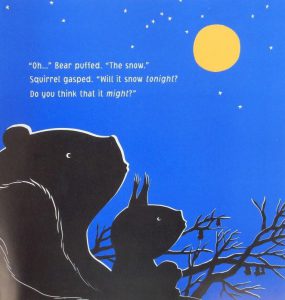
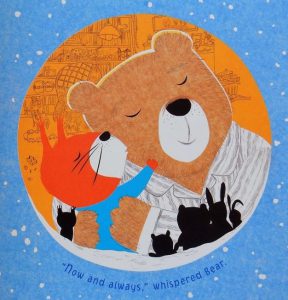
This is one of those stories that leaves you with a wonderful warm glow inside. It centres on the loving relationship between two woodland characters, a very old Bear and a very young Squirrel. Nothing the two do together is new to bear but doing it with Squirrel makes every experience ‘brand new’ for Bear.

%0a

One night Bear feels the first chills of winter and as the friends stand looking at the moon, he forecasts snow is on its way.

%0a

Next morning an excited Squirrel rushes to his window and having cleared a peephole through the frost looks out on a magical white world …

%0a

Bear meanwhile has a very nasty chill and needs to stay snuggled up in bed. Off goes Squirrel alone but without Bear to share it with him, even his fun-filled morning is less than perfect. The little fellow decides to take a snowflake home to give his friend and having caught ‘the perfectest one’ he puts it into his pocket and heads home. Now youngsters who have done the same will already be anticipating the outcome; and sure enough, when Squirrel puts his paw into his pocket, there’s no snowflake.
No matter, Bear tells him. “Snow comes and snow goes … but one thing lasts forever.” And Squirrel knows exactly what he means …

%0a

How beautifully author and artist capture that joy of experiencing snow for the very first time. Share this one with early years children particularly after a snowfall and let them try taking snow indoors. Share it at home snuggled up with a young listener or two, and follow with a mug of hot chocolate.

Raven Child and The Snow Witch

Raven Child and the Snow Witch
Linda Sunderland and Daniel Egnéus
Templar Publishing
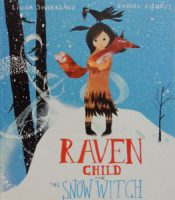
Right from its textured sparkly cover, there’s something of a Russian folk tale feel to this magical, chilling story of love, loss and bravery, from debut picture book author, Linda Sunderland, and illustrator Daniel Egnéus.
Travel with me over frozen lakes and shimmery mountains and through the Forest of a Thousand Eyes to the Snow Garden, home of young Anya and her parents. Despite her chilly surroundings, Anya is kept warm by the dress of feathers woven for her by her friends the ravens whose language she has learned. On the first day of spring Anya’s mother sets out towards the glacier on a mission to collect gentian flowers, her daughter’s favourites, accompanied only by the ravens.


Anya and her father remain at home and after a while, the child falls sleep and dreams. She dreams of hearing her mother’s voice telling of her capture by the Snow Witch and this is followed by terrible news from one of the ravens that had gone with her mother.
Anya tends him and listens to his story. What he tells her has father and daughter setting out next morning on a frightening and dangerous journey together in search of Anya’s missing parent.


It turns out though, as the two learn during the course of their journey, that Anya’s mother is not the only person missing: a whole village’s children have been stolen away. Anxious not to waste time waiting for the villagers, Anya, accompanied only by the raven she’s named Broken Wing and Half Tail (a fox rescued on the way) travels on, until finally they come upon tell-tale signs that their search has brought them to the right place.

%0a

Deep inside the glacier, Anya must confront her deepest fears; but is she a match for the Snow Witch? Can she rescue her mother and the children from the clutches of the evil woman …
Totally enchanting from cover to cover, this book will grip you right from its introductory verses to Anya’s final flight with the ravens. Daniel Egnéus’ haunting scenes of icy and snowy landscapes and Anya’s encounters with the animals she befriends are spell-bindingly beautiful.


Message in a Bottle

There have been several personalised books launched in the past couple of years and as far as I know this is one of the most recent. Here, established picture book author Tom Percival joins forces with Finnish book publisher/illustrator Tuire Siiriainen in a project for adults and children together and the outcome is:

%0a

Message in a Bottle
Tom Percival and Tuire Siiriainen
Blueberry & Pie
Meet Kiki, a Scarlet Hawaiian Honeycreeper who longs for adventure. When a bottle containing a message is washed up on the shore of her island home, it seems she’s being offered an opportunity to fulfil her dearest wish, to travel and see the world beyond her own tropical environs. Kiki resolves to deliver the message – bottle and all.
Now what this message is, and who is to receive it, is where the personalised part comes in: the giver of the book presumably already having decided upon its recipient, now creates the message that Kiki finds. This can be written in English or one of the other European languages offered: French, Polish, Luxembourgish or German. The message can be one of those suggested by the publisher or composed entirely by the sender of the book.
References to the recipient and their address are made throughout the story helping to heighten the engagement as Kiki’s journey progresses. That’s getting ahead of things though, for Kiki has no idea which way even to start flying.
With assistance – or not – from a somewhat confused clackety-clawed crab …

img_2845

a whale, a grizzly bear, a plover with no sense of direction, a sailfish, a troop of monkeys who squabble over the bottle, and a wise owl, Kiki and bottle meander their way across the globe from her Pacific island via North and South America, the Atlantic, Africa and Europe to England’s shore, and finally, onto the windowsill of the recipient’s bedroom.

img_2846

For Leo, only just four, this was the climax of the book. Having been riveted throughout the story, absorbed by the vibrantly coloured, cartoon style illustrations, and excited at the references to his address and name throughout, as well as listening avidly to the message in the bottle, he was less engaged with the final part about Kiki’s return home.
Older recipients of the personalised book will I suspect, be fascinated to discover Kiki’s Kids online club where, by clicking on the interactive map, they can find out more about the fourteen animals from the story.

To order your own personalised copy of the book visit the Message in a Bottle website.

How To Be a Hero / Mary Had a Little Glam

%0a

How to be a Hero
Florence Parry Heide and Chuck Groenink
Chronicle Books
Anyone who has read The Shrinking of Treehorn will be familiar with the author’s wry humour: that same humour is inherent in this posthumously published picture book. Meet Gideon, a nice boy who lives with his parents in a nice house and has, seemingly, everything a boy could want. What young Gideon really wants though is to be a hero but he’s not quite sure how to go about it. He has some ideas though: You have to be strong, brave and clever like this surely?

%0a

After further foraging into fairytales such as this one ‘the story where a witch gives a girl a poisoned apple and when she takes a bite she goes into a deep sleep which is sort of being dead but not really and nothing will get her awake except a kiss and someone does see her sleeping there and he kisses her and he’s a hero, just like that.’ however, he comes to the conclusion that really, all this heroism takes is just being in the right place at the right time. QED! Well that and err… keeping your eyes open. This does entail actually noticing what’s going on around you though – something of which Gideon appears unaware, as heroic act opportunities present themselves to left and right as he heads, eventually, to the supermarket to spend his pocket money.

dscn9195

There, a heroic act is, assuredly performed but by whom? Yes, Gideon is the recipient of a whole lot of media attention but for what? Wish fulfilled, he’s certainly front-page news – a hero. Err? He certainly thinks so.
Groenink brings out the subtle humour of the telling beautifully; it’s there all the way through if you look closely – very closely in some places; and in others, such as the shop sign with its reference to Propp (Vladimir – Morphology of the Folk Tale) and (Bruno) Bettelheim above the butchers it’s likely to go over the heads of young children. I love the way he switches from the dreary reality of Gideon’s home and locality to the more colourful fantasy world of the fairy tale world he visits in his imagination.
Certainly with this book, it’s a case of what you bring to the story making a big difference to what you get out of it.

dscn9189

Mary Had a Little Glam
Tammi Sauer and Vanessa Brantley-Newton
Sterling
A funky take on the nursery rhyme wherein fashion fanatic “I must accessorize” Mary starts school determined to make her mark. Seemingly her classmates at Mother Goose school are happy to merge into their surroundings though …

dscn9190

Mary however, is set on bringing a whole lot more glitz and glamour to her pals. She gets to work adding accessories and generally jazzing up not just the pupils, but everyone and everything in her school.

dscn9191

Playtime comes and with it a realisation that Mary and her decked-out pals are way too over-dressed for energetic outdoor romping and rampaging. No matter – Mary can turn her hand to un-accessorising too …

%0a

and she’s certainly queen of messy play – hurray for Mary.
With its bouncy rhyme and suitably flamboyant illustrations of Mary and her supporting cast, this is lots of fun to share with those around Mary’s age.

Du Iz Tak?

%0a

Du Iz Tak?
Carson Ellis
Walker Books
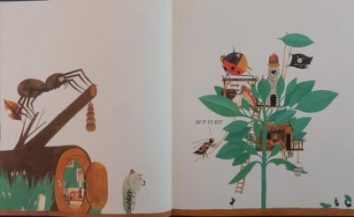
Google translate often comes to the rescue when one is confronted with a piece of text in an unfamiliar language. I doubt it would be of help here though for the characters in this story speak ‘insect’. It’s delivered in dialogue – nonsense dialogue unless of course, you happen to be a damselfly or another insect.
Du iz tak?” one asks the other as a pair of damselflies gaze upon an unfurling shoot. “Ma nazoot.” comes the reply. Now, as this brief exchange is contextualised by the picture we can take a guess at its meaning ‘What is that?’ and ‘I don’t know.’ in the same way somebody learning English as an additional language might.
Time passes: The shoot continues to grow and to the left, the dangling caterpillar has become a pupa. More bugs discuss the ‘thing’ -a plant, but what kind? They need something:“Ru badda unk ribble.” We need a ladder – context again.
They call on Icky who lives, conveniently, close by …

dscn9205

A ladder is produced, a cricket serenades the moon …

%0a

and work on building a ‘furt’ starts. Then danger presents itself in the form of an ominous arachnid

dscn9208

that soon starts enveloping their enterprise in a large web, until that is, along comes a large bird putting paid to that. Happily the gladdenboot remains intact and eventually, fully unfurled delights both the whole insect community and readers.

%0a

That however is not quite the end of the story for the cycle of nature must take its course with further transformations – plant and animal – so the whole thing can start over … and over and …
By this time readers will most likely be fluent readers of ‘insectspeak’, but whether or not this is so matters not: the superbly whimsical story visuals carry you through with their own spectacular grammar.
I do wonder whether despite being from the US, Carson Ellis could be having a satirical dig at the nonsense words six year olds are asked to read in that ridiculous phonics test they’re faced with towards the end of Y1; the one that many who read for meaning come unstuck with; the one the government insists is assessing reading. It’s not. At best, it’s merely assessing one aspect – decoding. Rant over: this extraordinary book is a total delight.

One Hundred Sausages

dscn9297

One Hundred Sausages
Yuval Zommer
Templar Publishing
As a vegetarian, sausages are NOT my thing at all, I’ll cross the road to avoid walking past a butcher’s and I’m certainly no dog lover. That said I was more than happy to see the return of Scruff, mischievous mongrel of One Hundred Bones fame. This funny story revolves around sausages, Scruff’s favourite food in the whole world and he certainly has a nose for them; sausages even fill his dreams every single night. Imagine his devastation then when he learns that his daily sausage sniff has been thwarted by a robbery.

%0a

Even worse, the number one criminal suspect is none other than Scruff himself.
What’s to be done? Either he faces a stint behind bars or he tracks down the real culprit. Straightaway, Scruff goes off to enlist the help of his doggy pals …

dscn9299

But it’s not until the s word is mentioned that the other dogs show any inclination to join the search.
Finally, the hunt is on: a sniffing party hits the city and eventually Scruff’s nostrils catch a whiff. Time to put those paws into action …

%0a

A chase ensues and the thief is finally apprehended …

%0a

after which it’s time to celebrate. You don’t need me to tell you what was on the menu for Scruff and his fellow pooches.
Zommer’s canines are a real laugh, not only Scruff, but Ada the Afghan, Pixie the Poodle, Percy the Pug and Sidney the Sausage Dog too, are real characters with their own idiosyncrasies. Pixie for example likes to file her nails and Percy considers himself a bit of a charmer.
Dog lovers especially will be delighted: the rest of us will have a good giggle over the crazy shenanigans shown in this daft detective tale.

Otto the Book Bear in the Snow

dscn9244

Otto the Book Bear in the Snow
Katie Cleminson
Jonathan Cape
If you didn’t meet library book residents Otto and his pal Ernest in their first adventure, then take the opportunity to do so now in this wintry one. Otto and all his library friends are getting ready for their annual winter party, an occasion Otto eagerly anticipates. But then Otto’s book is borrowed and the family doesn’t seem very eager to return it – worrying because that party date is looming ever closer. Even worse is to come though: the family departs for a holiday leaving Otto and Ernest all alone in the house, a house that’s right across the city from their library home –and a great distance for the two book bears to carry their book. Another strategy must be found and fast. All it needs is an envelope, some stamps and …

%0a

That WAS the plan but things don’t quite go as they’d hoped. The postman drops the sack as he cycles along the snowy road and CRASH! The friends find themselves hurtling into the path of an on-coming car. Phew!

dscn9246

Narrow escape but the library’s still a long, long walk away. Can they ever make it home, let alone in time for that party?
A real treat for lovers of books, reading, libraries and of course, bears. Katie Cleminson’s scenes, executed in pen and ink, watercolour and pencil, have something of a vintage feel to them.

%0a

Plants and Animals: Fact & Fiction

%0a

How Plants Work
Christiane Dorion and Beverley Young
Templar Publishing
A sequence of questions is used to introduce nine topics relating to the world of plants in this book that’s jam-packed with information. Each question is explored in a stylishly illustrated double spread, the first being ‘Why do plants have flowers?’ However an even more fundamental consideration: What is a plant?’ is discussed on the fold-out flap on the side of this spread.
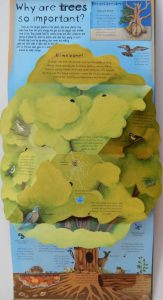
This is followed by how plants grow from seeds, what plants feed on and how, defence, habitats and the importance of trees …

%0a

We’re then introduced to some of the ‘weirdest’ plants, the edible ones and the final spread focuses on some of the uses of plants including some ideas that have come from observation of particular plants such as that by Swiss engineer George de Mistral who got his idea for Velcro from the burrs that attached themselves to the fur of his dog.
There are lots of flaps and tabs to explore; and the superb paper-engineering from Andy Mansfield really brings the whole thing to life. (Some of the tabs are not very robust and may not stand up to the enthusiastic handling of classroom use so it may be better to give this to individual readers.)

dscn9340

Knowledge Encyclopedia ANIMAL!
written by John Woodward
Dorling Kindersley
This truly is a weighty, although not a heavyweight, tome. After the contents page, introductory ‘What is an Animal?’, discussions on ‘Evolution and Extinction‘ and a classification diagram, the book is divided into six sections: Invertebrates, Fish, Amphibians, Reptiles, Birds and finally, Mammals.

dscn9392

The first spread of each section explains the meaning of the class as well as providing some general information.
I learned a fair bit (even with zoology as part of first degree studies) from this fascinating book including meeting some new animals such as the Sugar Glider and the Blue-Tongued Skink (note the helpful thumbnail picture, beside a human hand to give an indication of real size).

%0a

The 3D photographic illustrations are very impressive and many of the animals appear to be leaping right out of the pages, and the textual information has been authenticated by the Smithsonian Institution for accuracy.
A book for the family, for animal lovers young and not so young, and a worthwhile addition to the primary or secondary school library.
For those who prefer animals in stories take a look at:

%0a

Greatest Animal Stories
chosen by Michael Morpurgo
Oxford University Press
Author, former Children’s Laureate and co-founder of the children’s charity Farms for City Children, Michael Morpurgo has selected seventeen of his favourite animals tales from various parts of the world for this anthology.
These traditional tales are retold by ten different authors and illustrated by a dozen different artists.
Some of the stories can be read in a few minutes, others such as Pippa Goodheart’s lively telling of Puss in Boots

%0a

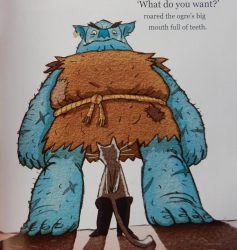
Puss in Boots is confronted by the ogre – a   Thomas Radcliffe illustration

and Morpurgo’s compelling rendering of Peter and the Wolf take a fair bit longer. No matter which story you choose to share at any particular time, make sure you allow time to explore the illustrations – every story has superb illustrations at every turn of the page.
All manner of animals from tricksters such as Anansi the Spider, Brer Rabbit, and Baboon to talking cows and cats are featured and Morpurgo provides a brief introduction to each of the tales outlining its origin, underlying message and something to ponder upon.
One for the family bookshelf or classroom library, or to give as a present perhaps.

The Snowflake Mistake / The Bot that Scott Built

%0a

The Snowflake Mistake
Lou Treleaven and Maddie Frost
Maverick Arts Publishing
The latest scientific research shows that what we’re told as children – that every snowflake is different – isn’t altogether true, although there are a great many structural variations. Now here’s a modern pourquoi tale explaining the popular idea that every one is different.
Princess Ellie lives with her mum, the Snow Queen, in a floating ice palace high above the clouds. In that palace is an amazing machine that collects clouds, squishing, crunching and stamping them to make into identical snowflakes.

dscn9243

But when Ellie’s mum has some business to attend to elsewhere, the young miss, (who would much prefer to be out playing) is left in charge of the machine. She decides to speed up the snow production …

%0a

and that’s when things, or rather the machine goes terribly wrong, and with a BOING! BANG! POP! it grinds to a halt.
With the only alternative being no snow for the children to enjoy, Ellie knows she must find another way of making snowflakes. Out comes her scissors and with the help of the birds, she makes snowflakes of all shapes and sizes, not perfect exactly, but every one beautiful, every one different. Hooray!
Full of wintry delight this rhyming story is another invention from the creator of the Oojamaflip – another quirky machine. Maddie Frost’s digitally rendered collage-style illustrations, especially those of the snowflake machine, are great fun and the final page provides information on how to make a snowflake.

dscn9187

The Bot That Scott Built
Kim Norman and Agnese Baruzzi
Sterling
It’s Science Day for Scott and his classmates and it’s Scott’s turn to demonstrate his robot. Things don’t go quite to plan though and that moment of glory rapidly descends into chaos as angry ants rampage, freaky frogs frolic and feast on flies, there’s a big-bellied boa on the loose and a whole lot more besides.

dscn9188

The cumulative rhyme dashes along at a frenetic havoc-making pace; and with lashings of alliteration and illustrations packed with hilarious details as the whole session turns from calm to mayhem, young listeners have plenty to enjoy as the catastrophes cascade into being until finally, a sense of order is restored. PHEW! Now who could have pressed that button in the first place, one wonders.

Are You Sure, Mother Bear / Goodnight World

dscn9229

Are You Sure, Mother Bear?
Amy Hest and Lauren Tobia,
Walker Books
It’s the very first night of winter; snow has fallen all around and it’s time for Little Miss bear and her mother to start their long winter sleep. The young bear however, is not ready for sleep just yet; she’d far rather watch the snowflakes falling. The two snuggle up together, munch on toast and stare through the window and gaze at the snowy world beyond.

%0a

Little Miss begins thinking of everything she’ll miss once she succumbs to sleep: the stars, the moon and the hills just right for rolling down. They’ll all be right there come spring, Mother Bear reassures her little one; but then she gives in. Out the two go for one last moonlit roll …

%0a

before finally, no matter what, it’s time for bed and sleep at last because that’s what bears do in winter, seemingly even semi-domesticated ones.

%0a

Full of feel-good warmth and reassurance, this is a lovely book to share with sleepy littles, who will enjoy both the snuggly indoor scenes and the beautiful outside woody, snowy landscapes.

%0a

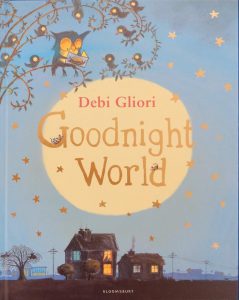
Goodnight World
Debi Gliori
Bloomsbury Children’s Books
With a gentle, lilting narrative and soft, soothing scenes of a world already to slip into sleep, this is a beautiful just-before-bed story for young children. As we bid ‘Goodnight’ to sun, moon and stars, ships upon oceans, rockets, cars and planes, the birds, bees and fishes,

%0a

the flowers and grasses, the animals in the zoo and in the park – pretty much everything in fact, a little child curls into a parent’s arms and shares a favourite book before finally falling fast asleep.

%0a

Gorgeous, dream-like images drift gently across every spread providing plenty of visual delight before gently lulling the listener to the land of slumbers too. Equally though, it’s great for joining in so I’d suggest a second reading and a third to allow for that, maybe on consecutive nights.

dscn9251

The Listzs

dscn9262

The Liszts
Kyo Maclear and Júlia Sardà
Andersen Press
Are you a list maker? There’s something satisfying about lists, especially lists of things to do, and in particular, the crossing off part. That was the part my favourite literary list-maker, Toad in Arnold Lobel’s Frog and Toad Together liked most too. In fact he couldn’t function properly without his ‘list of things to do today’.
A whole family of list makers populates this wryly whimsical book and they’re called, unsurprisingly, the Listzs. There’s Mum and Dad who make lists all year round, Sundays excluded; on such days they’re um, listless. Youngest child Frederick is a ‘list of fun things to do’ maker whereas big sister Winifred’s lists feature top tens and middle child Edward is a nocturnal list maker. Not wishing to be left out, Grandpa too makes lists – ‘his greatest admirers and most fearsome enemies’; even the cat’s a list maker.
Then one day a visitor arrives; nobody wants to engage with him – he’s not on their lists –

dscn9259

until he comes upon Edward. He has a list of questions and what’s more, he’s the one who’d left the door open and is ready to admit it too. “The door was open,” says the visitor. “I know. I left it open. …” comes the reply. “For me?” – that’s the visitor. Edward thinks so. The two exchange questions, which leads to more exciting outcomes …

dscn9261

Hurray for spontaneity and the possibility of something unexpected turning up.
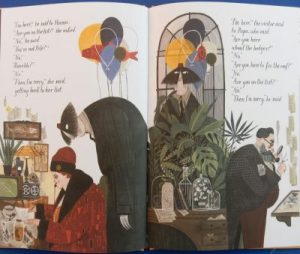
With a quirky gothic feel to it, this near nonsensical tale is likely to appeal to adults as much as children. Visual humour abounds in the suitably dreary-hued illustrations: look at this scene with the family spending a restful Sunday.

dscn9258

This is illustrator Júlia Saradà’s debut picture book: her illustrations herein reminded me very much of the work of Edward Gorey’s witty style. I look forward with interest to seeing what comes next.

Boo!

%0a

Boo!
Ben Newman
Flying Eye Books
No one is as brave as me and nothing scares me … you’ll see!” That’s the claim of the tiny stick-wielding character on the first spread of Ben Newman’s latest offering. (If you’re familiar with the awesome Professor Astro Cat books you’ll recognise him as their illustrator.)

%0a

Turn the page and you’ll immediately see this is far from true …

%0a

and then it’s a case of a series of claims to be the wearer of the ‘bravest’ mantle as an owl, a mischievous monkey, a toothsome, jaw -snapping croc, a leaping tiger …

%0a

and finally, a stampeding elephant all BOO! the previous pretender clean off the page.
Abolutely no one is as brave as me and nothing scares me!” asserts the latter super-confidently. Make no mistake about it; he does NOT have the final word …
Such a satisfying circularity herein and part of the fun is in the anticipation of the next BOO and the hooting, giggling, growling, snorting opportunities presented as each animal introduces itself. Oh, and that ‘nothing scares me … you’ll see!’ is repeated by each claimant, making it ideal for beginning readers to join in with on subsequent sharings of which, I foresee, there will be many.
Stylish and oodles of fun!

Penguin Problems

dscn9210

Penguin Problems
Jory John and Lane Smith
Walker Books
Being a penguin isn’t a barrel of laughs as we quickly discover in the first Jory John/Lane Smith collaboration, certainly it isn’t for the penguin narrator of this book anyway; we learn that right away when he’s woken from his slumbers by squawking from his fellow penguins. Nothing it seems is to this little fellow’s liking: he hates snow, the sun’s too bright and he’s extremely hungry. If the land’s not to his liking, the ocean’s even worse – too salty, distinctly lacking in fish, dark and decidedly chilly.

dscn9211

Oh great. An orca. Oh great. A leopard seal. Oh great. A shark. What is it with this place?” he mutters as he becomes hunted rather than hunter …

dscn9212

This fellow also has body issues; his buoyancy is faulty, his flippers tire too fast, his waddle is more of a wibble …

dscn9213

and of course, he can’t fly. Then there’s the issue of look alikes …

%0a

Enter stage right a walrus. His words of wisdom should go some way to changing Penguin’s attitude to ‘half full’ at the very least – some of the time anyway …

dscn9215

This book exudes humour both verbal and visual but put together the result is sheer gigglesome comedic delight at every turn of the page. Actually, make that before you start turning the pages; the perversity of the cover and penguin’s litany of negativity on the front inside flap, set the scene for what’s to come.

The Wish Tree

%0a

The Wish Tree
Kyo Maclear and Chris Turnham
Chronicle Books
When I taught reception age children we’d sometimes have a wish tree as part of the classroom environment, perhaps for the International Day of Peace or as part of an RE theme. Of course it wasn’t a whole tree, just a branch that had broken off and been collected for the occasion. Now here’s a storybook character wanting to find a wish tree in the great outdoors. His brother and sister dismiss the idea but with his trusty ‘Boggan’ for company, Charles sets out into the snowy world on his quest to find one.

dscn9184

Up hill and down they search, venturing into the woods where they stop to help various animals and make some new friends;

dscn9185

but try as they might, they cannot find a wish tree. Evening is nigh and the searchers are weary; they can go no further. But then something truly wonderful and magical happens as Charles and Boggan’s kindnesses are rewarded.

%0a

His newfound friends help him on his way and when he wakes up, he sees before him a snow-laden pine tree. Charles writes a wish, ties it to the tree and then he, Boggan and the animals partake of a seasonal feast together.

%0a

As the moon glows in a star-filled sky, Charles and Boggan finally make their way home to bed and perhaps to dream.
The snowy scenes have a subtle pinkish glow that radiates the wonderful warmth of the story despite the chilly outdoor setting. Openheartedness and friendship win through in this subtle tale of determination and tenacity.
With its in-built repetition that offers listeners opportunities to join in with those ‘La-di-da-di-da-daaaa’s of Charles and Boggan’s ‘Whishhhhh’ songs, this is a lovely book to share as temperatures drop and the nights draw in. I love the magical elements and the way gaps are left for readers and listeners to fill for themselves.

Charles Darwin’s Around the World Adventure

%0a

Charles Darwin’s Around the World Adventure
Jennifer Thermes
Abrams
In this introduction to the work of Charles Darwin, the author focuses on his five-year long voyage aboard HMS Beagle, the ship on which he served as naturalist. Before that though we’re given brief details of his earlier life leading up to his departure on the ship whose mission was making maps of South America.
The young man was absolutely fascinated by the sights and sounds around. He kept a journal, writing in it detailed daily observations of what he saw and heard –‘big observations about the tiniest of creatures’ we’re told.

%0a

So delighted by the wild life was he that Charles would often choose to remain on land while the Beagle sailed up and down the coast. This delight is portrayed in Thermes’ detailed watercolour portraits of the young man at work, work that set his imagination on fire and would later contribute to his ideas and writings on evolution. Her narrative fills in other details, particularly that of Darwin’s observations on individual creatures: ‘He saw a rare bird called a rhea that used its wings to steer as it ran, but could not fly’, and later in Tierra de Fuego, on the interconnectedness of all wild-life, indeed all of nature itself.

%0a

The stop on the volcanic Galápagos Islands particularly amazed Charles with its 200 pound tortoises big enough to ride on, but most notably the different kinds of finches he came across.

dscn9287

In addition to a detailed cross-section of the departing Beagle, there are large, colourful maps charting the exciting voyage for readers to enjoy …

%0a

Further information is given about Darwin’s life and work, and other related facts in the two final spreads.
All in all this does a very good job of capturing the excitement not only of the voyage, but of the wonders of nature as a whole. Definitely one for the primary school bookshelves and for individuals interested in wildlife in general.

Pinball Science & The Pen

%0a

Pinball Science
Illustrated by Owen Davey
Templar Publishing
The teacher part of me has always advocated putting scientific learning into a meaningful context: now here is an exciting project incorporating a whole lot of scientific principles that’s a tremendous learning opportunity. All you need to do is open up the box and follow the step-by-step instructions for assembling an 88 piece model complete with levers, plungers and flippers – awesome! In practice, I think it may prove a little more tricky.
Before plunging in though I suggest reading the pages describing the science behind the whole pinball wonder.

image1

Here’s Jack working on the model

It’s fascinating stuff: I learned it in deadly boring, text book only O-level physics with nay a practical in sight, but only understood what some of it really means, for instance Newton’s third law of motion ‘Every action results in an equal and opposite reaction’ when messing around with toy cars while teaching infants many years later. Now, it’s explained along with a simple investigation with a balloon.

%0a

And the difference between kinetic and potential energy? I remember learning that off by heart with little understanding but here, it’s neatly explained through an investigation with a tennis ball.

%0a

These practical activities and many others, all relevant to the enterprise about to be undertaken, provided by authors of the project, Nick Arnold (of Horrible Histories fame) and Ian Graham, are all stylishly illustrated by the wonderful Owen Davey.

dscn8435

The Pen
Raphaël Fejtö
Firefly Books
This near pocket-sized book is one of a series called Little Inventions. It’s a fascinating and delightfully quirky look at the history and development of a writing implement from the beginnings of writing when sharp reeds were used to engrave on soft clay tablets. It takes us up right through to the advent of Biros and then, the disposable BIC pens we’re so familiar with. In Japan, brushes were used for writing and these led to the invention of felt-tip pens so popular today for writing and colouring.
That’s it briefly; and the final page is a memory quiz. With amusing illustrations on every page,

%0a

this is just the kind of book to fascinate those youngsters less keen to embark on fictional stories: a whole lot of information, delivered narrative style, is packed into just 32 pages. Having read this one, I suspect children will want to seek out the other titles in the series: The Fork, French Fries, Glasses, Pizza and The Toilet (I bet that one proves popular!).
Just right for a school topic box, home library – anywhere there are readers (and writers) actually.

Pandora

%0a

Pandora
Victoria Turnbull
Frances Lincoln Children’s Books
I have to admit to doing a little dance when I saw this. I’ve loved all Victoria Turnbull’s books so far, but this one, with its tactile, satin, gold-sheened cover, is sublime. It takes picture book perfection to another level as it draws readers into Pandora’s lone world of broken things …

%0a

where she spends her time collecting, mending and recycling whatever she can.
Into that world one day crashes a small creature. That too needs fixing, but Pandora’s mending skills are, she feels, inadequate. Clearly not her caring though, for she nurses it with tenderness …

%0a

as it gradually gains strength and is able to fly once more. Pandora’s kindness is rewarded with small treasures …

%0a

But then one day she is faced with an empty box.
The emotional turmoil this creates is as devastatingly heart-wrenching for the reader as for Pandora. Alone once more she nurses her broken heart and, as it slowly grows back together,

%0a

other things start to grow in that box until one morning, the sun shines into her room drawing her outdoors to the best of all possible surprises …


%0a

The spare text means that every turn of the page is part of an exquisite contemplative experience that has you in its thrall throughout Pandora’s highs and lows, as you linger to explore every delicate detail of this ultimately, uplifting, fable of transformation; for as Alexander Pope said, ‘Hope springs eternal …’

The Darkest Dark / Ludwig the Space Dog

%0a

The Darkest Dark
Chris Hadfield and The Fan Brothers
Macmillan Children’s Books
The dark is for dreams – and morning is for making them come true.’ So says Chris Hadfield, retired Canadian astronaut on whose childhood this book is based. Herein we meet him as a boy, a boy who dreams of becoming an astronaut, flying to the moon or Mars.
Chris however, was afraid of the dark. For him the darkness that filled his bedroom when the lights were turned out was a darkness filled with aliens, very scary aliens.

%0a

One particular night, he has to overcome his fears and sleep in his own bed or miss the opportunity to visit a neighbour’s house the following evening to view the Apollo 11 lunar landing. So on the night of July 20th 1969, as he watches the TV (the only one on their island home) and sees the events unfolding, he realises just how dark space is – ‘the darkest dark ever’.
This is a turning point for the would-be astronaut. Chris has lost his fear and for the very first time he appreciates ‘the power and mystery and velvety black beauty of the dark.’ And in that dark your dreams await, dreams that can become your life, not tomorrow morning but some time …
The illustrators of this story really bring out both the mystery of darkness and the depth of young Chris’s nyctophobia when everything around him takes on a brooding, sinister appearance …

%0a

Certainly this is an inspiring story to share with youngsters who fear the dark, as well as those with an interest in space, whether or not they aspire to become astronauts: one never knows. Stories can generate dreams and you’ve read what Chris Hadfield has to say about those …
There’s more for space lovers in

%0a

Ludwig the Space Dog
Henning Löhlein
Templar Publishing
I guess if I had to choose an alternative world in which to live, I’d be pretty happy with the one wherein Ludwig and his five friends reside. It’s a world of books no less and unsurprisingly Ludwig loves to read, especially books about space. These books – as books generally do – generate dreams and ideas; and for Ludwig those ideas are about space and flying.
Try as he might though, Ludwig just cannot stay in the air for more than a very short time;

%0a

but then something unexpected crash lands right before his eyes. From that something steps its pilot – a space explorer who is in urgent need of assistance. And that is the starting point for a whole new life for Ludwig. Having fixed the rocket’s engine, he accepts the explorer’s invitation and finally takes flight on an amazing exploration of space.
Children can enjoy entering the bookish world of Ludwig and his friends, and joining the dog on his space adventure through the 3D glasses provided in the pocket inside the book’s front cover.
I love those quirky collage style illustrations of Henning Löhlein, which, even without the glasses, have in places, a three-dimensional look.

Line, Colour, Shape and Contrasts: Some Explorations

dscn9121

Free the Lines
Clayton Junior
Words & Pictures
It’s amazing how much you can say in a picture book without a single word of text. Clayton Junior does it all with lines – straight lines, curvy lines, thick lines and thin lines, lines close together and lines far apart; white lines and black lines. Using all these and the occasional bit of blocking, he tells a story of a small cat in a small boat sailing out into a large ocean to catch fish.

%0a

Into that same water comes a huge, smoke-belching trawler,

%0a

a trawler that casts an enormous net, an enormous net that scoops up everything in its path.

%0a

Fortunately- for the trapped, though not the trawler’s crew – an outstretched paw with a large pair of scissors puts paid to the marine life devastation and cat sails serenely into port over an ocean once more teeming with life.
This thought-provoking tale poses questions about the ethics of fishing and the fishing industry, as well as offering lessons in visual literacy and opportunities to explore and experiment Clayton Junior’s minimalist techniques of creating shape and form. It has something to offer all ages from around four to adult.
From the same artist is

%0a

Alone Together
Herein all manner of animals are shown as a means of exploring a wide range of opposites and contrasts. Each one of the stylish spreads could well be a storying starting point in addition to demonstrating the concepts chosen. This one really made me smile:

%0a

Also worth adding to your early years collection are:

dscn9118

Blue and Other Colours with Henri Matisse
Squares and Other Shapes with Josef Albers

Phaidon
These are two of the ‘First Concepts with Fine Artists’ series, beautifully produced board books that use the work of famous artists to introduce very young children to everyday concepts.
In the first, coloured cutouts from Matisse’s collages are the basis for teaching not only about colour, but also about shape and form, and how various colours can work when juxtaposed. Although blue crops up on most spreads, here’s one where it doesn’t …

%0a

Both inside covers are used to provide information: at the back is a brief introduction to the artist and some of his works, in particular the cutouts; and at the front, in tiny print, is a key to the works featured with their dates.
An unusual way to introduce colours and the notion of ‘painting with scissors’ and more important, especially if like me, you believe most children do not actually learn colours from books but from life experience, a springboard to creativity.
Equally fascinating and also essentially about colour juxtaposition and perception too, but this time introducing basic 2D shapes is an introduction to the 20th century artist Josef Albers’ work, in particular, Homage to the Square.

Home in the Rain & Home and Dry

%0a

Home in the Rain
Bob Graham
Walker Books
How does pouring rain make you feel? I must admit it doesn’t fill me with feelings of joy, far from it, but when I read John Updike’s quote below the dedication in this wonderfully warm story, I felt I was being chided somewhat. Here it is and it’s key to the story I feel: ‘Rain is grace; rain is the sky condescending to the earth; without rain, there would be no life.
A drive home from Grandma’s in pouring rain is the backdrop for Bob Graham’s warm-hearted story. In the little red car are Francie, her mum, and ‘her baby sister’ making her presence very much felt in Mum’s tum. The drive is long and the rain ceaseless; the car makes its way in the stream of traffic and as it does so we see the minutiae of life unfolding around: the baby rabbit diving for cover, the tiny mouse narrowly escaping becoming a kestrel’s next meal …

dscn9144

the fishermen hunched in a line

dscn9147

and the duck family just being, we even see a tiny snail and down below two men out of their cars arguing over a shunt.
The little car pulls off the road: Francie writes on the misted windows to help pass the time; she writes family names and then pauses; her little sister is yet to be named. They eat their picnic lunch and Francie snuggles. On they go and stop again to fill up with petrol: small events unfold: Francie sploshes in rainbow puddles,

%0a

an old man feeds his dog, a small girl loses her sweets and suddenly Francie’s Mum has a name for the new sister. The journey continues, the world moves on; the sun appears.
Bob Graham provides plenty to pore over and to discuss in his tender depictions of everyday life. It’s a lovely book to share, especially in those families where a new baby is imminent.
Also with a rainy backdrop is:

dscn9150

Home and Dry
Sarah L.Smith
Child’s Play
I certainly wouldn’t relish the prospect of living where the Paddling family does – on a small island underneath a large black cloud. A large black cloud from which for much of the year, heavy rain falls. This lifestyle seems to suit the Paddlings – Dad, Albert, a swimming teacher, Mum, Sally, who spends her time fishing, and their young son.

dscn9151

Come summer though, the rain ceases, the water dries up and the family home is now atop a hill. Life changes for the Paddlings who no longer receive their regular ferry delivery of food and mail. Off in search of a place to picnic, they’re unaware that another Paddling – Mr B. Paddling has set out to visit his nephew.
Uncle B. as he’s known, duly arrives to find an empty house so he decides to go back to the station. Down comes the rain, up comes the water …
It takes a rescue to bring Mr Paddling A. and Mr Paddling B. together at last and a celebratory fish supper is served by Albert.
There are echoes of both Sarah Garland and Mairi Hedderwick in Sarah L.Smith’s illustrations in this unusual family story. Much is shown in the watery paintings that isn’t told: most notably that the Paddling family grows from three to four during the story, and that’s before Uncle B. arrives on the scene.

Creature Close Up

%0a

Creatures Close Up
Philippe Martin and Gillian Watts
Firefly Books
If you’re at all interested in natural history, or know children who are, then take a look at the stunning photographic images in this book. Philippe Martin, captures his subjects in pin sharp focus by taking multiple close-up shots which are slightly different and combining them into a single image using computer software. The results are truly amazing. Most of the creatures were photographed in the Madagascan rainforest and some in the south of France where Martin lives. You can see every minute detail of the insects,

dscn9166

amphibians, reptiles, spiders, crustacea and mammals he has chosen as his subjects.
Every page evokes a sense of awe at the wonders of nature and nature as designer.

%0a

Please Be Nice To Sharks
Matt Weiss and Daniel Botelho
Sterling
Over a dozen sharks introduce themselves in this photographic parade of one of the world’s threatened species; threatened partly because of their popularity as the chief ingredient of shark’s fin soup, a Chinese delicacy but they’re also hunted for sport. Their loss as a species would be disastrous for the food chain as a whole as they play a vital role in keeping the animal populations of the oceans in balance. From the largest Whale Shark to the Bamboo Shark, one of the smallest …

dscn9181

each variety represented concludes its personal resume with the urgent plea: Please be nice to … sharks” and the final spread offers further information about what this means for we humans. One for the primary school topic box I suggest.

dscn9172

Dinosaurs of the Upper Cretaceous
David West
Firefly Books
If you’re a child fascinated by dinosaurs – and that’s an awful lot of children – you probably can’t have too many books on the subject. This particular one is part of a series of six each of which covers a specific period, that together make up the Mesozoic Age. The twenty five dinosaurs included herein are from 89 to 65 million years back – the period known as the Upper Cretaceous and, after an introduction to the period, are arranged in alphabetical order. Among them are some of the most well known such as Tyrannosaurus and Triceratops but many of those featured are less familiar, certainly to me. I’d not heard, for instance, of the Deinocheirus whose name means ‘horrible hand’ and whose fossil remains have been discovered in Mongolia.

%0a

Helpfully there is a shadow image of either a human (child or adult) or a cat alongside each of the computer-generated dinosaur images to gauge their relative sizes.
Interesting facts such as what each one ate, the meaning of its name, a description of specific features and where fossil remains have been found are provided. Addicts in the 6-11 age group will probably want to collect the whole set.

Motor Miles

dscn9201

Motor Miles
John Burningham
Jonathan Cape
A new Burningham book is always a cause for celebration.
Meet Miles, a rather difficult dog. He refuses to come when called, doesn’t like walks, turns his nose up at the food he’s offered and barks way too much. Despite all this he’s managed to win the hearts of his owners, Norman, and Alice Trudge who takes him for car rides, most notably up the hill to a café where he becomes a petted pooch.
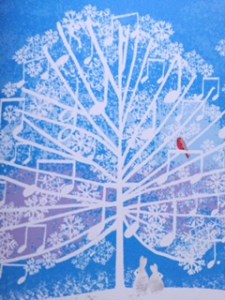
%0a

This however, becomes something of a chore for Alice Trudge. Thank goodness then for neighbour Mr Huddy, who builds Miles a car of his very own.

dscn9198

Miles learns to drive – love that sequence – takes to the road and starts taking young Norman on secret excursions. Some glorious Mr Gumpylike scenes show the two enjoying seasonal jaunts through fields …

%0a

woods and valleys,

dscn9200

all of which have a positive effect on Miles, who gradually becomes a reformed character. Inevitably however, Norman outgrows the car and Miles stops driving. Perhaps Mr Huddy has another surprise up his sleeve though …
John Burningham’s down-to-earth telling leaves his masterful illustrations of Miles discovering the joys of freedom, and those lyrical landscapes, to do the talking. For me, Burningham still wields a very special magic.

The Koala Who Could

The Koala Who Could
Rachel Bright and Jim Field
Orchard Books
Some of us find it harder than others to step outside their comfort zone; one such is koala, Kevin. This enchanting, cuddlesome creature is totally change averse and has three things – relaxing in the sun, clinging on and napping, and munching on a leaf-bun down to a fine art. Technically I suppose that’s four but for the sake of the story let’s not quibble. Our Kev. is ‘King of the Staying-Still Kings’. Put another way, he just stays put high up in his tree.
Down below the other animals race about enjoying themselves and making a lot of noise – it all seems far too large and strange for him, and despite invitations from the likes of Wombat,

and encouragements from the dingoes and kangaroos, nothing can shift cling-on Kevin. Occasionally he might have ideas about joining in but it never happens; his life just stays the same day in, day out.
Then one day something happens that undermines his whole raison d’être. Can Kevin finally let go of his safe, or now decidedly unsafe, existence?

The answer lies in just two little words.
I loved Bright and Field’s previous offering The Lion Inside with its African landscapes. Now we have a tale set in Australia, land of the eucalyptus trees that Kevin is so firmly attached to. What delectable scenes Jim Field has created to accompany Rachel Bright’s catchy, fun to read aloud, rhyming narrative. Kevin is a real heart-stealer; he might do nothing much, but his changing expressions as captured by Field, are a whole comedy in themselves. There’s so much more to delight though –the animated antics of the other animals, and the delight on the faces of one and all on the final page – that pretty much sums up the whole thing …

What are you waiting for? Join the new Kevin and give it a go.

Canine Capers

dscn9113

Fred
Mick and Chloë Inkpen
Hodder Children’s Books
Hooray! More from Fred.. I fell in love with this mischievous puggish pup in I Will Love You Anyway and now here he is, bouncing right back to delight us once again with his prankish behaviour. In fact now it seems he can tick off a whole lot of ‘can do’ items from the list of accomplishments one might expect of a little dog. He can fetch a stick, come when called, sit and stay. There’s one word though that still eludes the little chap; he doesn’t understand the meaning of Fred – a word often on the lips of his young owner. And something else puzzles him too: another dog upstairs that looks just like him –mmm!

%0a

Could he perhaps know what this strange ‘Fred’ word is all about? Strangely enough he seems to be popping up in other places too, places like the park and he has his paws on a certain ball belonging to our narrator …
After a very wet awakening, followed by a scream, a dash, and a jump, another face appears, a face that whispers a certain word over and over and then – light bulb moment …

%0a

Adorable!

Another canine has recently won a place in my affections; he’s the Boston terrier that stars in:

%0a

Harold’s Hungry Eyes
Kevin Waldron
Phaidon
Harold is a real foodie; he spends almost all his time either eating or day dreaming about his next meal. His dreaming is done lying in one position or another on his favourite chair – a chair he loves almost as much as he loves food. One day though, this super comfy chair is no longer where it should be when he goes to eat breakfast. A devastated Harold sees it being loaded onto the rubbish cart.

%0a

Without another thought for his meal, he takes off in hot pursuit and is soon lost and even worse, his tummy is starting to rumble. His food obsession kicks in and Harold begins seeing things of the edible kind wherever he looks …

%0a

Happily though, his wits and those hungry eyes of his finally lead him back home where he finds a satisfying breakfast and a delicious surprise … a new place whereon to relax.
With smatterings of edible humour, this stylish book is a wonderful visual feast that’s more than likely to have young audiences chuckling and perhaps, drooling.

Samson the Mighty Flea

%0a

Samson the Mighty Flea
Angela McAllister and Nathan Reed
Andersen Press
Samson the Mighty Flea is top of the bill at Fleabag’s Circus, which is no surprise: he can lift a match, a pea and, the lovely Amelie – all at once. Despite this, he’s not satisfied; Samson longs for the big time so he bids farewell to fellow Fleabag performers and off he goes determined to be “the biggest star in the world“.

%0a

But the world is a very big place and he’s such a small flea: “Go back where you belong,” a bug tells him. There’s no going back for Samson though, not until he’s performed before a huge audience. That does eventually happen …

%0a

but so does something else: Samson realises that however much he’d longed for fame, it’s worth nothing without his old friends and one in particular.
Meanwhile back at Fleabag’s that particular friend is about to give the performance of her life too …

%0a

Thought provoking and funny, this circus romp moves in and out of rhyme and so requires careful perusal by an adult reader aloud before public performance. I loved the offbeat nature of the whole thing: its unlikely characters are portrayed with finesse by Nathan Reed, who provides visual delight at every turn of the page.

Snail Mail

Snail Mail
Sharon King-Chai
Hodder Children’s Books
The majority of us receive much of our communication by text, e-mail and social media nowadays; letters are mainly junk with the occasional thing to delight – a letter from abroad, an exciting piece of publishers’ information, and of course all those wonderful books to review; I only ever receive picture postcards from one person. As a young classroom teacher in the 80s and 90s, before social media, one of my most favourite books to share was Janet and Allan Ahlberg’s The Jolly Postman and there have been other books with letters and cards thereafter. These can be a great stimulus for children’s own writing and now, there’s one more. Herein we meet 4 year old Seashell Snail, Sam, our narrator who has a large group of adventure-loving family and friends. Take big brother Tiger; it’s he who generates the snail mail, which gives the book its title. Tiger sets out on a world trip promising to write to Sam every day.

Good as he word, Tiger sends Sam a picture postcard from every place he stops at -. Brazil on Monday, the USA on Tuesday, India on Wednesday, Japan on Thursday, France on Friday. Goodness he does get around and those communications surely do keep Postman Perry busy, not to mention sparking off exciting activities for the seashore residents. Each card is delivered in a beautifully designed envelope appropriate to its place of origin; here’s the one from India.

The final communication contains something very special – a birthday treat for Sam; and it’s one that will undoubtedly inspire its recipient to start making some international travel plans too.
A super-silly story with appropriately crazy illustrations to delight – lots of fun to share and perhaps, a classroom stimulus to some imaginative written correspondences.