Two Dragon Tales

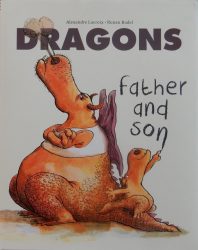
Dragons: Father and Son
Alexandre Lacroix and Ronan Badel
Words & Pictures
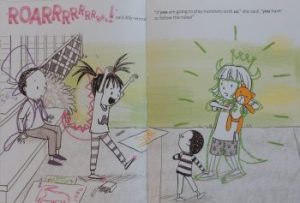
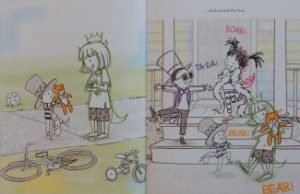
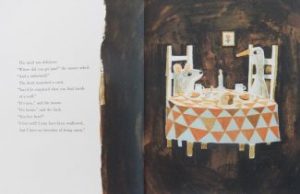
Young dragon Drake, a chunky little charmer, lives with his pot-bellied father, a traditionalist, who decrees that the time has come for his son to start behaving like a real dragon; and that means burning down a few houses in the village over the mountain. Poor Drake. He seldom emits a plume of smoke and setting fire to houses is something he does not want to do at all.
Next morning though he does as he’s ordered and finds himself a likely target. Just as he’s stoking himself up to commence his flame throwing, out rushes a little boy who offers a larger alternative, the village school.
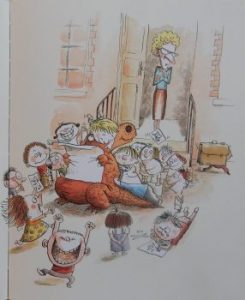
Here however, as he’s about to disgorge his destructive breath, the teacher and pupils disarm him completely with their appreciation …

and Drake finds himself heading for a third target. Yet again though, he is diverted.

What is his father going to say when Drake returns home and reports on his activities?
Needless to say, he’s more a than a little displeased; so it’s just as well that young Drake has, in the course of his travels, ‘learned a lot from the humans about being smart.’
Thereafter, we leave both father and son satisfied in the knowledge that there is, after all, more than one way to be a respected dragon.

Lacroix debut picture book text, although longish, is mostly in dialogue and has a droll humour that, with its themes of divergence and tolerance, will give it a wide age range appeal.
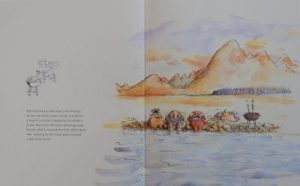
Badel’s watercolour and ink illustrations show Drake’s appearance in the village striking fear and consternation among the adult population but only excitement and adulation in the children he encounters. Perusal of the pictures also reveals an intriguing bit part player in the form of Drake’s pet bird which accompanies him on his adventure, appearing in both the large coloured scenes and the line drawn vignettes that punctuate the text.

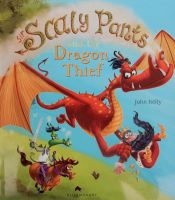
Sir Scaly Pants: The Dragon Thief
John Kelly
Bloomsbury Children’s Books
Sir Scaly Pants, the one and only Dragon Knight returns for his second adventure.
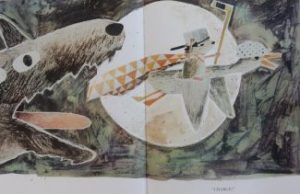
It all begins when a fire-breathing dragon kidnaps the King right from his saddle while he and the Queen are enjoying a paddle in the river. The Queen is distraught and of course, Sir Scaly Pants, furious at the behaviour of a fellow dragon, resolves to do his bounden duty and rescue his Highness from the kidnapper’s clutches.
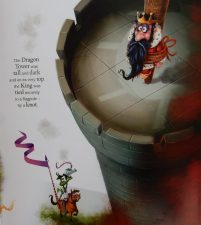
He leaps on his trusty steed, Guinevere, and gallops off eventually discovering the King’s whereabouts in a dark tower.

A tower guarded by the fearsome king-napper demanding gold in return for releasing his captive.
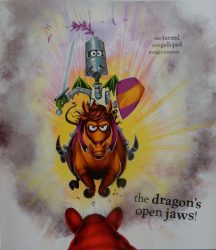
It certainly seems as though Sir Scaly has bitten off more than he can chew when he charges right at the open jaws of his adversary.

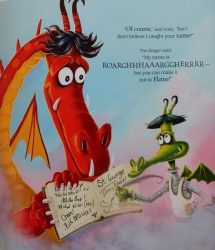
However, thanks to Gwinny, not to mention his own fireproof shield, Sir Scaly finally releases the King, removes his helmet and gives the king-napper the surprise of his life. It turns out that he’s not so wicked as Sir Scaly first thought: let a new friendship commence …

Striking, melodramatic illustrations with eloquently humorous expressions on the characters’ faces and in their body language, should ensure that this rhyming tale is set fair to captivate young audiences and win Sir Scaly more fans than just Flame.

Hibernation Hotel / Still Stuck

Hibernation Hotel
John Kelly and Laura Brenlla
Little Tiger Press

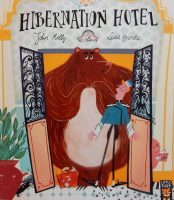
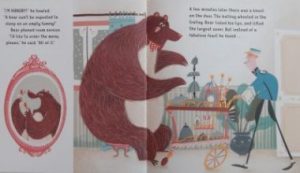
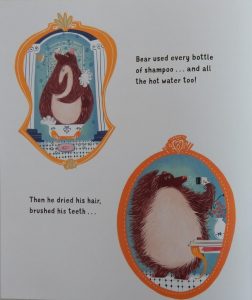
This book really made me think of winter, starring as it does, a bear, who despite it being past hibernation time, is still wide awake.
Bear’s sleeplessness is all down to his over-crowded cave but it looks like he’s thought of a solution.
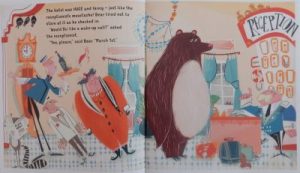
A phone call later, followed by a drive in his jalopy and he’s checking in at a smart hotel in the mountains. The perfect place for some uninterrupted shut-eye, especially as he’s asked the receptionist for a March 1st wake-up call.

How wrong could Bear be? Noisy, partying guests, an over-soft bed, and heavy bedding are far from sleep-inducing, and the TV shows just upset him.
Perhaps an empty tummy is the cause of his insomnia; room service should soon fix things …

And fix things it does, entirely satisfactorily; only not quite in the way Bear anticipated.
Kelly & Brenlla’s enormous ursine character with his fascination for hotel freebies, fixtures and fittings, is a peevish delight.

In that luxurious alien environment he discovers that creature comforts can come in unexpected forms.
Just right for a pre-bedtime giggle with little ones, especially those who need a bit of help dropping off.

More bedtime shenanigans in:

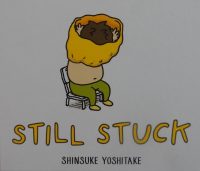
Still Stuck
Shinsuke Yoshitake
Abrams Books for Young Readers

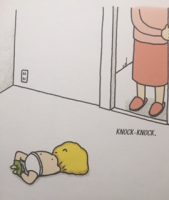
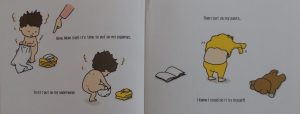
It’s time for a bath and the independent-minded toddler protagonist refuses help with getting undressed. Good on you, little one. But then, almost inevitably thinks the experienced nursery teacher part of me, his shirt gets stuck – well and truly so.
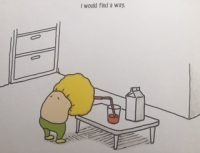
This sets the infant off on a surprisingly upbeat contemplation of the challenges of ‘stuckness’ and their problem-solving solutions – being thirsty for example …

Then there are the possibilities of friendship with other similarly stuck individuals: that could be lots of fun …

Coldness starts to invade his thoughts so the lad has another go at extricating himself, starting with his trousers – a valiant effort but definitely not a success.

Eventually Mum appears, disrobes the boy and lugs him off (wait for giggles at the bum views) to the bathroom.
But then, come the pyjamas – hmmm. What could possibly go wrong?

Yoshitake’s dead-pan text combined with wonderfully observed, cartoon comic, digitally rendered visuals make for a chucklesome pre-bedtime share for adults and infants.

Things to Do with Dad / You Can Never Run Out of Love

Things To Do With Dad
Sam Zuppardi
Walker Books

Dad and a small boy make and consume breakfast pancakes together. A promising and joyful start to the day but then Dad turns his attention to the ‘Things To Do’ list tacked to the fridge door – not so joyful.

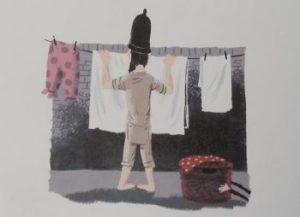
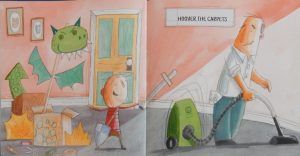
Dad makes a start with the chores with his son playing alongside. Washing up and bookcase building go smoothly enough but after a vacuuming incident,

the boy seizes the to-do list and his green crayon, and amends the list, starting with the title.

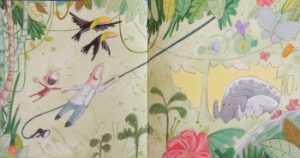
From then on imaginative play rules: ‘Make the beds’ becomes ‘Sail a pirate ship; ‘Hang out the laundry’ is changed to ‘Join the Circus’ and best of all methinks, ‘Water the garden’ morphs into a fantastic jungle adventure.

Good old Dad; he enters into the spirit of things heart and soul, so much so that at the end of the day, an exhausted but happy father and son snuggle together for a well-earned rest under a tree.

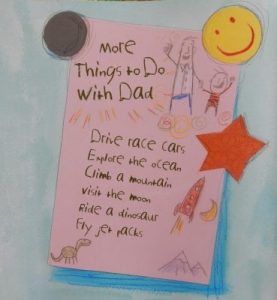
With only the list for text, Sam Zuppardi lets his own inventiveness flow in superb scenes of playfulness and the power of the imagination: the characters’ expressions say so much without a single word being spoken between the two.

The ideal way to turn boring chores into a fun-filled day: bring it on. We’re even supplied with a list of further ideas on the final page. I wonder which chores might generate these items.

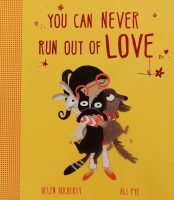
You Can Never Run Out of Love
Helen Docherty and Ali Pye
Simon & Schuster

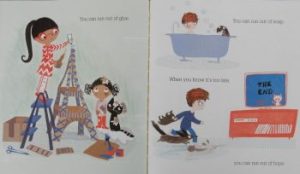
‘You can run out of time. / You can run out of money. / You can run out of patience, / when things don’t seem funny. BUT …// You can never (not ever), / you can never / run out of LOVE.’

That’s part of Helen Docherty’s tender, gently humorous rhyming text celebrating love- giving and accepting – and its inexhaustibility. Other things might be in short supply, but never love.

We see, in Ali Pye’s warm-hearted illustrations love in many forms – love between family members; love between friends, love for animals, love between a boy and girl next door …

Affectionate? Yes. Joyful? Certainly. Slushily sentimental? No; but it’s inclusive and perfect for bedtime sharing with young children.

I’ve signed the charter  

Lines

Lines
Suzy Lee
Chronicle Books

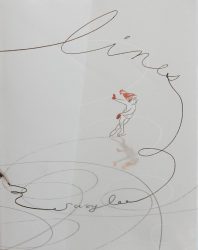
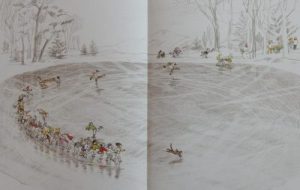
This truly is a wordless wonder.
A skater whizzes across the white page etching swirls and whirls onto the surface of the ice in a glorious solo dance – a veritable symphony of graceful motion, dizzying sometimes even.

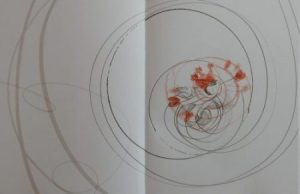
But then she takes one pirouette too many, loses her balance and crashes to the ground losing her hat in the process.
Turn over and you see a crumpled sheet of paper, a pencil and an eraser indicative perhaps of frustration on behalf both of the skater and the artist.
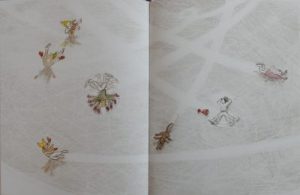
Turn over again and there’s the skater, alone and gazing at her hat on a wrinkly background. But then, enter left another skater and then another and … before long there are several others tumbling clumsily, but joyfully, around her.

Suddenly the whole of the ice is alive with skaters; one of them helps the girl to her feet and …

There’s joy in abundance as readers see the wintry wonderland that is the iced-over pond and the surrounding countryside.
Essentially the book can be viewed as an exploration of the notion that making mistakes is a vital part of the learning process be you a skater, an artist or any other kind of learner. This is something all children need to learn early on, and that some teachers would do well to remind themselves of from time to time.
Equally it’s a superb, thought-provoking picture book that transports us into unexpected places pushing at the boundaries of creativity.

Nibbles: The Dinosaur Guide

Nibbles: The Dinosaur Guide
Emma Yarlett
Little Tiger Press

Hurrah! Nibbles the book-eating monster returns in a new story and once again the help of readers is enlisted to try and catch him; this time because the little monster is in danger of becoming a dinosaur’s next meal.

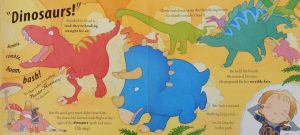
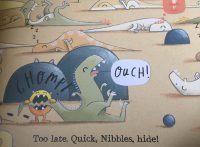
First he invades the Triceratops chapter from where he beats a hasty retreat when hotly pursued by not one but ten ‘hot-headed’, big bummed, stompy-footed creatures.

From there he moves to Diplodocus territory wherein the danger is from accidental consumption by the residents whose herby treat he sinks his gnashers in to.

Watch out for super-powerful Diplodocus parps, Nibbles!

The little monster’s definitely not out of danger yet: intruding upon dozing velociraptors is tantamount to suicidal.

However a hole in the page indicates Nibbles has made it out alive; but there’s worse to come.

So is that the end of our favourite book monster? Errm – let’s just say, it’s fortunate that, despite first appearances, a certain T.Rex is not totally omnivorous …

Goodness, gracious – great balls of fire!

Like Nibbles’ debut picture book, this one is totally engrossing and given the topic, the dinosaur details, the flaps to explore, the plethora of jokes and speech bubbles scattered throughout the illustrations, it’s likely to appeal across a wide age range.
I’ve had to read it dozens of times already to satisfy the demands of ‘Again!’ by enthusiastic listeners whose ages range from two to seven.

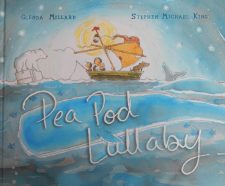
Pea Pod Lullaby

Pea Pod Lullaby
Glenda Millard and Stephen Michael King
Old Barn Books

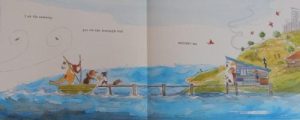
A mother and baby, a little boy and a dog are fleeing for their lives. They board a small boat and set sail across the vast ocean.

Soon after, they’re joined by a bird.
Some days later, they espy a polar bear adrift on what appears to be a fridge-freezer. The huge bear clambers aboard their small boat and after their initial apprehension, the passengers make him welcome,

sharing what little they have with the creature as they journey onwards through wind and rain.
Their ursine passenger disembarks upon an ice floe where three cubs are waiting; and the boat sails on through night and day until wind-borne leaves herald their own landfall.

King’s eloquent watercolour and ink tapestry-like strip sequences punctuated by large, full-page spreads chronicle a journey from danger to safety. In combination with Glenda Millard’s prayerful poem (the two worked in close collaboration throughout on an art gallery wall project), the result is a powerfully affecting, deeply moving book that speaks to people of all ages.
It’s a poem for survival: survival of the homeless and displaced, for refugees especially (and sadly there are ever increasing numbers seeking safety in countries other than their own); for the survival of endangered animals too.
This sublime picture book offers a heartfelt message of caring, connectedness, love and hope; it’s one to treasure.

Sam, the Most Scaredy-Cat Kid in the Whole World

Sam, the Most Scaredy-Cat Kid in the World
Mo Willems
Walker Books

It’s over a decade since we first met Mo Willems’ Leonardo the Terrible Monster along with Sam, the boy who is terrified of everything other than Leo. Now they’re back with Sam, (just as scared as before), being in the limelight until he encounters these two .

Seemingly Sam has a rival in Kerry, for immediately both humans, terrified of one another, start screaming uncontrollably.
Irked by their behaviour, the monsters decide to leave the children to ‘Figure it out’ and wander off the page together.
Having explored their similarities …

and differences, the humans eventually do just that and they too come to a decision, a wise and slightly mischievous one. And the two monsters are certainly in for something of a surprise when they return.

If you’re familiar with the first Sam and Leonardo story, then you’ll love this as a companion volume; if not it stands alone as a wonderfully funny account of forging a new and unlikely friendship.
Willems’ sombre colour palette, stand-out capitalised fonts and comic-style characters serve as well here as they did before, making this another monstrous winner for the USA’s master of drollery.

I’ve signed the charter  

Focus on Animals

Animalkind
Pablo Salvaje
Prestel
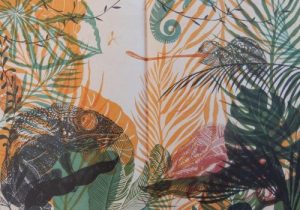
Spanish illustrator Pablo Salvaje pays homage to the animal kingdom in this visually stunning picture book that serves as a potent reminder that we are not the sole inhabitants of the earth. Rather we’re members of a vast ecosystem that includes countless numbers of other living things.
Herein we encounter a wide variety of creatures great and small from penguins to peacocks, snakes to spiders and crocodiles to chameleons. Each of these and many others are portrayed in Salvaje’s hand-printed spreads that form the greater part of this book.
By means of its division into sections: Love, Rhythms, Survival, Transformation,

Habitat, Water, Treasures, and there’s a final epilogue, we visit various parts of the planet and discover how like humans, animals too, such as penguins, may form bonds; have their own rhythms; form communities; need food for survival and may fight or co-operate to survive; undergo changes – temporary or permanent and go to great lengths to protect their young.

Compassionate and with a spiritual underpinning, this is a book for all ages and for those of both an artistic and a scientific bent.

My Encyclopedia of Very Important Animals
DK
How on earth does one decide what to include in a chunky book such as this? I guess cherry-picking is the answer and this really is a dipping-into book.
It’s divided into four sections: All About Animals, Amazing Animals, Animal Antics and More Very Important Animals and there’s a handy ribbon to mark your place, a glossary of animal words and an index.
There’s a wealth of information attractively presented in easily digestible bite sizes – even the odd fable – and a good balance between text and visuals;

the latter being predominantly, superb photographic images.
A worthwhile addition to a KS1 collection, or for families with young children to enjoy together.

Baby Dolphin’s First Swim
Sterling Children’s Books
From the American Museum of Natural History comes a sequence of photographs and accompanying narrative about the very first day in life of a baby dolphin.
We see the new-born close by his mother’s side as she nudges him to the surface of the ocean to take his first breath (through a hole on the top of his head), called a blowhole, so the straightforward narrative says.
Communication, feeding …

and being a new addition to the pod that serves to protect the infant are all part of the first day’s learning documented in the simple text and photographic sequence.
Neil Duncan, a biologist with the museum is featured in two final ‘Meet the expert’ paragraphs although whether he supplied the narrative or beautiful photos is not made clear. Nonetheless it’s an engaging book for young natural history enthusiasts or for a primary school topic box.

The Children Who Loved Books

The Children Who Loved Books
Peter Carnavas
New Frontier Publishing

The title alone made my heart sing: a story about book-loving children. What more can a book-mad reviewer of children’s books ask? Perhaps just that the book is as good as one hopes, and this one definitely lives up to my expectations.
It features a family of book lovers that have replaced almost everything else with books. There’s no car, no television, and they live in a caravan: no matter: everything they really need can be supplied by books.

There comes a day however, that their home just can’t accommodate any more books: it’s time to take things in hand …

Needless to say, things are NOT the same thereafter: the table is a tad unbalanced; Angus can’t see out of the window and the family, with so much space between them, begin to grow apart.
One day Lucy brings home a library book in her school bag and the magical experience of reading, with its power to enrich and unite, is rekindled, and with it comes a realisation that although it is wonderful to own books – lots of them – libraries have much to offer too.

The undisguised message at the heart of this is two-fold: the first concerns the powerful effects books and reading can have on a family; the second – one we adults need to keep reminding ourselves – is that a lot of material things are unnecessary for happiness.
With visual touches of Bob Graham, and a nod to Anthony Powell’s Books Do Furnish a Room …

Peter Carnavas has created a wonderful celebration of the power of sharing books and of libraries with plenty to think about and discuss with both children and adults.
I’m delighted to see New Frontier Publishing making his enchanting picture books available in the UK.

I’ve signed the charter  

Clumpety Bump / Barnyard Boogie!

Clumpety Bump
Phil Alcock and Richard Watson
Maverick Arts Publishing
Wally Wobblebottom is a kind-hearted soul; he has a horse named Clumpety Bump, a very lazy animal indeed. So lazy that when Wally sets out to deliver goodies to his various friends and neighbours, the horse’s response to his master’s words of encouragement on each occasion is “I can’t be bothered!” which leaves Wally more than a little frustrated, especially as the items he intends to deliver all go to waste.

By Thursday Wally has had enough; he decides to use his tractor when he goes, bearing flowers, to visit his lady-friend. However it seems machines can be just as unreliable as horses …

and in the end it’s Clumpety that takes Wally, at full speed this time, all the way to Ann Kacheef’s house. There disaster strikes … but all ends happily for everyone.
With its playful phrases and refrains to join in with, this story, with its themes of thankfulness and friendship, is one to encourage audience participation and promote the message that language can be fun.

More playful language in:

Barnyard Boogie!
Tim McCanna and Allison Black
Abrams Appleseed
Be prepared for a noisy storytime if you share this one: it’s a riotous read aloud thanks to the musicians of the Barnyard Animal Band.
All the animals have their instruments poised: Horse has a tuba, Goat plays a sax, Cat fiddles, Pig is a pianist, Sheep blows a trumpet and Dog bangs the drums. But what can Cow do? …

The crowd’s assembled ready to hear the performance; but how will the show start and who will lead the band?

Crazy rhyming onomatopoeic instrumental sounds, and a repeat refrain that young children will love to join in with, are part and parcel of the brief text that scans beautifully. Put together with bright, zany illustrations, the whole thing makes for a fun session with young children actively involved both vocally and physically.

I Want To Go First!

I Want To Go First!
Richard Byrne
Oxford University Press

I’ve never quite understood the obsession with being first in a line but it’s something that seems to take hold of children almost from the minute they start school – that’s if they’re made to line up anyway – a teachers’ obsession, often fuelled by parents, and one I dislike intensely.
The whole ‘going first’ thing can make for a fun story though and Richard Byrne exploits its potential for creating humour in his latest interactive picture book.
We join five funkily attired elephants, Elizabeth, Eleanor, Elton, Elgar and Elphie as they’re about to embark on ‘the long march to the watering hole at the back of the book’.
Elphie, the smallest of their number, is always the one that brings up the rear.
On this occasion however, he’s had enough of being last and asks to go in the front of the line. As usual though the response comes, ‘ … the littlest always goes last’.
Elphie isn’t prepared to walk at the back and instead he enlists the help of readers to help him with his plan of action. Help that involves first, shouting …

followed by hissing,

wobbling the book, squeaking and other noise making; all of which serve to get him to second place in the line right behind Elgar, just as they reach their destination where it looks as though we’re about to be rumbled …

Oops! The water hole is already occupied. Now what? Perhaps that squeak-squeak noise might come in useful after all … Could it even make the other elephants rethink their first in line criterion.
Enthusiastic orchestration and demands of ‘again’ were my listeners’ responses to this sizeist tale with its playful attempt to alter the status quo.

Last Tree in the City / Madeline Finn and the Library Dog

Last Tree in the City
Peter Carnavas
New Frontier Publishing

Edward lives in a city, one that appears totally devoid of beauty or colour. However, he knows of a tiny oasis in this concrete jungle.
At the end of his street stands one last tree and for the little boy (and his companion duck) it’s a place of joy; a place surrounded by nature where the two would spend many a happy time.

One day however disaster strikes: Edward’s tree has gone.

He’s devastated; but then he makes a discovery that brings hope to his heart, a tiny glimmer of hope that just might alter the city’s future in the very best way possible …

With minimal words and superbly eloquent watercolour and ink illustrations, Peter Carnavas has created a modern fable that has much to say to all of us; not only with its subtle ecological message but also with the empowering thought that one person really can make a difference.

Madeline Finn and the Library Dog
Lisa Papp
Old Barn Books

Madeline Finn, the story’s narrator, is a reluctant reader: she really does NOT like to read anything at all, not even the menu on the ice cream van. The trouble is that she finds the whole reading thing very hard work and sometimes her classmates make fun of her attempts at reading aloud. “Keep trying,” her teacher tells her giving her ‘Keep Trying’ hearts for her efforts.

Madeline though is desperate for a star sticker but those are only given to ‘good readers’: that teacher really needs to think about what she’s doing there.
On Saturday, Madeline’s mum takes her to the library where the girl reminds the librarian of her dislike of reading.

Miss Dimple however shows her a room where children are reading to dogs and offers her the opportunity to do likewise, introducing her to Bonnie, a large white dog.
Bonnie is a great listener; she ‘s non-judgemental, forgiving and patient; and week by week Madeline gains the confidence to make mistakes, to go at her own pace, and to take risks as she continues to read to the dog.

After many weeks, she is ready to read out loud at school. She starts out a bit wobbly but imagines herself reading to Bonnie and suddenly she’s done it.
Lisa Papp’s gentle watercolour illustrations capture the little girl’s feelings so beautifully in this encouraging story, which has a lovely surprise ending, both for the main protagonist and for readers.

I’ve signed the charter  

His Royal Tinyness: A Terrible True Story

His Royal Tinyness: A Terrible True Story
Sally Lloyd-Jones and David Roberts
Walker Books

I think I’ve just found my favourite ever picture book take on a new sibling. This one had me spluttering at every turn of the page; both words and pictures are utterly priceless.
Let’s meet the Happy Family: there’s a mum, a dad and a little princess: ‘the most beautifulest, cleverest, ever-so-kindest Princess with long flowing wondrous hair’ is how the young miss describes herself. (“That’s her tights,” one of my listeners was quick to point out.) Oh! and there’s a gerbil too.
All is peace and harmony in the kingdom aka The Land until one fateful day, a new ruler is born: His Royal Highness, King Baby. Let right royal disaster commence for, from that day forth for a whole year thereafter, the increasingly chubby babe rules The Land, not to mention the household. A certain young Princess’s nose is well and truly out of joint, but come infant’s first birthday, things get even worse.
Relations gather from far and wide to celebrate, fawning and fussing over the infant, and totally ignoring big sis. Seemingly the prince has cast a spell over The Whole Land.
Time for some drastic action: our innocent Princess knows just what to do – a disguise and a cunning plan are called for.

Before she’s barely even begun however, the sight of birthday cake and the sound of singing …

spark off horrendous screams, drooling dribbles and a tremendous tantrum from young King Billy.

Can anyone console the poor little chap?
Surprisingly, yes. But to find out exactly who and how, you’ll need to read the story for yourself …
Let’s just say that peace and harmony are finally restored and from a most unexpected quarter.
David Roberts must surely be king when it comes to pen and watercolour illustrations. Herein his distinctive illustrative style is retro 1970s (mum with frizzy permed hair and dad wearing bell-bottoms) ; but running in tandem with that are crayoned images showing the Princess’s version of events taken from Princess Marigold’s Drawing Book– a brilliant comic counterpoint if ever there was one. All this, alongside Sally Lloyd-Jones’ terrific fairytale pastiche and the result? A new dream team is launched.

Here’s one little princess totally loving the story.

World Pizza / The Wompananny Witches Make One Mean Pizza

World Pizza
Cece Meng and Ellen Shi
Sterling
Who would have thought that pizza could become a peace-maker but you never know.
The vast majority of us wish for world peace and the mum in this story does just that one night when a wishing star appears in the sky. But as she speaks her wish a sneeze comes upon her and her children are convinced her wish is for pizza. Suddenly a large pizza falls from the sky and truly delicious it turns out to be.
Soon yummy pizzas of every kind imaginable are raining down all over the world making people happy and content.

Even bullies become kindly and pirates cease their plundering; everywhere differences are forgotten and unlikely friendships forged and all in the name of pizza. Peace and love fills the world and all unbeknown to the instigator of the whole process.
Interesting and thought-provoking: would that it were that simple though.

More about the power of pizza in:

The Wompananny Witches Make One Mean Pizza
Jennie Palmer
Abrams Books for Young Readers
The Wompananny witches, Anita and Winnifred are sisters who like nothing better that preparing a delicious pizza in their kitchen. In fact they seldom set foot outside on account of the local, so they think, wild children. So when three of them come a-calling the two sisters are quite overcome with terror and decide to give vent to their feelings by pounding a new batch of dough.
Before you can say ‘baked pizza’, the dough has morphed into ‘one mean pizza’ that in true ‘runaway pancake style’, has upped and flopped its way out of the oven, through the front door and out into the street, hotly pursued by Anita and Winnifred.

Soon the entire child population of the neighbourhood, hungry and desperate for a nibble of pizza, is chasing after the yummy thing, all the way to the park where something very unexpected happens. Yes, the children are still wild decide the witches, only now witches and children are actually a very tasty combination and all thanks to pizza.

Full of humorous touches, Jennie Palmer’s ink, watercolour and photoshop illustrations for her whimsical tale bring to mind James Stevenson’s art.

A Trio of Search-and-Find Books

Where’s Bernard?
Katja Spitzer
Prestel
Bernard the bat is preparing for his night-time birthday celebrations but he wants help to find everything he needs for the party he’s throwing for his friends. His search involves nine items …

and takes him hunting in all manner of fascinating places: a greenhouse, an underground cavern, an ice-rink, a garden,

the woods, beneath the ocean and even in outer space, each one being populated by weird and wonderful creatures.
With its ‘glow-in-the-dark’ cover and quirky, vibrantly coloured, magical scenes that are not too busy for the youngest seekers, this is a good place to start on the whole ‘search and find’ genre.

A Thousand Billion Things (and some sheep)
Loic Clement and Anne Montel
Words & Pictures
A small girl takes us through a variety of everyday happenings – having breakfast, taking a bath, getting dressed, exploring the garden, going to market, helping dad prepare the dinner and more, asking us to locate items hidden in spreads brimming over with food, clothes, vegetables, …

fish and more. Each of these events offers plenty of choices and entices readers to linger over the delicately drawn flora, toys, clothes, delicious pastries etc –which almost prove too much for the young protagonist while also locating such items as 4 hedgehogs, a frog mask, a spotty green sweater, or a pyramid of cream cakes.
Then comes bedtime, which, so the young narrator tells us on the first page, is the one time she dislikes: instead of a multitude of choices, bedtime offers nothing but sheep, endless sheep and ‘it’s a complete nightmare!’
Accompanying Clement’s quirky textual narrative, Montel’s slightly whimsical images provide a visual feast; and it’s as well, in case one gets too carried away over the details, that a visual key with the answers is provided at the back of the book.
Absorbing, fun and rewarding.

Find Me: A Hide-and-Seek Book
Anders Arhoj
Chronicle Books
Children can join with two friends as they engage in a game of hide-and-seek from opposite ends of this book.

Two large pairs of eyes peer through the die-cut holes in the front and back covers, forewarning that child participants are going to need to keep their eyes peeled to spot the protagonists in their play.
Arhoj teases with his own game of give and take: if you look at the endpapers you’ll also be forewarned that the playmates sport differently shaped hats – that should make the whole thing easier surely. But then to make the spotting considerably more difficult, he makes the two slightly foxy characters change colour; not only once but on every spread, as they move through the book and their world of hustle and bustle.
It’s a world populated by all kinds of strange and cute creatures going about their daily lives and its these, as much as the main protagonists, that provide a lot of the intrigue. I found myself distracted in every setting, just exploring all the quirky goings-on, before even starting to discover the whereabouts of the foxy friends. Every location be it shop, office, park, hospital

or elsewhere, has potential for stories aplenty.
With minimal text Arhoj has created an engrossing story-cum game picture book that will enthral and gently challenge young readers.

The Snow Lion / Toby and Tabitha

The Snow Lion
Jim Helmore and Richard Jones
Simon & Schuster
Caro and her mum move to a new house in a new neighbourhood. Then, into the whiteness of everything comes a snowy lion inviting Caro to play hide-and-seek. Their play fills her day bringing cheer instead of loneliness; but can this new animal friend encourage her to venture outside and have fun with the local children?
That proves something of a challenge but little by little, with the lion’s help, Caro starts to find her inner courage and joins in with the other children.

When mum suggests adding colour to their new abode, and invites her new friends round for a ‘painting party’, Caro is concerned that the lack of white will mean no more visits from her wildcat pal.

He no longer appears anywhere inside her brightly painted house, but surely he can’t have deserted her altogether, can he?
A lovely, gentle, reassuring tale about moving and finding new friends.
Richard Jones’s mixed media, warm-hearted scenes of friends real and imaginary are enchanting.

Toby and Tabitha
Alexander Bar and Emma Proctor
Walker Books
Have you ever heard of dancing tortoises? No? Me neither. I suspect nobody has other than young Lucy, whose grandfather owns, the pet shop, Animal Palace. This establishment is full of all manner of desirable pets and one of Lucy’s favourite places. She loves to help with the animals whenever she can, her favourites being two tortoises, Tabitha and Toby.
Lucy has a secret though: when the shop is closed and darkness falls, the two creatures respond to her singing by leaving their beds and dancing together in the moonlight, with Lucy joining them in a ‘Tea for One’ rendition of her own.
Then one day, disaster strikes: Lucy arrives at the shop to find Toby alone: Tabitha has a new home with a little boy, so her Grandpa tells her.

When the boy returns with a question, “what do tortoises like to do?” Lucy has a dilemma. Should she share her secret with Tabitha’s new owner, or keep it to herself?
Who would have thought that a couple of dancing tortoises could be the catalyst for a burgeoning friendship between two children?

This debut picture book written by Mike the Knight creator, Alexander Bar and illustrated by Emma Proctor is a delight.
Bar uses a child-friendly, chatty narrative style with playful language and opportunities to join in and Emma Proctor brings out the humour of the story. Her exuberant, mixed media visuals are such that you want to stop and explore the plethora of whimsical details in every spread.

Look for Ladybird in Plant City

Look for Ladybird in Plant City
Katherina Manolessou
Frances Lincoln Children’s Books

There seems to be an ever-increasing number of ‘search-and-find books’ of late: here’s one from rising star, Katherina Manolessou that really caught my eye for its zany, action-packed illustrations.
When Daisy’s pet ladybird – a rather cheeky little creature – goes missing, she enlists the help of Basil, Plant City’s best detective.
Then with notes duly written by Basil, and appropriate tools in hand, the two begin a frantic search for the lost minibeast.
It’s a search that takes them through the entire city starting at Big Bones School, then moving on to the station, the museum,

the funfair, restaurants, the plant nursery. That would seem a likely place with its abundance of insect life; but there’s no sign of Ladybird. Actually, there is, but Basil and Daisy fail to find him, as they do in all the other locations; though that is part of what makes the book such fun.

Readers however, will eventually discover Ladybird’s whereabouts on every spread; or if not, they can always look at the answers inside the back cover.
In addition to the missing pet, there are five bees, five grey mice, someone crying and someone sleeping, all of which are waiting to be discovered at each place the detectives search, plus all the items printed in capital letters in the narrative for each venue.
I say ‘detectives’ in the plural because, as well as recovering Ladybird at the end of the search, Basil makes Daisy an offer she can’t refuse and that, I suspect, means more cases are to follow.
I spent ages poring over the wealth of details in each of the ten locations: every one has signs to read, visual jokes

and a plethora of diverting happenings which I’m sure, young readers will enjoy as much as this reviewer did.
Between the covers of this book lies rich potential for language development, but more important, it’s enormous fun.

It’s Raining and I’m Okay / Remembering Lucy

It’s Raining and I’m Okay
Adele Devine and Quentin Devine
Jessica Kingsley Publishing

Children with autism frequently show distress when unexpected changes are made to their routines. Now here’s a little book with bold, uncluttered illustrations to help such youngsters feel less anxious particularly when out and about.
The text takes the form of a little girl’s first person rhyming narrative wherein she tells how she uses focused breathing and other techniques to help her through such experiences as waiting in a long queue, going into a crowded café with challenges including spilling her drink and worrying about the consequences, an over-chatty adult and a noisy hand-dryer.

At the back of the book are details of additional resources that can be downloaded to further support emotional literacy.
Particularly useful with ASD children; but the focused breathing technique is helpful for all anxiety-prone youngsters.

Remembering Lucy
Sarah Helton and Anna Novy
Jessica Kingsley Publishers

Coping with the death of a classmate is extremely difficult whether or not a child has special needs, but often children attending a SEND school find a bereavement can be confusing and sometimes, overwhelming.
In this story young Joe talks about his particular school and friends; and in particular the death of his friend Lucy: what it meant for him and his classmates and how he coped.
Remembering is his key, for Joe tells how photographs and talking help him bring to mind the good times especially; times shared in messy painting or dressing up for instance. ‘As time goes by’ he says, ‘you will be able to think of the fun and happy times … rather than just feeling sad they are no longer there. … remembering her makes me smile.

The final seven pages are a user’s guide aimed at adults and contain lots of helpful suggestions for what to do whilst reading the book and afterwards, not only immediately afterwards but in the longer term for as the authors remind us ‘… supporting children with loss and grief isn’t a one-off event… children will re-grieve at different points in their lives … Our support needs to be ongoing.’
A down-to-earth, sensitively written and illustrated book to have on the shelves of any school where there are SEND pupils.

Imagine

Imagine
John Lennon, illustrated by Jean Jullien
Frances Lincoln Children’s Books

In this illustrated version of Lennon’s 1971 anthem to peace, published in partnership with Amnesty International, (royalties from the sale of the book go to the charity) illustrator Jean Jullien uses a pigeon instead of the usual peace dove to carry its message around the globe, asking readers to imagine a world without possessions, without greed or hunger a world where everyone is part of a universal brotherhood, sharing and caring for all; without countries or religion, with nothing to kill or die for.
We first see this feathered ambassador of peace emerging from the underground train, bag slung around its neck and then he takes off on his mission over land and sea …

The pigeon’s focus as it wings its way around the earth distributing olive branches to its fellow feathered friends, is on fairness and sharing …

and culminates in an uplifting embrace for all the birds seen on his flight. (They too have become peace messengers.)

The artist’s boldly outlined images, digitally coloured and set against backgrounds of eggshell blue, white, purple or orange have a simple, heartfelt poignancy that make this beautiful book the perfect starting point for introducing Lennon’s message of tolerance, understanding, inclusiveness, unity and peace to today’s children. It’s certainly as relevant as when it was written over 45 years ago: indeed, we desperately need it now even more than ever.
Published on 21st September, International Day of Peace, let’s all pause and … Imagine.

I Want to be in a Scary Story

I Want to be in a Scary Story
Sean Taylor and Jean Jullien
Walker Books

From the dream team that brought us Hoot Owl, Master of Disguise, here’s a story told entirely in dialogue: black type for the external narrator and purple – aptly – for chief protagonist, Little Monster.
Eager to be in a story, the totally endearing little enthusiast turns down the suggestion that a funny story might be preferable, assuring the narrator that a scary story it must be.
Talk about dropping you in it, but that’s exactly what the narrator does by placing the monster right outside a haunted house.

‘Spooky’, seems preferable, and that’s no walk in the park either, as the house might be inhabited by a scary witch, or a ghastly ghost just waiting to jump out; at least the narrator forewarns our Little Monster though. But there seems to have been something of a misunderstanding.
Little Monster wants to do the scaring, not be scared silly. Here goes …

But then comes another thought: what lies behind that door? The witch?
Much too scary; so what about ‘just a teeny weeny monkey and his friend’? Surely scaring them should prove suitably funny …

Sean Taylor knows just how much scariness little monsters, purple or otherwise, can take, and his clever scaling back of the terror as the tale proceeds, is spot on for keeping young listeners on the edge of their seats. Equally Jean Jullien’s creepy scenes have a sufficient degree of zaniness to grip but not unduly alarm; and that final twist really hits the spot.
Can I be in a story again tomorrow?’ asks Little Monster on the final page: I suspect young audiences, thrilled rather than chilled, will want it to be more immediate than that.

Kevin

Kevin
Rob Biddulph
Harper Collins

Sid Gibbons and trouble seem to go hand in hand: first it’s smashing the birdbath with his ball; then forgetting to put the tops back on his pens; his bedroom resembles a ‘pigsty’ and now his dinner is all over the floor. Needless to say, his mum is less than happy. But, none of this is Sid’s fault: no it’s Kevin’s.
And who is Kevin you might be thinking; he’s Sid’s friend. The pink spotted, vanilla furred pal with a single tooth and a tendency for clumsiness who comes through a hatch in his bedroom ceiling when Sid feels lonely, so he tells his mum, who naturally is having none of this ‘make-believe friend.’
Make-believe? Through that ceiling hatch there shines a light – a light of vanilla and pink striped rays: up the stairs goes Sid to be confronted by a truly amazing sight – a magical world filled with strange beasties…

Now though, the boot is on the other foot, so to speak: Sid is the invisible being here and this gives him an idea. Uh-oh!

As a result however, it also gives him an opportunity to question his actions: is it fair to blame your misdemeanours on a friend, albeit an imaginary one?
Time to make reparation – first to Kevin and then to his very own Mum …

All this and more is delivered through Rob Biddulph’s faultless rhyming narrative – a longish one – and his equally superb visuals. For the latter he moves from the monochromes of Sid’s reality to the glorious rainbow hues of Kevin’s kingdom. Fans of the author’s previous works will delight in guest appearances from Fred, the bear from Grrrrr!; Blown Away’s Blue and the occasional Odd Dog dachshund.

And, those beastie inhabitants of Kevin’s world, be they hairy, slimy, leggy or frilly, are splendid. As for Sid, he’s a totally believable character, full of mischief and absolutely adorable – I’m pretty sure I’ve taught him somewhere along the line; many times over in fact.
All this while exploring ideas about imaginary friends and the notion of facing up to the consequences of our own actions, which is so subtly embedded into the tale – genius!

Mrs Noah’s Pockets

Mrs Noah’s Pockets
Jackie Morris and James Mayhew
Otter-Barry Books

This totally fresh and original take on the Noah’s Ark story is an absolute bobby-dazzler and what an inspired author/artist pairing.
Jackie Morris’ s powerful prose is honed to perfection so that not a single word is superfluous: here’s a taste:
This rain came from a sky
dark as a bruise,
falling hard and fast,
beating the earth,
washing down tracks,
making streams of pathways
and rivers of roads.

I love that Mrs Noah is portrayed as a subversive character who, instead of snipping, threading, tacking, tucking and stitching what her husband assumes are curtains for his ark windows, is in fact fashioning herself a multi- pocketed cape within which to stash all the ‘troublesome creatures’ that Mr Noah has on his list to leave behind when they set sail on their voyage. Genuis!

James Mayhew has used a strikingly brilliant, new style for his atmospheric illustrations – a mix of collage and print-making …

The design too is superb and those vignettes are little beauties.

This, I think, is destined to become a classic: it deserves a place on every family bookshelf and would make a great addition to any primary classroom collection.

Toad has Talent

Toad has Talent
Richard Smythe
Frances Lincoln Children’s Books

Frozen ponds in the moonlit would, I suspect, normally have more allure for humans than forest animals; but not so in this story. Even those one might expect to be hibernating are willing to risk freezing paws, or tingling noses and toes, in the hope of winning the Moonlight Pond talent contest.
Not Toad however; he’s absolutely convinced he has nothing to offer this extravaganza. “It’s best if I keep myself out of sight,” he decides lest the other animals think he’s useless.
As he watches the glittering performances of the contestants …

further self-deprecatory comments pour forth from the amphibian, until, the competition draws to a close.
However, just as a winner is about to be announced, a snail halts the proceedings declaring, much to Toad’s displeasure, that one of their number is yet to perform.
Fully intending to resist, the hapless creature steps from the shadows and slips, trips, swirls, twirls and cartwheels across the ice, landing right in front of the judges.

Such a glittering ice-skating performance by a toad has never before been seen and so, by a unanimous decision, and to great applause, Toad is declared the winner. After all, to use Toad’s final words, “You never know what you can do until you try!
Hugely entertaining scenes are the real strength of the far-fetched tale so far as I’m concerned; and yes Toad (despite looking like a frog) may have won the prize; but for me, that yogic snake …

and the duckling troupe are the real show-stoppers.

This Orq (he say “ugh!”)

This Orq (he say “ugh!”)
David Elliott and Lori Nichols
Troika Books

Orq back in new book; me happy; me love Orq.
Orq and best friend Woma play happily together …

but despite this, life is hard. The family cave is cold and dark, they dine on raw bison meat and worst of all, Orq is being bullied.
The bully, Dorq, is big, much bigger than Orq; he’s hairy, thoroughly mean, and has a nasty-looking pet named Caba.
The fearsome duo like nothing better than taunting Orq and Woma.
One day Orq and Woma are out hunting when suddenly, Dorq hurls a missile at Woma’s head

causing Orq to see red – literally.
In fury Orq grabs two rocks and bashes them together over and over, causing sparks to fly. The sparks ignite a pile of sticks at his feet: Orq has made a surprising discovery …

Orq is a hero; everybody’s hero: no more cold dark cave, no more raw meat: warm cave, night light, hot bison burgers. Mmm!
Like This Orq (he cave boy) Elliott’s deliciously droll text is written in clipped prehistoric cave-boy speak, which, in combination with Lori Nichols’ wonderfully funny, digitally coloured pencil illustrations, make for another great storytime read aloud.
Individual readers can also enjoy taking ‘The Turtle Challenge’ to discover how many turtles the artist painted for the story; it’s quite tricky.

Minnie & Max are OK! / Florence Frizzball

Minnie & Max are OK!
Chris Calland, Nicky Hutchinson and Emmi Smid
Jessica Kingsley Publishers

Minnie has had a bad day at school having been teased and shunned by two girls, and now she wishes she looked more like them.
When her grandma meets her at the end of the day, she notices than Minnie is upset and decides that a trip to the park might help. On the way both Minnie and her dog Max peer at their reflections in a shop window and soon both of them are full of doubts about their appearance.
As they sit together in the café, Minnie tells her gran how she feels and Gran’ responds calmly, lovingly and reassuringly. “I love you just the way you are!” she says, “I think it’s wonderful that we all look so different … Just look around us.” And Minnie does …

Max sees a great variety of dogs too and before long both child and dog are playing happily with friends.

With its gentle humour, and Emmi Smid’s captivating ilustrations, this is a good book to read with any young child struggling with self-esteem be it related to body image or any other perceived ‘difference’. Equally if shared with a class or group, it should make potential negative commenters stop and think about how much better our world is for its rich diversity.
There is a final spread aimed at adults wherein the authors, both education consultants, offer ideas for discussion on the themes of teasing, self-image and diversity.
All in all, a valuable tool in the fight for embracing and celebrating difference and diversity.

Florence Frizzball
Claire Freedman and Jane Massey
Simon & Schuster Children’s Books

Florence the small girl narrator of this story has hair issues; her curly frizz is thick and unruly. Her little brother’s sleek, flat hair is altogether more preferable, so she thinks. It doesn’t tickle or prickle …

or obscure anyone’s view on windy days, nor when watching television; and no one else in the family is similarly troubled other than the dog, Scuff.
Can a visit to the hairdressers be the answer perhaps?

It certainly results in a transformation; but is straight hair really so desirable …
With its cute characters, this sweet rhyming tale presents themes of individuality, self-image and self-acceptance in an accessible story for the very young.

Early Years Storytime: Fergus Barnaby Goes on Holiday / There’s Unicorn in Town!

Fergus Barnaby Goes On Holiday
David Barrow
Hodder Children’s Books
Fergus Barnaby lives with his parents on the first floor of a block of flats. Their bags are packed

and they’re just about to set off on holiday when Fergus remembers he hasn’t got his bucket and spade. They’re still upstairs in Fred’s apartment, left here when they played together. Off he goes to the second floor to retrieve them.
As they start loading the car, Barnaby remembers his swimming goggles: those he retrieves from Emily Rose on the third floor and so it goes on – Barnaby seems to have loaned out half his possessions to friends – until finally everything is ready and off they go.
Surely there can’t be anything else left behind; or can there?
Despite his forgetfulness, or is it perhaps lack of possessiveness, Fergus is an endearing character and his flats have some distinctly unusual residents.

David Barrows’ funny, retro style illustrations for this, his debut picture book, are full of delightfully quirky details and young listeners will enjoy the supreme silliness of the finale.

There’s a Unicorn in Town!
Emma Pelling
Ragged Bears
Do you believe in unicorns? Some people do, some people don’t, but they make for a good yarn no matter what.
Rumour has it that there’s a unicorn in Brinton town: some of the residents even claim to have seen it. But then during the course of a week sightings are confirmed every day, so come Sunday, it’s time to draw up a find the unicorn action plan.
Justin the zookeeper is particularly keen to add a mystical creature to his collection of animals and young Cecily has designs on it as a pet.

The search is on, but all anybody can find are some sparkle dust and a few likely looking hoofprints and before long interest dwindles.
Only Cecily harbours a hope of seeing it again, a hope that is further kindled when, on her way to the park, she notices a rainbow flash …

Could it possibly be? …
A sweet story suffused with understated magic: just right for an early years story session.

I’ve signed the charter  

Friends Return: Oskar and Mo / Alfie in the Woods / Elmer and the Tune

Oskar and Mo
Britta Teckentrup
Prestel
In his first book Oskar the raven loved a whole lot of things; now he’s back with more love. This time it’s directed at his best friend Mo and we discover what the two of them love to do together. After all, unless you’re a solitary individual most things are better if you have a friend to share them with.
They share a favourite place where they go to share secrets. A shared love of stories means that Mo loves Oscar to read to her – good on you Oskar;

they love playing together, whether it’s block building or hide and seek but like all friends they do have the occasional tiff. But it never lasts long because they’re there for each other whatever the weather, night or day, happy or sad, be they close by or far away.
Full of heart, this is a winningly simple portrayal of friendship and a great starting point for discussion with pre-schoolers.

Alfie in the Woods
Debi Gliori
Bloomsbury Children’s Books
Little rabbit, Alfie returns for his third story and he’s out walking in the woods with his dad. It’s autumn and the young rabbit is collecting seasonal treasures.
He spies his friends and together they play hide-and-seek among the trees.
The mischievous little creature then starts using the available autumnal litter to transform himself into various other forest creatures: he becomes an owl gliding from tree to tree; a busy, buzzy bee, a hedgehog,

a dozy bear and even a tree.
All this imaginary play is pretty tiring though, so it’s a sleeping Alfie who is carried safely home by his dad after his crazy adventure.
Alfie has become a firm favourite with pre-schoolers and his latest story, with Debi Gliori’s captivating illustrations, is bound to be another winner.

Elmer and the Tune
David McKee
Andersen Press
How annoying it is when you get a tune stuck in your mind and the words just keep on going around and around no matter what you do. That’s almost what happens to Elmer when he’s out walking with his friend, Rose one day. First the tune gets stuck in her head and then Elmer too catches it and can’t stop humming the wretched thing.
So infectious is it that pretty soon all the jungle animals are humming that self same tune of Rose’s over and over. What are they to do?
Time to call upon Elmer. Can he come up with a solution to their problem?

Seemingly he can and it works for all his friends; but what about Elmer?
This is David McKee’s 24th Elmer story and his escapades continue to win him new fans as well as pleasing established ones; the latter, like elephants, never forget.

Moon

Moon
Britta Teckentrup
Little Tiger Press

Gorgeous collage style moonlit scenes grace every spread of Britta Teckentrup’s latest ‘peek-through the pages’ book wherein we travel the globe following the moon through one complete cycle.

As it waxes, we visit a woodland, a desert landscape, a snowy puffin rookery; sea birds using the moon to migrate to warmer climes, and a tropical jungle.

The full moon shines upon a southern beach where turtles have arrived to lay their eggs.

Under the waning moon, field mice hunt for food and ‘The ocean ‘sparkles, bluey- green, / Lit up by a magical scene,‘ – an ocean whose waves are influenced by the lunar cycle.

Bears standing on a mountainside; giraffes and elephants resting in the cool nocturnal grasslands; penguins huddling together for extra warmth beneath a snowy sky …

and finally, a row of houses, complete the waning moon landscapes.

Patricia Hegarty’s lilting rhyming couplets provide a gently soporific, textual accompaniment to Teckentrup’s nocturnal homage to the natural world.

The Cranky Caterpillar

The Cranky Caterpillar
Richard Graham
Thames & Hudson

Here’s an uber-stylish debut picture book from Richard Graham based on an utterly ingenious notion and quite unlike anything I’ve seen before:
It revolves round a little girl, Ezra by name and a caterpillar. Nothing very unusual about that, you might be thinking but wait. This particular caterpillar resides inside the piano in Ezra’s home and is anything but happy.

In fact, when the girl discovers the creature, it couldn’t look more woebegone and she resoles to try and improve its lot. After all who could blame the thing having been stuck inside a piano, going round and round, churning out just one sad tune for what feels like an eternity.
Fresh air, a tasty meal …

and a new hat all fail to help the caterpillar change its tune, but then a brainwave strikes Ezra.
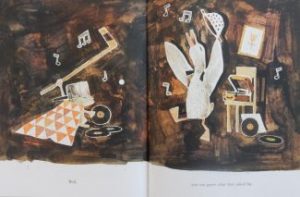
She invites her friends Pablo Tuba, Gary Gee-tar and Wassily over one afternoon and along with the house cat, they form a band; a band that fills the room with wonderfully uplifting rainbow colours: imagine the effect upon the caterpillar.
Suddenly from within the piano there comes a resounding ‘BOOM’ and when Ezra looks inside the piano, there’s no sign of its erstwhile resident.
An amazing transformation has occurred …

Irresistibly quirky, this funky tale will enchant readers of all ages especially those with a musical bent.

I’ve signed the charter  

Nothing Rhymes with Orange / Sam’s Hamburger

Nothing Rhymes with Orange
Adam Rex
Chronicle Books
I do love a book that encourages language play and Adam Rex’s crazy fruit-filled extravaganza does just that. His rhyming litany, interspersed with an orange’s lament at the lack of fun-filled opportunities afforded to one without a rhyme for itself is a hoot; and that long-suffering orange, with his constant interjections, is an absolute charmer.
Rex, not forgetting our citrus pal, introduces us to a plethora of fruits that can be made into rhymes,
And all the while, the solitary orange remains just that, until one empathetic apple takes pity on him and with a wonderful invented word, creates an opportunity to draw orange into the heart of the group.

Emotions run high throughout, where orange is concerned: I love the way the quirky collaged photographs show his changing feelings.
With a bit of Nietzsche thrown in for good measure …

a fruitful offering indeed,.

Sam’s Hamburger
David Pelham
Walker Books
If you want to illicit an audience response of ‘yucks’ and ‘eughs’ then this rhyming novelty will fit the bill. It relates how with her help, Sam’s brother, carries out a burger-shaped plan to unmask the thief who has been stealing his sister’s lunches.
The whole thing is absolutely bursting with creepy bugs and wriggly wigglies embedded within layers of onion, egg,

cheese, sauce and more, all sandwiched between a ‘nice big bun’.
Surely the consumer of that particular delicacy will be deterred from ever coming back for more …
Unless like me you’re a life-long veggie, I’d suggest sinking your gnashers into this tasty offering now back on the menu served by Walker Books.

Pirate Baby

Pirate Baby
Mary Hoffman and Ros Asquith
Otter-Barry Books

Yo ho ho! me hearties, there’s a brand new crew a’sailin’ on the high seas and we all love a good pirate yarn. This one though is altogether different and an absolute humdinger.
The crew of the Ramshackle are more than a little discombobulated when they discover a bawling baby bobbing about on a raft;

all the more so when they find out that the object they’re trying their level best to feed is actually a girl baby.

That’s only the start of their adventures however. The crew become the owners of a nanny-goat which they aptly name Nana; very useful when it comes to providing nourishment for the babe. Spoons the cook turns his hand to stitching nappies and other baby attire; and Red Bart the bosun even makes the infant a toy squid from a pair of old gloves.

None of your stereotypical pirates these.
As time passes and the babe, now named Isla, becomes mobile, the pirates, bothered by their lack of piratical action, resolve to plunder the next ship they spy. They think better of their plan though, when they discover the crew is all women.
Then an enormous sea monster looms up from the deep. The crew fear for their ship and their lives; and it’s Isla who saves the day with a truly selfless deed.
Thereafter, she’s recognised as “a true Pirate Baby” with a dazzling piratical future to look forward to.
No pirate crew is really complete without a parrot and a cat; these vital bit parts are admirably played here by McSquark and ship’s moggy, Plunderpuss.
Who better than Ros Asquith to bring out the humour of Mary Hoffman’s salty story? Awash with chucklesome details, her jaunty, swashbuckling scenes are set fair to create a splash with landlubbers young and not so young. A real treasure.

I’ve signed the charter  

What’s Next Door?

What’s Next Door?
Nicola O’Byrne
Nosy Crow

Carter the crocodile from Open Very Carefully appears to have got lost and landed up between the covers of a book, -this book – and he needs our help to get home. He’s not above issuing threats either, judging by the sign he’s clutching.

Much better to do as he (and the narrator) request; we certainly don’t want him getting cantankerous: those barbed teeth of his look pretty scary.
This will entail exercising drawing and thinking skills, and a bit of pushing and shoving, together with some deft manipulation of the book itself, as Carter requires -heaving, blow drying, having his tummy rubbed to warm him up and fanning to cool him off, before he finally arrives back home, safe and sound.
Nicola O’Byrne talks directly to the reader in her engaging, chatty style narrative but despite her best efforts and those of readers, the croc. ends up in some totally inappropriate places en route – a salty sea,

a chilly snowy landscape and a scorching desert .
Carter’s progress through the various doors and the die-cut pages of the book itself, are documented in the author’s superbly expressive scenes that show Carter’s reactions to all our efforts,

along with some animal friends he acquires during the course of his adventure.

Yoga Babies

Yoga Babies
Fearne Cotton and Sheena Dempsey
Andersen Press

Yoga with babies isn’t about getting into poses properly; rather it’s about having fun and starting out on what could, one hopes (says the yoga teacher in me) become a lifelong practice that has enormous benefits for both health and wellbeing.
Yoga is part and parcel of the everyday lives of the babies herein, and it looks as though they all enjoy giving it a go.

We see Maya making a bridge, which her brother then pushes his car under, a down dog,

child’s pose herein called ‘dormouse’ pose, watch Sophie’s mum eagerly unrolling the mats after a trying day; and Prakash and his granny having a wonderful stretch – all indoors.

But of course, it’s great to practice yoga outdoors too. There are sure to be lots of opportunities even if you don’t have your yoga mat with you …

And where better to try being a tree than in the back garden, which is just the place for some cat stretches too.

Invitingly written by TV presenter and mum to two young children, Fearne Cotton, and delightfully illustrated by Sheena Dempsey whose scenes of adorable yoga babies are full of fun, this little book really does show that yoga is for everyone.

I’ve signed the charter 

Chocolate Cake

Chocolate Cake
Michael Rosen and Kevin Waldron
Puffin Books

I can’t possibly imagine how many times I shared Michael Rosen’s Chocolate Cake poem from Quick Let’s Get Out of Here during my time as a primary teacher; it was certainly the most requested poem with countless classes and always an ideal offering to have at the ready when working in an advisory capacity. So to learn it was to be published in picture book format with Kevin Waldron supplying the illustrations was very exciting.
The poem itself is sheer genius telling of a little boy who just cannot get out of his mind the scrumptious chocolate cake he’s sampled earlier in the day and, knowing that there’s a considerable chunk still downstairs, cannot resist its temptation.
He creeps out of bed (ensuring he misses the creaky floorboard outside his parents’ bedroom) and downstairs into the kitchen. There, in the cupboard, is the object of his desire …

Out it comes and he notices there just happen to be some crumbs, and that the cake itself needs a spot of tidying up …

until things get just a tad out of control …

Such are the agonising details  used to relate the whole experience, that we’re right in that child’s head as he’s overwhelmed by desire, and we’re desperately wanting him not to get caught – which of course he does, although not until the following morning.
Oh dear, the embarrassment, the humiliation …

Kevin Waldron brilliantly captures all the subterfuge, the suspense and the final priceless denouement in his deliciously funny scenes, every one of which will leave you spluttering with delight.
If the whole thing doesn’t get your taste buds all a-tingling, then nothing will.

All About Cats

All About Cats
Monika Filipina
Child’s Play

Oh my goodness! There was I under the misapprehension that domestic cats spend the vast majority of their days sleeping: how wrong could one be?
The feline narrator of this book confides in readers, offering an altogether different picture, with a whole host of activities being on the agenda once those humans are out of the way and the cats left entirely to their own devices.
And there’s a variety of adorable moggies to participate in this show and tell.
Naturally after a fair bit of physical exercise, the odd snooze is perfectly in order but there’s too much to do to let any curl-up time last long. Very high on the agenda is cooking when it’s a case of all paws on deck …

Snack over, a spot of knitting maybe? Or even better some reading time – a perfect curl-up opportunity methinks; or what about a swim in the bathtub?
Better still engage in something co-operative such as forming a band or being creative …

Seemingly there are no holds barred just so long as all participants are safely back innocently curled up in that chair by the time any humans return; then they’ll never know. I wonder … Observant readers and listeners certainly will if the mess is anything to go by.
Now I’m far from being a cat lover but these creative creatures are just SO appealing and full of mischief that I was totally under their spell by the time I reached this …

Superbly illustrated, funny and such a wonderful invitation to youngsters to get out their pastels or paints and get creating.

My Museum / Crocodali

My Museum
Joanne Liu
Prestel
Here’s a thoroughly cool little wordless book by Joanne Liu, an illustrator/artist I’ve not come across before.
Max pays a visit to an art museum. It’s full of paintings and sculptures, each one an important work of art. Where better to go for a bit of art appreciation?
Max however, wonderfully divergent and imaginative child that he is, quickly discovers that there’s a whole lot more to see and enjoy than what the curators have put on display.
Art is everywhere, if you know how to look; and if you know how to look, you can also be a creative artist. That’s the message that shines through in each and every action of our young protagonist as he wanders among the grown-ups who are absorbed in the various exhibits, discovering art through the windows, on a burly man’s arm,

by changing his viewpoint, and by seeing the potential in other unlikely places …

He even explores ways of making his own …

A delight through and through.

Crocodali
Lucy Volpin
Templar Publishing
There’s a touch of Hervé Tullet in Lucy Volpin’s latest story. It stars Crocodali, who greets us, more than a little reluctantly, as we enter his studio.
The self-confessed ‘most talented artist in the whole wide world’ is about to start on a new painting but is having a little bother getting his canvas positioned. That’s when he decides to enlist the reader’s help.
Before you can say ‘masterpiece’ he has us tilting, tipping, shaking …

and rubbing and even blowing on the book,

as we become co-creators of his latest work of art. It’s bound to be stupendous; or is it?
Engaging, interactive, humorous and delightfully messy.

It’s Time for Bed

A Bear Hug at Bedtime
Jana Novotny Hunter and Kay Widdowson
Child’s Play
Imaginative play rules in this enchanting pre-bedtime romp: snuggle up and prepare for a bedtime hug or two.
A small child meets a variety of animals, large and small as bedtime approaches or does she? Look again and we see that in fact something entirely different is happening as she imagines various members of her family as animals: Gran morphs into a stripy tiger, Mum becomes a monkey,

her little brothers a lizard and a lobster. And Dad? He’s a huge hairy bear just waiting to leap out and engulf his daughter with a wonderfully warm, goodnight hug. Gorgeous!
Beautifully told, wonderfully illustrated and SO full of heart, it’s perfect for bedtime sharing.

Babies Can Sleep Anywhere
Lisa Wheeler and Carolina Búzio
Abrams Appleseed
There’s a distinct retro look and pleasing pattern to this languorous rhyming look at sleeping places. ‘Bats take a nap in a cave upside down. / Hay is a bed for a mare. // Wolves cuddle up in a den ‘neath the ground./ But babies can sleep anywhere.’
This three animals followed by one human infant pattern is used throughout the book until the final spread. This shows an array of sleeping human babes all looking totally blissful.

It’s good to see a mix of well-known and less familiar animals included, as well as the variety of human families on the final pages. Carolina Búzio’s bold colour palette is gorgeous.

I See the Moon
illustrated by Rosalind Beardshaw
Nosy Crow
For this delightful bedtime sharing book, Rosalind Beardshaw has illustrated sixteen popular rhymes, lullabies and poems (mostly anonymous but with poems by J.M.Westrup, Thomas Hood and Robert Louis Stevenson).
Populating her moonlit world with adorable children, foxes, squirrels, mice and other small creatures set in scenes generously embellished with silver and gold,

Beardshaw makes each spread sparkles with colour, light and nocturnal enchantment.

Preschool Menagerie

Animosaics: Can You Find Me?
Surya Sajnani
Words & Pictures
This lovely, large format search-and-find counting book will keep youngsters engaged for ages while they look for the animals illustrated on the right-hand pages that are also hidden within the full-page mosaic style habitat opposite; habitats such as the garden, the pond, on the farm, in the jungle or in the ocean.

In addition this is a counting book wherein you are invited to spot other creatures, for example, 1 butterfly in the garden, 2 tadpoles in the pond, 3 hens on the farm and so on, culminating in 10 fireflies in the nocturnal sky mosaic.
What makes this large format book stand out is Surya Sajnani’s bold, graphic art style, which is immediately striking, and also her cubist-constructed creatures set within the habitat appropriate coloured tesserae.

How Do You Sleep?
Olivia Cosneau and Bernard Duisit
What Are You Wearing Today?
Janik Coat and Bernard Duisit
Thames & Hudson
Here are two new additions to the playful, interactive Flip-Flap-Pop-Up series of board books with Duisit acting as paper engineer for both titles.
In the first readers can by manipulating the tabs, discover the sleeping places/positions of seven different animal species from various parts of the world.

In the second book children will enjoy changing the animals’ dress depending on their location, the weather conditions; or on occasion, the mood of the featured animal. This one has both tabs and flaps to help develop manipulative skills.
I’m sure Rita Rhino’s skirt being lifted by the wind …

will be a favourite with youngsters.

Dress Up Jojo
Xavier Deneux
Twirl
Jojo rabbit is back and he’s in playful mood. He dresses up in eight different ways: as a snowman, a spotty leopard, a sword-wielding knight, a cowboy, an alien, an astronaut bound for the moon, a deep sea diver and finally a pilot.
Toddlers can develop their fine motor skills by covering the little creature with snow, helping him balance on a tree branch, swish his sword, open the gates for him to find his horse, roll his eyes like an alien,

spin around in space, dive down deep in the ocean and resurface, and fly away on an adventure; all by placing a finger on the red dots and using their fingers to activate Jojo in his let’s pretend activities.

Zoo
Lisa Jones and Edward Underwood
Nosy Crow
In the second ‘Tiny Little Story’ Baby Boo and Daddy are off to the zoo on the bus. Once there, they meet giraffe, elephant, lion,

monkey, snake and the penguins and then it’s time to leave.
Short and sweet.
With attractive, brightly coloured, strikingly patterned illustrations and a brief text with some animal sounds to enjoy, soft, squashy cloth pages, and a velcro strap for attaching it to a buggy, it’s a perfect introduction to books for the very youngest; and, it’s washable.

It’s Time For School

               Here’s a handful of picture books, each with a school setting, albeit a somewhat unlikely one in the first three.

First Day at Skeleton School
Sam Lloyd
Bloomsbury Children’s Books
Following on from First Day at Bug School, Sam Lloyd moves deep into the dark forest for her new school-based offering. (Some of my listeners recognised the illustrative style having spotted it on my table and eagerly pounced on the book demanding an immediate reading.)
Skeleton School doesn’t restrict its intake to skeletons though; all manner of creepy pupils are to be found here in this night-time educational establishment run by one, Mr Bones who stands ready and waiting to welcome newcomers (and readers).
I’m happy to see that there’s a school library, albeit a haunted one; but at least one of the pupils needs to learn some appropriate behaviour – maybe she just hasn’t learned to read yet.
The curriculum includes a jingle jangle dance class with the skeletons, how to float through walls, ghost style and spell making, which has some surprising outcomes, not least for Mr Bones.

Sam Lloyd gives full rein to her imagination and in addition to the zany storyline delivered in her rhyming text, provides a visual extravaganza for young listeners to explore and chuckle over.
The endpapers cutaway spread of the school interior will definitely illicit lots of giggles not least over the toilet humour.


More crazy happenings in:

School for Little Monsters
Michelle Robinson and Sarah Horne
Scholastic
Side by side stand two schools, one for monsters, the other for ‘nice boys and girls’. The question is which one is which? And if it’s your first day, how do you know you’re in the right school, especially when some little monsters have been up to a spot of mischief making?
No matter which door you enter, there are some rules to abide by – fourteen in all;

and the whole day is assuredly, a steep learning curve for both human and monster newcomers; and has more than a sprinkling of the kind of gently subversive humour (bums, poo, trumps and bottoms) that young children relish.
Riotous scenes from Sarah Horne showing the pupils’ interpretations of Michelle Robinson’s rhyming rules in this read aloud romp.

Old friends return in:

Cat Learns to Listen at Moonlight School
Simon Puttock and Ali Pye
Nosy Crow
Cat, Bat, Owl and Mouse are not newcomers to Miss Moon’s Moonlight School; they already know about the importance of sharing; but listening? Certainly Cat still has a lot to learn where this vital skill is concerned.
On this particular night Miss Moon is taking her class on a nature walk to look for ‘interesting things’. She issues instructions for the pupils to walk in twos and to stay together. “Nobody must wander off,” she warns.
Before long, it becomes apparent that Cat has done just that. She’s spied a firefly and follows it until it settles far from the others, on a flower.

Suddenly though her delight gives way to panic: where are her classmates and teacher?
All ends happily with Cat’s friends using their observation skills until they’ve tracked her down; and the importance of listening having been impressed upon Cat once again, they return to school with their findings.
Ali Pye’s digital illustrations are full of shadows brightened by the moon and stars and Miss Moon’s lantern, illuminating for listeners and readers, the delightful details of the natural world on every spread.
Puttock and Pye seem to have a winning formula here: my young listeners immediately recognised the characters and responded enthusiastically to the sweet story.

Now back to reality:

Going to School
Rose Blake
Frances Lincoln Children’s Books
The pupil here is a girl, Rose, who shares with readers a very busy day spent with friends in their primary school class. There’s certainly a lot to pack in for our narrator, her classmates and their teacher, Miss Balmer: geography, art, English, maths, PE, science, computing and drama.
Fortunately though, it appears to be an active curriculum …

and Miss Balmer reads a story to the children in the “Book Nook’. Hurray!
Seemingly all of the children have firm ideas about their future paths and what they want to become. This is reflected in their choice of activities at work and play: visual clues as to what these are occur throughout the book.
Rose Blakes’s digitally worked spreads are full of visual narratives offering much to interest and discuss, and though this certainly isn’t a first ever day at school book, she certainly makes school look an exciting place to be.

I’ve signed the charter  

The Wild Fluffalump

The Wild Fluffalump
Mwenye Hadithi and Adrienne Kennaway
Troika Books

Here’s a lovely rhyming story penned by Bruce Hobson, the well known author, who writes under the name Mwenye Hadithi;
Set on the African plains, it’s a fun read aloud but with a serious intent: Hudson commissioned the book in aid of TUSK (a charity dedicated to protecting wild animals in Africa) with the aim that young children ‘should learn to feel protective towards rhinos and elepahnts’ as well as the more cuddly kinds of wild animals.
When a baby creature goes to sleep beneath a tall Cotton Wool tree, where Leopard’s child has been leaping and bouncing all night, little does it know it’s in for a big surprise the next morning.
When it wakes, it’s as a giant fluffy white ball and doesn’t recognise itself at all.
First on the scene are the Meerkats and they decide it’s a wild Fluffalump.
Other plains creatures come along one by one: Eagle, Buffalo, Lion, Hyena, Vulture, Bush Baby, Rhino, Giraffe and even Leopard’s child …

and with their poking, prodding, pushing and shaking, endeavour to identify the creature.
Down comes the rain, washing off some of its fluff as it heads to the waterhole for a drink. Crocodile cannot resist taking a bite of its bottom causing the thing to emit a loud trumpeting sound.

Recognising the cry, along comes mother Elephant.
She picks up Fluffalump, takes him to the lake, washes off all the fluff and restores the creature to his former self.

He then realises that he is in fact ‘Elephant’s Child.’
Adrienne Kennaway’s paintings of the iconic animals of the savannah are full of humour and suffused with glowing African sunlight. The prodding and poking inflicted upon the Fluffalump gradually expose bits of his disguise so that observant readers may guess the identity of the mystery creature before his mother does.
Great fun and a cause well worth supporting.

I Really Want the Cake

I Really Want the Cake
Simon Philip and Lucia Gaggiotti
Templar Publishing

Now here’s a lip-smacker of a book guaranteed to make your salivary glands go into over-drive.
Who can resist that wonderful aroma of a fresh from the oven chocolate cake?
The little girl narrator of this story really has my sympathies when she follows the delicious smell emanating from the kitchen and discovers a totally yummy-looking confection just sitting there waiting to be tasted.

The trouble is though, her mum has left a warning note ‘YOU MUST NOT EAT THIS CAKE’. There’s no ambiguity about that, so the whole deliciously tempting chocolate cake must quite simply be forgotten.
Easier said than done though and the temptation proves too much for the young miss who, after holding back for a while, then finds herself drawn by an irresistible longing, back to object of her desire. What else could she do but sample the thing?
But then, the lick gives way to a bite, which turns into a slice and …

Oops! No cake!
Still a replacement shouldn’t be much of a challenge, surely?

Simon Philip’s tasty rhythmic, rhyming tale slips so smoothly from the tongue making it a great read aloud. Combined with Lucia Gaggiotti’s high energy, laugh-out-loud illustrations of chocolate cake and calamity, the whole thing becomes a scrumptious treat to serve up to young listeners. (I love the way the narrator takes on a variety of personas as she grapples with her conscience.)
If my experience is anything to go by extra servings will be immediately demanded.
There’s even a recipe for chocolate cake on the final page – mmmm!

I’ve signed the charter  

Salty Dogs

Salty Dogs
Matty Long
Oxford University

Matty Long packed plenty into his Magic Forest picture books; now he turns his creative attention to pirates and once again the result is full of fun and frenzy.
Let’s meet the Salty Dogs: there’s Captain Fifi, super strong first mate, Barker, Mylo, the crew’s official watchdog, the rather excitable Sherman; Stewart the swordsdog extraordinaire – so he claims; Pug, the questionable cook and last but not least, Horatio Pawsworth 111, head of grooming. They however are not the only crew to be sailing the high seas in search of treasure; there are also The Green Shell Gang, The Crazy Horn Crew, The Feathered Furies and The Sea Monkeys – all forces to be reckoned with.
As the Salty Dogs sail towards Crossbone Island to unearth their long-buried treasure, they manage to get the better of the first three of their enemies; but then, they find themselves facing the mighty galleon the Scoundrel and its crew the dreaded Sea Monkeys.

It seems as though those Salty Dogs are in for some BIG trouble when the Scoundrel’s captain gives the order to fire the cannons.
Then it’s a case of sink or swim – doggy paddle style – as fast as they can to claim what is rightfully theirs.

But what exactly is this treasure that both crews are ready to go head to head over?
This crazy tale is absolutely brimming over with suitably daft details, speech bubbles and piratical humour. Readers will want to linger over every spread relishing the irresistible buccaneering bounties.

I’ve signed the charter  

Playful Pets: Buster and the Baby / Big Box Little Box

Buster and the Baby
Amy Hest and Polly Dunbar
Walker Books
A very boisterous toddler and a lively little dog star in this rumbustious romp of a picture book.
The dog’s called Buster and the infant – a female – is just called baby. Both are charmers and live with baby’s parents in a little red house.
There’s nothing Buster enjoys more than a game of hide-and-seek with the infant,

a pretty hazardous activity when it comes to finding suitable hiding places, from baby’s parents viewpoint, that is.
As for Buster, his heart goes THUMP, THUMP, THUMP, THUMP! as he waits and watches for baby to come …

CHAAA! out of the shadows like a small thunderbolt right at him with joyful exuberance.
The two of them cavort through the house and garden, and the book, all day until finally, it’s baby’s bedtime. Now it’s her turn to hide and wait …

Engaging textual repetition and exuberant, warm-hearted illustrations make this a lovely one to share with toddlers at any time of day.
A delight through and through.

Big Box Little Box
Caryl Hart and Edward Underwood
Bloomsbury Children’s Books
Experience has shown me that young children love to play in and with boxes but cats? Seemingly they too enjoy boxes; though I suppose I should have known, thanks to Eve Sutton & Lynley Dodd’s My Cat Likes to Hide in Boxes.
Certainly it’s the case in this book wherein the moggy character is a real box aficionado exploring the plethora of boxes to be found in his home, be they large, small, fat, thin, flat even. And they come in so many different colours …

and with attractive designs.
Taking things almost literally results in some interesting uses where this feline is concerned …

Now though he’s found a box that something has been having a nibble at; I wonder what that might be.
‘Cat peeks.’ Something squeaks …
Could this be the start of a beautiful new (although rather unlikely) friendship? …

Caryl Hart’s minimal text provides designer Edward Underwood a playful scenario with which to co-create his debut picture book. He does so with panache.

I’ve signed the charter  

Hic! / An Indian Beach by Day and Night

Hic!
Anushka Ravishankar and Christiane Pieper
Tara Books
I’m a big fan of Tara Books for many reasons; two of the most important being first: they’re unfailingly innovative and the production quality is always exemplary; second: their base is Chennai, and I’m a total India freak.
Specialising in writing nonsense for children, the author of this picture book has been dubbed the Indian Dr Seuss and nonsense Hic! truly is.
Revolving around a little girl who is suddenly struck by a bout of hiccups – we all know how annoying they can be – she has concocted a totally crazy rhyme about ways she might, or might not, get rid of them.
Suggestions include the fairly un-risky daubing of mustard on your nose and trying to lick it; and shouting AWALLAGULLAGABUGGAMUGGCHICK!
Thereafter proceeding to vomit-inducing spinning round and round …

and standing on your head – a definite no-no for one so young, thinks the yoga teacher in me – to my favourite, potentially suicidal idea …

German illustrator Christiane Pieper supplies the hilarious visuals making the whole thing so much more than the sum of its parts; I love her restricted colour palette.
Another innovative offering from the same publisher is:

An Indian Beach By Day and Night
Joëlle Jolivet
Tara Books
In her wordless offering, based on her observations, artist Joëlle Jolivet takes us through twenty four hours on Elliot’s Beach, a location near the southern Indian city of Chennai.
Her linocut scenes, printed on a long, continuous strip that’s been carefully folded to fit inside a sturdy cover-cum wallet, can be viewed in folded form or opened right out to form a complete circle. (The back pocket flap shows the various ways the book can be opened to display the scenes.)
As day dawns on the first spread we see fishing boats on the shore while in the foreground, people are taking exercise, commuters travel in a cycle rickshaw while behind them on the sand animals feast on the discarded spoils of the fishermen.
Turn over and this is the scene …

As the day proceeds and the sun reaches its height, the crowds disperse, to return as daylight fades and evening comes. Darkness brings a temporary lull in activity until everything starts over the following dawn.
Printed only in black and white with a blue sea backdrop, this is a wonderful visual resource with a bounty of starting points for discussion and storying that can be enjoyed as it is, or coloured in.

Mr Left & Mr Right

Mr Left & Mr Right
Daniel Fehr and Celeste Aires
Templar Publishing

Now here’s a book that makes ingenious use of flaps and the central gutter.
It stars Mr Left who lives on the left page and Mr Right who lives on the right page.

Thus far, the neighbours have never met but now they want to and therein lies the problem. There doesn’t seem to be a way to cross that central divide, no matter what they try.
Jumping across is a resounding flop …

as is climbing right over.
Digging under is an absolute disaster …

so seemingly, loneliness will continue to rule.
Unless that is, one of the characters can come up with a brainwave – some divergent thinking maybe.
Celeste Aires cleverly exploits the basic shape and form of the book and its pages using simple shapes and a restricted colour palette of matt red, blues, yellow, white and black to create a wholly satisfying treat that works in perfect harmony with Daniel Fehr’s cleverly conceived text.
I suspect this will appeal across a wide age range and has much to offer anyone studying picture book form be it in primary school or college.

I’ve signed the charter 

A New Day / Robin and the White Rabbit

Here are two recently published books from Jessica Kingsley Publishers that will be of particular interest to those working with children or young adults who have additional needs:

A New Day
Fiona McDonald
Jessica Kingsley Publishers
Talking about losing a loved one can be difficult: this little book offers a good starting point for opening up a discussion for young children and those with PMLD.
Following the death of Grey Mouse, Brown Mouse feels so sad she stays in bed. The other mice try to help, bringing tea and cake, a story …

and a comforting blanket but Brown Mouse says no to them all: she just wants to sleep – all day. Come evening though, she wakes up and joins the other mice in the kitchen.
There they all share their memories of their beloved Grey Mouse and thereafter, things begin to look just a little brighter.
Simply told and illustrated with line drawings, this could be a useful resource for adults looking for something to use with those needing help in coming to terms with the loss of a loved one.

Robin and the White Rabbit
Emma Lindström and Åse Brunnström
Jessica Kingsley Publishers
Children with autism have powerful feelings but often can’t find a way to express how they feel. Now here’s a book that offers those who work with ASD youngsters a means of helping them.
Many of those who work with ASD children will be familiar with the use of pictorial symbols to facilitate communication but this picture book deals specifically with helping youngsters understand and express their feelings.
The story centres on young Robin, who acts as narrator, and a white rabbit. It’s playtime and Robin sits alone in the playground under a tree. Her head is buzzing with feelings but she has no way to express them. Her sadness is palpable.

Enter a white rabbit who sees the child, disappears and returns with a blue bag full of picture cards.
Using these, the animal offers the girl or boy (it matters not) a way to access her feelings: a means of self-discovery through visual communication via the pictures on the cards:

a way that ultimately allows the narrator to begin to feel part of the group.
Emma Lindström and Åse Brunnström offer a very useful and empowering tool that can be used in school or at home; there’s no judgement involved; and the final explanatory pages speak directly to the listener (via Robin) and the reader aloud (via the book’s creators, Emma and Åse).

The Hat that Zack Loves

The Hat that Zack Loves
Michelle Robinson and Robert Reader
Puffin Books

There’s a satisfying circularity about Michelle Robinson’s new spin on the traditional The House that Jack Built.
It features Zack who buys the hat, a dog that snatches same and leads Zack in a merry dance down onto the subway; then into the park precipitating a frenetic concatenation of events wherein a host of other characters get involved.
There’s a cat, the wind, a grey goose and a policeman on horseback.
The whole chase is exhaustingly riotous, not least for Zack who falls from a tree;

then leaps into a boat in pursuit of his titfa.

But suddenly the wind takes over whisking it from the goose’s head, out of the park and up atop a statue, atop a column.

Will Zack ever get that elusive hat back? Or the whole thing just a wild goose chase?
Thanks to some nifty teamwork and precarious balancing, the hat is finally retrieved and then it’s hats all round.
This is a fun read aloud that, with its repeat refrain, ‘the hat that Zack loves’, cries out for audience participation.
Robert Reader debuts as a picture book artist with this rhythmic tale, gracing each spread with retro style scenes, every one of which has deliciously droll happenings that make you want to slow the pace and revel in the details.

I’ve signed the charter  

Say Zoop!

Say Zoop!
Hervé Tullet
Chronicle Books

Before you’ve finished reading this latest offering from the inimitable Tullet you and your listeners will have said a whole lot more than ‘Zoop’ and had an absolutely brilliant time to boot. Herein the artist takes pointillism and imbues it with his puckish genius.
It begins with a simple blue dot and an invitation to say ‘OH!’ A bigger dot appears demanding an appropriately ‘HUGE OH!’ and so on … Whoppee! We’re starting to make music – soft soft loud soft soft loud and so on; but that’s not all – how about a crescendo or the reverse …
We can also do a spot of dot counting or try some beats in dots and … wait for it, dive in dot sounds, rising up and … down;

then swim dot style, shiver and even cry.
Enter red dot – say ‘AH!’ And off we go again – double the possibilities: a dot dialogue or better still a robot dot dialogue – amazing! Then a spot of tickle induced laughter, dot style of course; or maybe a song and even a walk.
Oh no! Now there’s a very noisy argument … Phew! They’ve made up.
Oh my goodness, now there’s a sunny looking yellow dot WAAHOO! And off we go again, trampolining, zooming car style or singing like birds …

A whole new language perhaps?

Superbly creative: this absolutely cries out for performance over and over – first vocal, then perhaps with paint and after that, what about both together: WAAHOOAHTCHONKOHPLUCKZIKZOOPWHISHHH!! What are you waiting for?
The possibilities are endless and no reading will be the same as any other.
Zooper-dooper fun!

I’ve signed the charter  

Izzy Gizmo

Izzy Gizmo
Pip Jones and Sara Ogilvie
Simon & Schuster

Izzy Gizmo is full of go and seldom without her large bag of tools, after all one never knows when there might be an opportunity for mending, tweaking or inventing. She makes some pretty marvellous machines but the trouble is there do seem to be a fair few glitches along the way and often at the most inopportune moments.
It’s then that Izzy’s temper gets the better of her and she wants to give up.
Grandpa however, has other ideas: “Now, trust me, young lady. Sometimes you need to try again and again if you want to succeed,” he tells her.
After one such paddy, Izzy storms outside and all of a sudden a crow crash lands right in her path breaking his wings beyond repair.

Now the feisty young miss has a new challenge. First she tries to rehabilitate the crow but all the creature wants is to be able to soar with his feathered friends again. Despondent, she’s near to giving up but again Grandpa steps in with some timely moral support and that bag of gadgety things of Izzy’s.
Then it’s operation ‘new wings’ as books are consulted, components collected …

and assembled ready for the launch; but it’s a case of the best laid plans …
Can Izzy, not to mention her injured friend finally rise to the occasion or is the creature destined to stay forever grounded ?
Let’s put it like this: ‘where there’s a will, there has to be a way’

no matter the consequences …
I doubt many will fail to fall for Izzy and her mechanical mind.
Pip Jones’ rhyming narrative is a cracker to read aloud and Sara Ogilvie’s imagination must be almost as fertile as young Izzy’s. Her intricately detailed scenes of mechanical mayhem are simply magnificent.
A real riot.

I’ve signed the charter  

Boo Who?

Boo Who?
Ben Clanton
Walker Books

The pals from Ben Clanton’s Rex Wrecks It! – dinosaur Rex, robot, Gizmo, Sprinkles the unicorn-rabbit, and furry monster, Wild return; but there’s a new kid on the block and he wants to play.

The others are accommodating and try their level best to include him in their games; but for a ghostly apparition, bounce-ball is a non starter (the ball bounces right through him); ditto ‘pick-up twigs’ (Boo has no hands); and his would-be friends can’t feel a thing when Boo tags them.

Enough is enough: the four run off to play another game leaving Boo all alone and sad – ‘Boo-hoo’. Would anyone even care if he just disappeared, Boo wonders.
Meanwhile a game of hide-and-seek has started. Now that’s surely THE perfect game for a little ghost.

Three cheers for the established group and their patience and perseverance. It pays off in the end: and what a great example to young audiences, especially those just starting nursery or school.
Clanton’s artfully drawn characters portray the sensitive and empathetic way the friends treat the newcomer. Their changes of expression speak volumes about their feelings, as do those of Boo and his uncertainty about being accepted by the others, about fitting in and discovering his own strength.
Share and discuss with early years listeners.

I’ve signed the charter