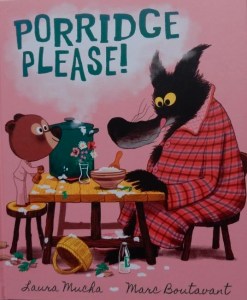
Is It Asleep?

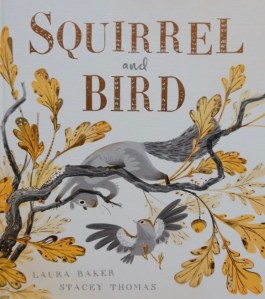
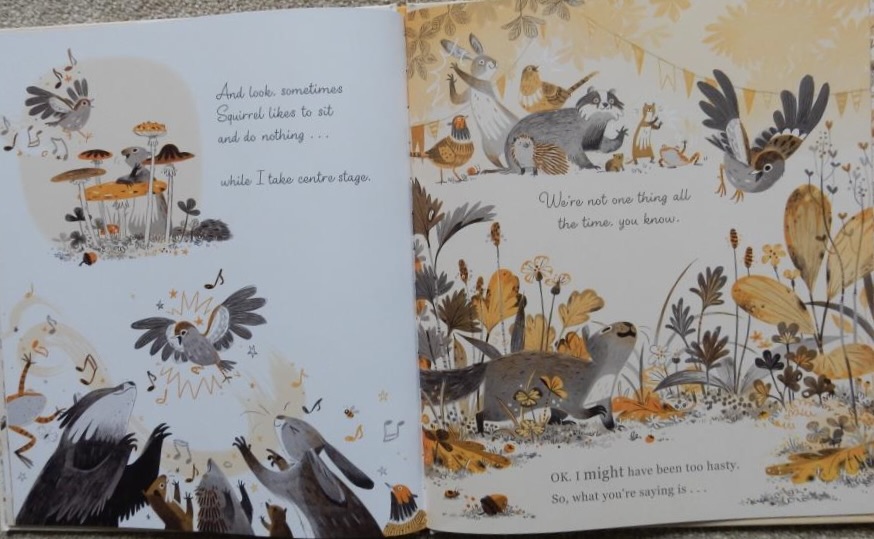
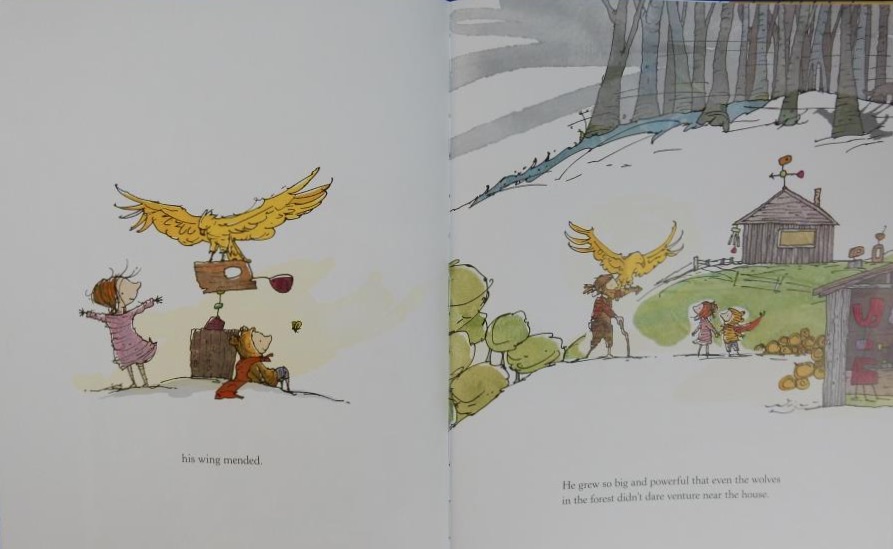
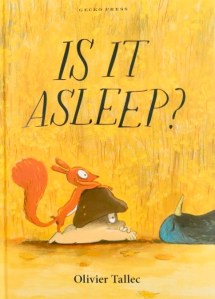
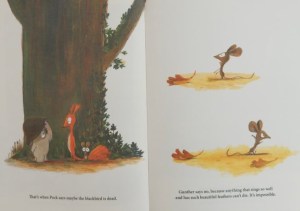
If you’ve read Tallec’s A Better Best Friend, you will already be familiar with best friends Squirrel (the narrator) and talking mushroom Pock. One of the things they love to do is to sit and watch the birds flashing past but on this particular day. having grown tired of so doing, they’ve moved on to the meadow to listen to their favourite bird, the blackbird. However, after searching carefully, eventually they spot it lying motionless on the path; perhaps it’s deeply asleep. After waiting quietly for some time for it to wake up. they decide to try being noisy but this has no effect so they fetch Gunther the mouse. Gunther’s idea of launching the bird into the sky doesn’t work and that’s when Pock suggests that perhaps it’s dead.

After another long wait they all decide that indeed the blackbird has in fact, died.
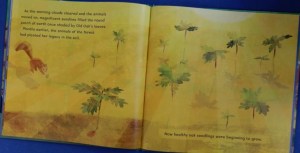
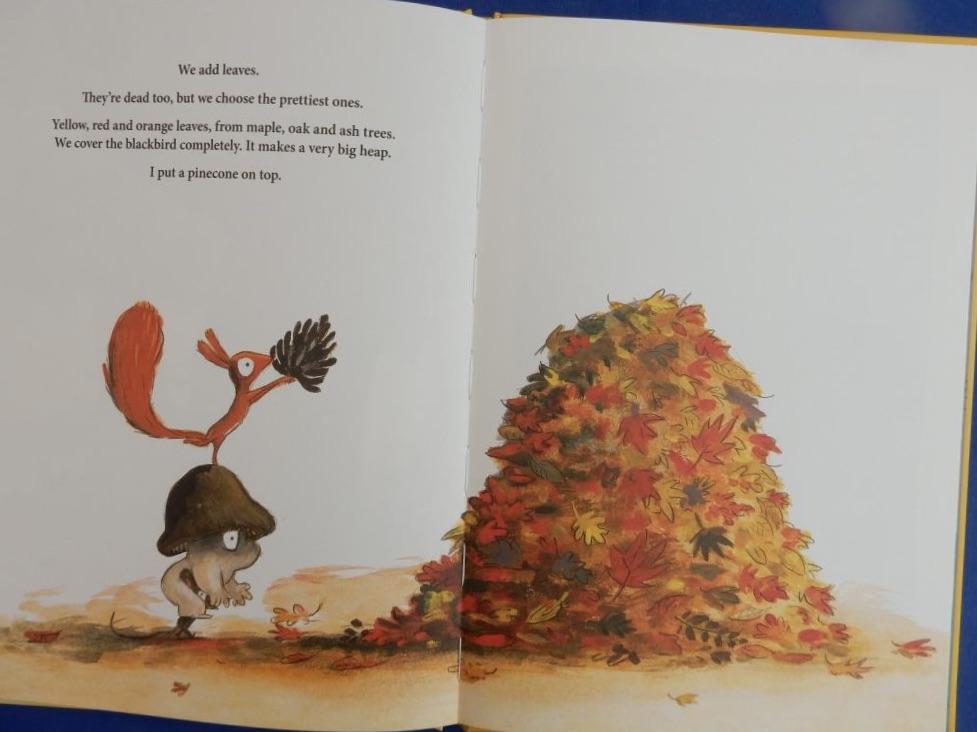
Working together the three bury it under a large pile of the prettiest leaves they can find

and once this is complete Gunther reads a poem, after which they stand and Squirrel thinks about the beautiful songs the blackbird sang. Having thought about ways to remember the bird, they pay it tribute in the very best way possible and finally a different bird pours forth its beautiful song.

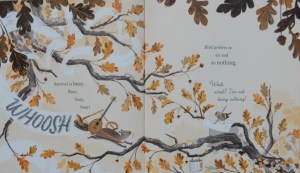
A poignant story that explores death simply and frankly and in so doing, offers possible starting points for adults in school or at home to discuss with young children what can be a very difficult topic. That the book’s creator has given the story an autumnal setting is especially appropriate: the warm red and gold hues of the scenes subtly convey sadness and the sense of an ending.

I Am So Strong

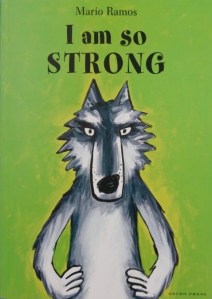
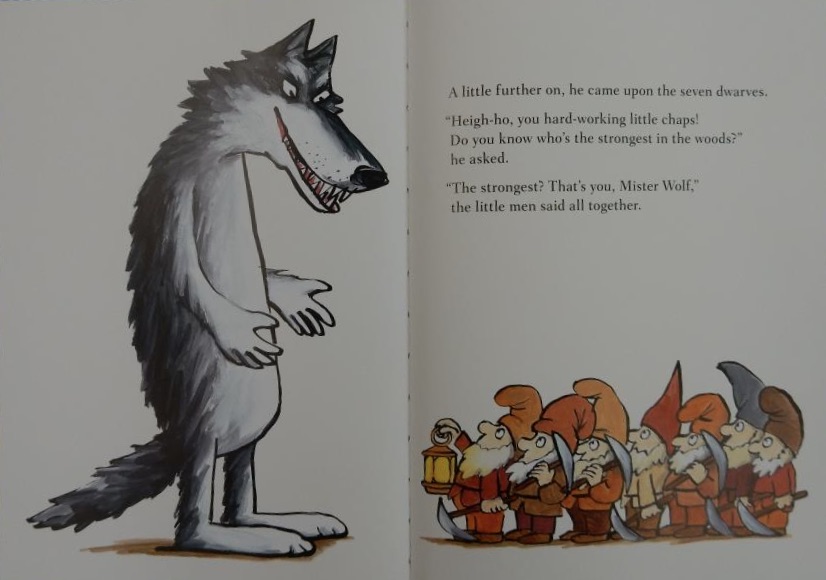
Self-opinionated and a bully, wolf decides to go for a walk in the woods and while so doing find out what others think of him. His first encounter is with a tiny rabbit. In response to wolf’s question, “Tell me, who do you think is the strongest around here?” the rabbit answers that it’s certainly Mister Wolf. This boosts the lupine’s ego (not that it needs any boosting) and he continues on this way. Little Red Riding Hood, the three little pigs and the seven dwarves respond in similar fashion.

Wolf decides it’s his best ever day but then he meets ‘a little toad of some sort.’ Could wolf be about to get his comeuppance at last?

At each encounter it appears that the wolf is thinking of something else in addition to polishing his ego: he addresses the little rabbit as ‘sugar bun’, Red Riding Hood is told she looks sweet enough to eat and called my little strawberry and the three little pigs are ‘little bacon bits’: is he creating a mental menu?

A thoroughly nasty bully finding someone who stands up to them calmly is a really satisfying occurrence, be the bullying physical, verbal or psychological and in this instance the little toad’ s use of calm reasoning completely surprises the wolf, pulling the rug from under his feet.

With Ramos’ s bold bright illustrations, repetitive textual pattern and almost exclusively conversational style narrative, this is a great book for dramatic reading aloud. (Imagine yourself with wolf’s super-scary teeth as you share it) I wonder what that little red bird watching the action from the safety of a tree branch is thinking: why not try asking your listeners.
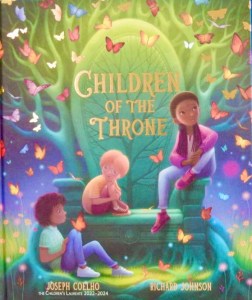
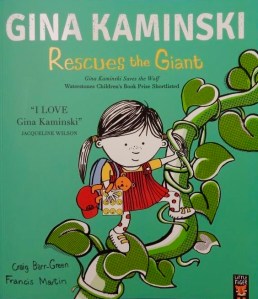
Gina Kaminski Rescues the Giant

Gina Kaminski, the book’s narrator, is a wonderful character and she’s back sorting out the errors in another fairy tale.

She and her classmates are on a school trip to a large art gallery, one Gina deems is rubbish as it’s too big, too brightly lit and lacks an obvious place for her to eat her lunch. On the first spread readers will notice she’s carrying a card with emojis and is accompanied by her helper, Anya. Realising Gina is stressed Anya takes her to the reading room, and selects two books asking the girl to choose but this is also stressful and so Anya decides on Jack and the Beanstalk.

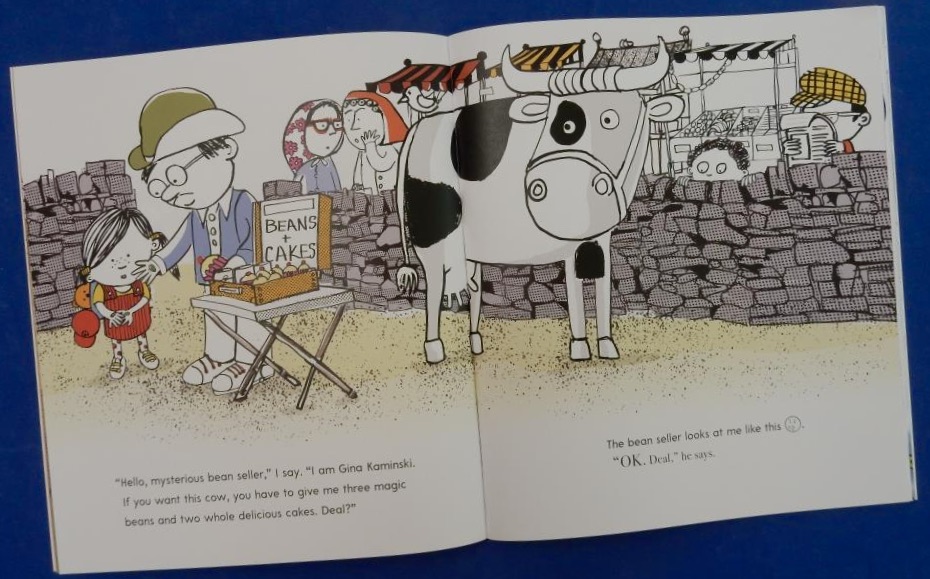
Straightaway, Gina’s analytical mind gets working and she points out that the book has ‘three massive mistakes’. She picks up her teddy, Lady Wiggles, puts it in her backpack and off they set to fairy land to sort out the mistakes. First comes getting a better deal in exchange for the cow: Gina negotiates two cakes in addition to the three magic beans.

Second, why actually plant the beans – that will put paid to any beanstalk. However, as she sits eating her cake a beanstalk grows, seemingly by itself.

Gina gets going on plan B: she warns the giant, confronts the villagers making them drop his harp and most special hen, deals with the beanstalk and bids farewell to the giant. 

She then returns to the Reading Room – job done, Gina informs Anya. Meanwhile Anya has found a map of the gallery which they use to find the place to have their lunch before taking Gina to an exhibit of everyday giant items that meet with her approval as well as causing her to reconsider her initial judgement of the school trip.

Practical, inventive and a hugely engaging hero – that’s Gina Kaminski; she’s also neurodivergent and looks at things in her own way as readers who have read her previous story will know, and others will likely have worked out.

Craig Barr-Green has carefully chosen his words for Gina so as to present her as someone who feels safer in an orderly, rational environment. Illustrator, Frances Martin’s illustrations ensure that in the busy opening scene, we readers share Gina’s unease, which continues until she gets to the reading room, then gradually become more relaxed as she takes control of the events.

Altogether a smashing book to share with KS1 children especially; they will love the protagonist and her alternative version of a favourite fairy tale.

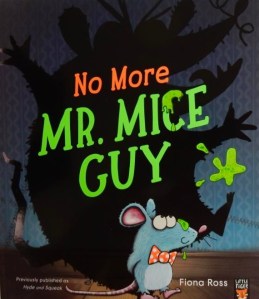
No More Mr. Mice Guy

This was originally published almost a decade ago as Hyde and Squeak, which may give today’s readers a clue as to the story it’s based on. This book features a young mouse, Squeak, that lives with Grandma and loves to enter competitions. We first meet them as Squeak has won another competition, the first prize being a rather large wobbly jelly, with so we read , ‘a whiff of something monstrous.’ Disgusted by it Grandma throws it in the bin straightaway but that doesn’t prevent Squeak from thinking about his slimy prize.

That night once Grandma is fast asleep, he creeps downstairs and tastes the squidgy thing. Big mistake! He grows and grows transforming into Hyde, a horrifying monster mouse. Said mouse consumes everything it can lay its paws on, clearing out the fridge and cupboards completely. Desperate for more food Hyde storms into the town and as he grabs a string of sausages his stomach starts aching and POOF! Hyde reverts to Squeak.

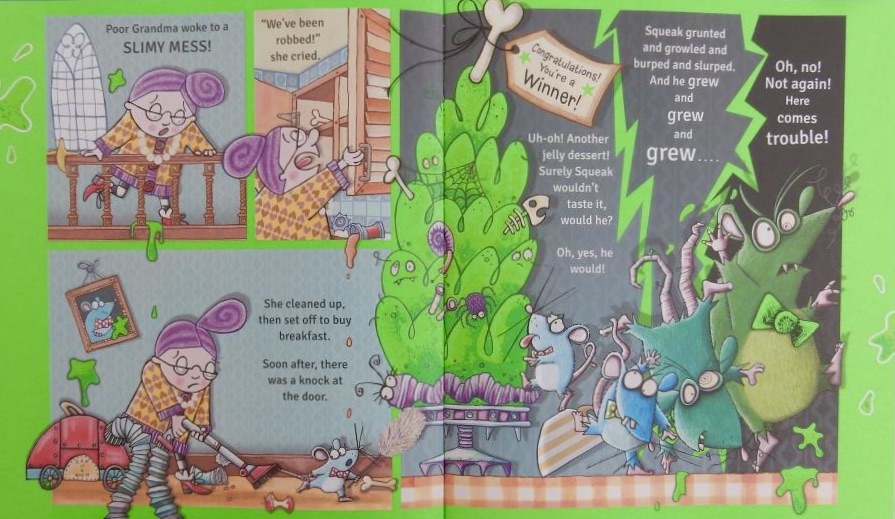
Grandma meanwhile wakes to find no food in the house and just as she’s setting out to buy something for breakfast another jelly desert prize is delivered.

The process starts over again but now as there’s no food Hyde decides to make a Mega Munch Machine that will turn everyday objects into food. Back comes Grandma to a find a slimy mess and nothing much else besides a sleeping Squeak who remembers nothing. The police are called but it’s Grandma who saves the day by means of a very large fruit. To say what happens would make me a story-spoiler so I‘ll say no more.

Presented in comic book style, there’s tension and craziness in both words and pictures making this a fun read, but beware, you’ll never again want to eat green jelly.

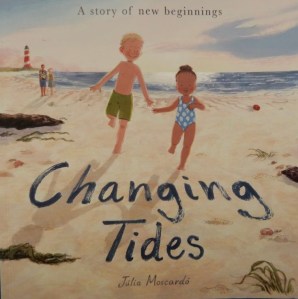
Changing Tides

Lula and her dad are going on holiday to the seaside, Lula’s favourite place, but for the first time Theo and his mum, Simone, are coming too. Lula isn’t at all sure about this; even though her dad reassures her that they are now part of the family. Having a big brother is something new for Lula.and she’s far from pleased when Theo gets her bucket and spade and puts them in the car.

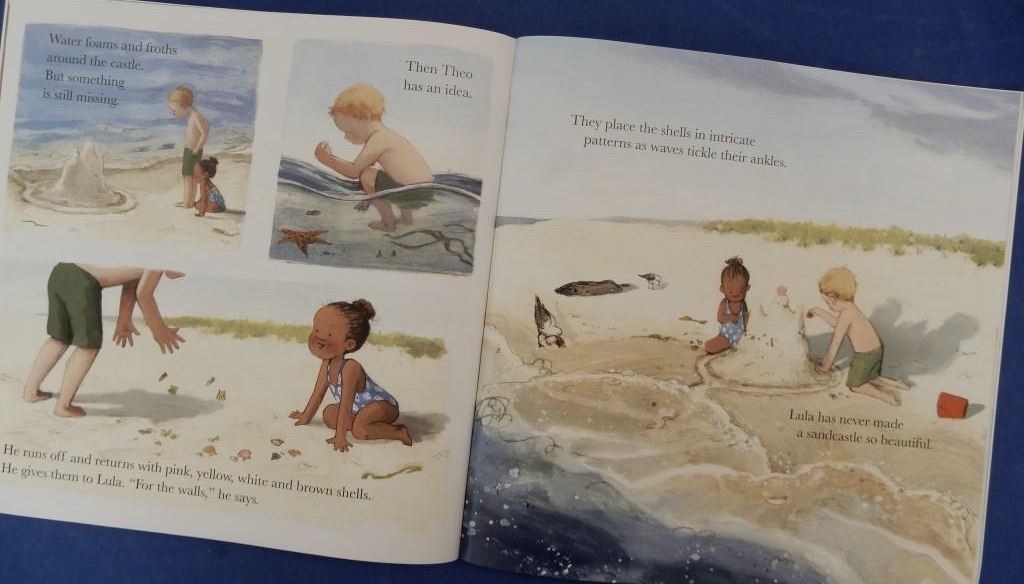
Once they reach the seaside, Lula dashes straight down onto the shore but Theo is reluctant to go near the water. Simone suggests the two children make a sandcastle together and as they do so, they begin to bond

and by the end of the day, having co-created a wonderful sandcastle, they are good friends despite the stormy water destroying the castle. As they walk back to the caravan together, the children are already making plans for the next day.

So realistic are Júlia Moscardó’s soft illustrations you can almost feel the sand between your toes, smell the salty sea and hear the waves breaking on the shore as the two children – full of life and enthusiasm – go about their play.

With its theme of adapting to change, and particularly relevant to blended families, this is a lovely book to share with young children at home or in the classroom.

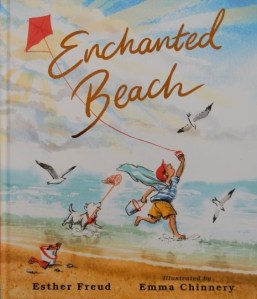
Enchanted Beach

A boy shares with readers the joys that each season brings him and his family when they visit the beach, not just in the summer when he relaxes on the sand, shell to his ear listening to the musical sounds, but in the winter, the spring and autumn too. ‘When autumn’s here I fly my kite. / Chase the seagulls. hold on tight. / Typhoons, whirlpools, fog, a gale. / A rainbow when the sun meets hail.’

You can almost feel the chill of the seawater on winter days as they all plunge into the waves with a shriek and then beat a hasty retreat back to the shore.

The sing-song narrative is mostly in rhyming verse and for the most part reads well aloud though I don’t advise sharing it sight unseen as there are a few bumpy bits.

Emma Chinnery’s detailed scenes are a delight and beg to be lingered over; the more you look the more you see. Young children might create their own stories using a picture, be it large or small, as the starting point: Emma Chinnery’s style reminds this reviewer somewhat of Simon James’ watercolour illustrations.

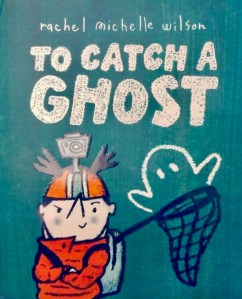
To Catch A Ghost

Young Sam has recently started at a new school and now must contend with her first Friday show-and-tell. Anxious to make a good impression, she decides to bring a ghost. Gumption is what’s needed for the task, Sam tells readers and plans the entire operation out in three easy steps: find the ghost, observe and get to know it and finally, catch it.

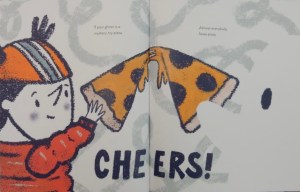
Having donned a hat with attached camera, Sam hunts everywhere in the playground until whoppee! A ghost. Time to get to know the presence. This Sam does by playing hide-and-seek, watering plants and sharing a pizza.

Then comes cage building (done while the ghost is having forty winks) and when complete Sam baits the trap.

By now though Sam has come to think of the spectre as a friend and so trapping it feels all wrong. Off comes the padlock and the ghost is free. Sam sits and weeps briefly but what will happen at show-and-tell? A disaster or a rewarding experience? That you must find out by getting your own copy of this deliciously quirky book. It’s penned in the second person and the interplay between the words and the wonderfully expressive chalky illustrations exudes a gentle humour that will delight both young readers and adult sharers.

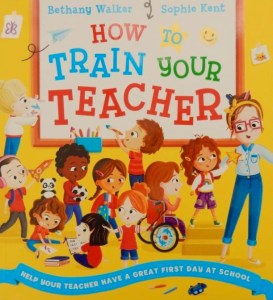
How To Train Your Teacher

From its title you anticipate this will be a fun story and so it is. Having taught both nursery children and reception classes for a considerable time I found it particularly amusing.
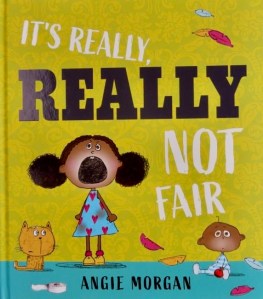
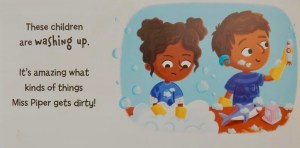
Our narrator is a member of a class of lively reception pupils and she is very welcoming and reassuring from the outset, for the teacher, Miss Piper, is in need of a lot of help. First she’ll struggle to remember names so needs to use a special list – the register and that’s before activities begin – activities such as ‘washing up’

and ‘make and build’. Alternatively you can opt to work outdoors and perhaps serve Miss Piper with her favourite snack.

As the day progresses she’ll definitely need help with her maths (numerical sequencing) as well as her favourite thing – really! – ‘making funny sounds’ aka phonics. No wonder she needs a ‘play’ at lunchtime while the children get their well-deserved rest from their jobs, especially as she’s likely to have to contend with some ‘difficult situations’

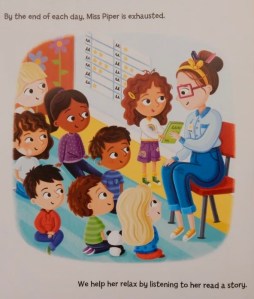
Come the end of the day, the children help an exhausted Miss Piper relax by listening intently to her as she reads a story.

This is vital as she’ll need lots more assistance the following day by which time, more than likely, she’ll have forgotten what she’s learned.

Bethany Walker’s carefully chosen words in combination with Sophie Kent’s scenes of young children clearly having a great time make this a highly reassuring book to share with young children, especially those transitioning from a nursery setting to a reception class.

Five Little Friends

What a treat for anybody who wants to get young children moving their hands, arms and sometimes their whole bodies, and using their imaginations too. This collection of thirty five short rhymes that cover all manner of topics both of the everyday and those full of drama, from tree climbing to teeth brushing, a bubble to a bike and a snake to snow.

There’s a wealth of lovely, playful language such as this from The Waterslide – ‘I’m sliding, sliding, sliding, / in a slipping, speeding flash. // Then I’m out the end / and ready for the … SPLASH!’

I had to laugh to myself as I read On My Phone that encourages young children (for the duration of the rhyme I hasten to add) to imitate the adults around them: it includes the lines ‘On my phone I listen music / and hear messages from my boss’ and concludes ‘I am on my phone so much / I think it’s stuck to my hand …’

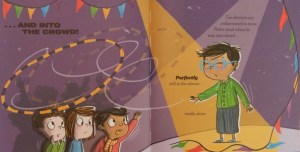
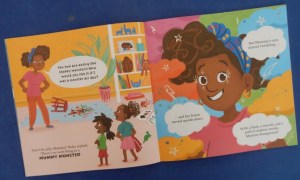
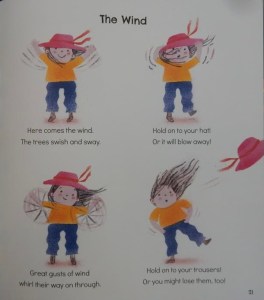
The way Fiona Woodcock has incorporated visual cues to suggest actions for the rhymes into her mixed media illustrations is nothing short of genius. See how she presents The Wind –


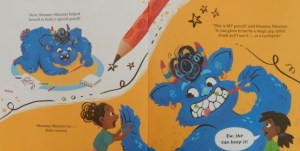
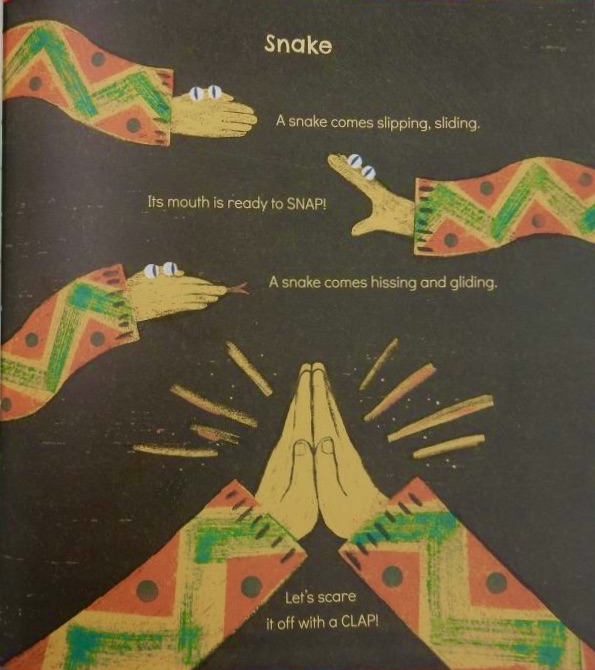
Totally different but equally clever and highly effective is the Snake portrayal –

Teachers, librarians and carers have long used finger plays and action rhymes with young children; this new collaboration from Sean and Fiona offering hours and hours of enriching fun is a must have.

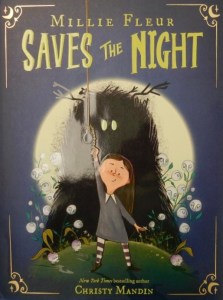
Millie Fleur Saves The Night

Those living in Garden Glen fear the dark and come nightfall, everybody switches on their lights and keeps them on until daybreak. Everybody that is except Millie Fleur La Fae; she loves the dark and since moving to the locality has missed all the nocturnal creatures that stay away from all the lights. To try and bring them closer, she plants a moon garden. Her mum removes the bulb from the streetlamp outside their home and this displeases the local committee whose members claim that’s dangerous and scary. Millie assures them that dark isn’t scary, “You just need to get to know her.” she says.

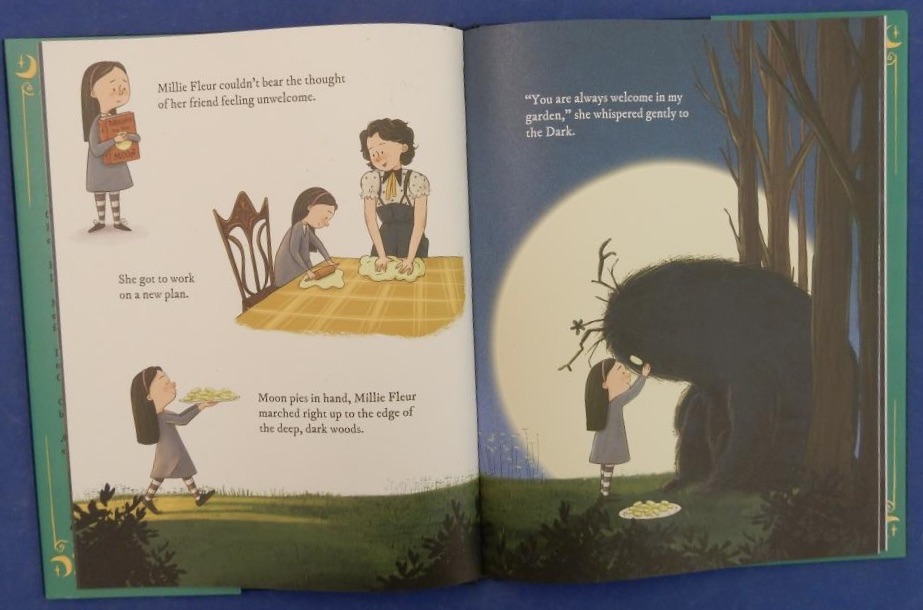
The girl embarks on a new plan: she makes moon pies and takes them out to the edge of the woods where she meets the Dark

and then the two of them lead the night creatures to her garden. There plants spring to life, their delicious aromas wafting towards the homes of her neighbours who decide to follow their noses and are drawn to Millie’s garden eager to see what lies therein.

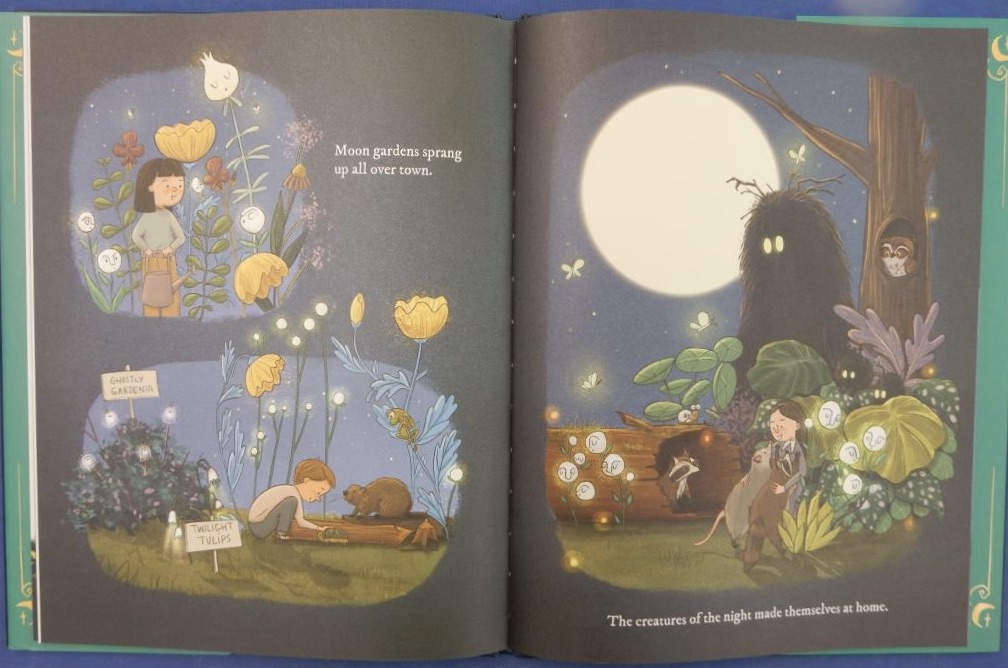
Millie Fleur tells them all to be brave, extinguish their lanterns and leave them behind, which they do; their path being lit by glowworms, fireflies and plants with delightful names such as ‘snoozing sugarplum’ and ‘forty-winks fern’. In the sparkling light the visiting children soon discover that the Dark offers amazing new experiences not found in the light.
Consequently, the lights around Garden Glen are switched off, magical moon gardens spring up and start to flourish as the nocturnal creatures settle in.

Finally, thanks to Millie Fleur the townsfolk have embraced the dark.

A magical bedtime tale that should help reassure children who are frightened of the dark. Christy Mandin’s illustrations of flora and fauna of the darkness evoke a sense of wonder that will enchant both young listeners and adult readers aloud.

The Tour at School (Because You’re the New Kid!)

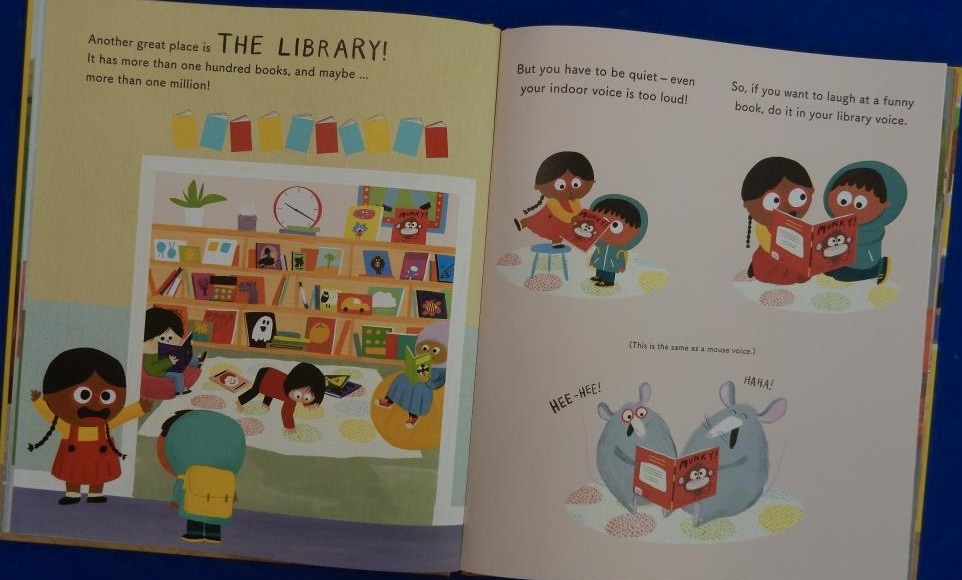
As the young narrator/guide informs us, ‘When you show a New Person around, it’s called giving them The Tour.’ The aim of this really important job is to make the new arrival feel welcome. As you might expect the tour begins with the toilets – a vital place of course but our guide feels things need to be made more fun with some additional facts such as, “The soap smells like strawberries” and there’s an ‘amazing-zing-zing’ echo when you sing (lots of people love to sing in the toilets after all).

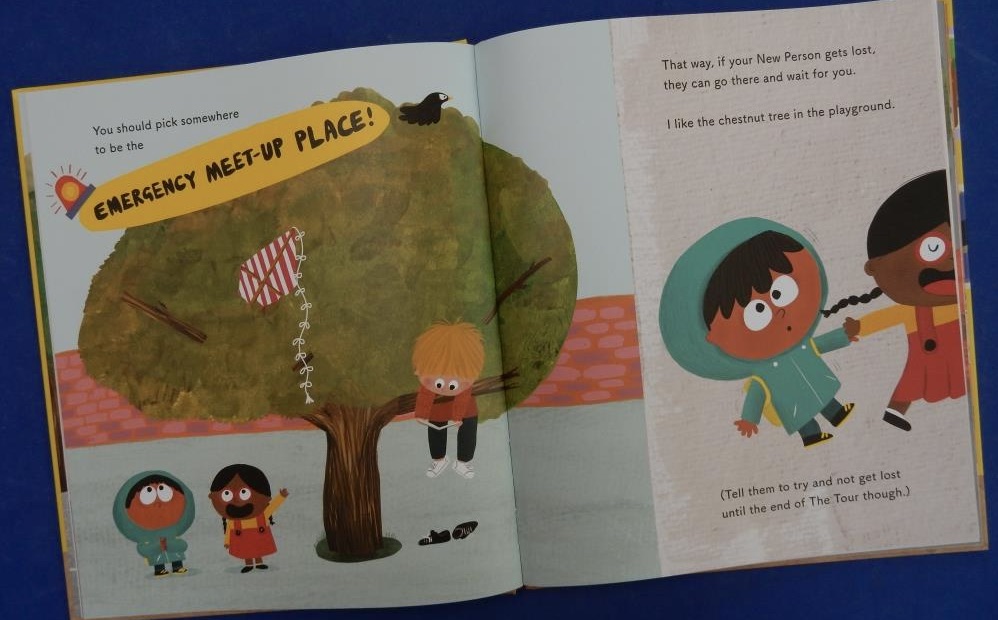
The next most important task is to decide on an ‘Emergency Meet-Up Place’

but it’s hugely important too to show off the best places – the playground and the library and to tell inviting stories about them but not to take too long.

Sensitivity is key so our guide considers introducing the newcomer to someone she knows, however this sensitive guide doesn’t notice everything especially that the new person is looking increasingly alarmed, overwhelmed even and may just have gone missing. (of course readers/listeners will have noticed).

Fortunately our guide tries putting herself in the new person’s shoes and also recalls ‘how it feels not to know anyone.’ This experience she shares with the new person whom she finds in the Emergency Meet-Up Place before proceeding to answer the all important question, “What happens when the Tour is over?” For any newcomer, the response cannot be better.

A smashing story that captures so well those collywobbles that many children feel when starting a new school. Equally it’s reassuring to know that an empathetic someone will be there to help. Both author, Katie Clapham and illustrator Nadia Shireen clearly understand how it feels to be starting something new. Nadia’s choice of colour palette is great and her illustrations are hugely expressive and in tune with the words. The use of capitalisation and font size make the book a terrific read aloud to share with a class or group.

The Sleeper Train

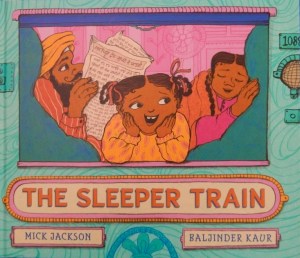
A little Sikh girl relates what happens when she and her family take an overnight trip on a sleeper train.
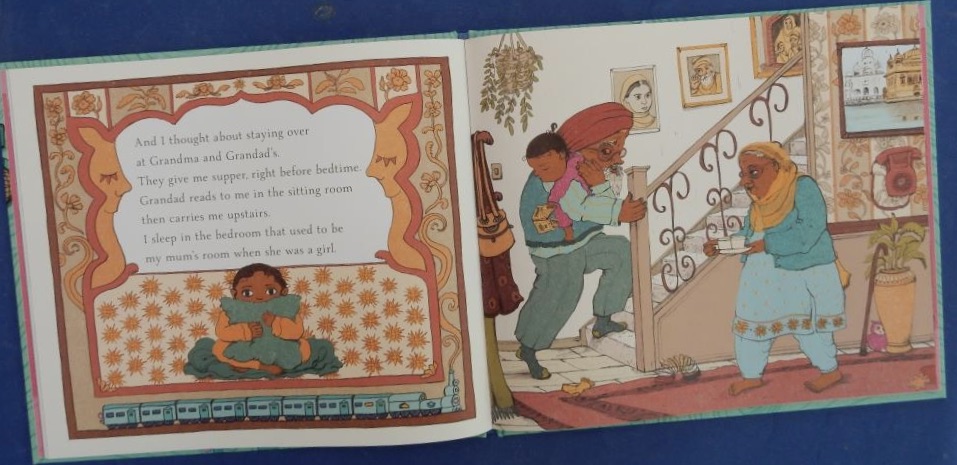
Having settled into their carriage and briefly look through the window. it’s time to open their bunks and get ready for bed. Mum and Dad are soon fast asleep but not so the little girl; she’s way too excited. She decides to bring on a sleepy feeling by remembering all the places she has slept starting with her parents’ room. She also recalls sleeping in a seaside hotel bedroom, a sleeping bag in a tent in a field, staying overnight in hospital for an operation and sleeping over at her grandparents home.

Seemingly by this time only the narrator and the train driver are still awake but eventually, lulled by the rocking of the train, the little girl goes off to slumberland. Come morning, the family dress, have breakfast and look out through he window until the train reaches its city destination.

There the family spend an enjoyable time with friends. Now the little girl has another memory to recall should she be unable to sleep on future occasions.

A warm-hearted tale of family love and togetherness. Baljinder Kaur’s vibrant scenes have lots of images that anybody who has visited India will recognise and the motifs in framed borders on many of the pages are reminiscent of block-printed designs.

Try sending your little one(s) off to sleep with this soothing bedtime story.

Every BOTTY Burps

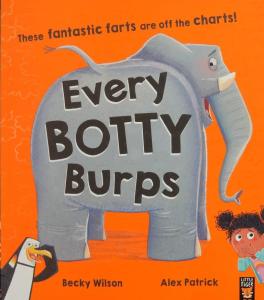
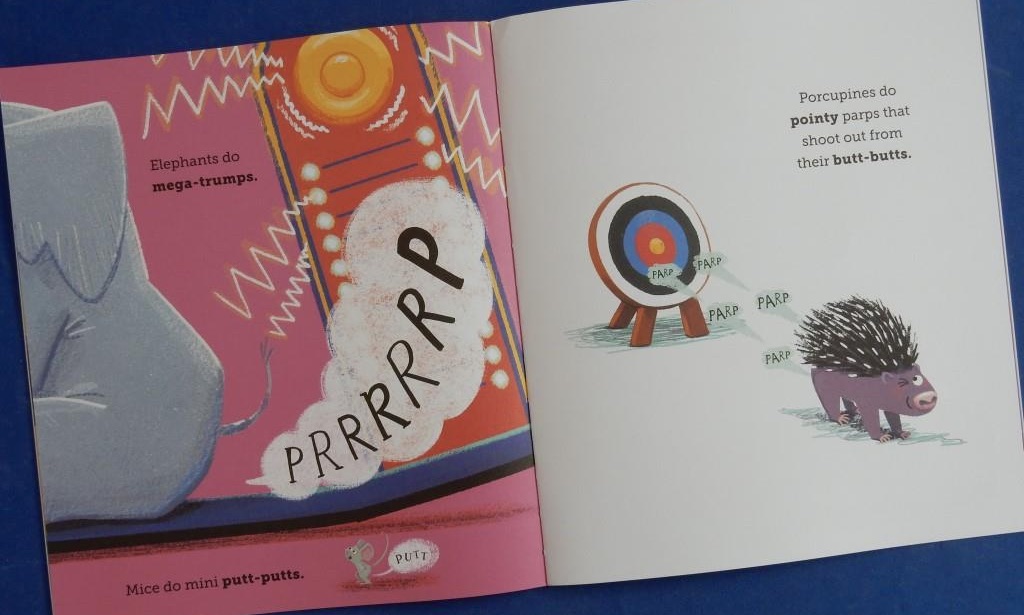
A fantastically silly but reassuring book about those rear end fizzling flatulences that tend to trump forth, often at the most embarrassing times. As the author reassures readers, ‘It’s just what bottoms do!’ We all break wind …” and she then proceeds in rhyme to give a host of examples from penguins’ popping parps to sharks’ silent but sometimes violent whooshing poots and elephants’ mega-trumps to the mini put-putts of mice; and if you can believe it, the pointy parps that shoot forth from the butt-butts of porcupines.

I could go on but then who wants to spoil the fun for anyone wanting to get their hands on a copy of the book.

Alex Patrick has certainly illustrated each of these examples and the others with an abundance of humour and should I say enthusiasm (he probably had some kind of air freshener to hand as he worked).
As for enthusiasm, this topic is one that seems to get young children thoroughly enthused whenever it crops up in a picture book and I’m sure Becky and Alex’s presentation will do so. I foresee cries for repeat renditions when you share this comical collaboration with an individual, group or class.

Heave Ho

After a bad night, Cub is so full of big feelings that there’s no room left inside his mind and body for anyone or anything else. As a result he lets fly at his friends and classmates refusing to allow them to participate in activities and even tosses Mo’s teddy bear way up into a big tree when she offers it to him to cuddle. Then having stamped and stomped around he begins to swing on a bendy tree branch that is even stronger than his feelings.

Gradually as he does so, with each pull and push, Cub’s big angry feelings begin to get smaller and smaller and he starts to feel he’s going to a good place. Eventually his friends Ossie, Flick, Rhu, Mo and Nook feel able to come and swing with him on the branch and they set off on a flight of fancy to an imaginary world far from their classroom: joy and happiness have replaced Cub’s inner turmoil and all is well once more.

A story that young children can relate to as they watch and hear how Cub responds to his big feelings that push him over the edge. If shared in a nursery setting or EYFS classroom, it could be followed by a circle time discussion.

George and Lenny Are Always Together

George, a brown bear and Lenny, a grey rabbit, are inseparable friends, something they discuss as they play on the swings in the playground. George seems one hundred per cent enthusiastic about this whereas Lenny wonders out loud what it would be like to be alone. ‘what if being alone is just as much fun as being together?’ he suggests but George feels this is impossible, saying so as he zooms down the slide. However, Lenny is determined to find out and tells his playmate that he’s off to find somewhere quiet to be alone.

When George offers to accompany him, he gets a flat refusal and eventually decides to try going it alone as well. Off goes Lenny to test his plan

and savvy George allows his friend sufficient space to practise some solitude. It’s fun, decides Lenny: ‘I can draw! I can build! I can blow bubbles! … Read a book! I can even just sit and think.’ He can also think about George and wonders if he’s found a good place to be alone: but where is his bestie? Has he too found the perfect place and if so where is it?

Told entirely in dialogue and through Agee’s characteristic images outlined with bold black strokes, this portrait of togetherness and a little bit of that vital me-time, is a powerful demonstration that it’s possible to have too much of a good thing, but that’s something everyone needs to discover for themselves.

Go Go Dodo!

This is one of those “look out he’s behind you’ stories and I can almost hear children’s voices shouting out from the moment Dodo decides to take that evening stroll through the ‘gentle jungle’ with a big cat hot on his trail. His perambulations take the bird across the ‘friendly swamp’ tip toe, tip toe,

then up the ‘peaceful hill’ and right down to the ‘soothing sea’, from where having been suitably soothed by its waves, Dodo proceeds into the lovely long fairly dangerous grass. Therein he suddenly becomes aware of the presence of a human with a net and a pith helmet – very dangerous for sure. That’s when realisation dawns

and our Dodo decides to beat a hasty retreat and then make his way back home to the safe haven of his bed. “Absolutely nothing to worry about.” we read on the penultimate page but there comes a delicious final twist …

The interplay of words and pictures as the drama unfolds is what makes this book such a winner.
Not only is it a terrific, suspenseful read aloud but with its short, patterned text, it’s also ideal for beginner readers to try for themselves, once they’ve heard it read aloud of course.

The Hug Button

On Matilda’s first day at The Meadows she wakes up excited at the prospect of starting school and her upbeat mood continues all the way to the school door as she and her Mummy sing together, jump over bubbles and count birds. However when they arrive Matilda’s tummy feels ‘all squirmy’. Her mum gives her a reassuring hug but Matilda finds saying goodbye very difficult. Moreover, she’s at a loss to decide what to play when her teacher, Miss Cartwright, asks. Eventually she plays with small world dinosaurs with Ana and draws pictures beside Leo but nothing stops her missing her mum.

The following day Matilda is anything but excited as she leaves home to walk to the Meadows and clutches her mum’s hand tightly at the door. When asked what is wrong, she tells her mum that she doesn’t like saying goodbye and misses her when she’s in school. Her understanding mum finds a pen in her bag, draws something on Matilda’s wrist and the same image on her own. “This is a hug button,” she tells her daughter and explains how they work. This helps her feel better as she goes into class. There are times during the day when she needs to use her special button and it definitely helps with her tummy wobbles. She even forgets the button as she has a fun time at the water tray

but then needs it at story time only to discover that it’s washed off. Tears start welling up but Matilda remembers that her mum had said that love is always there, even if the person you miss isn’t. Can she send her Mummy hugs without that button and will her mum know? And will that help button continue to work its magic until it’s no longer needed. When a new boy starts and Matilda sees him clinging to his dad at the gate, what do you think she does?

Starting nursery or school is often a tricky, anxious time for young children and the idea of a special hug button is definitely worth trying. The story is one that will help a beginner feel confident as they take those first big steps

The Fierce Little Woman and the Wicked Pirate

In days of yore there lived a fierce little woman in a house at the end of a jetty. She spent her days knitting woolly socks to sell to sailors, or walking along the jetty playing her bagpipes or swimming beneath the jetty. Winters were more restful and she’d sometimes sit by the fire fishing through the trapdoor in her floor.

One day a storm blows in and with it comes a pirate who taps at the window of the woman’s house as she sits knitting. She spurns his persistent demands to be allowed to enter and he retaliates with threats

several times over.

Eventually as darkness falls he tries a different approach and admits that’s he’s very frightened of the dark. Seemingly this pirate is more scared than scary; the woman relents, lifting her trapdoor and allowing him to come through into her cosy abode. As they talk, it becomes clear that each in their own way is vulnerable and they have things to offer one another.

After an initial refusal of his hand in marriage, the woman agrees, they get wed and raise a family together.

With her scenes from various perspectives Miho Satake skilfully brings out the quirkiness of Joy Cowley’s text and the battle of words that takes place between the two protagonists.

Feel Your Happy

Emily Coxhead has created another uplifting book overflowing with positivity. Its narrator is a small, very endearing sloth that offers lots of practical strategies to use when things get too much. ‘When I hear a noise that hurts my ears, I find somewhere quiet to be still and calm’, is one. ‘When the world seems too bright, ‘I ask someone to read me a story’ is another

and ‘when somewhere new smells different or strange, I take my softest teddy to snuggle so it smells of home.’ – all of these will appeal to young children and help them to ‘feel their happy’. I love the reassurance given at the end of the book: ‘Your feelings are part of what makes you, YOU! Just remember to be proud, be yourself …”

Using the five senses to manage feelings really helps to make things accessible to very young children, especially when the text is accompanied by warm bright, joyful illustrations with humorous details that are as positive as the words and enable little ones to feel involved.

All children find it difficult to manage their emotions at times, so this is a book to have in home and early years/foundation stage collections.

Our Pebbles

The young narrator and his Grandad loved going to their favourite place. They’d make their way through Wonky Woods, , stop briefly to wave to people on passing trains and to chat with spotty dogs, then climb over the stile when ‘Silly old Grandad’ would always say, “Careful you don’t hit your head on the sky.” Eventually they would arrive at the a place called Pebble Beach and here they’d spend the best of times together. The narrator recalls seeing a seal, playing pirates, eating ice cream while fending off marauding gulls and on every visit before leaving they’d each pick a pebble,

sit themselves in an abandoned boat – The Jolly Dancer – take out their paintbox and decorate their pebbles. These they’d add to those they’d already amassed (we see the collection depicted from above).

One day though Grandad moves away and inevitably the narrator misses his ritual, which becomes evident to his mother. She suggests the narrator takes her to see Pebble Beach and once at the favourite spot, the child selects two pebbles to take to Grandad when they visit him in his new home. There Mum gets out the paints and next time the narrator visits The Jolly Dancer there are two new pebbles to add to those displayed therein.

A beautiful, poignant demonstration of how joyful experiences can eventually become abiding, treasured memories. Jarvis’s illustrations are the perfect complement to his wonderfully warm words.

The Sun Thief

Team Hemming and Slater’s Squirrel is back and as the season is changing he’s once again confused about what is happening. When his friend Bird declares that it’s bedtime Squirrel disagrees, professing that he could never fall asleep when it’s still light. What he says and what he does though are two different things.

Then come bedtime a few weeks later there’s further confusion when he brushes his teeth as it’s dark when he expected it to be light. Squirrel insists to Bird that the dark is due to there being a sun thief, especially as he heard a peculiar “Hoo’ sound. This he’s told was merely an owl and the following morning just as Bird explained to him, joy of joys, the sun is back shining.

A similar thing happens as Squirrel is languishing in his bath the next evening but he tells himself it cannot be the sun thief. Venturing outside onto a branch with a torch he gives Bat a bit of a fright. “The sun thief just crashed into my tree” he shouts to Bird who explains about Bat being nocturnal.
Still unconvinced that a sun thief isn’t lurking somewhere Squirrel sets an early alarm that only serves to further convince the rodent that there IS a thief,. he wakes his friend before sunrise

and the ever patient Bird explains yet again. At last, Squirrel understands.

The final spread takes elements of the story – why the hours of darkness change throughout the year and the difference between diurnal animals including Squirrel and Bird, and nocturnal ones such as Bat.

Funny and gently educative,. Young children will thoroughly enjoy Squirrel’s over-reacting to a seasonal happening and delight in Nicola Slater’s close-ups that serve to enhance his verbal histrionics.

The Best Jollof Rice Ever!

Meet Kamsi and Kwame, best friends, each of whom declares that jollof rice is their favourite food and that their respective mums make the best jollof. Jollof is a yummy, spicy rice and vegetable dish that originated in West Africa and is now known and enjoyed all over the world. To settle the matter Kamsi has a suggestion. “Let’s each make our own jollof and see which is really the best … “ Off they dash into the garden to start collecting ingredients. They both like playing tricks and each chooses judiciously, selecting items with that in mind. Kamsi adds some nettles to Kwame’s mix and Kwame puts a bright green caterpillar into Kamsi’s pot and both continue adding other ingredients – muddy puddle water, ants for spice and dried-up chewing gum.

A mess they each create for certain. Did they forget what the competition was supposed to be about – not the worst jollof assuredly.

Meanwhile the mums have been busy in the kitchen creating the boys’ favourite dish and invite them to come inside and assist.

This they do and then everyone sits round the table to share a meal. Mmmmm! It’s the best ever jollof. “See, alone we make good jollof …” Kwame’s mum says. “But together we make the best jollof! declares Kamsi’s mum. The boys agree – working together is THE way to go; even though playing an occasional trick on one another is fun.

Vibrantly illustrated, this is a truly tasty story cooked up by Onyinye Iwu for whom it’s her first book as author/ illustrator. My mouth’s watering at the thought of that collaborative dish. I’ll have to try the recipe on the final page.

Welcome

Try to imagine what it would be like if you’d had to flee your home and look for another country to live in.

The animal characters in this book do their utmost make the three new arrivals feel welcome and wanted. Their intention is to make sure that nobody is left out because everyone helps to make a happy world. Axel’s illustrations show very different characters playing together, painting together, strolling together hand in hand, having tea together and much more. They communicate visually with the newcomers who speak a different language and allow them to choose games to play.

Equally, allowing the newcomers to be the helpers makes them feel part of the community,

as are shared games and stories. Of course there will be occasions when somebody gets upset and cross but if everybody apologises, these friendships become stronger.

‘Now, imagine if the whole world was like this book – if everyone was kind and helpful and welcomed everyone else. Doesn’t that sound good? “

It most certainly does but sadly it isn’t the case for all humans yet: would that they could all feel like that animal community – kind, open-hearted and ready to make a difference.

An uplifting celebration of empathy, kindness and togetherness. Anyone who buys a copy of this book is helping to make a difference because a donation is made to Three Peas charity (www.threepeas.org.uk) for every copy sold. Teachers and parents, get a copy for your class or family, enjoy sharing it and then talk about possible ways to be as open-hearted as Axel and Alison’s characters.
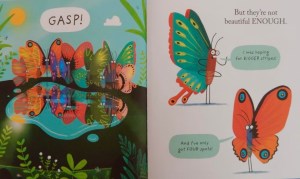
The Summer Puppy

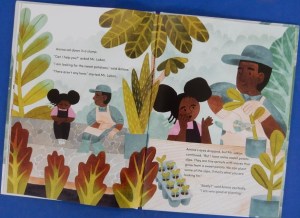
This truly beautiful book was inspired by memories of a real and much-loved dog that belonged to Jackie’s daughter and tells the story of Rosie and her first summer spent at their Pembrokeshire home. Cathy Fisher, the illustrator lives in Pembrokeshire too and it’s evident how much they both put into creating the tale. Jackie’s lyrical descriptions of the countryside: ‘The scent of sweet clover filled her nose / as the flowers towered over her. // So much to see, so much to find / in this emerald world.’

and in complete harmony with the words are the magnificent illustrations of the dog exploring its environment with its child owner. Through the changing seasons from early summer to autumn and the onset of winter, they investigate the woods, fields and beach.

Every turn of the page brings fresh delights for readers and listeners, including this reviewer who is cynophobic (but also a lover of the natural world) and likely to encourage lots of people to embrace the great outdoors and explore the joys of nature.

Dragon Dave The Not So Brave

Stuck in a storybook with an ending he really dislikes, dragon Dave the Brave desperately wants to get out.

One day as he sits beneath a bridge tinkering with some of the letters from the title page, along comes Prince George. The prince notices that Dave looks sad and on learning the reason, he shows Dave that his story words can be rewritten. Starting from the first page, they identity the unsatisfactory parts

and proceed to make substitutes till they reach the end.

Then back to the start they hurry

and the dragon in particular is thrilled with “the Best ending Dave had ever had.’ As you might expect, Dragon Dave is hugely thankful to the prince. He offers him a turn with the writing stick but it’s already in use …

An empowering story that shows we can all rewrite our own stories and that it’s fine to ask for and accept help – Dave and Prince George are both endearing characters and the witty final twist is great fun.
Captivating too are Philip Cullen’s bold, bright scenes and the expressions on Dave’s face especially show so much about his changing feelings.

Daring to be different is the way to go: let these two protagonists show young children the way.

As the World Goes By

As Buttons the dog watches the world through his window he notices a blue butterfly, its wings catching the sunlight. Fascinated, he rushes outside to share this delight with others but is puzzled to find that nobody else seems to have noticed, so involved in their run of the mill daily lives are they. As Buttons continues on his way he encounters two other friendly creatures; they too are fascinated and join him in pursuit of the butterfly all the way to the park.

There the three sit enthralled as the winged creature dances for a short while then takes off again and enters an art gallery. Once more nobody notices until Buttons calls loudly STOP! At last the crowds do just that momentarily and enjoy the blue beauty.

Finally the world’s humans take time to watch the wonderful butterflies and one hopes the rest of the beauty all around.

In today’s world where so many people spend their time rushing everywhere, this is a reminder to slow right down, stop and take time to appreciate the natural environment. With its charmingly quirky illustrations, this book is a gentle reminder to encourage adults – be they parents, carers or teachers – to provide regular mindfulness

The Rock Family Band

Using an appropriately jaunty rhythm Robert Tregoning tells readers of the Rock family. There’s Dad, a rock guitarist, Pops the singer, young Liv the drummer and Bo the keyboard player and writer of hit lyrics, not forgetting Nana who play the tambourine, and poodle Ziggy with her canine cacophony. With those platform boots, funky hair and more, it’s certainly a glam-rock family. There’s also the youngest of all, Sam, a flautist who loves peace and quiet and classical music; he feels he doesn’t really fit in.

With the school concert just a couple of days away, Sam is desperate to find a peaceful spot where he can practise but wherever he goes his family’s loud playing disturbs him.

On the concert morning he pleads with his family to stay still and quiet and listen o what he has to say just for three minutes but even that is too much. In a temper, Sam storms off to school feeling just a tad guilty about his outburst.

When it’s his turn to perform, Sam has an attack of stage fright.

Could it possibly be that at the vital moment his jamming, jiving grooving family is exactly what he now needs?

A celebration of individuality, family love and feeling validated – amore and amina at last. Laura Brenlla’s visual portrayal is brimming over with energy and funky style.

Unity Street School Saves the Planet

The Green Team – Fern, Verdun, Jade and Silas, not forgetting Selva their toucan puppet assistant visit Unity Street School. They talk about climate change, explaining how our planet is getting too hot and how bad that is for wild life and for humans. The children come up with a great idea: they will create their own wild, green space to look after at school. It’s to be situated in the old playground behind care-taker, Mr Moss’s tidy grass.

A fortnight later the Green Team return with litter-picking equipment, Mr Moss clears the playground, the children collect all manner of rubbish, most of which can be recycled and then comes the planting. Beans and hedge saplings are supplied by the Green Team, the children plant the beans in jars and Mr Moss plants a cherry tree. They also make a pebble pond.

Then it’s the holiday, after which the work, (including a fund-raising yard sale), continues through to spring when wildflower seeds are scattered and the beans and hedge saplings planted in the earth.
Weeks pass and eventually —- hurrah! Later that summer Unity School community’s hard work has paid off: something really exciting has happened.

An inspiring story of conservation and rewilding. that one hopes, will inspire others to think of ways to help our precious planet, having been shown the way by Unity Street School.

The Unicorn Who Came to School

Like many young children, the little girl narrator of this story has first day nerves when she starts school. On arriving at the gate though, what should she see but a unicorn who introduces himself as Sparkle and asks politely if he can come to school. The girl agrees and they go in together, talking of things they might do and they sit beside one another when the teacher tells everyone to “Find a friend.” The register is called and all goes well until the class has to line up for assembly. Guess who takes the lead.

During the art session paint flies every which way, music is very noisy and story an opportunity for Sparkle to do some chomping.

When it’s time for outside play Sparkle assists the narrator in making some new friends, but at lunch time his manners really let him down.

At hometime Sparkle waves goodbye to everyone but as he nears the gate, the teacher has a suggestion that might just make him change his mind …

Assuredly Sparkle has given the children their best possible first day at school and I’m sure young listeners, especially those moving from playgroup to a school setting, having heard Lucy Rowland’s rhyming narrative and giggled at Sparkle’s antics shown in Mike Byrne’s bright, zany scenes, will agree.

Punch!

‘GRRRRRR!’ goes Badger showing that he’s on the lookout for trouble as he sets off for the forest.
Before long he’s tripped Frog, shoved Moose, kicked Elephant, and given Bear a poke with a shovel.
Bear draws up a plan to teach their friend a lesson. Badger is to receive a punch from Bear,

a belt from Frog and not one but two socks from Moose and as he plants some flowers,

a slug from Elephant.

Then, all of a sudden Badger plants a smack right on the pachyderm’s nose.

The following day when Bear is stung on the paw by a bee, and is in need of some comfort, Badger reciprocates showing that he’s back to his normal self.

What we’re shown but is never mentioned in the words, is the reason for Badger’s behaviour: he’s grieving for his pet, Snaily. Fortunately he has friends that realise he’s upset and in need of support. What we’re also shown is that words can be deceptive; in this story their true meaning is conveyed in Michael Hall’s blocky collage constructed visuals.

With its message about the need to show kindness towards someone who is hurting, this book is a fine demonstration of how important it is for children to develop visual literacy.

The Bear Out There

Of fractured fairytale versions of Goldilocks and the Three Bears there have been a fair few. Now Jess Hannigan gives a child voice as she speaks directly to we readers, who have come knocking at the door of a cottaage. Straightway the child informs us that outside lurks a scary thing of an ursine nature. She reveals the three signs indicating the Bear’s proximity – ‘The hair on your arms stands straight up. You feel a pair of great big eyes watching the back of your head. Your feet get suuuuper itchy’. and even goes so far as to draw a picture of said bear.

The girl then invites readers to a game of cards during which something disturbs her; they continue playing with various other noises outside until there’s a crunching followed by a rattling at the front door.

This, the young ‘host’ insists on answering. The result is the throwing into question everything the host has said thus far, is and the throwing of herself through the window.

The rest of the narrative is delivered by the real owner of the house who offers tea like a good host

and makes it clear in an accommodating fashion that this isn’t a one time occurrence. “Believe it or not, break-ins happen all the time . Not to worry. I understand the woods can be quite frightening for non-bear folk…”

Frightfully and frighteningly good fun is this subversive rendition illustrated in bold cut paper scenes of the drama as it unfolds: I love the somewhat sardonic manner of the loquacious child narrator energetically portrayed. Making the entire thing even more subversive are the final endpapers showing that the original narrator hopes to make a mint out of her encounter, with her best selling memoir, ‘I Survived a Real Bear.’

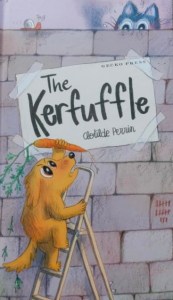
Kerfuffle Bird

Meet the Hushlings, they’re quiet, polite and always keep their feelings under control. It suits them to be thus, all except Maeve.. She really wants to let some of her Big Feelings out but does her utmost to keep them tamed.

One day there appears a large blue egg that. after three days, cracks open and there emerges a flamboyant and very noisy Kerfuffle Bird that shatters the peace of the Hushlings sending them dashing for cover. Not so Maeve however; she accepts the bird’s offer and they take to the air in party mood, coming to land in front of Maeve’s parents. Shock horror! The bird flies right into their abode, gobbles the food on the table

and proceeds to test the patience of Hushville’s residents to the limits. They said nothing until one night the bird’s powerful snoring releases something in them and it’s only Maeve who understands. So alarmed is the Kerfuffle Bird (what a terrific name) that it decides to leave Hushville.

Can any of the Hushlings do or say anything to make the bird change its mind? Seemingly it’s now not only Maeve that appreciates the importance of expressing one’s feelings: so can they all find a way to live harmoniously together?

A lively fun story about expressing your true feelings, acceptance and learning to live together. Gwen Millward captures so well the chaos that ensues with arrival of Hushville’s lively endearing avian in her energetic scenes.

Nelly the Very Different Bird

Nelly can’t fly so when the other birds migrate for the winter, she is left behind. However, she’s eager to join them and so being a determined, resourceful little creature, she learns ‘to do things differently.’ She orders an inflatable boat, an outboard motor, a map, climbing gear and other items and then begins her steepest learning journey yet but the great thing is she can travel far from the woods, scaling heights, sailing the seas,

traversing the desert, without the need to fly.

Eventually, thousands of miles away Nelly finds her flock. Unfortunately though, the next morning, they take off from whence they’d come, leaving her all alone. But not quite, for one bird remains; he like Nelly has discovered he can’t fly and appears far from happy about it.

He hasn’t however, expected to encounter Nelly who proceeds to teach him ‘how to do things differently.’

Before long they’re ready to embark on adventures together and in so doing they discover that ‘life’s a lot more interesting when you do things together … and a lot more enjoyable too.

An empowering, absolutely charming tale of doing things differently. It celebrates independence, perseverance, individuality, co-operation, creativity and friendship and is a great book to share with young learners. They’ll delight in the acrylic and gouache illustrations of the endearing Nelly and her lateral thinking achievements.
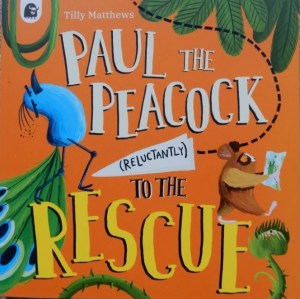
Robin and Pip

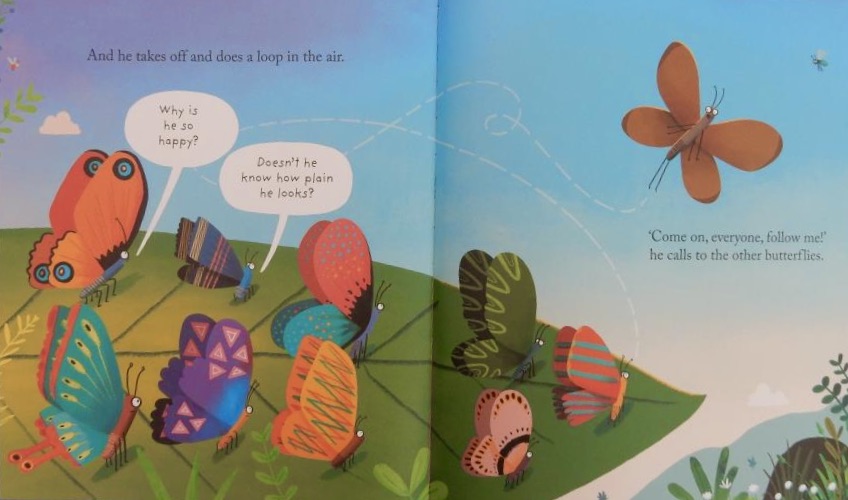
A touching tale about a Robin that worries. To ease those worries the little bird asks his patient pal, Pip the apple tree, lots of questions; first about the blossom. Does she miss the flowers when they float away? Now as Pip, a mature tree already knows of her naturally occurring life cycle she is fully aware of the series of stages she’ll undergo each year. Through Robin’s continuing questioning and Pip’s responses, readers share these natural changes.
The little bird and young listeners learn that the tree is able to provide stability through her roots and strength and flexibility through her branches to grow and hold up the fruits until they’re ready to fall or are harvested. Finally Robin nestles into Pip’s welcoming.comforting branches and reassured, the bird’s questioning ceases.

A gentle blend of story and information, this is a book to share and talk about with early years children who will be helped to understand that it’s okay to feel worried about things, but by far the best way to cope with their worries is to find someone to talk with. The author’s pen and watercolour illustrations are a delight and really bring out the feelings of the little worrier and the reassurer, while also including some amusing details of seasonal happenings and minibeasts.

The Old Forest Path

This story is the first for young readers by musician Jamie Catto.

Once upon a time, deep in a magical forest lived fairies: delicate, graceful and ballerina-like is how Kanako Wakabayashi portrays them. The fairies delighted in dancing among the flowers and shrubs and were mindful of doing as their elders had taught them – to stay on the path and return home each evening. However, there was one fairy who was so captivated by the forest music that she would stray from the path, unaware of the concern of the other fairies.

One afternoon a piper arrived playing tunes so enchanting that all the fairies were completely enthralled;

but there was one fairy who was so completely transfixed by his music that she stepped forth, the two joined together in a dance that lifted them high, high above the forest canopy never to be seen again. Meanwhile the forest path disappeared completely leaving the remaining fairies free to go wherever they wished in the forest.

A demonstration of the power of music to transform, lyrically told and beautifully illustrated in delicate watercolours, this unusual book with its echoes of Arthur Rackham and Cicely Mary Barker’s Flower Fairies sent me back to my childhood days.

For older picture book lovers I suggest.

Diggers, Dozers & Dumpers

Translated from the original German by Melody Shaw, this contains fourteen mini stories each of which features a different construction vehicle. Every story but one unfolds over one spread and all show realistic pictures of the vehicles and their amusingly portrayed animal drivers.. The vehicles include a dumper truck driven by Roberta Elephant, a telescopic crane that concert pianist Cordula Cow uses to carry her piano to give a free concert in the pasture to her ‘less successful sisters’. I think my favourite and probably that of young children, is J.J. Wolf’s mini-digger story. Having dug a small hole in the sheep paddock he’s surprised to find that the following morning some sheep have fallen in. The cunning guy invites the sheep to dinner at his house. Err …

The cement mixer story spread is a recipe for pancakes that requires more than two thousand litres of milk, s two thousand plus tons of flour and over thirty two thousand eggs and there’s a tale of grass mowing one-upmanship entitled ‘combine harvester’.

Each tale has additional information in italics about how the vehicle is used. The countless young vehicle loving children will probably most enjoy seeing the machinery whereas adult sharers will have a good giggle over the animals’ actions.

A fun amalgam of story and information; it’s great to see several of the machines have female operators.

Zeki Goes To The Market

No matter where little Zeki goes he always brings a big smile to the faces of those he encounters. He definitely does just that when he and his Mummy visit the bustling Saturday market. There he experiences a veritable symphony of sights, sounds, smells and tastes as they stop at various stalls. There’s Salvatore whose pasta shapes are fascinating to look at, Fleur who makes smoothies; Zeki tastes a very fruity one. Next stop is at Mr Adams the spice seller where Zeki smells what appear to be cinnamon sticks – mmmm – a delicious aroma (as well as a yummy taste when ground and sprinkled on porridge perhaps).

Zora offers the boy a taste of her sweet, sticky buns – maybe those have sprinkling of cinnamon in them, they’re definitely irresistible. Miss Fay suggests a dab of belly butter ‘for a better belly’; it makes Zeki’s skin extra soft and smooth.

Mum then decides it’s time for a short rest; she puts down her heavy bag and treats herself to a cup of Paloma’s delectable hot chilli chocolate (my favourite too). Feeling refreshed she moves on and buys take-home noodles from Yuto before making her final purchase at Sean’s veggie stall. Finally with a goodbye wave, Mum and Zeki set off home.

There’s SO much goodness packed into this small book. It would be really fun if adult sharers could have to hand some of the items Zeki’s Mummy bought to enable small children to share in Zeki’s sensory samplings.

Music of the Mountains

This story is set in the Northwest mountainous region of Pakistan where, taught by her Neeka Baba (grandfather), young Roohi, a Pashtun girl, is learning to play the rabab, a lute-like folk instrument. Eid-ul-Adha is approaching and she yearns to become sufficiently proficient to play well in the school concert. When she tells Neeka Baba that she’ll never be as good as he is, he responds thus: “You must feel the rhythm, feel the beat of your people … “You must believe in yourself … You must play with the courage of all those who came before you.” Every day she has a lesson but one day Neeka Baba is coughing and despite his reassurance that all is well, he cannot teach her as he has to rest in bed.
So great is the pressure of letting everybody down Roohi feels she just can’t pick up her rabab. “I’ve heard you play. We are all so proud of you” reassures her Mama … “Maybe play like yourself.”

Come the day of the concert, Roohi bravely walks on the stage and begins to strum. Can she find courage within herself to continue after a fumbled first note? Can she now at this vital moment find her own rhythm?

A lovely interweaving of family bonds, music and culture. Sabrina Shah’s rhythmic text conveys so well Roohi’s feelings and with richly-hued illustrations by Manal Mirza, capture the cultural setting beautifully. I love the patterns and detail on the clothing. (Backmatter gives additional information about the rabab, the Pathan/ Pashtun people of northwest Pakistan, as well as Eid-ul-Fitr and Eid-ul-Adha,, and on Roohi’s kamees partug. There’s also a short Pashto glossary.)

I Could Be Eaten By a Shark

One day when on the beach with his grandfather, Louie sees a shark, albeit only a small one, and refuses to go back in the water. So instead his grandpa takes him to a variety of other watery places – the lake and swimming pools but they too cause the boy to see sharks. As do even paddling pools and bubble baths, indeed anywhere where there’s water. How can this problem be sorted out?

Grandpa (‘who is very wise)’ takes Louie to the library to learn about sharks. Having discovered that shark attacks are rare and been surprised to read of a shark that’s smaller than a human hand, Louie remains cautious, refusing to go right up close to relevant book. Moreover he sees potential sharks lurking in places everywhere, even the loo.

Now, rather than telling his grandson not to worry, Grandpa says something else, for he knows how Louie feels as he too was terrified of a large creature and convinced it would eat him. Maybe through ‘time – and hard work’ Louie, like his Grandpa, could learnt to live with his fear and keep it under his control. That way he wouldn’t miss out on the wealth of opportunities life has to offer …

Cleverly interweaving basic shark facts into the narrative, Marcela Ferreira offers a story that demonstrates how one’s fears can be embraced and made manageable: in tandem with Mark Chambers’ witty scenes full of amusing details, this is a book that offers reassurance and lots of discussion possibilities, especially for anxious little ones.

The Big Day

The child narrator of this story receives a very large envelope containing an invitation to the wedding of two giants.. “ I fashioned a pen from / the trunk of a tree// and used it to / write a HUGE RSVP.” A detailed one asking about means of transport to the celebration and listing such possibilities as ‘travelling on the omnigrobbliwobblibus’ .

Come the big day, off sets the child in a smart new outfit feeling not particularly brave and keeping the destination secret from Mum. The church is full of enormous wedding guests of the fantastical kind such as witches, monsters and goblins and Giant Aunt Clara wearing her ten-ton tiara. The organ starts up and in come the two male giants (one carrying ‘fresh morning dew from the dawn’ (something new); the other holding ‘sky that bright stars wandered through.’ (something blue). They say their vows before a official,

everyone sits for the grooms’ speeches and the feasting commences.

Why was I invited wonders the small human narrator and groom two reveals the reason: there’s a message to go back with “love is just love, whether GIANT or small.”

A joyful, life-affirming demonstration that everyone matters and love is love delivered in Rachel Plummer’s rhyming text with lots of playful language and Forrest Burdett,’s illustrations in suitably vivid hues on pages that will excite with their flaps, die-cuts, and gate folds.

Wild

A child with a great affinity for the countryside moves to live in the city. Replacing the wildness, especially the bird with blue wings that sings and the earth full of stories, are grey glass buildings with ‘their fish scale sides’ that cannot be climbed, pavements that cannot show their secrets and skies without any visible stars. The city is lonely, so too is the young narrator who tells readers, “I’ve lost my wild.’

Somehow though, in response to a plea for help in this grey wilderness, the bird with blue wings appears in the dark sky calling to the child. Swooping and looping, the bird leads the protagonist through the crowded city streets to a river. a river that ‘rolls and twists and shows me the secrets hidden under its tongue.’ This is a place where herons wait to catch silvery fish and there’s an abundance of other birds.

The child carries on following the lead of the blue-winged bird and they find leaves, wild flowers and insects.

In a little forest place, the child climbs a tree and can hardly believe the abundance of wild life -: ‘A burst of parakeets colour the air green’ and then as day turns to night a fox appears and stars light up the sky. Now the child realises that there is wildness everywhere’.It’s both within and all around.

Katya Balen’s poetic narrative reads aloud well and accompanied by Gill Smith’s mixed-media scenes of the contrasting grey cityscape and the vitality of the wild places will, one hopes, encourage children to look for and appreciate their own wild areas.

My Rice Is Best!

There’s absolutely nothing in the entire world that Shane prefers to eat than his Mum’s home cooked rice and peas. She uses a recipe passed down to her through many generations. When Mum suggests he take some for his school lunch the following day, he jumps at the chance.

Next day Shane sits beside Yinka and is surprised to learn that she considers the best rice in the whole world is Jollof rice. The two children have a loud dispute which is interrupted by Chong who insists his fried rice is undoubtedly the best. Then several others join in, each claiming their version of rice is BEST. The vocal dispute degenerates into a physical one

that ends up with the contents of Shane’s lunch box scattered all over the floor.. He’s devastated, but quickly Yinka offers her tub to him and as Shane tastes her Jollof rice, he’s surprised how tasty it is. There follows a lot of sharing between the rice eaters but one child, Tim, is confused for he has rice pudding not for lunch but for breakfast, which all the other children think must be pretty scrumptious.

I must admit I have to disagree with that however: the only time I ever got a detention at school was when lukewarm, stodgy rice pudding was served for afters. I discreetly – so I thought – opened the canteen window and threw the contents of my bowl out onto the path and the teacher on duty caught me in the act.

Selina Brown’s deliciously funny story is vibrantly illustrated by Maxwell A. Oginni whose scenes of the rice face-off are wonderfully dramatic and expressive. A super story to encourage children to try new foods, especially those from cultures other than their own.

A Mouse Just Ate My House!

The narrator of Kes Gray’s text speaks in rhyme as he relates the disaster that has befallen him, or make that sequence of disasters. There’s a mouse in his house and she has nibbled, munched and chomped her way through pretty much everything except the resident himself. First, as you might expect she sank her teeth into the skirting board but as soon as the narrator had retired to bed, she got started on the downstairs rooms and their contents.

Traps proved totally ineffective, indeed they merely served as part of the rodent’s repast before she proceeded to the bathroom, followed by the bedroom,

where not even poor Ted escaped from a severe nibbling. Other deterrents – a cricket bat, the neighbour’s cat

and pest controller and much more failed to survive. It will come as no surprise to readers that the mouse’s belly appears to have increased in size considerably after all this but there’s no sign of her suffering from indigestion or nausea. How is that possible?

This whole sorry saga is heightened by Sebastien Braun’s dramatic, hole-strewn depictions of the trail of destruction.

With an absolutely delicious throwaway final twist this one has winner stamped all over it. Listeners and readers aloud will relish it.

So Devin Wore a Skirt

Devin’s family are getting ready for Nanabapa’s Big Birthday party. Everybody in the household has already found their perfect outfit for the celebration: Jay’s new tie makes him look super stylish, Amaia’s wings give her a magical look, Mummy looks like ‘a soft, pink cloud’ as she wafts around in her lengha but Devin still can’t make up his mind what to wear. He tries all kinds of things such as his red trousers, his favourite jumper and several hats. He keeps the blue beret on and eventually decides to put on his sister’s blue and purple sparkly skirt. He likes what he sees in the mirror but then in bursts Amaia protesting “You can’t wear my SKIRT! What will Nanabapa say?”

Rather than taking off the skirt, Devin decides a disguise is needed so he selects a ninja suit and a wizard cape. Then with a feather in his hat as a finishing touch, he’s good to go. By this time the party is under way and he joins his mum in the dancing.

Having bopped and boogied for some time Devin is very hot and decides it’s time to shed a layer or two but he gets even hotter as he continues dancing. Eventually he removes the ninja suit revealing the sparkly skirt. As Devin stands nervously in front of his Nanabapa he’s worried about what his family will say especially Nanabapa. Not for long though as the response is unexpectedly positive. Soon everyone is dancing joyfully including Devin who feels as magical as the others but most importantly, he feels like himself.

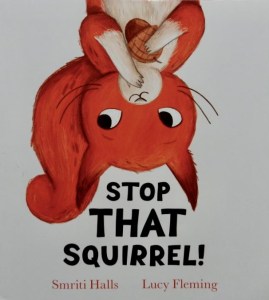
Lucy Fleming’s textured illustrations capture so well Devin’s changing feelings as layer by layer he takes off his disguise and finally reveals his skirt to everyone in Shireen Lalji’s warm-hearted family story about being true to yourself.

This Letter Says I Love You

This book was inspired by the true story of ten year old Matilda Handy who, when thinking of ways to connect with her grandma and grandpa, had the idea to set up a memorial post box to send letters to loved ones who have died.

In the story, a little girl misses her grandmother and wants to be able to talk to her so she decides to write her a letter. Somewhat stuck for a beginning, Mum suggests she should, “Try to fill it with what’s in your heart.” And so she does, drawing things that she herself has done as well as those she and her gran shared, things such as baking cakes together, den building and games they played together.

Included too are some of the sad and angry occasions and how her Mum helped her cope with them.

When the letter’s done, the girl narrator and her Mum set off to post it, the former wondering how Gran will know what’s been said and how she’ll reply.

When they reach the white post box, the narrator feels a little better so she tells us, and her mum reminds her that “We’re always connected to those people we love.” and suggests the girl continues to share things. By the time they walk back home the stars are shining above and they seem to have a special message for the letter writer.

Lyrically told in Lucy Rowland’s rhyming narrative and beautifully illustrated by Sharon Rentta whose scenes of everyday events and fond memories exude warmth, tenderness and love.
(The postboxes like the one in the story are to be set up at 36 other sites across the country after Matilda’s moving tribute to her grandparents proved so popular.)

Pearl & The Fish

Many young children fear the dark and so it was with little Pearl who imagined shadowy things hiding under her bed. That however was before she had her brainwave. At bedtime she’d bake six imaginary biscuits using her toy kitchen set and put them on an invisible plate in a particularly shadowy place. Come morning the biscuits had always disappeared and the shadowy thing that consumed them had become her friend.

Then one night a rumbling sound wakes Pearl from a dream about a goldfish and ,secure in the knowledge that whatever made the sound must be friendly, out of bed she gets and discovers a huge goldfish snoring. A gentle poke causes it to release a bubble and then many more, until her room bounces with ‘bubble popping play, jubilant jumping and glorious giggles.’ The two enjoy themselves until come the dawn the fish vanishes and Pearl gets back into her bed and sleeps till morning.

Was it all a dream, she wonders but the following night, the fish is back. Introducing itself as Goldie, the fish explains how it came to be and the two of them fly to the Moon, Pearl taking delight in the shooting stars around. She even catches one and takes it back to Earth.

The next morning after a cosy sleep, she is woken by her mum talking of a special surprise for Pearl. That evening she still makes her six friendship biscuits but these have for a different purpose altogether.

Magical, reassuring, and with fantastical, luminescent illustrations, Patricia’s telling reads aloud really well: I love the playful alliteration and the way Pearl takes the initiative to control her fears.

Higher Ground

In this highly visual story we follow the lives of a grandmother, a brother (the narrator) and sister and their pet rabbit who are stranded in their city apartment as a result of what Grandma calls The Great Flood. Everybody else left before the water came and so there was nobody to see their rooftop message pleading for help. Thus this space becomes their entire world but Grandma tells the children they must never lose hope.

Day by day she teaches them everything she knows: things about sowing and planting, making repairs, fishing, reusing and recycling, observing their changing surroundings and more. The children seize upon her teachings with enthusiasm, optimism and creativity. The seasons change but so too does Grandma: little by little her strength diminishes. With the waters continuing to rise, the children start building a raft and loading it with produce.

Grandma knows she has little time left so she encourages the children to sail away leaving her to protect their garden: ‘with each ending a new beginning unfolds’, she tells them giving her necklace to her granddaughter and saying that she’ll always be with them.

Weeks later, having been completely lost, battered by fierce stormy waters and on the point of despair, a seabird flying overhead reminds the siblings of Grandma and with lifted spirits they struggle on, eventually finding dry land and a new home among other people. Using their experiences they then show compassion towards other people who also find themselves lost, stranded.

Tull Suwannakit uses predominantly mixed media visual imagery to convey the story, skilfully blending wordless graphic novel sequences, some in black and white, beautiful softly hued landscapes

and double spread diagrams of instructions for such things as catching a fish. The result is a hugely moving account of how even under the very worst of circumstances, like those two protagonists, we should never give up on life.

Embracing such themes as home, belonging, loss, grief, refugees, self-sufficiency and the consequences of climate change, this is a book that deserves to be widely read at home and in classrooms.

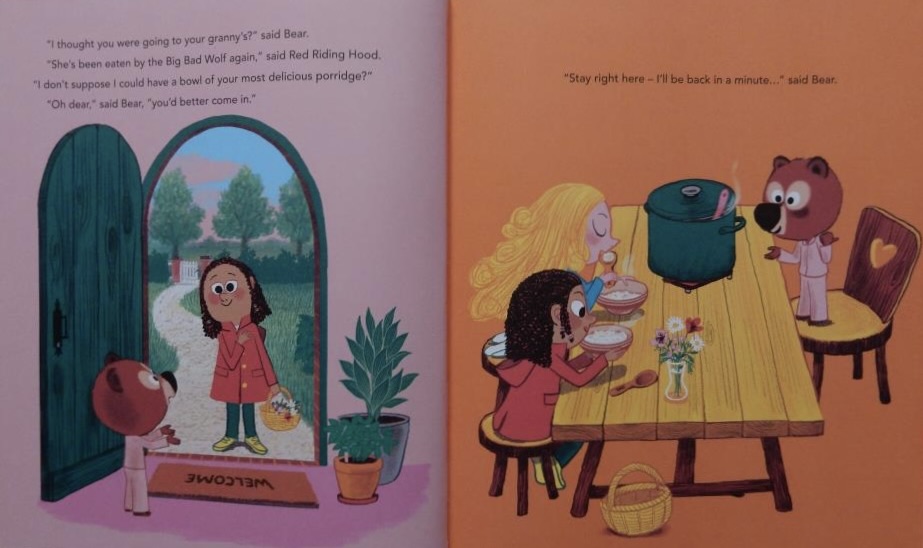
A Good Night’s Sleep

Young listeners will likely know what Little Red Riding Hood did when she discovered the big bad wolf in the woods. However young Maudie uses rather different tactics. Moreover she actually has several animal intruders in addition to the hungry bear she meets lurking among the trees. Having dealt with the large hungry ursine and proceeded to the woodland house, she finds a lion in the kitchen that has designs on her as part of his late-night snack. Rather than panic, clever little Maudie makes a request of the lion and then proceeds to mix up some ingredients for a chocolate cake, which she then puts into the oven, goes off upstairs

and leaves the creature drooling. But what should be waiting in the bedroom with hungry grins upon their faces but a pair of wolves. These too she cleverly outwits,

only to come upon a crocodile in the bathroom: can she get the better of him as well?

Suddenly Maudie remembers that cake in the oven. Downstairs she goes to find the lion still drooling, plus the bear. Now you’ll have to admit that this young miss is a canny character and does something nigh on genius after she’s added icing to her cake. However, to discover what, you’ll have to get your own copy of this super fun tale. Assuredly Emma’s latest offering is a book that children will relish and want further helpings soon after.

The Best Garden in the World

When Steve the squirrel moves from the city to the forest. he’s intent on finding his wild side in the countryside. He has resolved to build the best garden in the whole world and is bursting with ‘big and very particular plans.’ His new forest dwelling neighbours are eager to help and Steve gives them clear instructions as they plant, prune, sow and sort all day. Everyone then agrees that Steve’s is the best garden they’ve ever set eyes on, despite it also being the only one.

Steve meanwhile settles down to enjoy some peace and quiet. Not for long though: very soon his new friends are busy doing their own things. Shock horror, they’re ruining the garden.

Time for some ground rules, a plethora of signs and … the disappearance of all this friends. It’s peaceful, yes

but Steve decides he should do some market research: what is it that makes for a perfect garden?

Steve is startled by his discoveries and so down come all the signs and up goes a completely different one. Manicured lawns and trimmed hedges are all very well but it’s time for a spot of rewilding that will attract his new friends and accommodate their particular requirements and ways of living.

A great story to demonstrate to young children that is everyone is different and so too are their needs.

The Bear-Shaped Hole

Loss , especially death is always difficult to deal with even when you know it’s coming. So it is with this companion book to the creators’ The Hare-Shaped Hole. Skilfully written in rhyme, poet John Dougherty tells the story of Gerda and Orlo. Orlo bear is gentle, caring, kind and fair – the most respected creature in the woods. Orlo is much loved by young Gerda and the two spend a great deal of time together walking, talking, playing and telling stories but one day Gerda notices a change in Orlo. He’s much slower and seems to have lost that zest for life. Orlo explains that he’s ill and will soon die. Gerda’s initial response is one of anger and she runs away roaring uncontrollably in her misery.

However as we read, ‘ … you can’t outrun sorrow. You can’t outrun pain’: Gerda returns tearfully to Orlo who welcomes her with a big bear hug and then goes on to validate her feelings, assuring his young friend that despite her hurt – that hole in her heart – she will feel happiness again and Orlo will live on in her heart and her head as she remembers the wonderful times they shared. Eventually, come the autumn after making more memories together through the summer,

Orlo dies. Eventually Gerda does find she’s ready to make new friends and have happy times with them.

A reassuring message and it’s stunningly illustrated by Thomas Docherty whose scenes are bright and over-flowing with love. A must have to share with children at home and in the classroom.