Horses: Wild & Tame / Home Sweet Home

Horses: Wild & Tame
Iris Volant and Jarom Vogel
Flying Eye Books

My experience of and with horses is decidedly limited, or so I’ve always thought. Certainly my only riding experience was when  aged about twelve, I had gone to find my best friend who lived round the corner in a suburban road like mine. She wasn’t in but suddenly appeared round the corner on horseback. She dismounted and insisted I took her place. Now, never having ridden before I was reluctant but let her persuade me with ‘It’ll be fine, he only goes slowly.’ Next thing I knew the creature had taken off and was, so it felt, bolting up the road while I slid ungracefully down its back and off into the road, landing on my rear.
Having read the Horse Character page in this book however, I can look back and consider the character of that creature: was it a cold blood, a hot blood or a warmblood?

From Volant’s description it certainly wasn’t the first, and was most likely the last ‘strong and agile … perfect for riding’, despite thinking the best fit was ‘hotbloods … bold, spirited character’.
Flicking randomly through, I came across other spreads that particularly resonated. There’s one featuring Black Beauty, Anna Sewell’s classic novel; a book I loved as a voracious child reader. That story, as we’re reminded here, ‘encouraged people to be kinder towards horses, leading to many new laws in England and America’ concerned with the protection of horses.
However, it was the Royal Steed spread that came as an exciting surprise. It tells how in 1576 during the Battle of Haldighati, Rajput warriors made false trunks for their horses to wear, thus confusing the elephants ridden by their Mughal enemies so that they wouldn’t attack what looked to them like baby elephants. We also hear how Chetak, the badly injured horse belonging to the Rajput ruler carried his master to safety.
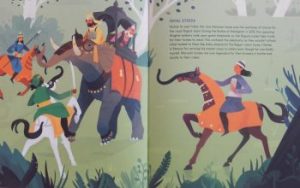
I’ve visited Haldighati on more than one occasion on trips to India and during my annual holidays in Udaipur am frequently reminded of the creature by an imposing statue of that particular horse in the centre of a roundabout in Udaipur city, aptly named Chetak Circle.
Author, Iris Volant, goes way back further than that though, right to horse evolution. Indeed there’s probably something for everyone in this fascinating book that has artistic references, literary ones, horses in legend, war horses, work horses, horses in sport and more. How fortunate that its illustrator, Jarom Vogel, decided to become an artist rather than pursuing his studies as a dentist; he’s certainly done these beasts proud.
Home Sweet Home
Mia Cassany and Paula Blumen
Frances Lincoln Children’s Books

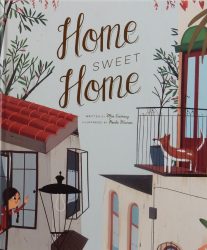
Both author and illustrator of this book come from one of my favourite cities, Barcelona. We’re given a look at different homes from around the world from the viewpoint of the pets, mostly dogs and cats, with the occasional bird and even a tortoise, that live in them.
Readers can discover what it’s like to live in say, a waterside house in a Netherlands village;

a tiny apartment in Hong Kong, China; a cabin with a roof of grass in Iceland or a townhouse by the Thames in London.

Cleverly conceived with the animal narrators, in addition to what we’re told in the text, there’s a great deal of visual information about each of the homes and lifestyles packed into every one of the locations we visit. Every one is made to look exciting:

where would you choose to live?
A stylish and fascinating addition to a primary classroom library or topic box.
Amazing Information Books

Bees
Toni Yuly
Walker Books
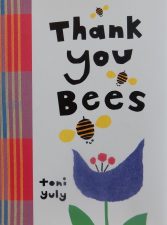
For the very youngest is this beautifully simple book of gratitude that demonstrates our connectedness to the natural world: it’s narrated by a small boy, who we see interacting with the things he mentions.
‘Sun gives us light. // Thank you, sun. // Bees give us honey. // Thank you, bees.’ Thus begins the concatenation of connections: from sheep we have wool. From clouds comes the rain, trees provide wood

and thanks to dirt, there are plants.
Appropriately, bold, bright collage illustrations combine fabric, paper, wood, ink and tissue, re-enforcing the biological bounties of the natural world.
Perfect for an end of the day sharing, be it with a single child, or nursery group; and equally with its minimal patterned text, it’s ideal for those just starting to read.

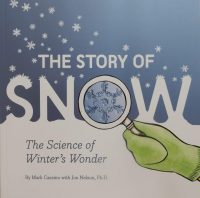
The Story of Snow
Mark Cassino and Jon Nelson
Chronicle Books
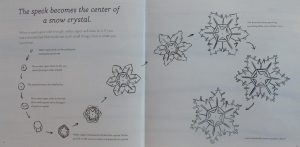
In this narrative non-fiction book we begin high up in the clouds with an explanation of how a tiny speck of earthly matter becomes a snow crystal (each crystal requires a single particle to start growing); and then we zoom right into a crystal.

Did you know that its shape depends on the wetness of the cloud and how cold it is? Or, that a single crystal is rarely perfect.
We learn that there are in fact, three main types of snow crystal – star-shaped, plate and column-shaped; and are told something about each kind including the different conditions under which the three kinds form.

With its succinct text, diagrams and amazing photographs of each kind of crystal, this is an excellent starting point for those who want to discover more about snow and can be used across a wide age range. There’s even an instruction spread on how to catch and observe snow crystals; and I love the final quote from Japanese scientist, Ukichiro Nakaya, ‘A snow crystal is a letter from the sky.’ – a perfect ending to a fascinating book.

Bugs
Simon Tyler
Pavilion Books
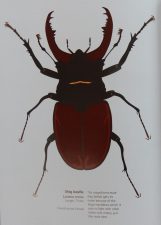
This large format book is packed with bright, bold illustrations and is designed to draw readers into the fascinating world of insects, the title word being used as an alternative generic term for this entire class of animal.
The first third is devoted to their general characteristics including anatomy, life cycle, eyes …

and other senses, and how and what they eat. Also included is an explanation of taxonomy.
The remaining 60 or so pages cover the nine main insect orders including beetles,

true bugs,

dragonflies, flies, cockroaches and termites. There’s also a double spread each, covering the most dangerous bugs, and some beneficial ones at the end.
The larger than life illustrations of representatives of each order are drawn from all parts of the world and each is captioned with its own common and scientific names, its size, its geographic range and a short factoid of additional information. The detailed scientific information together with the superb illustrations make it appropriate for a wide readership.

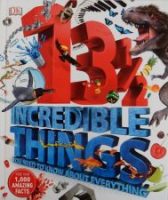
13 ½ Incredible Things You Need to Know about Everything
DK
Dorling Kindersley do non-fiction books really well and this one is amazing.
The title of this large volume makes you stop in your tracks and wonder what on earth could be inside.
Prepare to be impressed at the superb exploded illustrations you’ll encounter at every turn of the page, be they of Fantastic Fungi, Super Seeds or any other of the biological topics explored.

Biology isn’t the only subject herein though. The book also covers medicine, space, geology, history, technology, music and more, such is its diversity.
With over a thousand facts (not to mention those myth-busting halves, one per topic) you’re guaranteed a fascinating read. And if you don’t come away from the book knowing a whole lot more than before you started reading it, then your knowledge must have been truly encyclopaedic.