This Book Will Make You an Artist

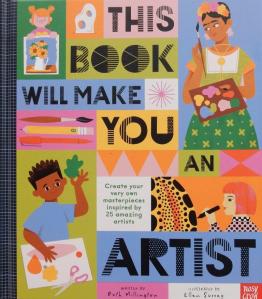
Author and art historian, Ruth Millington, has created a truly inspiring book. Together with illustrator Ellen Surrey, she takes readers through the essential steps towards becoming an artist. First she looks at where our artistic endeavours might take place, then presents various tools and materials that artists use and introduces the colour wheel. Thereafter come the spreads that showcase individual artists, their techniques and examples of their creations.

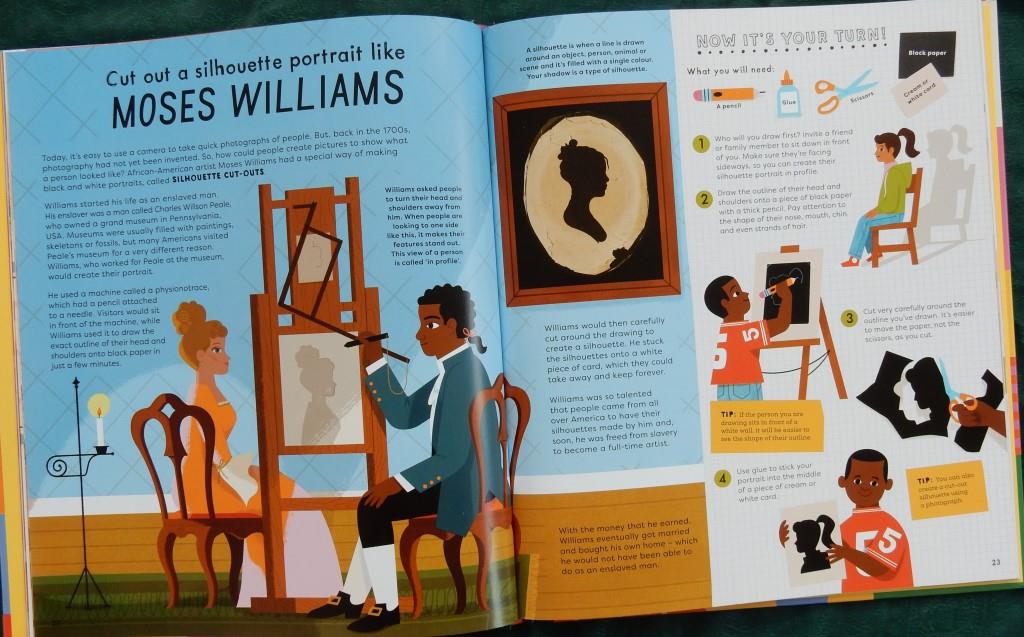
Ellen’s superb illustrations will surely invite readers to experiment with hand printing in the style of a cave painter, use tiny tessera to design a mosaic like an ancient Roman, experiment with block printing in the style of Katsushika Hokusai, emulate Moses Williams by cutting a silhouette portrait,

have a go at pointillism, the technique used by George Seurat or, inspired by seeing the illustration of Yayoi Kusama’s work, even try making a polka-dot pumpkin. Maybe you’d rather get crafty and wrap a string sculpture like Judith Scott: I learned from this book that as well as wrapping many everyday items, she also covered herself in ribbons, scarves and fabric to make a sculpture of her own head. Also showcased among others, are Frida Kahlo, Andy Warhol, Liu Bolin aka ‘the invisible man’ – a total of twenty five in all.

Back matter includes a glossary of terms and a short paragraph about both author and illustrator of this excellent book, one I’d suggest isn’t only for children. Anyone interested in art will find this a valuable resource.

The Looking Book

The Looking Book
Lucia Vinti
Pavilion Children’s Books

Very young children are all artists, no one’s told them otherwise; but once they get to around seven, many become hypercritical of what they create saying such things as “I can’t draw”. Or to use the words of Pablo Picasso, “ Every child is an artist. The problem is how to remain an artist once he grows up.”
Now here is a book that will help them get over that can’t do notion.

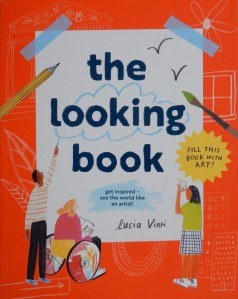
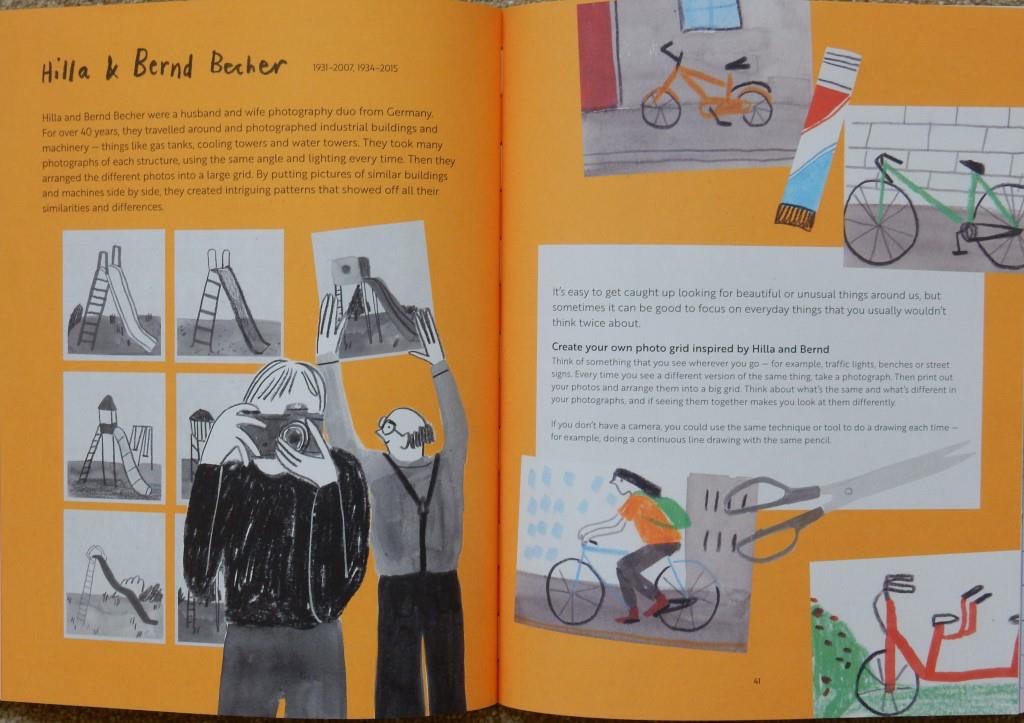
It’s full of creative ideas that show youngsters how to view the world as an artist might and then go on to create art of their own. By looking at things as if through the lenses of eleven artists including Clementine Hunter, David Hockney, husband and wife photographers Hilla and Bernd Becher,

Kehinde Wiley and Henry Moore children can try their hand at producing folk art paintings, a ‘joiner’ sequence, a photo grid of different versions of one item (a bench perhaps), a portrait in the style of Kehinde Wiley

and draw a collection of some interesting natural objects, maybe textured sticks and leaves to use in a design for a sculpture, as did Henry Moore.

These are just a few examples of the exciting challenges of the seventy suggested by illustrator Lucia Vinti. She encourages looking closer, looking up, down and all around, taking time to appreciate the surroundings, not taking anything you see for granted wherever you are and wherever you go (ideally with a copy of this book at the ready along with items from the toolkit shown on the opening spread).

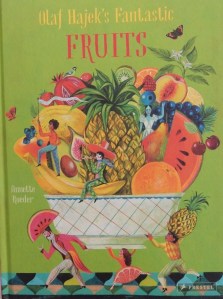
Olaf Hajek’s Fantastic Fruits

Olaf Hajek’s Fantastic Fruits
Annette Roeder and Olaf Hajek
Prestel

A veritable array of scrumptious fruits – depending on your taste of course – are served up in this third collaboration between author Annette Roeder and illustrator Olaf Hajek.

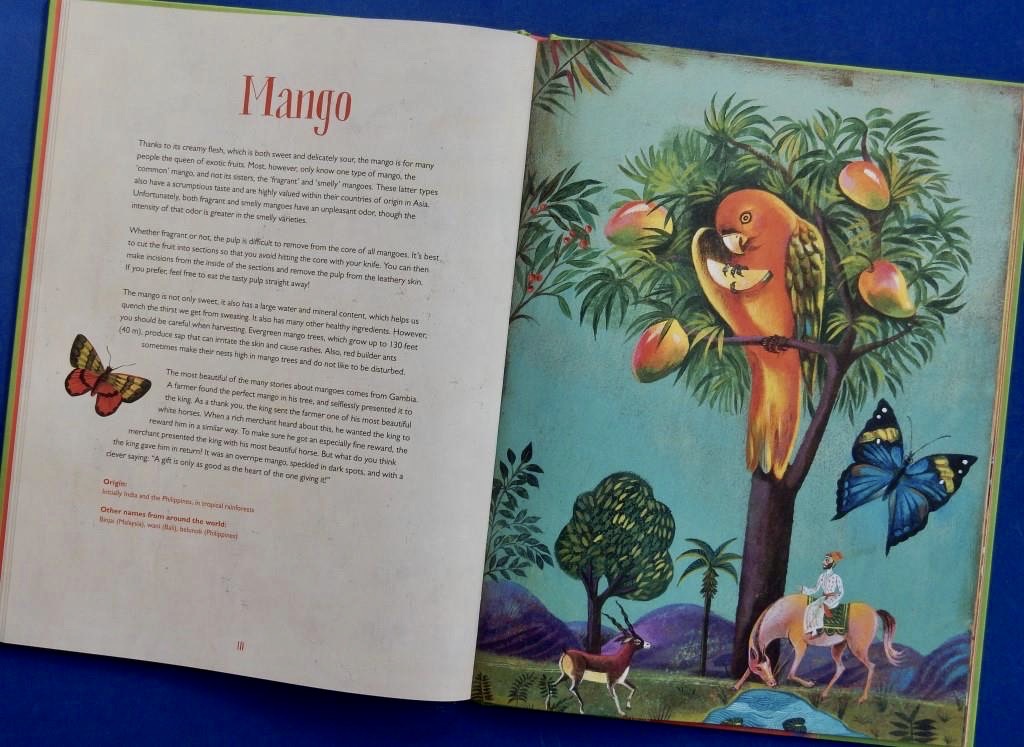
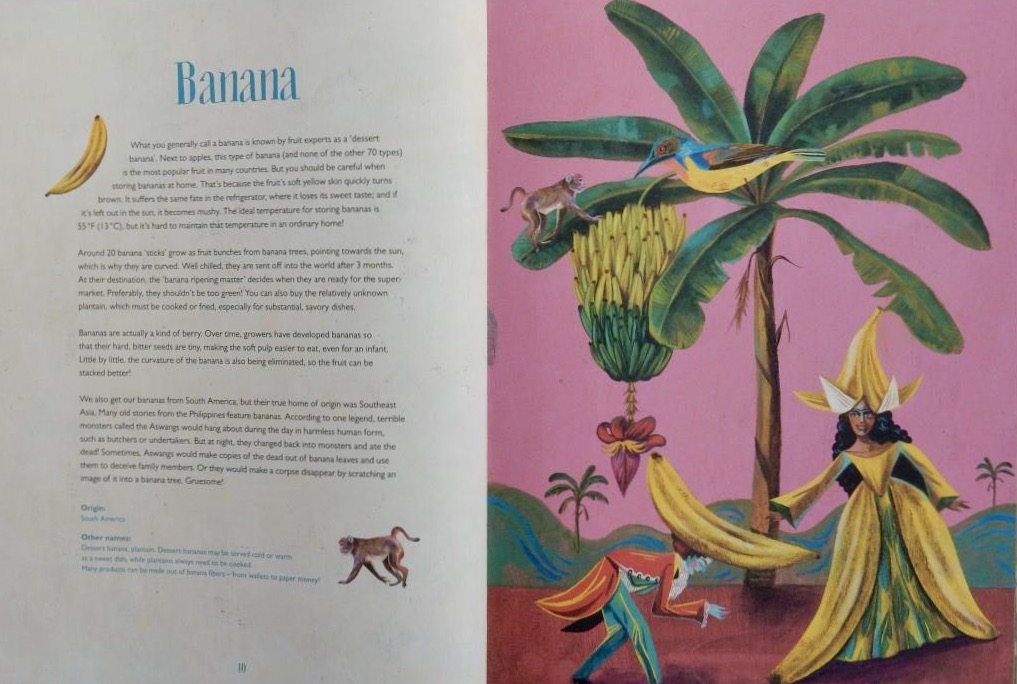
As with Veggie Power and Flower Power, Hajek draws on a variety of cultural heritages and artistic traditions, as he playfully conjures up an entire, imagination-sparking story world brimming with details in every one of his seventeen luscious surreal paintings.

For instance the style of the richly hued mango scene transported me to India and Mughal art, but Hajek’s arrangement of images with the dominant parrot clutching in its claws a neatly cut slice of the juicy fruit raised the question, ‘Was it sliced by human hands and if so, whose?’

In contrast the gooseberry and currant composition, had for me, something of the Mexican, Frida Khalo about it.

As well as providing visual clues as to how each fruit is grown, in some paintings, the featured fruit or the skin thereof, is used as part and parcel of a character’s attire. That is so with the gooseberries while in the case of banana, there’s a woman’s dress and hat comprised mostly of that fruit.

No matter where you open the book, opposite the illustration is an engaging page of text by Annette Roeder. This provides straightforward factual information drawn from history as well as modern times; there’s often some folklore, or perhaps a truncated myth or traditional fairytale. The final spread entitled ‘A colourful fruit salad fairy tale’ has a story so the author says, whispered to her by a woman in a shop about a spoiled prince and pineapples that grow wings so he can consume them at their perfect stage of ripeness; and there’s information about choosing wisely when it comes to selecting what to include in your own fruit salad.

Assuredly this large format book is full of mouth-watering delights and occasional surprises too.

Meet the Artist: Sophie Taeuber-Arp / Great Lives in Graphics: Frida Kahlo

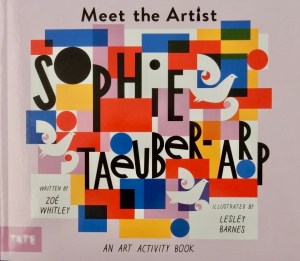
Meet the Artist: Sophie Taeuber-Arp
Zoé Whitley and Lesley Barnes
Tate Publishing

In this, the latest in the Tate Meet the Artist series readers visit the vivid world of Sophie Taeuber-Arp.

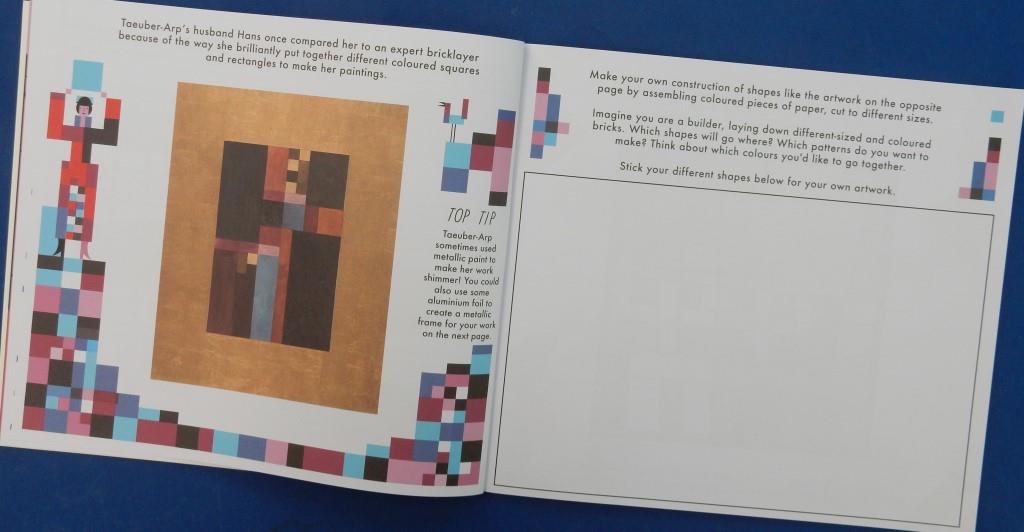
As well as being an abstract artist, she was a designer, puppet-maker, dancer, architect and magazine editor whose husband once compared her to an expert bricklayer on account of ‘the way she brilliantly put together different coloured squares and rectangles to make her paintings.’ Readers are invited to experiment in their own way with this idea, imagining being a creative bricklayer and making a design on the page opposite one of the artist’s works.

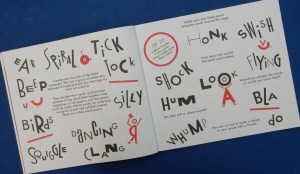
That is just one of the opportunities children are offered as they read about the artist’s life and are introduced to her key themes and works of art. Inspired by these, youngsters can also create a candle holder, design a magazine cover for a new publication, experiment with puppet making or funky costume design and more. Indeed an entire class might like to try creating and moving to sound poems in the fashion of the Dada movement of which Taeuber-Arp was a part.

Both engaging and lots of fun, try offering this book to a child from around six. (The activities don’t require any materials not likely to be found at home or youngsters could suggest their own alternatives if the odd thing is not readily available.)

Great Lives in Graphics: Frida Kahlo
Button Books

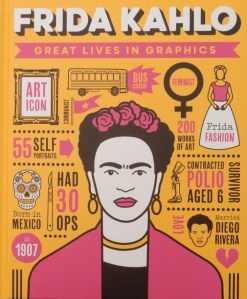
New in the publisher’s infographics series for KS2 readers, this features one of the world’s most famous artists.

Born in Mexico City, Frida spent her childhood in a bright blue house built by her father where she grew up with three sisters. While she was very young the Mexican Revolution broke out; her father couldn’t get much work so her family were forced both to sell their furniture and to rent out rooms in the blue house so they could afford to live.

Indeed many sad things happened in Frida’s life. At age six she caught polio, spending months in bed, after which time her right leg became very thin and her foot stopped growing.

This didn’t stop her gaining admission to Mexico’s prestigious school where she and eight friends formed a clique known as Los Cachuchas. Members got up to all kinds of mischief including stealing food from famous artist, Diego Rivera. Another tragedy happened when Frida was eighteen. A bus she was travelling on was hit by a tram, shattering the bus and severely injuring Frida who was again stuck in bed for months.

It was during that time she began to draw; her mother had a special easel made that Frida could use from a lying position; and she started painting self-portraits. It’s partly on account of this, we read, that most of her paintings are quite small.

From her schooldays Frida had a crush on Diego and they met again two years after her accident. Despite the twenty year age gap the two fell in love, married and had a stormy relationship, divorcing and remarrying a year or so later.

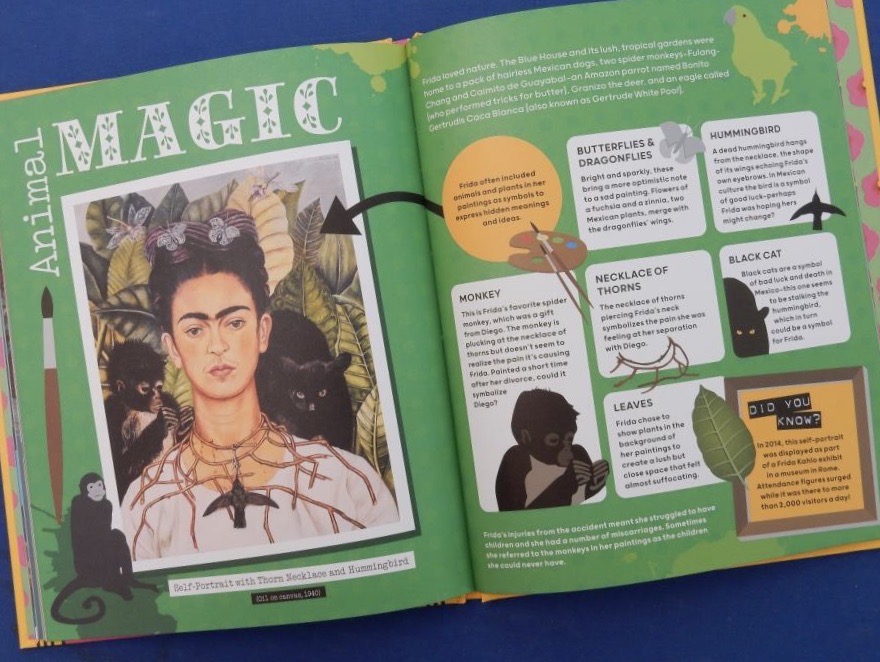
If little else, most people know of Frida’s flamboyant style of dressing and adorning herself, as well as her love of nature which often features symbolically in the paintings.

All this and more is included in this enticing book. Youngsters interested in art/artists and those studying Frida Kahlo in primary school especially, will want to get hold of a copy.