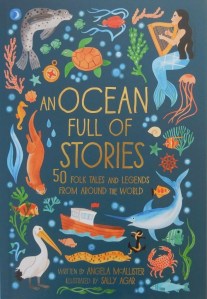
An Ocean Full of Stories

This is a fascinating collection of fifty folk stories, legends and traditional tales from all over the world retold by Angela McAllister. All are centred on different aspects of ocean life and the book is divided into six sections: Fishy Tales, Crossing the Water, Pools, Lakes and Rivers, Tricks and Trials, Ocean Gods and Water Spirits and finally, Beside the Sea, Beneath the Waves.
Some, including the North American Why River Waters are Never Still, Why the Sea is Salty (from Japan) and Why the Crocodile has a Wide Mouth (also from North American) are pourquoi tales that seek to explain why things are as they are.
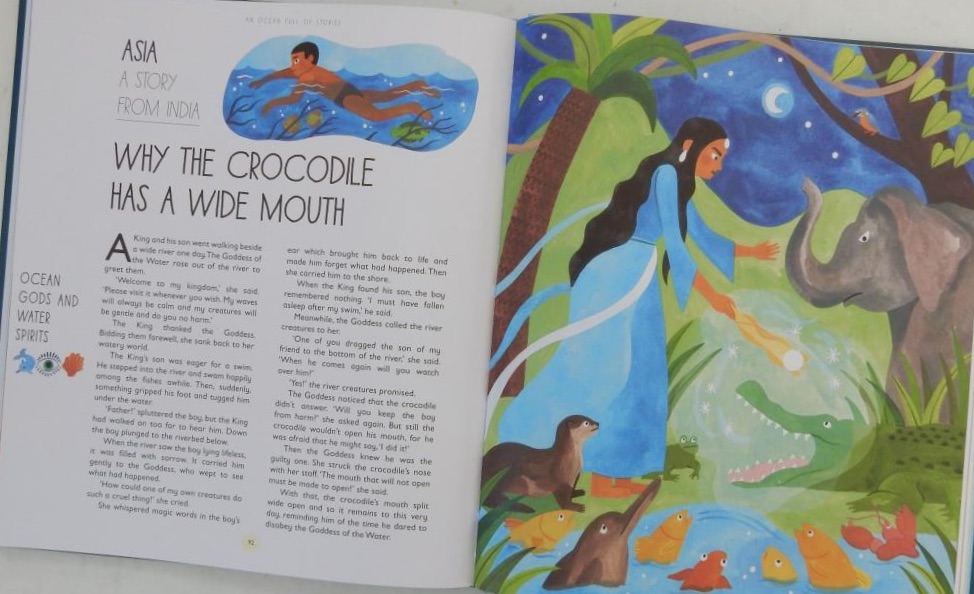
You’ll discover several stories about greed and its consequences such as The Fisherman and his Wife and The Sea King’s Gift.

Not all the stories have human characters, indeed many are all about animals: a story from England that’s new to me The Magic Mackerel has anthropomorphised fish and we discover what happens when Lord Shark decides to hold a grand ball although he doesn’t have a ballroom.

As with many traditional collections, Anansi the trickster manages to find his way into this one. He’s taught a lesson by Anene the crow that he endeavours to get to do all his work for him in Anansi’s Fishing Trip.
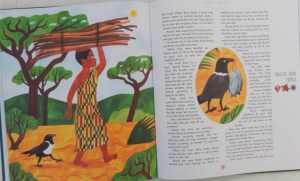
That Ghanian tale was also new to me: indeed one of the joys of collections such as this is discovering new stories. If you read them aloud to a class or group, make time to let your listeners enjoy Sally Agar’s bold, lively illustrations.
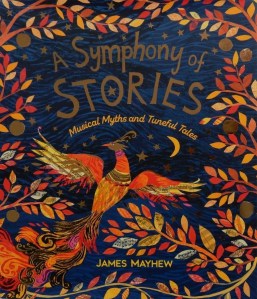
A Symphony of Stories

This stunner of a book is a companion to James’ Once Upon a Tune. Herein the author/artist features works by composers from different parts of the world that will be familiar to many – Saint-Saëns, Vivaldi, Debussy, Holst and Stravinsky – and also introduces a work new to me and I suspect many other readers, a famous Chinese piece by Chen Gang and He Zhanhao . As the author says in his introduction, ‘Most of the stories are retold from the original tales that inspired the composer.’

First, readers are invited to Saint-Saëns’ The Carnival of the Animals which is cleverly imagined with a regally-attired lion cheerily introducing the show in a sequence of riddling descriptions as the various creatures participate in a procession through the streets of Paris.

Next is Vivaldi’s The Four Seasons wherein the author uses his own research into the composer’s life imagining him being inspired by living in the countryside. Third, Claude Debussy’s The Sunken Cathedral has its origins in an ancient Breton myth and plunges us into a tragic love story.

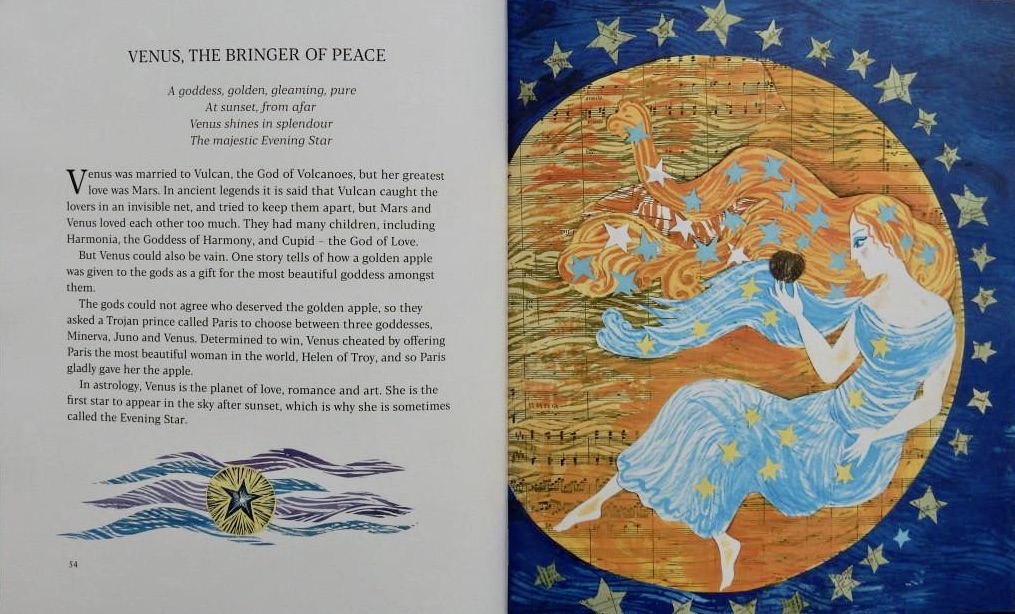
The focus of The Planets (Gustav Holst) are stories of the Roman gods and goddesses that they were named for.

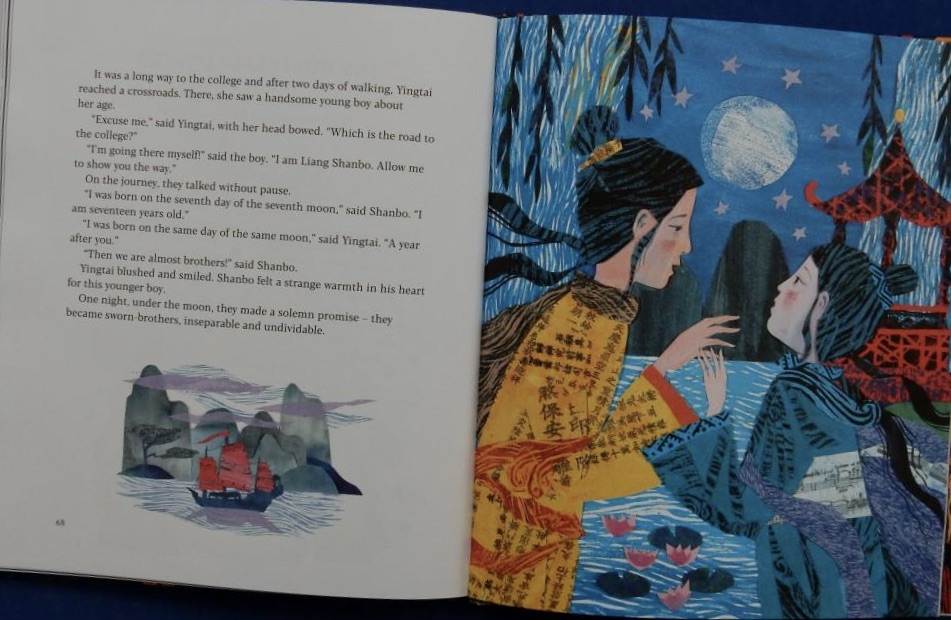
Also with its roots in tragedy, a Chinese legend of thwarted love The Butterfly Lovers tells of a girl who. to fulfil her longing to be educated, disguises herself in her brother’s clothes. On her long walk to the college clad in male attire she encounters a boy who offers to show her the way. The two become ‘sworn-brothers’ undividable: the boy, Shanbo forms a very deep bond with Yintgai but can the two ever be united?

Originally written for a ballet, Stravinsky’s The Firebird is the final piece, as engagingly told as the previous stories. Having visited magical realms, readers are brought back to reality with some musical notes from the author and the book concludes with some recommended recordings of the music to stream or download.

An absolutely terrific celebration of creativity through art, music and words. A book to keep and to give.

Future Hopes: Hopeful stories in a time of climate change


‘… dreams and stories are the real seeds of change.’ So says Nicola Davies in her foreword to
this book, a collection of nine compelling short stories edited by Lauren James, the theme being the climate crisis.

First we have Eyeballs, Tentacles and Teeth by Oisin McGann’s exciting tale of plastic eating bacteria and geoengineering with its unintended consequences – there’s a giant squid in this one. Next comes Tolá Okogwu’s Saving Olumide, a tale of community food production using a farm created on the roof of an apartment building, family love and neighbourly kindness. All the stories are thought-provoking and each has its own appeal. I laughed at Louie Stowell’s playful comic strip They Came Back with its rewilding theme and fanciful elements; but I think my absolute favourite is M.G. Leonard’s Food of the Future which tells how two friends win their school competition which asks that pupils create a sustainable, preferably innovative dish; the Bug Burgers that Borneo and Francesca make are assuredly that, but they taste delicious too.

Lauren James follows each story with a summary and the facts behind the fiction, together with observations and ideas about how each of us, through our lifestyle choices, can make a difference. In so doing, having read this optimistic book, one hopes today’s children feel galvanised and sufficiently empowered to become part of the change that saves our precious planet Earth. With its terrific cover art by David Litchfield, it’s a must have collection that needs to be in every upper primary and secondary class collection.

This Book Will Make You an Artist

Author and art historian, Ruth Millington, has created a truly inspiring book. Together with illustrator Ellen Surrey, she takes readers through the essential steps towards becoming an artist. First she looks at where our artistic endeavours might take place, then presents various tools and materials that artists use and introduces the colour wheel. Thereafter come the spreads that showcase individual artists, their techniques and examples of their creations.

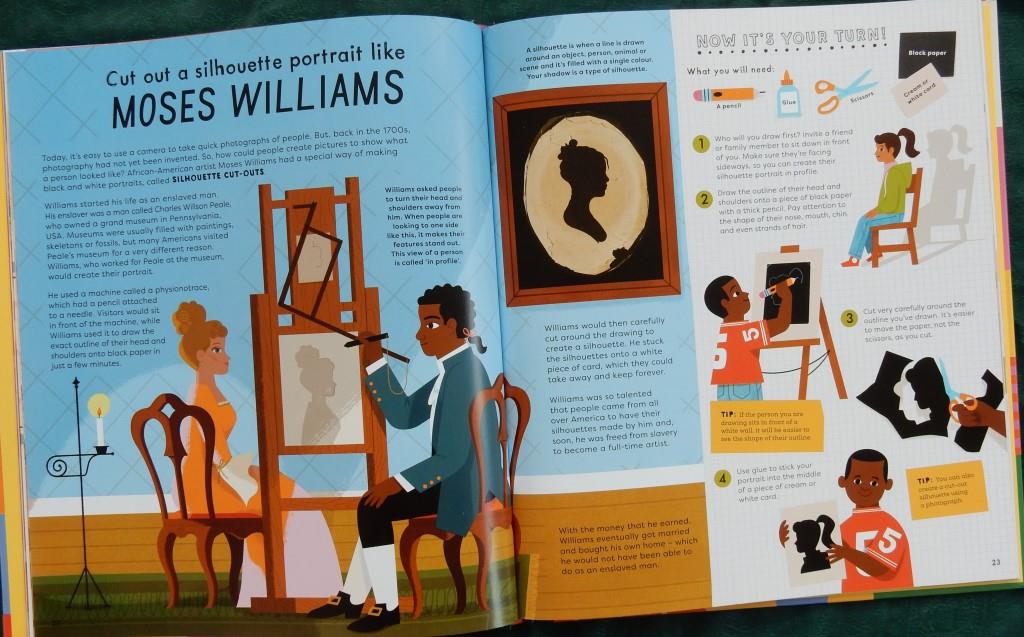
Ellen’s superb illustrations will surely invite readers to experiment with hand printing in the style of a cave painter, use tiny tessera to design a mosaic like an ancient Roman, experiment with block printing in the style of Katsushika Hokusai, emulate Moses Williams by cutting a silhouette portrait,

have a go at pointillism, the technique used by George Seurat or, inspired by seeing the illustration of Yayoi Kusama’s work, even try making a polka-dot pumpkin. Maybe you’d rather get crafty and wrap a string sculpture like Judith Scott: I learned from this book that as well as wrapping many everyday items, she also covered herself in ribbons, scarves and fabric to make a sculpture of her own head. Also showcased among others, are Frida Kahlo, Andy Warhol, Liu Bolin aka ‘the invisible man’ – a total of twenty five in all.

Back matter includes a glossary of terms and a short paragraph about both author and illustrator of this excellent book, one I’d suggest isn’t only for children. Anyone interested in art will find this a valuable resource.

A World Full of Winter Stories

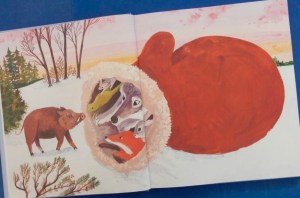
This is a veritable cornucopia of folk tales, myths and legends – fifty in all – gathered from around the world and retold by Angela McAllister. There are six sections: Birds and Beasts, Tricks and Troubles, Ice and Snow, Quests and Journeys, Spirits and Magic and the shortest, Christmas. Each contains stories I was familiar with, but also several new to me. One such was the very first, a tale from Japan telling how snowballs made by the children of the Sky Goddess become the ‘The First Rabbits’. Also new to me, from the same section is an amusing Ukrainian story about a dropped mitten that, unbeknown to its boy owner, becomes a temporary shelter for seven animals.

From the Tricks and Troubles section, a story from Kazakhstan that made me smile was The Marvellous Coat wherein a crafty man tricks another into exchanging coats, ending up with a thick warm coat plus a fine horse, instead of his original holey coat and worn out steed.

Bears feature quite often in wintry tales and this book is no exception. The Long Winter. a Dene story from Canada, in the Ice and Snow section tells how a group of animals struggling from the constant winter climb up into the sky to search for the world’s warmth. There they discover some bear cubs from whom they learn of the whereabouts of that which they seek, although reclaiming it from the mother Bear and restoring sunshine is anything but an easy task.

If you’ve ever wondered why some trees and bushes never lose their leaves, The First Evergreens, a Mongolian tale in section four, offers an explanation that involves a good-hearted swallow.
There’s an Inuit story in Spirits and Magic that took my fancy. It tells how a stolen wife was reunited with her husband, a village chief thanks to an old woman, a special charm and some magic words remembered just in the nick of time.

You might be surprised to learn that a scarecrow features in the final section, in a story from North America, a scarecrow that ends up helping Santa.

This book is a joy to share with children at home or in the classroom during the winter months. The tales are just the right length for a story time session and Olga Baumert’s illustrations, be they large or small, bring an extra touch of magic to each one.

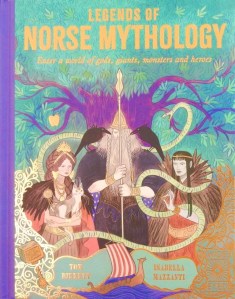
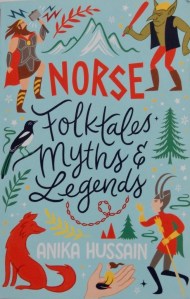
Legends of Norse Mythology / Norse Folktales, Myths and Legends

This image has an empty alt attribute; its file name is dscn9983-1.jpg


This book transports readers way, way back through time to a realm of ice and fire, magic and mischief. There they will encounter characters from Norse mythology including gods and goddesses, monsters, giants, elves, dwarfs, the Valkyries and other mythical beings – over thirty in all.


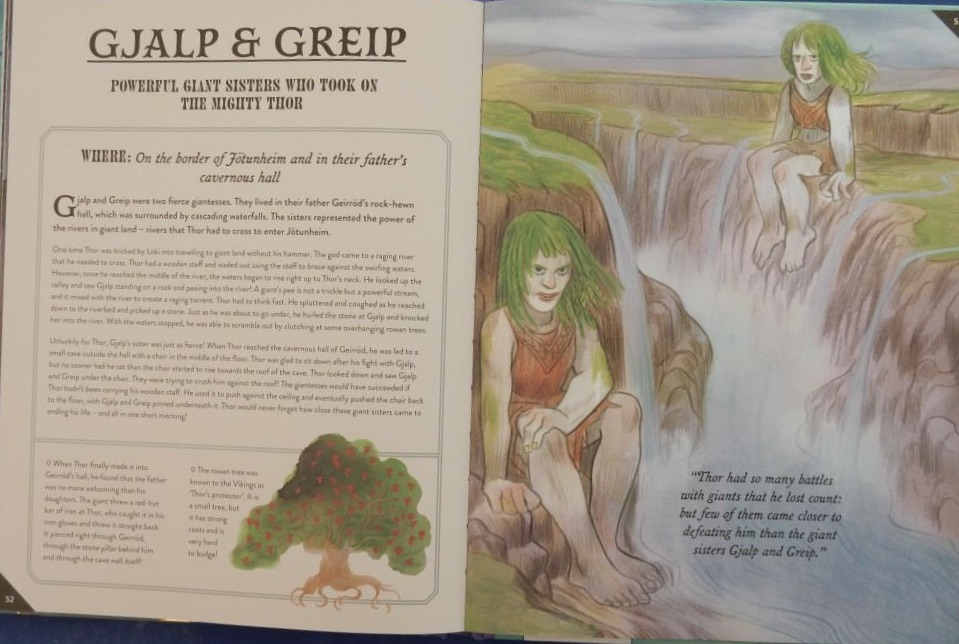
Starting with Odin, each individual profile introduces us to the character, giving such details as their chief attributes, there’s a story and additional details. Yes, all the well-known deities are there but you will also meet the likes of the bright and shining god, Baldur, renowned for his goodness,

This image has an empty alt attribute; its file name is dscn9984-1.jpg

Sif, goddess of wheat and golden hair, married to Thor, the Norns – Urd, Verdandi and Skull, controllers of the destiny of each and every living being in the world. If your preference is giants then you can search the contents page for where to learn of giant sisters Gjalp and Greip,

This image has an empty alt attribute; its file name is dscn9985-1.jpg

and Fenja and Menja, strong giantesses who grind out the salt on the ocean bottom.
Interspersed with the profiles are summaries of famous Norse tales and events such as that of Thor’s hammer and the story of Ragnarök.


The book is concisely written by Norse mythology expert Dr Thomas Birkett and illustrated beautifully, occasionally aptly spookily, by Isabella Mazzanti who manages to capture the essence of each character in her portrayals.


Altogether a very useful introduction to an endlessly fascinating topic; for KS2 readers and beyond.

This image has an empty alt attribute; its file name is dscn9996-1.jpg


Divided into four parts, the book comprises Legends from Norse Mythology, and a selection of folk tales from Denmark, Norway and Sweden, each section having five stories.


As you would expect, Loki the cunning, shape-changing trickster and powerful Thor, his ‘brother’ feature in the first, the Norse mythology section.


Along with lesser-known stories, the Danish section includes a retelling of Hans Christian Andersen’s Little Thumbelina, the tiny golden-haired girl with the beautiful voice who enchants creatures with her singing including a mole that she narrowly misses having to marry.


New to me in the Norwegian part, using the same folktale structure as Snow White, is The Twelve Wild Ducks wherein a queen who yearns for a daughter makes a deal with a witch: give up her twelve sons in return for a princess daughter.


I read of Jolly Calle for the first time in the Swedish section. It tells of a boy who remains upbeat and positive no matter what, and finds beauty in simple everyday things.


A delightful collection of tales retold in an appropriately direct style; it deserves to be added to KS2 primary class libraries and home bookshelves.

Snow White and other Grimms’ Fairytales / A Fairytale for Everyone

Snow White and other Grimms’ Fairytales
Jacob and Wilhelm Grimm, illustrated by MinaLima
Harper 360

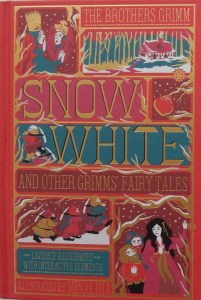
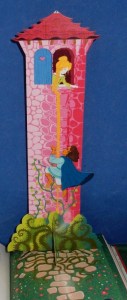
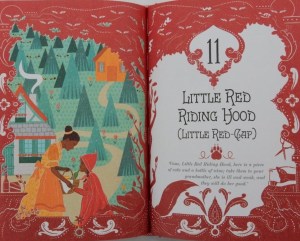
Twenty fairy tales are given the design team, MinaLima (Miraphora Mina and Eduardo Lima) treatment in this glorious collection. What this means in short is wonderfully imaginative artwork exquisitely detailed and engaging design with interactive elements (nine herein), bring to life timeless stories including, Sleeping Beauty, Rapunzel, Rumpelstiltskin, Hansel and Gretel, Little Red Riding Hood (Little Red-Cap),The Frog Prince and The Elves and the Shoemaker.

You will delight in such surprises as the awesomely intricate thicket surrounding the castle the prince must deal with to release Sleeping Beauty from her slumbers, a pop up tower that climbs right out of the book in Rapunzel, with a prince you can make climb up her golden hair – possibly my favourite.

A close contender though, is the pop-out house in Hansel and Gretel that opens into a diorama of the interior with a kitchen and a wicked witch waiting to lure the two children inside.
It’s good to see that ethnicity has also been a consideration in the portrayal of the characters, some of whom have brown or black skin: Red Riding Hood is shown as black, for example.

With vividly coloured illustrations, both large and small throughout, this book is one for keeping and for giving. With the festive season fast approaching, it would make a magical Christmas present.

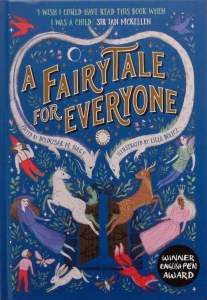
A Fairytale for Everyone
edited by Boldizsár M. Nagy, illustrated by Lilla Bölecz
Farshore

This groundbreaking collection of seventeen re-imagined traditional stories was highly controversial when originally published in Hungary on account of its inclusive nature. However because LGBTQ+ characters are featured it rapidly became a symbol in the fight for equality and against discrimination in Hungary and received a great deal of support both in the country and outside.

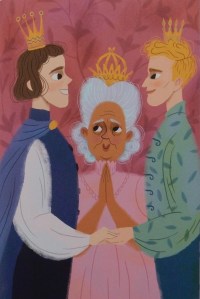
You’ll find stories that push back the boundaries of traditional gender roles showing how heroes can be any shape or size, princesses enormously powerful such as Margaret the Giant Slayer. In the final story written in rhyme, a prince finds true love, not with the blonde princess presented to him, but with her equally fair brother.

I loved the reworking of the Thumbelina tale of Little Lina who discovers what being big really means when she meets a fairy prince, small in stature like herself.

A true celebration of diversity that will likely appeal most to those with an interest in traditional tales.

Grimms’ Fairy Tales / Lore of the Land

Grimms’ Fairy Tales
retold by Elli Woollard, illustrated by Marta Altés
Macmillan Children’s Books

Having read Elli Woollard’s splendid rhyming renditions of some of Aesop’s Fables I was eagerly anticipating these new rhyming fairy tales. Elli has chosen five well known ones on which to weave her rhyme magic and the result is again brilliant.
First to get the touch of her wand is Little Red Cap who is off to visit her grandma with a freshly baked cake and some elderflower wine. I love the way that wolf meets his demise. Next is The Elves and the Shoemaker, followed by Hansel and Gretel, The Musicians of Bremen and finally Cinderella, each story being deftly retold in a way that makes them a sheer pleasure to read aloud.

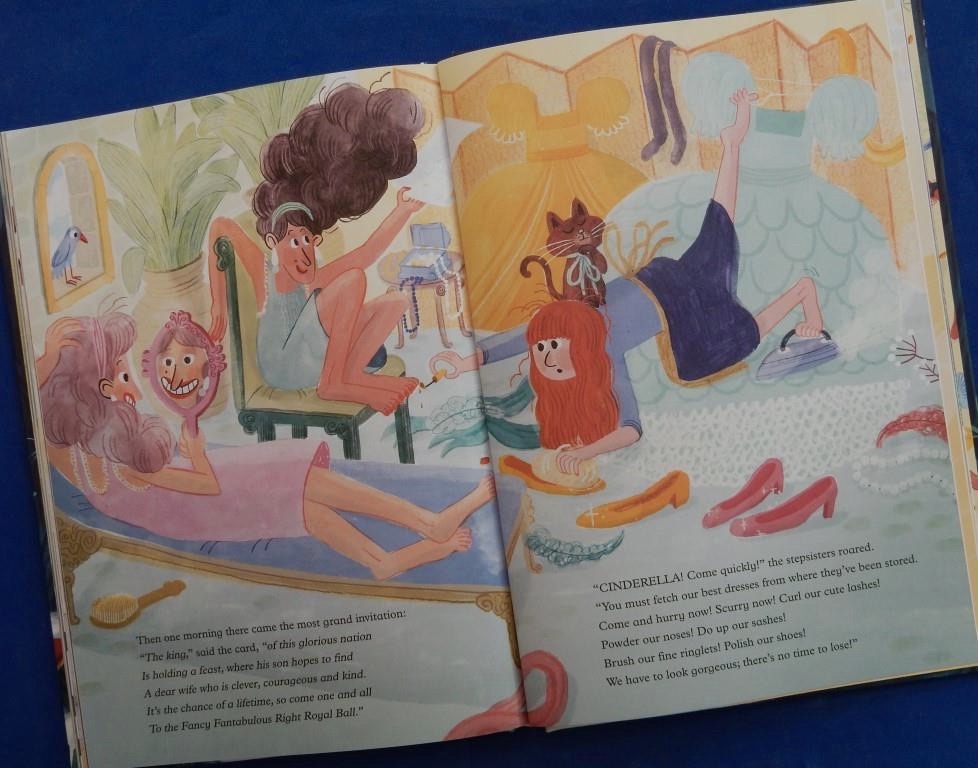
Marta Altés gorgeous illustrations too, help bring each telling to life and contain some really fun detail. The spread showing the stepsisters’ preparations for the Fancy Fantabulous Right Royal Ball is hilarious.

Enormous fun for young readers and listeners as well as adult readers aloud, and a cracking book from cover to cover.

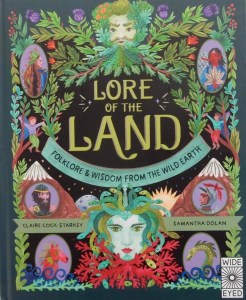
Lore of the Land
Claire Cock-Starkey and Samantha Dolan
Wide Eyed Editions

Folktales about landscapes the world over, along with secrets from the natural world are unearthed in this stylishly illustrated book.

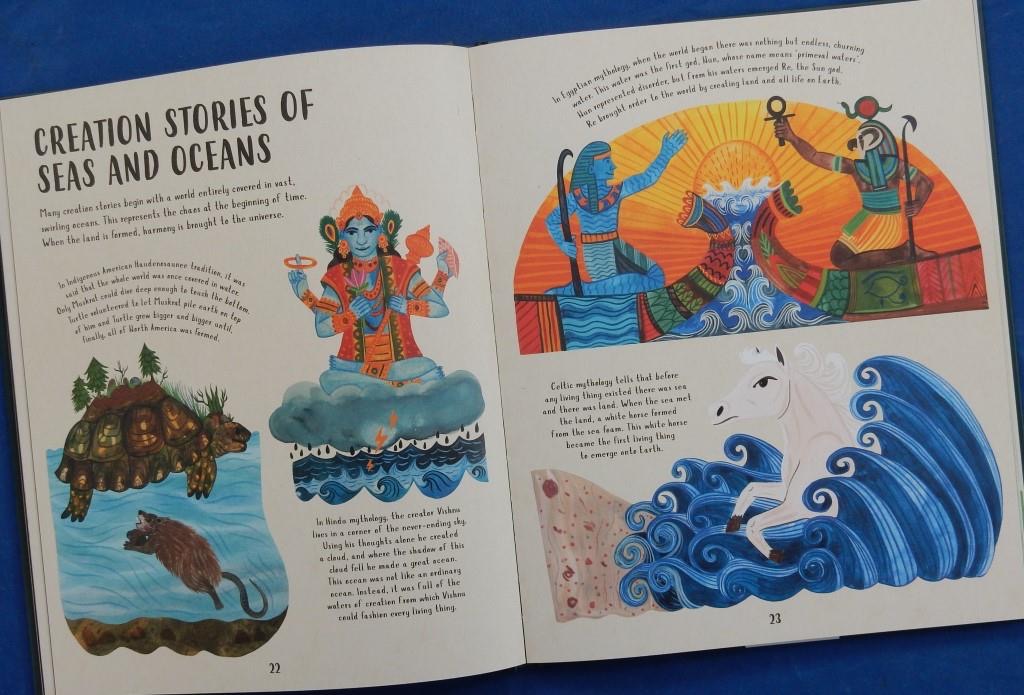
There are six parts, each presenting the folklore of a different landscape: forests, seas and oceans, mountains, hills and valleys, rivers and lakes and finally, wetlands. Each part begins with a folk story, the first being a Czech tale Betushka and the Wood Maiden telling how a girl and her mother’s fortunes are forever transformed by the daughter’s acceptance of an invitation to dance with a stranger instead of working at her spinning when she takes her goats into the forest to graze.
The next spread has synopses of creation myths associated with the forest. (Each of the other landscapes also has a creation stories spread.)

There’s an abundance of ancient wisdom associated with such things as sprites, spirits and other mythical creatures, plants, and more. You can discover why the massive volcanic mountain, Mount Tararnaki stands alone on the edge of New Zealand’s North Island as well as why Ancient Greeks thought there was a forge beneath Mount Etna and what was made there. This and much more is arrestingly illustrated in folk style artworks that grace every spread. There’s plenty to engage young lovers of nature, especially those with an interest in fictive possibilities.

Stories of Peace & Kindness for a Better World / Human Kindness

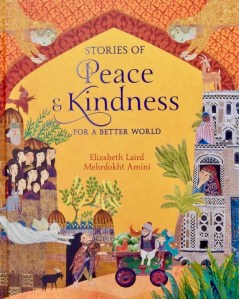
Stories of Peace & Kindness for a Better World
Elizabeth Laird, illustrated by Mehrdokht Amini
Otter-Barry Books

This book contains Elizabeth Laird’s lively retellings of seven folktales from various parts of the world – Ethiopia, Sudan, Palestine, Yemen, Afghanistan, Syria and China – each of which is intended to inspire hope and reconciliation following recent conflict or war; and each of which is elegantly illustrated by Mehrdokht Amini. In view of the on-going Russian attacks on Ukraine it couldn’t be more appropriate and timely.

In the first story from Ethiopia a fight between two dogs, one small, one large quickly escalates into a battle between two clans wherein lives are lost on both sides. Can the words of a wise old man show the fighters the error of their ways?

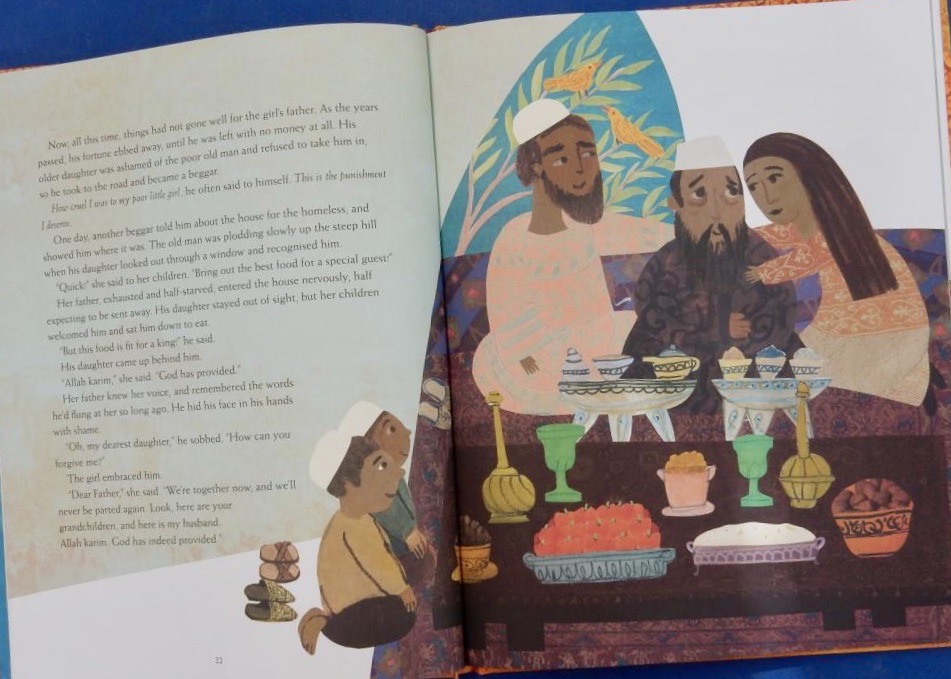
It’s the discovery of buried treasure, and an act of forgiveness that ultimately lead to a reunion of a father and the younger of his two daughters in Allah Karim, the tale from Sudan.

A Palestinian shepherd tries and succeeds in showing a rich sultan what real kindness is; and a camel is fundamental in an ageing father’s choice of an heir to rule his kingdom in Yemen. There’s a selfish Emir ruling a great kingdom in Afghanistan: can the angel that appears in his dream cause him to change his ways and become a caring ruler? From Syria comes a tale wherein a woodcutter ventures onto an island, persuades the resident lion to allow him to take away some of the wood to sell thus saving himself and his family from starving, only to spurn the lion when he tries to join a party he’s hosting: what does that mean for the woodcutter/lion friendship? Finally in the Uighur story from China the Khan’s nine princess daughters eventually bring peace and happiness to the kingdom of Kashgar and best of all is the fact that it’s done without fighting.

Rich in pattern, the illustrations are infused with a gentle humour that subtly convey both the futility of hostility and fighting, and the joy brought about by peace.

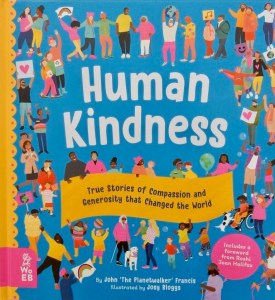
Human Kindness
John Francis and Josy Bloggs
What on Earth Books

Starting with some examples from his own life, author and Planetwalker John Francis explores aspects of kindness before moving on to look at the history of kindness from the times of prehistoric humans to the present. He uses evidence from archaeological findings and ancient texts presenting a variety of versions of the ‘Golden Rule’ from different world views.
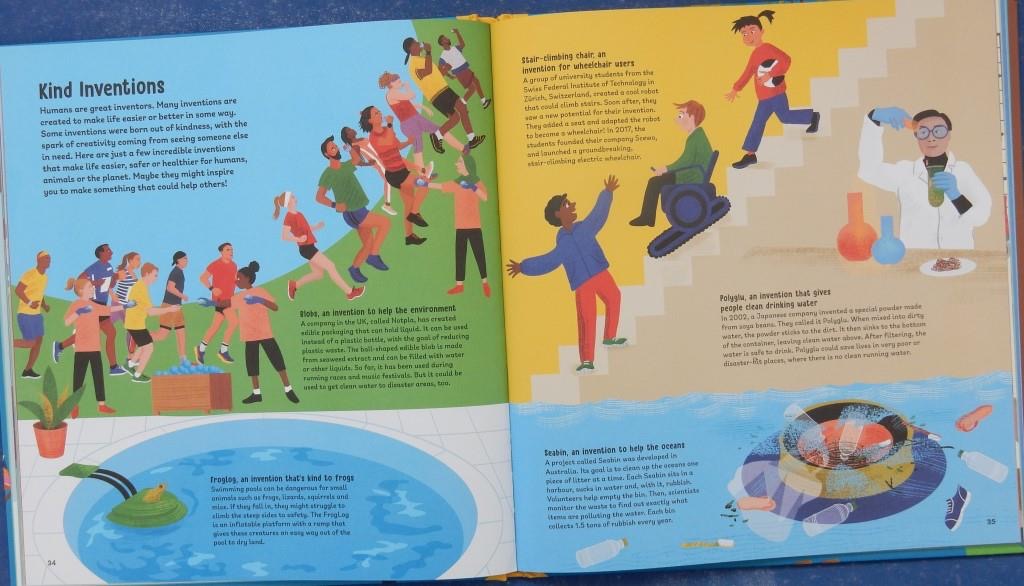
One section of the book is devoted to stories of kindness from all over the world and include such people as Malala Yousafzai, Harriet Tubman, Harold Lowe (a junior officer on the Titanic), healthcare workers and healers, people who have raised money for various charities concerned with education, hunger prevention, healthcare provision and animal welfare. Did you know that there are inventions that arose out of the imaginations of individuals who saw the need for creating a means to make life better for humans, for animals or for the planet?

There’s also information on the science of kindness – how being kind and compassionate benefits our health and happiness, and some examples of ways children can be kind.

Be they large or small, acts of kindness make the world a better place so, with its warm, bright illustrations by Josy Bloggs, this is a book that I’d like to see in primary classrooms and on family bookshelves.

The Looking Book

The Looking Book
Lucia Vinti
Pavilion Children’s Books

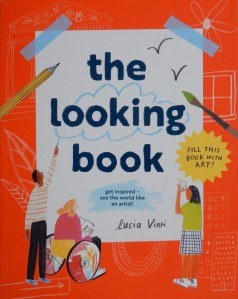
Very young children are all artists, no one’s told them otherwise; but once they get to around seven, many become hypercritical of what they create saying such things as “I can’t draw”. Or to use the words of Pablo Picasso, “ Every child is an artist. The problem is how to remain an artist once he grows up.”
Now here is a book that will help them get over that can’t do notion.

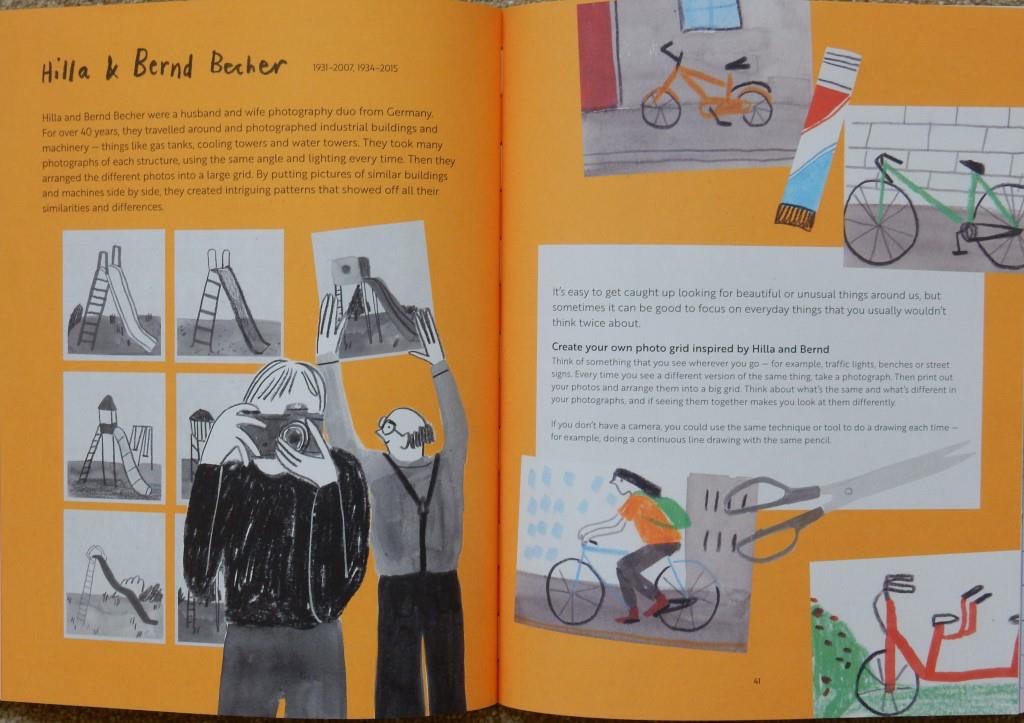
It’s full of creative ideas that show youngsters how to view the world as an artist might and then go on to create art of their own. By looking at things as if through the lenses of eleven artists including Clementine Hunter, David Hockney, husband and wife photographers Hilla and Bernd Becher,

Kehinde Wiley and Henry Moore children can try their hand at producing folk art paintings, a ‘joiner’ sequence, a photo grid of different versions of one item (a bench perhaps), a portrait in the style of Kehinde Wiley

and draw a collection of some interesting natural objects, maybe textured sticks and leaves to use in a design for a sculpture, as did Henry Moore.

These are just a few examples of the exciting challenges of the seventy suggested by illustrator Lucia Vinti. She encourages looking closer, looking up, down and all around, taking time to appreciate the surroundings, not taking anything you see for granted wherever you are and wherever you go (ideally with a copy of this book at the ready along with items from the toolkit shown on the opening spread).

Olaf Hajek’s Fantastic Fruits

Olaf Hajek’s Fantastic Fruits
Annette Roeder and Olaf Hajek
Prestel

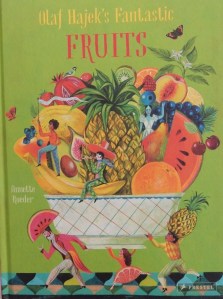
A veritable array of scrumptious fruits – depending on your taste of course – are served up in this third collaboration between author Annette Roeder and illustrator Olaf Hajek.

As with Veggie Power and Flower Power, Hajek draws on a variety of cultural heritages and artistic traditions, as he playfully conjures up an entire, imagination-sparking story world brimming with details in every one of his seventeen luscious surreal paintings.

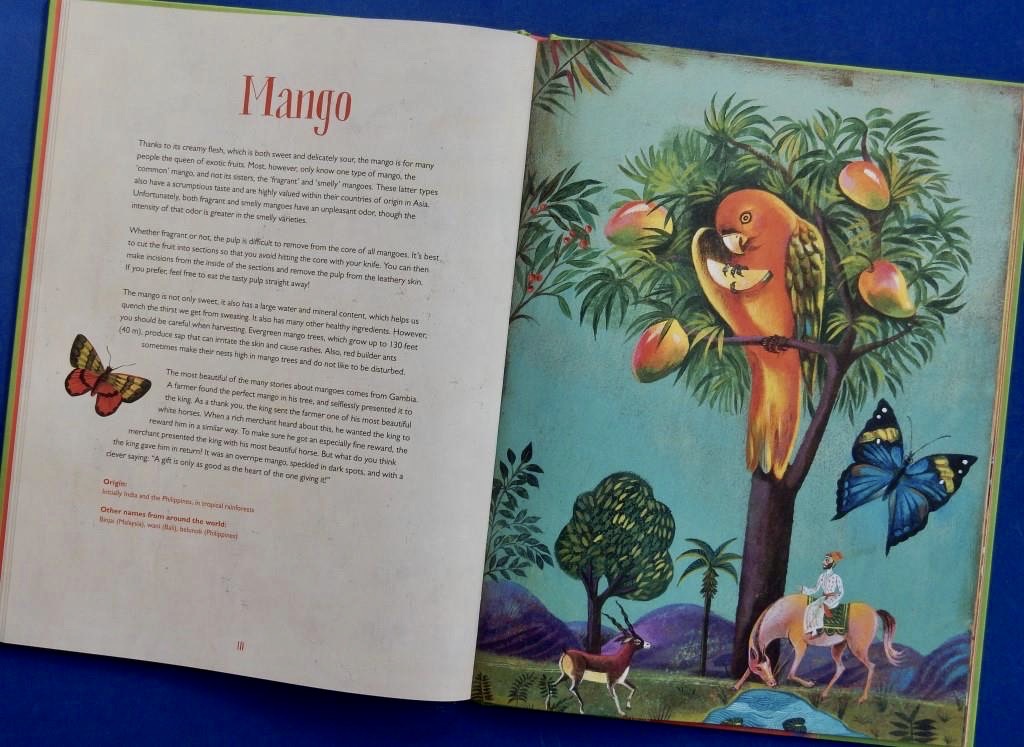
For instance the style of the richly hued mango scene transported me to India and Mughal art, but Hajek’s arrangement of images with the dominant parrot clutching in its claws a neatly cut slice of the juicy fruit raised the question, ‘Was it sliced by human hands and if so, whose?’

In contrast the gooseberry and currant composition, had for me, something of the Mexican, Frida Khalo about it.

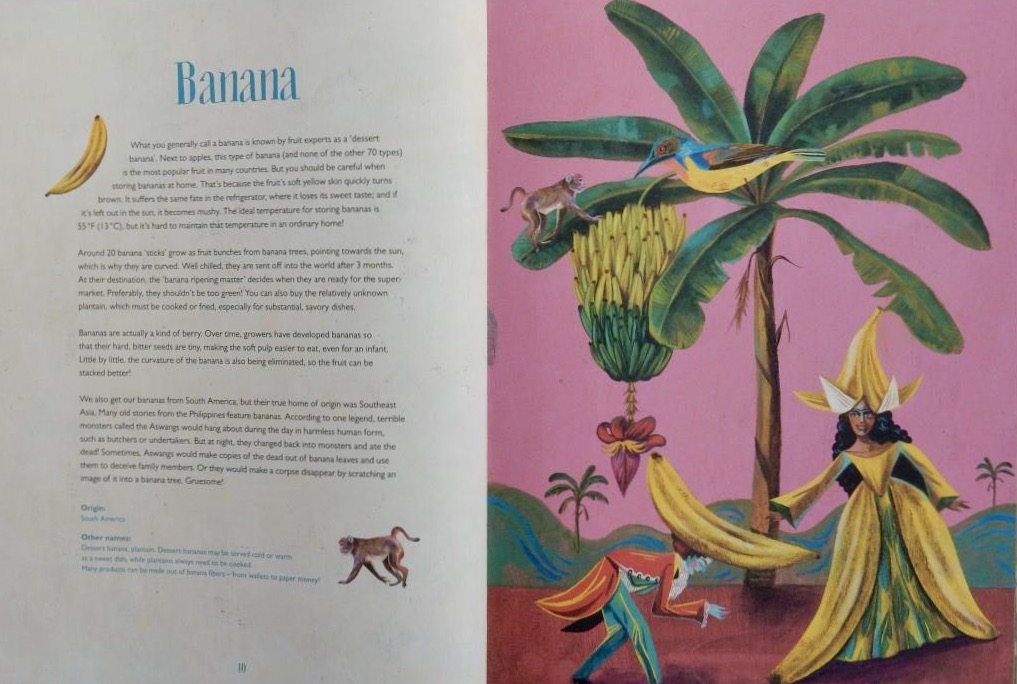
As well as providing visual clues as to how each fruit is grown, in some paintings, the featured fruit or the skin thereof, is used as part and parcel of a character’s attire. That is so with the gooseberries while in the case of banana, there’s a woman’s dress and hat comprised mostly of that fruit.

No matter where you open the book, opposite the illustration is an engaging page of text by Annette Roeder. This provides straightforward factual information drawn from history as well as modern times; there’s often some folklore, or perhaps a truncated myth or traditional fairytale. The final spread entitled ‘A colourful fruit salad fairy tale’ has a story so the author says, whispered to her by a woman in a shop about a spoiled prince and pineapples that grow wings so he can consume them at their perfect stage of ripeness; and there’s information about choosing wisely when it comes to selecting what to include in your own fruit salad.

Assuredly this large format book is full of mouth-watering delights and occasional surprises too.

Meet the Artist: Sophie Taeuber-Arp / Great Lives in Graphics: Frida Kahlo

Meet the Artist: Sophie Taeuber-Arp
Zoé Whitley and Lesley Barnes
Tate Publishing

In this, the latest in the Tate Meet the Artist series readers visit the vivid world of Sophie Taeuber-Arp.

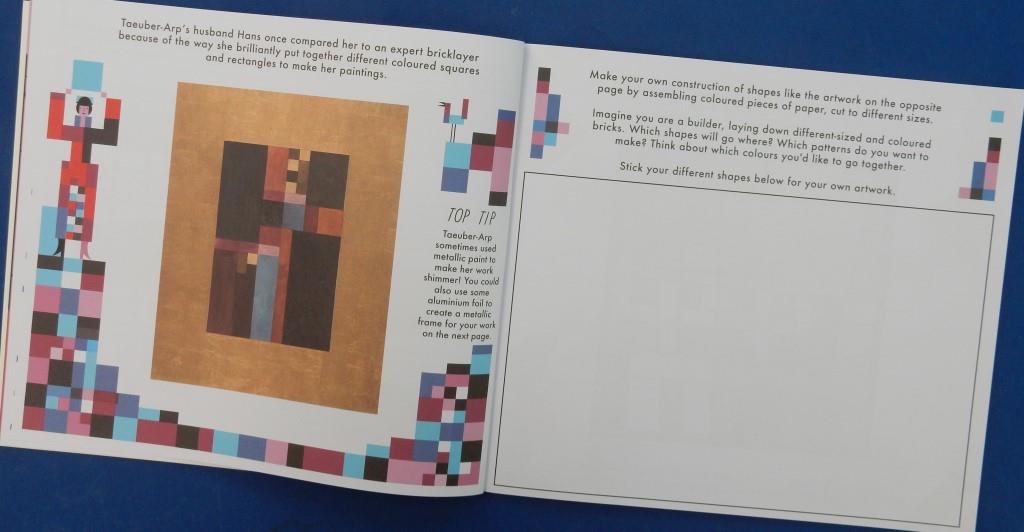
As well as being an abstract artist, she was a designer, puppet-maker, dancer, architect and magazine editor whose husband once compared her to an expert bricklayer on account of ‘the way she brilliantly put together different coloured squares and rectangles to make her paintings.’ Readers are invited to experiment in their own way with this idea, imagining being a creative bricklayer and making a design on the page opposite one of the artist’s works.

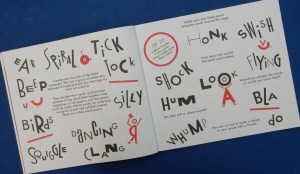
That is just one of the opportunities children are offered as they read about the artist’s life and are introduced to her key themes and works of art. Inspired by these, youngsters can also create a candle holder, design a magazine cover for a new publication, experiment with puppet making or funky costume design and more. Indeed an entire class might like to try creating and moving to sound poems in the fashion of the Dada movement of which Taeuber-Arp was a part.

Both engaging and lots of fun, try offering this book to a child from around six. (The activities don’t require any materials not likely to be found at home or youngsters could suggest their own alternatives if the odd thing is not readily available.)

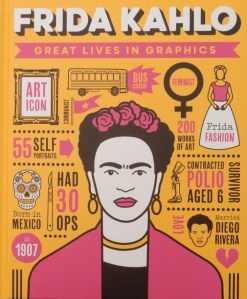
Great Lives in Graphics: Frida Kahlo
Button Books

New in the publisher’s infographics series for KS2 readers, this features one of the world’s most famous artists.

Born in Mexico City, Frida spent her childhood in a bright blue house built by her father where she grew up with three sisters. While she was very young the Mexican Revolution broke out; her father couldn’t get much work so her family were forced both to sell their furniture and to rent out rooms in the blue house so they could afford to live.

Indeed many sad things happened in Frida’s life. At age six she caught polio, spending months in bed, after which time her right leg became very thin and her foot stopped growing.

This didn’t stop her gaining admission to Mexico’s prestigious school where she and eight friends formed a clique known as Los Cachuchas. Members got up to all kinds of mischief including stealing food from famous artist, Diego Rivera. Another tragedy happened when Frida was eighteen. A bus she was travelling on was hit by a tram, shattering the bus and severely injuring Frida who was again stuck in bed for months.

It was during that time she began to draw; her mother had a special easel made that Frida could use from a lying position; and she started painting self-portraits. It’s partly on account of this, we read, that most of her paintings are quite small.

From her schooldays Frida had a crush on Diego and they met again two years after her accident. Despite the twenty year age gap the two fell in love, married and had a stormy relationship, divorcing and remarrying a year or so later.

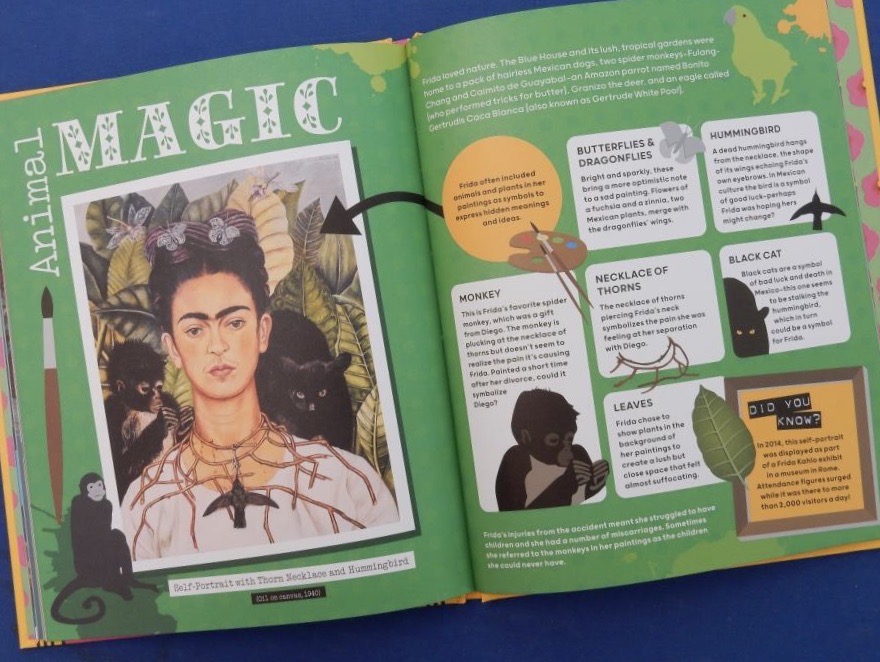
If little else, most people know of Frida’s flamboyant style of dressing and adorning herself, as well as her love of nature which often features symbolically in the paintings.

All this and more is included in this enticing book. Youngsters interested in art/artists and those studying Frida Kahlo in primary school especially, will want to get hold of a copy.

A Journey Through Greek Myths

A Journey Through Greek Myths
Marchella Ward, illustrated by Sander Berg
Flying Eye Books

Classics expert Marchella Ward, courtesy of Little Owl and her grandpa owl, takes readers on an exciting journey through Ancient Greece and the Greek myths from the beginnings of the Universe in Greek mythology, right through to the tale of Daedulus and Icarus, via the Labours of Heracles in her spellbinding sequence of stories awesomely illustrated by Sander Berg.

Perched atop the Parthenon in Athens, Little Owl listens to her Grandfather Night owl as he begins to regale her with stories of the ancient Greek world, stories that had so he says ‘taught the owls all of their wisdom’, the first being of events before Athens even existed and of whence came gods that first the Greeks and then, all humankind came to know.

The stories are divided into several parts: Athens, (where we hear of The Birth of Zeus and the incredible Birth of Athena), Mount Pellon, Mount Parnassus, where the owls encounter Pegasus, and we’re told the tale of his friendship with Bellerophon;

the city of Thebes, Across the sea, The city of Argos,

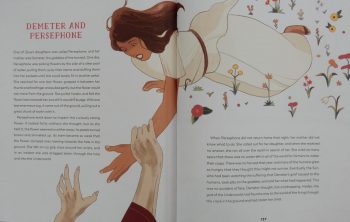
the Underworld (approaching which the two owls meet a third, White Owl that tells his favourite story Demeter and Persephone;

and finally, the ‘Land of the Living’, each of which acts as a stopping point on the journey we take with the two owls during a cool, dark night.

Be regaled by tales well known and less so, of gods and goddesses, and heroes as you tour the Mediterranean, learning too about the places where each story takes place and why it is important.

As well as the manner in which the myths unfold, I love the family tree at the start, the map of the stopping points and the end papers.

This book would make a smashing present for an older child (there’s a note before the title page that ‘some content may not be suitable for younger readers).

It’s OK to Cry / The Happy Book

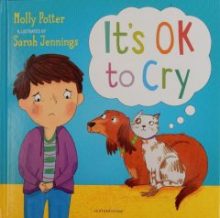
It’s OK to Cry
Molly Potter, illustrated by Sarah Jennings
Featherstone (Bloomsbury Education)

Molly Potter’s latest book that offers both parents and teachers a starting point for developing emotional intelligence/ emotional literacy with youngsters is written particularly with boys in mind.

How many times in my teaching career have I heard a parent say to his/her young boy words such as “Stop all the fuss, boys don’t cry like that.”? Way too many; and if children are subjected to such comments from a very young age they soon internalise what they’ve been told and become afraid to show their feelings. Instead, from the outset we all need to encourage children to feel safe to talk about and show how they feel.

The author starts by presenting some commonplace scenarios to explore why it is that boys have a tendency to keep their emotions under wraps.

She then goes on to look at where some of the messages about ‘acting tough’ might come from, and to explore the importance of being able to articulate how you really feel.

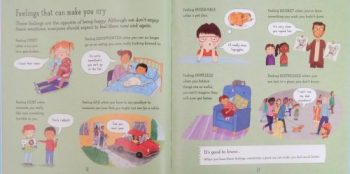
This is followed by a look at a variety of different feelings, some positive, others negative. In each case the text is straightforward and easy to grasp, and offers starting points for opening up discussion, and is accompanied by Sarah Jennings bright, friendly illustrations.
There’s also a ‘park full of feelings’ that is a great discussion jumping off point, as well as some suggestions to help cope with ‘uncomfortable feelings’.

The final pages are directly aimed at parents and carers again with the emphasis on boys.  Included is the stark reminder that ‘poor male emotional literacy is reflected in the fact that in the UK suicide is the single biggest cause of death for men under the age of 45.’

With a down to earth approach such as the one Molly Potter offers herein, let’s hope all children will develop coping strategies to deal with feelings and emotions.

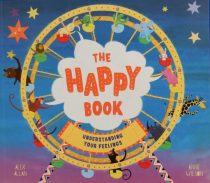
The Happy Book
Alex Allan and Anne Wilson
Welbeck Publishing

Developed in collaboration with child, psychotherapist Sarah Davis, this accessible book explores with a young audience in mind, five emotions – happiness, sadness, anger, fear and worry.

The author’s tone is warm as she encourages readers to consider carefully so they can identify their feelings and possible causes, as well as the reactions they might cause.

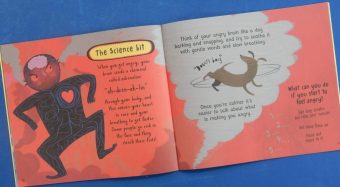
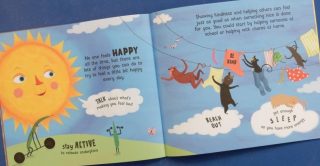
Occasional questions add to the interactive nature of the text and for each emotion, there is a paragraph (or several) explaining the science of what happens in both the brain and the body: ‘When you are happy, your brain releases a chemical called dopamine that helps you to learn, remember and helps you sleep well.’

There are also ‘top tips’ as well as a host of other suggestions to encourage positive feelings.

Anne Wilson varies her colour palette according to each emotion so for example red reflects an angry mood

and blue-black, sadness in her amusing illustrations. I particularly like the green vegetable characters and I’m sure they will appeal to youngsters.
This book provides an ideal starting point for parents and educators wanting to develop emotional intelligence in young children.

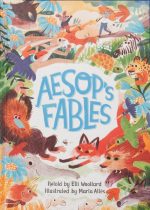
Aesop’s Fables

Aesop’s Fables
Retold by Elli Woollard, illustrated by Marta Altés
Macmillan Children’s Books

To attempt a rhyming rendition of one of Aesop’s fables is rather a risky business; to do it well and then go on to write a further seven in unfaltering rhyme that just glides off the tongue is incredible; but that is just what Elli Woollard has done. How she’s pulled off this feat I can’t imagine but only surmise it was with a combination of wit, wisdom and trickery – the characteristics exhibited by the animals she writes about.

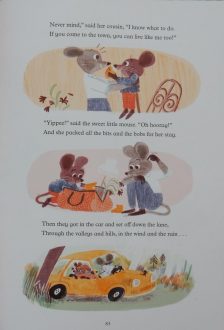
Whether you choose to share one of the better known tales such as The Hare and the Tortoise, The Boy Who Cried Wolf; or The Town Mouse and the Country Mouse;

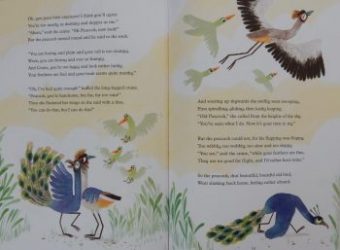
or want to discover what the bear whispered in the small traveller’s ear in the first story; or perhaps learn how the peacock was taken down a peg or two,

each telling is a treat for both reader aloud and listeners

Marta Altés illustrations too are absolutely superb. Every single one, be it a small vignette, a double spread or the single page pattern design sandwiching alternate stories,

is a seductive combination of a rich colour palette and inbuilt humour that fits the vivacious, up-to-the minute tellings of the stories perfectly.