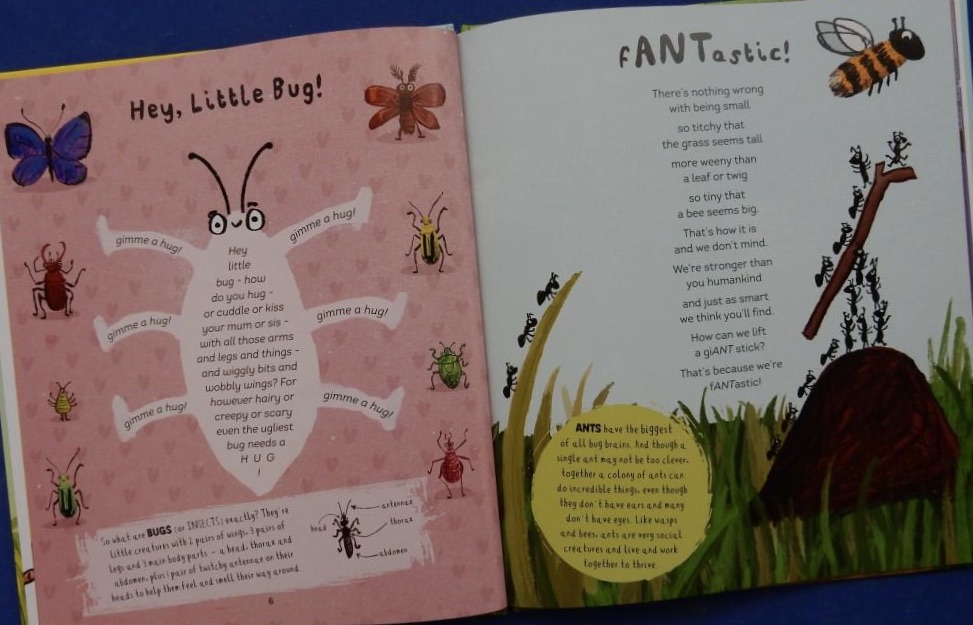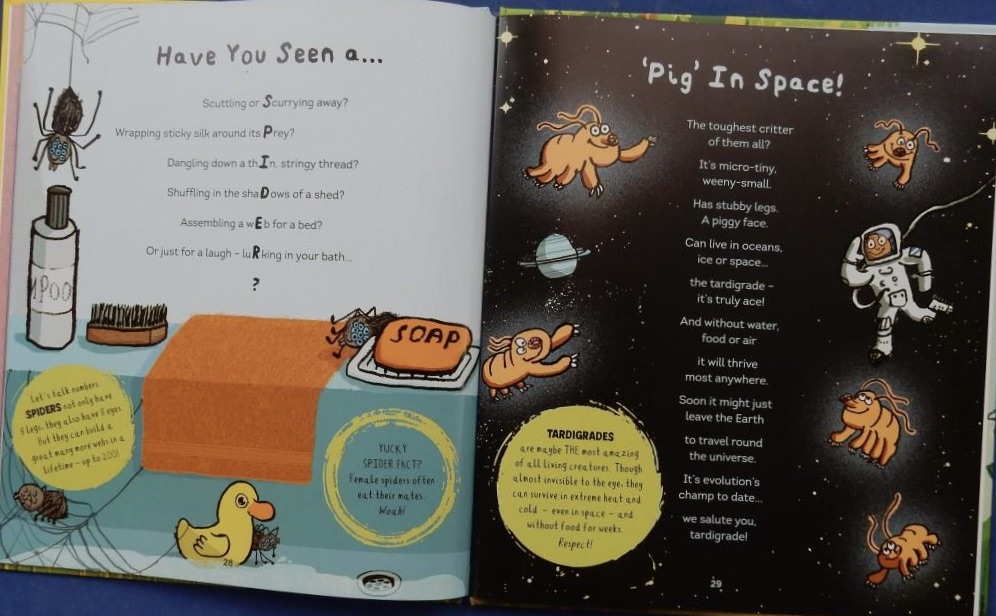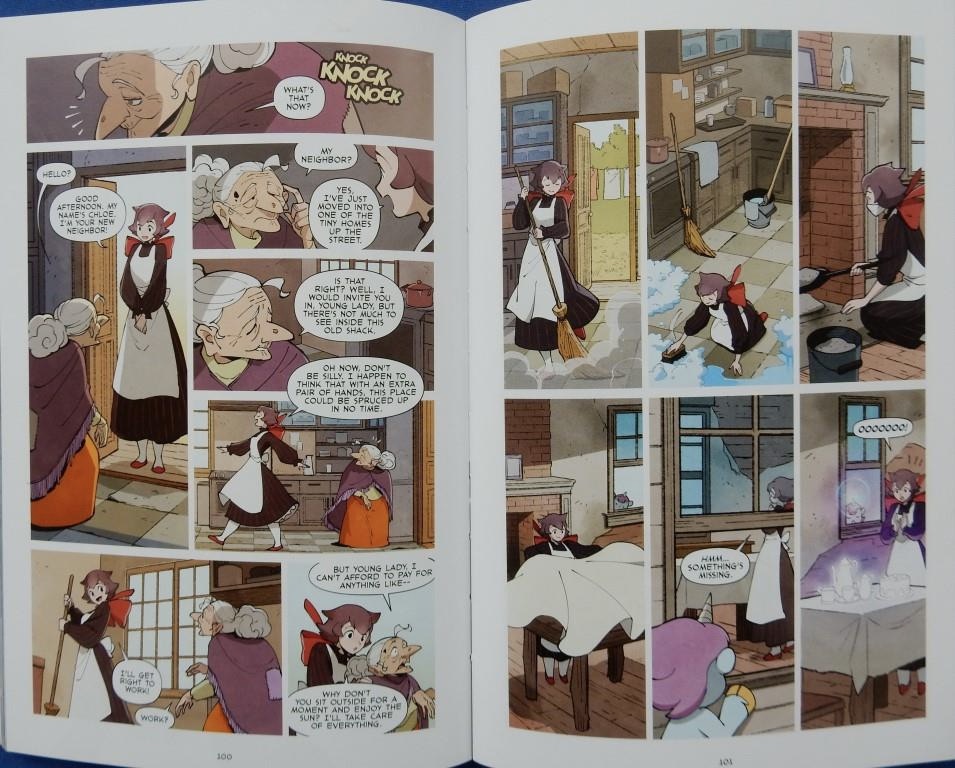
My First Book of Evolution Sheddad Kaid-Salah Ferrón and Eduard Altarriba Button Books
The stellar pair, author Sheddad Kaid-Salah Ferrón and illustrator Eduard Altarriba present another important STEM topic – how all life came to exist.
Starting close to home, there are pages that look at both the family tree and the tree of life, the latter being defined as ‘the family tree of all living things that have ever lived on Earth.’ Then comes a spread on species comprising a definition and examples, mentioning that the definition doesn’t actually apply to everything in the natural world, including many bacteria.
Evolution itself is presented next
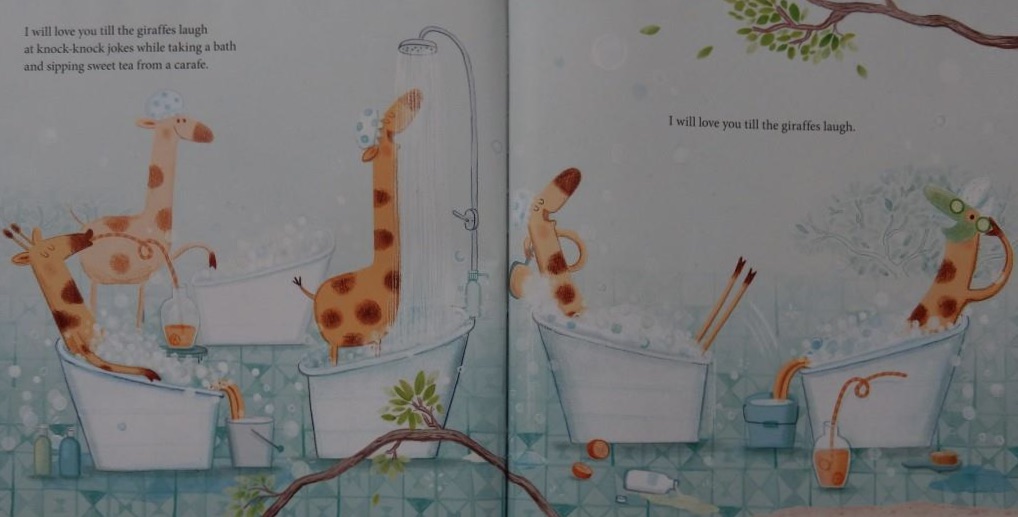
followed by the process of natural selection wherein it’s explained its connection with evolution using giraffes as examples. Charles Darwin is mentioned here and the voyage of the Beagle, Dawin’s observations and his ‘The Origin of Species’ are the subjects of two double spreads.
Heredity, Gregor Mendel and genetics including mutations are also explored; there’s a look at LUCA (the ancestral organism all living things are descended from) and the book ends on future possibilities.
Exciting and accessible, this is a great starter book for budding scientists at home or school, as well as adults who may not have learned about the topic previously.
The Faerie Isle: Tales and Traditions of Ireland’s Forgotten Folklore Sine Quinn and Dermot Flynn Walker Books
In this collection of Irish folklore you will meet all manner of faerie beings each of which has an introductory fact page that precedes the story. For example Giant tells of.their enormous height, awesome strength and fights, mentioning such as Fionn mac Cumhaill and the tale Stomping Ground relates how two cow eating giants, seen by a boy and his grandmother, fall asleep in a field. In the next field the grandmother keeps her beehives and she engineers that her bees should attack the giants, sting them so badly that they never go anywhere near her place again.
Then there are the shapeshifters of which there is an abundance in Irish folklore called piseoaitthe (charm setters) . One I found particularly fascinating is The Charmer, a silver-tongued faerie said to be the most beautiful of all the ‘good people’.
Also known as the ‘love-talker’ this mystifying faerie with his seductive voice, (supposedly a member of the leprechaun family), is able to leave a person trapped by unrequited love as was red haired Nora in the story that follows. One evening we read, she encounters a mysterious handsome stranger who charms her completely only to vanish almost immediately leaving the girl devastated to the extent that, so the story goes, she still walks the road whereon she met him, searching for her faerie lover.
Selkies, mermaids, a banshee and sheeries also wait to enrapture readers between the pages of this Faerie Isle. Anyone with an interest in folklore, especially those with some Irish blood running through their veins will be fascinated and enchanted by Sine Quinn’s text that has been richly illustrated by Dermot Flynn whose portrayals of the faerie folk range from utterly spine-chilling to alluring.
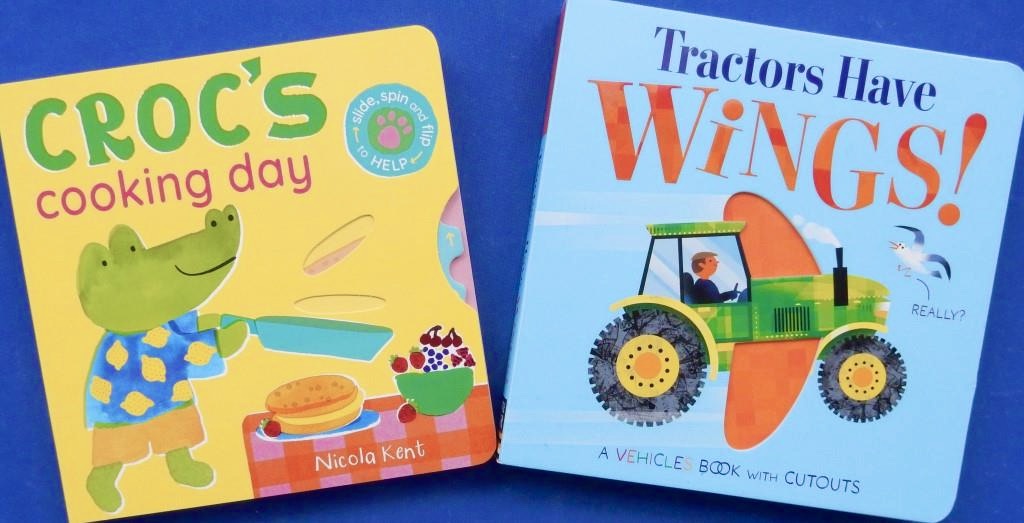
These are both Little Tiger books: thanks to the publishers for sending them for review.
Time Travellers: Secret and Spies Sufiya Ahmed
This story begins during the Easter holidays when friends Suhana, Mia and Ayaan are spending time together in Edinburgh. It’s not long before down comes the rain and the three head into the Museum of Scotland. Very soon though they are spinning back in time and their trip to Scotland becomes a trip to 1799 India: their mission being to ‘save the young princess’.
As they are wondering what exactly that entails they encounter young Imran wanting to know why they’re talking about The East Indian Company.. Dressed as a soldier, Imran tells the three that he’s preparing to join Tipu Sultan (the Sultan of Mysore) in battle. He then helps them explore the fort and palaces. They’d seen the date of the Sultan’s death in the Edinburgh museum so things are urgent; they split into two groups and Suhana and Mia head to the harem in search of the little princess. There they see a little girl, Casimebi, causing a todo about her doll and decide she must be the princess they seek. However the female guard is suspicious of their presence and the girls have to make a run for it and hide. This results in them discovering a secret passage in the harem grounds.
Slightly later they overhear a conversation between an army general and Tipu Sultan’s dewan who is planning to betray the Sultan. Perhaps it’s too late to save the Sultan from his fate but what about his family, especially the little princess?
Based on historical events, this dramatic story is an excellent way for readers to learn something about British Colonial history, a subject that should be more widely known. Make sure you read the author’s note after the conclusion of the story.
There’s time travelling of a sort in
The Arctic Fox Holly Webb, illustrated by David Dean
Ellie is thrilled to be spending five days in Lapland during the Christmas holidays but before she goes, is horrified to learn on a school trip, that Arctic foxes were trapped for their fur in the early part of the 20th century. Her mum reassures her that this no longer happens and that it’s not likely they will see an Arctic fox during their holiday as these extremely rare creatures are very shy.
However soon after their arrival, Ellie looks out the cabin window and sees what she thinks is a fox. She worries about this fox when the family go to see the Northern Lights. In bed that night she’s woken by a sudden light and when she creeps outside to see the foxfire, she hears an eerie wail and tries to find its source.
The narrative then alternates between Essi (a dream character perhaps) and Ellie. A snow fox, Āppās, is freed from a trap but Ellie is a long way from her family and the cabin. The fox leads her through the snow but a lynx appears which Ellie manages to ward off with a pine branch and return safely to her cabin.
An exciting adventure with occasional illustrations by David Dean that younger animal lovers especially will love: it made me want to go and see the Northern Lights.
Fia and the Last Snow Deer Eilish Fisher, illustrated by Dermot Flynn Puffin Books
I deferred reading this, put off by the hype it’s had, but once I started, I was immediately drawn in by the author’s lyrical writing and magical storytelling, reading her verse novel in a single sitting. The setting is Ireland in ancient times and it’s narrated by Fia whose village is trapped under a blanket of snow where after several unending winters the starving villagers are eagerly awaiting the return of the hunters, due to arrive before the next solstice.
However they come with barely enough for a couple of days and so the villagers gather to determine the fate of Fia’s snow deer, Solas (born under the same solstice as the girl thirteen years ago) not only for his meat but also for an ancient prophecy promise that an ultimate sacrifice will return sunlight and life to the world. However, Fia plots with her great grandmother to seek out the Deer Mother who wakes the world at the winter solstice thus saving the village and Solas. Then Fia and her cousin Mish run from the village with Solas, travelling through the harsh landscape, facing such perils as lurking shadows and hardship. They also meet a wolf.
During the journey Fia learns a lot about loyalty, love, family, friendship, jealousy and kindness, and readers find out more about both Fia and Mish, their relationship and standing within the village, as well as the expectations and pressures of birthright and of prophecies. Will they make it to the Deer Mother and ultimately, will Fia find the courage to make the sacrifice required to end winter and bring the sun back – a sacrifice she didn’t fully understand at the outset?
An integral part of the story are Dermot Flynn’s stunning illustrations which echo the transition from darkness to light, while highlighting the love, hardship and hope of the narrative.
A spellbinding read for chilly winter days, best enjoyed snuggled up while consuming a hot chocolate.
Scrap: The Good, the Bad and the Rusty Guy Bass, illustrated by Alessia Trunfio Little Tiger
In this second story in the trilogy readers join Scrap, Paige and Gnat as they journey across Somewhere 513. The book opens with the three going on a quest to find the Pink-Footed Goose, supposedly it’s landed somewhere in the no-go Badlands of Elsewhere and it’s their only chance – so the children’s mother said – of getting off-world. There are perils aplenty but then they encounter Wired Bill who takes them to the wandering robot town of Mooch where the robots have rejected Mayor Highshine’s views, welcome the three visitors and make them feel at home.
Wired Bill is even more welcoming when he learns that Scrap and KI-NG are likely one and the same. Scrap then begins to think perhaps the three of them should abandon their plans to escape the planet and instead make their home with the folks of Mooch. Enter Newman desperate to know where the King’s core is and promising to help and keep the children safe in return.
Then Paige starts seeing visions of ghostly humans: now she can hardly wait to get away from the strange town. And when their gofer is fixed that’s what she’s determined to do but then agrees to stay another night, the result being an attack from glowsharks, one of which bites Paige. When they eventually depart for Tumbledown Canyon things get more perilous and suddenly Scrap learns something that rocks him to the very core. Events get progressively weirder, Gnat gets angry, but who can be trusted?
The book ends on a cliff-hanger with Scrap, Paige and Gnat taking the only chance they have and heading off in search of Newman’s ship which may or may not have been destroyed already. Brilliantly done with a scattering of splendid illustrations by Alessia Trunfio. Book three can’t come quickly enough for me and I’m sure Scrap’s countless followers.
Told in rhyme and narrated by a young girl, this is a story of welcoming refugees, young children’s capacity for kindness and communication through play and pictures, and making strangers feel welcome and at home.
The child narrator tells how she does her best to dispel the obvious sadness that the newcomer feels as only after some time, she unpacks her few things onto the floor. These include some pens and paper, and this starts a pictorial exchange between the two children relating to their homes, families and other personal things. From one drawn by the refugee child it’s evident why she feels so sad.
Little by little through small acts of kindness – meeting her host’s friends at school, learning words from each other’s home language and a video chat with the newcomer’s family – she starts to feel better.
The narrator realises that she can’t make everything seem right but by standing beside her new friend at all times and showing empathy, she will feel upbeat for longer periods. Then another child, new to the country, joins their class looking very worried as he stands watching the other children enjoying themselves: you can guess who asks the boy to join her in play, someone who radiates colours -‘ Colours of life, that unite and restore.’
Inspired by her childhood in Germany, Sandra Dieckmann presents twenty of Grimm’s fairytales. most of which are well known, such as Sleeping Beauty, Rumpelstiltskin, Hansel and Gretel and Cinderella, others less so. The latter includes Jorinda and Joringel – about two lovers and a wicked sorceress, and one new to me, The Star Talers wherein a little orphan girl wanders the forest with just the clothes on her body and a piece of bread in her pocket. One day the lonely child meets a poor old beggar man asking for something to eat. She gives him the whole piece and then on coming upon a little girl who declares that she’s freezing, gives the little girl her hat. The third child she meets has no dress and the little girl gives hers to child three leaving herself clad in just an undershirt. Come nightfall, alone in the forest the kind girl stands staring up at the sky
and suddenly something magical happens: she’s clad in a new shirt of the finest linen and has sufficient gold coins to make her rich for life.
Strikingly illustrated throughout with a mix of presentations from a double spread devoted to a single picture of Sleeping Beauty to beautiful borders, with its subtle feminist twist, this is a wonderful book to buy, to treasure and to give.
Doctor Fairytale Catherine Jacob and Hoang Giang Walker Books
This is a rhyming spin on favourite traditional tales wherein a young girl physician and her assistant spend a rainy day administering to popular fairytale characters. The first is Cinderella – poor thing, her feet are covered in large blisters and her toes red and raw; Goldilocks’ bum is full of splinters after breaking a wooden chair and her tongue scalded from porridge she consumed hastily.
The big bad wolf has some very nasty burns having tumbled down the three pigs’ chimney into a fire;
Snow White falls into a deep sleep after biting into a rosy apple but during the doctor’s visit it’s not the patient but the doctor who ends up feeling poorly.
After a hectic day the little physician gets caught in a heavy downpour and reaches home soaking wet and feeling really ill herself. She retires to bed and as she rests she gets a big surprise: all the patients who received her care during the day have come to pay her a visit, something she well deserves after giving each of them her kind consideration and tender care.
I love the playful treatment of the fairytales and the way Catherine Jacob cleverly adjusts some of their endings, something children will delight in I’m sure. Hoang Giang’s warm, slightly quirky illustrations range between double page layouts to vignettes and youngsters will enjoy all the playful details and spotting the additional fairy tale characters not mentioned in the text. A gem of a book to share with those who are already savvy with the original stories.
The Brighter I Shine Kamee Abrahamian and Lusine Ghukasyan Lantana
A young Armenian girl is celebrating her birthday and part of this celebration are the stories her mama tells her of how she came into the world – ‘a gift from our ancestors’ Mama says. As with many children, birthdays are a time for special baking and decorations. In this family though they are also a time for sharing stories about your homelands and ancestors. On this particular birthday the girl’s Mama recounts a story of how she felt their ancestral spirits filling the room as incense burned and her grandmother prayed for the infant’s safe arrival.
During their making of dough for mantuh (a traditional dumpling) there are further stories, one about a very old flour sifter carried from Beirut over the ocean by the child’s great grandma.
Others tell of the journeys of ancestors from homes they were forced to leave because of war.
With the aroma of dried herbs and cooking pervading the house, guests arrive and the birthday girl hears them talking of how they fear their stories and language will disappear now they are so far from their ancestral homes.
After everyone has left the girl discovers a card from her grandmother, containing a letter written in Armenian and as a result of her mama helping her to read it, she comes to see the family stories in a new light: ‘stories are like stars that I hold inside, so when I am in the dark and I feel lost, I can light my own way’ she tells readers.
After her narrative, the author has written a letter to readers in which she tells of her own Armenian ancestry, and offers some questions for exploration of their own history and ancestors. Lusine Ghukasyan’s brightly hued scenes capture the joy of the birthday celebration and the girl’s connection to her family’s past beautifully. Altogether a moving book about discovering your identity through preserved memories and stories told by one’s ancestors.
Agent Harrier is back with another mission. First off he goes to collect his eagerly awaited spy car from Doctor Doppler at BARK’s gadget lab. What he’s given though is let’s say disappointing, though there are supposedly some useful gadgets that need slight adjustment before it’s ready. Off goes Harrier to see Patsy. Her reaction to his obvious feelings about the vehicle is to tell him, “The spy car does not make the spy”.
Time for the mission: apparently somebody from inside BARK has stolen Top Secret files, leaving behind a car with a symbol and Harrier is tasked with uncovering the double agent. The next thing Harrier knows is that his car has disappeared – stolen. The traitor perhaps? A chase is on with Patsy at the wheel and hair-raising, not to mention car raising it definitely is.
Following a near disastrous landing Harrier finds himself facing a carbon copy of himself – a doppelgänger no less. A weird conversation between the two Agent Harriers ensues but how will the whole mission end?
That would be telling; but I will let you know that the DIY reference made this reviewer both groan and splutter with laughter.
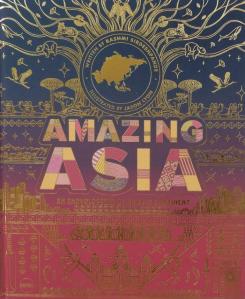
A second zany, punny graphic novel ideal for new solo readers.
Wonderful Words That Tell A Tale Tom Read Wilson, illustrated by Ian Morris Words & Pictures
Presented by word wizard Tom Read Wilson, this is another collection, alphabetically organised, of fascinating facts and anecdotal stories related to everyday words. There are four words for every letter of the alphabet and each starts with an amusing ‘star word’ poem/story after which come a definition, information about its origin, meaning and etymology.
Did you know for example that astronauts wore nappies during take off and space walks as it’s impossible to go to the loo, so instead they use what are called MAGs (Maximum Absorbency Garments).
What about those jeans you love to wear: the word denim is a contraction of ‘serge of Nimes’( a French city), serge being a heavy fabric from which lumberjacks’ workwear was made. I loved discovering this palindromic phrase – palindromes need not be single words, we’re told – is made up of seven words – ‘Murder for a jar of red rum’.
Assuredly a book to encourage children to enjoy language and words for their own sake as well as showing how the English language has evolved and continues to do so. Have a copy in your classroom collection: youngsters can have fun reading it, enjoy the humour in Ian Morris’s illustrations, then go home and impress their parents and siblings with what they’ve discovered.
Relic Hamilton Genie Hunter Joseph Coelho, illustrated by Hyun Song We Walker Books
Twelve year old Relic lives in London’s Soho with his grandfather who runs an antiques business under their home. From things we learn early on it’s evident that the boy is being bullied.
One day as he’s sorting through items in the basement, Relic comes upon a box containing brass oil lamps, six small ones in the middle of which is a larger one. As he starts to polish the large one Relic unleashes a genie – a powerful one of the evil kind that feeds on people’s hopes. “What do you wish for Relic Hamilton?” he asks Relic starts to feel strange and the next thing he knows his grandfather is lying on the floor beside him, unconscious. After that he loses consciousness again and wakes to discover that he is being whisked away in a jet called Aladdin with his grandfather who is lying in a bed. Also on board are two people, The Professor and Raphaela who tell him that they are members of the Hermitic Sodality of Genie Hunters and so is his grandfather.
Meanwhile, Ravenna, the genie Relic has unleashed is taking over Taya Porter, a girl with lots of wishes. Every time Taya makes a wish her power over herself diminishes. Seemingly such genies will stop at nothing to get what they want and to thwart the evil Ravenna, Relic is plunged into a thrilling but dangerous adventure that takes him back in time. He meets pirates and giant squid as he gradually discovers more about himself and the world, in his endeavours to save his beloved grandfather.
With creepy illustrations by Hyun Song We, this fabulously exciting story ends on a cliff hanger that will leave you eagerly awaiting Grandfather’s revelations and what they lead to in the next book. You’ll certainly never think of genies in the same way again
Totally Chaotic History: Roman Britain Gets Rowdy Greg Jenner with Dr Emma South, illustrated by Rikin Parekh Walker Books
Greg Jennings is a sure winner when it comes to bringing historical information to primary age children. Here, as with the previous book in this series, he is joined by an expert in the period, in this instance Dr Emma Southon whose discussions with the author, their banter and especially the Accuracy Alarm interjections add to the entertainment value for readers. These alarms introduce the important idea that information relating to history cannot be assumed to be fully accurate, certainty and historical accounts are often open for debate.
Now most people know that Gaius Julius Caesar was the first ever Roman to land on the shores of Britain (Britannia as the Romans called it). However, less know that he came and went, then returned a year later in 54 BCE and even that wasn’t a great success as invasions go. Indeed it wasn’t until the arrival on the scene of Emperor Claudius (who took just sixteen days to out perform Caesar), that despite the valiant efforts of Caractacus, Britain was largely conquered, though that took a few years.
The whistle stop ride through Roman Britain continues with the murder of Emperor Claudius by his wife, the rebellion of Queen Boudica who is eventually defeated in the Battle of Watling Street, the construction of Hadrian’s Hall (122CE),
the crowning of Constantine the Great, who then in 313CE makes Christianity legal in the Roman Empire, all the way through to 409CE when the Romans left Britain for ever.
Your brain will probably be in a spin by the time you reach the end of this book but you’ll have had a great deal of fun along the way and learned (or in my case re-learned) a fair bit of ancient history too. Rikin Parekh makes the book even more enjoyable with his zany cartoon-style illustrations.
The Snow Thief Alice Hemming and Nicola Slater Scholastic
Squirrel receives another practical lesson on the changing seasons with the help of his friend Bird. It begins as the bushy tailed rodent looks out onto – shock horror – no grass. Bird is on hand to explain all about snow and invites Squirrel to participate in a fun exploration beyond the tree, an invitation that receives a firm “No, thank you”. Later however into Squirrel’s home comes a snowball thrown by Bird in an attempt to get Squirrel to enjoy the possibilities snow offers.
Down comes Squirrel enthusiastically, over-reacting as you might expect as Bird explains that every snowflake is different. Squirrel’s next misguided response to the cold concerns “smoke coming out of my mouth”. As for ice-skating – let’s say a showy-offy performance results in
and so the concatenation of dramatic reactions continues with reference to missing hazelnuts, culminating in the disappearance of most of the snow –
surely the work of the titular snow thief, who has left one thing behind.
Farcical fun thanks to one character’s absurd pronouncements, comical facial expressions and body language in Nicola Slater’s boldly hued portrayal of Squirrel’s theatricality, and the clever use of different type faces. (In a final spread after her story, Alice Hemming gives explanations of a more scientific kind relating to snow and some of its effects.)
Bobby’s world is one of grey – grey people going about their grey lives. Bobby appears grey too, on the outside at least, but inside he’s full of colour and sparkles. Occasionally he would forget himself and let his sparkly colours shine forth but naysayers who saw always shouted at him making Bobby lose his inner colour.
Desperate to show his true self he seeks help from his mum and she responds by taking Bobby to see a pantomime. This sparkling show makes the boy start feeling bright once more, particularly when he watches the pantomime dame getting the better of the baddy denying her colourfulness to the extent that the audience shout out in support. Suddenly it’s transformation time: the dame’s dress becomes a wonderful rainbow causing Bobby to ponder upon her power.
Back home he takes a towel, fashions it into a turban and to his delight, it appears that he’s discovered the source of the panto. dame’s magic. Can he now spread his own magic and revolutionise the world around him? Oh yes he can!
Drawing on pantomime memes, Mama G has created a magical story of self-belief, discovering and using your inner resources and having the courage to initiate change. A perfect match for the text are Toto’s scenes of the events that start almost entirely in greys and then burst forth into rainbow hues once Bobby has made his life-changing discovery.
How to be Silly Every Day of the Year Harry Hill Walker Books
Once upon a time Harry Hill was a doctor but he gave up practising medicine and became a comedian instead. If you are looking for reasons for being silly then you can blame this guy for compiling a book that encourages readers to be silly for a whole 365 days. Alternatively if you fancy a short spell of silliness you can dip in and see what takes your fancy just for a few days at a time. Assuredly you will find some hilarious suggestions among the activities.
Want to impress your parents? How about turning yourself into a human hoover. to do so you will need several rolls of double-sided sticky tape to wrap around yourself. Then all you have to do is lie down on the carpet or a rug and roll around picking up whatever fluff and rubbishy bits are there.
Maybe you’d like to adopt a conker. If so, ask an adult to make a hole through it so you can thread it onto a string and then off you go for walks together. (One of my young relations adopted a pine cone of the longer kind. She named it Violet and wrote stories about it. I don’t think her intention was to be silly however.) And in case you find you’re forgetting to be silly then try creating a SILLY acrostic that you can stick in a strategic spot as a reminder.
With facts of the silly sort and lots of doodle drawings to jazz up its appearance, this is a book to brighten up those days of doom and gloom especially. “Being silly is a serious art,” I heard someone say on the radio recently: what do you think?
A Lot Of Silly Joy Cowley, illustrated by David Barrow Gecko Press
Herein we have almost forty pieces of silliness by Joy Cowley, all of which I think have come from her previous works and it’s terrific to have them brought together just waiting to make both children and adults giggle.
Doubtless everyone will have different favourites but some that especially appealed to me are MyTiger that tells what happens when a child takes his tiger that is suffering from toothache to the dentist. Following the fixing of the problem the dentist instructs, “Tell him he’s not to have cake again. … It’s bad for him.” The dentist goes on to say that the tiger should in future restrict his diet to “The same as other tigers,” You can guess what happens.
Also tickling my fancy was The Big Red Rose. This features Bubba, a little elephant that sniffs said rose; it goes right up her trunk and becomes stuck. A visit to the vet with Mother Elephant proves unsuccessful despite the fact that, ‘The vet got out his telescope, / a light, some pliers, a bit of rope’. Mother Elephant then resorts to an application from a sneeze-inducing condiment. Will that remove the blockage? Ah / Ah – ah / Ah- ah- ah … “ Hurrah!
There are a number of other poems and tales about elephants and you will also find such subjects as frogs, cats,
witches, a grizzly bear that gets stung by a bee and The Horrible Thing with Hairy Feet, intent on making a meal of a bunny rabbit.
Equally full of fun are David Barrow’s illustrations, which combined with the text make this a thoroughly enjoyable book to give or to share in a primary classroom.
Freedom Braids Monique Duncan and Oboh Moses Lantana
Every morning, Nemy, a child on a plantation walks through the fields scattering seeds, pulling out weeds and stripping leaves. She watches Big Mother hard at work cutting sugar cane, cooking yucca roots and in the evening she listens to her stories before bed. Then one night Nemy follows Big Mother to a shack, outside which sit a group of women braiding one another’s hair. She too has her hair braided, by Big Mother, and it makes her recall her own Nana. Nemy feels part of the community of women that night as she too forms lines of plaits just the way her Nana has taught her and in so doing she evokes the smells of the oils and herbs her Nana used.
In the midst of her protective community, the girl learns how to braid maps, messages and information concerned with freedom into another’s hair;
even seeds were hidden in cornrows that would be planted once the wearers were free. This entailed keeping careful watch of their captors as they crept out into the forest once night fell, staying clear of danger thanks to the dark surroundings. This is what Nemy and her fellow group members did until finally they’d left behind the sugar fields, trudged through forests and finally found a place to establish a new home – freedom at last!
In a final spread, author Monique Duncan explains how her story is based on real life experiences of the enslaved, in particular those in Columbia ,and includes some fascinating information about the meaning of the various styles of hair braiding.
Despite the terribly unjust treatment of those sold into slavery, the enslaved courageously found their own ways of resisting and this poignant story is infused with hope. Oboh Moses’ digitally rendered, almost exclusively nocturnal scenes of the women capture their beauty and serenity, and his use of colour intensifies the drama particularly in the scene where the women are on the path to freedom. A book that deserves, indeed needs, to be shared widely as a reminder of the courage shown by the enslaved during the centuries of the Transatlantic slave trade.
Tosh’s Island Linda Sargent, Joe Brady and Leo Marcell David Fickling Books
This story told in graphic novel form was inspired by co-creator Linda Sargent’s real-life childhood beset by aches and pains which are eventually diagnosed as Still’s disease (an early on-set form of arthritis).
Like Linda did, Tosh is growing up in the countryside of Kent and often visits the county’s northern coast with her adoptive parents who farm hops. Tosh’s best friend is Millie, daughter of the postman and just before starting secondary school, Tosh is beset by pain. Pain that causes her to fall and be unable to grip properly, but which the doctor calls attention seeking and the result of an over-active imagination. Millie is supportive as are Tosh’s parents who agree to Tosh’s request for a day at Oyster Flats. It’s there as she sits gazing out to what she calls, “my island” that she notices close to the breakwater a boy drawing. He introduces himself as Louis and as it turns out, both of them consider the island is a magical place.
Then by means of Tosh’s stories and Louis’ drawing the friends share magical trips to the island: this enables Tosh to exchange her hurting legs for a mermaid’s tail. Before leaving, the two agree to write to one another and this gives Tosh something to feel hopeful about.
Back at school though, it feels as though Millie is leaving her best friend behind as she becomes involved with a group of girls some of whom are unkind to and about Tosh. Her illness develops further and following a reckless action, her father decides that something urgently needs to be done. Tosh is hospitalised and meets a very kind, supportive nurse and a doctor who gives her a diagnosis of juvenile arthritis, explaining that she’ll never get better as she’s been hoping, but will receive help to manage her pain.
The diagnosis brings about changes for the entire family, Tosh continues to write to Louis and eventually the two meet again on their special beach. There Louis reveals something sad he’s never before told Tosh and the friends agree to share everything as they prepare to face new adventures, real and imagined. One is left hoping that neither of them will ever feel isolated by pain – physical or mental – henceforward.
Hugely moving, this book with its powerful art is one that will linger long in the minds of those who read it. It’s an inspiring demonstration of the power of the imagination to heal and to offer hope in times of adversity.
Cactus Kid : Rumble At The Rodeo Emmanuel Guerrero Flying Eye Books
Cactus Kid continues his search for someone to teach him the real wizarding skills he requires to be a proper wizard and as the story opens he’s heading off in search of Big Boulder, a mysterious dirt magic master he wants as his teacher. Having learned what he needs, the Kid hopes he can finally make his dad proud. He makes the mistake of stopping for snacks on the way and while so doing his trusty bike is damaged by what appears to be an earthquake but is actually a very large rock monster. He now requires a mechanic to fix it urgently, but there’s a problem. Rhyan the mechanic is participating in the three day New Moon rodeo event. While speaking to Rhyan, Cactus Kid sees a wanted poster for Big Boulder and is convinced that the wizard he needs is the one that beat him up. Is he right though?
Without waiting for his bike to be mended Cactus Kid sets out on foot but then discovers his compass is missing. Before long things have gone completely out of control. He’s in the muck mines with Ryan.
Not only is an army of wicked little baby spiders after the Kid but the very existence of the wizard Big Boulder that he’s searching for is called into question. Moreover the Spidermama is intent on destroying not just the mines but the whole town. Is there even a tiny chance that Cactus Kid can prove his father wrong, and save the day and the town?
A second madcap adventure: its ’to be continued’ ending means that Cactus Kid’s adventures are far from finished. Followers of the protagonist will zoom through this one and look forward to the next wacky tale.
King Alfred and the Ice Coffin Kevin Crossley-Holland, illustrated by Chris Riddell Walker Studio
Prize-winning author Kevin Crossley-Holland and artist Chris Riddell join forces again, this time in a mythic re-imagining of a story set in Anglo Saxon times. We hear at the start of this rhythmic, dramatically told prose poem, how King Alfred of Wessex met a trading traveller with ‘a tale to tell’. The trader is Wulfstan of Ravenscar and he spins a story to the King, his wife and the royal household telling of adventure, shipwreck and love.
It tells how at an early age, Wulfstan became skipper of a small trading boat. A boat that after a violent storm eventually reached a jetty where he expected a hostile reception. However the people that helped them ashore were welcoming and assisted the traders in mending their boat. One day after the death of the nearby town’s headman, the visitors learn of some of the people’s customs including their use of a hollowed out ice log as a coffin to preserve the man’s body
and the events that happened including a horse chase hunt for the headman’s wealth, leading up to placing of the body onto the funeral pyre. As for the treasure hunt, Wulfstan himself became the winner of a real treasure, the beautiful golden haired Eliza whose heart he had won.
Riddell’s rich illustrations are at first rendered in sepia tones but once the story of the sea voyage begins, change to blue tones, returning to sepia after Wulstan concludes his account.
This would make a good read-aloud for Primary School classes looking at Anglo Saxon history as well as a solo read those interested in that period.
The Not-So-Wicked Witch Bethan Stevens Frances Lincoln Children’s Books
This is a delightful play on the wicked witch trope with a young protagonist who puzzles the other little witches by not joining in with their trouble-making deeds that include such things as eating the very last biscuit in the tin and pinching one of your favourite socks.. Because of this, the baddy brigade decides that the littlest witch needs to be rescued from ‘all this icky, gooey goodness’.
The lessons in wickedness commence with upsetting children at meal times, which fails dismally. Next location is a birthday party – what better place for a spot of wickedness?
Our littlest witch is instructed to acquire various items for a potion that will enable them to steal all the marshmallows (their favourite ever food) from the party.
What happens however is rather different: the littlest witch concocts her own sweet recipe and sabotages the plans of the would-be marshmallow stealers.
The result is that the wicked little witches finally learn that ‘kindness beats wickedness’ …
With detailed illustrations of the enchanting kind, a thoroughly endearing little witch who doesn’t fit the mischief-making mould, a wealth of speech bubbles for the adult reader aloud to dramatise, young human listeners will delight in watching as the littlest witch teaches everyone that goodness is the way to go.
These are all recently published Nosy Crow board books: thank you to the publisher for sending them for review.
Pip and Posy At Bedtime Pip and Posy: The Birthday Party Camilla Reid and Axel Scheffer
The first book is part of the Where are you ? series and we join Pip and Posy playing a pre-bedtime game of hide-and-seek. Pip hides and Posy seeks but can she discover her friend’s hiding place? Yes, with the help of toddlers who will love looking behind the felt flap on each spread. They will also enjoy frog’s antics as the hunt progresses. In the second story it’s Posy’s birthday and Pip has come to celebrate with her bringing a present. They have fun playing with Posy’s new toy bus and enjoy lots of party games – musical statues, keepy up balloons, hide-and-seek and pinning the tail on the dinosaur. After all the games the friends sit down for a birthday tea and Pip then goes to fetch a special surprise for Posy but as he approaches the table, he trips on the new toy bus and both he and the cake go flying. Oh goodness me! Posy looks a sorry sight with cake all over her head. After a quick clear up, Pip saves the day with the suggestion of making some new cakes. Yummy cakes for everyone out in the garden. Both books are just perfect for the very youngest children.
Bizzy Bear At the Zoo Benji Davies
In this Find and Follow book, Bizzy Bear pays a visit to the zoo. He arrives at breakfast time to feed the animals but needs some assistance to find his way around. First it’s the elephants’ turn for some of that yummy fruit from his cart but Bizzy Bear is in need of some help to find his way to the hungry pachyderms so toddlers can guide him and in so doing practise their fine motor skills. Then comes the turn of the crocodiles including the newly hatched babies
– more help needed by Bizzy, not only to find the baby crocodiles but also the penguins. He drives his off-road jeep to get to those and meets lots of other animals on the way; and then it’s time to go home. First though he needs to say goodbye to the pandas – toddler help required again. In addition to the moving disc, on each double spread the verso shows small, brightly coloured, named items that little ones can enjoy searching for in the larger scene on the recto. They will enjoy too, joining in with the repeat sentence, ‘Bizzy Bear, which way to the __ ? ‘ on each double spread. With Benji Davies’ alluring scenes, there’s lots of fun learning between the covers of this one.
Having made an initial introduction on the title spread, Clotilde Perrin then gives readers a scene showing the abode of each of the thirty eight remarkable children she’s chosen to feature. Thereafter we meet them one by one; some are fantastical whereas others are far closer to reality but each of them has their special talent(s) depicted as a superpower. You will probably find similarities between The Electric Child, the Thunder Child,
the Speedy Child and the Springy Child, each of whom has an excessive amount of energy. The same is true with the Sticky Child and the Rooted Child both of whom are reluctant to leave home though the former can get attached to friends whereas the latter always wants to remain close to its parents. Imagine having both the Electric Child and the Thunder Child together in your home: they’d surely, as the latter says, ‘shake up the house’.
I found myself laughing at the comic strip style page of an encounter between the Immaterial child and the Diamond child whose home the former visited by passing through the wall, surprising the sparkly one and then inviting Diamond to a game of hide-and-seek.
I couldn’t resist choosing particular children I’ve taught over the years and then trying to match their personalities with characters portrayed in the book as well as immediately thinking of other individuals as I turned the pages: I’m pretty sure I’ve encountered each and every one of Clotilde’s Remarkables at one time or another.
Having met all thirty eight on the pages of this wonderfully quirky book, why not turn to the final spread and work out what type of child you are.
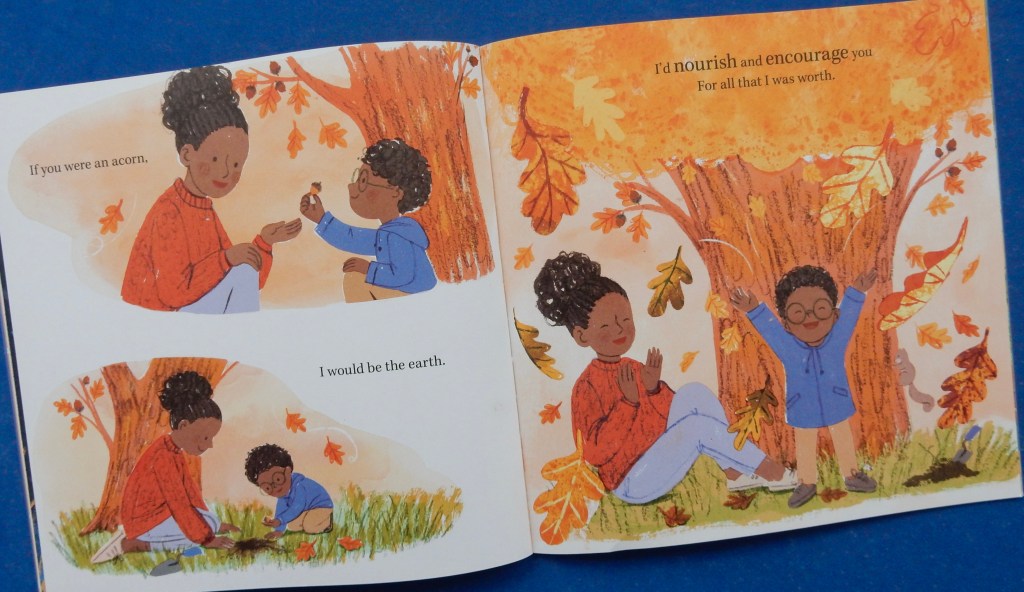
Oak: The Littlest Leaf Girl Lucy Fleming Walker Books
Oak, the tiniest leaf girl of all lives with her parents in a large oak tree in the middle of the woods. She’s full of fun, has soft wings and bunches in her hair and spends her time playing with her family and her friend, Squirrel. One day though, there’s a chill feeling in the air: “Times are changing” Mama Oak says. “Soon, it will be time to leave the tree behind,” Papa Oak announces.
Oak is worried when she goes to bed that night, fearful of what might be waiting in the unknown wild.
Further changes in the weather take place and eventually with the branches of the oak tree almost stripped of leaves, despite Oak’s reluctance, it’s time for the family to leave. “All leaves must nestle into their winter acorn homes,” says her mother reassuring her daughter that they can return in the spring: even Squirrel says that it’s time for a long winter sleep, so what will Oak do. “ I trust you to go at your own pace and find the right moment to leap,” Papa Oak tells her.
Her parents both leave and go to an acorn home on the forest floor nearby; not Oak though. But then she starts to feel lonely and realises what it is that brings her real happiness, not the tree but her family.
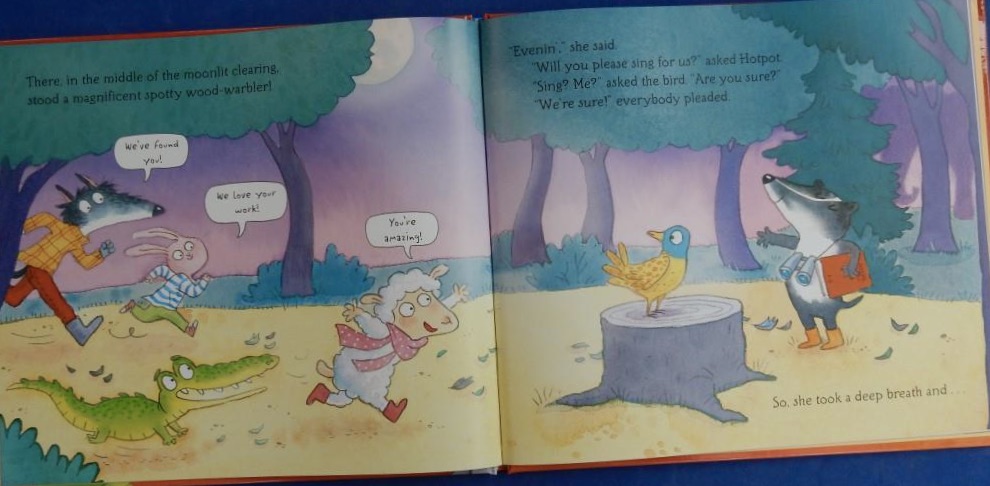
So she closes her eyes, takes a slow deep breath and …
I’m sure the way Oak resists change and the unknown will resonate with young children – maybe they’re just starting school – and Lucy’s story with its fairytale woodland setting provides a warm, non-threatening way to demonstrate the importance of courage, accepting the need for change and taking it in your stride. The illustrations with the difference in colour palette for autumn and winter scenes enhance the telling.
Barnaby Unboxed! The Fan Brothers Frances Lincoln Children’s Books
The Fan Brothers (with Devin joining his older brothers for this story) take readers back to the recently reopened Perfect Pets store selling boxed creatures that have interactive personalities that have been genetically created. One such is Barnaby, ‘half mouse, half elephant’ and a tiny bit of flamingo to add the pink colour: he’s been on the shelf far too long and is eager for somebody to come in and choose him to be part of their family. Then one day, somebody does: a little girl who immediately falls for him.
Before long the two are inseparable: the girl reads him bedtime stories,
they watch the Saturday tv programme ‘Barnaby and Friends’ and go on walks together. Life is as near to perfect as possible until one Saturday morning everything changes: when they turn on the tv to watch their favourite programme Barnaby has been replaced by the new Rainbow Barnaby.. The following day the little girl asks her father to buy her a Rainbow Barnaby pet which he refuses to do. Barnaby is relieved but then notices a change in the girl’s attitude towards him as little by little she loses all interest in her playmate.
Now it’s the girl’s father who takes Barnaby on his Saturday walks and on one such, the little creature slips free of his lead intending to run away ‘just long enough for people to miss him.’ However as days turn to weeks and then months Barnaby is unable to find his way home; instead having had a narrow escape from a feline, he bonds with other lost pets, makes new friends including some squirrels that help him survive the winter. Come the spring the little girl, searching for her lost pet, comes upon a very bedraggled little creature: could it possibly be Barnaby?
She does various things to try and trigger his memories of their life together and now all she needs to do is to take him home and regain his trust: will she succeed?
Poignantly told and with its detail and varied viewpoints, an absolute delight visually, the story – longer than average for a picture book – has messages about accepting imperfection, responsibility, pets and long term commitment.
Lulu Meets The Bees Anna McQuinn and Rosalind Beardshaw Alanna Max
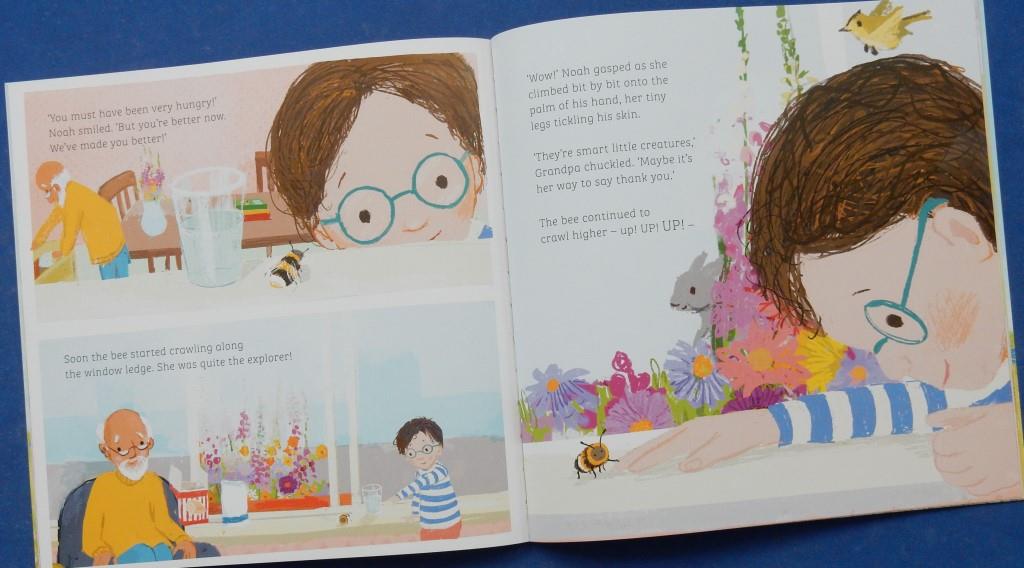
Full of curiosity, young Lulu is excited when she accompanies her mum to visit her friend, a beekeeper who lives in the city. As the adults chat Lulu carefully observes the bees foraging for food among the flowers. They then go up onto the roof of her home where Zora has her hives and there watch the worker bees returning having collected nectar and pollen. Then because Lulu is to go right up close to the baby bees when Zora shows her inside the hives, Lulu has to put on a special protective suit after which Zora lights a smoker to make it easier to work with her bees. Inside the brood box are the baby bees and Lulu is fascinated by the contents of the cells
Zora also shows Lulu the queen bee and next they move on to a hive atop which is a ‘super’, a compartment wherein the bees store extra honey.
A treat is in store when Lulu tastes some of the delicious honey from Zora’s bees and so inspired is the little girl by all she’s seen and heard that she asks Zora how she too can help bees. Being Lulu, she begins creating her own bee-friendly wild place as soon as she gets back home.
A lovely way for young children to learn some basic information about bees, Anna McQuinn’s text together with Rosalind Beardshaw’s scenes of the visit to a beekeeper are an example of narrative non-fiction for preschool children at its best.
Kevin the Vampire: A Fanged and Fearsome Fiend Matt Brown, illustrated by Flavia Sorrentino Nosy Crow
As the story opens Kevin receives a notice concerning his Gloaming,. This is an ancient test that eleven year olds have to pass to demonstrate they have the skills required to be a vampire. There are three skills, the first being Transformation when Kevin must turn into a bat. The second is Mind-Speaking which requires speaking in someone else’s mind and third is a Melt. (into the darkness). The first two shouldn’t prove any trouble for Kevin, however the third is something he isn’t able to do. But if he doesn’t pass all three he will be cast out forever. Kevin needs help and support but the one who could provide these cannot attend the event as it’s only for vampires, no matter she is regarded as part of Kevin’s family; to do so would be a violation of vampire rule number ninety three. What about a werewolf vampire though?
Before the tests begin Kevin’s Dad presents him with a special good luck surprise – the Aurelius Hat of Good Fortune and it certainly works for the Transformation though not all participants are quite so successful.
After this part Kevin and his vampire werewolf buddy take a walk and there follows an unexpected encounter first with dragons and then the Creature Keeper who is impressed with Kevin’s skills.
The MInd-Speaking set in the Orchard of Complete Forbiddenness
proves problematic for Kevin and he almost fails but due to unforeseen circumstances, eventually manages to succeed. That only leaves the next day’s Melt: can Kevin complete it in the allocated time? If not then what …
A terrific adventure with a satisfying finale, a cast of characters that includes some pretty nasty beings and Flavia Sorrentino’s weird and wacky illustrations: younger readers will be eager to get their fangs into this one for sure.
Tibor, a werewolf and Roza, a vampir who was transformed into an Alsatian, are best friends and have been since they were put in an orphanage from where Baron Ambrus adopted them. (The Baron intends that Roza should keep an eye on Tibor and guide him.) Living in the Baron’s luxurious House of Gold, Tibor is eager to find out who his real parents were and where he was from. In the hope of discovering a clue he attempts to break into the safe when the Baron’s out hunting. While so doing they hear a sound and thinking their guardian is returning, run outside so they won’t be caught. They then discover the rider is a woman and they hear these words, ‘There’s a little spell I need to prepare before we arrive.’
Worried that the stranger could be conspiring against the Baron, they hurry back to warn him only to learn that he was expecting the woman. He later introduces her as Professor Kira Halim, a celebrated scientist; moreover she appears to know all about Tibor. The Professor asks Tibor if he knows of the Dark Lantern Society. She goes on to present him with a gift on the society’s behalf – it’s a small carving of a knight and the Professor is able to make it spin in the air. The Professor then explains that she’s a member of the Society and they are searching for a lost artefact. She informs Tibor that he possesses an exceptional gift that will help them retrieve the Midnight Treasure but only on Spectre Night. The Baron explains that if not found the Treasure will disappear for a whole year. As more is disclosed, Tibor becomes increasingly concerned about what is being asked of him.
Overcoming his initial reluctance, Timor agrees to help and a few days later, accompanied by the Professor and Roza, he sets forth. What a perilous quest it turns out to be. It’s difficult for Tibor to know who can be trusted as he and Rosa encounter bears with which they battle, vampirs and more as the clock keeps ticking. However this proves to be an amazing adventure that will change his life and Roza’s forever.
An absolutely fantastic, superbly structured read with awesome world-building and characters. I can hardly wait for the second Midnight Treasure book.
Iona lives with her mum and stepdad on the Kestrel estate. Iona helps her mum run the pony trekking centre and despite money being tight their life is a happy one. However, when the owner of the estate dies, Iona’s family are pressurised to sell their cottage and stables to the new owners – stables that have long been in her family’s care and which Iona’s mum has no wish to sell.
Horse loving Iona has a connection with her dressage horse, Jinks, and longs for stardom but money has always prevented her from participating in the big competitions. But then local dressage star, Jessica Jefferies, asks that her own injured horse be kept at her mum’s livery while he recovers and goes on to offer to train Iona. What more could she want? However, as she becomes part of a new, much more exciting world, Iona starts feeling resentful of her family’s struggles but not everything is as it appears in this new friendship. We also meet Oscar, a good friend to Iona and another rider, April, from a well-to-do family, Iona’s rival at events whom it’s clear Iona doesn’t get along with.
All the while pressure is being increased on Iona’s mum to sell the stables and as Iona’s successes mount some unexpected and upsetting incidents take place.:Are these all connected? Iona and Oscar are determined to discover who is behind the troubles that upset the girl’s very security. The story draws to a life-threatening climax, followed by a confession and we leave Iona feeling differently about her own family set-up and about April. Finally both Iona and Jess are full of hope about the future.
With themes of friendship, family loyalty, fame and betrayal, a fascinating cast of characters and a powerful narrative, Olivia Tuffin’s latest book will be enjoyed by older KS2 readers, horse mad or not.
Jonty Gentoo Julia Donaldson and Axel Scheffler Alison Green Books
Jonty Gentoo, the penguin, lives at the zoo with his aunts. When they share stories with him of the South Pole, an icy, snowy land with penguin colonies, Jonty decides that’s a place he must definitely visit. One moonlit night he makes his escape though a hole in the fence and sallies forth into the unknown. He has no idea of the meaning of a geographic pole though he realises that the flagpole, barge pole and tent pole he passes aren’t what his aunts meant so he keeps walking until tired of so doing, he plunges from a cliff edge into the sea.
After weeks of swimming the water temperature drops and eventually he reaches a white icy wilderness. Surely this is the place he seeks: but having waddled for weeks not a single penguin has he spied. Having been in danger of becoming the next meal of a huge bearded seal, he encounters a polar bear that shoos off the seal
and offers him help. It turns out that the little penguin has travelled in completely the wrong direction – north instead of south. Months pass and then a tern, surprised at seeing a penguin in that location, agrees to guide Jonty to his desired destination. And so, ‘the bird in the sea and the bird in the air’ travel together southwards, at one point aboard a boat all the way to …
the Antarctic and ‘A heart-warming huddle of gorgeous gentoos.’ Just what’s needed after an arduous journey.
Despite the chilly location, Julia’s rhythmic, rhyming narrative is also heartwarming – it’s perfect for reading aloud and young children will delight in the details of Axel Scheffler’s illustrations, a few of which may send frissons of fear through them. The book concludes with brief notes giving information about some of the birds in the story. Another sure-fire winner for team Julia and Axel.
Anya’s Quest Jasbinder Bilan, illustrated by Jane Ray Walker Books
Little does Anya know when she complains to her papa of boredom that she is soon to embark on a vital quest. With her goes Mahi, the cook’s daughter with whom Anya reluctantly accepts as someone to play with in the snow. Anya is called by the goddess, Ganga and the two girls step into a chariot drawn by Ganga’s river dragon spirit companion and they undertake an epic journey through time and right across India.
As they fly Ganga explains that she urgently needs their help to heal the terrible damage that greedy, thoughtless humans have done to the fragile planet over time. They search for elusive spirit animals, lullabies long forgotten and while so doing Anya realises that she’s treated Mahi badly and apologises asking that the two become friends. Friends who can communicate effectively with the children of the world about the horrendous, pollution and its effects and save everything before it’s too late. The girls have to be brave, confront their fears and Anya has to dig deep within herself and connect with her ancestors as her friend has always done. She also needs to find a sacred star-shaped flower from her dreams, said to have healing powers, and use it to help a wounded bear cub.: could the bear be Anya’s spirit animal?
Once Ganga knows both girls are ready, she tells them that they ‘need to join the songs of all the children and sing the earth lullaby’, and thereby gradually heal the planet just like Anya helped the bear cub to heal. She also enlists the help of the other gods to support the earth healing cause and so more and more appear to join in ‘the celebration of sharing the lullabies and the message of hope.’ Finally with a promise to Ganga to do their utmost, the girls return home to the palace where anxious parents await and Anya and Mahi regale them with an account of their adventure and how they intend to make changes in their own lives.
Jasbinder Bilan’s thoroughly enchanting tale inspired by Hindu mythology, and equally enchantingly illustrated by Jane Ray, combine to make a truly gorgeous book. It’s one that will make a superb gift for a special occasion be that Diwali, a birthday, Raksha Bandhan or even Christmas.
The Carousel Horse Tony Mitton and Penny Neville-Lee Bloomsbury Children’s Books
This is an enchanting story of a fairground merry-go-round horse that longs for adventure. One night when the people have all left and the horse expresses a desire to fly to the moon, there appears before him a shimmery princess who tells him to let go of his fear and make his wish. Having done so, with the princess on his back the horse rises up, up far above the fairground eventually coming to land on the moon. From there they stand and look around admiring the beautiful colours of the distant earth. They then return to the world below and set forth to explore: they visit places high and low, hot and cold;
they watch dolphins leaping and swans swimming. No matter where they go, though the horse feels the need for a sense of purpose, a place where he belongs. So, at the princess’s suggestion, he returns from whence he came,
thereafter providing the fairground visitors fun aplenty, but safe in the knowledge that at full moon time should that urge arise, a wish will see him and the princess reunited, ready to take another magical journey together..
Told in perfect rhyme, this tale of wish fulfilment and finding where you truly belong is a joy to share: observant readers/listeners will notice that the painted scenes atop the carousel and the animals below that provide the rides – rabbit, dolphin, squirrel, swan, frog are all encountered in the dreamtime journeys so magically depicted in Penny Neville-Lee’s scenes.
Revenge of the Killer Worm Kathryn Foxfield, illustrated by Robin Boyden Scholastic
Eleven year old Milo is looking forward to the summer holidays: it’s to be our summer of adventure, so he tells his three friends who are also going camping at Stourmouth. His interest isn’t in the upcoming StourFest: the intention is to spend time playing video games in the dilapidated arcade, eat lots of doughnuts on the wasteland of a beach and generally getting up to mischief with Danny, Nora and Grace. It’s especially important as Milo and his mum are moving very soon and life will be very different then. Currently Milo (a brilliant story teller who has dyslexia) is obsessed with a game called Worm Attack invented in the 1990s and despite being ace at video games he’s never made it past the giant killer worm and always gets eaten up. From the start of the holiday the children notice weird things: the town’s mayor seems to be stealing huge trays of raw chicken; then Beth the arcade owner falls off the helter skelter roof shouting ‘He’ll come for you too’ and is taken away in an ambulance. Moreover Milo insists something was chasing them in the underground tunnel they’re investigating under the adventure golf course. Surely this story about the killer worm can’t be real – or can it? Convinced that the answer is to be found in the game, Milo persuades his friends to join him on a nightmarish investigation.
This is where I’ll leave them and merely say a life-threatening situation occurs, Milo comes to accept that change is inevitable and that this holiday is one he and his friends will not easily forget. Kathryn Foxfield’s blend of monsters and mayhem, scariness and humour, with occasional pictorial frights from Robin Boyden, will keep readers around Milo’s age on the edge of their seats till the final page.
Terror Tower Jennifer Killick Farshore
This is the sixth and final story in the Dread Wood creepy horror series and creepy it most definitely is. We start with Angelo and Gus wandering in the woods reminiscing about how they and three others formed Club Loser, when they come upon Kaya. Following an exchange of the meaty kind, she’s suddenly bitten by hundreds of little caterpillars and ends up in hospital. It turns out these are no ordinary caterpillars; they’re a sub-species of oak processionary caterpillars, so the announcement in assembly informs everyone, going on to remind them all about the meat-free month project the school has taken on. There’s a strong possibility that the dastardly Latchitts have something to do with this alarming infestation. Then there’s the issue that caterpillars transform into something else which could be even more deadly. It’s time for Club Loser to investigate in the woods even if it means first having a Saturday detention with Mr C. who immediately has suspicions about why they are there. Once in the woods the friends are suspicious of a masked stranger who watches them from behind a tree. Things go completely downhill when Collette disappears, the other club members are attacked by some sort of poison and end up flat on their backs in hospital; then Mr C is taken away by the police.
At this stage we’re only half way through the book but to learn how this super-scary tale ends, you’ll need to get your hands on a copy and read on, preferably while sipping a cup of Mr C’s favourite ‘hot choccie’.
Red Reading Hub is delighted to be a part of the blog tour for Dragons Love Underpants
Dragons Love Underpants Claire Freedman and Ben Cort Simon & Schuster
The latest in the pant-loving series features a group of monstrous marauders that flew around the countryside in bygone days sporting pants pinched from anyone and everyone. However being such fiery beasties, the dragons had a problem of the blazing kind, for no sooner had they donned their new undies, they accidentally set them on fire. OUCH! More pants very soon, was the order of the day and where better to find replacements than the Kingdom of Pantasia ruled over by pants aficionado King Top-Bot. Off they set at top speed. At this point Faith (4½) with whom I was sharing the story commented, “I have an assortment of pants. They’d better not come and take any from my bedroom.” Once aware of the winged invaders, the king sent out his most loyal knight to do battle with the dragons, but the knight merely made a rapid dash for it. Meanwhile the poor king was airborne, gripped firmly by the seat of his pants by one of the dragons.
Soon after, a ransom note arrived at the palace demanding piles of pants in exchange for the monarch who otherwise would get his bum badly burnt. Young Princess Tilly cooked up a clever plan. She headed over to the forge, grabbed her hammer and fashioned some very special undergarments of the fireproof kind. (Faith wondered how the dragons managed to stay up in the air with such heavy pants. “They’d need to flap their wings really really hard,” she said. Having received their new garments, the dragons stuck to their side of the deal, they set free the King and in true fairy tale fashion, everyone lived happily ever after. Claire Freedman has woven a new and splendidly silly rhyming narrative for her seventh underwear yarn for which Ben Cort has conjured hilarious scenes of fearsome fliers, fearful fugitives and one smart young princess.
Now here are Claire Freedman’s Top 5 Tips for Writing in Rhyme
1) Get Used to Rhyme If you are a total beginner at writing in rhyme, keep things simple to start with. Nursery rhymes can be a quick and useful resource. Maybe try a couplet rhyme – two lines that rhyme together – such as ‘Humpty Dumpty sat on the wall, Humpty Dumpty had a great fall’. ‘Mary had a Little Lamb’ is a good example of a four-line verse where the second and last lines rhyme. Nursery rhymes generally have simple metres and memorable rhythms for a child to read. Plus, nursery rhymes are also easy to run through in your own head.
2)Let Your Mind Drift Once you have your chosen rhyme metre in your head, try and take it with you as you go through your day. I often find the best rhymes come to me whilst having a shower or walking to the shops. I find it helps to continually count the syllables of each word, so they fit. If one word doesn’t fit the rhythm of your rhyme, play around with other words in your head, perhaps with fewer or more syllables. Sometimes you can get it right by just changing the order of the words. Keep repeating the lines until you feel satisfied that they flow well.
3) Use a Rhyming Dictionary This might feel a bit like cheating, but a lot of writers use them – including me! Sometimes just flicking through the pages can give me an idea for a different rhyme that might work better. My personal rhyming dictionary is also full of other rhymes of my own that I’ve scribbled down, so it has become a brilliant reference book for when I’m stuck! A thesaurus is useful too. If I’m trying to convey a particular feeling or atmosphere to my story, and I can’t get my chosen descriptive words to rhyme or fit the metre, sometimes I’ll find an alternative (or better) word in my thesaurus.
4) Map Out Your Story I love writing in rhyme, but it is a challenge. I have to think – not only about the rhyme, rhythm and metre, but also the pace of the story. Picture books usually have twelve spreads and, ideally, each spread will be illustrated differently, to help the book move forward as much as the words do. Sometimes it can help to map out your story in your head first, or write it down. Then you know what you have to fit into each spread. Of course, write with manoeuvrability – your map is a helpful guide, but you dictate the story!
5) Read Out Loud Picture books are perfect for reading out loud, and for enjoying as a shared experience between parent and child, family and friends, and also teachers and pupils. So, they MUST read well. It’s important to read your own work out loud to yourself. Listen out for any clunky rhymes and words that don’t flow as they should. When working on a rhyme, I can read it countless times, and it seems fine to me. But when I pick it up a few days later and read it out loud, I’m disappointed to find areas where the rhyme or rhythm clearly doesn’t work. Read out loud to friends and family too. It really helps to identify areas that need more attention.
Enjoy a sublime time with rhyme!
Please visit the posts of the other blog tour participants too.
Lockett & Wilde’s Dreadfully Haunting Mysteries: The Ghosts of the Manor Lucy Strange and Pam Smy Walker Books
Matilda Lockett acts as assistant to spirit medium Signora Valentina (in reality her Aunt Evelyn) and Uncle Barnabus (close friend of her aunt).Really no ghosts appear at her aunt’s seances but she manages to convince those who attend that ghosts are actually reaching out from beyond the grave. When Matilda isn’t pretending to be Edna at the seances she enjoys trying to solve mysteries. Then one night Matilda thinks perhaps she did actually see something (or someone) during the act: a ghost perhaps? After the show, a woman bursts into their dressing room, introduces herself as Baroness Rosa Beachamp, announces that her home Beauchamp Manor is haunted and that she needs ‘Signora Valentina’s help urgently. Can her aunt pull off a real exorcism, Matilda wonders: apparently the baroness has offered a tidy sum in payment.
When the three arrive, the baroness introduces them to Mr Symmonds who is there to catalogue a collection of paintings in the folly (supposedly the National Gallery are interested in them) asking that they don’t disturb his work. He plays a violin (terribly) to keep ghosts at bay. There follows a lot of snooping on Matilda’s part, assisted by a ghost boy, Edgar with whom she forms a bond. But what is Mr Symmonds really up to? A mystery needs solving.
There’s a treasure supposedly hidden somewhere. During their stay Matilda sees and hears things that make her worry about her future. How will this all end?
This suspenseful, often humorous tale, with Pam Smy’s atmospheric illustrations, has eeriness aplenty but it’s also about working together, trust, love and the importance of friendship. Just right to curl up with as the nights draw in.
The Colour of the Sky Layn Marlow Oxford Children’s Books
This story of a boy and his grandfather begins with the boy, Poya and his fascination with the many colours of the sky When the lad expresses a wish to reach the very top of the sky, his grandfather, Opi responds by showing Poya an old kite that he’d made with his own grandpa. They’d painted it blue to match the sky on a sunny day and it gave Opi the feeling he could react the sky whenever he flew it. Having heard that, Poya begs to try the kite and Opi agrees.
They climb to the top of a nearby hill where there’s plenty of wind. Following his grandpa’s instructions, the boy is thrilled when the kite takes flight and he starts running faster and faster, the kite soaring higher and higher. Suddenly Poya loses his footing
and Opi tells him to let go the kite string and the kite disappears into the blue leaving the boy feeling miserable. A sympathetic Opi takes his grandson home and to cheer him up, suggests they make a new kite together. Poya decides it should be painted the colour of the sky: I wonder what it will look like.
A lovely story that celebrates the special bond between a grandfather and grandchild and the beauty of nature. On the final page, the author gives instructions for making a mini kite from easily found materials. With autumnal, gusty days on their way, this is a book to share with foundation stage children. You can almost feel the wind blowing through the pages of this atmospheric exploration of autumn days and intergenerational love.
Despite having seen a strange figure at the window during the night on her previous visit, nature-loving Pippa Newton is looking forward to staying again with her grandfather in his cottage at the edge of a forest. Her brother Jed though, isn’t happy about spending half-term without a decent wi-fi connection in a freezing place. However it very soon becomes evident that something isn’t right. For starters, Grandpa seems scared all the time, his home is full of twig creatures, there’s forest debris everywhere and he insists on wearing his jumper inside out. He tells the siblings they are on no account to venture into the forest. Meanwhile, there are scary beings lurking, watching the children who are in danger from ancient, dark forces, eager to get them into their clutches. Pippa in particular is determined to find out what is happening and so ignores Grandpa’s instructions to stay out of the forest. Nightmarish happenings both keep her awake at night or are the subject of her dreams. Should she talk to Grandpa and risk getting into trouble? Pippa has a falling out with Jed who thinks talk of faerie magic is stupid.
I’ll leave you pondering on the possibilities and merely say that this tale will very quickly have you in its creepy clutches and keep you reading till the final sentence. It’s superbly written, perfectly paced and full of intrigue and frights. KS2 readers who enjoy spooky tales with love this one.
There are more frights in:
Bella Bright and the Witch Tree Carolyn Ward, illustrated by Beatriz Castro Welbeck Children’s Books
This is the scary sequel to Bella Bright and the Ghost Game. Now Bella has moved she’s pleased to be meeting up with her three friends again; she’s invited them to visit her new home, Spooktwist Cottage, located in the grounds of a ruined manor house. Are there ghostly beings around? As they wander around those grounds, they come upon a hedge maze and despite not everyone being keen to explore it, enter they do. Suddenly they’re back in bygone days (1713 they later discover) when any woman deemed to be a witch could be hanged from a tree. Not only are they facing ghostly beings, there’s a man after them. They also meet a girl named Eva who seems friendly and takes them to see her Aunt Comfort, a healer, who asks if they’d travelled there by touching the tree. They learn that the man, Hopson, is a villainous one full of prejudice and hatred and his son Henry is missing. Somehow, thanks to the willow tree, Bella manages to get back to the present but without her friends. Reaching the old manor buildings she sees another ghost: it’s Henry Hopson. After talking with him, Bella knows she must get the boy back to his own time and rescue Skylar, Regan and Lex before they disappear for ever.
With many nail-biting moments and several cliffhangers, readers will be rooting for Bella as she digs deep, summons all her courage and strength, determined to succeed in the face of a roaring fire. It’s terrifyingly good stuff and eerily illustrated by Beatriz Castro.
Ava and the Acorn Lu Fraser and Paddy Donnelly Hodder Children’s Books
The cycle of the seasons and of life itself are sensitively related in rhyme between the leaves of this poetic picture book which focuses on the loving relationship between Ava and her grandfather and the ancient oak tree growing on a nearby hill.
The glorious illustrations show the two travelling through the seasons from ‘singing spring’,
through the long days of summer when they’d picnic ‘neath the oak’s spreading canopy, on into the golden glowing autumnal months when breezes bent the boughs of the oak sending its leaves dancing into the air now starting to chill in the shortening days and there are acorns to collect from among the fallen leaf litter. Then come the chills of winter time. Chills which cause Grandad to stay snuggled beneath his quilt and Ava to venture forth alone with only her teddy for company as she makes her way to the hill to the now drooping Oak standing still and silent as snow swirls around its bare branches. Leaving her bear to stand sentry guarding the tree she then whispers to it of the coming spring.
This she continues to do night after night till, joy of joys, Grandad is ready to sally forth again to visit their Oak now spring’s approaching.
What they find however brings tears to Ava’s eyes: the tree no longer stands tall. Thanks to Grandad though, first with his wise, uplifting words and then with his discovery of an acorn which they plant together, Ava’s heartbreak turns to a loving memory and hope of what is to. come. Little by little both acorn and Ava grow and grow through the years and we’re reminded that ‘All the things that you’ve lost – that you’ve loved – are not gone. When they’re held in your heart, a small part still lives on.’
A bear, a bee, and a honey tree Daniel Bernstrom and Brandon James Scott Hippo Park
The book begins with the three natural objects named in the title each shown in an illustration of their own. The bee – a busy one of the honey obsessed kind – then flies out from the tree to visit a flower. The bear – a hungry one – sallies forth intent on obtaining some honey from that tree. On the bee’s return we see two busy creatures in the tree looking far from happy. The drama escalates as the honey hunting ursine faces a swarm of ‘fuzzy buzzing bees’, then cascades down to the ground coming to land in a weedy patch above which one angry bee searches and the bear hides before both the million buzzing bees, still busy, return to their tree and a very disgruntled, exceedingly hungry bear returns to it’s cave.
With its cleverly constructed text using minimal words by Daniel Bernstrom and dramatic story telling scenes by Brandon James Scott, this playful board book will entertain both little humans and grown-up sharers.
Dinosaurs: A Pop-Up Book Ingela P Arrhenius Walker Books
There are five double spreads allocated to dinosaurs in this large format novelty board book, each one introduced by popular illustrator, Ingela Arrhenius. First we meet the Long Necks, all nine featured are herbivores, each with a long tail, very long neck and small head. Next come the Spiky Dinos – ten in all, and every one had bony plates along its back and spikes on its tail. (A Sauropelta (new to me) had spikes all over its body however.) Lifting the flap beside the Kentrosaurus (also new to me) is a sentence about its brain – despite the creature’s huge size, its brain was only the size of a walnut. The third spread has nine dinos, all with bird-like beaks. Most also sported frills on their necks and some had horns. The least frilly of the Frilly Heads, Psittacosaurus got its name on account of having a parrot-like beak: Psittacosaurus means ‘parrot lizard’.
Fourth come the Feathered Friends, dinosaurs that walked on two legs and were often feathered and winged. The smallest known dinosaur is featured here: it’s the Microraptor. The final spread features dinosaurs Fast and Fierce and includes Tyrannosaurus Rex, Spinosaurus and Allosaurus. Some of these beasties moved extremely fast, others had sharp claws and teeth with which they would attack and consume their prey. Most small children are dinosaur mad so this book with its flaps, central pop-ups and brief factual snippets will be a winner for Ingela.
The Language of Flowers Shyala Smith and Aaron Asis Lantana
Juhi’s Appa, a florist, has taught her the language of flowers. She knows that stargazer lilies, irises and jasmine represent different kinds of love. On account of her flower knowledge she is aware of the various celebrations and special events that happen in her neighbourhood: frangipani is for those who pray on full moon days, dried henna petals are used to paint hands on a variety of occasions, daffodils announce the birth of a new baby and peonies often decorate a birthday cake. However of all the customers who visit the family’s florist shop, Mr Potter is her favourite. He is always cheerful, enjoys telling jokes and stories from long ago and every Wednesday chooses flowers of the brightest hues for his wife. Mr Potter lives life to the full, Appa tells his daughter.
Then one Wednesday it’s Mrs Potter who comes to buy flowers; she wants them for her husband who is in hospital and Juhi knows just the ones that will cheer him up. Several weeks pass and there’s no sign of either Mr or Mrs Potter and then on a Friday Juhi enters the shop and finds Appa making an enormous bouquet of white flowers. Sadly he tells her that Mr Potter has died and the bouquet is for his wife. Juhi though does not know the language of grief and remains silent.
Appa asks Judi if she’d like to accompany him to deliver the bouquet. However she doesn’t think that the white bouquet her Appa has made truly represents the way she wants to remember Mr Potter’s life of joy. Instead she makes a garland of all his favourite, brightly coloured blooms from his world travels.
This moving story of love, community, grief and self-expression is told in Shyala Smith’s elegant direct words and through Aaron Asis’s often vibrant, textured gouache and digital illustrations.
Step into my shoes Alkisti Halikia and Fotini Tikkou (translated by Constantine Matsoukas) Lantana
Matou, the narrator of the story, lives with her parents in a small town just outside Paris. One Friday afternoon, her school finishes early and walking home alone, Matou passes the mosque. Outside she sees what she calls ‘a sea of shoes.’ Her eye is drawn to a pair of trainers and as nobody is around, she tries them on. Then suddenly the door opens and she hurriedly removes the trainers and puts her own shoes back on. Shortly after a boy wearing the trainers passes her.
Henceforward Matou would make a habit of stopping and trying on various pairs of shoes left outside the mosque.
A few weeks later an eagerly anticipated day arrives; Mum has promised to leave work early so the two of them can visit the shops together. The perfect opportunity to show her mum those sports shoes, thinks Matou. But when she gets home, it’s Dad who greets her with the news that her mum is unable to take the time off from work. Matou is very angry, Mum apologises and asks her daughter to … “step into my shoes for a moment.” Having had this saying explained to her, Matou agrees to try.
The result is that by recalling her mosque shoe trying, the girl is able to understand her Mum’s difficult position and all is well between them.
Come the spring, Matou is much happier; not only does she have a new friend, she also has a special new pair of shoes. With themes of acceptance, positivity and optimism, this book with its French setting, and mixed media illustrations, will enable readers to step into the shoes of the girl narrator.
Dexter Procter the 10-year old doctor Adam Kay, illustrated by Henry Paker Puffin
Pretty much the moment he was born it was evident that Dexter Proctor was no ordinary infant. He spoke his first words when just four seconds old and by the age of three when most little ones are entering nursery, Dexter had passed eighty six A-levels. By age ten he was working as a paediatrician at Lilydale General Hospital having gained A* in all his exams at medical school bar communication skills where he only managed a B minus.
On his very first day he’s assigned to A & E where during the afternoon he’s called a genius by one of his first patients – a man who had a toilet seat stuck on his head,
or rather he did until Dexter successfully extricated him from his ‘bathroom-themed necklace’. It will come as no surprise however to learn that many others Dexter encountered are much more ageist towards him.
Pretty soon Dexter is moved to the paediatrics department where he has a few run ins with Dr Drake who quickly becomes his arch enemy. Add to this that the boy is constantly having to navigate the challenges posed by his irritating, albeit loving family and his loyal friends, not to mention a bullying classmate nemesis Toby Tanner who turns up with a troublesome foot. No prizes for guessing who he’s related to. Then comes a major issue at Dexter’s old school where all the teachers are inexplicably struck down with severe diarrhoea; what on earth or in the school staffroom is the cause. Can Dexter possibly solve the mystery, save his medical career and find his place in the world?
Brimming over with humour, some of it of the gross kind, Adam Kay’s first novel for KS2 readers, liberally dosed with Henry Paker’s hilarious illustrations to complement the text, will have readers giggling all the way to the final letter.
Patrick and Flippa Wendy Meddour and Merle Goll Oxford Children’s Books
Best friends Patrick, a polar bear, and Flippa, a seal, love to watch the clouds together. Each day Flippa dives into the ice cold sea to catch juicy fish for Patrick to fill his tummy. However, despite having a full tummy, Patrick is suffering from an empty-bear feeling, so he tells Flippa. The trouble is that he thinks Flippa is overly dominating: why should she always be the one in charge never allowing Patrick to make his own decisions?
Following some disagreeable words between the two, Patrick stomps off, but to his surprise he feels no better. A snow fox comes along, stops and offers some wise words to the polar bear. Patrick decides to follow the fox’s advice; he plunges into the sea and for the very first time, catches his own fishy meal.
Unbeknown to the polar bear, Flippa has been watching and admits that she was already aware that Patrick could fish, going on to explain her reason for being so over-bearing. Of course being besties, the two talk things over, make up and all ends happily.
With themes of friendship and boundary setting, Wendy Meddour’s gently humorous story in combination with Merle Goll’s equally humorous scenes that convey the changing feelings of the two characters, make a read aloud tale that offers a good starting point for discussion with young children.
Hercules: A Hero’s Journey( On a School Trip) Tom Vaughan, illustrated by David O’Connell Scholastic
Hercules Braver (aka Herc) has a secret; he’s actually a demigod. Zeus’s other offspring all have a super-skill – bravery for instance, music or healing powers. Why then does he seem just ordinary? Now the boy is absolutely determined to prove to his actual father, whom he calls Zooey, that he too is awesome. With the first term at big school having gone badly, he hopes the second one will be an improvement. It certainly seems a possibility when he discovers a large fang near one of the school wheelie bins and with the help of Ken (his ungodly dad) discovers it belonged to a boar. With bravery high on Herc’s list of super-skills, he decides to try and catch said boar. This is something a couple of his friends, for reasons of their own, then decide to get involved with.
Operation boar is disastrous but it does result in one of them winning a competition , the prize being a school trip to Greece. Just the place for Herc to discover his super-skill especially with a visit to the Acropolis being first on their itinerary; a chance to see if he is a healer. This does not go well, so that’s one to cross off his list. Having promised his mum before leaving home that he wouldn’t consult any Greek gods, Herc is stumped. Until that is his pal Pav mentions an oracle. He has his own reasons for wanting to consult said Oracle. However, Herc lands himself in more trouble, resulting in being confronted with the well nigh impossible task of horse poo shifting and spreading; either that or he’ll be sent home. Dare he break his promise to his mum?
Further disasters unfold as the week progresses: there’s a mountain emergency, a dad disappearance and a fierce raven attack, not to mention the shenanigans between Athena, Apollo and Ares. But what of Herc’s quest to find his super-power? Let’s just say after all his trials and tribulations, there’s a bolt from the blue …
Very loosely based on the 4th, 5th and 6th Labours of Hercules, friendship and kindness are key in this often hilarious saga, presented in diary form and liberally scattered with David O’Connell’s zany drawings. Whether or not readers are Greek mythology enthusiasts, they’ll find themselves frequently laughing out loud. Highly recommended for KS2 readers.
Ivy Newt and the Vampixies Derek Keilty, illustrated by Magda Brol lScallywag Press
At the start of the story Ivy and Tom, (Ivy’s best friend and familiar) set out with Griselda the Sand Witch on an expedition to find the spell ingredients from her very long list. Their first stop is the Isle of Hob with its extinct volcano Mount Krakatoenail; there they hope to find sneezewort. This they do, but they almost lose Tom when he falls into a quarry-like area in the side of the volcano. Close by, they discover cart tracks running into tunnels that they deduce are part of a dust mine from where Dust Pixies mine the ore which is crushed to make a dust that is on Griselda’s list of required spell ingredients. However as they collect the dust they overhear something alarming that causes them to hide and from their hiding place they hear an announcement from Queen Drusilla, the leader of the Dust Pixies. Said Queen then proceeds to turn the Dust Pixies into Vampixies that will then go and sprinkle this dust everywhere in Miracula thus robbing the witches and wizards of their magical powers.
Griselda and Ivy realise that something needs to be done urgently to prevent this disaster; but what can they do to stop the malevolent plot and thereby save both Miracula and magic itself? The next thing they know, they’re hurtling into the sea not far from the Fishy Wizards’ ship. Perhaps the captain of this ship can help them …
With a plot that moves fast, gentle humour, a satisfying finale and lively black and white illustrations, this fourth adventure for Ivy and Tom will captivate newly confident readers and also works well as a KS1 read aloud.
Dream Weavers: Chaos of the Fun Fiend Annabelle Sami, illustrated by Forrest Burdett Little Tiger
Tito is eagerly anticipating the holiday with his grandparents especially as his best friend Neena is joining him, his parents and little brother for the week.at the seaside. However even before they arrive at his grandparents’ home Tito feels that something isn’t right. Then the reception they all receive from Nan and Grandad is decidedly unwelcoming. All Grandad is interested in is listening to the clock ticking. It’s very strange indeed that his grandparents’ behaviour is uncharacteristic of their usual fun-loving selves. Tito decides that to get to the root of the trouble he and Neena should dreamweave into Grandad’s dream that night.
Despite feeling somewhat guilty that it’s an invasion of his privacy, he and Neena create a portal through which they enter and it soon becomes evident that they’ve found Grandad as a boy. Then suddenly there appears a tall pale figure that immediately begins to sap child Grandad’s energy. It’s a vampire.; not one that sucks blood, rather this one sucks fun.
In the morning Grandad and Tito talk and iGrandad realises his grandson is a Dreamweaver. He, Tito and Neena set out walking and Grandad tells them that he is a Spiritlink and they in turn tell him about the vampire. As they walk Neena suggests the Bhoot (her uncle) has done something to speed up his plan of merging the human world and the spirit world. Things get progressively weirder but it’s evident that it’s up to the children to find out exactly what is going on. There’s a confrontation with the Bhoot: he’s obviously up to evil tricks and more are to follow.
The story ends on a cliff hanger with Neena and Tito agreeing that they must travel to the spirit world. A thoroughly gripping tale, the third in the sequence: you really need to read the first two before this one though.
Frog in a Fog Marielle Bayliss and Mariela Malova Graffeg
Frog is in high spirits at the start of this rhyming tale as he boogies on a log along with three bhangra-loving bumblebees; seemingly he hasn’t a care in the world. However that quickly changes as a large lorry starts up emitting foul fumes. Frog then has to make his way through piles of litter of the plastic kind. Then in the fen he continues dancing with Wren and Snipe until foul fluids gush from a rusty pipe flooding the pool and further fumes make the air murky.
Come the evening Frog and a friend rhumba under the stars but what they’re dancing on is a massive pile of trash and suddenly Frog’s leg becomes stuck on a wrapper and the froggy twosome tumble into the mire.
Things deteriorate further still when Grayling flaps her fishy tail and the shimmying pair hit the ground finding themselves too close for comfort to a blazing fire left burning beside the lake. As the froggy friends sit huddled together they ponder upon the horrific pollution they’ve encountered during the day. Happily though Grayling then surfaces once more and tells them the good news concerning a special location; it’s a nature reserve and it’s free from all detritus.
Led by Grayling, they make their way to the reserve. Frog starts to spread the word and to this unpolluted paradise come all manner of creatures where nightly they perform their celebratory dances while in the bog frogspawn floats and glistens in the moonlight.
The message about pollution comes across loud and clear in Marielle Bayliss’s dramatic story. Mariela Malova’s quirky illustrations are full of movement starkly contrasting the delights of dancing with the desolation of the polluted landscapes. I particularly like the portrayal of the wren vibrating with song.
One word of warning for adult readers aloud: you may need a bit of practice to do justice to the rhythm of the rhyming narrative.
Loki: A Bad God’s Guide to Making Enemies Louie Stowell Walker Books
As readers of this hilarious series presented in diary form have come to expect, Loki has once again upset somebody or in fact more than one somebody. This time there’s his school friend, Georgina whom he’s got into trouble and then there’s Vinir Volundsson, an elf prince from Alfheim. Said elf for some reason unknown to Loki, beams him aboard his chariot and challenges him to a duel of the magical kind.
Initially Loki manages to extricate himself from this by sweet talking but the elf doesn’t give up that easily. Vinir even allows Loki to practise his skills but rather than returning to elf land, he turns himself into a a human child who shows up at school. calling himself Alfie. An opportunity for his opponent to study the elf for any weaknesses he might have thanks Loki.
Meanwhile Valerie continues to be obsessed with aliens, Thor remains obsessed with Frost Giants, and Heimdall and Hyrrokkin are pressurised into helping out with the school’s winter fair. There’s so much for our narrator to contend with not least the way a certain elf endlessly witters on about his dad and a seemingly endless string of detentions, not to mention that irritating brother Thor. So many lessons to learn about being good and surprisingly our young hero comes a considerable way in just one month.
Like this reviewer, many primary readers will eagerly anticipate Loki’s fifth adventure.
Clive Penguin Huw Lewis Jones and Ben Sanders Little Tiger
Far, far away lives a penguin named Clive; but is he happy? No poor Clive is having an identity crisis. ‘Same old snow. Same old bloomin’ penguins, ‘ he tells us. He’s clearly fed up with his mundane existence and after due consideration, he decides to leave his boring abode and seek a new life. There’s sure to be something incredible waiting around the corner, so he thinks. His travels don’t last long for very soon he comes upon an enormous whale floating in the sea. Wow! Nevertheless, this isn’t what excites Clive Penguin. Rather, he is attracted to something much smaller close to the whale.
It’s unique, fashionable and what’s more, it has many possible uses.
Sporting his new find – it’s a perfect fit – back goes Clive to his huddle. At this point the narrative states, ‘… they lived happily ever after …’ However, in case you’re thinking this applies to Clive, you are in for a fun surprise. Our adventurous Clive is not feeling comfortable AT ALL …
This witty tale will certainly bring some laughs but it will also make readers ponder upon its message: finding what you think you want is not necessarily compatible with discovering where you truly belong and Clive has to go a long way to appreciate his true identity. A cool and hot tale amusingly illustrated by Ben Sanders.
Superwolf Helen Docherty and Thomas Docherty Alison Green Books
Little Luna has a yearning: to be a superhero is her life’s goal. Her big brother tells her this can’t happen because everyone beats a hasty retreat when they see a wolf. Undaunted, Luna works hard honing her super hero skills until she feels ready to show others just how super she can be. Off she flies and soon encounters a kitten stranded atop a tree. Luna swoops towards the treetop and in so doing causes the kitty to take a leap – right into the paws of his waiting parents and the three dash away.
Soon Luna spies a bus stuck in a muddy patch. Having shot downwards, she uses her strength until the wheels are free. No recognition of her might is forthcoming though: the passengers merely run to hide.
And so it goes on. No matter where she goes and what she does, her help is unappreciated. Thoroughly dejected, Luna creeps away, tossing her cape aside, she is ready to give up following her dream; but then she hears a cry for help coming from the river. A family of rabbits in a boat are being swept towards a waterfall. Could this be the opportunity Luna has been looking for? She grabs her cape, flies after the terror-stricken rabbits and …
All this goes to show that you should never give up on your dreams.
Told in a jaunty rhyming text by Helen and illustrated by Thomas, whose scenes of Luna’s endeavours to prove herself are bursting with life, full of drama and fun details including a bird that appears in every picture.