Little Bird Lands

Little Bird Lands
Karen McCombie
Nosy Crow

‘Fifteen years ago, my mother looked down upon me – cradled and broken in her arms – and made a wish. She wished that I might live, since it seemed likely that I would not.’ So begins Karen McCombie’s sequel to the superbly written Little Bird Flies. (If you’ve not read it you might want to start there.)

The brave, determined Bridie aka Little Bird, and her father and brother Lachlan have now been in the US for two years and are in a snowy copper mining settlement in Michigan. Here they face plenty of challenges: a fever lays Bridie low but happily there’s a woman doctor temporarily lodging with them at Hawk’s Point; the mine in which Lachlan has found work is said to have a Chippewa curse on it, and a ghost of a Chippewa maiden supposedly haunts the entire town.

When Dr Spicer suggests to Bridie that she gets involved in the setting up of a school for the local children and the newcomers, the girl’s initial reluctance at the idea of teaching quickly gives way to excitement and resolve.

The issues of taking land from the Native American peoples, of reservations and of the incomers’ selfishness rear their ugly heads. So too does that of who has the right to the education the doctor and Bridie are offering; as well as the question of whether or not ‘servant’ Easter – as she’s deemed by ‘cocky’ boy, Charlie – and Bridie can become true friends.

Then comes a disaster at the mine causing terrible injuries to many of the workers. Is this remote place ever to feel like home? Especially when Bridie discovers the secret that Easter has been keeping about her mistress for many months …

Later, when she finally understands what Lachlan has been trying to tell her about this ‘mistress’ and comes face to face with her, she realises that the young woman has the knowledge and the power to ruin her life and those of her father and brother all over again …

Totally engrossing throughout: McCombie’s carefully researched, compelling story chronicling Bridie’s experiences as an immigrant, is superbly woven and ultimately uplifting; all its characters really come to life; and there’s SO much to think about.

If you’re searching for a book to offer a confident upper KS2 reader, or want something of a historical nature to share with a class, this is a smasher.
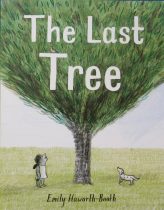
The Last Tree

The Last Tree
Emily Haworth-Booth
Pavilion Books

Trees are one of our planet’s greatest assets in the fight against climate change, so why oh why are the grownups in The Last Tree so careless in their use of this precious resource?

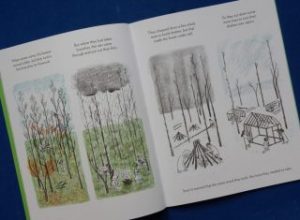
We first meet them when they’re searching for a suitable place to live and they spy their first tree; it’s part of a forest. They enjoy the summer living among the trees and sleeping outdoors.

Come winter they start cutting down a few branches for firewood but this leaves space for the rain to come through and extinguish their fire.

With each new season the loss of the trees creates further problems provoking yet more trees to be lost culminating with the construction of …

Now only one spindly specimen remains.

Inevitably with no view except their wall, the villagers become inward, self-obsessed and thoroughly disenchanted. Instead of a happy community they distrust one another and the adults in every family covet that single remaining tree sending their children to harvest it.

With axes in hand the children creep beyond the wall but in the joy of seeing one another they quickly forget their purpose. Rather than cutting down that tree they care for it, watching it thrive and grow, bringing instead planks to their parents who use them for barricading themselves in their homes.

Even so the wind comes blowing down the fences and out rush the adults to discover …

In the bright daylight they recall the good times and understand their foolishness.
Time to make a fresh start: and so it is that the last tree becomes the first of a brand new forest.

A timely parable of the destruction of the natural world and its effect on our planet’s climate, made all the more effective by Emily’s hugely potent graphics rendered in shades of green and grey.

As in our ‘extinction rebellion’ times, here too it’s children who have the imagination to become the agents of change.

Talking Is Not My Thing

Talking Is Not My Thing
Rose Robbins
Scallywag Press

Having a neurodiverse member of the family can be challenging for everyone as Rose Robbins, the author/illustrator of this, her second book knows so well for she has a brother on the autism spectrum and she also teaches young people who have autism.

Much of this story is conveyed through the female narrator’s thought bubbles; the rest through her brother’s words in speech bubbles and Rose’s dramatic illustrations. The narrator’s opening thought is ‘I don’t speak. But my brother finds it easy.’

Having followed her brother’s call to come indoors as dinner is almost ready, we learn how she does sometimes attempt to speak using her voice but the words come out wrong. Furthermore as the narrator is sound sensitive the noises of dinnertime cause her some distress, but she likes to feel included.

She also on occasion needs to convey how she feels or what she needs by means of one of her flashcards ( PECS symbol cards perhaps),

It’s great that brother and sister are able to play games together and that sometimes little sister acts as teacher.

Clearly understanding is not a problem, for shared story sessions with her brother reading aloud from a book, give his sister much pleasure.

At other times, such as when things go missing, mutual assistance is enormously beneficial. First a beloved soft toy bunny is located

and then once his sister is safely in bed, she finds her brother’s lost car. A highly satisfactory ending to their shared day.

Once again, Rose has created an enormously empathetic story that she conveys with subtle humour and a sense of respect for the siblings she portrays in Talking Is Not My Thing.

That sense of respect and understanding is what I saw yet again very recently while walking in the grounds of Ruskin Mill College, a specialist education establishment near my home that caters for neurodiverse students of between 16 and 25. A fairly newly admitted boy whom I’ve never seen stand still before, stood transfixed watching a heron that had perched atop a tree in the grounds. At least three members of staff stood fairly close keeping a watch on his wellbeing, allowing the boy to take as long as he wanted to observe, what was for all of us an awe-inspiring sight.

Lion Lessons

Lion Lessons
Jon Agee
Scallywag Press

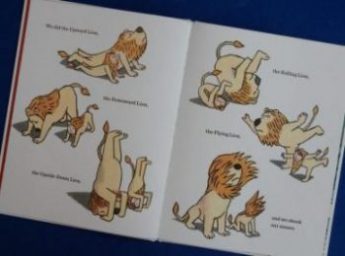
When the boy narrator protagonist of this story decides to take lion lessons, he quickly discovers that despite the ‘7 easy steps’ claim in the window of the teaching establishment, the diploma course is a steep learning curve.

The teacher is an actual lion with a degree awarded by the Harvard School of Claw and before starting on the ‘steps’, the learner must first engage in some yoga stretches.

Thereafter though, things rapidly go downhill. The teacher is less than impressed at his pupil’s efforts at appearing fierce. Roaring, selecting stomach-filling fare, prowling,

sprinting and pouncing are equally far from promising. In fact the lad’s scores are well below par.

Then comes the seventh step: Looking Out for Your Friends. Could this be the game changer perhaps …

Maybe, just maybe our small student can grow in stature and discover his inner lion sufficiently to surpass our expectations and become the proud owner of that graduation Lion Diploma after all …

What an artful fusion of words and pictures. With its deliciously droll, punchy narrative and littering of splendidly comic details on every spread, Lion Lessons will keep listeners on the edge of their seats right up to its deadpan final twist.

A simply stupendous, superbly paced read aloud say I; Jon Agee does it again.

Elsie

Elsie
Nadine Robert and Maja Kastelic
Abrams Books for Young Readers

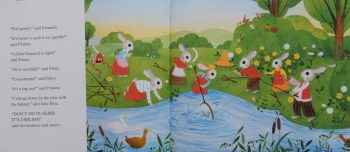
On fine sunny Sundays the seven Filpot rabbit children go fishing. Six are enthusiastic; divergent thinking, Elsie (with her head in a book), is not.

However she does go along following her own creekside path and when it comes to bait, despite her siblings’ advice, Elsie insists she’s going to put a buttercup on her hook.

Why not, after all, surely thinking for oneself and having innovative ideas is the right way to go: and so it is here, for Elsie’s is the rod that twitches and she’s the one with a successful haul.

Now is the time for her six siblings to listen to her point of view.

The combination of Maja Kastelic’s retro feel, vibrantly hued, detailed illustrations rendered in tempera and watercolour, and Nadine Roberts’ lively text mostly in the form of dialogue (with some judicious use of capital letters), result in a book that is thought-provoking, and hints at the notion of neurodiversity

All in all, a sweet story with important messages about being true to yourself and showing respect to those with different ways of relating to the world.

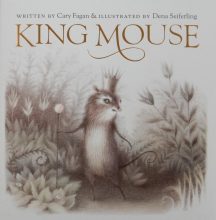
King Mouse

King Mouse
Cary Fagan and Dena Seiferling
Walker Books

As softly spoken as this fable is, its message is powerful, its theme highly pertinent.

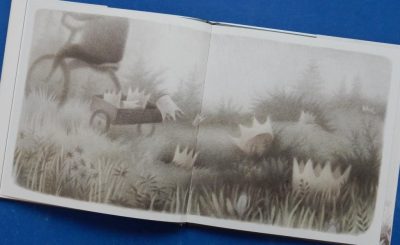
The story begins with a wordless spread rendered in soft silvery graphite to which has been added very gentle digital colour.

Turning the page reveals a just woken hungry mouse discovering not food but a tiny crown in the grass.

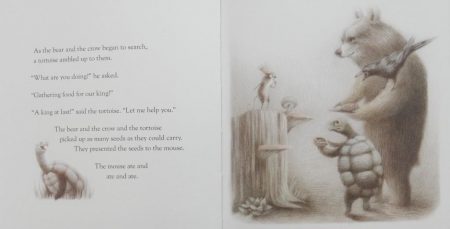
The mouse dons the crown; it fits perfectly and very soon a bear comes along. “Are you a king?” he asks. The mouse considers briefly before replying in the affirmative. “Hail to the king!” comes the bear’s response.

Before long a crow and a tortoise have come along and they all set about collecting food for the ‘king’.

Up comes a fox suggesting they create a dramatic offering to alleviate the mouse’s boredom and the mouse voices his approval.

In the meantime a snake too discovers another crown in the grass and puts it on her head. The other animals decide she’s a queen and show due respect, all but mouse; he’s less than pleased.

Then it’s the fox’s turn to discover a crown – that’s two queens and before you can say ‘ruler’ the other animals all declare themselves either a king or a queen.

All that is except the bear and off he goes in search of a crown. Unsuccessful, the bear is downcast as he watches the others prancing round showing off their regality and then he shambles away.

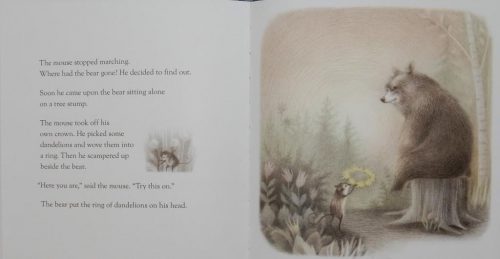
The mouse notices his absence and seeks bear out. Then the little creature fashions a special gift for the bear

and together the two share and savour what is really important.

Who is the real leader here and what makes him/her so? These are questions you could invite the children you share this poignant book with to consider and talk about.

The thoroughly engaging story of inclusion and friendship ends with a beautiful balance  created by a final wordless page …

Throughout, Dena Seiferling’s illustrations provide additional visual interest with details you need to search for, as well as in the form of tiny playful vignettes on many of the pages of text.

They Did It First:50 Scientists, Artists and Mathematicians Who Changed the World

They Did It First: 50 Scientists, Artists and Mathematicians Who Changed the World
Julie Leung and Caitlin Kuhwald (edited by Alice Hart)
Macmillan Children’s Books

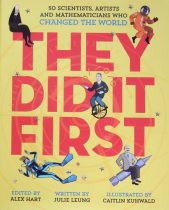
This book profiles 50 STEAM boundary-breaking trailblazers – pioneering artists, scientists and mathematicians – each of whom overcame enormous challenges to make incredible contributions in their own fields, and in one way or another, change the world for the better.
Some Julie Leung selected will already be familiar to readers – Ada Lovelace, Alan Turing,

Jane Goodall, Toni Morrison, Aretha Franklin, for example, but  that many others will probably not be.

It’s clear that the author has made an effort to feature men and women from around the world, as well as choosing from a variety of cultural and ethnic backgrounds. Thus she highlights Nikola Tesla, the first person to invent the AC motor (1887) Johanna Lucht the first deaf engineer to help manage a crewed NASA flight from mission control – “Never give up” she advises aspiring deaf engineers and scientists” with time and patience … “you will gain hearing allies.” along with the first Chinese woman – Tu Youyou – to be awarded a Nobel Prize (2015) in Physiology or Medicine.

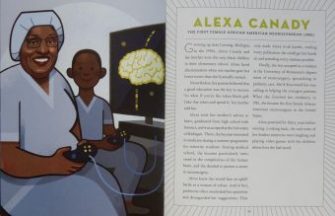
New to me are Alexa Canady who faced an uphill struggle as a woman of colour, to become the first female African American neurosurgeon;

she specialised in paediatric care, saving numerous young lives.

I’d not heard either of Riz Ahmed, first EMMY Award winner for acting (2017) who is of Asian descent;

and other than her name I knew little about Zaha Hadid, the first woman to be awarded the Pritzker Architecture Prize (2004).

The subjects, arranged chronologically, mostly came to prominence in the 20th or 21st centuries, although Isaac Newton (1668) is there, as are two 18th century people Maria Gaetana Agnesi, an Italian mathematician, and German astronomer Caroline Herschel.

Like me, I suspect youngsters reading this fascinating and inspiring compilation, will be prompted (perhaps by their motivational quote) to do their own digging to discover more about some of these incredible people starting perhaps with some of those for who a vignette portrait with a sentence beneath and a brief paragraph on the next spread, are all we’re given. To that end there is a final list of books and other resources.

Also at the end of the book is a time line, as well as a note from the illustrator, Caitlin Kuhwald whose stylised portraits, painted digitally, are instantly eye-catching..

Role models for aspiring youngsters, all.

I DIdn’t Do It!

I Didn’t Do It!
Michael Foreman
Andersen Press

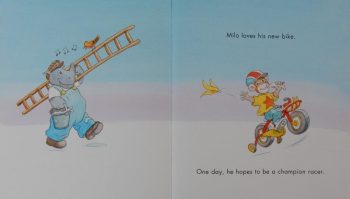
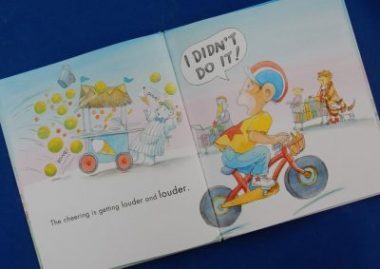
In his haste to see the finish of the Big Cycle Race would-be champion bike racer and proud owner of a new bicycle, Milo,

precipitates a concatenation of escalating chaos through the town, shouting “I didn’t do it” at every consequence of his determined haste to arrive before the competitors take the flag.

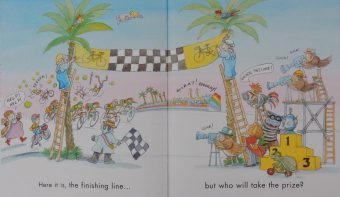
He does so, reaching the finish line just as the participants are about to make their final sprint,

and just in time to set off in hot pursuit after the thief as he makes off with the prize trophy.

Will Milo succeed in apprehending the dastardly cup snatcher?

What will happen to the baby that’s hurtling through the air and who will secure the prize trophy?

In this story Michael Foreman lets his wonderful watercolour illustrations do most of the talking, keeping the text to a minimum.

As a result, not only is this superb piece of slapstick a terrific read aloud book, but, with its speech bubbles and noises that orchestrate Milo’s journey, it’s also great for children in the early stages of their journey as readers. Make sure you read it to them first though.

Wild Wolf

Wild Wolf
Fiona French
Otter Barry Books

The inspiration for Greenaway medal winner, Fiona French’s Wild Wolf story was an Algonquin folktale called ‘Moowis’. However, a sighting in the Rocky Mountains of a single black wolf by the author some ten years back inspired her to write a different ending from the original folktale’s sad conclusion.

It’s a story of pride and its consequences for Proud Girl and Bravest Warrior. There’s rejection, anger, revenge,
love,

remorse, forgiveness and the life saving action of the wise guardian spirit narrator Wild Wolf.
Finally though, it’s love that wins out.

The bright artwork executed in oil crayons, with added graphite and coloured pencil detail, is arresting and stunningly beautiful. Fiona’s illustrations are inspirited by First Nation costume, quillwork, embroidery and beadwork of the Algonquin people of Canada and North West USA. Every single spread is a visual feast; what a wise choice of the publishers to use matt paper for the pages. (Make sure you check out the gorgeous patterned endpapers.)

This wonderful book is rich in potential for classroom use and I have no doubt many readers, either at home or in school, will be reaching for oil pastels/crayons to experiment with their own designs after studying the art herein.

(A donation from sales of the book will go to the Katarokwi Grandmothers’ Council of Kingston, Ontario.)

Narwhal’s Otter Friend

Narwhal’s Otter Friend
Ben Clanton
Egmont

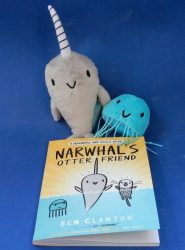
This is the fourth graphic novel style Narwhal and Jelly book and it’s as brilliant as ever.

It begins with an encounter between best pals Narwhal and Jelly, and newbie Otter. Narwhal declares self-professed ocean explorer, Otty, “Otterly awesome!” Ever-sceptical Jelly on the other hand, is less enthusiastic and disinclined to believe some of his stories.

His enthusiasm wanes further when Narwhal invites Otty to accompany him on an adventure. “Really? Does this mean we’re friends?” Otty asks. “Pretty much!” comes the response.

Guess who is jealous and feels left out. So much so that he decides to seek out a new friend; not very successfully
and eventually he befriends a rock, he names Rocky.
They play ‘oodles of awesome games’ that Rocky excels in ‘Go Fish . . . Marco Polo . . . Staring Contests’ as Jelly informs Narwhal and Otter when the latter finally hunt them down.

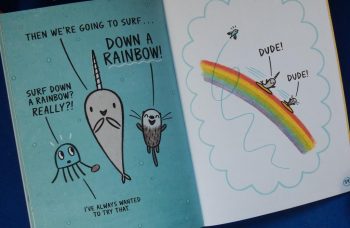
You’ve probably surmised that it was never Narwhal and Otter’s intention to sideline Jelly and he’s over the moon – or rather, the rainbow – to be invited to join them on the ‘awesomest adventure ever’. ‘Seas the day’ guys!’

As always Ben Clanton’s illustrations are terrific – whimsical, witty, wonderfully expressive. His text has its measure of splendidly groanworthy puns and there’s the usual sprinkling of animal facts as well as another Super Waffle and Strawberry Sidekick offering, from Jelly and Rocky on this occasion.

Plunge in and relish the three tales and more in this friendship tester; it’s a laugh-out-loud winner once again.

I Am NOT An Elephant

I Am NOT An Elephant
Karl Newson and Ross Collins
Macmillan Children’s Books

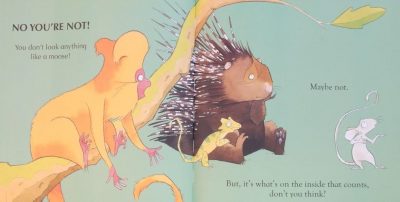
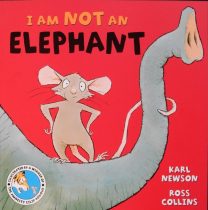
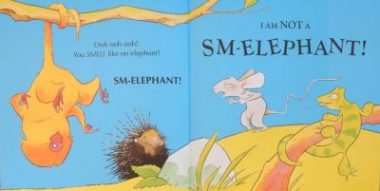
Hurrah! Team Karl/Ross have created a splendid sequel to their I am a Tiger with star of the show, Mouse, returning in all his naysaying glory, as he struggles against the odds to convince various beasties “I am NOT an elephant.” The odds being in turn, a lizard – who starts the concatenation of pachyderm positive ID-ing, followed by porcupine.

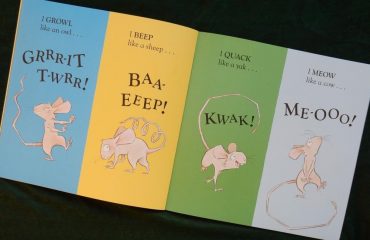
This sets our little rodent off doing some noisy acrobatics as evidence.

It’s of little use though, for up rocks a third creature going on about poor Mouse’s pong.

This leads him to make a shall we say, unwise claim, which almost ends in disaster; but our quick thinking Mouse tries another tack that includes some rather creative thinking,

culminating in a flying leap into unknown territory.

But hey! What’s this? If you’ve been observant from the outset, you’ll have noticed that Mouse reclining against a large subungulate foot nibbling a tasty fruit, and by now he’s rather anxious to finish dining so long as he’s not put off by any unexpected malodourous whiffs … after which it’s probably time to do away with his final claim and break into rhyme.

That way leaves the stage wide open for a third glorious episode of hilarity courtesy of Karl and Ross. They’ll be hard pressed to get Mouse to out-perform his show-stopping theatrics in this superb piece of silliness though.

Little Lost Fox

Little Lost Fox
Carolina Rabei
Egmont

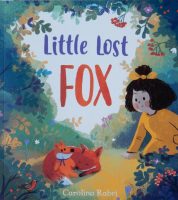
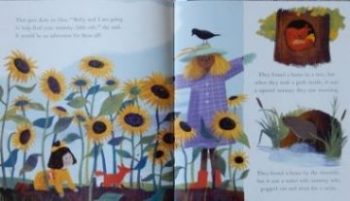
Despite the lack of other children in the vicinity of her country home, Kate is never lonely. Her friends and playmates are her toys; there’s story-loving Miss Bunny, Mr Ted, with a penchant for picnics and her favourite Ruby the Fox.

Imagine Kate’s distress when she notices Ruby has gone missing.

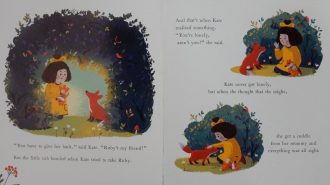
She searches everywhere and then spies a trail of pawprints that she follows until she discovers a real fox cub.

Kate implores the cub to return Ruby but the little creature only howls.

The little girl understands that the cub is lonely and decides that a cuddle from a parent will make everything feel all right.

Off they go together on a find Ruby’s mummy adventure that takes them first to a hollow tree wherein they see not a fox but a squirrel mummy. By the waterside there’s a mummy water vole but no mummy fox

and on the hillside a rabbit mummy appears.

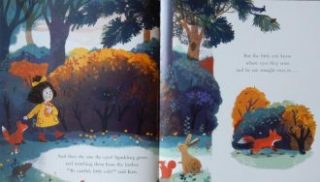
Eventually Kate discovers more pawprints of the same shape as the cub’s, leading into a wood, a wood full of strange sounds. Suddenly a pair of green eyes stare out of the bushes and the cub heads straight for …

Now the hour is getting late and with the foxes reunited, Kate must head for home. It’s a long way; how will she find her way back safely? Perhaps with a bit of assistance from her new-found friends. Friends that will keep returning to spend more time with her …

This warm story of caring, determination and friendship is a delight. Carolina Rabei’s richly hued, detailed illustrations show so well the main characters’ changing feelings as well as the beautiful rural landscape setting.

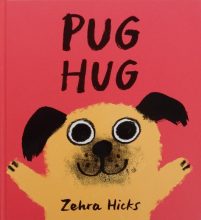
Pug Hug

Pug Hug
Zehra Hicks
Hodder Children’s Books

We first see Pug standing at the window looking out as his young owner departs for school.

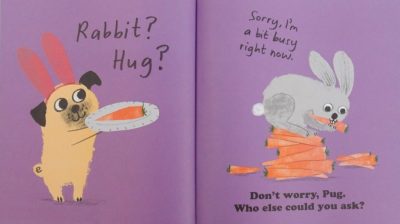
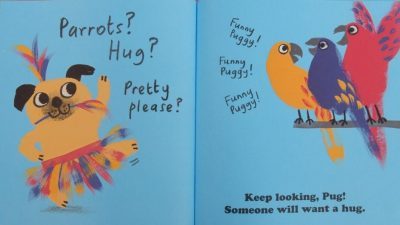
Seemingly the dog is desperate for a hug. The trouble is no matter which animal he approaches, not a single one wants to hug.

Cat doesn’t like hugs, Hamster is too difficult to catch, Rabbit is busy chomping,

hugging a goldfish doesn’t really work. Maybe a parrot will oblige; but no, all he receives to his request is amusement at his efforts to please.

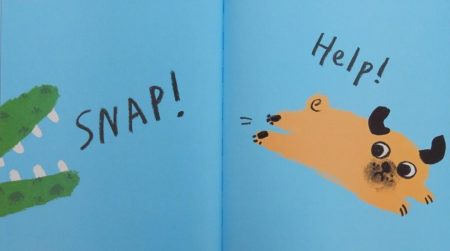
Lots of the potential huggers are fast asleep and it appears as though our hug seeker is about to give up in despair. But then he gets an offer, he definitely CAN refuse – and fast …

Will Pug ever have that elusive huggy moment he so much desires, and if so from what source?

Zahra’s smudgy, superbly expressive illustrations showing in particular, Pug’s entreaties, are enough to make any human – even those like this reviewer who isn’t a dog fan – feel like embracing him as he keeps on getting rebuffed.

The text takes the form of Pug’s requests and the responses from the animals along with a sequence of encouraging suggestions and comments from an external narrator.

The result is picture book harmony of words and pictures creating a story that is both funny and satisfying.

Boundless Sky

Boundless Sky
Amanda Addison and Manuela Adreani
Lantana Publishing

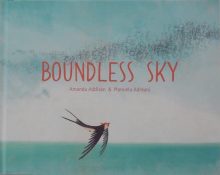
It’s almost impossible to imagine how a bird tiny enough to fit into your hand could undertake a flight halfway round the world and back. One cool September morning however, as Alfie stands in his garden a little bird pays a brief visit before flying off over the fields towards the sea.

A mother on board one of the fishing boats comments to her son, “Off they go, flying south for the wintertime!”

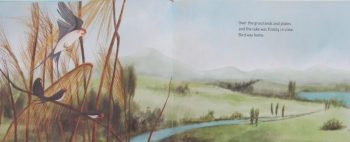
The journey continues over snowy mountains where village children spy the home seeking flock. Then as Bird undertakes the hardest part of the journey over the desert, a little girl Leila calls, “Bird! Welcome to my home” offering a welcome drink to the visitor.

Having flown above the jungle to the river, over the plains and grasslands, Bird finally has a view of an African lake. Home at last.

Summer passes quickly and it’s time to start the return journey but when Bird stops at Leila’s oasis home, she receives no reply from the little girl.

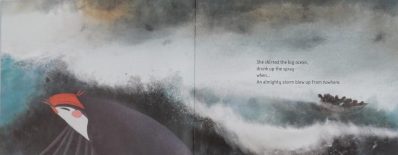
As she crosses the ocean once again a storm blows up

and it’s an exhausted Bird that rests in a mountain village before continuing her flight back to a garden in a town from where she started her flight, and where Spring it on its way.

A delighted reunion takes place there …

Some things are left unsaid – but readers are shown so much more – in this beautiful, moving, tenderly illustrated story of flight, searching, and finding a home; and the story’s poignant homecoming finale will really touch your heart.

Flights of Fancy

Flights of Fancy
Quentin Blake, Anne Fine, Michael Morpurgo, Jacqueline Wilson, Michael Rosen, Julia Donaldson, Anthony Browne, Malorie Blackman, Chris Riddell, Lauren Child
Walker Books

Now in paperback, here’s a truly special gem of an anthology subtitled ‘Let your imagination soar with top tips from ten Children’s Laureates’. It brings together the ten awesome authors and illustrators who have held the title (given in celebration of their outstanding achievements) and first awarded to Quentin Blake in 1999.

To open, Michael Morpurgo explains how the original idea of the role (each person holds it for two years), was first thought up by himself and Ted Hughes, the then Poet Laureate.

You might be especially interested in poetry, rhyme and wordplay, if so head first to the sections from Michael Rosen and Julia Donaldson. Michael in Poetry Belongs to Everyone talks about playing around with a word to create a poem. Julia Donaldson’s Plays to Read and to Write discusses one of her own plays that she based on the Aesop’s fable, The Hare and the Tortoise, offering a fun, lively 6-parter

If you’d rather be playful in the visual sense then Anthony Browne’s The Shape Game could be your starting point: having talked about how to play it, he showcases some examples from 3 other famous illustrators to whom he gave the same shape to play as the one of his own shown in the book. The potential with this one is endless. Probably that is the case with most of the chapters however.

In The Only Way to Travel, Quentin Blake writes with reference to  Dahl’s stories, about how when illustrating someone else’s texts it’s important to ‘put yourself inside their story’ and capture the atmosphere before diving in and drawing those fabulous illustrations of his.

More about how other fabulous illustrators approach their drawing and what provides their inspiration comes from Chris Riddell –

make sure you check out his brilliant cartoons of all ten Children’s Laureates in the final section – and Lauren Child.

How fantastic and moving is Michael Morpurgo’s Find Your Own Voice that tells children how to do so in ‘I Believe in Unicorns’.
I thoroughly enjoyed too, Malorie Blackman’s Taking a Word for a Walk using SEA as her example,

before she moves on to discussing from whose viewpoint a story is being told when one writes.

If you want to inspire children to let their imaginations soar, then you really, really must have a copy of this cracker of a book in your home or classroom; not only will it do just that, but it will also ignite or add fuel to a passion for reading, writing and illustrating. (BookTrust, which manages the Children’s Laureate gets 50p from every sale.)

Runaway Robot

Runaway Robot
Frank Cottrell-Boyce, illustrated by Steven Lenton
Macmillan Children’s Books

After being in a road accident, twelve year old Alfie has been fitted with a prosthetic hand – this makes him ‘a bit bionic’ he tells us. Along with the loss of his hand though, the boy has lost his confidence.

He explains how he bunks school( aka Limb Lab) – ‘swerving school’ he calls it, and instead of joining in the “New Life’ lessons he goes to hang out at the arrivals lounge of the airport.

On one such swerving occasion Alfie accidentally loses his state-of-the-art hand. At lost property, instead of his hand, the lad finds Eric, a six-foot tall, metal robot with a propensity for singing the national anthem. “I AM YOUR OBEDIENT SERVANT” Eric announces and “I CAN ANSWER ANY QUESTION” (except the ones he doesn’t know the answer to, that is.)

Eric too is missing a limb, one if his legs. Despite this, unlike the other robots Alfie decides Eric is anything but ‘a disappointing robot’. Indeed, he declares him ‘the most-not-disappointing robot you could ever meet’.

It’s no surprise then that the boy will do everything he can to keep the illegal Eric from being crushed at the R-U-Recycling scrapyard.

No easy task as despite his fine manners, Eric takes instructions literally, which inevitably gives rise to a fair few problems.

But with reports of a rogue robot at large terrifying the estate, should Alfie even be bent on saving Eric?

Alfie’s world might be full of things robotic (he does make some new human friends too) though in essence this story is about what being human really means.

With a plot that makes you both laugh and cry, that’s what makes Frank Cottrell-Boyce’s highly original book so satisfying. Add to that a sprinkling of Steven Lenton’s smashing illustrations and what you have is an unmissable treat.


Mermaid School

Mermaid School
Lucy Courtenay, illustrated by Sheena Dempsey
Anderson Press

The first of a new Lucy Courtenay series sees young mermaid Marnie Blue determined to make a good impression on her very first day at Mermaid School.

She has the usual first day nerves about making friends, and is concerned at the prospect of perhaps having to ride a seahorse but she has something additional to be worried about.

Her aunt, the famous singer and DJ, Christabel Blue, is an ex pupil and her reputation as a student at the same educational establishment leaves a lot to be desired. Indeed she is on record as having been the naughtiest mermaid the school has ever had on role. In contrast Marnie’s mother was a model student.

Marnie really wants to impress both staff and fellow pupils but will her teachers give her a fair chance or have they already decided what kind of newbie they’re dealing with in the latest Blue family enrollee to Lady Sealia Foam’s Mermaid School?

Her first day is definitely not a success except that Marnie makes friends with Pearl Cockle. Surely the mayhem-causing snake in her school bag couldn’t possibly have been put there by her aunt, could it? If not then who was responsible?

What about Orla, who from the outset seems determined to be unkind to her and causes her to get into trouble? Something decidedly fishy appears to be going on.

Then Orla goes missing; who will come to her aid?

There’s SO much more to discover about life at Mermaid School and Marnie’s family in this story that bubbles with excitement; all the more so thanks to Sheena Dempsey’s illustrations.

I know one 7-year-old reader who is already eagerly anticipating Book 2, The Clamshell Show, coming in May.

Emmanuelle engrossed in the story

Some of Emmanuelle’s comments on this book:
“It was VERY, VERY, VERY good and very funny, especially Marnie’s aunt, Christabelle Blue. I really like that she said the Mermaid school was ‘terrible’ and also her love aspect with a human.”

She was also inspired to draw this picture of Marnie’s aunt.

Rhinocorn Rules!

Rhinocorn Rules!
Matt Carr
Egmont

Matt Carr’s Ron is a rhinocerus after my own heart – a fun and art loving, rule subverter, full of ideas of the divergent kind.

Being grumpy, a loner and ready to charge should anything approach is not for him. Instead Ron is at heart a fun-loving, art and music enthusiast, brimming over with creativity and joy. Moreover he wants to share his joyful ideas with the other animals but none of the rule-abiding creatures is interested.

Life for Ron is pretty mundane until one sweltering afternoon at the waterhole he catches sight of his dull reflection in the water. Thinking that if only he could show himself as he really is then friendship would follow, an idea strikes him and Elmer the patchwork elephant style, Ron sets to work with his creativity …

Once he’s dried off he is transformed into a true life work of art and as you might expect, he now feels A-MA-ZING!

Time to get himself noticed and so he does: first he impresses the meerkats and before long lots of animals are eager to have fun and be friends with the transformed Ron. Happiness at last.

Happiness however is not what his fellow rhinos feel; oh dear no. Ron is a total embarrassment, so they tell him.

Fortunately though, the meerkats stand up for their new friend and point out something that hadn’t occurred to the rhinos. Realisation dawns and then there’s only one thing to do … and Ron does it in one deft move of his forelimbs.

I wonder what new rules he created in place of old ones. What three would you have chosen?

Through his droll illustrations and heartfelt words Matt has created a thoroughly inspiriting story. The message is loud and clear: be true to yourself, be proud of who you are; and if that means finding a way round, over or under the rules then so be it, and good on you.

Love the cleverly worded title and the final ‘Did you know?’ page.

Everybody Counts


Everybody Counts
Kristin Roskifte (translated by Siän Mackie)
Wide Eyed Editions

This immersive book subtitled ‘A counting story from 0 to 7.5 billion’ is the 2019 winner of the Nordic Council Children and Young People’s Literature Prize. It’s easy to see why. It’s like no other counting book, that’s for sure and what is counted is people, people from 0 (no one) to 7.5 billion – the entire world.

The people are members of groups and many belong to two or more groups and so stories evolve around the characters, starting with a boy and his family making a total of 5.

You can follow these characters through the book, seeing how their various life stories intersect and diverge.

The narrator makes brief comments about people in their settings, for example in the classroom scene, of the 20 children ‘One of them is thinking about all the people who’ve lived before us. One of them has lost the class teddy bear. One of them is dreading football training. One of them will become prime minister.’

However, much is left unsaid so there are sufficient gaps for readers to fill and likely fill differently, on each reading.

Dive in, get lost in the pages, stop; study each one thoughtfully, and move on; eventually you’ll have met 2768 people. Then perhaps move back; the ‘spotting section’ at the end will certainly encourage you to do that.

Most importantly though, whatever other interpretations readers make, the indisputable messages that emerge are, that we are all part of one enormous, interconnected world group – the human race – and that each one of us has our own unique story, for as the title says, Everybody Counts.

Just imagine how many philosophy for children sessions might evolve if you start exploring this ingenious, visual festival of a book in the classroom.

Gnome

Gnome
Fred Blunt
Andersen Press

I was recently thinking I hadn’t seen anything new from Fred Blunt and then this cracker from Andersen Press arrived in my mail.

Mr Gnome is a naysayer if ever there was one. No matter how politely the requests made to him are proffered, his response is always in the negative.

So, it’s “No” to accompanying him on his fishing expedition

and a resounding “NO” to coming to the aid of Mr Hedgehog, even for a reward.

As for the plea from the witch who does assist Mr Hedgehog, our curmudgeonly Gnome may be about to get his comeuppance when he flatly refuses to stop fishing in her pond.

Deliciously silly, Fred Blunt’s cautionary tale will have readers and listeners spluttering in delight especially at the finale but not just that. Every spread is chuckleworthy – it’s impossible to choose a favourite – and Fred’s comic timing is spot on as it builds up to the wonderful climactic revelation.

Share it here, share it there, share it everywhere you can: I wouldn’t mind betting you’ll get the same immediate “read it again” demand (maybe with the odd ‘please’) as you close the covers as I did.

The Surprising Lives of Animals

The Surprising Lives of Animals
Anna Claybourne and Stef Murphy
Ivy Kids

The author of this look at animal lives talks in her introduction of the close link between humans and other animals, dividing the book into five aspects of behaviour that we all exhibit. She then goes on to explore elements of each one through a wide variety of animals both large and small, using playfulness (Having Fun), Thinking and Feeling, Everyday Life, co-existence and community (Living Together), and Settling Down and reproducing, as themes.

Adults as well as young readers will find plenty of interest: I was surprised to learn for instance that seagulls have been observed playing catch by dropping a stick or a stone from high up in the sky then swooping down to catch it before it reaches the ground – an aspect of playfulness so some scientists think.

Did you know that octopuses are highly intelligent and are able to work out how to undo screw-top jars and childproof containers to get their tentacles on tasty snacks?

Or that that an African grey parrot named Alex, studied by animal brain scientist Dr Irene Pepperberg was able to identify different colours, shapes and materials, and sort items into categories? This is just one of the numerous things she discovered during her 30 years of training and working with the bird.

Equally clever in their own way are the Army ants found in South America that are able to build bridges out of their own bodies. Then having done so they use the bridges to get across gaps and work co-operatively until all members of a colony have traversed the gap. That’s teamwork for you.

Anna Claybourne mentions the work of a number of animal scientists in her ‘Scientist Spotlight’ insets. Her narrative style makes the entire book highly readable as well as informative; and Stef Murphy’s illustrations illuminate not only the animals’ fascinating behaviours but also their habitats and characteristics.

Recommended for family bookshelves as well as primary school collections.

Poems Aloud

Poems Aloud
Joseph Coelho, illustrated by Daniel Gray-Barnett
Wide Eyed Editions

Joseph Coelho is a performance poet so it’s no surprise that the nineteen poems in this book are first and foremost, intended to be read aloud or performed. Through so doing children can have lots of fun and discover the pure pleasure of spoken words.

There are poems for a range of moods and for each one, Joseph provides a helpful introductory line or so about reading it out loud.

There are some short playful alliterative Tongue Twisters to start with, including the sibilant The Slime Takeover that children will definitely delight in:
‘Slipping, shimmering, stinking slime, / sloppy cerise or shades of scarlet sublime. / It sticks and sucks and spits and spools, snaking slime slumping several school walls./ The slime swells and stretches, and starts to sprout, … ‘

They’ll also relish The Chilly Chilli with its homophones. Here’s the second verse telling how it feels since being ‘shipped to store’:
‘A little chilly chilli / feeling cold and in a knot. / Not a happy, chilly chilli. / In fact, this chilli feels quite ill / like it’s caught the flu. / It flew all this way / packed in a plane / to add heat to otherwise plain food.’
It sounds as though the poet had as much fun composing this as youngsters will when they read it, emphasising the bold words as he suggests.

As I write today the following are my favourites  (although they might well be different on another day): This Bear with its figurative language such as is used in the opening verse:
‘This lumbering bear is old / This lumbering bumbling bear / has shuffled over rugged imagined mountains. / Urged his bulk, slow and strong. / Slow as geography. / Strong as tree growth / through the forests of his mind.’
What a wonderful picture that paints in the reader’s mind even without the splendid illustration.

I love too the short Animals offerings that include Lion: ‘I am meat-licker, / bone-cruncher, / big–meower. / I cat walk with pride. / My mane is a hairdo of envy. / My roar is a rumble of mountains. / My claws, a savannah of pain.‘ Superb!

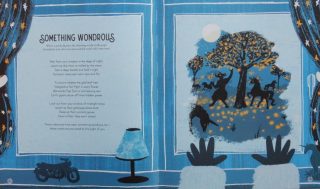
Next is the fantastically fanciful Something Wondrous, the first line of which urges:
‘Peer from your window in the deep of night.’ You might spy these, for its second verse goes thus:
‘A unicorn nibbles the gold leaf tree, / hobgoblins fist-fight in every flower. Mermaids flop from a luminescing sea. / Earth giants show-off their hidden powers.’ Joseph’s  power with poem creating is certainly not hidden and I really like the use of silhouettes in Daniel Grey-Barnett’s illustration.

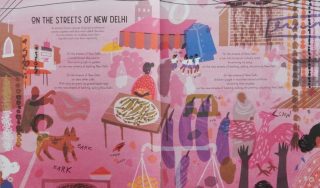
The final one of today’s favourites conjures up a place whose sights, sounds and smells I’m familiar with. Even if you’ve never been On the Streets of New Delhi this poem will make readers feel that they’re experiencing the place. Here’s how it begins:
‘On the streets of New Delhi / a small brown dog yawns. / The morning light is golden / on the new streets of barking New Delhi.’
It concludes, thanks to the cumulative nature of the last line of each verse: ‘on the new streets of barking, selling, thrumming, chuckling New Delhi.’
Get hold of this cracking book to discover what causes the thrumming and chuckling referred to. Or you could cheat and look carefully at the action-capturing illustration  below;

but buy the book anyway – it’s a smasher!

The Monster in the Lake / Unicorn Academy: Isla and Buttercup

Here are the latest stories in two magical series from Nosy Crow

The Monster in the Lake
Louie Stowell, illustrated by Davide Ortu
Nosy Crow

We’re back in the magical world Louie Stowell took us to in Dragon in the Library with youngest magician in the world, Kit Spencer. Beneath that library in Book Wood, she’s having ‘spelling’problems. She hasn’t been distracted, her pronunciation was spot on as were her hand gestures; so why, oh why, are her spells going haywire?
Then Kit and her pals learn two things: one: they can understand what the animals they encounter in the park are saying and two: Dogon the delightful dragon dog is poorly, very poorly.

Definitely time for a spot of investigation …

Almost before you can say ‘weird’ the friends find themselves face to face with a strange creature calling itself Lizzie and saying it’s a Lesser Nessie from Scotland.

After a conversation with Lizzie, the friends return to the library and before long they’re embarking on a double rescue undertaking in Scotland, via one the library’s portal books.

Once there they discover a mobile library and its librarian Duncan. Then follows a terrific adventure full of mermaids, ancient curses and much more. It’s dangerous, nail-bitingly tense and absolutely perfectly paced.

Once again Louie Stowell’s telling with its mix of magic, friendship and bookish references works a treat, and with Davide Ortu’s stylish illustrations, the result is another spellbinding foray into the world of Kit, Faith, Josh and Alita.

An absolutely brilliant, unmissable story for primary readers: and what a superb final observation by Faith, “Whatever else changes, whatever threats we face … We will always have books.”

For slightly younger readers:

Unicorn Academy: Isla and Buttercup
Julie Sykes, illustrated by Lucy Truman
Nosy Crow

Can it really be the 12th visit to the magical Unicorn Academy? I know one girl, now seven, who has lapped up all the stories so far and has been eagerly awaiting this new one. I’m sure she will devour it in a single sitting.

The term is drawing to a close and Isla is eager to graduate along with all the other girls. When her unicorn Buttercup discovers that his magical power is ‘finding magic’ Isla hopes that he’s capable of using this special power to find the evil Ms Willow who has disappeared.

Does 2nd year student Valentina know anything about her whereabouts – she’s certainly acting strangely. Why is she receiving so many letters, and who is sending them?

Once again, teamwork is key in this adventure: Will the girls find the missing teacher; will Isla finally believe in herself and will everyone receive their graduation scroll at the end of term?

River Stories

River Stories
Timothy Knapman, Ashling Lindsay and Irene Montano
Red Shed (Egmont)

Prepare to immerse yourself in Timothy Knapman’s tales of five rivers.

Our travels begin on the African continent with a trip along the Nile, at 6,695 km. the world’s longest river. Rising in the African jungle it comprises two tributaries, the Blue Nile and the White Nile, and flows through forests, mountains, lakes and deserts before reaching the Mediterranean Sea.

However its exact source is disputed. Timothy tells readers that one explorer John Hanning Speke declared the true source to be Lake Ukerewe (now called Lake Victoria).  During the trip we learn of festivals, historic events associated with the river, view some wildlife and visit the pyramids, tombs and temples of Egypt.

The second journey is along the Mississippi that extends the entire length of the US all the way to the Gulf of Mexico. This river is home to over 1000 animal species and flows through the site, I was fascinated to learn, of Cahokia, a lost 12th C city.

We’re in Europe for the third journey that takes us from a glacier in the Swiss Alps to the Netherlands where the Rhine’s delta is located.

There are mentions of music and musicians, magic, myths and legends, and sightings of fairytale forests as well as castles, windmills and bulb fields.

High on a Tibetan plateau is where the Yangtze journey starts. We read of dragons and dolphins, glimpse pandas and if the timing is right, see the amazing Dragon Boat Festival.

The Amazon with its incredible rainforest flora and fauna is the river of the fifth trip. There’s so much to discover and I was astonished to learn of Ed Stafford’s walk along its entire length, making him the first person to do so, a journey of 6,992 km that took him 860 days – WOW! Awesome!

There’s much of interest whether yours is history ancient or modern, geography, mythology or something else Timothy includes, and illustrators Aisling Lindsay and Irene Montano show in the engrossing, vibrant spreads that unfold to show the entire length of each river journey.

World stories to wallow in for sure.

Neither of the rivers I’m personally familiar with – the Thames and the Ganges – are included in Timothy’s book; now’s that another story – or many.

Books For Babies And Beyond

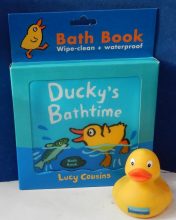
Ducky’s Bathtime
Lucy Cousins
Walker Books

Quack! Quack! Hooray! – it’s Ducky’s bathtime day. In a lovely squishy waterproof, wipe- clean format, this delightful Ducky adventure is totally irresistible.

Not only does it provide the perfect opportunity to introduce Lucy Cousins’ adorable Ducky to babies, they can also meet the quacky duckling’s friends including fish, ducks, frog and newt.

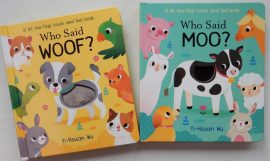
Who Said Woof? / Who Said Moo?
Yi-Hsuan Wu
Little Tiger

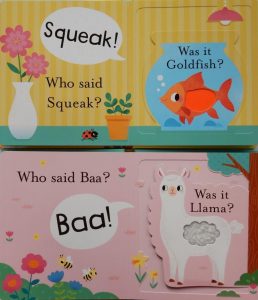
Four animals in each book make their characteristic sounds but they’ve all hidden themselves away beneath flaps depicting four other animals each with a tactile die-cut shape on its back.

So, it wasn’t Bunny who said ‘Woof!, nor Guinea Pig who said ‘Meow!; neither did Goldfish ‘Squeak!’ nor Tortoise ‘Squawk!’ but lifting each flap wlll reveal the sound-creating creatures.

As you might expect. Horse did not ’Moo!, Llama certainly didn’t ‘Baa!’, Dog definitely didn’t ‘Quack and Rabbit wasn’t responsible for that ‘Oink!’

Toddlers will enjoy discovering the hidden culprits that they’re likely already to have guessed, beneath the flaps in Yi-Hsuan Wu’s jolly illustrations.

The final spread of each book collects together the entire cast of animal characters with a question “What sound do you say?’ – anything goes!

With their predictable repeat refrains, both books are just right for older siblings beginning to read for themselves, to share with a toddler brother or sister and everyone can enjoy making the animal noises.

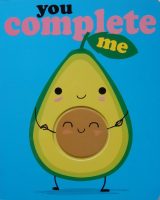
You Complete Me
Thomas Elliott
Caterpillar Books

‘Better together’ (a wider, hidden meaning perhaps?) is the message in this tasty, playful, peek-a-boo board book where partnerships prove paramount.

Set against vivid backgrounds, bright, eye-catching toddler foodie favourites such as milk and cookies, and peanut butter and jelly, unite to make the point loud and clear in Thomas Elliott’s delicious die-cut piece of daftness.

With its puns and clever design, adults will savour the pleasure along with their little ones as they share this one.

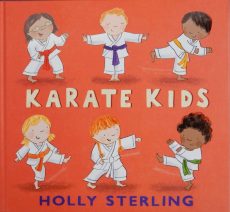
Karate Kids

Karate Kids
Holly Sterling
Walker Books

Holly Sterling teaches karate and competed for England in karate, winning many medals, so it was almost inevitable that she would eventually create a picture book on the topic and here it is.

Let’s meet Maya who narrates the book, announcing before the story starts that she aspires to be a karate kid.

We then join her one Saturday morning as she dresses in her special suit (a gi) and sets off with her dad and soft toy lion to the dojo.

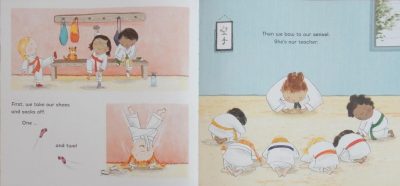
There she and her friends are greeted by their sensei or teacher, and then having removed their footwear, they bow to her and the class begins.

They warm up, practise blocks, then try out

and perform a patterned sequence of moves called ‘kata’ and conclude with mokuso (meditative breathing).

It’s evident that Maya as well as the other learners thoroughly enjoy participating in the session

and as she leaves Maya pauses to watch and admire one of the older children, a black belt wearer practising her kata.

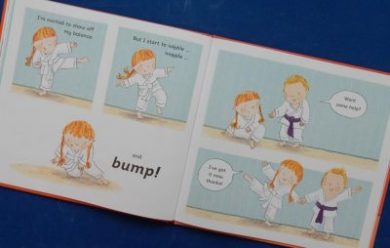
In addition to showing Maya and her friends’ joyful enthusiasm for what they are learning, Holly’s lively art reflects her own enthusiasm both for karate and for portraying young children.

Be sure you check out the end papers of this karate-enticing book.

Show and Tell

Show and Tell
Rob Biddulph
Harper Collins Children’s Books

I’m delighted to tell you that this piece of rhyming brilliance from Rob Biddulph is a February paperback publication – be sure not to miss it if you haven’t got the hardback.

How Rob does it time after time I can’t quite fathom, but the guy is surely a genius when it comes to picture books.

He sets this story in the classroom and he zooms us right there with the opening credits page with its trolley full of named drawers.

Having met the class in question 2L who so we’re told, are ‘excited’ we’re introduced to their teacher Mr Lumsden as he announces what they’ve all been waiting for – a show and tell session. “The child that impresses me most wins a prize,” he says.

Now there’s rabid competitiveness in 2L as is very quickly evident, but things begin quite simply with Adam and his lowly sunflower seed.

This is immediately poo-pooed by another class member as being “BORING!” She has something far superior, so she thinks – a tin of blue spaghetti.

Very soon the event turns in to an ‘anything you can do, I can do better’ competition as the items brought – goodness knows how – begin to escalate. We see a red robot, a racing car, immediately followed by an alligator,

and a space ship complete with alien operator, Zorg. Then we have Big Ben, out-bigged by a flaming volcano

and wait for it – the MOON!

There follows a totally unexpected, added bit of out of this world wackiness, before Mr Lumsden finally picks the winner.

Thereafter comes a brilliant twist that shows us all something really important. On this matter I’ll say no more.

When I was a class teacher, I never had ‘show-and-tell’ sessions for the very reason that Rob has so cleverly and humorously shown and told with his 2L.

Max & the Midknights

Max & The Midknights
Lincoln Peirce
Macmillan Children’s Books

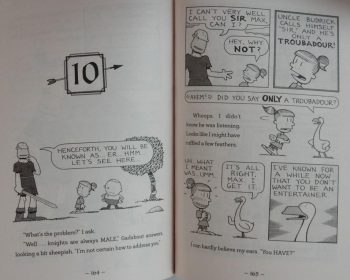
Author/cartoonist Lincoln Peirce mixes comic strip and conventional prose to plunge readers back to the Middle Ages in this enormously engaging, madcap tale of young Max who longs to become a knight.

Max, (who acts as narrator), lives with Uncle Budrick, a totally inept troubadour in whose footsteps, as tradition dictates, the youngster is supposed to follow.

When ‘Sir Budrick’, as the side of his wagon announces, is taken captive by the evil throne usurper King Ghastly, Max and some other kids form The Midknights with the intention of storming the enormous castle where Budrick is imprisoned, rescuing him and restoring kindness to the kingdom.

First though they have to do battle with wicked sorceress, Fendra,

and ghastly, grimy, winged rats; oh and there’s a dragon too.

Then of course, there’s the thorny issue of gender – only boys can be knights – and the fact that your uncle can by accident, become a duck.

The dialogue between the young characters is entirely child appropriate and funny, and there’s plenty of word play and jokes as well, along with lashings of kindness and bravery.

Cleverly woven into the mix too are thought-provoking ideas relating to gender and being able to determine your own future no matter what. I absolutely love the King’s final declaration and the children’s confirmation that “Any child, boy or girl, may become a writer … or a magician … or a knight”.

Finally, a new chapter begins in Byjovian history and Max’s armour certainly shines bright.

Waiting for Anya

Waiting for Anya
Michael Morpurgo
Egmont

This month Egmont publishes Michael Morpurgo’s superbly plotted, totally gripping story Waiting for Anya with a film tie-in cover.

It’s set in France, in the mountain village of Lescun during World War 11.

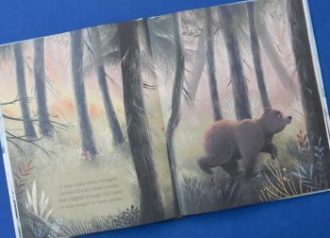
A twelve year old shepherd boy, Jo whose father is a prisoner of war, is alerted by Rouf, his dog, to the presence of a bear. Now wide-awake, Jo dashes to warn the other villagers and the creature is hunted down and killed.

In search of Rouf, Jo returns to where he saw the bear;he encounters a man whom he discovers is reclusive Widow Horcarda’s son-in-law, Benjamin and that he’s in hiding.

Watching him through the widow’s home window, Jo recalls that he’s seen the man the previous summer holding tightly to the hand of a little girl.

He then learns that Benjamin has become separated from his daughter, Anya and that he believes that eventually they will be reunited.

As a trust grows between the widow and her son-in-law, and Jo, it’s revealed that Benjamin is Jewish and while he waits for that hoped for re-union, he is involved in a dangerous mission – leading other Jewish children away from the Nazis over the mountains, across the border to safety in Spain.

Jo is determined to help and starts bringing supplies to Benjamin’s hideout.
But then war makes itself well and truly felt in Lescun with the arrival of Nazi soldiers in the village: their eyes and ears are everywhere, and it’s announced that anyone helping fugitives will be shot. A curfew is imposed.

Jo is surprised to learn that not all the German soldiers are totally evil when he develops an unlikely friendship with a German Corporal through their shared interest in bird-watching.

Then despite the dire warnings the villagers plan to help another group of twelve children hidden away in a cave.

Just one slight slip up and lives will be lost …

There certainly isn’t a happy ever after ending to this tale; it’s tense, not everything goes well and there is one poignant final surprise. What for me resonates especially though, is the way the author shows the French villagers living alongside the Germans, not all of whom are bad. In the final pages we’re told, Jo ‘had come at last to see him (the Corporal) as a man in the uniform of the enemy, a good and kindly man … but nonetheless an enemy too’ – a ‘confusion he did not wish to confront.’

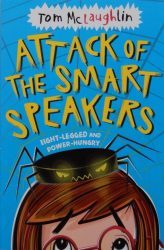
Attack of the Smart Speakers

Attack of the Smart Speakers
Tom McLaughlin
Oxford University Press

Here’s another hoot of a story from Tom McLaughlin. It tells what happens when a new and crazy fad hits the town of Happyville in the form of smart speakers.

Seemingly everybody has one or is about to acquire same, for it appears as though these Nova devices – virtual assistants – are mega helpful. But are they?

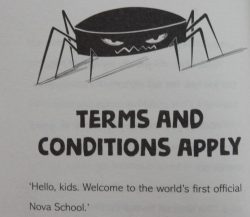
It isn’t long before Tyler and her pals are starting to become just a tad suspicious. Are they the only ones concerned about who, or indeed what, is really doing the controlling. I wonder what the terms and conditions accompanying these things actually say – has anyone read them? That I doubt.

A big surprise awaits the children when they arrive at school. Their headteacher announces that he’s signed up to a new sponsorship deal with – guess what – Nova – and he at least is super-excited about it. Uh-huh!

When the ‘things’ start acquiring appendages we wonder how much worse things can get. Robot spiders intent on a take-over not just of the town but humanity itself? No thank you.
Come on geek guys Ashley, Dylan and Tyler – it’s up to you.

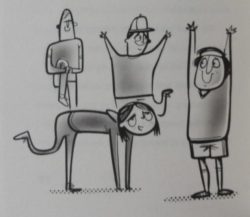
Following a communal dance session –Nova controlled,

a foresty foray, and a possible unlikely alliance, plans are finally afoot but …

Absolutely full of gigglesome moments, with plenty of zany pictures as well as the spidery speakers that provide visual chapter headings,

this book with its unexpected twist, will enthral junior audiences, especially those with a techy bent, whether its read alone or shared as a class read aloud.

(If you’ve not tried Tom’s earlier story set in Happyville, then you should try Happyville High: Geek Tragedy that also features Tyler et al.)

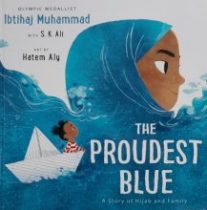
The Proudest Blue

The Proudest Blue
Ibtihaj Muhammad with S.K.Ali, illustrated by Hatem Aly
Andersen Press

This is a powerful and empowering book created by team Ibtihaj Muhammad, a fencer and the first Muslim woman in hijab to represent the US, novelist A.K. Ali and artist Hatem Aly.

We first meet Asiya and her younger sister, Faizah when their Mama takes the girls to a hijab shop for Asiya to make her choice for that important ‘first-day hijab’.

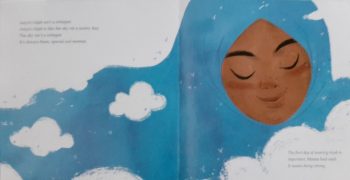
The following morning the sisters leave for school, Faizah (the narrator) sporting snazzy new trainers and wearing a new backpack, Asiya wearing her brightest blue hijab that reminds her sister of the colour of the ocean, if you squint your eyes and pretend there’s no line between the water and the sky. “I’m walking with a princess” Faizah tells us and “Her hijab smiles at me the whole way.”

Once at school however, the comments from other children start. These are alternated with meditative spreads showing and telling of Faizah’s thoughts about her sister’s hijab, along with Mama’s words.

A bully boy starts laughing.

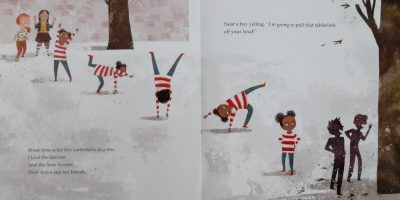
Come break time, the bullying continues with one boy shouting at Asiya, “I’m going to pull that tablecloth off your head.”

Her sister recalls Mama’s wise words “Don’t carry around hurtful words … they belong only to those who said them.”

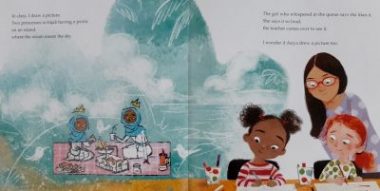
At the end of the day it’s a strong, smiling Asiya who awaits Faizah and together they return home, Faizah proudly carrying the picture she’s drawn in class of the two of them.

Having shown the bullies her back, now she too is beginning to appreciate and understand the beauty and strength Asiya and mother see in her hijab.

This beautifully, lyrically told story that highlights the importance of family bonds, with its sensitive illustrations wherein bullies are depicted as faceless, is a must for inclusion on classroom bookshelves.

It also celebrates Muslim girls who are hijabis. I have taught Muslim girls, some of whom as young as seven, have suddenly turned up wearing a hijab and I’ve not thought it appropriate to question them; and I have many Muslim friends both here in the UK and in India but none of them wears a hijab. So I’ve not had an opportunity to talk with young hijabis about this topic, or the coming of age rite it signifies in this book. I found this superb story enlightening, and uplifting in its clear messages about equality and the power of women.

Board Books Matter

Board books form the bedrock of children’s reading – or rather one hopes they do; but not all new parents appreciate their potential and their importance. Thanks to Little Tiger, here are some new titles. The first is already published the others will be early in February.

Where’s My Unicorn?
Kate McLelland and Becky Davies
Little Tiger
Right from a very young age, there seems to be a magnetic attraction between young children, (girls mostly) and unicorns, so I’m sure this textured book will please.

Its first spread shows the rear end of a hoofed animal that has left a trail of footprints as clues to follow through the pages until the missing unicorn is found on the final spread hiding in plain sight.

On the way little ones encounter a mermaid with a colourful tail, a flamingo with soft fluffy plumage and a narwhal with a magical horn.

Tactile hide-and-seek fun for tinies who can enjoy the search as well as joining in with the repeat refrain, ‘Where’s my unicorn?’ Becky Davies provides the words, giving a sentence about each creature; Kate McLelland has created the alluring visuals.

What Can You See: On the Farm?
Kate Ware and Maria Perera
Little Tiger

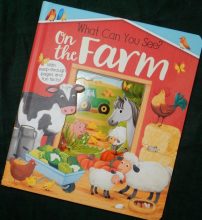
As well as providing an introduction to what might be seen on a farm, and something to count on each spread, this, the first of a new ‘spot and count’ series provides plenty to interest little ones in Maria Perera’s jolly scenes of farm life.

First we visit the farm shop where different kinds of delicious-looking vegetables are on sale. Lunchtime is an opportunity to watch the sheep being fed; the pigs too need feeding and fruit trees near their sty supply a wealth of apples when they’re ready for eating.

The farm also has a duck pond alongside which is a weeping willow; there are several different kinds of birds to see in that scene.

Later in the year, the combine harvester gathers the wheat from a field where lots of small creatures have made their homes; and finally it’s teatime and the farmer collects eggs from the barn where there are hens, cows while other animals scamper along the rafters.

Toddlers can by means of the die-cut visuals, acquire some facts, do some counting and develop their observation skills, using Kate Ware’s words as guidance.

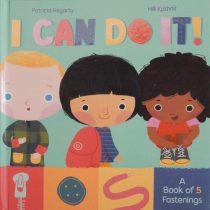
I Can Do It!
Patricia Hegarty and Hilli Kushnir
Caterpillar Books

Try teaching preschool and reception age children and you’d be amazed how many 4/5 year olds start school unable to dress themselves properly. I know parents find it easier when they’re rushed in the mornings to dress their youngsters but essentially this is deskilling children. Much better to set time aside to help them learn in a playful manner to cope with zips, buttons, poppers, laces and Velcro type fastenings themselves.

This robust board book with Patricia’s text and Hilli Kushnir’s enticing illustrations will be a boon in this respect.

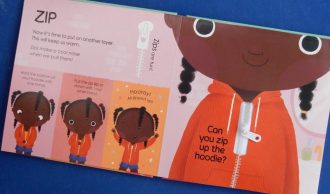
Using five little children as models, the narrative provides an introduction to each fastening with instructions on how to work it, and asks each time ‘Can you fasten the …? alongside a bold, bright illustration of a child wearing the item needing to be done up.

One boy fastens shirt buttons, a little girl zips up her hoodie,

another boy does up the hooks and loops fastening on his coat; a child closes the popper on a backpack and finally a little girl has lace-up shoes to tie up on her trainers.

Fun, instructive and I assure you, early years teachers will be truly thankful if your child can manage all the five fastenings.

Getting Ready for Spring / Make and Bake

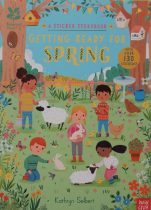
Getting Ready for Spring
Kathryn Selbert
Nosy Crow

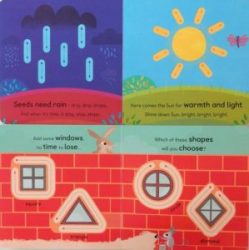
I’ve no doubt that we’re all looking forward to the arrival of spring. I’ve already seen snowdrops and the occasional primrose but have yet to spot any baby deer like those shown in this sticker storybook created in collaboration with the National Trust; and, inevitably already as I write, the supermarket shelves are stacked with hot cross buns and other Easter fare.

Herein we see a family picnicking beside a lake, children decorating Easter eggs, birds being fed in a garden, spring cleaning on a rainy April day.

There are more preparations for Easter, a family visit to a farm, the children bake Easter treats with Grandma and when the festival day arrives there’s an egg hunt and an Easter parade.

The final pages comprise a ‘Can you spot?’ feature with over 30 items to find in the preceding spreads, and 3 pages of stickers to add to the named pages.

Seasonal fun to engage little ones and there’s plenty of interest to discuss on each of Kathryn Selbert’s main spreads.

If your opportunities to get outside with youngsters are limited in this unpredictable weather, then this book will help them anticipate the delights of what is to come in the next two or three months.

Also useful on days when the weather tends to keep youngsters inside is:

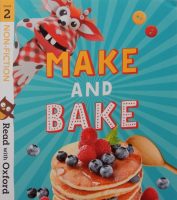
Make and Bake
illustrated by various artists
Oxford University Press

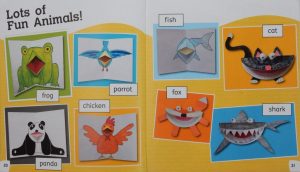
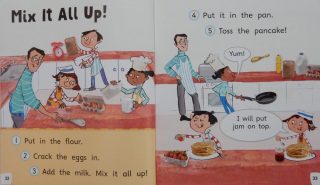
This is part of the OUP ‘Read with Oxford’ series that uses ‘step-by-step’ stages and is phonic based. Many readers of my blog will know that I’m anything but a fan of the approach to reading that underlies this way of learning to read. However, this non-fiction title offers six fun activities for those in the early stages of becoming readers.

Young children can, guided by the six sections make frog cards (and paper plate animals that could become puppets – children can think up their own animals too);

enjoy some pancake making (with an adult); create a sock goblin hand puppet; find out something about growing foods you might eat on a picnic; discover how to grow strawberries and eventually make ‘Strawberry Mess’ and enjoy eating same; the final part, ‘Snack Attack’ is about what constitutes a healthy snack. Readers follow two characters who visit a market and on their return, make the snacks using what they bought.

Also included are simple activities such as matching animal pictures with their names; sequencing instructions, sorting, unjumbling letter sequences to make food words and a word search. A mix of photographs and illustrations by various artists

help make everything clear.

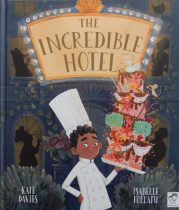
The Incredible Hotel

The Incredible Hotel
Kate Davies and Isabelle Follath
Frances Lincoln Children’s Books (First Editions)

Stefan the understairs porter has a rather mundane life working in the kitchen of The Incredible Hotel situated in the great city of Delaunay. He spends much of his time fetching and carrying, mopping and chopping and doing the washing up; but Stefan dreams of cake making.

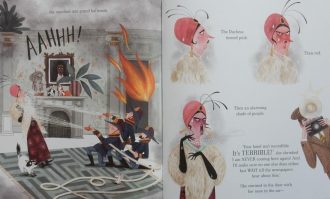
One morning early, a meeting of all staff is called. Mr Starch announces that the hotel is celebrating its centenary with a grand ball, the guest of honour being none other than the Duchess of Delaunay, an incredibly royal, particularly picky person with a penchant for closing down hotels. Uh – uh!

In her honour Chef Zagat is asked to make her favourite delicacy – a profiterole tower – the tallest, creamiest, ‘most profiteroley’ one ever.

The bakers set to work right away with Stefan acting as coffee maker; however he is an observant fellow and can see why the chef’s efforts are not a success, so he offers a suggestion.

All he gets for this is a tongue lashing from the chef and he’s banished from the kitchen.

That night Stefan leaves the hotel and sets to work profiterole creating in his own domain.

Come the morning of the ball, without Stefan’s input, the hotel’s usual clockwork routine breaks down. Indeed disaster strikes and a call for Stefan’s help comes from the chef.

He of course isn’t there to hear.

Meanwhile upstairs the guests start arriving, including the Duchess. She’s far from happy to be stalled by Mr Starch and insists on entering the grand ballroom … She’s even more unhappy at what follows and is about to stomp out … until a wonderful aroma wafts into the room.

The rest, shall we say is mystery – until you get your hands on a copy of this truly delectable treat of a book cooked up by Kate Davies whose words are superbly selected, and Isabelle Follath, whose illustrations are a splendid mix of nostalgic delight, rich detail and fun. (Keep your eyes open for the bit part players, the cat and mouse that appear on every page.)

Don’t miss this one! Satisfaction assured!

Winnie and Wilbur at Chinese New Year

Winnie and Wilbur at Chinese New Year
Valerie Thomas and Korky Paul
Oxford University Press

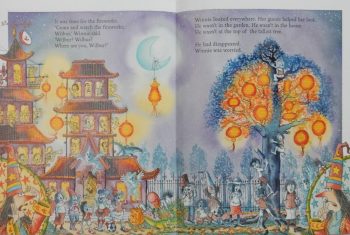
To alleviate her boredom while Wilbur naps, Winnie the witch scrolls through her mobile and discovers that Chinese New Year is coming soon. It sounds exciting and so she decides to throw a Chinese New Year party to celebrate with friends and family.

The preparations go pretty smoothly with Winnie waving her wand to create fabulous decorations and a yummy-looking feast.

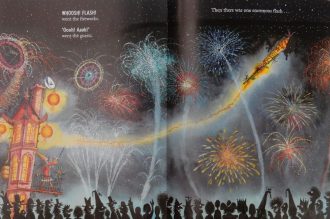
Then comes a spectacular parade with dragons large and small, as well as lions including a baby one; but just as the fireworks are about to start, Winnie realises that Wilbur has vanished.

Is the party sparkle about to disappear too, or is there an explanation for the cat’s mysterious absence?

Perhaps just one more wave of that wand of Winnie’s might just rescue the situation …

Valerie Thomas and Korky Paul’s magical two W characters have been exciting children for over thirty years and their powers seem to be showing no sign of waning. Youngsters to whom I introduced Winnie and Wilbur as a young teacher now have their own children to share this whizz bang crackling,

lucky money envelope cascading story with in celebration of Chinese New Year at the weekend.

The illustrations are absolutely brimming over with detail and I love the gallery of children’s art that adorns the endpapers.

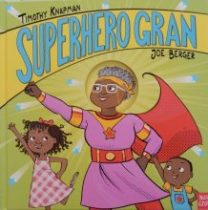
Superhero Gran

Superhero Gran
Timothy Knapman and Joe Berger
Nosy Crow

Timothy Knapman children’s author, playwright and lyricist teams up with illustrator Joe Berger for I think, their seventh in the Superhero family series.

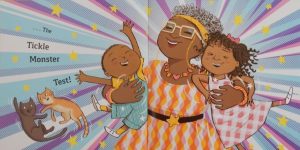
Most young children I know think their grans are amazing humans and so it is with the gran in this story.

No she doesn’t fly through the air, battle villains, control minds or wield an indestructible shield; instead she makes the days her grandchildren spend in her company the very best possible.

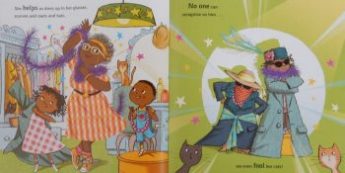
Her house is full of exciting paraphernalia for creating disguises.

Her stories are enthralling, the Tickle Monster Test tale being the very best of all. especially when accompanied by tasty cookies.

Unlike mum and dad, she doesn’t put a limit on the consumption of these treats.

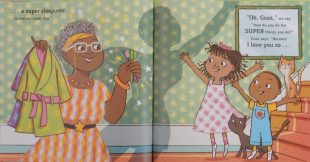
As for her garden, it’s blooming brilliant and great for games of hide-and-seek; moreover she knows when, at the crucial time her grandchildren want to stay, to make a call to Mum and Dad suggesting the little ones remain with her for a sleepover.

Super powers indeed; and what a thoroughly heart-warming, vibrant celebration, verbal and visual, of a loving grandmother.
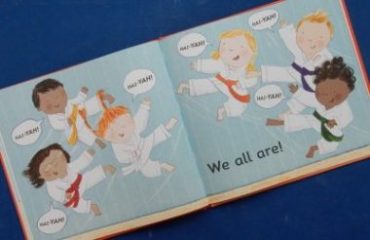
It’s just perfect for grans and little ones to enjoy reading together.

Some Dinosaurs are Small

Some Dinosaurs are Small
Charlotte Voake
Walker Books

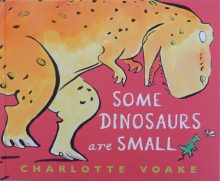
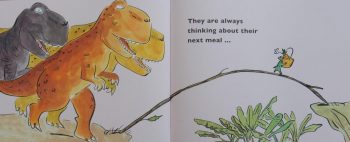
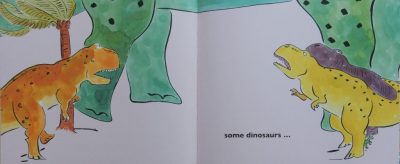
Can you EVER have too many dinosaur books? Definitely not if one of them is this, the latest offering from Charlotte Voake.

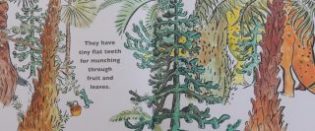
Charlotte weaves opposites – big/small, fast/slow, flat/pointy, (as well as showing both carnivorous and herbivorous creatures), into an exciting and amusing picture book story where the action and feelings are shown in the art, while the words are pretty much descriptive: it’s the amalgam of the two that makes this book such a tasty offering.

It begins with one very small dinosaur foraging for fruit which goes into a basket.

Lurking in the background are some BIG, sharp-clawed, pointy toothed dinosaurs with their eyes on a tasty snack or two. And seemingly these speedy movers are never satisfied …

While the confrontational drama is taking place between the marauders and one ENORMOUS dino.

little humans will be relieved to see the little dinosaur has found a safe place to withdraw from the action before embarking on some further foraging, which is shown on the final endpapers.

Terrific fun with thrills aplenty, early years audiences will find this irresistible and, like those big hungry dinosaurs, are bound to demand second or even third helpings …

Nop

Nop
Caroline Mageri
Walker Books

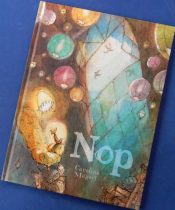
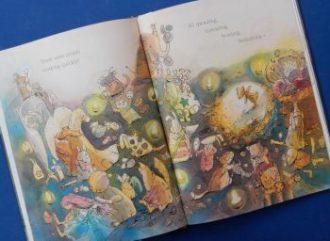
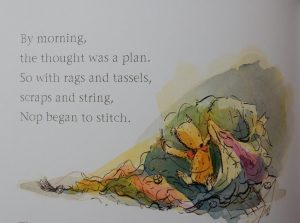
Meet Nop resident of Oddmint’s Dumporium, a dusty place piled high with assorted goods all in need of some mending, fixing or fancyfi-ing by those that work by candle light.

When it comes to Nop though, nothing, be it button, ribbon, or spangle quite fits the bill. Seemingly the bear is doomed to remain on the unwanted shelf instead of being placed in a splendidly crinkly paper bag and carried away in the arms of a happy customer.

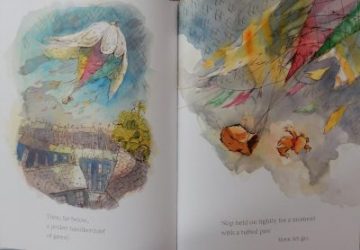
But then he spies something red on the floor just waiting to be transformed into an exciting adornment and thus embellished with same, an idea floats into his mind.

Come morning, stitch by stitch

the idea becomes the means to start an exciting adventure in the big wide world where, who knows, perhaps a new friendship awaits.

Spendidly whimsical, Caroline Mageri’s Nop with its themes of hope, enterprise and new beginnings is an uplifting, lyrically written delight.

Board Book Delights

Both Walker Books and Nosy Crow publish smashing board books – here are some of the latest:

Little Baby’s Busy Day
Little Baby’s Playtime

Nick Sharratt and Sally Symes
Walker Books

These ‘Finger Wiggle Books’ are full of adorable babies doing everyday things, the action being supplied by inserting a finger through the two die-cut holes that go from cover to cover in each book.

Busy Day portrays wake up time, breakfast, looking smart ready to go out, shopping, having a wee, inviting a tummy tickle, a sudsy bathtime and finally, arms extended for a bedtime cuddle. Nick Sharratt supplies the bright jolly visuals in his unmistakeable bubbly style and Sally Symes has created the brief rhyming ‘One little baby … Wiggle wiggle … ‘ narrative.

Little Baby’s Playtime opens with travelling in a sling, then moves to a playground swing, a wizz down a ‘slippery slide’, a tricycle ride, a dig in a sandpit, a game of peek-a-boo, excitement at the sight of a butterfly and finishes with a farewell wave.

Terrific for sharing; and with their patterned text and inviting scenes, these two spell out loud and clear to tinies that all important ‘books are fun’ message.

If You’re Happy and You Know It!
illustrated by Yu-hsuan Huang
Nosy Crow

This addition to the ever -popular ‘Sing along with me!’ series is another established nursery favourite. Here the main characters are bears with other creatures playing the bit parts. We first see the bears cooking together, after which they go out shopping together before returning home. Then small bear then goes out to meet some friends.

As they sing along, little ones can use their fingers to make the small bear clap, stamp, nod and on the final spread, reveal his friends and everyone can join in with the “we are” finale.

There’s a bar code to scan which will provide a version of the song to sing along to. With its cute illustrations, this will become a favourite in the series, I suspect.

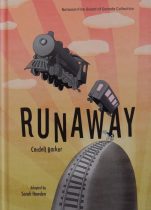
Runaway

Runaway
Cordell Barker adapted by Sarah Howden
Firefly Books

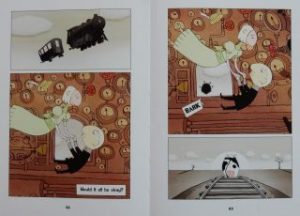
This book, in graphic novel format is an adaption by children’s book author Sarah Howden, of Cordell Barker’s 2009 animated film of the same name.

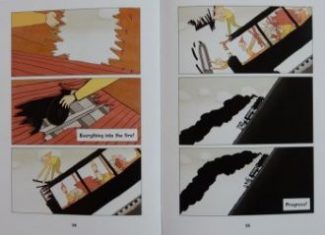
It begins with a cow strolling on a railway track along which a passenger train is speeding. It’s a disaster waiting to happen.

The engineer, or Captain as he likes to be called, is distracted by a fuzzy object that has been found by the Fireman and belongs to the Lady. Keen to impress her, the engineer shuts the fireman up and fusses over the dog only to receive a bite on his finger.

The train continues dashing along the tracks now out of control. The fireman is concerned – where is the Captain? But nobody else is bothered. The fuel gauge is dangerously low: the passengers provide alternatives to coal; the train climbs

and slows …

Tension builds and builds; the Captain reappears

and saves the day – or does he?

What you get out of this allegorical tale depends considerably on what you bring to it and with re-readings new understanding emerges. Assuredly though it’s full of action and wry humour, and at least it appears there might be one happy ending.

That though, won’t save everyone – for that, collective love is required and as Auden said in September 1,1939, ultimately ‘ We must love one another or die.’

Supercats v Maximus Fang / Sam Wu is NOT Afraid of ZOMBIES

It’s great to see these two popular fiction series going from strength to strength:

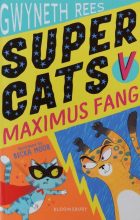
Supercats v Maximus Fang
Gwyneth Rees, illustrated by Becka Moor
Bloomsbury Children’s Books

This is the second of Gwyneth Rees’ Supercats series that will delight animal lovers, especially those who enjoy tales with a bit of a zesty bite. They’ll certainly get that with Tagg, a recent recruit to a team of crime-fighting supercats. (think feline MI6). Tagg’s personal superpower is camouflage, a tremendously useful skill for any secret agent.

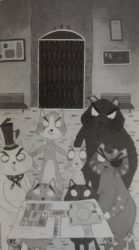
In this story Tagg and another member of the team, Sugarfoot have their first mission. They need to infiltrate the dastardly Killer Cats crew that includes just back in town, Gory Gus, and thwart his plans to break his partner in crime Maximus Fang out of prison.

The prison break has to be stopped but are the newbie supercats up to the task?

Assuredly they’ll need to employ both their superpowers and all their feline wits or else they’ll end being fish-sliced in the paws of the Hit Cats. Moreover, Gory’s superpower is telekinesis and Maximus’s power is weather control. ‘Think tsunamis! Think tornadoes and hurricanes!’ Hmm!

Can Tagg and Sugarfoot succeed in their mission? Perhaps with the help of ‘the Weapon’ …

There’s plenty of tension, especially when having persuaded the Killer Cats to let them join their crew, Tagg and Sugarfoot discover what that entails …

Add plenty of fun to the mix, with additional lashings thanks to Becka Moor’s illustrations, and what you have is a highly satisfying moggy adventure.

Sam Wu is NOT afraid of ZOMBIES
Katie and Kevin Tsang, illustrated by Nathan Reed
Egmont

Sam Wu is still trying to prove he’s not afraid of anything in this his fifth fear conquering challenge. He’s already succeeded in becoming unafraid where ghosts, sharks, the dark and spiders are concerned – well almost!

So what about zombies? Surely such thoughts won’t send frissons of fear running through the lad will they? Err, maybe not, except … supposing his arch nemesis Ralph Zinkerman the Third, lets it be known that there are zombie werewolves living in his basement.

Is this really something Sam wants to tackle, especially when Ralph has just told tales on him in class? But, Sam has loyalties to Ralph’s sister Regina so maybe he should summon up all his courage, accept the invitation to visit the Zinkerman residence and (along with some friends) see what is going on in that basement of theirs, despite strict orders from Mr and Mrs Z that said basement with its locked door was ‘strictly off limits’.

Could this perhaps be Sam’s scariest fear-confrontation yet?

Splendidly funny through and through with a great finale, and terrific Nathan Reed illustrations scattered throughout that highlight the hilarious situations, this series just keeps on getting better.

Little Bird Lost

Alesha enjoying reading the story    for herself

Little Bird Lost
Patricia Hegarty, illustrated by Sebastiaan Van Doninck
Stripes Books

Many possible interpretations spring to mind on reading Patricia Hegarty’s tale of Little Bird and the kind hearted Deer that comes to his aid when he hears a plaintive “Chick-kee!” coming from a pile of leaves and discovers a small injured bird that has crash landed on the forest floor.

Little Bird has become separated from his flock, and having consulted his forest friends, Deer undertakes to ‘follow the sun’ towards the warmer place they think the flock is heading to.

Thus begins an adventurous, sometimes hazardous journey

that takes them through the forest and through the seasons

to spring.

By then much has happened: Little Bird’s wing has healed, a strong friendship has been formed between the two travellers and with spring – a time of hope – other things too are evolving …

Now though, it’s time to bid farewell to a very special friend, safe in the knowledge that a friendship such as that is forever …

Poignant and immersive, this is the latest in Stripes Publishing’s full-colour fiction series– especially aptly with this story, for those readers just flying solo. How powerful it is to discover a book that you can almost read unaided and that’s what happened with one such reader, Alesha.
As much as the story, she loved Sebastiaan Van Doninck’s splendidly expressive illustrations and stopped several times to comment on how both they and the narrative made her feel. Spring was her favourite section: “I was excited when Little Bird found he could fly; it made me so happy.

All the Dear Little Animals

All the Dear Little Animals
Ulf Nilsson (trans. Julia Marshall) and Eva Eriksson
Gecko Press

Told without a vestige of sentimentality is All the Dear Little Animals, a story from Swedish author Ulf Nilsson and illustrator Eva Eriksson. The first person narrative voice is that of one of the participant founders of an unlikely and short-lived enterprise.

It all begins when Esther, another of the founders, discovers a dead bumblebee. Having nothing better to do, she decides to dig a grave for it. Her companion – the narrator – offers to compose an appropriate death poem and they bury the bee in a secret clearing in the woods.

The team of two becomes three when Puttie, Esther’s little brother gets involved. He finds the whole procedure of the next burial – that of a mouse – extremely sad, but soon overcomes his greatest concerns and thus Funerals Ltd. is up and running. Esther digs, the narrator pens poems and Puttie cries.

A suitcase containing a shovel, various sized boxes and other funeral accoutrements (including ‘’ice-cream sticks for small crosses/ Big sticks for big crosses) is packed and the three spend the day providing a service for the pets and domestic animals of family and friends.

By the time darkness falls, all manner of creatures including finally a blackbird

have been duly interred before he children decide to call it a day.

‘Another blackbird sang a beautiful song. I got a frog in my throat when I read. Esther cried. We all felt very reverent. Sadness lay like a black quilt over the clearing. And Puttie went to sleep.’

That’s not quite all though, for after the closing verse of the narrator’s poem comes an absolutely wonderful throw away finale: ‘The next day we found something else to do. Something completely different.’

Both playful and sad, with a touch of whimsy, the combination of text and illustration is just right for those starting out as solo readers, as well as for sharing. More importantly though, the book offers a way to talk about death with young children from any faith tradition or none, that should help them transcend feelings of sadness.

Although written from a child with a Christian world view’s perspective of death, if shared in an education setting, the book could open up a whole topic on religious rituals.

Too Small Tola

Too Small Tola
Akinuke, illustrated by Onyinye Iwu
Walker Books

Small in stature young Tola may be but she’s one determined little girl – a mighty force to be reckoned with. Tola lives with her older, very clever sister Moji, her fleet of foot brother Dapo and her very bossy Grandmummy in a flat in Lagos. There are three stories in this, the first of a new series and we meet not only these family members, but in addition encounter many other residents of the city.

The first episode sees Tola accompanying Grandmummy on a trip to the market. During their journey they find themselves taking on shopping for friends and neighbours in addition to their own, and Tola helps Grandmummy ensure the market vendors don’t cheat her.

In Small but Mighty Tola and Moji cope with no electricity and no water. They go to the nearby pump where Tola and some of the local ladies demonstrate woman power to the stroppy Ododi Brothers.

Easter and Eid are both fast approaching in the final story. It’s a busy time especially for tailor Mr Abdul as everybody wants to celebrate with new clothes. But then the tailor is knocked off his bicycle while out and about collecting measurements; his leg is broken, but not his sewing machine. Can Tola, with her excellent measuring skills, come to his aid so that all his customers are satisfied.

As well as giving an insight into city life in Lagos, Nigeria, these stories are bursting with love for family and friends, warmth and affection for the local community. With delightful illustrations (love the cover art) by Onyinye Iwu on every spread, this is a smashing chapter book for newly confident readers.

Search-and-Find A Number of Numbers

Search-and-Find A Number of Numbers
AJ Wood, Mike Jolley and Allan Sanders
Wide Eyed Editions

What at first glance appears a relatively simple search-and-find counting book rapidly becomes a totally immersive experience in the hands of Amanda Wood, Mike Jolley and Allan Sanders.
Once you dive into the pages comprising their sequence of zany spreads with scenes as diverse as a monocyclist, marine life, a castle scene, and canines galore – both adult and pups, you’ll find it hard to stop before the end.

This playful offering will surely have a wide age appeal – pre-schoolers for instance will relish the number 3 pages whereon nursery favourites the ‘3 blind mice,’ rhyme, the 3 bears, the 3 billy-goats gruff and the 3 little pigs all put in an appearance along with a host of other items in 3s, to locate.

Few of any age will be able to resist the delicious picnic spread out along the banks of a meandering river (number 10,) or the 19 robot with all manner of inappropriate items left inside by its absent-minded boffin constructor.

Another of my favourite spreads is 5 with its splendidly embroidered woolly glove – perfect to wear in chilly weather.

By the time anyone reaches the 100 challenge – a building site – their counting fingers will likely be all a-tingle and their eyes agog; and their visual skills will most definitely have been honed considerably, thanks to every one of Allan Sanders splendidly eccentric scenes. But there’s still one final challenge …

Brilliantly playful and playfully brilliant – don’t miss it!

Board Book Play and Learn

When I Grow Up I Want To Drive …
When I Grow Up I Want To Be …

Rosamund Lloyd and Richard Merritt
Little Tiger

Both books hide much of their brief snippets of information beneath the thirty flaps found between the covers.

The first offers 5 different vehicles – a tractor, an ambulance, a cement mixer, a recycling truck and an aeroplane each shown on the verso and then as part of an appropriate scene on the recto, while the final spread is an integral scene …

A similar pattern is used in the look at 5 possible jobs tinies might aspire to, with a representative from each introducing themselves opposite a look at the role in action. Again the places of work are all shown in the final spread.

Bright artwork by Richard Merritt shows in turn an astronaut, a teacher, an athlete, a firefighter and a doctor.

Let’s Find The Dinosaur
Let’s Find The Mermaid

illustrated by Alex Willmore
Little Tiger

Search-and-find fun with a hunt for a T.Rex in the first book, and Mermaid in the second, is given a tactile element with felt flaps and die cut pages.

As tots engage in the game of hide and seek they’ll listen to descriptive clues such as ‘T-Rex has a scaly head. Could this be T-Rex behind the leaves.’ Or ‘Mermaid has a swishy tail. Could this be Mermaid in the coral?’

Alex Willmore’s attractively patterned spreads will ensure that each game is a playful learning opportunity, while the repeat refrain textual patterning will help with word recognition if appropriate for the particular child.

Baby 101 Touch and Trace: Plant and Grow/ Build a House
Patricia Hegarty and Thomas Elliott
Caterpillar Books

Two new titles in the STEM series for toddlers take a look at horticulture and building construction.

Plant and Grow tells of the vital things needed for seeds to germinate and thrive until the crops are ready to pick and consume.

There’s a mathematical thread to Build a House with such vocabulary as basic 2D shape names and simple counting (of roof tiles) as well as a spread showing how bricks might be bonded.

Both titles have a tactile element thanks to the ‘touch-and-trace’ details built into Thomas Elliott’s illustrations on every page to  help develop the fine motor skills of little users.

Fun learning for babies and toddlers.

Beware of the Crocodile

Beware of the Crocodile
Martin Jenkins and Satoshi Kitamura
Walker Books

You can always rely on Martin Jenkins to provide information in a thoroughly enjoyable manner and here his topic is those jaw snapping crocs, which, as he tells readers on the opening spread are ‘really scary’ (the big ones). … ‘They’ve got an awful lot of … teeth.’

With wry, rather understated humour he decides to omit the gruesome details and goes on to talk about how they capture their prey: ‘ Let’s just say there’s a lot of twirling and thrashing, then things go a bit quiet.’ I was astonished to learn that crocodiles are able to go for weeks without eating after a large meal.

The author’s other main focus is crocodiles’ parenting skills; these you may be surprised to learn are pretty good – at least when applied to the mothers.

Not an easy task since one large female can lay up to 90 eggs; imagine having to guard so many  newly hatched babies once they all emerge.

As for the father crocodiles, I will leave you to imagine what they might do should they spot a tasty-looking meal in their vicinity, which means not all the baby crocodiles survive and thrive to reach their full 2m. in eight years time.

As fun and informative as the narrative is, Kitamura’s watery scenes are equally terrific emphasising all the right parts. He reverts to his more zany mode in the final ‘About Crocodiles’ illustration wherein a suited croc. sits perusing a menu (make sure you read it) at a dining table.

All in all, a splendid amalgam of education and entertainment for youngsters; and most definitely one to chomp on and relish.

Two Bears

Two Bears
Patricia Hegarty and Rotem Teplow
Caterpillar Books

As simplistic as Patricia Hegarty’s story may at first seem on the surface, Two Bears is a picture book with important themes that can be appreciated and discussed on many levels.

It’s a story of two very different bears from very different worlds, far apart … until they are displaced by the consequences of human actions.

Grizzly Bear’s northern forest home is ravaged by fires caused by man’s selfish actions.

Polar Bear’s Arctic home is also in dire trouble as the ice cap starts to melt on account of global warming.

Consequently each bear embarks on a long journey, Polar Bear moving south; Grizzly Bear going in a northerly direction to find food.

Their travels are arduous, the weather testing and food scarce, causing the bears to get thinner and thinner; still though, they remain strong in order to stay alive.

Just before they lose hope the two bears meet.

Yes, they have some superficial differences but what they have in common allows them to transcend all else and thus begin a peaceful life of understanding and togetherness ; and come spring, something very exciting takes place …

Rotem Teplow’s captivating illustrations show the bears’ physical and mental journeys as they seek safety far from their homes, helping to make the book one that successfully combines storytelling with information about the predicament of the bears. The inside cover gives brief details about this and explains how both species are attempting to cope with being under continuing threat.

The Moonlight Zoo

The Moonlight Zoo
Maudie Powell-Tuck and Karl James Mountford
Little Tiger

With an arresting die-cut cover like the one on this book, from the creators of Space Train, who could resist plunging in to join young Eva as she undertakes a nocturnal search for her missing moggy Luna.

It all begins when Eva hears strange sounds coming from beneath her bed, dives underneath and finds herself at the gates of The Moonlight Zoo.

The guard wolf informs her that it’s a safe night haven for lost animals and with the helpful creature as guide she begins to hunt for Luna.

They look in various possible locations, find some clues – Luna’s collar and a lump of cat fur – but not that which they seek.

Time is running out for the zoo closes at dawn; then Eva hears a rumbly sound; could it possibly be Luna? …

Animal lovers especially will relish this adventure wherein they can explore the nocturnal world Karl James Mountford has created in his fantastical zoo populated by penguins, monkeys, guinea pigs, dogs, wolves, elephants and other lost creatures.The cutaway peep-through pages add to the visual delights of Maudie Powell-Tuck’s enchanting story wherein determination is key.

Stories on My Street / Eric and the Green-Eyed God

It’s great to see the return of some old favourites given new looks.

Stories on My Street
Shirley Hughes
Walker Books

This brings together four stories featuring the children and their families, who are all residents of Trotter Street. The tales were originally published with Shirley’s coloured illustrations, herein replaced with black and white ones.

In the first, New Wheels for Carlos, friends Billy and Carlos love to race their old bikes down the hill in the park but both of them are outgrowing their old slow machines. With birthdays fast approaching each would truly love a new bike; will it be a ‘Happy Birthday’ for both boys? …

A heart-warming tale of friendship, longings and surprise.

The Patterson family are the focus of The Big Concrete Lorry. It’s a tight fit with four humans and a dog at number 26, their little home. So, after a family conference it’s decided that they should have an extension. The cost won’t be excessive as Dad, (with help from willing neighbours) will build it himself.

All goes to plan until CRRURK! CRRUCK! CRRUCK! the arrival of a lorry bearing the name JIFFY READY-MIX CONCRETE CO on the side and it’s a day early …

Thereafter a massive effort on the part of the community is called for.

This smashing story with its wonderful illustrations put me in mind of the time years back, when my partner and I were installing an Amtico floor that had to be put on top of a self-levelling screed in our kitchen and the antics that ensued to prevent it setting too quickly.

In Angel Mae and the New Baby, Mae’s mother is expecting a baby, something about which Mae has mixed feelings especially as she is to play the role of the Angel ‘Gave-You’ in her class nativity play very soon. But when Mae wakes up on the day of the play, there’s no sign of either her mum or dad; instead Grandma is in the kitchen cooking breakfast.

The tension mounts as the show proceeds with Mae hoping against hope that at least one of her parents will arrive to see her debut performance …

Warmth and humour as only Shirley can do it, abound in this third tale.

The Snow Lady is what Sam and her friend Barney create one chilly day. It bears a close resemblance to their grumpy neighbour, Mrs Dean, Barney decides, and makes a pebble name ‘Mrs Mean’ at her feet.

Mrs Dean is away to spend Christmas with her son, but she arrives back unexpectedly late on Christmas Eve. Conscience-struck, Sam is concerned that come the morning Mrs Dean will see what she and Barney have done and feel hurt.

Of course, like the others, this gently humorous story has a happy ending and is equally deftly illustrated in Shirley’s exquisite style.

Eric and the Green-Eyed God
Barbara Mitchelhill, illustrated by Tony Ross
Andersen Press

Eric’s mum is soon to marry but there’s a snag; she’s marrying his teacher known as ‘the Bodge’. That in itself is pretty awful but even worse is that his globetrotting Auntie Rose has sent a wedding present sparkling with emeralds and it’s said to be imbued with magical properties that might result in more than one new addition to his family.

Eric and his friend Wez don’t know the meaning of the words his aunt has used in relation to the gift but their pain in the neck classmate Annie certainly does and she insists such objects work.

Eric and Wez simply have to locate this present among all the others and stow it away somewhere where it can’t work before Mum has a chance to open it on her big day.

Locating it is relatively easy but hiding it away is another matter especially since Eric and his fellow pupils are engaged in the ‘Loving the Earth’ project the mayor has set up. Moreover Eric has failed to clear up the mess made when he and Wez were opening all the presents and now his mum thinks there’s been a break in and the police are involved.

Things just keeping on getting worse: how can Eric get himself out of this increasingly troublesome situation?

Barbara Mitchelhill’s mix of zany humour, magic and emotions will result in giggles aplenty from young readers of this episode in the series especially since the inimitable Tony Ross has supplied plenty of wacky new illustrations.