I Ate Sunshine for Breakfast

I Ate Sunshine for Breakfast
Michael Holland FLS and Philip Giordano
Flying Eye Books

‘Plants are essential to your world. Without them, no other living thing would be able to survive.’ So begins this absolutely beautiful book aptly subtitled ‘A Celebration of Plants Around the World’ that presents much about the truly amazing plants of our planet in glorious colour. With spring well and truly bursting forth around us now, what better time to pay tribute to botanical beauties (and some animals along the way) – were you aware that some plants – the carnivorous kinds – actually feed on insects?

Written in a child-friendly style by Michael Holland, the book is divided into four main sections that together comprise pretty much everything a youngster would need to know and more, starting with what plants are, their parts, their essential processes – photosynthesis, respiration and growth, reproduction (I’m sure readers will be amused to learn of the world’s largest seed – coco de mer, that looks remarkably like a gorilla’s rear) and why they matter. 

Then comes a look at the plant kingdom in general – evolution – did you know all plant species originated from just one type of plant, millions of years back? There’s a family tree, a look at adaptation, 

food chains and food webs.

The latter part of the book explores how plants sustain our everyday lives: there are plant extracts in medicines, in toothpaste, in clothes, cooking oil, soap, plastics and then of course there are all those delicious fruits and vegetables we consume as part of our daily diet.

Despite the huge amount of information in the book, it’s all split up neatly into small sections and paragraphs, making it super-easy to digest and there’s a glossary at the back should you come across unfamiliar botanical terms. Plus, there are a dozen suggestions for some simple plant-based science experiments such as creating cornflour slime and cultivating a wild weed bottle garden. Of course environmental pollution affects plants too so the last part covers that as well as a spread entitled The Future is Green.

Visually stunning with retro-style graphics that provide a perfect complement to the text, this is a must-have book for budding botanists, family bookshelves and class collections. Readers will surely want to dig into it time and time again.

Not a Cat in Sight / Ruffles and the New Green Thing

Not a Cat in Sight
Frances Stickley and Eamonn O’Neill
Simon & Schuster Children’s Books

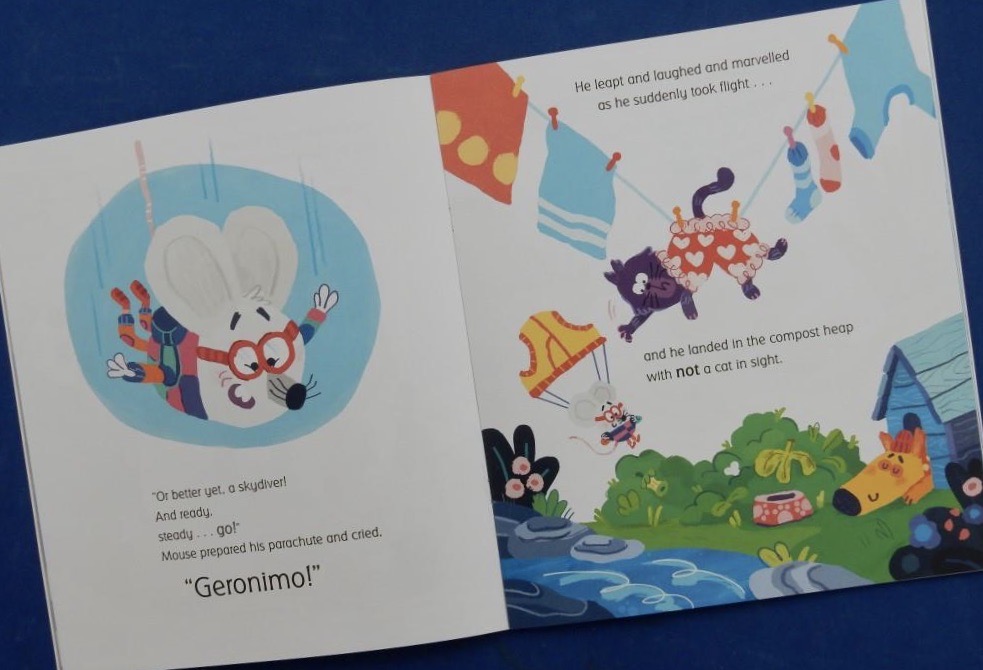
Mouse sports a snazzy pair of specs so how come he is completely oblivious to the presence of a very large cat following his every move on this warm, sunny day? I’m sure young listeners to Frances’s splendidly rhythmic, rhyming narrative will, in addition to joining in the repeat refrain ‘with not a cat in sight’, be wanting to shout out to the little creature in best pantomime style, “Look out he’s behind you” as debut illustrator Eamonn O’Neill shows him in his suitably playful scenes dressing and venturing outdoors to spend an almost unimaginably ‘perfect day’.
Determined to make the very most of his day we see Mouse teeter across a tightrope, try a spot of skydiving,

delve deep in the compost for treasure, play at being a pirate, and more besides.

It’s sheer theatrical delight as myopic Mouse frolics hither and thither, his stalker ever on his trail until a comic slapstick moment involving a pooch coming to his aid, almost certainly saving him from a catastrophic demise.

But will our Mouse ever realise that during all of his wonderful adventures something has been right on his tail?

Ruffles and the New Green Thing
David Melling
Nosy Crow

When it comes to canine things Ruffles is pretty much like most other dogs; however he’s somewhat averse to anything new and different. It’s certainly true when he spies something green in his bowl: what ever is this green item unlike anything he’s ever seen before?
His initial sensory investigations yield no ideas but then he’s distracted by the arrival of his pal Ralph. Ralph is the dog that can dig deeper, find bigger sticks and jump higher than Ruffles but they both share a love of …

Having spend some playful energetic time together with his friend, Ralph decides to chomp at the new green thing and then it’s a case of anything Ralph can do … and suddenly the bowl is completely empty. What’s more Ruffles has a new favourite food. So Ruffles loves new things? Errr! …

With its clever mix of droll humour in the illustrations and a straightforward narrative, Ruffles fans will eagerly gobble this new episode up and I have no doubt the adorable pooch will add to his following too.

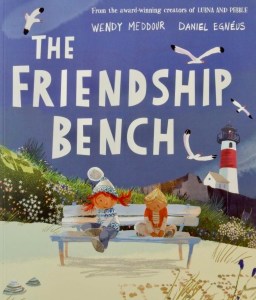
The Friendship Bench

The Friendship Bench
Wendy Meddour and Daniel Egnéus
Oxford Children’s Books

New beginnings is the theme of this beautiful story that celebrates young children’s creative play.

Tilly has just moved to a new home beside the sea: the setting looks gorgeous but she’s very disappointed when her mum tells her that her beloved dog Shadow can’t go into her new school on her first day. Nothing is the same without her canine friend.
At playtime, Tilly is alone and when her teacher notices this he suggests she try the Friendship Bench. However when she gets there, the bench is already occupied. Back to the teacher goes Tilly who tells her to have another try.

The little boy hasn’t vacated it however, so she joins him and after a bit they both decide the bench needs fixing to make it work. They set to work improving it until …

On the way back from school that afternoon Tilly tells her Mummy about how she and Flint transformed the Friendship Bench and about their future plans.

As always, there’s power in both Wendy’s straightforward, finely honed telling and Daniel Egnéus’ dreamlike illustrations. I love his warmth, the occasional gentle humour in the details and the way he puts readers right close to the action.

One to add to foundations stage/KS1 collections and family bookshelves.

The Light Hunters / Dragon Storm; Ellis and Pathseeker

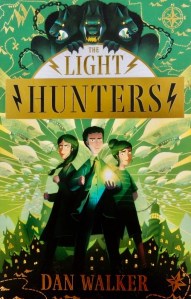
The Light Hunters
Dan Walker
UCLan Publishing

Prepare to be immediately swept up in this rip-roaring, action-packed fantasy adventure. ‘You ask me what light is? Light is everything. Every single thing . The very fabric of our world is made up of this force – people, trees, … Few can access Light, control it. You are one.’ So writes Professor Medela before the real story begins; but it’s key to the entire thing.

Twelve year old Lux lives with his ailing Grandpa and Miss Hart, his grandfather’s carer (but much more besides) in Grandpa’s clock repair shop. At school Lux, his best friend, tech-loving Maya and their fellow students are drilled in what to do should there be a Monster attack. For centuries the Light Hunters have, for the benefit of the townsfolk of Daven, done battle with these terrible creatures, not always successfully. In one attack a decade back, Lux’s immediate family along with half the town’s residents lost their lives, turning the people against Light.

Lux is on a mission to save his Grandpa’s life and to this end has been told to search for a book called Investigations into Light and Healing by a former Light Hunter. Now Lux himself has a secret: not only is he able to wield light, there’s a possibility he might be the finest Light Healer ever. Against his Grandpas’s strict instructions never to reveal his secret, Lux first uses his healing power for saving Maya when she receives a life-threatening injury from a Monster. However this deed draws to the town, one Deimos, a fallen Hunter determined to harness Lux’s power for his own dark and nefarious ends.
Readers join the hero on a journey with lightships, heart-stopping sights and perils unbounded, in this deft amalgam of relatable real-life emotions, a vividly conjured world, a race against time, humour and some wonderful characterisation. What more could one ask, other than, when is the second episode coming?

Dragon Storm: Ellis and Pathseeker
Alastair Chisholm, illustrated by Eric Deschamps
Nosy Crow

In the kingdom of Rivven dragons are forbidden. However, hidden from normal people and their King is The Dragonseer Guild, a place for a group of people with a special power enabling them to see beyond the human world. Ellis and his dragon Pathseer are part of this secret league.

Now it’s the Maze Festival in Rivven, and Ellis and Pathseeker are set on being first to complete the three mazes in the the king’s palace grounds and become this year’s tournament winners. But in the mazes they discover a mysterious girl who has her own reasons for wanting to win the tournament and she’s secretly using dangerous dragon magic by wielding a strange necklace.

Now there’s much more at stake for Ellis and Pathseeker. It will take all their courage and expertise to find a path back out of the mazes; yes Pathseeker does eventually discover her power. But can they keep the existence of dragons and the Guild a secret from King Godfic?

This third Dragon Storm adventure is every bit as exciting as the previous two and existing fans as well as new readers will be swept up by the narrative, but want to pause to enjoy Eric Deschamps’ illustrations along the way.

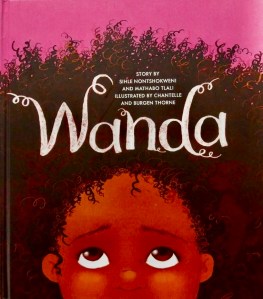
Wanda

Wanda
Sihle Nontshokweni & Mathabo Tlali, illustrated by Chantelle & Burgen Thorne
Otter-Barry Books

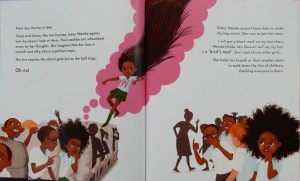
“Intombi mayizithembe mayazithe, Wanda. Be confident. Trust in yourself.” So says Wanda’s Mama in this uplifting story starring a girl with a wonderful head of hair that makes her feel anything but confident as she’s teased by unkind members of her class. Unbeknown to her Mama, who spends ages combing her daughter’s hair each morning, before she goes into her classroom Wanda usually changes her hairdo making the ‘big switch’ so that her teacher won’t call her hair a “bird’s nest”. However on this particular day she’s late and unable to make the alterations.

Mrs Stewart sends her to find an Alice band in the lost property box and this she wears throughout school time.

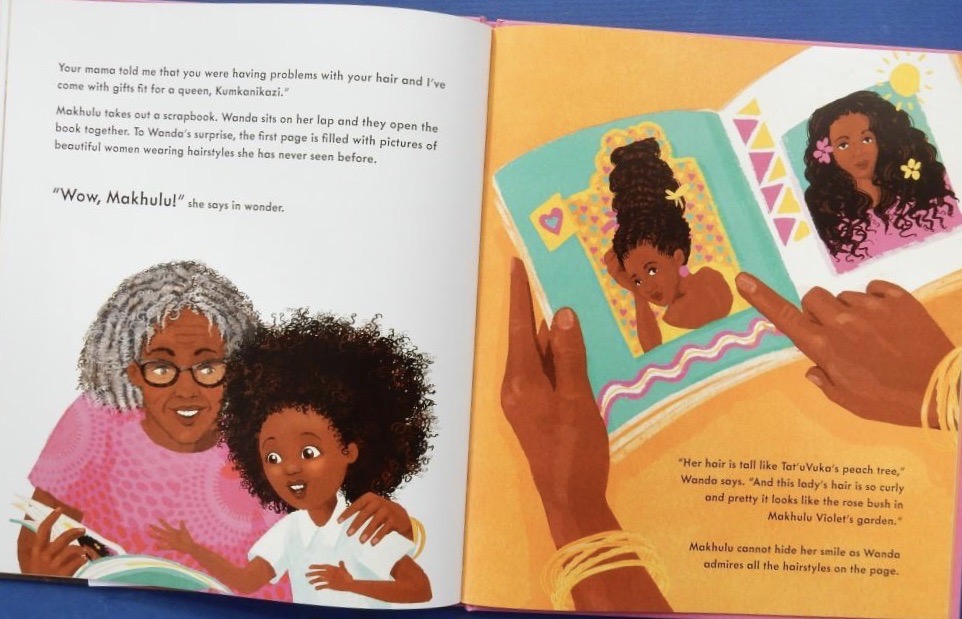
On the way home she sadly tells herself that maybe after all, she’s not that proud African queen with beautiful hair, ‘strong like clouds’, as her Mama tells her every morning. However on her return she’s greeted by her Grandmother who, after a distraught Wanda has shared how she feels, is able to help her swallow all that sadness, partly by giving her a scrapbook that they look at together. Therein Wanda sees pictures of African women with amazing hairstyles, each one of them beautiful and every one of them, deservedly famous;

then on the final page is her own mother. At last Wanda can truly embrace her own hair, especially with a bit of extra knowledge from her gran concerning the secret of her crown – “Water and 100% olive oil.”
Next morning,, it’s a proud, emotionally strong Wanda who waits at that bus stop.

This heartfelt look at how society can drain the positivity instilled by a loving family, is a powerful reminder that everyone has the right to feel confident to celebrate their culture and that we should all share in that celebration rather than attempt to undermine it. The broad themes of the story – self belief and kindness, with its compelling, vibrant illustrations, make this a book to share with primary classes wherever they are.

A Trio of Board Books

Sophie has Lunch
Sophie Goes to Sleep

Templar Publishing

Designed to foster routines that create happy mealtimes and bedtimes, these two board books feature a giraffe toy from France, ‘Sophie la girafe’.

In the first it’s 12.30pm – time for the little giraffe to have her lunch. Before that though, as per the instructions, she should wash her hooves (the text says, “Before we eat, we should wash our hands.’) Then having done so and helped set the table, we see what foods are on offer – it’s good that there are several vegetables and Sophie tries cucumber for the very first time. Seemingly she enjoyed her first course for her plate is almost empty and she’s ready to choose something sweet and healthy from the fridge.
In addition to the simple main, always upbeat narrative, each double spread has a helpful tip for adult sharers.

In the second book Sophie is almost ready for bed. But first she should tidy away her toys, enjoy a splishy splashy bath, brush her teeth – as per the instructions, then put on her pyjamas. Clever Sophie! She appears to have done this by herself and once in bed, it’s time for a bedtime story and a cuddle before she snuggles right down under her favourite blanket and light dimmed, drifts off to sleep.
With brightly illustrated, textured pages, practical tips from Lizzie Noble and simple home-related language, there’s lots of learning potential for little ones here.

Bizzy Bear My First Memory Game : Animals
Benji Davies and Camilla Reid
Nosy Crow

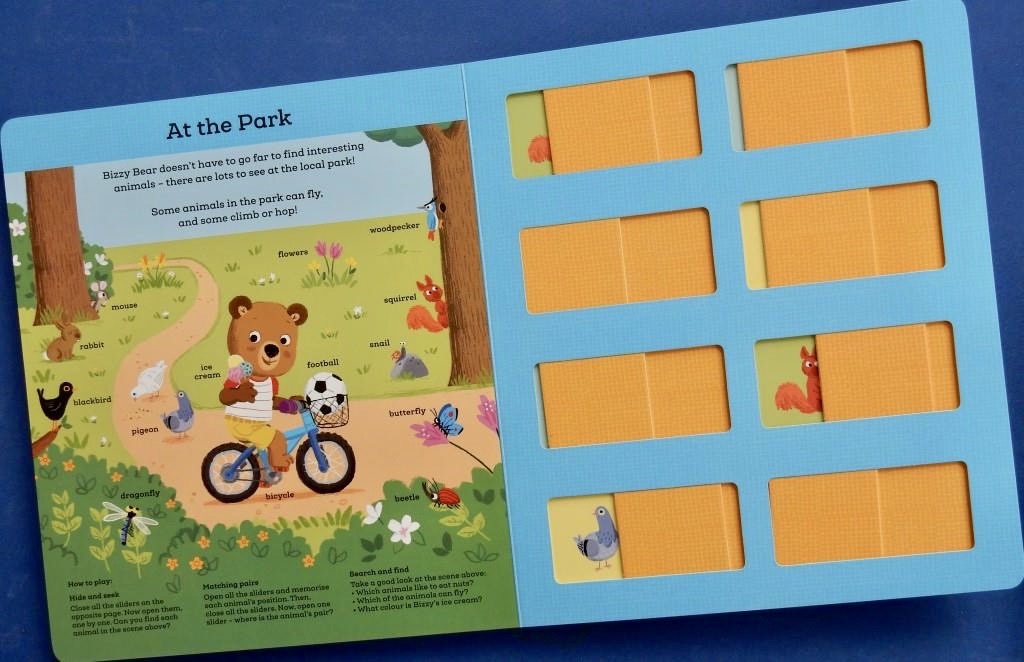
There’s an abundance of animals large and small to be discovered in the four settings – the farm, the zoo, beneath the sea and in the park – that Benji Davies illustrates in his busy scenes for this large format board book. At each location, Bizzy Bear has a different role: he brings food for the farm animals, acts as ranger driving around visitors to the zoo, is at the helm of a submarine under the sea and enjoys a cycle around the park.

There are three memory games for each location: hide and seek wherein all the sliders start closed and then a little hand should open them one at a time and search in the full page scene opposite for the creature revealed beneath each slider. Matching pairs is game two where memorising the animals’ positions beneath the sliders is required

and the third is a search and find game with three questions, the answers to which are found in the relevant large picture.

With a wealth of fun language possibilities, memory building and more (depending on the age of the child) this is recommended for family enjoyment especially, though I’m sure imaginative early years practitioners can also think of ways to share it with small groups.

Earth, Sea & Stars

Earth, Sea & Stars
Isabel Otter, illustrated by Ana Sender
Little Tiger

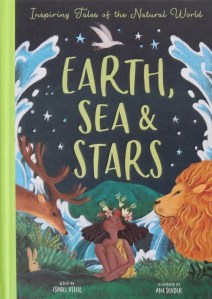
This anthology of twenty stories from ancient cultures takes readers on a journey around the world and back in time to when tales such as these would likely have been told among people sitting around a fire. A time when humankind’s respect for, and awe of, the natural world was greater than it is today.

From as far afield as Syria, Scotland and South Sudan, Nigeria and Norway to name just some of the places from which these stories have come, we encounter a life-saving baboon with a lesson to teach a farmer in a Swahili tale,

an armadillo that uses her knowledge of plants to outwit a fox in the Argentinian Pampas, an ant that comes to the aid of King Lion (from Myanmar) and discover how the people came to have light, warmth and power thanks to a spider’s ingenuity, a woodpecker’s strength and a young woman’s bravery (the Democratic Republic of Congo).

Flora feature prominently in The Flower Thief (Syria) that demonstrates the vital importance of stewardship; The Sky Garden – a Dreamtime tale; and from Tahiti comes a beautiful tale of a Banyan Tree with its amazing roots.

After the moving tellings themselves, Isabel Otter offers some background details, a spread of thought-provoking questions to consider (one per story) – great for classroom discussions, and a bibliography. Ana Sender’s stunning illustrations grace almost every spread of this collection that as well as being a joy to read and to share, is a reminder that wherever we are we should treat our precious planet and the living things thereon with the care it needs to survive and thrive.

The Wild Garden

The Wild Garden
Cynthia Cliff
Prestel

Jilly lives in a village called Mirren with her Grandpa and dog, Bleu. Outside the village, as we see in the beautifully detailed illustrations, is a wonderful wild place, a mix of meadowland, woods and ponds, while within the village is a carefully cultivated shared garden wherein people grow row upon row of vegetables and ornamental plants.

It’s the wild place that Jilly, Grandpa, and Bleu, spend much of their time, in spring enjoying the birds and minibeasts and searching for edible greens to eat for supper. At the same time the community garden is a hive of activity. And so it continues through the seasons, one difference between the two locations being that Jilly never knows what their forays might yield,

whereas the results of the labours of the other villagers in their garden are much more predictable.

Then with winter comes a fierce snowstorm after which the villagers decide to enlarge their growing space: a much much bigger garden should result in more and more rows of plants. Needless to say this plan perplexes Jilly and Grandpa: what will happen to the meadows, the nut trees and all those animal habitats? They have to do something to stop the wildlife devastation. Can two people possibly show all the other village residents that a bigger garden isn’t as they think, a better garden?

Perhaps there’s a way that everybody can be satisfied …

Cynthia Cliff’s illustrations of the contrasting growing spaces show that both have much to offer while both these and her story help make youngsters aware of the beauty and vital importance of nature; and how our amazing planet isn’t owned by humans, rather we must share it with the wealth of flora and fauna, respecting and caring for their habitats.

The Lost Whale

The Lost Whale
Hannah Gold, illustrated by Levi Pinfold
Harper Collins Children’s Books

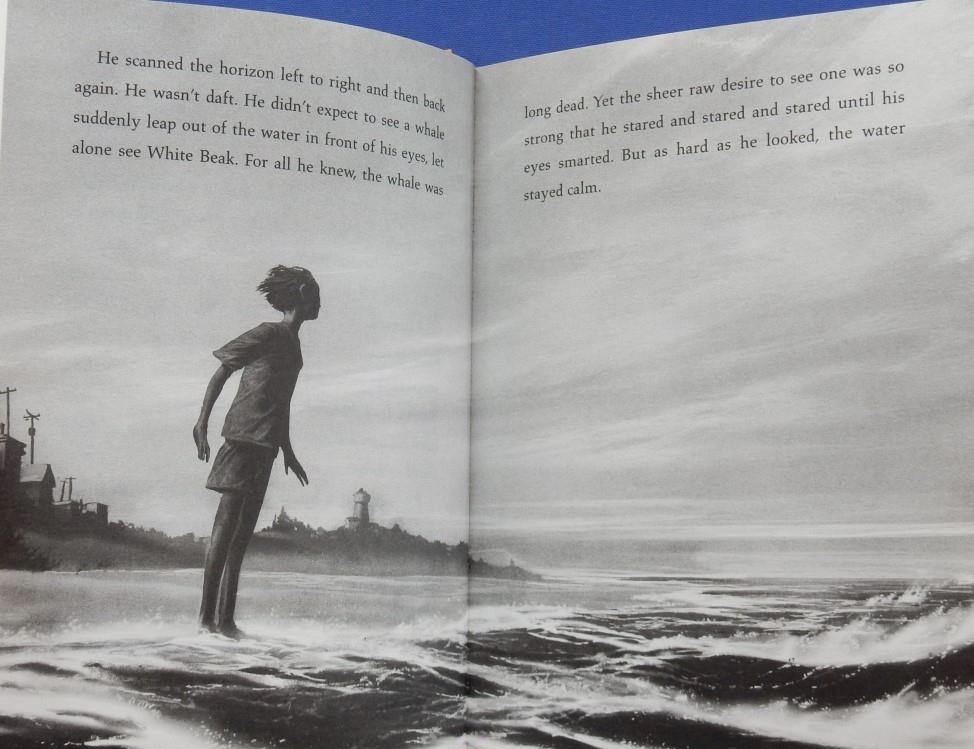
Hannah Gold is a wonderful weaver of words. In this story we meet eleven year old Rio who is sent to stay with his grandmother in a small coastal town in California while his musical mum goes to hospital for treatment. Having last met Grandmother Fran over five years ago, and knowing virtually nothing about where she lives, he is reluctant to go but has no choice about leaving his friends and everything familiar.

Then, one day Fran gives Rio a box containing treasures that had belonged to his mum. Inside is a sketchbook of drawings of whales, one of which seems to call to the boy. He discovers she’s named White Beak on account of her distinctive markings. This leads him down to the harbour

and a chance meeting with Marina, a girl around his own age who lives on a boat with her Dad, Birch, and they run whale-watching trips for visitors.

Now, Rio has a focus and perhaps too an anchor, for he feels that if he can find White Beak it will help heal his mother. He discovers that not only has he an affinity for whales, but he is able to hear them when nobody else can.

You’ll likely feel tears welling up at certain places in this beautiful, unputdownable book. The author’s way of embedding information about animals (in this case whales and protection of their environment), within a gripping narrative with brilliant characterisation is awesome. I urge you to dive headlong in, relish the opportunity to lose yourself in this watery world, spot some whales in Levi Pinfold’s illustrations that are as exquisite as Hannah’s writing and notably capture the majesty of White Beak, as well as Rio’s journey both emotional and physical.

The Journey Home

The Journey Home
Frann Preston-Gannon
Pavilion Books

The conservation message of this tenth anniversary edition of Frann’s thought-provoking picture book is even more urgent now than when it was first published.

It begins with a Polar Bear, forced to leave home when the ice has melted and there’s no longer any food. As he swims he comes upon a small boat, climbs in and sets out he knows not where. Soon he discovers a city and there on the dockside is a Panda. The Panda climbs into the boat and they sail off together. Some time later they see an Orangutan, now without any jungle and Panda invites her to join them.

Suddenly Orangutan notices an Elephant that is endeavouring to hide from tusk-stealing hunters. Then there are four packed into that tiny boat and before long a storm brews up carrying then far, far away from all their homes.

Eventually the boat approaches an island upon which stands a Dodo.

The sailors explain their plight, saying that they really want to go home. “Well of course you can go home!” comes the reply … “You can go home when the trees grow back and when the ice returns and when the cities stop getting bigger and when the hunting stops.” What choice do they really have but to stay put and as the Dodo suggests, “Let’s see what tomorrow brings.”

We adult readers know what the Dodo’s fate was, but it need not be the same for Polar Bear, Panda, Orangutan and Elephant. Yes the story, with its beautifully executed collage illustrations in a muted colour palette, is pretty bleak; and as we discover in a factual section after the narrative, all these wonderful creatures are either vulnerable, endangered or critically endangered. However all is not lost thanks to the work being done on their behalf by various organisations and individuals. To that end, the final page has ideas about what young readers and their families (or classes) can do to help the environment.

Sam Plants a Sunflower / Tilly Plants a Tree / Shelly Hen Lays Eggs

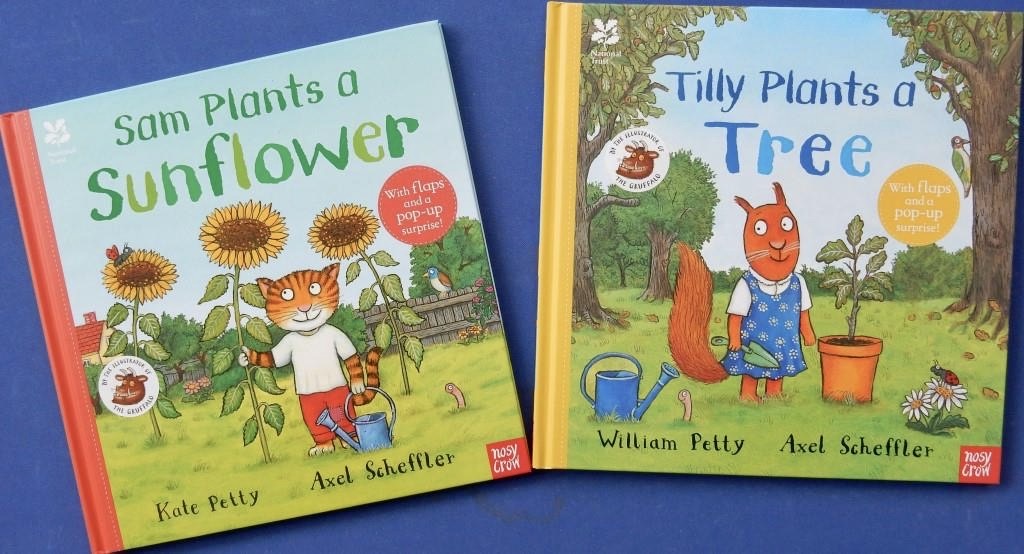
Sam Plants a Sunflower
Kate Petty and Axel Scheffler
Tilly Plants a Tree
William Petty and Axel Scheffler
Nosy Crow

Published in collaboration with the National Trust, these lift-the flap books each with a strategically placed pop-up are just right for helping young children discover the delights of growing things for themselves.

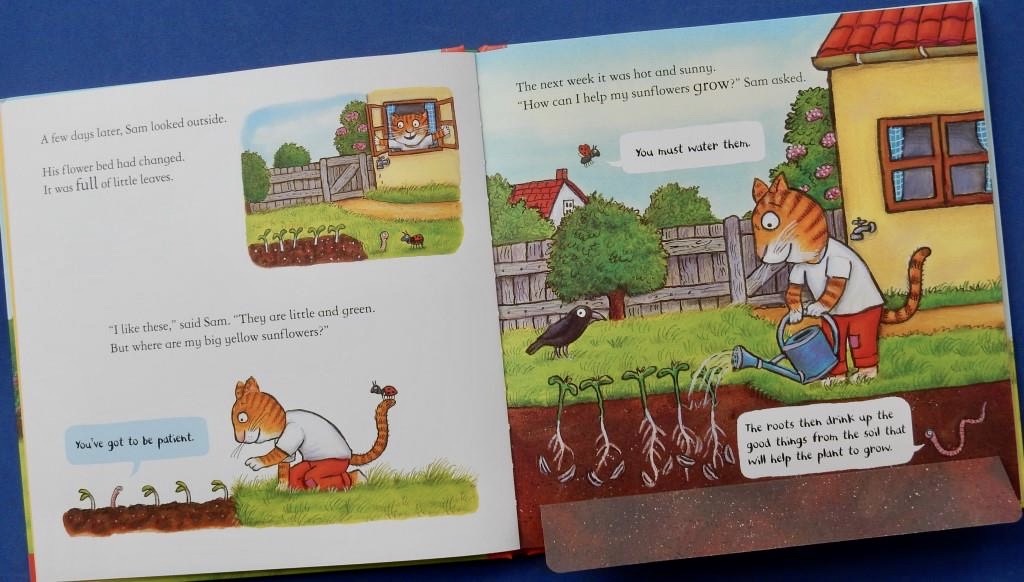
As Sam cat basks in the sunshine a passing ladybird responds to his “Why can’t the sun shine every day?”with a suggestion that he should plant sunflowers. We then follow the process as he chooses a suitable day, a suitable spot in his garden, plants and waters his seeds and waits. And waits … Beneath the soil (and a series of flaps) an earthworm watches adding comments until a few days later, Sam discovers a row of sprouting leaves. As it gets hotter Sam worries about how to help his sunflowers grow and receives advice from the ladybird. The plants continue getting ever taller until eventually buds appear but still Sam waits for his big yellow sunflowers until at last there to his delight, that of his friends and of readers, they are.

As summer ends the petals fall, the leaves wither and there again is the reassuring ladybird telling Sam to remove the seeds, share them with his pals and plant them the following spring.
If by chance, the story hasn’t made youngsters eager to plant sunflowers, there’s a final page of helpful tips.

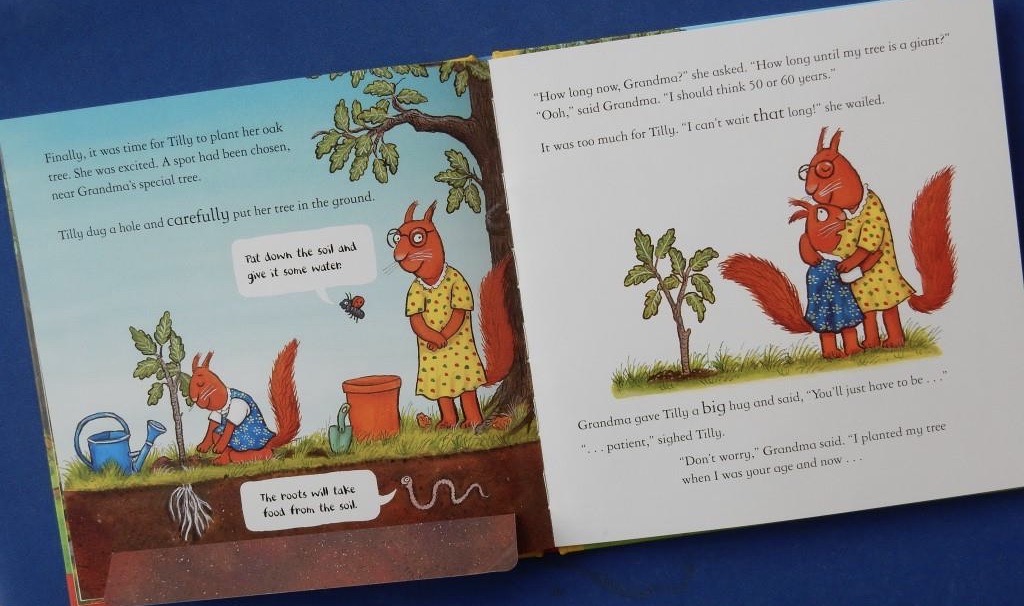
Tilly, the main character in the second story is a squirrel. One day she rushes home from school with exciting news; everyone in her class is going to grow an oak tree. Grandma takes Tilly to a woodland full of majestic oaks and beneath Grandma’s special tree the little squirrel finds an acorn. Gran knows just what to do to get the acorn to germinate and after more than a year, with the help of ladybird and worm too, Tilly’s sapling is ready to be planted out in the wood near her Grandma’s.

With its straightforward explanatory narrative and a final page of tips I’m sure many little humans will be eagerly collecting acorns for planting this autumn.
Ideal for sharing with foundation stage children and for home use, both books have bright, expressive illustrations from Axel Scheffler that young children and readers aloud will enjoy.

Shelly Hen Lays Eggs
Deborah Chancellor and Julia Groves
Scallywag Press

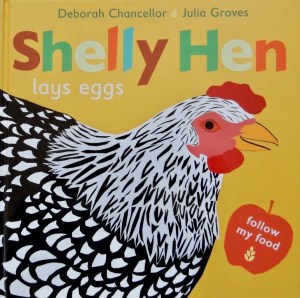
This is the third in the Follow My Food picture book series aimed at helping young children understand where their food comes from. We join a little boy as he watches Shelly a free range hen as she takes a dust bath to get rid of mites, feeds on bugs in the grass and herbs she comes upon, clucks with her friends in the flock, returns to her coop at sundown, settles down in the nesting box and at dawn, lays an egg ready for the helpful little boy narrator to collect along with the other eggs later in the morning. It might even be the one he eats for his tea.
After Deborah Chancellor’s straightforward narrative accompanied by Julia Groves’ bright, cut paper illustrations comes a trail-type quiz based on the facts of the story, where youngsters match words and pictures. There are two further information pages with paragraphs on ‘Happy Hens’, ‘Tasty Eggs’ and Chatty Chickens’.
Food is a popular theme in foundation stage settings so this would be a useful book to add to school and nursery collections.

No More Peas

No More Peas
Madeleine Cook and Erika Meza
Oxford Children’s Books

Given the chance, young Oliver would restrict his meals to pizza, chips, burgers, cakes and other sweet stuff. However his father insists on giving him carrots – hard ones, broccoli (green and puffy) or a plate of roly-poly peas at dinner times. All of these Oliver donates to the dog.

Time to devise a healthy eating plan, thinks Dad.

Next day off they go into the garden where as Dad informs his son, “I grow vegetables here.” Again Oliver comes up with his usual “YUK!” response. Dad doesn’t give up that easily though and proceeds to tell the boy all about the growing process as well as the wealth of colourful vegetables it’s possible to cultivate. Now Daniel is impressed at the possibility of eating a rainbow: seems as though Dad’s plan is starting to work.

That evening Oliver helps prepare the meal:

there are lots of exciting new veggies to try but what will be the boy’s reaction? Is there at last a vegetable he really truly likes? Happily yes: it’s tiny, spherical and green. So why that title? …

Madeleine Cook’s fun, gently educative story of growing your own vegetables, healthy eating and trying new foods is deliciously illustrated in Erika Meza’s scenes that – like good picture books do – convey so much not said in the words; Oliver’s feelings about Dad’s offerings are superbly captured as are those of the other characters.

Whether or not there’s a fussy eater in your family, (or class) this is a terrific book to share with foundation stage/KS1 children for so many reasons and the classroom potential is enormous.

Starfell: Willow Moss and the Magic Thief

Starfell: Willow Moss and the Magic Thief
Dominique Valente, illustrated by Sarah Warburton
Harper Collins Children’s Books

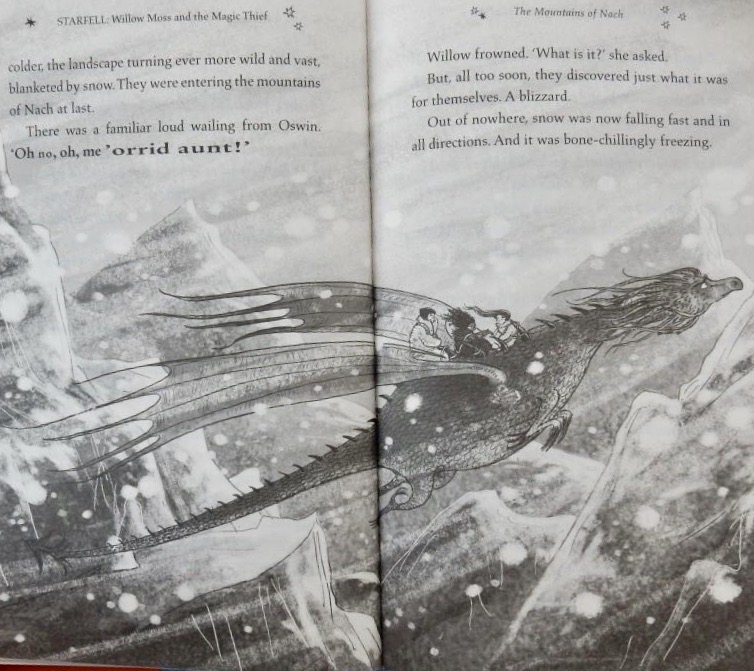
The fantastic fourth instalment of Dominique Valente’s fantasy series sees young witch, Willow Moss without her magic power that has been stolen by the renegade wizard Silas. Now with Starfell on the brink of disaster and destruction, facing formidable danger Willow and some friends set out a-back dragon Feathering to the Mountains of Nach , where if a story her Granny once told her is right, she will find the legendary beast, the Craegun.

She hopes what’s believed about this powerful being – that it can restore anything that has been lost, albeit at a cost – is so. The clock is ticking and she has only a few days to complete her mission or all the magic of Willow’s world will be forever lost.

It’s a huge learning journey for Willow; by the time this epic tale ends wherein she often recalls her Granny’s wonderfully wise words, she’s learnt to love herself for the awesome person she is; and a lot about magic, it’s might, and what it really means to herself, her family and the Starfell community.

Truly a celebration of friendship, empathy, kindness and consideration, equality, determination and resilience: oh my shrinking giants! – this is such a terrific read, full of memorable moments and so superbly illustrated by Sarah Warburton. Please don’t let it be the last we hear of Willow et al.

Around the World in 80 Trees / Around the World in 80 Musical Instruments

Here are two titles in a Welbeck Publishing series – thanks to the publisher for sending them for review

Around the World in 80 Trees
Ben Lerwill and Kaja Kajfež

Trees are crucial to life on Earth: they release oxygen. They also provide food, medicine, materials and shelter and since Stone Age times have been prized by humans, some cultures even seeing certain of them as holy. So says Ben Lerwill in his introductory spread for this book.

Then having explained the different kinds of trees (coniferous and broadleaf) and their various parts, with the help of Kaja Kajfež’s gorgeous, detailed illustrations, he takes readers, around the globe to find out about some of 60,000 plus species that are found in the Americas, followed in turn by Africa, Europe and Asia, and finally Oceania. Between each main geographical section are spreads on more general topics – leaves,

roots, pollination, flowers and seeds, and the importance of trees.
Do you know what the oldest tree in the world is, or where it grows? I knew that it’s been named Methuselah but not that it’s the bristlecone pine and has been growing in the White Mountains of California for over 4850 years. In the same state is another record breaker, the coast redwood, the tallest known tree. Other locations visited in this section are the tropical Amazon rainforest and the Andes.
Growing in several parts of the African continent is the mighty baobab, six of the seven species of which I read, can only be found on Madagascar.

Such is the strength of baobab bark that it can be used to make nets, ropes, bags, homes even; and happily the bark that’s ripped off is always replaced by new growth.
Whether you dip in and out of this book or read it straight through, you’ll likely learn something new and exciting; but in conclusion, the author provides a stark reminder that it’s important we all play our part in helping the future health of these wonderful plants.

Around the World in 80 Musical Instruments
Nancy Dickman and Sue Downing

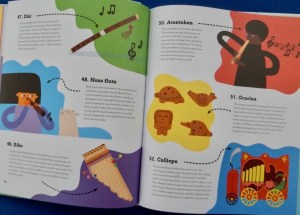
No matter where on earth you might go, you’ll always come across people making music; we might call music-making a universal phenomenon. There are many hundreds of different musical instruments to be found all over the world and they are used for many purposes including for concerts, alongside dancers, in celebrations, for religious ceremonies, and even unfortunately, as a form of intimidation or aggression.

In her account for this book, author Nancy Dickman groups eighty of them under four main headings based on how the instruments make their sounds: percussion instruments, stringed instruments, wind instruments

and a miscellaneous assortment she calls ‘weird and wonderful instruments’. She’s also created a very helpful musical family tree discovered by opening a central gatefold.

We read about the various materials used in the making of the instruments featured in each of the four sections as well as the places in which they are played. Although I’ve seen and heard hundreds of instruments and collected a good many in my travels, I encountered many new to me in this fascinating book with Sue Dowling’s bold illustrations large and small; I’m sure other readers will too.

For school collections and interested individuals from around seven.

A Little Bit of Hush

A Little Bit of Hush
Paul Stewart and Jane Porter
Otter-Barry Books

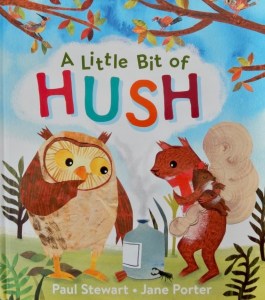
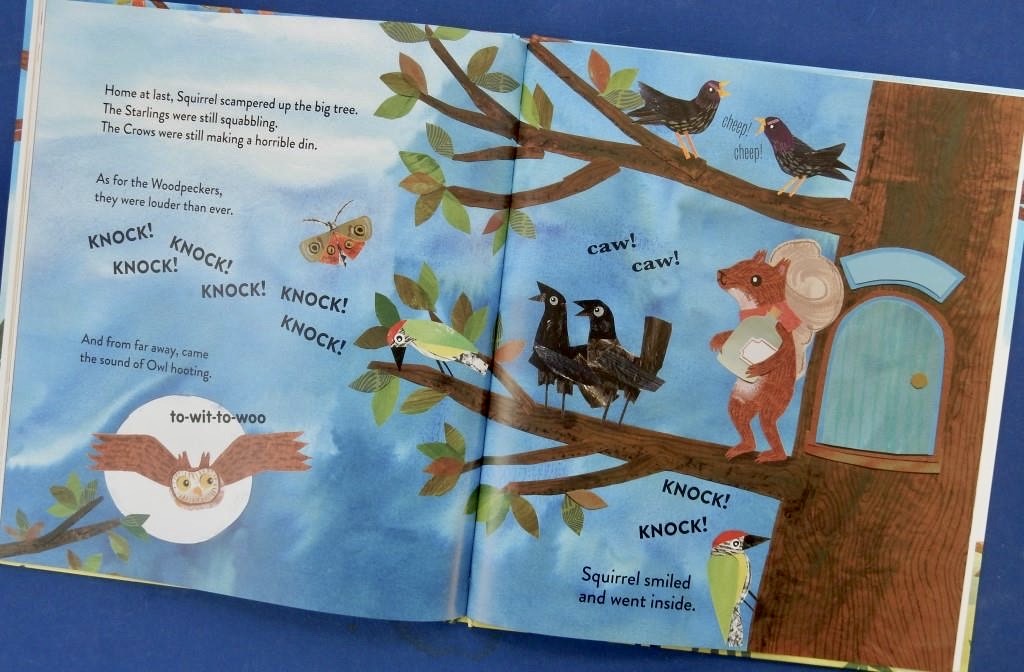
Squirrel and her babies live in a big tree; so too do all sorts of noisy birds. Their cacophony is such that the baby squirrels are unable to get to sleep so their mother decides to consult Owl. Having heard her problem Owl brings out a jar containing so he says, “A Little Bit of Hush”. Squirrel is somewhat puzzled that she can’t see anything in the jar so Owl demonstrates the way in which it works and goes on to show her his special invention, a Silence Catcher.

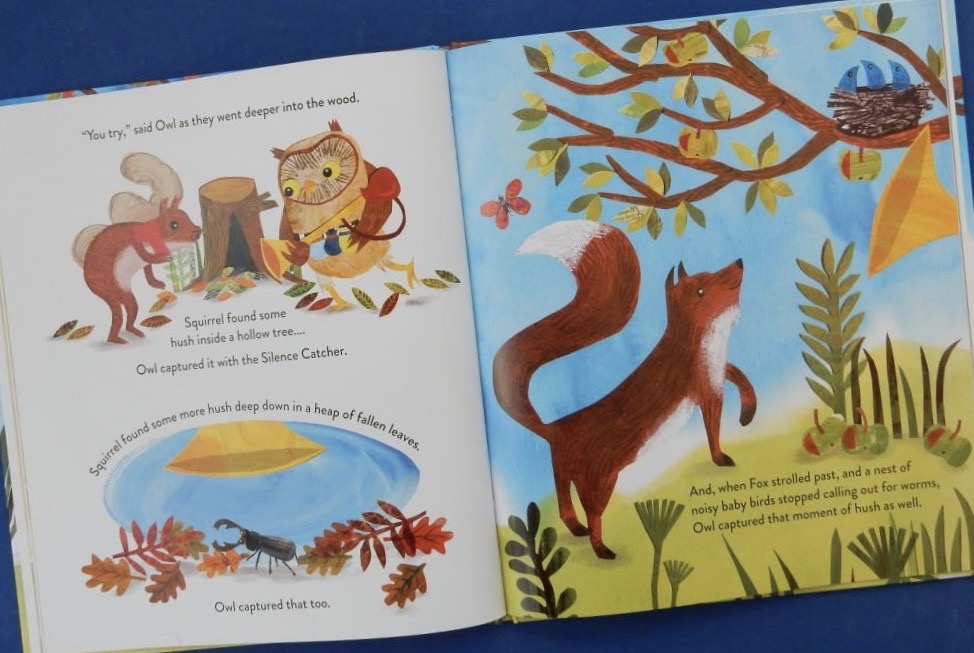
The two of them then embark on a magical journey through the woods with Owl capturing the hush between the Blackbird’s song and its alarm call, and encourages Squirrel who finds some of his own – the hush within a hollow tree stump, a hush deep down in some fallen leaves.

Owl then captures the stillness after an acorn drops before it bounces on the forest floor and even the silence between lightning’s flash and thunder’s roll. All these Owl stows in pockets of peace and pouches of stillness and hush; then back in his workshop he uses these ingredients, creating a special mixture that he puts into a jar for Squirrel to take back to her family.

The noise outside her front door is louder than ever when she returns, but now she has her own bottle of helpful hush. Will it work its unique magic on the five squirrels?

I love this idea and tried it out on my walk after this book had arrived in the post. It certainly made me more mindful of the spaces between the natural sounds that surrounded me as I stopped and sat for five minutes just listening.

With its examples of natural sounds, though interesting in themselves, but which can sometimes becomes distracting, Paul Stewart’s story shows the importance of silence in our busy world. Like Squirrel we all need times without noise either to drift off to sleep or as a kind of sacred space into which we can retreat and be contemplative. In her collage illustrations, Jane Porter beautifully captures the noisy woodland environment of the creatures’ quest for peace and quite, amusingly portraying the various sources of the distractions.

One Tiny Dot

One Tiny Dot
Lucy Rowland and Gwen Millward
Templar Books

The transformative effect of kindness is personified and explored in this tale of what starts off as a small spherical entity and ends up in the same state; but it’s what happens in between that matters and that we discover, as we follow the blue dot for a day.

Starting its perambulations in a busy town street our titular dot encounters a boy proudly wearing a new pair of trainers. Act of kindness number one comes when the boy invites the dot to stay for a while and off they go cheerfully until …

Happily a girl sees the soaked shoes and then comes act of kindness number two accompanied by an increase in the size of our dot. All three proceed on their way together and an encounter with a distressed old gentleman leads to act of kindness number three and a huge increase in girth for the dot.

Through the fields they go, kindness flowing behind them, until there’s a veritable crowd of happy people also exuding kindness and enlarging the kindness dot to a gigantic size. They reach the town and there smiles and goodness soon pervade the entire place attracting the attention of the mayor. Much impressed at what he sees, it’s a case of “ice creams on me”. Suddenly though as they make their way to the beach, this is what they come upon …

Fortunately Kindness knows a thing or two about Anger: but can that blue Kindness dot save the day?

Carrying with it a vitally important message, Lucy Rowland’s rhyming narrative rolls along as well as her main character in this uplifting story. Helping equally to spread that message are Gwen Millward’s inspiriting child-centric scenes. May that dot just keep on rolling. Adult readers aloud, be they at home or in primary classrooms, can help maintain the theme’s momentum.

(Having read the story, teachers might try using a small blue ball in a circle time, throwing it to each child in turn who suggests their own act of kindness for the day).

Max Counts to A Million / Wigglesbottom Primary: The Talking Lamb

These are both very funny books from Nosy Crow – thanks to the publisher for sending them for review

Max Counts to A Million
Jeremy Williams

Those first days of lockdown in March 2020 are probably still lingering in the minds of many of us in the UK whether we are adults or like Max, a child at primary school. Max, so he tells readers, is an ordinary eight-year old boy living an ordinary life with his father, a hospital doctor, and nutritionist mother. Then Covid 19 happens: like the rest of us he is scared, frustrated, confused, often bored, missing close contact with family and friends, and thinking it can’t last for long. But it does; schools close and for Max it means that his father goes to stay in a hotel to keep family members safe; he’s under his mother’s feet much of the time and his Grandad is briefly hospitalised with the dreaded virus.

Max doesn’t actually plan to count beyond the hundred he’s told to, it just kind of happens when after an upset with his mum he announces, “Fine” … I’ll count to a million.” This extraordinary statement, crazy as it may sound, becomes not the way to distract himself the boy first intends, but a protracted act that over the weeks, with the help of family, friends and neighbours, brings together a whole community and raises vast sums for NHS charities.

Poignant, honest, humorous – I found myself laughing out loud on many occasions – and splendidly told in a chatty style by Max himself a keen observer who shares his ups and downs, this ultimately uplifting book perfectly captures a moment in recent history we’re unlikely to forget.

Wigglesbottom Primary: The Talking Lamb
Pamela Butchart, illustrated by Becka Moor

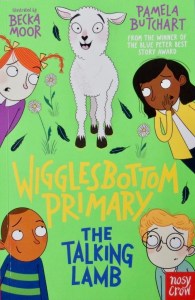
It’s always fun to be in the company of Miss Riley’s Class 2; in this eighth book are three further lively episodes. The first tells of what Theo Burke decides is probably the best day of his life, a trip to a petting zoo. Having visited and appreciated – mostly – several animals everyone sits down for lunch on the picnic benches beside the lambs. And that’s when the real fun begins: one of the lambs puts in a request.

Or does it? Be it yes or no, the result is considerable chaos, some chastisement and a surprise revelation.

The same is true when a new art teacher arrives. Dev, as she asks to be called, rather foolishly – but then it’s her first encounter with Class 2 – asks them as she sits on the floor, to “Paint! Paint your passion! Paint off the paper!” Enough said …

In the final episode of this book (but hopefully not of the series), despite it being almost the end of the summer term, and Year 6’s final day ever because they’re off on a week’s residential trip, members of Class 2 are surprised when they are approached by the leavers, who pass on instructions that as of now it’s down to them to protect “the school secret”. To reveal what this is would be to spoil the story but let’s just say it involves a very big box and something potentially very dangerous.

Laughs aplenty guaranteed for readers be they the solo kind or adult readers aloud. As always Becka Moor’s illustrations are a hoot and play a significant part in the hilariousness of this series. ( Her portrayal of Dev is splendid.)

Natural History Board Books

Who’s Hiding: In the Garden?
Pintachan and Amelia Hepworth
Little Tiger

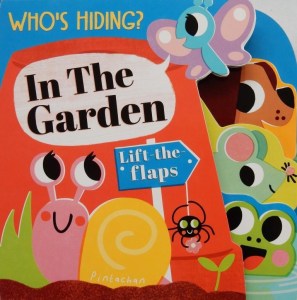
Having lost her five babies, Mummy Snail needs help to find them. First she asks Frog and thanks to him, locates the first of her missing offspring. Following Mouse’s suggestion, she discovers baby number two and Puppy’s advice enables her to find the third. With two still in hiding along comes Butterfly as she approaches the strawberry plant. You can guess what’s beneath one of the juicy fruits … and that leaves just one. Now where can it be? …
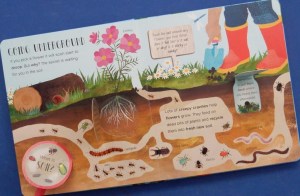
With flaps for little fingers to manipulate in Pintachan’s bold, bright cut away spreads of the search, a simple narrative with speech bubbles and sounds coming from the baby snails to join in with, Amelia Hepworth’s countdown narrative provides plenty to engage little ones who participate in Mummy Snail’s hunt.

One Little Seed
Becky Davies and Charlotte Pepper
Little Tiger

It never ceases to amaze this adult reviewer how from one tiny seed, a lovely flower can grow, often indeed many, many beautiful flowers. It all depends on what kind of seed whether you get a single bloom or a multitude all blooming on one plant and we see both examples in Charlotte Pepper’s bright, alluring illustrations.
In her text for this biggish board book, Becky Davies’s engaging narrative certainly encourages young children to go outdoors with an adult, involve themselves in nature and use all their senses to investigate the flora, (along with the fauna and natural environment in general) around them,

preferably with the book to hand.
There’s a spread with information about how to grow your own flower from seed, and/or a bulb; another showing some of the delicious fruits and vegetables flowering plants produce; we visit a community garden and finally are reminded of the cycle of life in which every one of us, young and not so young can play a part. With a wealth of flaps to explore – several per spread – with further information – visual and verbal – beneath each, this book will one hopes, motivate little ones to be outdoor explorers.

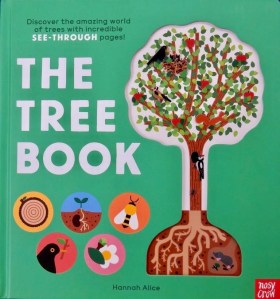
The Tree Book
Hannah Alice
Nosy Crow

Illustrated by Hannah Alice, this large format book was produced in consultation with Simon Toomer, recently appointed Curator of Living Collections at the Royal Botanic Gardens, Kew. The sturdy, see-through pages contain a considerable amount of information written in a young child-friendly style. Interesting, fun and interactive, it introduces users to the inner workings of a tree.
The cut out, see-through pages allow you to ‘look inside’ each part of the tree – roots, trunk, branches and leaves – and see how it functions and grows. Each page presents a different tree-related topic such as new leaves, flowers and pollen, leaves and photosynthesis,

fruits and seeds, mighty minibeasts, underground roots of different types of trees.
The written narrative, with corresponding stylised but clear pictures, takes us through the four seasons and concludes with a look at the importance of caring for and perhaps planting new trees. Without these wonderful plants, none of us would have fresh oxygen to breath.
Walking in a place that has lots of trees is one of my favourite things to do, and I’d certainly suggest it’s never too early to start fostering a love of trees in children; this book could be a good place to start.

Do You Love Exploring?

Do You Love Exploring?
Matt Robertson
Bloomsbury Children’s Books

In the third of this series Matt Robertson’s wildlife adventure takes readers to visit a variety of habitats all over the world.

First stop is the grasslands of Africa where on the savannah roam some grass grazing creatures including zebras, giraffes, black rhinos and elephants. However these have to keep alert as lions lurk, often with the female waiting to spring on unsuspecting prey which will act as food for herself and her family. By means of an illustrated strip we’re also introduced to grassland dwellers from other parts of the globe too. There are some less iconic creatures too including dung beetle; these almost unbelievably are said to be the strongest animals on Earth.

I was amazed to see how many animals, large and small make their home high up in mountainous regions and I’d not even heard of Blue sheep that reside in the Himalayas and other places (a weird name since the creatures are neither blue nor indeed sheep).

Other habitats, each allocated a double spread, include rainforests – one wherein gibbons communicate by singing, wonderful woodlands, islands including the Galapagos, the North and South Poles, searingly hot deserts – watch out for one of the world’s deadliest scorpions – aptly called the Deathstalker,

and a beautiful coral reef deep beneath the ocean.

The final spread presents some endangered animals and the ‘… which … can you spot?’ should send readers back to search for the nine featured thereon.

All of this should convince readers that it’s enormously exciting to meet so many creatures, albeit by means of Matt’s humorous, vibrant illustrations into which a considerable amount of factual information is set.

Sunshine at Bedtime / Let’s Go Outside

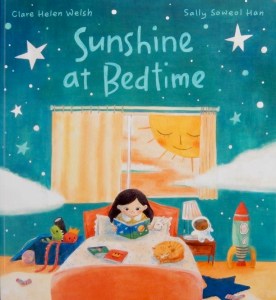
Sunshine at Bedtime
Clare Helen Welsh and Sally Soweol Han
Storyhouse Publishing

When inquisitive young Miki realises that despite being told it’s time for bed, the evening is still light and the sun shining. she’s puzzled. As her mum sees her to bed, she begins to explain and the two of them then embark on a journey of discovery that takes them soaring off into the sky far from Miki’s bedroom across land and sea and out into space.

As they travel Mummy explains how the earth spins on its axis once every 24 hours and slowly slowly orbits the sun during the four seasons that comprise a year. Miki notices Earth leaning towards the Sun giving summer to the people residing in the north and Mum fills in that in the south at this time, it’s winter and thus less sunshine and longer, darker nights.
They then watch as the north leans away from the Sun, which is then sharing its light with the south 

and after flying over all the places the sun shines, it’s time to return and for Miki to got to bed.

Told in Clare Helen Walsh’s poetic prose and shown through Sally Soweol Han’s illustrations – a mix of double page spreads, strip sequences and occasional vignettes showing views of earth and space, this story is one to share and discuss now as the days begin to draw out, for UK audiences at least. (More details about the earth and its tilt and the sun are given at the end of the story.)

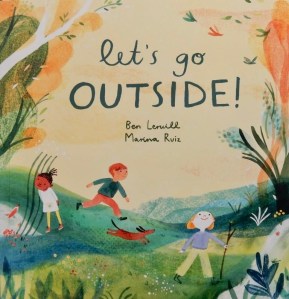
Let’s Go Outside!
Ben Lerwill and Marina Ruiz
Welbeck Publishing

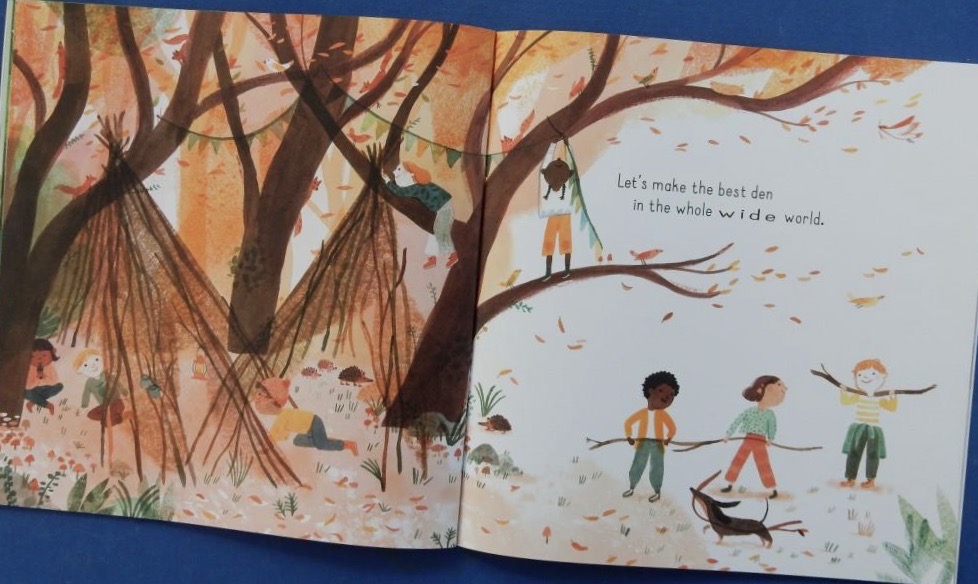
What joys there are waiting for those who venture outdoors suitably clad of course, no matter the weather. That’s what author Ben Lerwill and illustrator Marina Ruiz make evident in this foray through the seasons as we join the group of friends who make the most of every opportunity. There are hills to climb, forests with their wealth of wildlife to explore and if you venture close to the sea, then you’ll certainly notice the wind in your hair and face. 

It’s always great to feel the warm sun on your face, especially if like the children here you take a rest, lie back and just breathe. Minibeasts in abundance are there for the finding especially if like one or two of the nature detectives herein, you’ve remembered to take along a magnifying glass on your walk.
The gently sloping hills are great places for some roly poly romping and who can resist a chance for
dam making like these young co-operators.

I have to admit I often need to make myself go out when it’s raining hard: not so the group of friends herein. They’re quick to find lots of sploshy puddles to jump in. Whereas a snowy day means snow angels, creating snow sculptures and of course, a game of snowballs.
Whatever the season, there’s plenty to relish and most likely by the end of the day, as it is with the friends in the book who go their separate ways, a cosy home awaits.

The last two double spreads are devoted to some starting points for discussion and questions to tempt young readers, no matter where they live, to leave their screens and embrace the exciting outdoors.

The Eyebrows of Doom

The Eyebrows of Doom
Steve Smallman and Miguel Ordóñez
Little Tiger

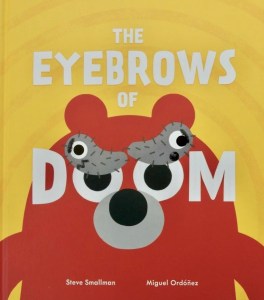
Keep alert as you go about your daily tasks for you never know if, like the bear Dave in Steve Smallman’s rhyming story, you might be next to be attacked by the titular hairy facial features (actually slugs).
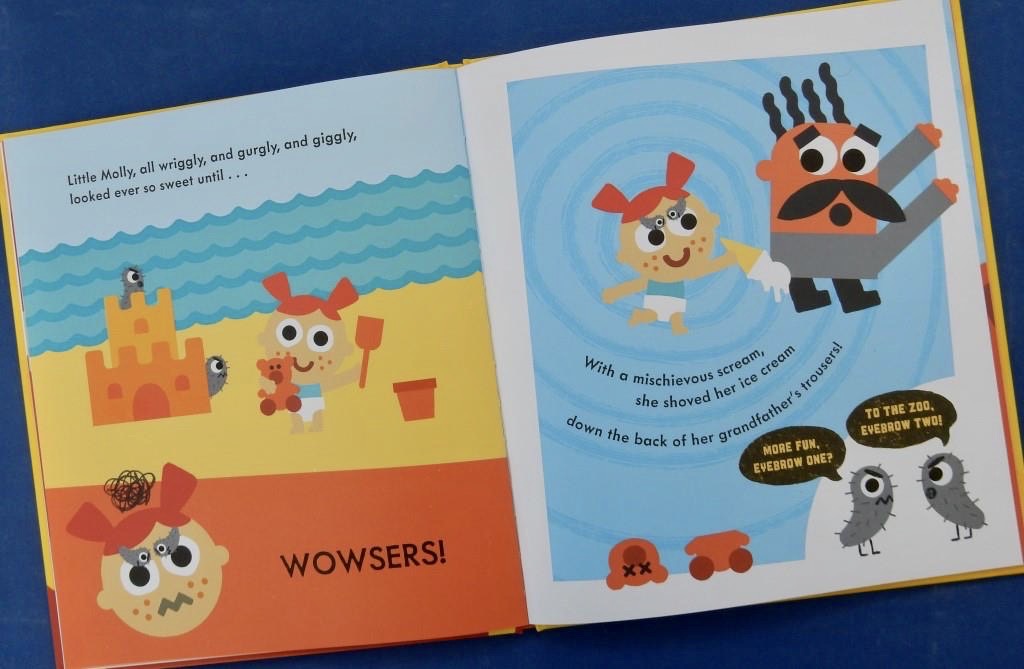
Said eyebrows once in place upon the unsuspecting ursine character, unleash in him the desire to perpetrate a series of dastardly deeds, before departing to land upon Ron a young seagull. As he takes flight, Ron poop bombs the sunbathers on the beach and then little Molly becomes the next to have a visit from the eyebrows prompting her to give her grandfather a spine-chilling shock.

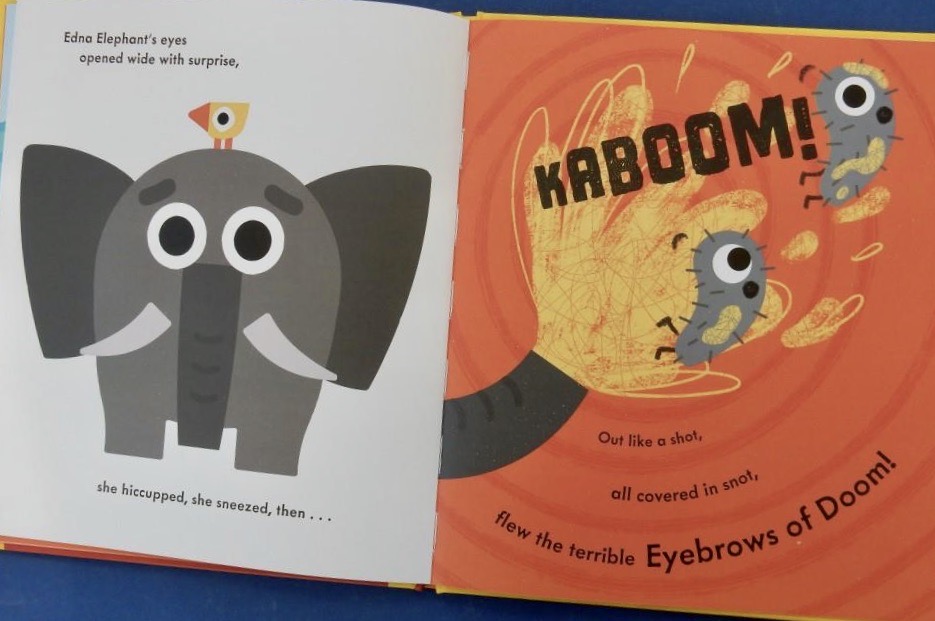
Meanwhile all is calm and peaceful at the zoo until along come those evil eyebrows whereupon chaos is let loose as the dastardly duo rush hither and thither before Dave appears broom in hand and sees them. Whereupon they seek a hiding place and in their haste select the trunk of Edna Elephant. Not a wise choice for they so discombobulate her that she sneezes them out all coated in snot. Yuck!

Then with a splash they enter the sea, their bothersome behaviour over once and for all; or is it? …

Steve’s bonkers tale is a fun read aloud, which, daft though it is, offers listeners plenty to ponder upon. A perusal of Miguel Ordóñez’s zany scenes of the unfolding drama provides no clues but are likely to cause giggles aplenty. I love the way the speech bubble dialogue between the slugs serves to move the story forward.

Coming Up For Air / Sisters of the Mist

Coming Up For Air
Lou Abercrombie
Little Tiger

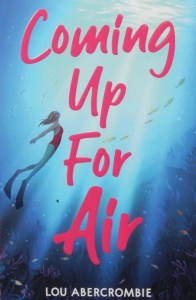
When Coco has to move to the seaside town of Piscary where her mum grew up, she’s eager to make friends and learn more about the family her mum has kept from her. What she doesn’t expect is the resentment shown by the community and her mum’s secrets are certainly deep-rooted.

Staying with her reputedly brilliant biologist Uncle Henry who is struggling with ME, Coco is an aspiring film-maker and an excellent swimmer with as she discovers, a talent for freediving.

Within Piscary are factions: the residents born and bred in the town (Fishes), those who have bought property to live in (Cuckoos), and the ‘Zombies’ who come to spend the summer enjoying what the town offers. As Coco explores the rift between her mum, her family and her hometown, making an occasional friend along the way, she becomes more and more determined to bring the town together.

But then disaster strikes when she and ace swimmer/diver Leo and new friend Shiv investigate a cave that involves diving deep and swimming along a tunnel. Will it be a case of tragic history repeating itself or can Coco finally see herself as part of a proper family?

Lou Abercrombie’s powerful, gripping coming of age story is told from the viewpoint of Coco who intersperses her narrative with filmic directions, adding an unusual element to the book.

Sisters of the Mist
Marlyn Spaaij
Flying Eye Books

Frygea Forest is ancient and mysterious; trolls lurk and mischievous changelings scuttle around. It’s also the place on the edge of which three sisters go every summer to stay with their grandmother on her farm.

Kyra and Janna have been eagerly anticipating another chance to climb trees, toast marshmallows and play some silly games in the woods with their big sister Margot who will be starting senior school after the holidays. Things are different this year however. Margot is less enthusiastic about spending all her time with her siblings. But when she’s lured into the midst of the swampy woods by the phantom-like beings in the mist – the Fog Furies – a worried Kyra is determined to help her

and that means facing the frightful Hellhound. What’s actually happening is that on account of the mysterious forces, Margot is being transformed into a young adolescent.

Marlyn Spaaij’s cleverly conceived, dramatically illustrated graphic novel combines swirlingly strange fantasy elements with Margot’s coming of age and starting her periods, both these being aided by the Furies and her understanding grandmother. It’s a good one to give girls especially those around ten before those changes of growing up start to happen, especially as it shows that facing up to scary changes doesn’t have to mean leaving behind the power of the imagination.

A Best Friend for Bear

A Best Friend for Bear
Petr Horáček
Walker Books

As Black Bear wanders alone he decides a friend would cure his loneliness but finding one in a large forest is far from easy. Suddenly to his surprise he comes upon another creature: it’s Brown Bear and co-incidentally that bear too is searching for a friend. Brown Bear agrees to Black Bear’s suggestions that they look together and off they go, both commenting on the difficulty of their mission. The search is occasionally hazardous but exciting

and it’s good to have a fellow creature to help when needed.

After hunting unsuccessfully for a while, Brown Bear suggests they practise with each other by playing hide-and-seek. All goes well until Black Bear is unable to find Brown Bear until …

and then as they sit side by side, a realisation dawns …

Young listeners will delight in being in the know with the author about what’s coming in the two final spreads and equally will love the warmth and on-going humour of the story. Petr Horáček’s arresting, richly textured and coloured, scribbly visuals are truly gorgeous: I love too, the way the bears’ eyes say so much in their search for what’s right there in front of (or beside) them all along.

Bella Loves Bugs / Billy Loves Birds

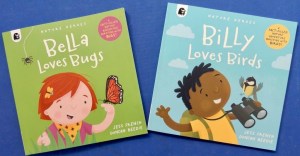
Bella Loves Bugs
Billy Loves Birds

Jess French and Duncan Beedie
Happy Yak

These two narrative non-fiction picture books are written by zoologist, naturalist and vet, Jess French whose passion for wildlife shines through in both Nature Heroes titles wherein she uses the titular children as narrators.

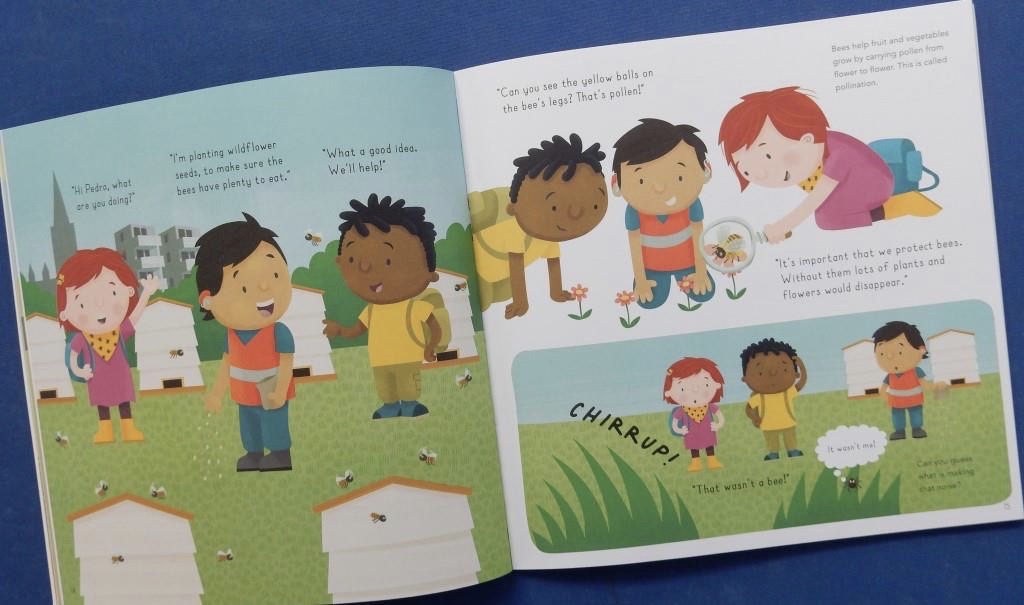
Bella is an aspiring entomologist who shares a day in her life with readers and it’s certainly a very exciting one with lots of discoveries. Her first task is to collect garlic mustard to feed her caterpillars and then with a few useful bug hunting items she sets out to look for minibeasts and to meet up with some of her fellow nature hero friends.
By following Bella’s interactions with her friends and the additional facts this becomes a learning journey for readers who encounter social insects – ants in particular – a honey bee collecting nectar and others around their hives,

several jumping bugs and then a “fluttery butterfly” (why a non-native monarch?). Their next stop is at a pond, absolutely alive with water creatures on and below the surface; time for some pond-dipping (with an adult close by).
As they go into the forest Bella makes several discoveries – woodlice, a wolf spider with her eggs, and inside her trap she finds a stag beetle and a stag beetle grub. Down comes the rain bringing out the slugs and snails, and then it’s time to head home where something else exciting happens inside her vivarium.
Look out for the spider that makes occasional comments along the way.

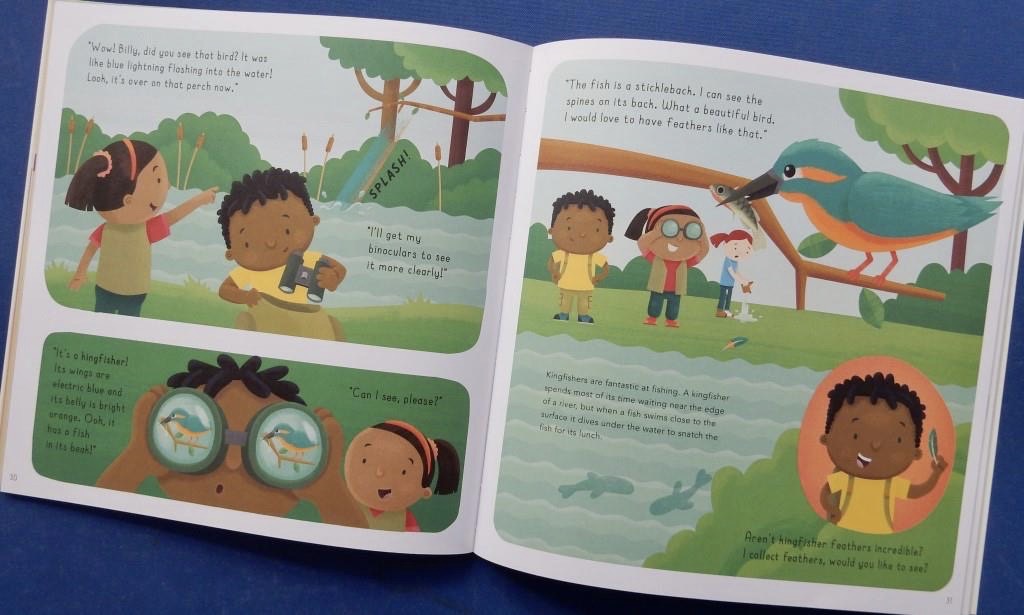
Bird loving Billy (in the company of a talking tit) spends a day at forest school, sharing his observations with readers and his friends about the wealth of birds they encounter. There’s a woodpecker, a dunnock nest with several eggs including one of a different colour and there’s great excitement when Billy spies a kingfisher and comes across a beautiful feather to add to his collection.

Eventually he reaches the tit nest box located high in a tree where there are little chicks just preparing to leave the nest.

Bursting with information engagingly presented in the words and in Duncan Beedie’s amusing illustrations, both books should encourage youngsters to go outdoors to investigate and one hopes, appreciate the wonders of nature that’s all around us.

The Royal Leap-Frog

The Royal Leap-Frog
Peter Bently and Claire Powell
Bloomsbury Children’s Books

Written in perfect rhyme is Peter Bently’s very funny version of Hans Christian Andersen’s The Leaping Match fable. It tells, and shows through Claire Powell’s splendid, vibrantly coloured illustrations, what happens when a flea and a grasshopper (both convinced they’re the best) compete before the king whom they want to decide which one of them can jump the higher. Along with them to the palace goes a little green frog.
Utter chaos ensues as first flea

and then grasshopper leaps – captured with panache in Claire’s detailed scenes for which she uses a variety of layouts.

Both insects then depart the royal dining room leaving the king flat out on his sofa. However his respite is brief for up steps the frog claiming an ability to out-leap both previous contestants. What will be the outcome of his attempt?

A laugh-out-loud book that’s great to share in the classroom or at home with individuals, whether or not they’re familiar with the original fairy tale.

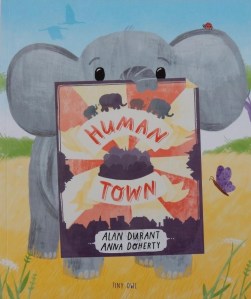
Human Town

Human Town
Alan Durant and Anna Doherty
Tiny Owl

Holding a mirror up to us is this story wherein elephants Junior, Lulu and their parents visit Human Town. Whereas their parents suggest it’s likely to be a boring place, the offspring consider it cool.

On arrival they first peruse the list of rules and then start wandering around, Dad warning of the potential dangers and unpredictably of humans. They pause to watch people entering shops empty- handed and coming out with bags stuffed full of ‘things’. Things, says Dad, make humans happy. The young elephants are shocked to learn that some humans eat sheep, chickens and cows. “You can’t judge them like us, … they’re wild animals,” is Dad’s comment.

The football game is a disappointment; but even worse is the stream full of rubbish and the foul-smelling air, both the results of human carelessness and hence points out Mum, one of the reasons they are dying out;

so too is the “farting car” Junior spies. The church, cinema and school are completely empty: not a human in any of them; and those outside their homes are shown fighting one another

while inside others watch a boring thing called ‘Teevee”.

Then totally unimpressed, the elephants stop for a family picnic before returning home. First though Junior asks one final question about the likelihood of humans becoming extinct. Mum’s answer along with her young one’s response on the last page are thought-provokingly alarming.

Cleverly presenting consumerism, conflict, pollution and the vital importance of the environment and protecting animals, this book is an excellent starting point for discussions with children on those themes. Yes it’s wryly humorous, but the truths of what we see and read are evident the world over: we can no longer turn our backs on what is happening on this planet that we – humans and wildlife – share.

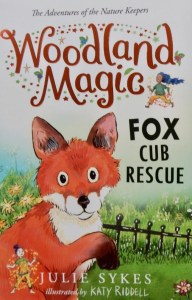
Woodland Magic: Fox Cub Rescue / The Smidgens Crash-Land

Woodland Magic: Fox Cub Rescue
Julie Sykes, illustrated by Katy Riddell
Piccadilly Press

This is the first of a new series about a community of tiny sprite-like beings residing in the depths of Whispering Wood in Hidden Middle, out of sight of the Ruffins (humans) who live on the edge of the woods. Living off the land, seeking out and collecting their food and useful objects discarded by Ruffins, these tiny folk are called Keepers. Early every morning the Keepers head off into Ruffin territory to repair and protect the environment from the actions of the Ruffins.
The main protagonists of this story are Cora and Jax, would-be Keepers in training who are excited about their very first venture in the Big Outside where they’ve been asked to reseed land bulldozed by the Ruffins, and if possible to collect various natural items. They must complete this work by dawn or risk being sent back to school.
The two friends think they’ve plenty of time to do the bidding of Scarlet Busybee, but once in the Outside they’re soon distracted, first by a mother fox and her cubs and then a shiny metal slide and only just make it back in time. They’re given another chance and the following day set out, full of good intentions, with two specific jobs to do.
Again the two are distracted in part by something that’s happened as a consequence of their previous day’s actions. Seemingly it’s going to take more than a mere sprinkling of Cora’s woodland magic to put things right 

but perhaps some timely unexpected assistance by fellow Keepers could yet help save the situation.
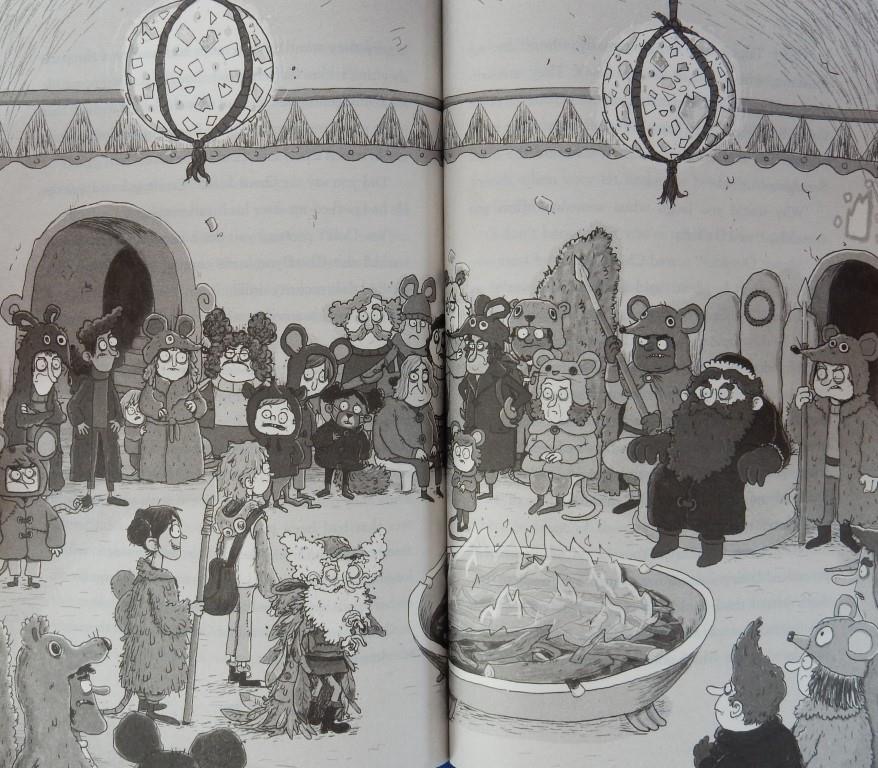
Julie Sykes cleverly weaves the actions and consequences thread into her enchanting story while Katy Riddell’s sprinkling of black and white illustrations imbue the telling with a misty magical feel.
New solo readers, especially lovers of nature sprinkled with woodland magic, will delight in this book and eagerly anticipate the further titles in the series mentioned after the ‘create your own wildflower meadow’ instructions that follow the adventure.

There’s more magic with tiny beings in:

The Smidgens Crash-Land
David O’Connell, illustrated by Seb Burnett
Bloomsbury Children’s Books

Since her previous adventure Gafferty Sprout has been very good but this hot-headed young Smidgen seems to have a nose for trouble. In this second adventure it isn’t long before trouble is what she finds as she and new best friend Will take to the air but only briefly; a mishap with their glider plunges them down right by Noah who is out shopping at the ‘Big Folk’ market with his mum.
Even bigger trouble soon turns up in the form of another Smidgen, one Crumpeck, who claims to have discovered the location of the third Smidgen clan’s home, a place called Burrow. ‘… even more Smidgens to get to know – and more friends’ thinks Gafferty. But is it really that straightforward, for Crumpeck steals Gafferty’s precious magical knife and starts heading for the Burrow. What else can she do but follow him, harmless Smidgenologist or not?
However when Gafferty eventually finds a way into the Burrow she discovers that these Smidgens are not the friendly folks she’d anticipated.

Meanwhile the evil Claudia Slymark is on the prowl, still searching for a piece of that magical mirror.
In the end (though happily not the end of the series), Gafferty must rely on Smidgen rule 4 to extricate herself from a very very tricky situation. Can she do it?
Superbly illustrated once more by Seb Burnett, this is another of David O’Connell’s wonderfully exuberant mixes of humour, adventure and magic. It’s sure to leave readers and listeners eagerly anticipating Gafferty’s next adventure: perhaps therein the three Smidgen clans will be reunited – you never know …

Antarctica

Antarctica
Karen Romano Young, illustrated by Angela Hsieh
What on Earth Books

This book was written by polar explorer, author, artist and much more, Karen Romana Young.
Immediately engaging, her writing is a combination of personal narrative and facts about people, fauna and flora and of course, the land itself, as she takes readers on a trip across the melting continent. We meet her fellow scientists working at Palmer Station and the author’s responses to some of the questions they posed, form part of the narrative including, ‘As the ice retreats and Antarctica warms, what will happen to the seed clouds and the rest of the Antarctic food chain?’

It’s truly alarming to read of the 80% drop in Antarctic krill in the last half century, on account of both global warming and overfishing of the krill, a source of food for penguins.

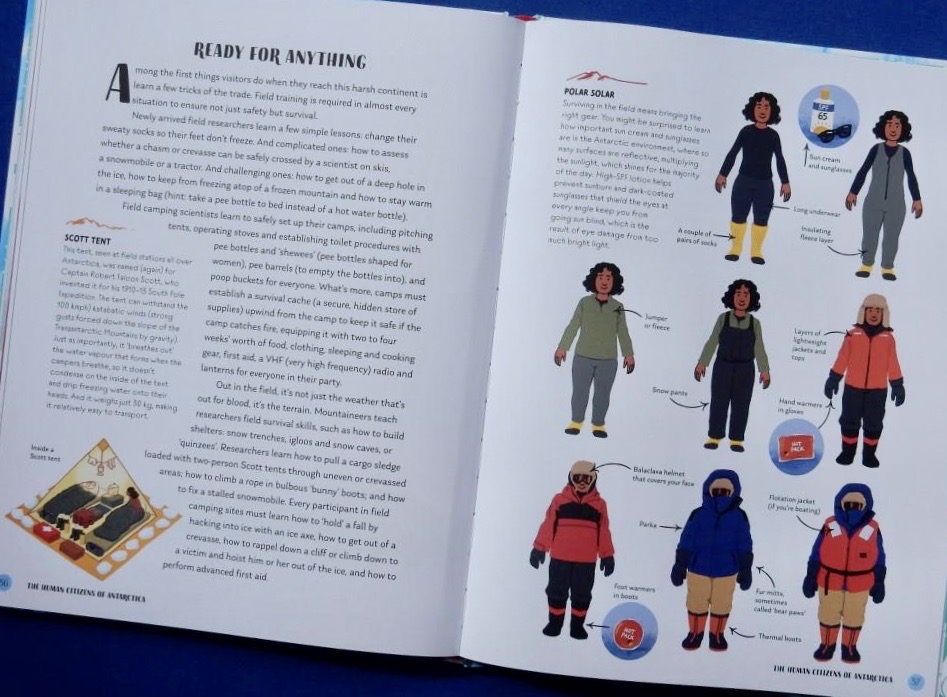
There’s information on the continent’s geological history, how visitors can get to Antarctica, how researchers manage to stay alive despite the extreme cold and testing terrain,

what happens at a research station, and a look at some of the recent scientific discoveries.

Amazingly a lot of animals do live in this, the world’s coldest, windiest and driest continent, most in or near to the sea: readers are introduced to some of these including nematodes and microscopic tardigrades (nicknamed I discovered herein, ‘water bears’). However if your interest is in the larger creatures, then you’ll be fascinated to read of polar gigantism, a phenomenon still puzzling scientists and which has resulted in massive jellyfish and colossal squid; even the krill here, which form the foundation of the Antarctic food chain, are twice the size of those anywhere else on Earth.

Angela Hsieh (who has also visited Antarctica) provides the illustrations – a helpful complement to the text – and there’s a final, glossary, some source notes and an index.

An excellent resource for youngsters (and others) with an interest in the location, climate change and biology.

Our Fort

Our Fort
Marie Dorléans (translated by Alyson Waters)
New York Review Children’s Collection

Not so much a fort, rather a den, is how I’d describe the ultimate destination of the three children who celebrate the arrival of spring with a visit to their camp.

The story is really more about their journey than the construction they sally forth to find. Their walk takes them past sheep in a field and through billowing grass fields that almost engulf them. After a pause to share some cookies, the sky darkens and a wind storm blows up

and the three – full of ideas about potential adventures – have to fight their way forwards until the storm eventually blows itself out. With concerns about the fate of their fort after such a violent wind, on they go to their haven, which happily has withstood the onslaught and is ready and waiting for their arrival.

As we readers follow the children out through their front door, we too feel immersed in the countryside.

It’s as though we’re also making our way onwards and upwards in Marie Dorléans’ delicately worked, realistic rural scenes of her beautifully observed celebration of children’s ability to observe with all their senses and to find delight in the natural world around them, storms and all. Oh the joy of childhood’s freedom in a rural environment – a joy many adults rediscovered during the covid lockdowns of the past couple of years.

All Around Bustletown: Nighttime

All Around Bustletown: Nighttime
Rotraut Susanne Berner
Prestel

The award-winning creator of the seasonal Bustletown series of large format picture books shows us the town’s nocturnal happenings across an hour in this latest offering.

Look very closely – that’s always what you need to do to get the most from each spread – and you’ll see on the opening pages that it’s ten o’clock on a kitchen clock in a multi-generational residence. There’s still a fair bit of activity in and around the building: a boy (Joshua) is spending the night under canvas and reading by torchlight while his father (presumably) points to his wristwatch.
A couple (Cara and John) are taking a stroll – we learn the names from the back cover – and a cyclist, Frank rides past, sans light.
If we follow these characters, stories unfold. As Frank passes a petrol station with a police car being filled at the pump, one of the officers notices the lack of lights on his bike

and Tony chases after and eventually apprehends him several minutes later. I love the sleepover on the same spread – how many of the literary pictures do you recognise exhibited in the cultural centre?

Turn over and Frank is now pushing his bike, the strollers sit on a bench watching as the police deal with an attempted break-in at the dentist’s above the bookshop and a dog takes Cara’s hat.
On the penultimate spread we see the police have now caught the burglar, and the dog (plus hat) are hotly pursued by a man. In the final scene said hat is once again spied by Cara; Frank chains up his cycle outside a food outlet in front of which the police car is passing.
If you turn back to the beginning, you might decide to follow the man in black seen sitting in the police car in the final scene. Indeed it’s possible to trace all the recurring characters and Berner poses several questions on the back cover that will likely send you back for another read.

With the same mixture of a look-and-find and chances to invent your own stories, there’s hours of fun to be found in this totally immersive, cleverly created book.

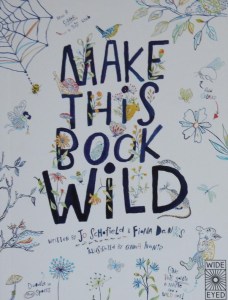
Make This Book Wild

Make This Book Wild
Jo Schofield & Fiona Danks, illustrated by Anna Ivanir
Wide Eyed Editions

If you know a child who is fond of sketching, drawing – observational or otherwise, writing and who enjoys being in the great outdoors, then this is for them. With some sixty nature-themed activities it’s a great way to gently encourage children to observe the natural world, to have fun and be creative, the idea being to make the book look as wild as possible. That of course means that when they go out, the book needs to go too (along with some drawing materials and probably some of the other items listed on the ‘how to use this book’ page).

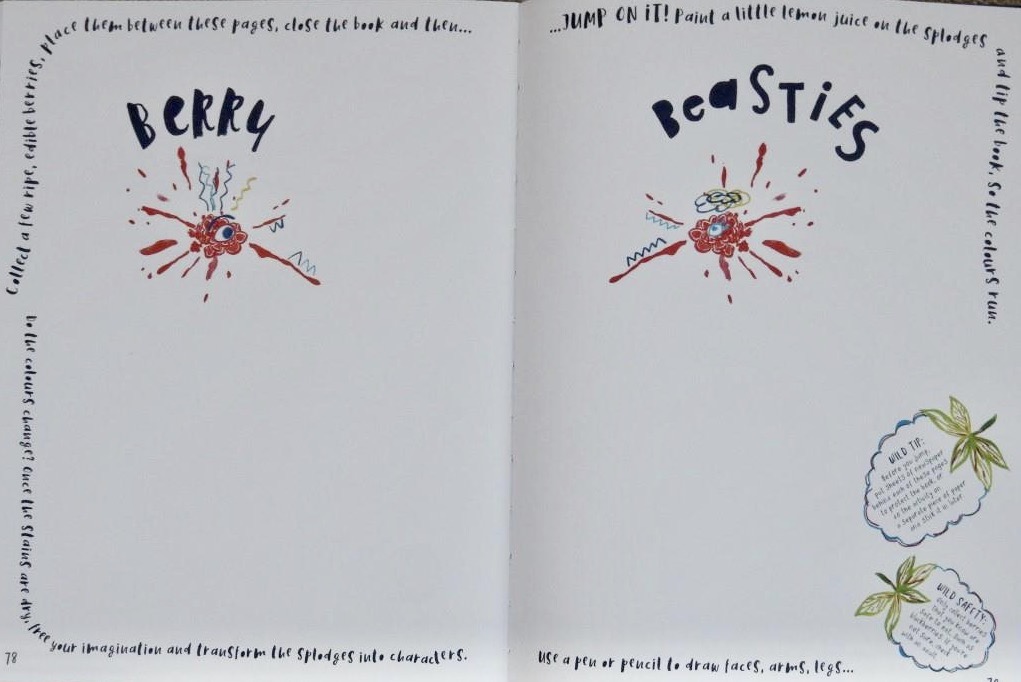
Before sallying forth however, the user must be made aware of the safety precautions in the front, as well as remembering the five points of the ‘protect nature’ code. Thereafter there’s freedom to make the book dirty, stick in items, draw or paint on the pages, possibly using natural tools like feathers or pine needles collected -and perhaps with some of the mud, the berry or leaf juice you’ve extracted. I like the idea of making ‘berry beasties’ by collecting a few ripe edible berries, placing them between the relevant pages, closing the book, jumping on it and following the rest of the instructions (I’d go for using separate paper and sticking in the results.)

If writing’s more your child’s thing then there are opportunities for list making (from observations), poem and story writing and more; you can even write about your ‘dragon hunt’. Science and imagination comes together in this fun-filled book and it’s all about encouraging youngsters to observe nature closely and enjoy so doing. I know a lot of children who would love to get their hands (and feet) on a copy of this.

An Artist’s Eyes

An Artist’s Eyes
Frances Tosdevin and Clémence Monnet
Frances Lincoln Children’s Books

As the story opens adult Mo and young Jo are out walking together. Readers are invited to notice their eyes – they have the same friendliness, shape and smallness but Mo’s eyes are different: she has artist’s eyes. As they walk through various different natural places Mo comments imaginatively on their surroundings: she sees the seascape as ‘a dazzling duck-egg blue, a swirl of peacocks and the inky, indigo of evening, whereas Jo says it’s “so blue!” As they continue Jo describes the forest literally as “green” whereas Mo sees “a shiny apple-green, the lime of gooseberries, and the spring zinginess of moss.”

The field of yellow flowers are “bright yellow” to Jo and Mo notices variations in shades. “Notice how light changes the colour. See the mellow yellow of melons and the pale pastel of primroses.” Jo’s response is despondent: he becomes angry and frustrated at not seeing like an artist.

Patiently, Mo encourages him to trust his own eyes and little by little Jo begins to see what they show him; and what they show him as he deploys his imaginative powers to the full are patterns, textures, shapes and more.

No, he doesn’t see as Mo sees but he does now see with artist’s eyes.

Assuredly, with Clémence Monnet’s gorgeous mixed media illustrations, and Frances Tosdevin’s empowering story, this is a book that, shared with the right adult, will encourage youngsters to accept, employ and make the most of the unique skills they have, as well as conveying the idea that everyone can see like an artist and describe imaginatively what they see.

Once Upon a Big Idea

Once Upon a Big Idea
James Carter and Margaux Carpentier
Little Tiger

What a wealth of playful language poet James Carter uses in his story of inventions large and small., all the outcomes of bright ideas generated by human brains. he tells how for example the plentiful supply of rocks and stones beneath the ground have been used to create tools, bricks and walls with which the pyramids were built.
Animals too are a rich source of materials; they provide meat for some, wool to make into clothing and much more, and their bones were also used in the fashioning of more tools.
Homes, bridges and boats often have wood in their construction but what invention has had the biggest impact on lives ever? James suggests it’s the wheel and I’d probably go along with that. I wonder how many things you can think of that include wheels in their design: if you’re a primary teacher you might try asking your class that question when you share the book.
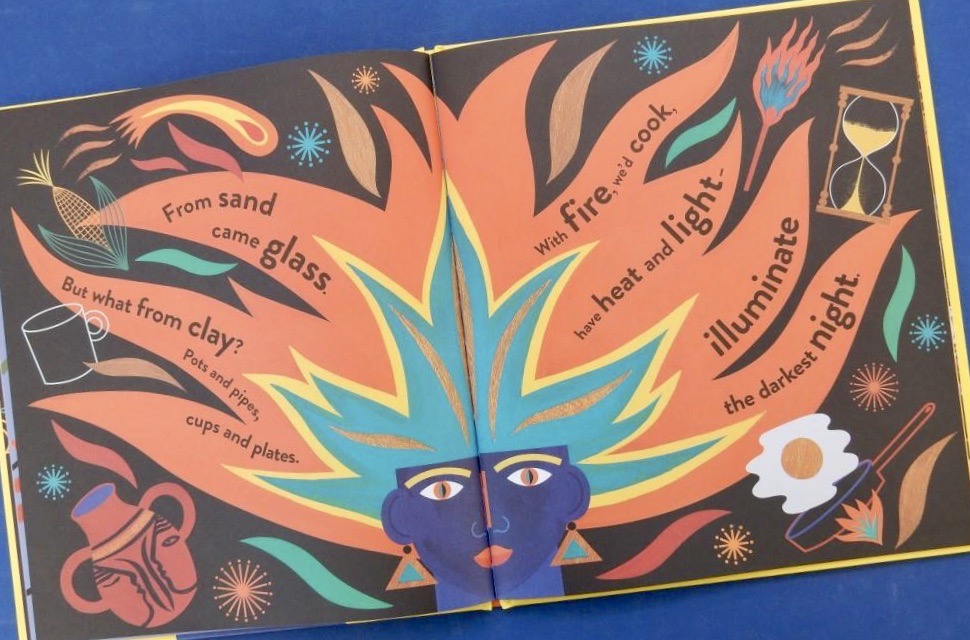
What a wealth of creativity came as a result of sand, clay and fire … 

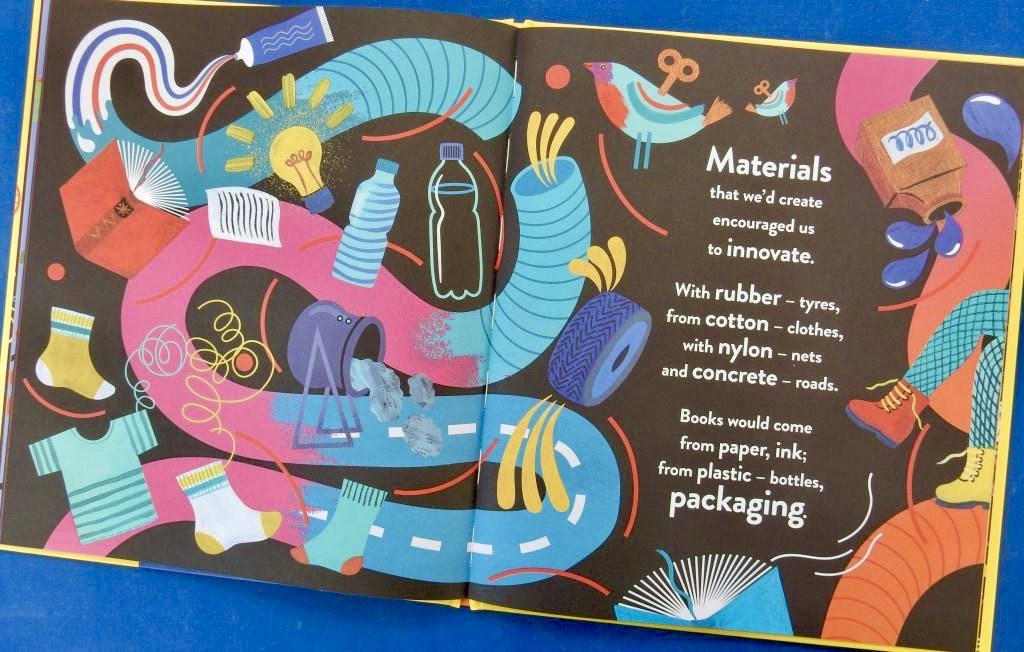
‘Fire we learnt, was elemental – / heating working, smelting metal.’ we read; while modern materials – rubber, concrete, nylon and plastic have changed our lives, not always for the better. 

Finally, readers are reminded of the importance of recycling and reusing in James’ text as well as through Margaux Carpentier’s arresting visuals. Don’t forget to read the concluding four-letter acrostic.
Rich in STEAM classroom potential, this is a picture book to inspire young inventors of the future.

Phyllis & Grace

Phyllis & Grace
Nigel Gray and Bethan Welby
Scallywag Press

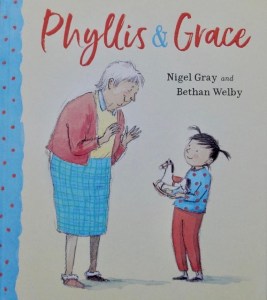
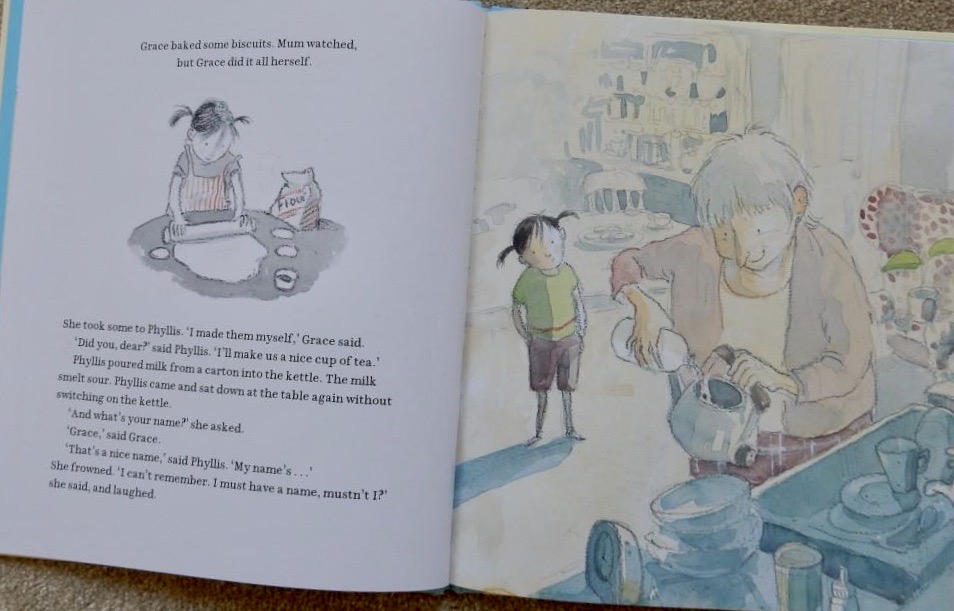
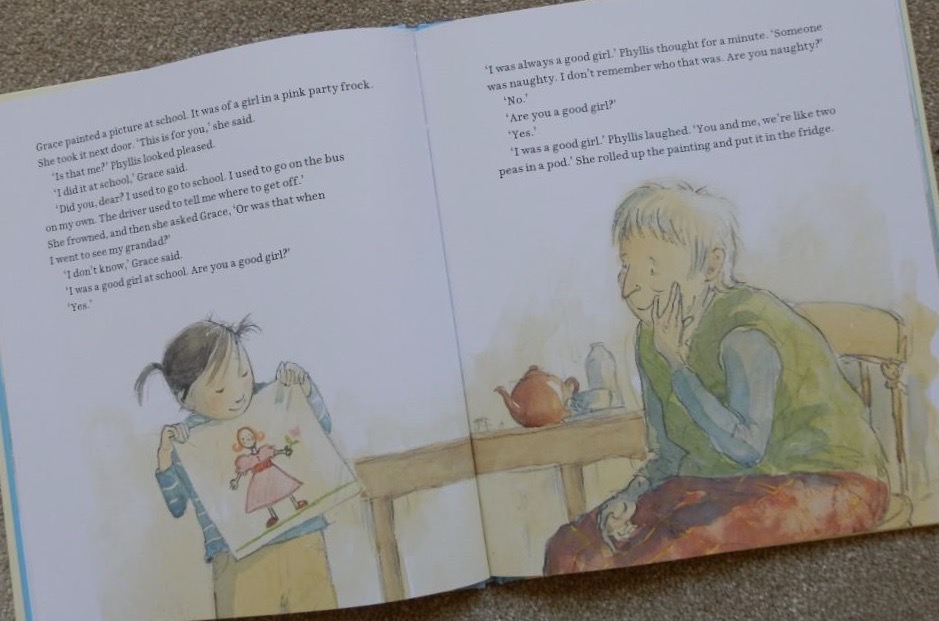
In this moving story, a little girl Grace pays regular visits to her next door neighbour, an elderly woman who lives by herself. Whenever she visits, Grace takes Phyllis something: a slice of cake, a bowl of stew, biscuits she’s baked herself,

jelly and a drawing she’s done at school.

It’s obvious that Phyllis enjoys Grace’s visits but as she shares with her, stories about her life, it’s evident that her memory is fading – names are forgotten, things misplaced, and events confused. Nonetheless despite the huge difference in age and Phyllis’s increasing disorientation, Grace forms a strong bond with her neighbour and eventually goes regularly to visit her in an old people’s home and even meets her son who takes Grace somewhere very special.

Basing the story on the experience of his own granddaughter and her neighbour, author Nigel Gray’s story is told with great sensitivity and equally sensitively illustrated in Bethan Welby’s gentle watercolour scenes. Together words and pictures beautifully document the progression of dementia and how it might appear, from a young child’s viewpoint. A book for adults and children to share and discuss as gently as it’s presented by its creators.

One World: 24 Hours on Planet Earth

One World: 24 Hours on Planet Earth
Nicola Davies, illustrated by Jenni Desmond
Walker Books

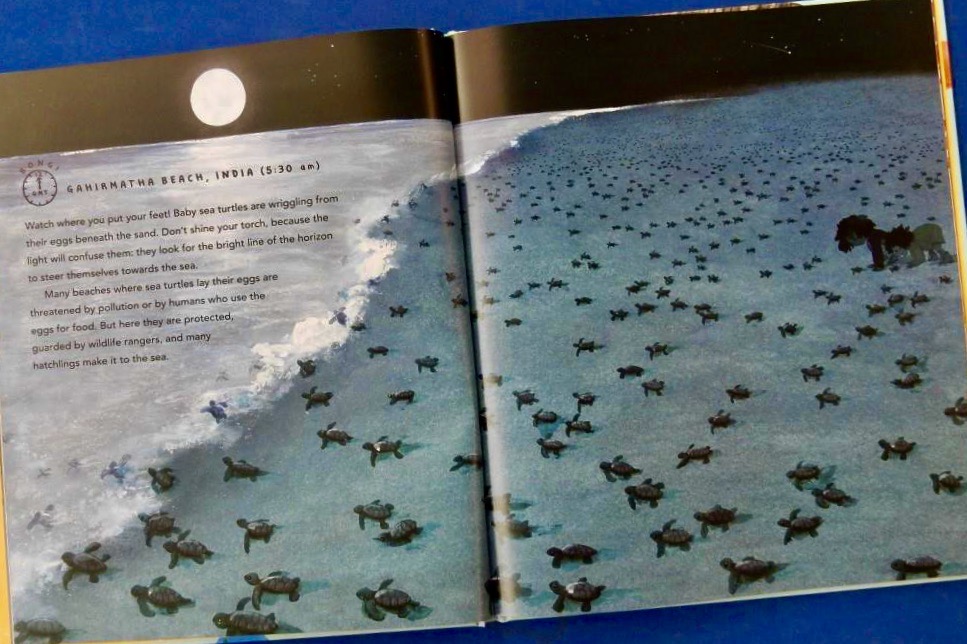
With the clock striking midnight, a little girl and her even littler sister leave their bedroom and take a round the world trip visiting animals large and small. 

They see elephants and lions in Zambia, baby turtles on Gahirmatha Beach in Odisha, India, 

gibbons in a Chinese nature reserve, sharks in the warm waters around the Philippines, kangaroos in one of Australia’s national parks, emperor penguins on Antarctica’s Ross Island and encounter a humpback whale near a Hawaiian island. At the same time California’s Pinnacles National Park is a-buzz with bees and hummingbirds, 

owl monkeys wake up in a forest of Ecuador’s Yasuni National Park, jaguars hunt their prey in Pantanal Brazil where it’s 8pm and finally, in Southern Georgia an albatross sits huddled on her nest. 

The last stroke of midnight is the signal for the sisters to traverse land and sea while beneath them are numerous warning signs of global warming. As the first hour of Earth Day, 22nd April begins in London it’s time to reflect upon the amazing wonders the girls have seen and contemplate the multitudes of others they haven’t, in preparation to issue a rallying cry to the world; it’s time to make a difference before it’s too late. We can all help to halt climate change but the clock is ticking …

As well as celebrating our awesome planet, author Nicola and artist Jenni show the way actions of we humans are adversely affecting different ecosystems worldwide. 

Powerful words and stunning illustrations make this a must have book for families and primary school classrooms: Celebrate Earth Day 2022 by sharing it.

I’m Not Upside Down, I’m Downside Up / All About Dyspraxia

Here are two recent neurodiversity titles from Jessica Kingsley Publishers – thanks to the publisher for sending them for review.

I’m Not Upside Down, I’m Downside Up
Harry Thompson and Danielle Jata-Hall, illustrated by Mollie Sherwin

In this slim but hugely informative book we meet Ariana; PDA (Pathological Demand Avoidance) is what I am she says. This is a form of autism and the girl narrator gives readers an insight into her mind explaining why the feeling she has that she must be in control all the time can look as though she’s just badly behaved. 

School is challenging as she feels it takes away her freedom to be her true self. Assuredly Ariana’s behaviour is often unpredictable but she’s also creative, witty and clever: ‘I want to tackle the big questions of life …what happened before the big bang’ is indicative of her preference for big talk as opposed to small talk – the everyday natter other people often use.
I wish I’d been able to read this when several years ago I had a little boy in my nursery class. who had a PDA diagnosis and like Ariana, his behaviour was unpredictable. I’ll never forget one story time he took himself off into the cloakroom and there he remained singing Rod Stewart songs until it was time to go home.

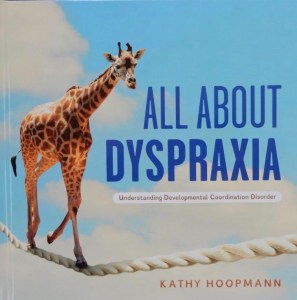
All About Dyspraxia
Kathy Hoopmann


As with her All Cats Are on the Autism Spectrum, Kathy Hoopmann uses superb colour photos
of animals paired with a direct text (plus occasional thinks and speech bubbles) to show children how dyspraxia isn’t all about being clumsy. Along with other neurodiverse people, those with dyspraxia have brains that are wired differently from others.
This means we learn, that a child with dyspraxia might become adept at avoiding activities if they fear they might fall but with encouragement and time, with the activity or instructions broken down and lots of practice, they often manage a lot better. It’s good to allow plenty of time to learn a task or grasp new ideas,

and to celebrate achievements: reading for example is tiring and the text may well become blurred.
Did you know that movement often facilitates listening for a dyspraxia learner and for those who find writing especially challenging, a keyboard can make life much easier.
Rather than making a child with dyspraxia anxious by saying that they are lazy, not trying hard, not listening or whatever, it’s important for adults – parents, teachers or other educators – to appreciate how hard they work, how clever they really are, to celebrate their creativity, their unusual ways of solving problems, their determination and successes.
A book to have in school collections, both to show educators and classmates ways to be understanding and supportive, and to lend to parents with a child recently diagnosed with dyspraxia.

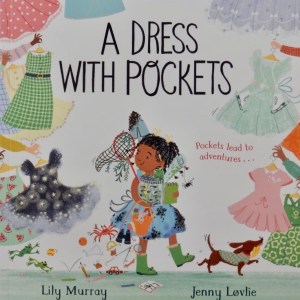
A Dress With Pockets

A Dress With Pockets
Lily Murray and Jenny Lovlie
Macmillan Children’s Books

Oh wow! Jenny Lovlie’s illustrations for this story are simply out of this world – every one of them is brimming with exquisite detail. Attention to detail is evident too in Lily Murray’s rhyming narrative; with its playful language it’s a brilliant read aloud.

Now without further ado let’s head over to the Fabulous Fashion Store where, on young Lucy’s birthday, she’s taken by her Aunt Augusta to choose a new dress. The shopkeeper brings out all manner of dresses: fancy ones, frilly ones, stripy ones, silly ones, sun dresses, fun dresses, blue dresses, green dresses and a host of others.
However, be they witchy, swirly-twirly-whirly, wispy-gauzy-floaty, or even twinkly, they don’t impress Lucy.

What she has in mind is something much more practical; something with places to accommodate the creepy crawlies, ‘fossils and flints and butterscotch mints,’ … with room ‘for skimming stones and mysterious bones’ and any other curious things that might take the fancy of this inquisitive child.

Can the shopkeeper come up with the dress of her dreams? He certainly has all the sales patter. Let’s just say that Aunt Agatha does make a purchase as we discover in the final reveal.

Gently whimsical and humorous, and underscored with a subtle feminist message, this is a joyous ‘read it again’ book and one that if shared with more than one child at a time, must be taken sufficiently slowly to allow for enjoying the wealth of detail and ongoing canine capers shown in every scene.

The Fairy Garden

The Fairy Garden
Georgia Buckthorn and Isabella Mazzanti
Ivy Kids

Mimi loves her garden. Every morning she tends it with great care, removing all the weeds and spraying the plants to keep bugs away, making it as near perfect as possible in the hope that a fairy will pay a visit.
Despite all her efforts, there is no sign of any fairies, so around her perfect garden she places little fairy houses: perhaps these homes might attract the visitors she so longs for. However, again Mimi is disappointed, even when she adds a welcome sign.

Is she doing something wrong?

Astute listeners to this cautionary tale will likely, by now have realised that she is. For that night as a tearful Mimi looks out at her garden she sees that she has visitors. Some fairies have finally come, but what they have to tell her surprises the little girl.

Her well intentioned perfection has led to the destruction not only of the garden’s wildlife, but the kind of environment that fairies would inhabit: a fairy-friendly garden is wild.

This environmental fable is gorgeously illustrated by Isabella Mazzanti whose fairytale landscapes and the richly detailed, verdant flora and latterly the insect life, are a delight.

Look closely too at the expressions on the faces of the three fairies as they gently chastise Mimi. How well the artist captures the ethereal nature of those visitors and the total absorption of the little girl at work in her garden. (The final two spreads detail how to grow a fairy-friendly garden and how to make a fairy house.)

An engaging way of alerting youngsters to the importance of rewilding, done with a gentle touch by author Georgia Buckthorn and artist Isabella Mazzanti, and it’s printed on 100%recycled paper.

Big Hedgehog and Little Hedgehog Take an Evening Stroll

Big Hedgehog and Little Hedgehog Take an Evening Stroll
Britta Teckentrup
Prestel

Big Hedgehog and Little Hedgehog are out for an evening stroll and as the sun sinks on their return journey, Little Hedgehog asks that they can pause and wait for the sun to set, which they do. Once it’s completely disappeared on they go, but after moving a little way further Little Hedgehog again wants to stop, this time for the moon to rise. Big Hedgehog agrees, they pause

and then with Big Hedgehog insisting it’s now late, they continue homewards.

Before long, Little Hedgehog wants to make another stop – to inhale the scent coming from the wildflowers and they stand, so doing for a long time. These stops continue, next to visit an owl family, then to look for the moon as it emerges from behind some clouds, followed by a pond pause to bid goodnight to the frogs and fish. By this time it’s decidedly chilly but that doesn’t stop Little Hedgehog from following a tiny firefly

until it reaches a host of others that together perform a beautiful dance. Surely after such a long stop, Little Hedgehog must be completely ready for some sleep: almost but first there’s one more request …

This is such a gorgeous story about the joys of slowing down to appreciate, and be awed by, the natural world with all its wonders from the immense to the minute. Brita Teckentrup has a wonderful way of capturing the natural world in her richly hued and textured collage scenes that are certain to make big humans sharing this book with little humans, also slow right down to imbibe the beauty of each one of them.

This Girl Can Do Anything / Sometimes: A Book of Feelings

This Girl Can Do Anything
Stephanie Stansbie and Hazel Quintanilla
Little Tiger

Meet young Ruby, strong-willed, knowing exactly what she wants and determined to do things her way.: in short, she’s unstoppable. Yet despite her toughness and inner-strength, there are times when she allows just a little bit of softness to seep through.

Of course not everything goes right straightaway, but with encouragement from her mum, Ruby is always prepared to have another go.

Her energy is boundless yet come the end of the day, despite what our protagonist says about not feeling tired, at bedtime, Ruby is ready for something special from her mum and dad.
For sure Ruby is a force to be reckoned with, unafraid to speak out about what she wants to do; however she does have a soft-centre that occasionally, she lets us enjoy a taste of too.
I love the way, illustrator Hazel Quintanilla uses a different colour background for each spread.
From the same author is:

Sometimes: A Book of Feelings
Stephanie Stansbie and Elisa Paganelli
Little Tiger

Stephanie Stansbie adopts a rhyming narrative to explore emotions, as we follow a sister and brother through a single day beside the seaside. It’s a day full of ups and downs: occasionally the dominant feeling is one of darkness and fear, but that can be dispelled by a brave leap; likewise disappointment and boredom can be overcome, perhaps by doing something active – dancing.

After presenting other feelings of the less desirable kind – anger, sadness 

and loneliness too, the mood turns much more upbeat as we see the boy and girl exhibiting kindness and forgiveness which dispel those bad feelings, allowing them to be replaced by a sense of peace, contentment and calm. With equanimity prevailing, brother and sister are ready to return to the family home, safe in the knowledge that once there, somebody will be waiting to show them the most important feeling of all: love.

With Elisa Paganelli’s expressive scenes of the children’s highs and lows to complement Stephanie’s words, this book offers a helpful starting point for exploring emotions with young children either at home or in a foundation stage/KS1 classroom.

Through the Forest

Through the Forest
Yijing Li
Lantana Publishing

‘I was lost in a deep, dark forest. I couldn’t find my way back so I keep on walking.
I was searching for something but did not know what.’; so begins this first person narrative by a small boy. He meets a ghostly giant figure who introduces itself as Emptiness and the boy suggests they might continue their search together, a suggestion to which the empathetic being responds positively.

Continuing on side by side they come across objects in the snow the first being a pinwheel. It puzzles Emptiness but sparks memories for the boy who recounts them to his companion. Then because he’s unable to fit it into his pocket, Emptiness takes the pinwheel for safekeeping.

The next object is a kite and again it triggers memories in the boy and his companion takes it to carry.
The vase they find calls forth sadness in the child, “This is a piece of Dad’s special vase. It was smashed the morning Mama left.” But in a clearing their discoveries – a book, a harmonica, a first drawing and a tie all evoke happy times.

Eventually the two arrive at a wildflower meadow littered with memories

but now Emptiness stops walking. Full of the memories they’ve found together, he explains that now they’re out of the forest, he’s remaining behind for the memories will always be available to guide the child as he ventures forth, should he need them. The boy looks around him and is finally able to see a path both behind and in front of him. Thus, we realise that forest has served as a metaphor for the child’s state of mind, which thanks to Emptiness, has now cleared.

Yijing Li’s digitally worked watercolour and ink scenes of the journey are contemplative and reassuring, and there’s a misty, occasionally brooding, dream-like quality to the entire book. .

One Boy’s Choice

One Boy’s Choice
Sueli Menezes (translated by Kathryn Bishop) and Annika Siems
minedition

Set in the Amazon jungle, this is a story about a boy who goes out in a canoe to spend a day fishing with his grandad. The boy is eager to catch a really big fish to take home and show his friends. Grandad navigates the boat around the huge water-lilies while the boy peers into the water, watching and waiting for that fish. They wait and wait and wait, then move on and cast the net instead of a line. Still nothing, and while they wait Grandad tells stories about the various fish that live beneath the water-lilies.

Hours later lo and behold to the boy’s delight, there’s a water-lily fish – an Arowana – in the net. However, his delight quickly disappears when Grandad says they must release the fish – and then he shows the lad this male Arowana, has a mouth full of tiny fish and explains that for a month that’s where the little fish live safely, as well as telling him of the Arowana’s importance in eating mosquitos that can make humans ill. Grandad puts the choice in his grandson’s hands: keep the huge fish and impress his friends or let it go free so male and children can continue living safely in the river. The decision the boy makes pleases his Grandad who remarks, “I am very proud of you. Today you have become a really grown-up boy.”

Showing how our actions affect wildlife, Sueli Menezes’ thought-provoking story becomes even more so in tandem with Annika Siems’ richly hued portrayals of the beautiful Amazon forest in which it’s set.

All About Cats / Mother Goose’s Nursery Rhymes

All About Cats
Frantz Wittkamp (trans. David Henry Wilson), illustrated by Axel Scheffler
Macmillan Children’s Books

As an ailurophobe I wasn’t predisposed to like this book, but on the other hand I’m a poetry lover and Axel Scheffler’s illustrations are terrific fun so the positives have it. And David Henry Wilson’s translations from the original German work well too and rhyme well. Do I detect a touch of the Eleanor Farjeons in Cats are … Sleepy?

From the fourteen four-line poems herein we discover a fair bit about cats, their habits and their predilections. They enjoy reading, arithmetic – yes really, painting, making mischief, playing toss with a ball or perhaps a small rodent if they can get their paws on one; and when it comes to food, each one has a favourite – it’s not always fish.
Parent cats show love towards their offspring, working together to keep things sweet between mums and dads. However I definitely disapprove of certain tomcats – those that net butterflies and keep them as pets, whereas the bath routine at the end of the day gets an endorsement from this reviewer, and how wonderfully economical with water they are in Axel’s illustration at least (3 in a tub together.)
But no matter if said moggies are making music or celebrating a birthday with rhubarb juice and fishcakes, or even feeling a tad grumpy if caught in a rain shower, they make the best of the situation, as is evident in Axel’s splendidly droll scenes and tiny vignettes.

To foster a love of language in young children, cat lovers or not, share the rhymes and playful pictures with them: perhaps some of them can come up with own cat capers too.

Mother Goose’s Nursery Rhymes
Axel Scheffler
Macmillan Children’s Books

This treasury of almost sixty nursery rhymes is linked by eighteen short stories written by Alison Green, the first of which sets the scene by introducing Mother Goose herself. She lays three eggs and it’s to her goslings the rhymes were told and then eventually written down by a wise old heron. (I love that.) It’s also her’s and her goslings’ activities that are related in the stories.

You’ll find lots of your favourites here: I Had a Little Nut Tree,

Miss Muffet, Jack and Jill, The Grand Old Duke of York, Polly (who puts the kettle on), Old King Cole, Humpty Dumpty, Sing a Song of Sixpence, Hey Diddle Diddle

and lastly some bedtime ones including Twinkle, Twinkle Little Star and Wee Willie Winkie, still dashing round town in that nightgown.

Every rhyme and story is humorously illustrated in such a way by Axel Scheffler that the wit behind the words is evident. A super present to give a new baby and a book to acquaint preschool children with the richness of nursery rhyme language that sadly, many of them are unfamiliar with.

Thanks to Macmillan Children’s Books for sending both titles for review.

The Young Designers

The Young Designers
Paul Smith and Sam Usher
Pavilion Children’s Books

Fashion designer Paul Smith and Sam Usher present a second story about Mr Brown (famous fashion designer) and his assistant, Moose.

Could the two be taking on a big challenge when Rainbow Class come to visit his studio for their school trip. Mr Brown’s confident assertion, “I’m sure they’ll be no trouble at all,” might prove erroneous when the lively crowd pours in, especially as almost immediately his phone rings and he disappears leaving Moose in charge.

It’s not long before things start going wrong and Moose decides the best thing to do is to take the visitors out on an observational walk to give them some inspiration for the T-shirt designs they are to do – once they’ve sorted out their correct sizes. A quick foray into the art gallery proves anything but a good idea, so maybe the park could furnish some ideas of a nature-related kind.

The mention of biscuits and drinks for sensible behaviour seem to do the trick and after an eventful park visit

Rainbow Class actually settle down to their designs. Moose takes advantage of this period of calm to investigate what’s happened to the article of clothing that had been given a wash after an earlier elephant accident. To his horror it’s undergone some modifications: what on earth will Mr Brown say on his return?

Full of fun and an abundance of exuberant young animals brilliantly portrayed in Sam Usher’s watercolour scenes, this hilarious story celebrates creativity and demonstrates how it’s possible to transform mistakes into exciting works of art.

The Boy with Flowers in his Hair

The Boy with Flowers in his Hair
Jarvis
Walker Books

Whimsical, wonderful and full of heart is this latest offering from Jarvis. The narrator is a little boy who is best friends with David the boy with flowers adorning his hair. Both boys are members of a happy class with a caring teacher, Mrs Jones, and nobody show the least concern about David’s unusual hairdo, not even Mrs Jones who gets hay fever; and not even when it attracts bees or a family of birds settles there for a while. 

‘But one day something happened.’ We know not what except that a petal comes off into his friend’s hand as he waters David’s hair. David becomes quiet and uninterested in playing.

The following morning David comes to school wearing for the first time ever, a hat and he’s uncharacteristically quiet. Having removed outdoor garments as Mrs Jones’ instructs, David reveals a ‘twiggy, spiky and brittle’ head sans the remaining petals that fall once his hat is taken off.

Initially David’s classmates are somewhat unnerved and steer clear of the boy, not so his best pal however who remains close not concerned by occasional scratches. He has an idea – a very creative one

– and before long everyone else in the class is involved in project restore David’s colour.

Little by little David regains his joie de vivre and eventually his original flowers too, although his best friend keeps his box of bits and pieces just in case they’re needed ‘Because he’s my best friend, and I am his.’

In Jarvis’s painterly illustrations he shows so beautifully the changing emotions of David and his best friend as well as other members of the class. With themes of acceptance and the power of friendship, his story is a touching demonstration of kindness and supportiveness just when it’s needed. Full of messages adults will want to pass on to youngsters, this book is perfect for sharing and discussing with foundation stage classes, and with young children at home too.

The Ogress and the Orphans

The Ogress and the Orphans
Kelly Barnhill
Piccadilly Press

Hugely moving and sublimely written with carefully considered pacing, this is a book for everyone at all times, but especially these troubled times through which we’re living.

It’s set in Stone-in-the-Glen, a once idyllic town that after a fire destroyed its library, has undergone many changes for the worse: the school also burned down, other fires led to the loss of the town’s trees. Rather than the close community it was, rumours spread easily as people are now focussed on their own problems, suspicious of one another and reluctant to do anything for the benefit of neighbours. There’s a flashy self-serving mayor who manipulates any attempts at discussion leaving those of his constituents who go to him for help unable to recall what their problems are.

In the town too is the Orphan House: home to a group of fifteen children cared for by a loving elderly Matron and her husband Myron. Now no longer supported by the townsfolk, they do their best to stretch their meagre resources. In the orphanage though is a wonderful resource of a different kind: a fantastic reading room.

Living on the town’s edge is an Ogress. She’s a gentle loving soul who delights in leaving vegetables and wonderful goodies made from the produce grown in her garden for the residents as they sleep. However being different, she’s become the townsfolk’s scapegoat, so when one of the orphans, Cass, decides to run away, the Ogress is held responsible for the girl’s disappearance. In fact it’s she who rescues Cass tending her and bringing her safely back to the orphanage, but her return is seen and misinterpreted by a man as confirmation of the wickedness of the Ogress.

When the grownups won’t listen to Cass and the other children, they must find another way to help their generous neighbour and repair their broken community. This means getting the townsfolk to ask key questions such as ‘What and who is my neighbour? Is that possible? Perhaps yes, with the help of some crows, the ogress, one or two empathetic townsfolk and a stone. Happily, in the end, it’s knowledge, story and books, community, kindness and sharing that wins out. So it is in Stone-in-the-Glen and so we hope, can it be again in our own fractured world.

It’s impossible in a short review to do full justice to this powerful story: the author leaves space for readers to form their own opinions on some of the book’s philosophical questions and I suspect we’ll all bring different things to this allegorical tale.

Piano Fingers

Piano Fingers
Caroline Magerl
Walker Books

Adorably quirky and absolutely magical is this latest Caroline Magerl picture book.

Little Bea comes from a musical family. Her self-confident and a trifle bossy big sister, Isla, creates beautiful music on her violin (her honey fog machine) while Bea, dissatisfied with the bink, bink, bink sound she makes with her triangle, casts it aside and goes to search for something with more potential on which to express her latent talent.

What she discovers is a piano, but despite being ‘a baby mountain’ it doesn’t play the sweet music that Bea yearns for. “The world is not ready for my genius” she declares. However, up steps the encouraging Maestro Gus with his, “There are whole symphonies up those sleeves. All you have to do is …pick a key. And with a plink there comes ‘the sound of an icy tear falling from a star.”

The music swirls forth as ‘A song of winter trees spinning barley sugar clouds for springtime.’ – what a wonderfully sparkling debut. But while Maestro Gus may have helped Bea discover her talent, she subsequently sends him packing outside into the rain in the ‘moth foggy dark’.

Eventually, back indoors, the three music makers, Isla, Bea and Maestro Gus come together before the Maestro retires for the night.

Their music making will assuredly enchant young listeners to this lyrical story from a hugely talented picture book creator, whose words embody musicality and when read aloud, are as mellifluous as the sounds one imagines emanating from the sisters’ instruments.

A subtle exploration of finding one’s own talent that should act as an encouragement to children to persevere, work hard and follow their passions.

Every Bunny is a Yoga Bunny / Sweet Dreams, Bruno

Every Bunny is a Yoga Bunny
Emily Ann Davison and Deborah Allwright
Nosy Crow

Little bunny Yo-Yo finds it impossible to keep still and going to bed at night, she just can’t sleep. One day Grandpa has a bright idea: he’s going to teach them some yoga he tells the little ones. Roxy and Flo soon manage the bridge and mountain poses; not so Yo-Yo who waggles, wiggles and jiggles. And when it comes to trying tree, two little bunnies can do the breathing and the balancing whereas their sibling is distracted by a passing butterfly which she just has to follow.

Before long she’s lost in a shadowy forest and starts to panic. But then having flopped to the floor she begins to recall some of the things her Grandpa has taught her. First comes the slow breathing and as she calms down she recalls the yoga shapes she’s been shown

and with her thoughts no longer whizzing, she’s able to imagine the route that will take her all the way home. Once there she finds the others still doing yoga. Can she join them and this time, stay calm and still?

Following debut author Emily Ann Davison’s sweet story, are instructions and demonstrations by Yo-Yo of six yoga poses, to help young children breathe, stretch and feel calm. Deborah Allwright’s amusing illustrations made the yoga teacher part of me giggle as I recalled some of the Yo-Yos I’ve encountered in classes over the years.

Published in collaboration with the National Trust, there’s a QR code inside the front cover of the book which if scanned with a mobile provides a free reading of the book.

Sweet Dreams, Bruno
Knister and Eve Tharlet
minedition

Despite it being that time of year, young marmot, Bruno is reluctant to settle down for a long winter sleep. Various other of the animals offer alternatives: goat suggests spending winter climbing on
the slippery rocks; jackdaw says he can share her nest high up in a tree; he could brave the moggies in the farmhouse and move in with mouse, join hare and romp in the snow or even accompany the swallows and winter in Africa. However none of these are feasible for the little creature and with a yawn and a sigh, Bruno decides, “I guess everyone spends winter in their own way. For a marmot hibernation’s the best.” Bidding a temporary farewell to his friends, he settles down in his cosy den and falls fast asleep.

His dreams provide Bruno with the action and exciting adventures he eschewed in real life as he leaps from mountain top to mountain top – ‘Hooray!’, floats up to join jackdaw in her nest – ‘Amazing!’ and even accompanies mouse on a cat hunt – ‘Woo-hoo!’

There’s further fun too, lasting until voices break into his dreamworld as his friends call him to action for a long summer of togetherness.

Eve Tharlet’s seasonal scenes are at once naturalistic and whimsical adding gentle humour to Knister’s straightforward telling. A story for bedtime sharing or KS1 story sessions.

What Makes a Lemur Listen?

What Makes a Lemur Listen?
Samuel Langley-Swain and Helen Panayi
Owlet Press

This story of Maki, a little ring-tailed lemur living in the Madagascan rainforest, was inspired by the author’s experience of being the parent of a neurodiverse child who, like the protagonist in the book, struggles to listen, especially to instructions.

Fed up with his Mama’s seemingly endless instructions,

Maki ,who always thinks he knows better, decides to go it alone on a ‘big adventure’. No more rules and no having to listen to anyone are his expectations as he moves joyfully across the forest floor. His joy doesn’t last for come nightfall a realisation dawns: Maki is far from home and completely lost. Now, having refused to eat his breakfast, his tummy is rumbly and as the chilly wind blows through the branches, he misses his siblings’ snuggly warmth.

After a night spent alone and scared he wakes and hears a voice responding to his comment. A voice Maki puts down to his imagination; but then he hears further remarks as he looks for food and continues on his way.

Come nightfall once more, Maki stops again and curls up (on a branch so he thinks) but the voice continues and mentions something very long and scaly.

Just in the nick of time, Maki responds to the “Run!’ command he hears from a small rainbow coloured creature. Then from a safe hiding place he realises that the voice he’s been hearing all the while has been that of a savvy chameleon – Sofina – as she introduces herself. Surprised that she knows all about keeping safe and finding food in the forest, Maki is even more surprised at his new friend’s next remark, “I listen to my Mama!” Perhaps now, the little lemur is ready to do likewise.

Young listeners will enjoy finding out how Maki eventually learns to listen, while parents and educators could well learn alternative non-demanding ways to communicate with children be they or be they not, neurodiverse. Debut illustrator, Helen Panayi’s scenes of the lemur family and other creatures Maki encounter are great fun. She captures the young lemur’s changing feelings really well and adds gentle humour to the story: I love the meditating lemurs on the first page.

Every Cloud / You’re Not the Boss of Me

Every Cloud
Ros Roberts
Little Tiger

Moving from primary to secondary school is a big change for everyone, but nothing is going right for eleven year old Amy. She’s already had to move house and that means she’s no longer in the catchment area of the secondary school her best friends will be going to. Moreover with Amy’s supposed best friend Cassie being unaccountably mean and Pop’s dementia getting worse, so much so that she and her Mum are to spend the holidays on the other side of town with Pops and Gran. Things can’t really get any worse.

However, to Amy’s surprise, living across the road from her grandparents is Jay a quiet, kind boy from her primary school who is going to her designated secondary school. Pops confuses him with his erstwhile best friend Spinney whom he hasn’t seen for many years and the two of them start playing shove ha’penny together.

As a friendship develops between Jay and Amy, she discovers that friendship can mean much more than she originally realised: having somebody you’re comfortable talking to, someone who listens attentively, is just as vital, maybe more so, than any other quality.

During her stay with Gran and Pops, a lot of surprising things happen and towards the end of the holiday Amy has an important decision to make: one that will affect the next stage of her life. How will she respond?

Exploring the importance of family, friendship and growing up, this empathetic story will appeal particularly to those readers around the same age as Amy.

You’re Not the Boss of Me
Catherine Wilkins
Nosy Crow

Loud and proud, positive but far from perfect, Amy Miller truly is a force to be reckoned with.
When the lower school comedy show is announced, she signs up immediately; she can’t wait to start writing some sketches; but then their drama teacher puts Harry in charge. Initially Amy doesn’t understand why he blocks her writing submissions and is extremely unpleasant towards her. She thinks that he just doesn’t like her but then she sees other girls also being sidelined and realises it’s more than that. Harry is being sexist, her elder sister, Caz informs Amy. Moreover, Mrs Hague who appointed Harry her shadow director, won’t listen to anything Amy says about her treatment. Fortunately Caz provides Amy with the information she needs to show how unfair the planning and organising of the revue really is, preparing her to do battle to fight for her rights.

Meanwhile at home Amy’s determined efforts to make life for her entire family better, have the completely opposite effect; the same is true, when she does likewise for school friends.
On a more positive note, Amy begins to forge a new friendship with Lexi who becomes her musical collaborator for the show. Anil too (her erstwhile best friend) also steps up to the mark, but then declines to own his part in Amy’s plan.

By the end of this laugh out loud story, Amy has learned a fair bit about herself, not least concerning her misguided helpfulness both at home and with best pals Mai and Sadie; she also finds out more about Anil and gains an insight into Harry’s behaviour.

Showing that everyone has the right to demonstrate their passions in a way that feels right for them, Catherine Wilkins’ brilliantly observed tale of determination and drama in the face of sexism and misogyny, is a great one for older readers.