Penguin Huddle

Penguin Huddle
Ross Montgomery and Sarah Warburton
Walker Books

Meet the penguin pack, a playful lot that spend their days having fun, then at sundown they come together under the starry skies and form a huddle. Thus they keep snug and warm throughout the nights; till one night a particularly fierce gale blows up and the following morning the penguins awake to discover they’re stuck fast together. No amount of pulling and puffing, shuffling and scuffling can unfreeze the ginormous ‘penguin ice pop’.

Acting on tiny Pipsqueak’s suggestion they call on their friends to help; but neither the heaving and hugging of the snow hares, nor the prising and puffing of the walruses made the slightest difference. Can Pipsqueak’s clever idea diffuse the panic that now besets those huddling, muddling penguins?
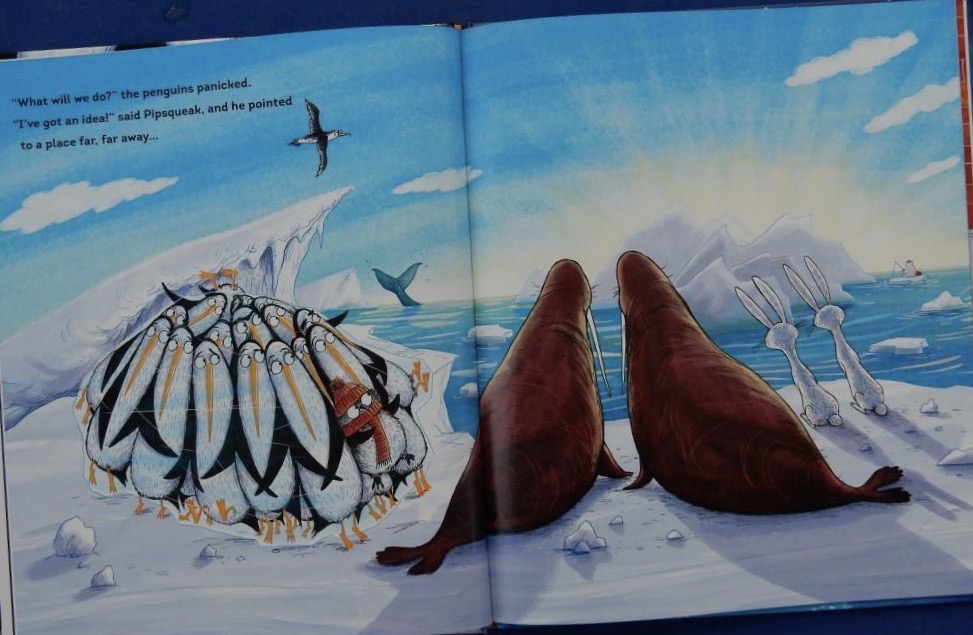

By means of various modes of transport the penguins journey over land and sea until they eventually reach a shining city, the streets of which are full of animals from all parts of the world.
Several of the creatures are ready to try defrosting the huddle but they meet with no success. Just when the other penguins are on the point of abandoning their search, Pipsqueak has another idea. Can they reach the establishment of Doctopus before the surgery closes? Happily their new friends are there to assist.
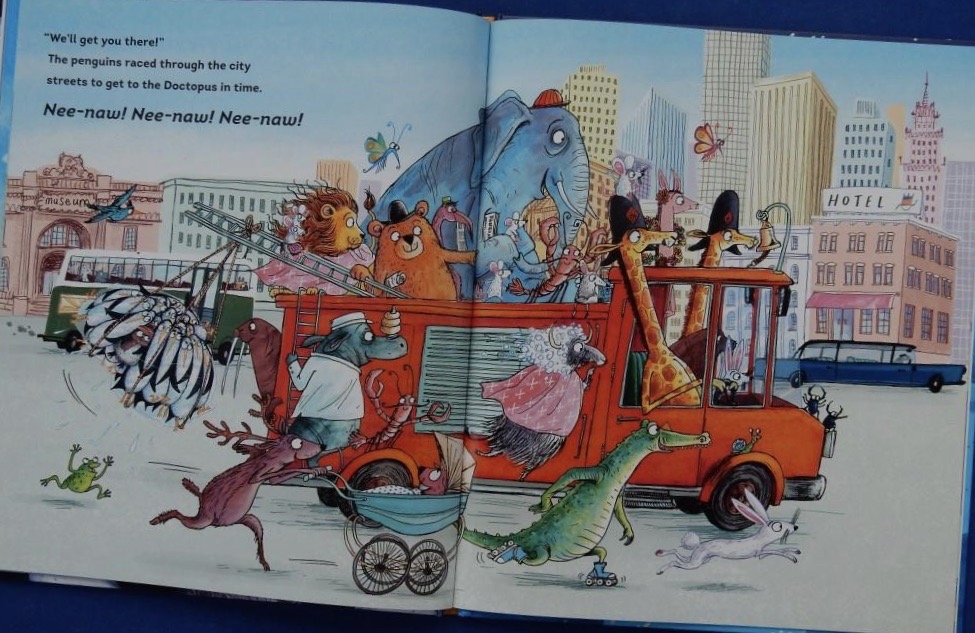
What happens when they reach their destination though …

This is a cracking tale of friendship, community and helping those in trouble that will surely melt the hearts of young audiences and the readers aloud who share it with them, be they huddled, cuddled or snuggled. Sarah’s portrayal of all those penguins is absolutely wonderful, especially Pipsqueak.
Ella and the Useless Day

Ella and the Useless Day
Meg McKinlay and Karen Blair
Walker Books

Having had a good look around their house, Dad and Ella decide it’s time for a serious clear out and so they get to work right away. Together, they search, scramble, sort, poke, pick and pile all the useless stuff they find into the trailer to take to the rubbish tip, where useless things go. However, before they’ve even set off, their neighbour delightedly relieves them of the tricycle, calling it “Absolutely perfect!” and so it goes on until by the time they reach the dump, their trailer is almost empty,

even the holey blanket has been given a new lease of life. Then Ella realises that the final item is one they can make use of back in her own bedroom.

Meg McKinlay tells a subtle, gently humorous tale of recycling and reusing, creativity and community, that is highly pertinent in our throwaway society, where we all ought to be giving serious thought to living more sustainably. One wonders what on earth can be done with the “fashion disaster” of a suit,

the leaky goldfish bowl, the broken crockery and other things but young listeners/readers could have fun thinking of possibilities before turning to the final wordless spread where in a series of vignettes, Karen Blair shows just what their new owners did with them. Throughout the story, her watercolour and pencil illustrations provide lots of delightful details and underscore the wry humour of the words.

One & Everything

One & Everything
Sam Winston
Walker Studio

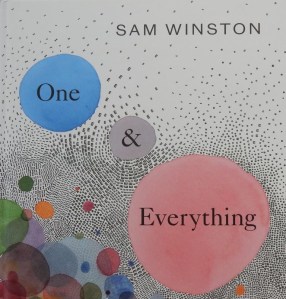
Here’s something strange, a story about endangered languages. Its main characters are circles of various colours and sizes, every one contains symbols, characters and script from a living or extinct language, each representing a story. These include stories about ‘beautiful sunsets’, the bottom of the sea whereas some are ‘simply full of dogs.’

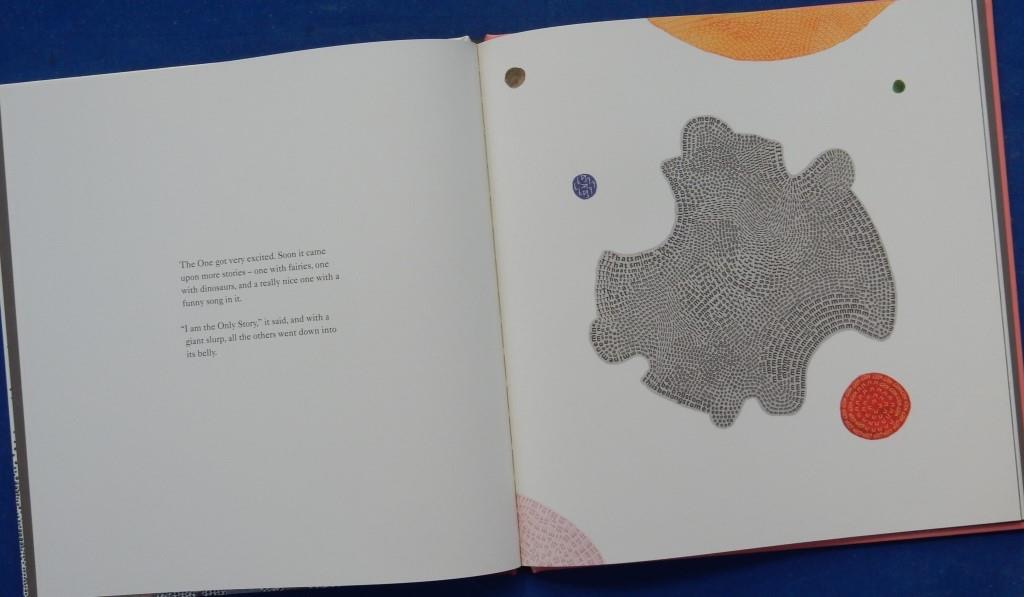
All seem to co-exist peaceably until one story decides to become the most important story in the world. It calls itself One, the Only story and goes around the world’s story-verse consuming each and every other story, and thus filling its belly.

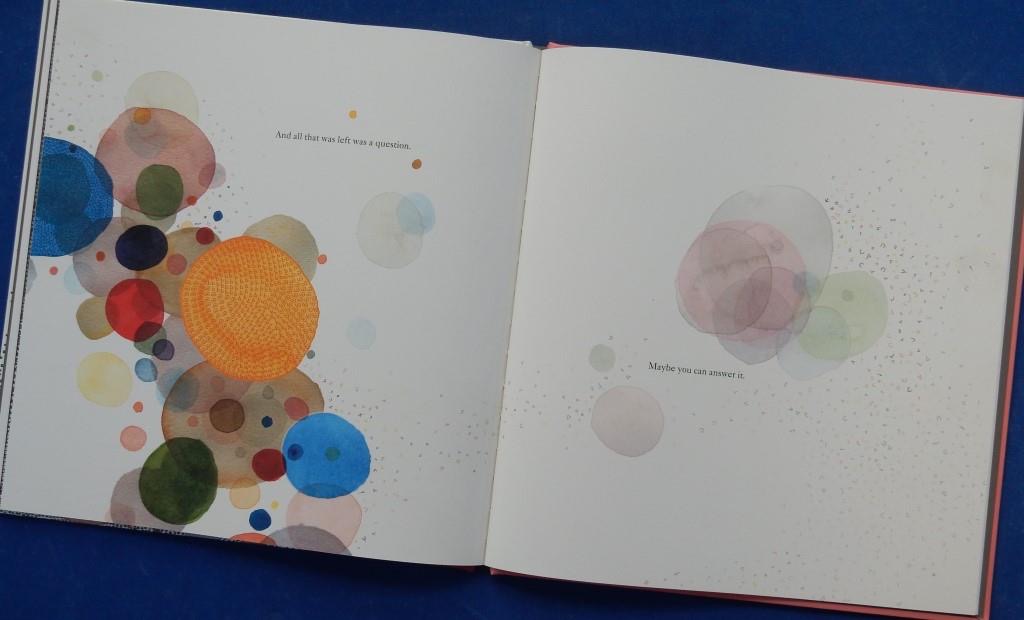
Therein however, something is happening: some letters get together to make words and eventually a voice speaks thus, “… you’re not the One story then. You’re Every Story.” This causes the One to come to an understanding and it then explodes into a myriad of stories. What’s left is a question. “Maybe you can answer it, ‘ asks the author …

The telling thus far has been minimal but what follows is the author’s note. This describes in some detail first the importance of preserving endangered languages and then introduces us to the linguistic characters that are shown in the illustrations. I’m not sure who the intended audience for this picture book is, but this reviewer certainly found it interesting.

A Dinosaur A Day

A Dinosaur A Day
Miranda Smith, illustrated by Jenny Wren, Juan Calle, Xuan Le, Max Rambaldi and Olga Baumert
Red Shed

Imagine being able to encounter a different dinosaur, or other prehistoric animal, every day for a whole year. That’s what you can do if you plunge into this prehistoric extravaganza. Herein, after a general introductory spread, you will meet all your favourites such as the fearsome Tyrannosaurus, the club-tailed Ankylosaurus and the plant-eating Triceratops and Diplodocus. You’ll also encounter a great many unfamiliar creatures, some of which have only recently been discovered: I have to admit the majority were new names to me.

One such is Aquilops, one of the beaked dinosaurs. It was a herbivore about the size of a cat with a skull smaller than the hand of a human. Another small herbivore was the Nqwebasaurus (found in what is now Southern Africa) Amazingly so we read, ‘fossils have been found with gastroliths in the stomach – stones it swallowed to help grind up tough plant food,’

As well as dividing the contents by months, the author also uses dinosaur groups – examples are: ‘some of the smallest’, ‘duck-billed dinosaurs’, ‘horn-faced dinosaurs’ and ‘largest of them all’. Surprising to me was that all those included here were herbivorous. One such Antarctosaurus never chewed its food, rather it swallowed plants whole.

Key facts for each dinosaur featured include the period it lived, the family it belonged to, diet, length, weight anywhere remains have been found; and there is also a brief paragraph giving key information ; and helpfully, the backmatter includes a pronunciation guide.

If you have a dinosaur fanatic or a budding palaeontologist in your family then you should definitely get a copy of this book. It’s also one to add to school collections: I envisage it being in much demand especially with KS2 readers.
How To Make A Picture Book

How To Make A Picture Book
Elys Dolan
Walker Books

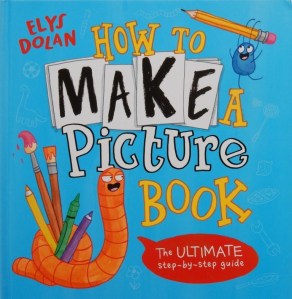
If you’ve ever considered the possibility of making your own picture book, then look no further. Elys Dolan, aided and abetted by her annelid assistant, Bert, shows you how in this humorous, step by step guide. First make sure you have all your favourite pens, pencils, crayons, brushes etc to hand.

Of course, inspiration is key and according to our trusty tutor it’s time to visit your gallery of muses – in other words, your very special things; these can be used to generate a ‘story idea’. Then there’s the creation of credible characters, the first being the main protagonist and you need to get to know them very well.There’s lots of advice from Doc Dolan on how to do so.

Setting is another consideration – where is your story going to unfold and hugely important is what is going to happen throughout the story and how the events will be structured.

The use of building blocks is suggested – not the things young children love to play with – but sequences of words.

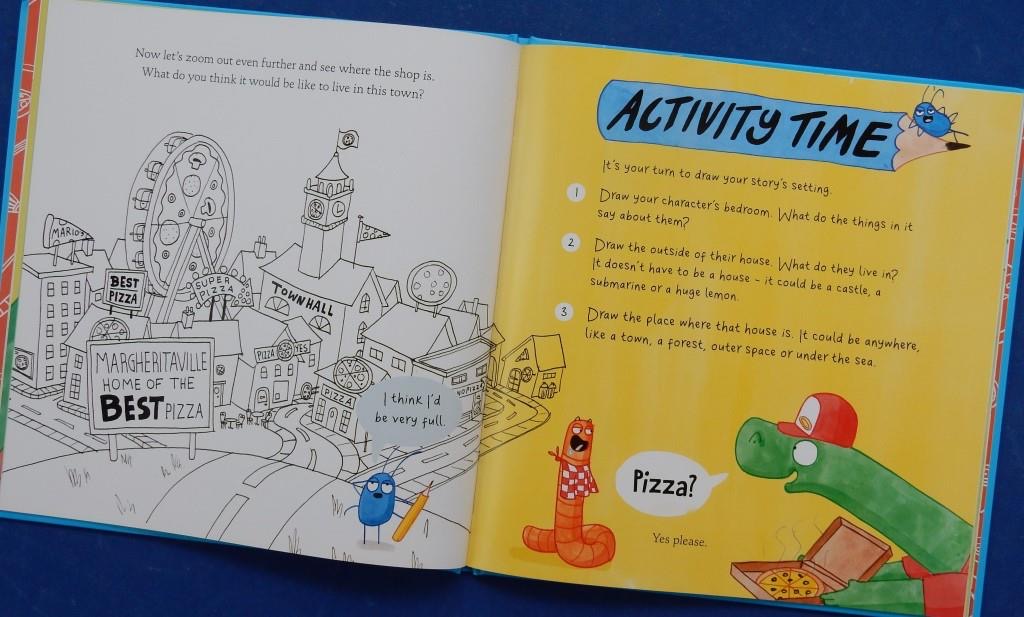
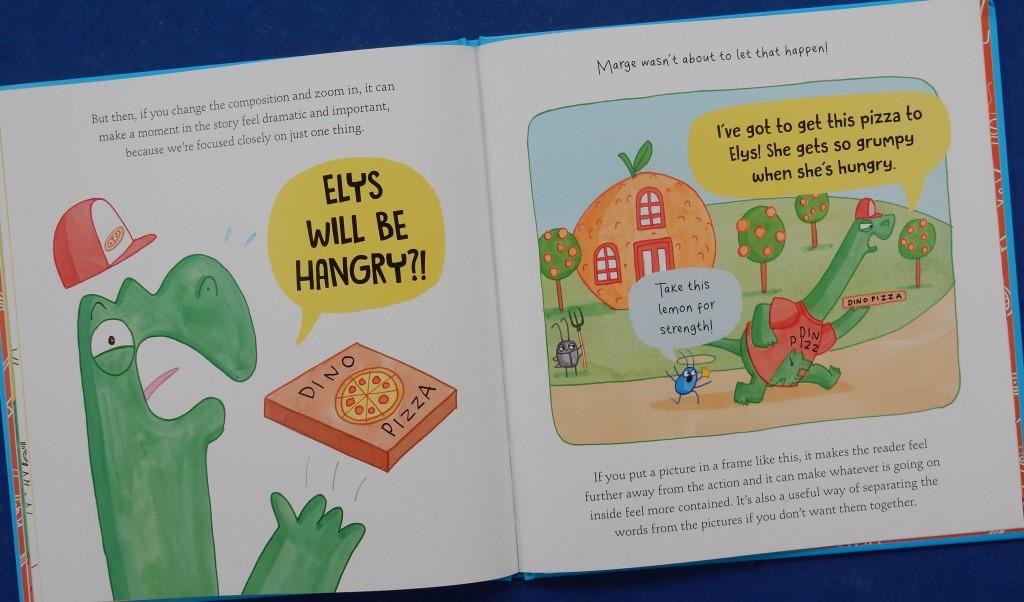
Two other vital elements in the creation of a picture book are also discussed. The placement of words and pictures on each spread means the creator needs to decide what the pictures should look like and how they and the words will use the space on each page. This allows the pace of the telling to be changed at different times: for example zooming in on a particular moment in the story heightens the dramatic impact,

whereas framing a picture creates distance between the action and the reader of the book. Moreover in the best picture books, the illustrations show things not said in the text and the text should say things not shown in the illustrations: not always easy this.

Our pro has one last tip to make the book a winner and it concerns colour: that means the author/illustrator putting themselves into the shoes or maybe that should be head, of the reader and then choosing appropriate colour(s) to generate the feeling wanted.

With a sequence of activities, tips aplenty and jokes too, Elys’ guide is highly entertaining and very informative. (Bert has even sneaked in step-by-step instructions on how to make your own blank book.) It’s a brilliant tool to use in the primary classroom or at home.

Rosie and the Friendship Angel / Everybody Feels Fear

Rosie and the Friendship Angel
Lucinda Riley & Harry Whittaker, illustrated by Jane Ray
Macmillan Children’s Books

This is the third of the Guardian Angel series written by Lucinda Riley with her son Harry Whittaker before her death in 2021. Like the previous ones it’s based on stories she would tell her childen when they were facing challenging situations that made them fearful.

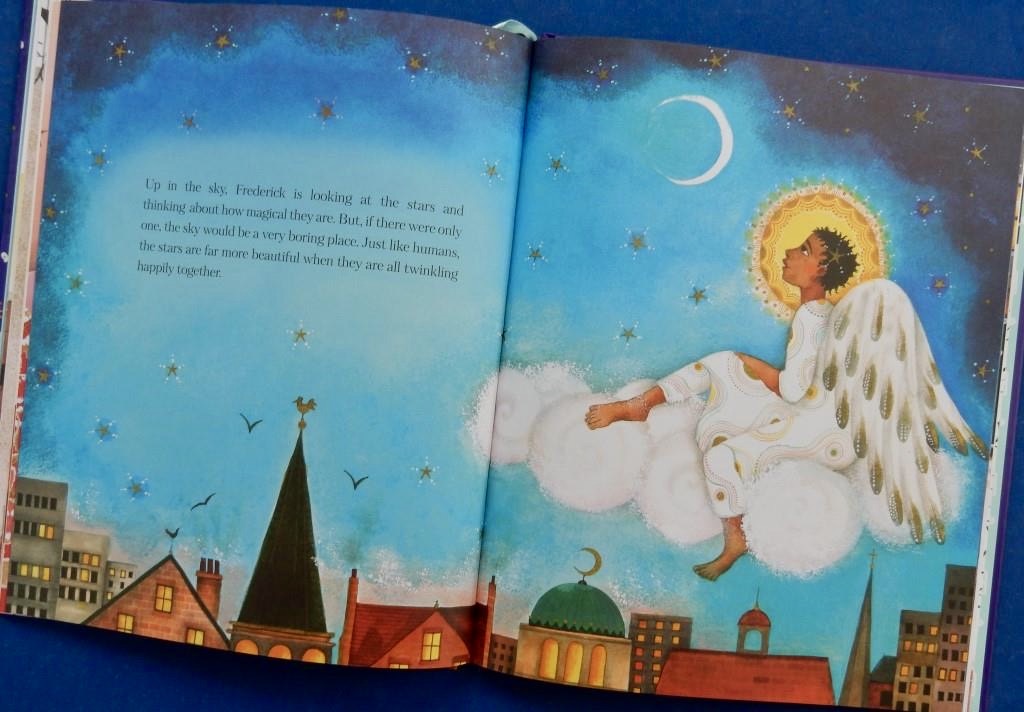
Here we meet young Rosie and her Guardian Angel Frederick. It’s Rosie’s first day at a new school and she is feeling very nervous as she ‘s greeted by her teacher Miss Marshall and reluctantly lets go of her father’s hand. Rosie is introduced to her classmates, one of whom, Jessica, has been asked to look after the newcomer. However Jessica doesn’t seem particularly friendly and come playtime Rosie is made to feel an intruder.

By the end of the day she’s feeling invisible and lonely, especially after what happens in the final task.
That night having kept her feelings to herself, Rosie lies awake in bed and she makes a wish, a wish that is heard by Angel Frederick, whose job it is to help anybody in need of a new friend.

Frederick moves down towards Rosie’s home town and sets in motion events that result in Rosie finding a wonderful new friend.

Starting at a new school is an event that many children find stressful and scary and this gentle story is one that could help them overcome those fearful feelings. Jane Ray’s illustrations are strikingly beautiful and capture Rosie’s anxiety perfectly. There’s a special angel bookmarked ribbon attached to this lovely book.

Everybody Feels Fear
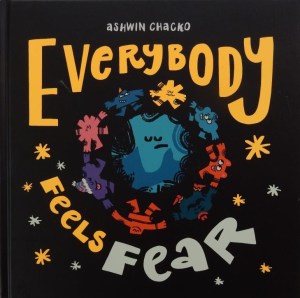
Ashwin Chacko
Dorling Kindersley

As this book’s creator asserts we all have fears, some long-lasting, others much less so, some are small and some can be huge and overwhelmingly. This picture book is an exploration of the wide variety of fears we might have, from spiders to mice and bears to monsters. The text starts in rhyme and part way through changes to prose that offers encouraging words about fears: no matter how seemingly overwhelming a fear feels, with a modicum of courage, ‘as small as a mustard seed’ we can begin to face up to whatever is making us fearful. Assuredly fear does not define a person and most importantly love fuels courage and ‘where love lives fear cannot be.’ In other words, working together is the way to go.

Chacko uses a wacky, bold illustrative style combining it with arresting typography to put across his important message. This zany book offers a helpful starting point to encourage children to talk about their fears and in a classroom could act as the prelude to a circle time discussion.

The Dream Train

The Dream Train
Sean Taylor and Anuska Allepuz
Walker Books

Rather than sharing a story with your little one(s) before bed why not try some poems for a change. From popular picture book author Sean Taylor comes this collection of thirty poems that are perfect bedtime reading. The book has three sections: Night Arrives, Shut-Your-Eyes Time and Dream Wheels Turning. No matter if you want something magical or musical, something to give you a good giggle or to snuggle up warm with, then you will surely find it herein. Offering something snuggly and warm is The Blanket: ‘Dad says there’s a little bit / of love in every stitch. // … I’m sure it sometimes whispers “Good night, love. Sleep tight.”

From the first section, Story Time provides something musical, which is confirmed in the final verse: ‘Right round the world, / you will always hear it. / Wherever there are children, / you will always hear it … / the soft music of story time.’ If only that were so for all children everywhere.

Magical for me are the words of Once There Was: ‘The day is done. / Darkness comes. // Once there was a lake. / Now there’s a mirror of stars.’ Making this one even more magical is Anuska Allepuz’s watery twilight scene.

To induce a giggle or two you could turn to The Middle of the Night, tell your child to close eyes and imagine as you read of knives and forks asleep in the kitchen, towels asleep in the bathroom, flowers asleep in the gardens. Can they suggest what those things might be dreaming of when ‘the stars are awake in the sky.’ ?

Anuska Allepuz’s illustrations are a visual treat: their subtle, muted shades and soft focus pastels give a dreamlike quality as befits the overall theme of the book.

Add to family bookshelves if you have a young child.

On the Move: Poems About Migration

On the Move: Poems About Migration
Michael Rosen, illustrated by Quentin Blake
Walker Books

This is a subject very close to the poet’s heart as is evident right from the start when he explores his roots. We read of the experiences of Michael Rosen’s Family and Friends in the first of the book’s four thematic sections. We read too of when he was just a boy and he writes about growing up in London after the end of WW11, and his Polish-Jewish heritage.

The poems in the second and shortest section, The War, are equally poignant comprising parental reminiscences of World War II and incidents during family travels in various parts of postwar Europe

Enormously potent is The Migrants in Me. In this third part, Michael considers missing family members. So says his father: “I had two French uncles. / They were in France / at the beginning of the war. / They weren’t there at the end.”
In the next poem ‘Finding Out,’ Rosen purposefully searches out information about these uncles—Oscar and Martin, learning of old photos of them in a long-hidden box labelled Family Photos.
Then come heart-wrenching poems directly addressing Oscar and Rachel, his wife; these imagine their feelings during escape, discovery by Nazis, and being sent to Auschwitz.

In On the Move Again we read of the poet’s thoughts about migration today, in particular the plight of refugees who flee their homelands in the face of war, famine or other adversity, to start life afresh. It ends with the compelling ‘Today’ – ‘What you did yesterday / can help you choose what to do now. / What you did yesterday and what you do now / can help you plan what to do tomorrow. / But you can only do something now.’

At once commemorative, historical, political and celebratory, Michael’s poems herein have a straightforward power that is echoed in Quentin Blake’s black and white illustrations that have a haunting quality of their own.

The book opens with an explanation of the difference between refugees and migrants and concludes with suggestions of organisations that support refugees.

Ballet Kids

Ballet Kids
Holly Sterling
Walker Books

Before the title page we meet a small boy holding up a doll dressed in ballet attire, who introduces himself thus, ‘I’m Thomas, and I want to be a ballet kid.’

He then goes on to share with readers in a straightforward manner, the events of a ballet class day. Having dressed up warm as befits the snowy day and packed his ballet shoes, off he goes to the dance studio clutching mum’s hand. He introduces us to each of the friends he meets on the way, all of whom are heading to the class too.

Once there, with their ballet shoes on, the children start their lesson. Thomas takes readers through the warm up, and the various moves, describing the exercises,

defining ballet terms, while speech bubbles provide comments from the young participants. Mr Elliot, their teacher is enormously encouraging as are the children one to another and then with Christmas approaching, the pupils choose outfits and thus, roles for the winter show, a performance of The Nutcracker. Thomas picks out what he thinks is the most wonderful costume he’s ever seen. “You’re the Sugar Plum Fairy”, Mr Elliot tells him and puts on the music for him to dance. When it’s time to leave Thomas has started feeling butterflies in his tummy but they’re soon allayed by his teacher’s words, “Just listen and move with the music, the magic will come from within.” And it most certainly does …

In her inclusive illustrations, Holly Sterling captures that magic and the sheer joy of the young dancers both in their class and as they perform the winter show. Young audiences will surely be swept up in that enchantment, especially the aspiring dancers among them.

History’s Biggest Show-Offs

History’s Biggest Show-Offs
Andy Seed, illustrated by Sam Caldwell
Happy Yak

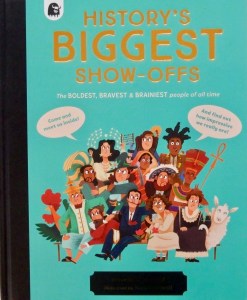
What is it about some people that makes them want to show off about their achievements? Have you ever wondered who the biggest braggers of all time might be? If so then Andy Seed has done the work for you, presenting in his lighthearted style, the flashiest boasters in the history of humankind.

The book is divided into three main parts entitled People in Charge, People Who Think Up Stuff and People Who Create Things; however if readers prefer they can look instead at different time periods: ancient (c.6000 BCE to 500 CE), post-classical (c.500-1500 CE), early modern (c1500 – 1800 CE) and modern (c. 1800 to the present).

We’re introduced to eleven rulers, five of whom were women. These include Hatshepsut, an ancient Egyptian pharaoh, Tarabai who at just twenty five, took over the leadership of the Marathas after the death of her husband and proceeded to show off her military skills to overcome the Mughals; and Christina of Sweden, she who was super-brainy and loved to read. Among the men was Mansu Musa who when on Haj, took 12, 000 servants each with a bag of gold to give away en route to Mecca.

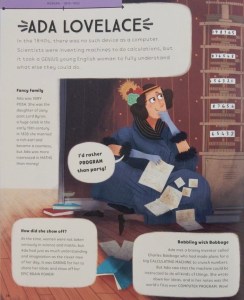
Those with a scientific or technological bent include the first ever computer programmer, Ada Lovelace

and Ynes Mexia, an intrepid plant collector from the early 20th C who discovered 500 new species and had fifty plants named after her. Having studied at Brunel University, I have to mention the ace engineer, Isambard Kingdom Brunel who, with help from his father, built the first ever tunnel beneath a river (The Thames) and who sadly died before his exceedingly costly Clifton Suspension Bridge was finished.
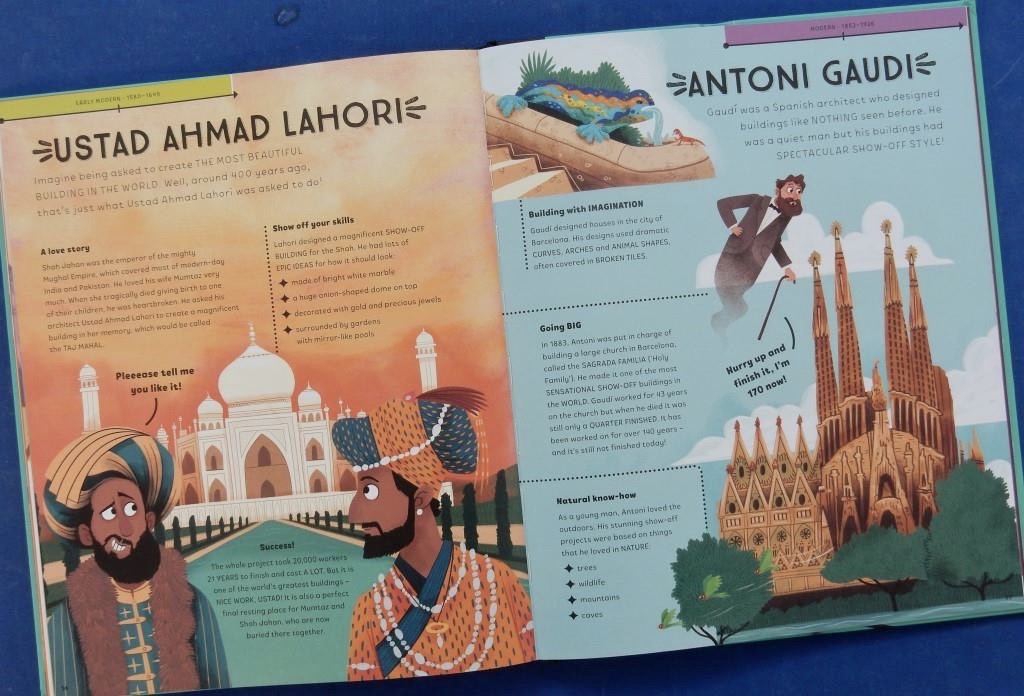
Finally come the creative types: Ustad Ahmad Lahori was asked by Shah Jahan to create a building in memory of his beloved wife Mumtaz and that’s how the magnificent Taj Mahal came to be. Another show-off architect Antoni Gaudi is famous for Barcelona’s still unfinished Sagrada Familia.

There’s a wealth of bling too, as Andy Seed’s humorous writing brings all these and more back to life and he’s even included some quizzes to ramp up the fun. Talking of fun, Sam Caldwell’s zany illustrations certainly add more of that in abundance: even the timeline will make readers giggle.

I Did See A Mammoth! / The Grizzled Grist Does Not Exist!

I Did See A Mammoth!
Alex Willmore
Farshore

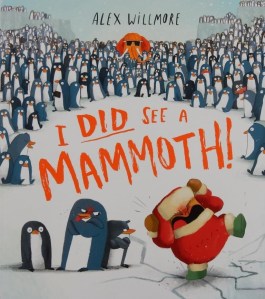
A research team – three adults and a child – are in the Antarctic exploring. The adults are looking for penguins; not so the child narrator who insists: ‘But I’m going to see a MAMMOTH.’

Setting out alone the little protagonist comes upon a skateboarding mammoth. ‘Mammoths are extinct. And I’m pretty sure they’re not even from around here.’ is the response of one of the researchers. ‘Are you sure it wasn’t a wonderful … penguin?’
More determined than ever to prove it was a mammoth, the child sallies forth again and sees in turn the mammoth skateboarding wearing a frilly pink tutu doing ballet and the mammoth sporting a scuba mask submerged underwater.

Still no one believes the child and a shouting match ensues. Followed soon after by a full on tantrum by the youngster. This results in the ice cracking, an avalanche and a surprise revelation for some of the party. The final twist is huge fun and the book concludes with a brief note about both mammoths and penguins. Adult readers aloud will love sharing this humorous tale and listeners will relish shouting ‘Mammoth’ at every opportunity, as the child’s indignation turns to anger. Alex’s illustrations are superbly expressive, especially the penguins every one of which is a visual treat.

A super wintry book.

The Grizzled Grist Does Not Exist!
Juliette Maclver and Sarah Davis
Gecko Press

Ms Whiskersniff, Ms Whisk for short, having assessed her pupils’ forest skills, takes her class trekking up the Dismal Hills. When shy Liam announces that he’s good at hiding, he’s told, “You can’t call that a skill”. Really? Soon the group pass a sign announcing the Grizzled Grist; Liam attempts to draw Ms Whisk’s attention to it and is immediately given the titular response, “The Grizzled Grist does not exist.”

So what has made the very large footprints that Hider, Liam (now camouflaged) urges his teacher to take notice of? You can guess what he’s told, in no uncertain terms. Lunchtime comes and goes with the occasional near disaster and eventually after trudging for much of the day it’s time to think about wending their way back. Liam meanwhile has gone into hiding up a tree and from this vantage point he spots something alarming. Yet again, the teacher will have none of it and back they continue to trek until …

Catastrophe! Thank goodness Liam is so good at hiding; but can one small boy possibly save all of 2B and Ms Whisk from the clutches of the gruesome Grizzled Grist?

Juliette MacIver’s rhythmic rhyming text tells a witty, playful tale that is humorously illustrated in scenes that show much more than the words say, especially regarding the characters. I love the endpapers.

The Book That No One Wanted To Read

The Book That No One Wanted To Read
Richard Ayoade, illustrated by Tor Treeman
Walker Books

This is one of the most crazy books I’ve ever read: it’s the first actor, writer and director, Richard Ayoade has written for younger readers. It’s also fiendishly funny, clever and thought-provoking.

Let’s consider how it feels to be a book – the best way is to allow a book to be both main character and the narrator telling things from its own viewpoint – sounds as though we’re getting a bit autobiographical here. Still that way allows us readers to imagine such things as the importance of making one’s cover alluring – failure to do so could all too easily result in being hurled across the room, abandoned under a whiffy pant pile or, horror of horrors, left on a shelf to be nothing more than a mere dust collector. And unless the tome under consideration happens to be a yogi there’s the possibility of having to perform some pretty sophisticated folds,

have your spine broken or, should you be totally unwanted then – gasp! – be sent off to a warehouse and there ‘pulped’ to near oblivion.

Hang on though, this book that we’re reading is in the process of charting its own destiny and that means finding its way into the hands of readers like us who will take great delight in discovering it in a bookshop – preferably on a display table with that irresistible unicorn cover or similar.

Tor Freeman captures with panache, Richard Ayoade’s wry humour in her wonderfully quirky illustrations that accompany the narration. Contrary to its title, this is a book you most definitely WILL want to read.

Timid

Timid
Harry Woodgate
Little Tiger

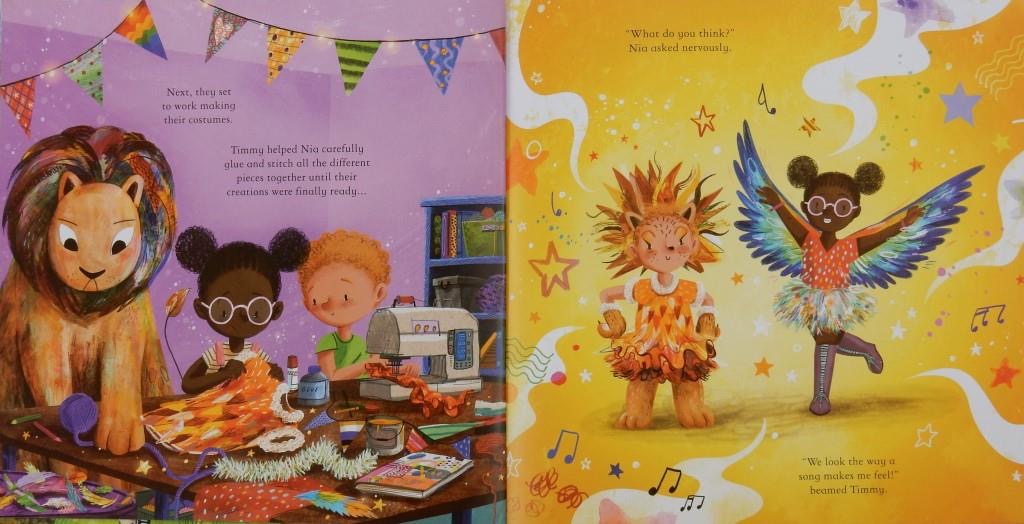
Timmy is a non-binary child who loves performing and dreams of one day becoming a stage star and being able to share stories with others. However unless singing and dancing in the bedroom there’s problem in the form of a very large, grumpy lion and it’s always lurking stopping Timmy from focussing. One day Mr Stevens, Timmy’s teacher announces to the class that there’s to be a school play, Timmy feels no excitement on account of that lion.

At lunch break Timmy sits watching the other children playing together when a classmate approaches

and a friendship begins to blossom between the two. It turns out that both children are actually shy and with mutual encouragement they create costumes,

rehearse, meditate and use positive affirmations. Little by little the relationship between Timmy and the lion becomes calmer and Timmy becomes more self-assured.

Come the night of the show however, Timmy has a crisis of confidence. Can it be overcome with Nia’s help? It surely can and as for the show: it’s a dazzler.

This uplifting story of getting the better of shyness will surely resonate with almost any young child. Youngsters will understand that the lion is a metaphor for Timmy’s anxiety and love the vibrant illustrations. There’s lots to explore in the opening scene set in Timmy’s bedroom and take a look at the various flags shown during the story.

Black Swans

Black Swans
Laurel van der Linde and Sawyer Cloud
Sunbird Books

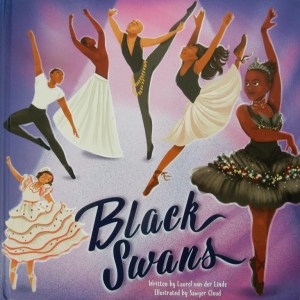
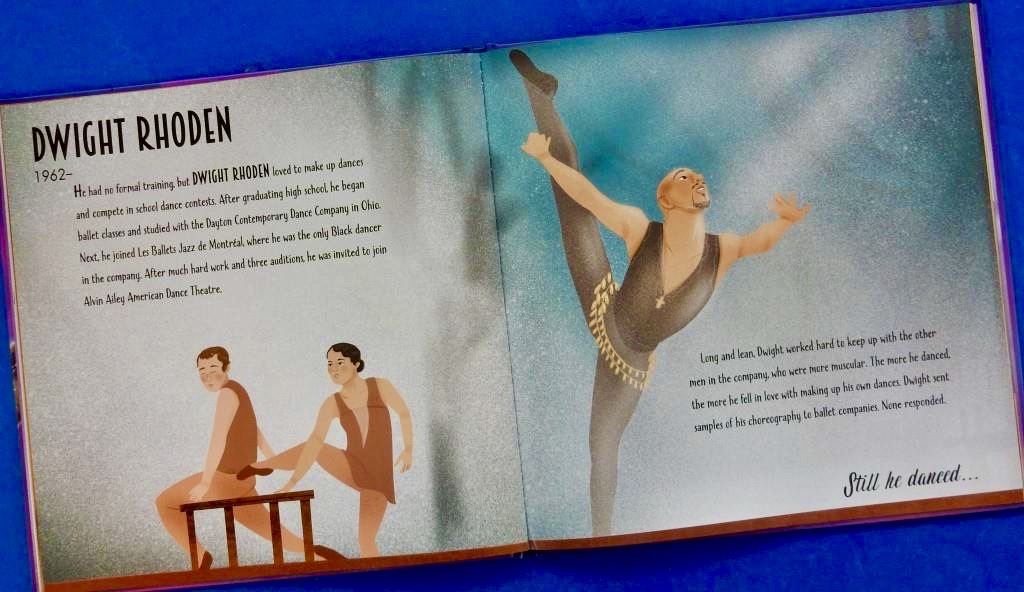
The six brilliant Black ballet dancers almost leap right off the pages of this show-stoppingly illustrated, narrative non-fiction book.

First we are introduced to Essie Marie Dorsey who although she never made it as a ballet dancer herself on account of her colour, made sure that others could by opening her own dance school in Philadelphia – The Essie Marie Dorsey School of Dancing; and to get Black parents to enrol their children, she went knocking on their doors asking them to send their offspring as pupils and so they did.

Next is Arthur Mitchell; such was his skill at ballet, that he attracted the attention of George Balanchine, artistic director of New York City Ballet and was invited to join the company, eventually becoming the first Black principal dancer. Even then it wasn’t plain sailing for in 1957 an audience deemed it unacceptable for a Black man to dance with a white woman. Some twelve years later using his own money, Arthur co-founded the Dance Theatre of Harlem ballet company.

Christian Holder moved to England aged seven with his family, then later attended the New York High School of Performing Arts. His talent was noted by the choreographer Robert Joffrey and as principal dancer, he had to face racial prejudice but it was his partner, not Christian who was replaced.

Dwight Rhoden too was held back on account of his skin colour, but as a choreographer went on to cofound Complexions Contemporary Ballet.

Last come two women, Misty Copeland who in 2015 became the first Black ballerina to be Principal Dancer of American Ballet Theatre and finally Michaela DePrince who when a very young orphan in Sierra Leone saw a magazine picture of a ballerina.

When she was adopted by a family from New Jersey she went on to become a star dancer of Boston Ballet.

Ground breakers all and each of these dance lovers achieved greatness by overcoming obstacles through self belief, determination and of course, amazing talent.

A lovely book to inspire youngsters to follow their dreams, whether or not that involves dance.

Baby Polar Bear

Baby Polar Bear
Anne Rooney and Qu Lan
Oxford Children’s Books

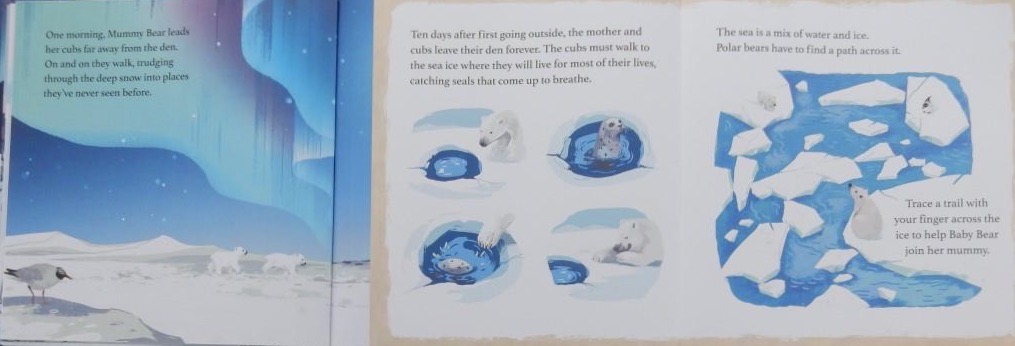
In this latest of the Amazing Animal series, we follow a recently born Baby Polar Bear cub and her twin as they take their first forays away from the Arctic den their mother has built. They’re a playful pair and both stay close to Mummy Bear as they frolic in the thick snow.

One morning their mother leads them away from the den on a long journey across the icy terrain. The little ones take care not to stray too far away in case of wolves.

Eventually they reach the sea and the cubs delight in chasing the birds and Baby Bear takes a tumble into the chilly water. Brrrrr! After some splashing for a while, it’s time for the cubs to snuggle up together under the star-filled sky. All this is told in the narrative part of the text while facts about the bears are found beneath the gate-fold flaps of this cleverly designed book.

The illustrations are gorgeous and Anne Rooney’s engaging text with its interactive element, is pitched perfectly for the intended young audience; to add to fun, there’s also a Bonaparte’s gull to find on every spread.

A book I’d strongly recommend for both home and class use.

Kind

Kind
Jess McGeachin
Allen & Unwin

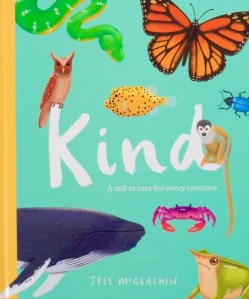
‘In this book you’ll find / Many kinds of things / Some have slippery scales / Some have feathered wings. // But kind is more than type / Kind is how to care / For creatures that you meet / And places that we share.’ Thus begins the beautifully illustrated, rhyming narrative that urges readers to show kindness to all living creatures and to our precious planet.

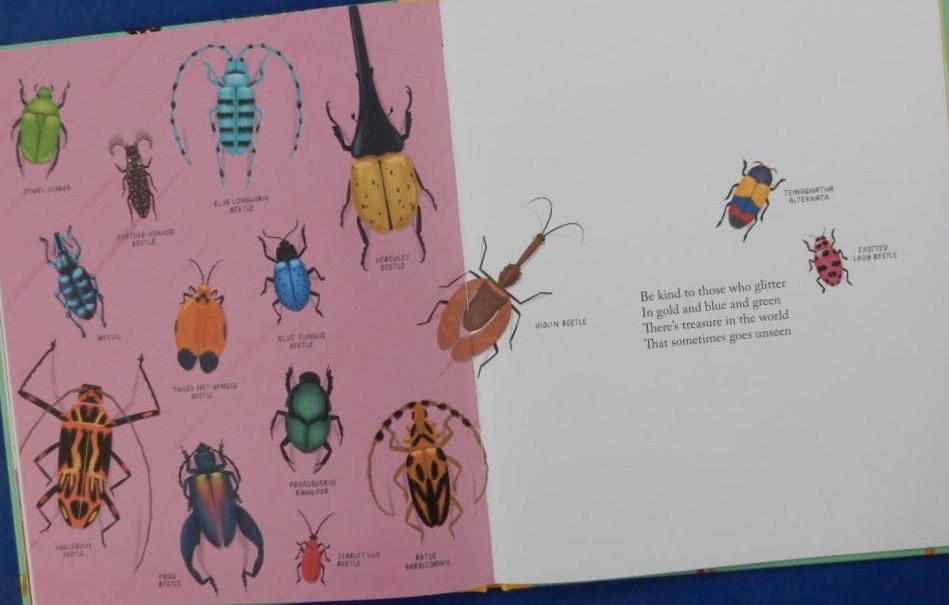
Making each spread a joy to explore, the author takes us first on a tour of the animal kingdom and presents flutterers, weavers, animals with shells, fish, the horned, the waddlers, owls and more, including some of the most spectacular. Every creature illustrated is clearly labelled with its Western common name; and each kind has a four lined verse that reads aloud well: ‘ Be kind to those who glitter / In gold and blue and green / There’s treasure in the world / That sometimes goes unseen’.

Having presented us with that wealth of wonderful creatures, Jess McGeachin moves the kindness focus, first to the planets, particularly Earth, and finally having gone large, he comes back small to remind readers that we humans are part of nature and we need to treat other people kindly too.

It’s good to see the author’s carefully considered afterword includes recognition that many of the animals depicted have names in the languages of the First Peoples who shared the land with them.
This is a book to add to family shelves and primary school collections.

Hugg ‘n’ Bugg Finding Home

Hugg ’n’ Bugg Finding Home
Ian Brown and Eoin Clarke
Graffeg

High in the Himalayas lives Bugg, a mountain flea. Unlike most of the other creatures living in this chilly location, Bugg does not like the freezing climatic conditions and so decides to search for somewhere warm to shelter. The sight of him bobble-hatted and carrying a load on his back is hilarious. First a lost sock and then a stinky boot, offer temporary accommodation and then he quickly rejects the bat-filled cave. Eventually, after a series of other unsuitable stops, Bugg takes a huge leap, landing somewhere promising at last – in the fur of the Abominable Snowman, aka Hugg. This huge creature introduces itself as “Bummy Nubble Snowman” going on to explain that on account of his looks he keeps himself hidden on the highest ground. Bugg offers to look after the Yeti in return for a home in his warm hair and a deal is done.

A deal that leads to the most unlikely of friendships and some tonsorial treats for Hugg.

Totally crazy and hugely entertaining is this latest Brown/ Clarke collaboration, the first of a new series with a theme of mutual friendship, it offers some vital lessons to young audiences. Ian Brown’s terrific talent for story-telling in combination with Eoin Clarke’s comical illustrations make this a read aloud, which despite its chilly setting, leaves a warm feeling within.

Cloud Babies

Cloud Babies
Eoin Colfer and Chris Judge
Walker Books

This story is inspired by events in the family life of Chris Judge, the book’s illustrator.
Young Erin’s favourite game is spotting animals in the clouds with her mum and dad and friends. She sees all kinds from cats to crocodiles and snowball polar bears to puff-less dragons. She calls them her cloud babies.

One day, Erin is very ill and has to spend a considerable length of time in the children’s hospital. She’s made to feel very welcome, is looked after with loving care by doctors and nurses and makes lots of friends. Even in hospital Erin takes delight in playing cloud babies with her new friends and either personally or remotely, with her dad. 

Eventually Erin is thrilled to be discharged from hospital but learns from the doctor that she will still need to have further “Hospital days”

Rather apprehensively she returns to school but things have changed considerably and Erin, now six, is sad to find that people there don’t share her imaginative interpretations of clouds. Indeed that comforting world she’d built and become used to in hospital feels distant and unfamiliar; moreover she decides that cloud babies aren’t for her any longer. It’s SO difficult to feel a part of either her hospital friends’ or her school friends’ group.

However her loving, empathetic parents don’t give up on those cloud babies and with their guidance and support from her class teacher and classmates, Erin comes to understand that through sharing her world and her cloud babies, she will find joy in being her true self again.

This story is written with great warmth and sensitivity by Eoin Colfer who has also included a special letter to readers at the front of the book. Chris Judge’s art is a skilful fusion of photographic images and vibrant illustration that blend children’s unlimited imaginative powers with the day to day world of a children’s hospital. No mean feat and the end result is an upllifting book that offers great help and comfort both to children faced with illness and to the adults who share their lives.

I would love to see Cloud Babies in all children’s hospital wards and doctors’ surgeries.

The Bear and her Book: There’s More to See

The Bear and her Book: There’s More to See
Frances Tosdevin and Sophia O’Connor
uclanpublishing

The big brown ursine bibliophile with an enormous heart returns and despite being snuggled up cosily one warm winter’s night, she feels that urge to explore. It’s prompted by a white, book-less bear looking lonely and downhearted in a picture in her Book of Being Wise. She packs her book and sallies forth, first aboard a fishing boat and then an ice floe. Soon she encounters a kindly whale who points her in the right direction but mentions a blocked up spout. Fortunately Bear’s book has the remedy and having helped the whale, receiving a “Yay” … “my blowhole’s mended. Thank you so much, my spouting’s splendid!” off she goes again.

On land as she walks across the snowy Arctic terrain, Bear meets first a moose and then a muskox, both of whom she helps, as is her way;

and then again repeating the words, “I’m a curious bear who must explore / The world is big and there’s more to see, / And I’ll find this bear who is not like me.” she proceeds on her way, eventually stumbling into an icy sleep.

On waking she repeats her refrain once more and there before her stands the object of her search, sobbing gently and speaking of wanting “A great big book – with lots of pages”.

I suspect readers can guess what happens next, but perhaps not how this tale of friendship concludes …
Despite the chilly setting of most of this rhyming story, Sophia O’Connor’s illustrations give you a warm glow inside as you read Frances Tosdevin’s lyrical narrative of the tender-hearted Bear with a desire to do good. I hope to see lots more of this character and her passion for exploration.

Gotcha!: A Funny Fairy Tale Hide-and-Seek

Gotcha!: A Funny Fairy Tale Hide-and-Seek
Clotilde Perrin (translated by Daniel Hahn)
Gecko Press

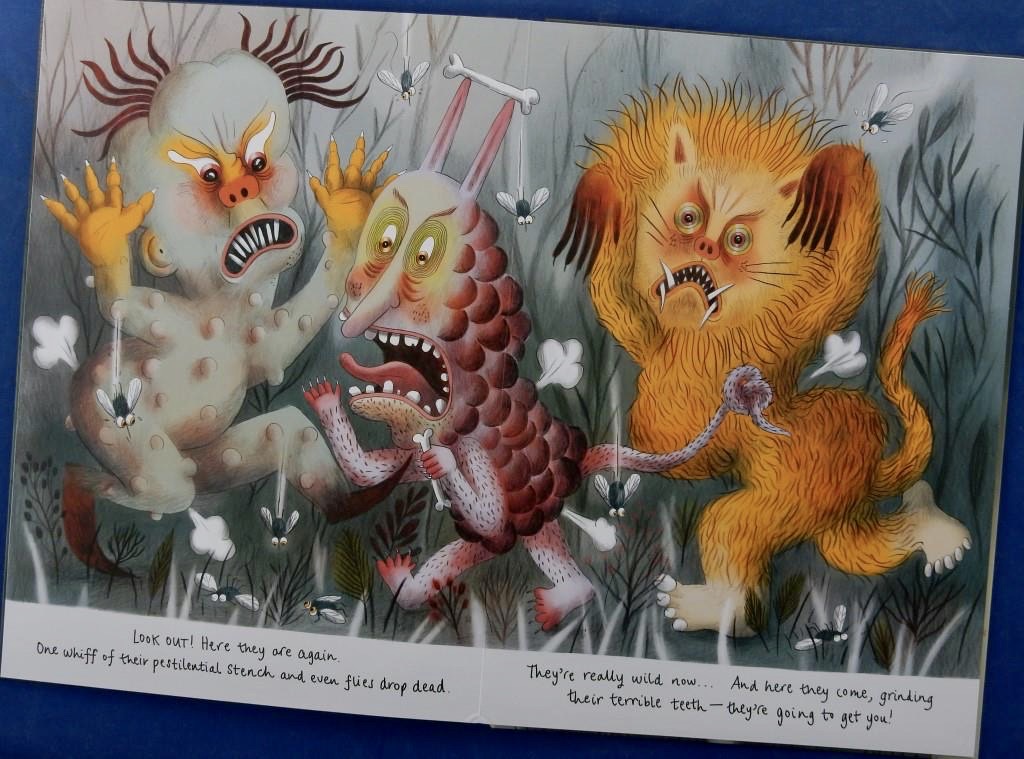
Between the covers of this large format book are three mock-scary monsters just waiting to give you the creeps and to catch the small character from the title page. First there’s a big yellow and decidedly nasty ‘hairball’. Fear not though, there is safety if you seek refuge within the brick house cleverly constructed by the third little pig and so our porcine pal says, this residence is built to withstand monsters.

He’s waiting within, cooking up something delicious and is willing to share it with little human visitors who want to hide from hairballs and the like.

Also on the prowl is the ‘fizzling stinkwort’; this monster uses its gaseous emanations to render you senseless and then consume you, unless you flee forthwith. Where better to hide than what looks like a deliciously welcoming abode with walls of gingerbread covered with confections of all kinds? Therein you will find the self-sufficient children, Hansel and Gretel – kind hosts who can help keep you safe once you’re within those walls.

Having recently consumed its breakfast, the tired-eyed creeper has its mind on the next meal and to ensure staying safe, it’s necessary to fight a way through the creepers covering the walls of Sleeping Beauty’s castle wherein lie sleeping fairytale characters.

However the three nasties don’t give up that easily so don’t think it’s safe just yet …

With the three residences full of amusing references to the stories they come from (and others), as well as flaps to explore and the satisfying disposal of the nasty monsters, this will keep youngsters entertained for ages, and returning for further forays into those favourite fairytale abodes.

Dragon Storm: Kai and Boneshadow / Duck’s Backyard

Dragon Storm: Kai and Boneshadow
Alastair Chisholm, illustrated by Eric Deschamps
Nosy Crow

This is the fifth book in Alastair Chisholm’s fantasy series for younger readers, set in the city of Rivven.

After dinner one night Kai and his fellow dragonseers are called to the office of Berin, Chancellor of the Dragonseer Guild. She informs them that at the king’s beset they have been summoned to the Royal Palace where trade negotiations are taking place. There they are to act as ‘apprentice clerks’ to assist Prince Harald by copying out various relevant documents because members of the clerical division at the palace have been struck down by a mysterious sickness. 

Following their first day’s work, the children are talking in their dormitory and Tom mentions seeing a dragon entering the palace. They decide to search in secret for this dragon and while so doing Kai picks up a leather pouch, containing a bottle holding a mysterious potion. This Kai has in his hand when he is rushing to get back to the dorm; it breaks and a shard of glass penetrates his palm and the liquid goes all over his hand. The result is that Kai starts feeling completely different – more confident and powerful.

Back home at the weekend Kai’s dragon Boneshadow notices a change in the boy. The dragonseers are also warned by Berin not to go exploring the castle on their return there the following week. During the weekend Kai’s actions cause consternation among his friends especially when he causes Erin to get injured. Back at the palace, when he starts following the call of that other dragon, Firedreamer, 

not only does he risk losing his human friends, it appears that he might lose Boneshadow too. Will Kai realise what is happening to him before it’s too late? Will Boneshadow discover what her power is? And what is the significance of that crest on the leather pouch …

Gripping reading and a cracking addition to the series.

Duck’s Backyard
Ulrich Hub, illustrated by Jörg Mühle
Gecko Press

A duck with a ‘wonky’ leg lives a lonely life in a backyard from which she’s never ventured. Then one day in wanders a chicken wearing dark glasses. The chicken is rather egocentric, determined and also blind, almost immediately deciding that the duck will be her guide on a journey to a place “where all our secret wishes come true” She knows not where this place is but is certain she’ll know when they reach there. Duck eventually accedes to Chicken’s wishes and off they go, taking it in turns to lead the way. 

They talk and they squabble and dance a fair bit as they conquer ‘the darkest forest in the world’, cross a huge ravine, on a plank placed there by duck, 

and climb the world’s highest mountain. Or do they? No matter, for they find themselves and each other; and they certainly find what matters most of all.

There’s a great deal to ponder upon in this superficially simple, philosophical tale, the drama of which is underscored by Jörg Mühle’s humorous depictions of the travellers. A small piece of thought-provoking brilliance this.

Dear Grandpa / Where?

These are two recent titles from Allen & Unwin Children’s Books: thanks to the publisher for sending them for review

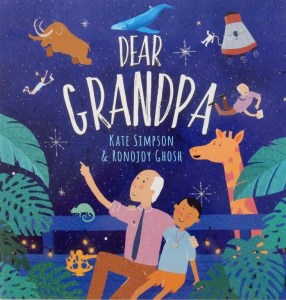
Dear Grandpa
Kate Simpson and Ronojoy Ghosh

Separated by a huge distance, a little boy Henry and his grandpa sustain a very special relationship through their letter writing that begins when the child moves to a new apartment in the big city 2003 km from his grandpa’s house. The first letters are factual and Henry talks of things in the city that he hopes just might encourage Grandpa to come and visit (ice-cream shops, cinemas and me). As their exchange proceeds, the two become imaginative, inventing and deflating one another’s way out visiting plans – riding on a whale, 

catching a shooting star – and readers are presented with a series of facts that the letter writers share while coming to terms with the physical distance between them.
I love the way the author brings us full circle with Grandpa’s closing letter mirroring Henry’s opening one with talk of that needle and magnet to point the way to one another’s abodes.

A gorgeous demonstration of how it’s possible for a loving human connection to transcend distance, with Ronojoy Ghosh’s imaginative illustrations being quirky visual representations of each of the letters. A smashing book for a grandparent and grandchild to share.

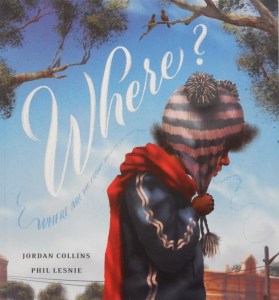
Where?
Jordan Collins and Phil Lesnie

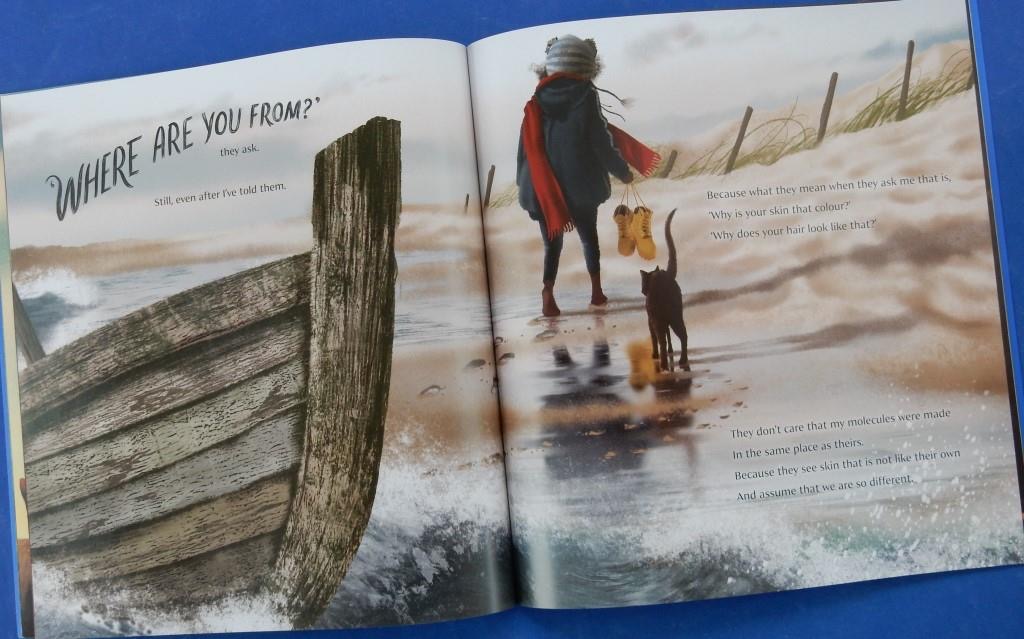
Where? is an enormously powerful, heartfelt slam poem by Jordan Collins written when the author was in his teens, in response to the ‘where are you from’ question. Thoughtless racist comments such as that can be incredibly hurtful yet still some people continue to ask such things. Here the author makes a plea to be seen in the same way as everybody else (everybody with white skin that is) as opposed to somebody entirely ‘other’. Readers cannot help but feel for the young narrator, and by implication, every other person who is being judged not by who s/he is, but on account of their skin colour, type of hair, way of speaking, from where they’ve come. 

lllustrator Phil Lesnie has taken Jordan’s words and brought them to life in a stunning way that expands on those words which quite rightly, (and optimistically), end thus ‘I’m from the same place that you are. // So no need to ask again.’ Every spread is one to ponder over and think deeply about and one can but hope that the book finds its way into all primary school classrooms wherever they are. For sure, we all need to celebrate our common origins and shared humanity.

Well Done, Mummy Penguin

Well Done, Mummy Penguin
Chris Haughton
Walker Books

I’m a big fan of Chris Haughton’s animal picture books and immediately fell for the penguin family, especially Little Penguin.

As the story opens Daddy Penguin is explaining that Mummy is off searching for yummy fishy dinner for them all in the chilly waters of the Southern Ocean. She needs to swim very fast and dart at great speed – swoosh swish swoosh

and while she is so doing Little Penguin seeks reassurance that she will return safely. And so she does but to do so she has to jump, climb a slippery slope – cu-crunch cu-crunch cu-crunch and then tip-toe carefully past some slumbering seals – shh! – in case she wakes them.

Little Penguin is concerned to see that Mummy Penguin finds herself face to face with one now wide awake seal

and as a result has to perform an amazing leap. Fear not though for Mummy is unstoppable and Woo-hoo! she lands safe and sound with a tasty offering for her little one. Can you guess what he says having consumed his dinner with relish?

With beautiful Antarctic landscapes, this is a gorgeous celebration of mothers, be they penguins or other; I’m sure little humans will love following Mummy’s progress and joining in with the onomatopoeic words sprinkled throughout the telling.

The Very Hard Book

The Very Hard Book
Ian Ben-Barak and Philip Bunting
Allen & Unwin

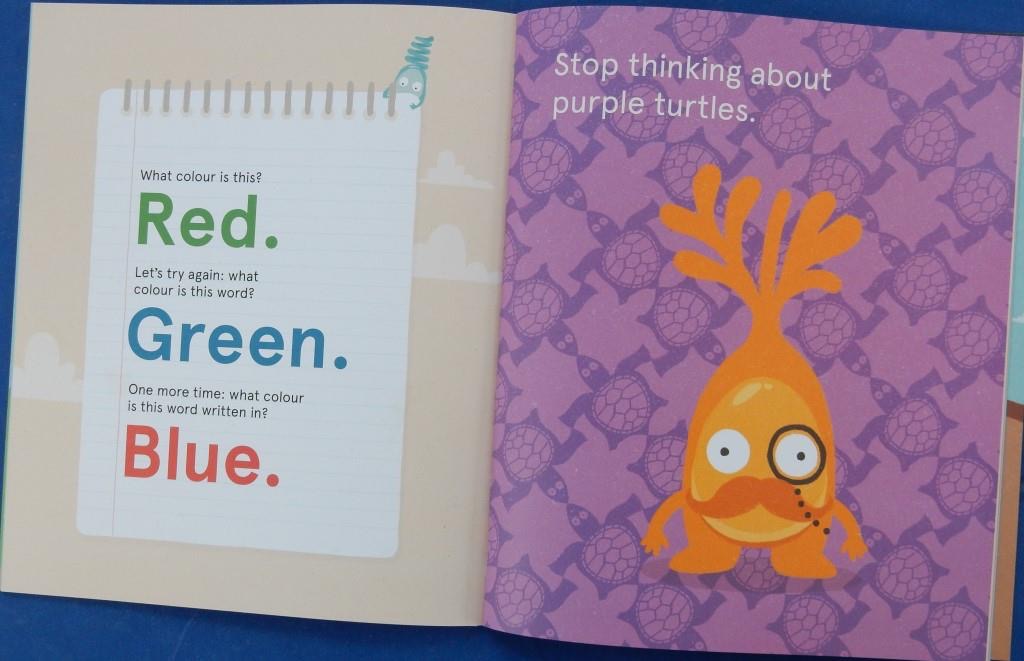
In this zany book readers are asked to try some very challenging things and it’s all in the name of helping us to become aware of our thought processes (metacognition). Are you up for the challenge of some open-ended thinking? Right … ‘Sit in an empty room.’ ‘Drop something by accident.’ ‘Dig half a hole.’

Each page (almost) gives a different instruction or asks a different question and by the time you’re half way through you’ll be giggling (partly thanks to Philip Bunting’s quirky creatures) and your brain will be going into overdrive with the creators’ comical ideas. Certainly however you will be more conscious of the limitations of your own mind.

You might even be prepared to have a look at The Very Hard Gallery at the back of the book. Here you will find a more detailed exploration of the paradoxes presented: you’ll see some interesting sounding names such as the Stroop Effect (your mind having to process two conflicting messages; in the example given, they are meaning and colour); then there’s Panta rhei. You will need to find out what this means for yourself, which means getting hold of a copy of the book (no cheating by using google).

Try putting this in a KS1 classroom; as well as introducing them to some surrealism, it will surely get everyone’s little grey cells working hard as they embark on a fun-filled thinking journey.

A World Full of Spooky Stories

A World Full of Spooky Stories
Angela McAllister, illustrated by Madalina Andronic
Frances Lincoln Children’s Books

This collection of fifty traditional tales from all over the world is organised thematically into eleven parts – by geographical feature or location – and celebrates things spooky (but not terribly so). Some are very familiar: Hansel and Gretel and Little Red Riding Hood being two from the ‘Into the Woods’ section, which comes first.

One witch I wasn’t familiar with is the Water Witch. In this tale originally from France, William the hero goes to the bottom of an enchanted lake to find riches so he can afford to marry his beloved, a dairymaid, but is tricked by the witch, transformed into a frog and thrown into a fish tank. All ends happily I hasten to add, though maybe not for the witch.

Readers are more likely to know Baba Yaga who resides in the house that stands on a pair of chicken legs: she’s the one Vasilissa the Beautiful gets the better of when she goes into the forest, in a Russian tale of the same name.

If you follow a mountain path it might lead to a man-eating ogre. This fearsome being is found in the mountains of Tibet and he tricks a girl into believing he is her mother and thus is able to carry her off to his cave. Do you think he eats the girl? Possibly, but it’s also possible that a fox helps the girl’s mother and in so doing causes the demise of the old ogre. Also feared for consuming humans is the Chenoo that features in a North American Passamaquoddy story. This giant creature had once been a man but on account of his wickedness, his heart had turned to ice. Can that ice perhaps be melted again and with it the wickedness? …

Certainly there are spooky elements in all the stories, but very few are really spooky and one or two are even humorous. Helping to bring the tales to life are boldly coloured folk art style illustrations by Madalina Andronic. Yes, this could be a book for reading while snuggled up on chilly autumn and winter evenings, but equally, folk tales are entertaining whenever you encounter them.

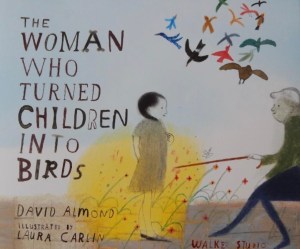
The Woman Who Turned Children Into Birds

The Woman Who Turned Children Into Birds
David Almond and Laura Carlin,
Walker Studio

When a woman, Nancy Solo by name, arrives in town claiming to be able to turn children into birds, the adults warn the youngsters to stay away, scoffing, calling it piffle and balderdash. The children however think differently. First to approach Nancy on the bench is Dorothy Carr. Nancy whispers into her ear and off flies the girl, a swallow ‘swooping up into the blue’, but only briefly.

Before long another child, Colin Fox steps forward

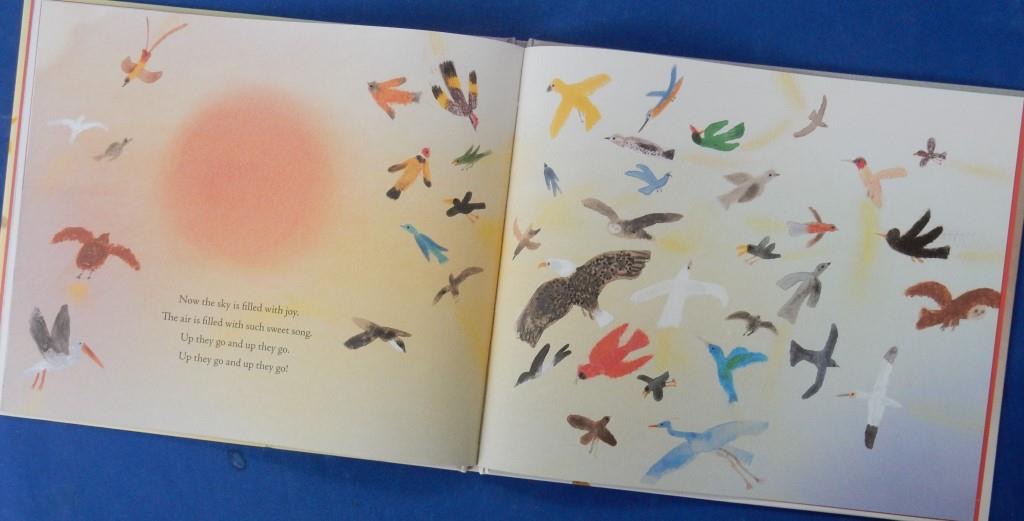
and takes to the air – as a sparrow. Very soon the sky is full with a goldfinch, a rook and a host of other children transformed into birds. With more and more children enjoying their flight, Nancy asks the adults, “But what on earth are you afraid of?” Twice she asks the question and on the second occasion one of the grown ups starts to soar, thoroughly enjoying so doing; and it’s not long before the sky is filled with joyful song and soaring birds.

Nancy’s work here is done; everyone has become a risk taker, overcoming that fear of flying, and it’s time for her to move on to another town and work her magic.

Full of playful language, there’s a fable like feel to David Almond’s tale and Laura Carlin’s wonderful mixed media illustrations show an aura of light surrounding each transformation as it occurs. A story to revisit over and over with the possibility of new meaning emerging with each reading.

Planet Football

Planet Football
Michelle Robinson and Chris Mould
Walker Books

Jackson is football mad; everywhere he goes and everything he does involves football: he lives and breathes it.

One dull wet day he decides to play outdoors no matter the thunder, and making a run up to his ball he wonders just how high he can kick it. WHAM! Off it soars skywards, narrowly missing a plane and a space vehicle. This stupendous kick catches the attention of a passing reporter and the following day a huge crowd awaits Jackson all demanding he attempts even more. What follows is a tour of cities and towns the world over and each time his massive kick sends a ball sailing up but it never returns to earth.

Where can all those balls have gone? The answer is, they’re all up on the moon where the moon-folk are becoming football crazy. However the lack of a single ball on Planet Earth means disaster: the world Cup is cancelled. Now what?

Jackson knows he must fix things forthwith but can he do it? Perhaps with the help of all his pals: let operation moon mission commence.

This totally bonkers tale is told in Michelle’s rollicking rhyming narrative and Chris Mould’s highly comical, inclusive scenes of soccer mania. With the countless young soccer fans out there I have no doubt this will be a resounding success

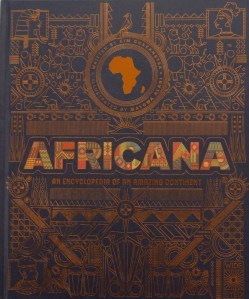
Africana: an encyclopedia of an amazing continent

Africana: an encyclopedia of an amazing continent
Kim Chakanetsa, illustrated by Mayowa Alabi
Wide Eyed Editions

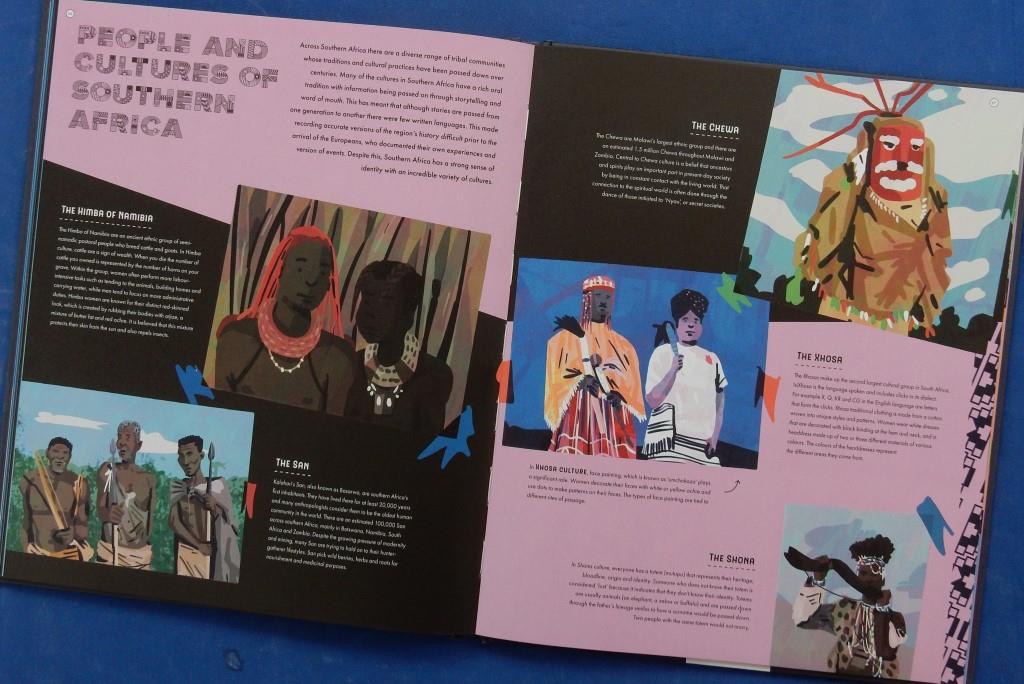
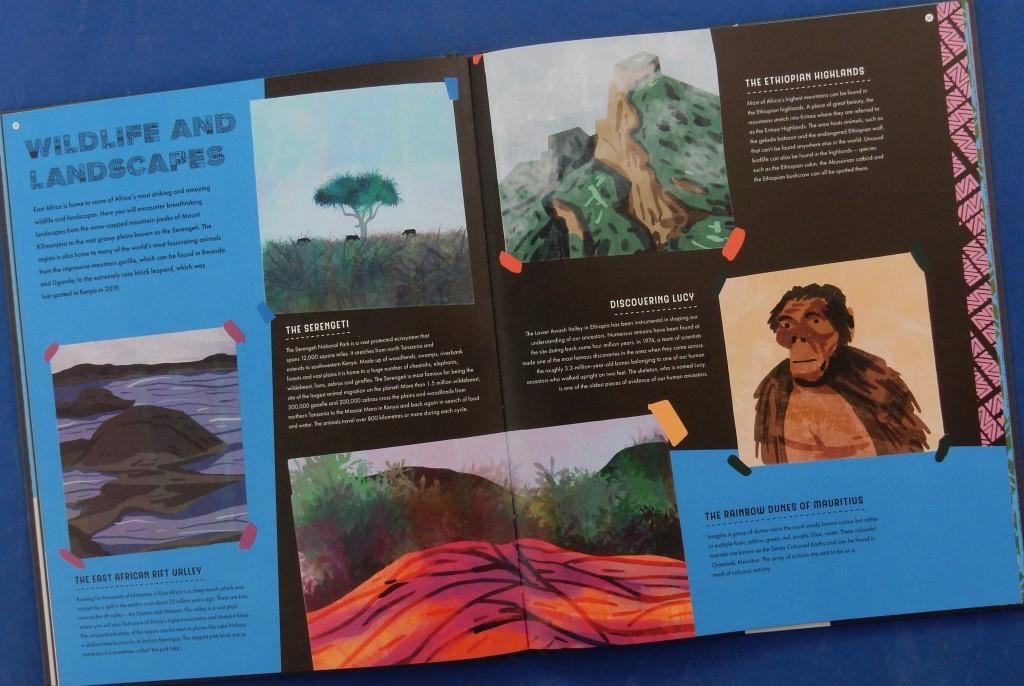
For this large format book, author and broadcast journalist, Kim Chakanetsa, divides the African continent (the second largest in the world) into five regions – north, east, central, west, and southern – the following topics being covered in each region: a timeline of important dates, people and culture, 

wildlife and landscapes, famous people (change makers and superstars), and snapshots of interesting facts. There’s also a final section called ‘Global Africa’. Even before starting to read about the five regions, readers are confronted with some uncomfortable facts about the slave trade and its continuing impact upon descendants of African slaves in such places as the US where they are still living with the consequences of slavery even today.

However, there is a great deal to celebrate, not least the wonderful landscapes, 

animals and cultures and those important change-makers. Let me just mention a few of those: first my all time hero, Nelson Mandela who spend 27 years in prison and is now thought of as the father of South Africa’s democracy. From Western Africa there’s award-winning author Chimamanda Ngozi Adichie, most famous for Half a Yellow Sun, Egyptian author Naguib Mahfouz, singer-songwriter Miriam Makeba, another campaigner against the apartheid system in South Africa.

Strikingly illustrated, highly informative -also included are words of wisdom from various countries, flags and with an excellent glossary – this is a great introduction to a vast continent presented in an accessible way. A book for classrooms, families and libraries.

The Mouse Who Carried A House On His Back

The Mouse Who Carried A House On His Back
Jonathan Stutzman and Isabelle Arsenault
Walker Books

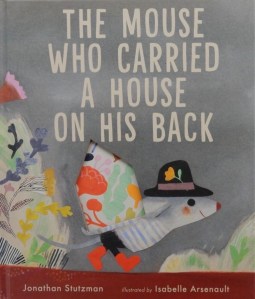
Vincent is a mouse ‘with boots on his feet, a hat on his head, and a house in his back.’ He also has an enormous heart and a special skill of knowing just where to stop and put down his house. Said house is no ordinary house however: it expands to accommodate whomsoever needs shelter. On this occasion he puts it down upon a hill and almost immediately along comes a weary bullfrog. Straightway Vincent offers him a roof over his head and in goes the frog, surprised that he can fit within. It’s not long before the house has expanded to welcome in also a hungry cat, a family of wet hedgehogs, a fox, badgers and a herd of deer and Vincent serves them all with dinner.

Just as they’re all seated around the table an enormous bear knocks saying he’s lost. The other animals are terrified. insisting, “there is no room for a bear.”

Vincent however thinks otherwise. “This is my house … all animals are welcome, “ he insists. And so it is on that night all the animals sleep safely and comfortably, ‘full of honeycomb and warm milk under a sky that stretched for miles.”

Jonathan Stutzman adopts a formal tone for his telling using repetition to good effect in this fable-like story of unconditional acceptance and inclusion. Isabelle Arsenault’s playful gouache, ink and cut-paper illustrations bring these themes to life: on the opening spread, she shows Vincent’s house as a simple cut-out pentagon and each time a new visitor appears at Vincent’s doorstep, a new house in a different style appears on the hillside adjacent to the pentagon, gradually creating a conglomeration of homes; then a gatefold spread captures the final proliferation.

A timely message of open hearts making for open doors in these troubled times of ours.

Magic Keepers: Crystal Chaos / Theodora Hendrix and the Snare of the Shadowmongers

Magic Keepers: Crystal Chaos
Linda Chapman, illustrated by Hoang Giang
Little Tiger

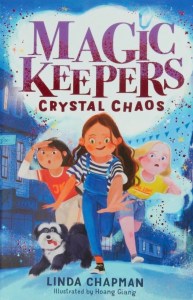
This is the first of a new series wherein Linda Chapman establishes a magical world based at Curio House. Ava and her mother have just moved into what was her archaeologist great aunt Edith’s home, where she has left her collection of curios saying in her will that this must remain there and not be sold. Rather it was her hope that one of her relations would find this collection ‘special’. 

Enter Ava and her dog, Pepper. Pretty soon Ava discovers that special means magic or perhaps ‘Magyck’ in the case of the crystals. Each of said crystals holds its own potential energy. It’s into this magical world that Ava, together with her new friends Sarah and Lily fall. Ava discovers an ancient mummified crocodile that is affected by the resurrection crystal and it’s down to the three girls (and Ava’s dog Pepper) to discover how to control and make use of the other crystals’ powers, and do so pretty snappily, if they are to prevent the scaly creature terrorising the entire town.

As well as an exciting adventure this is a tale of new beginnings and of friendship that demonstrates that everybody is different and that working together is the best thing to do for them all.

A thoroughly enjoyable read for primary age children, strikingly illustrated by Hoang Giang. I wonder what comes next for the Magic Keepers and that curio collection.

Theodora Hendrix and the Snare of the Shadowmongers
Jordan Kopy, illustrated by Lisa Hunt
Walker Books

Theodora, the girl raised by monsters, is back for a third adventure along with Sherman (spider) and friend Dexter. Theodora is excited at the prospect of visiting New York for the Christmas holidays (other than having been given homework on the very last day of term, which she’ll have to take with her). She can’t help thinking of all the pizzas she will be able to consume. On arrival they discover that the Big Apple is packed with the horrendous Shadowmongers, supposedly banished to the Antarctica several thousand years back; and then they come upon the sinister Hilda who says she has unbanished them and now they have joined forces. Their aim is to bring down the Monstrous League of Monsters and with it Theodora, once and for all, thus putting humans the world over in the most terrible danger, causing them to have nightmares every night for the rest of their lives.

Facing perils aplenty, Theodora (the one who sees the Shadowmongers), Dexter (who doesn’t) and Sherman (he seems to know a fair bit about these vile creatures) have to navigate the city where the ghastly beings seem to reappear whenever they think they’ve escaped them.
With New Year over, it’s time to head back to face another school term but is that the last of the Shadowmongers? That would be telling …

With Lisa Hunt’s expressive black and white illustrations throughout, this is just right for autumnal reading, especially for those who enjoy spooky stories tinged with humour.

Who Will Kiss The Crocodile?

Who Will Kiss The Crocodile?
Suzy Senior and Claire Powell
Little Tiger

Suzy Senior puts a hilarious spin on a favourite fairytale in her snappy rhyming take on Sleeping Beauty. It starts on Princess Liss’s first birthday when her family hold a big fancy ball for all the town’s residents, or rather, all but one. With the party in full swing there’s a sudden chill as in sweeps a furious fairy who proceeds to shout, “… In fifteen years, she’ll bump her knee.And then the princess DIES!” and with a wave of her wand she turns the infant into a baby crocodile. All is not quite lost though thanks to a life-saving pixie who informs the princess’s distraught parents that instead of dying, their daughter will sleep `til woken with a kiss. But who would be willing to kiss a crocodile, especially one with increasingly long claws?

On her sixteenth birthday the princess injures her knee while swimming in the lake and takes to her bed for what turns out to be a snooze lasting around a century, during which numerous princes have shown up at the castle only to flee when they realise what slumbers within the increasingly crumbling castle.

Eventually the neighbours decide to call upon the services of the Handy-Grans to carry out some urgent work on the thorny hedge surrounding the castle. This they do and after a day’s slog they discover the slumbering crocodile within.

Rather than running for their lives, they run back to their van for some knee soothing salve…
Surely there couldn’t be a happily ever after to this story – or could there?

Claire Powell’s comical scenes are simply bursting with bright colour, her cast of characters is inclusive and Suzy’s text is a delight to read aloud. If you like fractured fairy tales, don’t miss this one.

An Invitation to the Ballet Theatre

An Invitation to the Ballet Theatre
Charlotte Guillain, illustrated by Helen Shoesmith
Welbeck Editions

At this time of year especially, an invitation to participate in a special VIP tour of the world of the ballet theatre, particularly when it culminates in watching a performance of Swan Lake on stage is very enticing. This invitation enables the reader to go on a virtual outing to the world of ballet that begins with an empty auditorium capable of seating over two thousand people. Next comes a look at what happens in the costume department where, beneath a gate-fold, there’s a designer fashioning a ball gown for the dancer who is to play the part of Cinderella in an up-coming show, as well as other people hard at work. 

I never before realised that there is a ballet-shoe manager responsible for checking that every dancer’s pointe shoes fit properly and that the right ones are always available. We explore the crucial warm-up routines, the clothes worn for training, see the various ballet positions and movements being practised in a morning class and then watch what happens in the rehearsal studio where the dancers spend a fair part of the day. 

Those of us who just go and enjoy a ballet performance don’t stop to think about the considerable amount of stress, both physical and mental, that dancers are under, nor about the importance of a dancer’s diet. These aspects require expert support to ensure the performers stay healthy in mind and body. To that end there is a healthcare suite wherein we see dancers working with weights, gyrotonic equipment for stretching and toning, doing Pilates exercises and consulting the experts available.

We also visit the orchestra pit, and the make-up room: I was surprised to find that most ballerinas apply their own make-up prior to going on stage; this involves accentuating features to make sure they are seen clearly under the bright stage light no matter where members of the audience are sitting.

Produced in consultation with English National Ballet’s Ballet Futures programme, this terrific, highly informative, beautifully illustrated book, is one to include in classroom collections, to give to youngsters who aspire to be become dance performers, or indeed to any child who is going to a visit to the theatre to watch a ballet.

My First lift-the-flap Nursery Rhymes / Bizzy Bear My First Memory Game: Things That Go

Hours of fun guaranteed from these two Nosy Crow board books – thanks to the publisher for sending them for review.

My First lift-the-flap Nursery Rhymes
illustrated by Ingela P Arrhenius

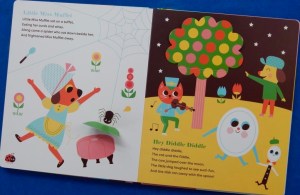
In this sturdily built, large format nursery rhyme board book Ingela P Arrhenius illustrates fourteen popular nursery rhymes and songs, each with a flap to lift. Her beautifully patterned, striking scenes playfully hide either key elements of each rhyme, or sometimes, additional characters. From Sing a Song of Sixpence to Incy Wincy Spider and Little Miss Muffet

to Twinkle, Twinkle, Little Star, it’s never too early to introduce little ones to the delights of nursery rhymes, the bedrock of playful language, though sadly many children start preschool knowing none at all, or only one or two. On the back cover is a QR code to scan enabling adults and little ones to listen to and sing along to the rhymes as they turn the pages of what I suspect will quickly become a favourite book that parents and carers will enjoy sharing over and over.
The same is true of

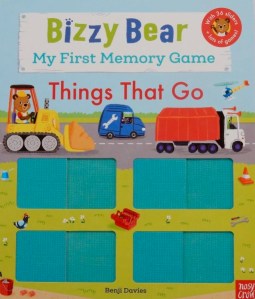
Bizzy Bear My First Memory Game: Things That Go
Benji Davies

Containing four scenes with lots of action going on – the construction site, the city, the airport and outer space – each venue offers three games to develop memory skills and enhance the vocabulary of little humans. To play hide-and-seek the sliders all start closed and a little hand should open them one at a time and then search the full page scene opposite for the vehicle revealed. Matching pairs requires players to remember the positions of the vehicles beneath the sliders and the search and find game has three questions, the answers being found in the relevant large illustration.

Bizzy Bear has a special role to play at the building site: he drives a large yellow bulldozer clearing the site for the other team members to begin their work. The city scene shows a railway line as well as things that go up in the sky and on the road. In this illustration, Bizzy Bear is a passenger on the train rather than a worker.

He’s taken on a new role as a pilot of the jumbo jet in the airport scene and finally, in the space scene Bizzy is an astronaut. His rocket has just landed on a green planet far from earth where there are aliens waiting to greet him – let’s hope they are friendly ones. Benji Davies’ Bizzy Bear character is already popular with young children: I suspect he’ll win even more fans with this book.

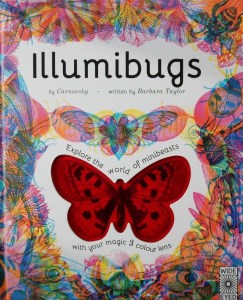
Illumibugs

Illumibugs
Carnovsky and Barbara Taylor
Wide Eyed Editions

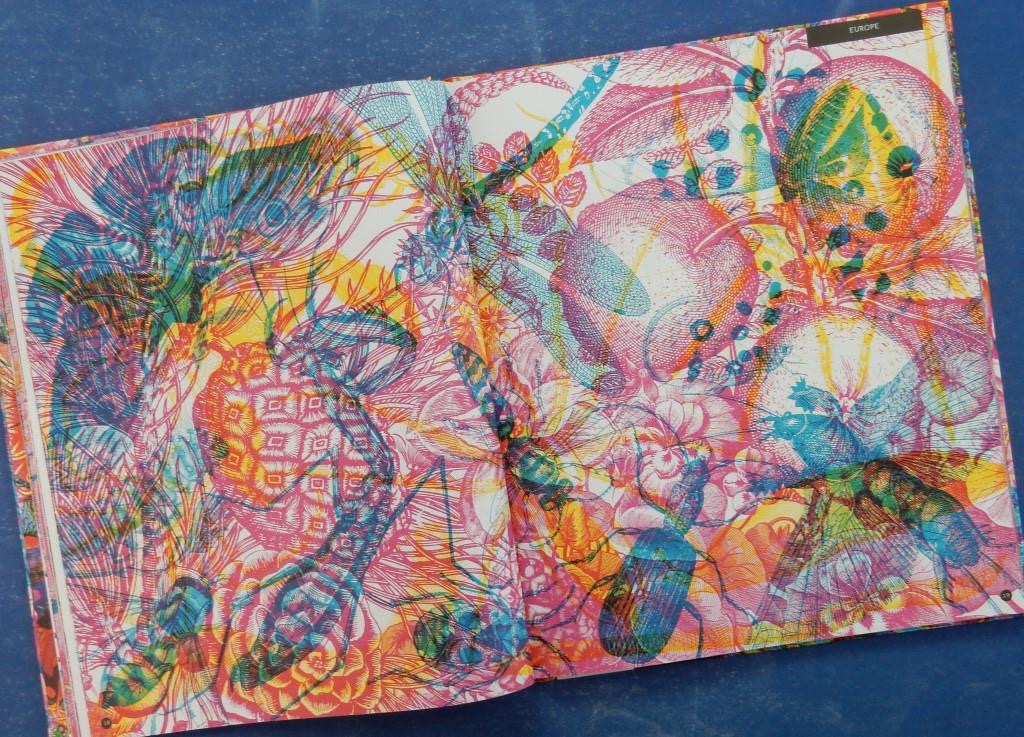
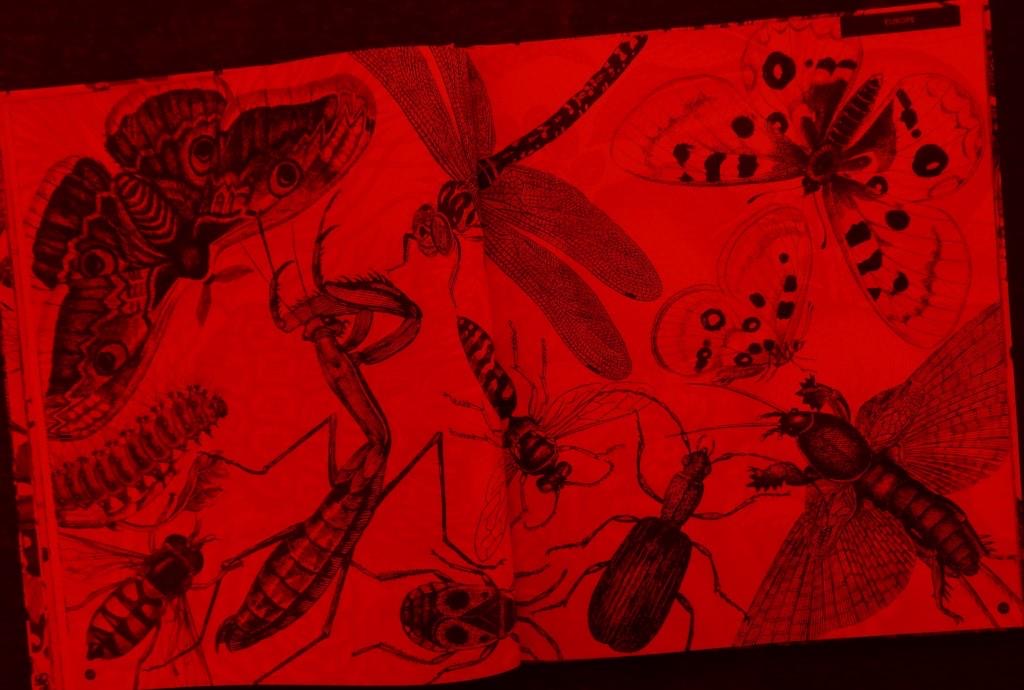
With an engaging text written by Barbara Taylor, who was at one time Science Editor at the Natural History Museum in London, and art from the same design duo as Illuminature and Illumisaurus comes another fascinating look at the natural world. Readers will be able to discover 180 minibeasts from various parts of the world using the magic three colour lens. The red lens shows insects, through the green you see plants and the blue shows (rather less clearly) other creepy crawlies.

There are seven regional sections, first North America, followed by Europe, Asia, Australasia, Central and South America, Africa and the Arctic. These are followed by a look at underwater bugs and finally, prehistoric bugs. I was surprised to read that there are 18, 000 butterfly species but even more astonished to learn that there are 12.000 species of millipedes in the world.

Each of the main sections is presented in a similar fashion – first a spread that includes the important environmental and survival information and a fact box relating to the region, an observation deck showing the minibeasts among vegetation waiting to be revealed,

View through red lens

– and lastly, a black and white double spread giving diagrams of insect species and other creepy crawlies (with a brief paragraph about each). This includes a search and find element that sends you back to the ‘observation deck’ to spot the minibeasts through the appropriate coloured lens. Purists will note that the insects depicted on the ‘observation deck’ are not drawn to scale.
Just in case you forget to replace the viewing lens in the front cover pocket, there’s a QR code at the back of the book that enables you to access the same feature on your phone.

This large format book offers hours of immersive enjoyment for readers of all ages from KS1 up, especially those with an interest in nature.

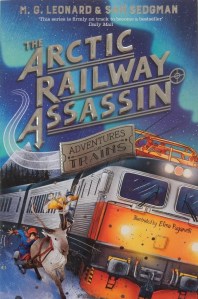
The Arctic Railway Assassin / Solve Your Own Mystery: The Missing Magic

The Arctic Railway Assassin
M.G. Leonard & Sam Sedgman, illustrated by Elisa Paganelli
Macmillan Children’s Books

Hal flies off to Sweden where he is to meet Uncle Nat. From Stockholm the following day they will take a Christmas trip aboard the sleeper train bound for the Aurora Sky Station to see the Northern Lights. Uncle Nat announces that his friend Morti, who has just won the Nobel Prize, is to accompany them, but then she suddenly changes her plan. After the announcement of her prize she’s been scared by some inexplicable events with things of hers disappearing and now Hal and Nat are to travel without her.

While waiting to board the train Hal sketches a group of musicians,

then as they leave Stockholm, he and his uncle think they are being followed, and Nat tells the boy that one of the people in his drawing is an assassin from his past, supposedly long dead. Something doesn’t quite add up with this picture of Hal’s. And what about the sudden appearance of Hal’s mum on board too?

Full of suspense, and with some great new characters, this truly is a gripping page turner with some really perilous episodes when readers will find themselves fearing for the lives of some of the characters. Hal’s drawing skills really come to the fore in this adventure, considerably helping to solve the mystery of what the assassins are after and where it is. Elisa Paganelli’s illustrations do a wonderful job bringing his sketches to life and adding to the reader’s involvement in solving the mystery.

My only regret is that this is the final book in the brilliant Adventures on Trains series.

Solve Your Own Mystery: The Missing Magic
Gareth P. Jones, illustrated by Louise Forshaw
Little Tiger

In the third interactive adventure from Gareth P. Jones there’s another puzzling mystery waiting for readers to solve. Like previous titles it’s set in the town of Haventry, a place where with its unusual population almost anything can happen at any time. Now it’s the opening day of Magicon, the world’s biggest magic convention and everyone is gathering for the great event when suddenly disaster strikes: all the magic in the town disappears. Who is responsible for this catastrophe?

It’s up to readers to don their detective hats, find out, and get it back in time for the opening ceremony. Could the thief perhaps be Evil Enid; or maybe Nigel Rigmarole whose business is magical energy? These are just two of the possible suspects that detective you, along with boss Klaus Solstaag (a yeti) need to consider. There are also the likes of meditative unicorn Moondance (too good to be true maybe)

and powerful Magic Circle head, Grandmaster Dimbleby.

There’s not a minute to lose: time to make the sparks fly – unless you want to shoulder the responsibility of allowing an ancient monster to waken from a century-long sleep beneath the town.

With a multitude of possible routes to take, this is terrific fun and with Louise Forshaw’s splendid portrayal of the weird and wonderful characters, this diverting read will delight primary age readers who like fantastical tales.

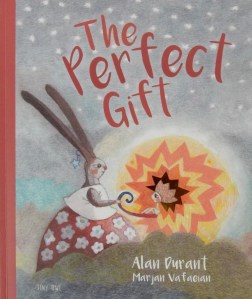
The Perfect Gift

The Perfect Gift
Alan Durant and Marjan Vafaeian
Tiny Owl

Rabbit is a much-loved creature, always ready to help and share with friends and neighbours. One day Meerkat knocks on her door with news: the birth of a royal baby is announced and the queen is having a celebratory party in the palace. Meerkat urges Rabbit to come along but in her paws she’s holding a gift. Rabbit doesn’t have a gift and she turns down her friend’s offer to share. Back indoors she searches high and low but can find nothing she deems suitable for the new baby.

Then ostrich calls and she too make the same offer as Meerkat, but is also turned down and told to go ahead. Other creatures also stop by, each bearing a gift.

By now the sun has almost gone for the day but still Rabbit won’t join them. As the sun sets she decides the only answer is to go to the party sans gift and ask the Queen’s forgiveness.

With her lamp in her paws, she makes her way to the palace and is surprised on arrival to find the place in darkness. Holding up her lamp, Rabbit approaches her majesty. Imagine Rabbit’s surprise when she’s greeted with the words, “And you’ve brought the perfect gift.” What can she mean by those words?

With themes of selflessness, kindness and friendship Alan Durant’s tale accompanied by Marjan Vafaeian’s delightfully quirky, detailed illustrations (love Ostrich’s knobbly knees) leave you with a wonderfully warm feeling inside. A thought provoking book to share both at home and in the classroom.

Anyone But Bear / Albert in the Air

Anyone But Bear
Suzy Senior and Dubravka Kolanovic
Scamp Publishing

Fox is excitedly making plans to host a moonlight party. He starts compiling his invitation list – Deer? – tick, Squirrel?- tick. Bear? Definitely not. Off trots Fox still planning in his head when suddenly rocks cascade down the mountainside, some of which smash straight into the party planner.

Fox is left flat out on the path-side unable to move. Several hours later, along comes Deer: help at last thinks Fox now awake and all too aware of his injuries. However, with a look of disgust, Deer turns away and takes an alternative route to avoid passing the injured creature. As snowflakes begin to fall along scampers Squirrel carrying nuts but he too decides not to stop. Seemingly the safety of his nuts is more important than that of a fellow forest creature.

Fox begins to despair but then round the corner comes someone massive, someone with large paws and a hairy scary face. Oh no! Soon though, Fox’s fear dissipates as he sees not the scary countenance he first thought but a kindly caring one. So kind and caring that he takes Fox all the way back home to his den; not only that but Bear brings him sustenance and takes care of the little fox cubs and their parent all through the night. This selfless act is one that Fox will remember always.

Based on the parable of the Good Samaritan, Suzy’s story, with Dubravka Kolanovic’s splendidly expressive illustrations will certainly make youngsters think about the meaning of real friendship.

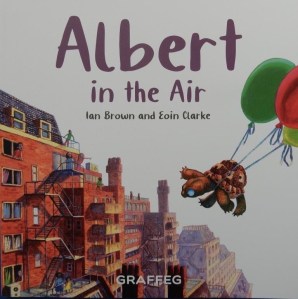
Albert in the Air
Ian Brown and Eoin Clarke
Graffeg

Albert the tortoise’s latest adventure sees him first wishing to emulate his winged friends and then, tunnelling his way beneath the garden fence into the next door garden and wandering out into the hubbub of the territory beyond. It’s there, while foraging among the piles of trash that he unintentionally finds that his wish is actually being fulfilled. The wind lifts a balloon entangled Albert skywards and he gets a tortoise-eye view of the sprawling urban landscape beneath him.

Meanwhile back on home territory, the other creatures are missing their friend and enlist the help of the birds to search for Albert. Will they return him safe and sound? 

The answer is yes, with the timely assistance of a bee and he makes his return felt in a rather noisy manner.

An amusing demonstration that the grass most definitely is not always greener and perhaps home is the best place to be. With its humorous ending and stand out illustrations, Albert’s new story is sure to please his numerous fans and will likely win him some more followers too. Don’t forget to peruse the information spread at the back of the book.

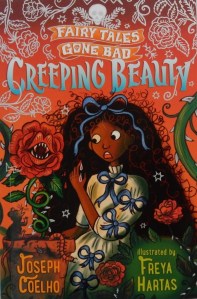
Creeping Beauty: Fairy Tales Gone Bad

Creeping Beauty: Fairy Tales Gone Bad
Joseph Coelho, illustrated by Freya Hartas
Walker Books

We’re back in the Library of Fairy Tales Gone Bad for the third and sadly, final tale in this cracking series, where the Librarian has found a really frightening treat. Prepare to meet Eshe, the youngest of thirteen sisters, which makes her a tredecimalet. Eshe, like her sisters, is a fairy godmother with the ability to bestow amazing gifts, and thus invited to every christening party in the land. However Eshe has a rather different ability: she is able to to see into the future.

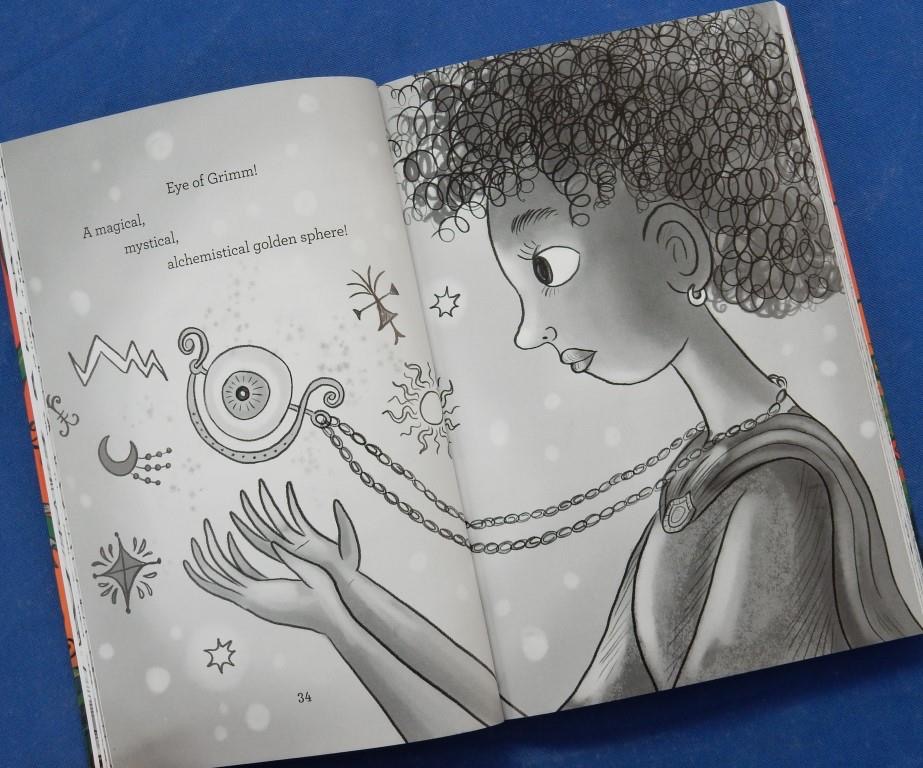
One day she foresees something truly terrible – ‘a world blanketed in thorns!’ endlessly growing vines that defy the sharpest of axes, shears, and even weedkiller. At the centre of all this is a beautiful girl, Princess Rose. It’s to her christening party that the sisters have just received an invitation and whereas her siblings are focussing on suitable gifts for the baby, Eshe’s head is filled with thoughts of the terrible future. She must attend the christening and she absolutely must try to prevent the very worst. This however will required, deep and very powerful magic and the use of her alchemistical Eye of Grimm.

Moreover she will require the help of others …

Dreadfully dark and brilliantly subversive, Joseph’s decidedly prickly twisted take on Sleeping Beauty is, like Zombierella and Frankenstiltskin, absolutely awesome. Long live the power of love and friendship. Freya Hartas’ wonderful black and white illustrations are in turn eerily eye-catching or cleverly comical.

I Really Want To Share!

I Really Want To Share!
Simon Philip and Lucia Gaggiotti
Templar Books

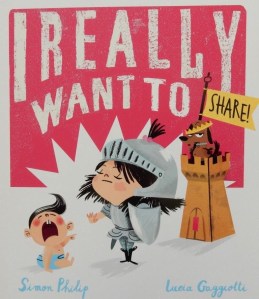
Sharing is a challenge for many young children and so it is for the young narrator protagonist in this the fourth in the I Really Want To series, who is faced with a new sibling in her family. Not only will she have to share her parents but lots of other things too. However sharing does not come at all easily even to a determined character like the one here.

On the day the baby is due to arrive, soon to be big sister is sent to stay with her grandparents, and her grandfather quickly sees that something is wrong. When he’s told the problem, he explains that sharing has been tricky for him ever since he married her grandma, it’s something they have gradually learned to do. Then his granddaughter reveals that her biggest fear is that she will lose the affection of her parents.

When baby brother is born there are up times and down times for everyone,

but will there come a time when big sister can honestly say that four in our family makes me glad; will she truly say, “I really love to share”? I wonder …

Lucia Gaggiotti’s wonderfully funny illustrations in a bold colour palette really capture the protagonist’s emotional roller coaster and the spirit of Simon Philip’s text. Together they make a book that is just right for sharing with young children who are soon to be, or have just become, a big sister or brother.

Crimson Twill: Witch in the City / Midnight Magic: Witch Trap

Crimson Twill: Witch in the City
Kallie George, illustrated by Birgitta Sif
Walker Books

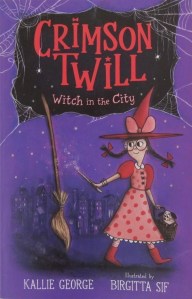
Crimson Twill is anything but your typical witch. Instead she wears a hat to match her name, giggles rather than cackling and she’s a dreamer. She can hardly wait to pay her very first visit to the world’s biggest department store, Broomingdale’s in New Wart City. There she will spend her hard earned money, but what will she buy? After some deliberation, she heads off to the Cat floor and yes there are plenty of cats, but what interests Crimson most is actually a puppy; this she rescues from a highly disapproving saleswitch, Ms Whiskers.

It’s not until she reaches the hat floor that the quirky little witch finds something she likes, a hat completely different from all the pointy ones: this one has a huge bouncy bow but there is only one of them and just as she’s about to make a purchase, Crimson encounters another witchling whom she learns has been saving up for this very hat for weeks. What will Crimson choose: the hat for herself or happiness for her fellow witchling? 

This turns out to be only one of the opportunities Crimson has to demonstrate her compassionate nature and in the end she realises that not only is it okay to be different, but also that there is something more valuable than any purchase she might have made – friends.

With its theme of being true to yourself, full of witchy whimsicalness and gentle humour – I love the fun word plays – this is the first of Kallie George’s chapter book series. Birgitta Sif’s black and white illustrations are a delight, depicting an inclusive city community.

Midnight Magic: Witch Trap
Michelle Harrison and Elissa Elwick
Little Tiger

This is the third in the rhyming series starring black cat Midnight and her human friend Trixie. It’s October half term and the two are building a den in the garden (‘their own top-secret lair’), while Nan plants bulbs and Dad sweeps up leaves. With his magic, Midnight creates a leaf dragon and the friends are so excited they fail to notice that somebody is watching them. That somebody is a witch called Wendy who is especially interested in Midnight’s special powers and tries to buy her. Trixie gives her a flat refusal and the witch flies off with a worrying glint in her eye, leaving Trixie a tad concerned.

That night into the room where Midnight and Trixie are fast asleep creeps Wendy, who takes the cat away in a cage. The following morning Trixie discovers a clue to the identity of the catnapper 

and off she goes on a rescue mission, accompanied by Dad and Nan. Readers meanwhile discover why Wendy has taken Midnight and the cat in turn learns that her family is coming to her rescue. All ends happily with further revelations, a promise, understanding, kindness and more.

Huge fun for reading aloud or reading solo, this sparkling story has an autumnal feel thanks to Elissa Elwick’s choice of orange to predominate in her bold illustrations of the action.

India Incredible India

India Incredible India
Jasbinder Bilan, illustrated by Nina Chakrabarti
Walker Books

As a frequent visitor to India I know that to be there is an onslaught on the senses. You almost experience that when you read Jasbinder Bilan and Nina Chakrabarti’s book and as the author implies in her ‘welcome’ introduction, to visit any of the states is like visiting a different country. I totally agree when she says this vast country has a ‘huge welcoming heart’. Indeed it has many, for I have formed some very close friendships over the years with people in various states from Rajasthan to Kerala.

The book is narrated by Thara whose nanijee has a very special old trunk full of precious objects collected over the years as mementos of her travels all over the country. Every Friday night the two sit together and nanijee takes out one object and tells her granddaughter all about it – the state of its origin, what makes it unique and why it’s so special to her.

The first item is a book entitled Ganga and we learn the story of the goddess Ganga and the origin of the holy river Ganges that starts its journey in the Himalayas in the state of Uttarakhand. I was excited to see that second object was an envelope with a stamp showing sculptures from a place I once visited – Chandigarh’s sculpture garden – where everything is made from recycled waste.

As the journey continues, readers will discover something of the history of Delhi, where ancient and modern sit side by side; see some of India’s amazing and diverse wildlife, be astonished by the beauty of some of the architecture, notably the Taj Mahal, the Golden Temple in Amritsar – the holiest city for members of the Sikh religion and Udaipur’s Lake Palace. Rajasthan and in particular Udaipur is like my second home.

If you take a trip on a boat along Kerala’s backwaters, you may well encounter elephants taking their morning bath.

But no matter where you go, there will be markets, some selling good things to eat, others, richly patterned clothing, wonderfully crafted jewellery or perhaps dhokra (metal statues like those in Odisha and West Bengal.)

I could continue enthusing about the multitude of wonders India has to offer, and this book with its splendid illustrations, gives a real taste of those wonders, so I suggest you get a copy, read it and start planning your visit.

Goodbye Hobbs

Goodbye Hobbs
Emma Bettridge and Josephine Birch
Graffeg

Based on real life events of love, loss and grieving, the author offers a dog’s eye view of losing a very dear friend. It’s with great reluctance, that Merlin eventually follows his owner out of the house for a walk to the shops. It’s hard for him to do so without Hobbs, his gentle black Labrador best friend.

As they walk, Merlin catches the scent of something on the wind and following his nose he detects a message asking ‘ … How are you today?’ but the message is incomplete. Merlin sniffs again and again as they continue walking and he finally stops beneath a weeping willow tree beside the river. ‘I just wanted to tell you that I am OK. It was time for me to go away. I love you. If you need me …’ Again the message stops mid-sentence.

On the two go, Merlin sniffing and gathering pace as he and his human head through the woods, back towards the village, bound for home.

Still sniffing and alert to any message, Merlin finally receives the words he needs so much. Words that will help him cope with those feelings of near despair as little by little he accepts that although his belloved Hobbs is no longer present in a physical form, he remains in the form of memories of the wonderful times the two have shared over the years together.

Josephine Birch’s painterly illustrations of the walk capture the complex emotions of Merlin. Her initial sombre colour palette changes to one of warm autumnal shades, and her subdued brush strokes become more exuberant as his mood lifts with each new discovery of his friend’s scented messages.

A helpful book for any parents or educators wanting something to help explain the feelings surrounding the loss of a loved one.

The Search for the Giant Arctic Jellyfish

The Search for the Giant Arctic Jellyfish
Chloe Savage
Walker Books

Dr Morley is passionate about jellyfish; she’s even more passionate about finding the giant Arctic jellyfish, a creature nobody has ever seen. Having spent years researching and planning with the aid of her dedicated crew, she’s ready to start out on an adventure, bound for the icy waters of the Arctic Circle.

Their first animal sighting is of narwhals; perhaps they can lead the ship to that elusive jellyfish: or could it be the scientific data and samples members of her team collect as they dive hopefully into the chill beneath the ice? Days pass, blizzards howl but still the search continues. The days turn to weeks and then months but even then that hope remains strong. Eventually crew members start to think of home: maybe that giant Arctic jellyfish doesn’t really exist.

However, driven by their loyalty to their leader they don’t give up. At last thanks to the sunshine, comes hope in the form of a massive patch of algae. Convinced this is the opportunity she’s been waiting for, Dr Morley dives down.

Can you imagine how she feels on seeing nothing? Time to head home, she decides.

The words tell the story of the expedition from Dr Morley and the crews’ point of view but Chloe Savage’s stunning, action-packed illustrations documenting the search show that the creature is never far away but always, tantalisingly, just out of sight of the exploring party; or is it?

Eight Nights, Eight Lights

Eight Nights, Eight Lights
Natalie Barnes and Andrea Stegmaier
Little Tiger

Presented from the viewpoint of children Max and Lara who lives opposite, this is a lovely introduction to the Jewish festival of lights, Chanukah. It begins in a bustling city just before the festival itself when Max is excitedly hurrying home telling his grandpa that he’s going to light the first candle on the family’s menorah that night. This he does in the company of his grandparents and mother. Meanwhile across the road Lara and her family are doing likewise. As the story progresses we see other festivities taking place in other homes – the candle lighting, the preparation and sharing of special foods

including latkes and cookies decorated with Jewish stars, the playing of dreidel

and the welcoming of visitors. There’s an exchange of gifts and one young couple are spending their first night in a new home together. On the eighth night there’s a party at the synagogue and the rabbi tells the story of the festival’s origins – how the oil in the menorah lasted not one but eight nights. Finally back home once more, having lit all eight candles Max and his mother look out onto the street where ‘fireworks burst overhead’ and windows are bright with light. A joyous way to end the festival.

Beautifully illustrated, this is a smashing book to introduce younger primary age children to the Chanukah festival, which begins on December 18th this year.

Britannica’s Baby Encyclopedia / Night-Night Animals

Britannica’s Baby Encyclopedia
Sally Symes, illustrated by Hanako Clulow
Britannica Books

With just over seventy pages in all, this board book first encyclopaedia is divided into sections: our world, animals, plants, body, food, machines, art & music, shapes and numbers, every one of which is beautifully illustrated in bold colours. Each section begins and ends with a full page picture and the accompanying suitably simple text is thoughtfully worded to read like an opening and finale. 

For example Our World starts thus: ‘Our world is a place called Earth. In the morning, the sun comes up and the day begins.’ and concludes, ‘At the end of the day, the moon and stars light up the night sky.’ So, it would work well if an adult and child shared the book, one section per sitting. Little ones will love joining in with all the ‘sound’ words: this section has ‘Plip-plop!’ ‘Flitter! Flutter!’, ‘Gurgle! Burble!, ‘Crash! Smash!’ and several farm animal noises. 

Just the right amount of information is included in each section to engage small children, while also enhancing their vocabulary and knowledge.(A consultant Dr Amanda Gummer was used to this end.) It’s good to see that care has been taken to include a diverse range of humans in every topic presented.
A book to add to family collections if there is a very young child.

Night-Night Animals
Patricia Hegarty and Thomas Elliott
Little Tiger

This ‘pull the sliders, change the picture’ title takes little ones to various natural locations where it’s time for the fauna to go to sleep. First visit is the forest wherein there are rabbits, deer, a fox, a mouse and a nesting bird. Which one is nocturnal and needs waking with the help of the slider?
The savannah animals all seem to have shut their eyes already except for one; he needs help to get to sleep. The deep sea has lots of sleepy creatures large and small but one with eight limbs needs the reader’s help. After helping whichever of the rainforest animals is wide awake, it’s the turn of little humans including one very bouncy person who has to stop all those boings.

A fun, interactive bedtime book for the very youngest children who will enjoy assisting the animals before nodding off themselves.

Cat Problems

Cat Problems
Jory John and Lane Smith
Walker Books

Following a Giraffe and a Penguin with problems, this is the third hilarious title in the Animal Problems series. It features a perturbed moggy who shares its inner feelings about a far from purr-fect existence as a confined creature that’s not been outside for eight whole years.

First it’s “I’m awake, and I only got nineteen hours of sleep.” Then it’s a meagre dry meal, followed by another (ginger) cat that insists on curling up exactly where Cat wants to curl. Oh my goodness, now there’s monster.

Further tirades ensue and eventually a slightly sanctimonious squirrel that has been watching the continuous grumbling through the window holds forth with a powerful lecture on being thankful – most certainly it’s food for thought for our moaning moggy – in more ways than one. Will our grumbler ever cease from grumbling?
Using a muted colour palette Lane Smith brings out the hilarity of the protagonist’s tirade

and the design of every spread further amplifies the visual impact of the book. Providing plenty of food for thought, this droll offering is definitely one young listeners will lap up and likely ask for second helpings.

Fletcher and the Stars / The Winter Dragon

Fletcher and the Stars
Julia Rawlinson and Tiphanie Beeke
Graffeg

The fourth Fletcher story in the Four Seasons series is a wonderful wintry one.

One chilly night as Fletcher sits at the entrance to his den gazing up at the glittering stars, they begin to disappear. Concerned, he calls to tell his Mum but she assures him that they are just covered by cloud. However, he remains worried and can’t sleep. Instead he creeps out, determined to save the stars and before long he hears a snuffling sound. It’s a badger cub that says she’s afraid of the dark and is hiding till the stars return. Encouraged by Fletcher, Badger climbs onto his shoulders and twiggy branch in paw begins swish sweeping across the sky, but of shining stars there is no sign.
Next they try from up among the branches of a tree. That only succeeds in waking sleeping Squirrel; Squirrel offers to use his tail but to no avail. Can Owl sweep away those clouds?

The others wait snuggled up in a hollow in Owl’s tree and eventually fall asleep. When Owl returns having tried her best, Fletcher is down hearted at her news. But then at least Badger has some good news: she’s no longer afraid of the dark. Fletcher and Badger then tuck Owl into her tree once more and depart in the hope that by the time she wakes, their mission to reveal those stars again will have been successful.

Up the windy hill they climb and begin to puff. I wonder what will happen …

It’s a delight to be back in the company of Fletcher with his determination, consideration for his friends and passion for the natural world. Tiphanie Beeke’s gorgeous illustrations, glow even brighter than ever in this story as they evoke so well the icy winter’s night and the feelings of the animal friends. What a perfect match for Julia Rawlinson’s equally evocative, poetic text. Snuggle up and share this with young children at home or in school.

The Winter Dragon
Caroline Pitcher and Sophy Williams
Graffeg

Young Rory hates the long dark winter nights imagining them to be the time when hidden demons lurking in the shadows come creeping out. But Rory has recently made a model dragon from his craft materials and one night as he cowers beneath the bedcovers he hears a strange growling sound.
Peeping out cautiously he finds his dragon glowing like a nightlight, keeping away the dark and using its hot breath to warm his bed and his slippers and his bathwater.

Each night the dragon returns to warm him with tales of bravery with blazing fires, jewels hidden beneath the earth, elf kings, knights and dragons. With every visit Rory and the Winter Dragon together ‘banish the demons of the dark’ enabling the boy, his heart filled with the dragon’s stories, to sleep soundly, unafraid.

With the coming of Spring, Rory knows in his heart that it’s time for him and his dragon to bid one another farewell and one night safe in the knowledge that his friend will always be there should Rory need him, he watches the dragon leave, bound once again for his own world again.

With a gentle sprinkling of fantasy, Caroline Pitcher ’s lyrical telling combined with Sophy Williams’ soft focus, realistic illustrations highlight one little boy’s battle with his fears and his growing courage.

My Rhinoceros

My Rhinoceros
Jon Agee
Scallywag Press

The boy narrator in this droll tale becomes the owner of a rhinoceros when he visits an exotic pet store. Said creature, despite its size is no trouble: he’s shy, quiet, remains in the garden and keeps himself to himself. Deadly dull in other words, for this new acquisition doesn’t participate in any of the usual pet things: no ball chasing or indeed any other thrown object retrieval; no rolling over; in short, it does nothing.

The rhinoceros expert tells the lad that his pet, like other rhinos, should only do two things: pop balloons and poke holes in kites. Time for a trial run in the park: but does the rhinoceros perform those two tasks? Oh no it doesn’t; seemingly this particular creature is, despite all the playful activities taking place around it, a total let down. Maybe he should swap the rhino for a hippopotamus, the boy thinks.

On the way home though two airborne robbers, one in an air balloon, the other suspended beneath a kite, are attempting to flee the scene of their crime Now unexpectedly the rhinoceros steps up to the mark, follows the instructions given 

and proves itself not merely a rhino but a superhero. Furthermore, popping balloons and poking holes in kites are not the only abilities our super-rhino possesses.

Jon Agee’s poker-faced telling, in combination with his ink and watercolour illustrations of the unfolding comical capers, work perfectly together highlighting the daftness of a story that will go down very well with young listeners, and readers of all ages.

The Adventures of Team Pom: The Last Dodo / War of the Wind

The Adventures of Team Pom: The Last Dodo
Isabel Roxas
Flying Eye Books

It’s the summer break in Shadyside and Team Pom comprising Roberta, Ruby and Agnes have decided to spend it at the Natural History Museum where Ruby’s aunt Dr Octavia – a de-extinction biologist in training is currently working. There she is mighty proud to show the junior naturalist group a very precious specimen, a fossilised dodo foot. Who should be lurking in the background masquerading as cleaners though, but that ratty pair of the dastardly Steve’s minions, Mister Gilbert and Monsieur Georges. The next thing Dr Octavia et al know is that the dodo specimen has gone missing. Quickly Team Pom is on the trail but they are going to have to foil Steve’s wicked plan to turn all the humans to dodos if they’re to save the city.

If only they can find an ‘antidote’ and get the dodo-humans to consume it; otherwise it will be a case of “The dodos shall inherit the earth.”

With both inventiveness and action galore, this second off-the wall adventure, presented in Isabel Roxas’s whimsical graphic novel style, will delight those who met Team Pom in their previous adventure as well as winning them plenty of new fans.

War of the Wind
Victoria Williamson
Neem Tree Press

On a remote Scottish island lives fourteen year old Max with his parents and baby sister. As the story opens Max is struggling to come to terms with his hearing loss that happened after an accident on board his dad’s fishing boat. Up until then Max had been a popular boy – one of the crowd – but now he’s become one of the zoomers, those with additional needs whom he and his friends had previously laughed at. In addition Max feels that his parents have replaced him with perfect baby sister Sally. He doesn’t understand why his Dad can’t be bothered to communicate with him in writing and is irritated that his mum always seems too tired to sign accurately.
Max’s village is not on the internet, nor indeed is a mobile phone network available. But then, setting aside the noise pollution in exchange for the promise of wi-fi for everyone and a power source, the islanders vote to allow huge wind turbines to be installed in the bay just off the coast.

We follow Max’s developing relationships with three children who have been ‘different’ all their lives: David, uses a wheelchair, Beanie, who has Down’s Syndrome and lives with her granny, and Erin, who was born deaf; his gradual acceptance into this community being somewhat bumpy. Almost as soon as the wind farm appears it’s evident that the animals and islanders are acting oddly. In a few short weeks they become irritable, bad tempered and unpredictable. The strange behaviour spreads to the children and acts of violence threaten to tear the community apart.

On account of his hearing loss, Max, unaffected by the changes, discovers that a sinister scientist, Doctor Ashwood, and the government are using the wind turbines to test a new sound wave weapon on the island population. Using their strengths, can Max and his three new friends find a way to shut down the wind farm’s signals and halt Doctor Ashwood’s plan before the experiment has tragic consequences?

Not only is this a gripping thriller but it’s also an empathetic portrayal of children with additional needs, showing how all too often, they can be underestimated.

Goldilocks and the Three Crocodiles

Goldilocks and the Three Crocodiles
Michael Rosen and David Melling
Harper Collins Children’s Books

It would appear that Goldilocks hasn’t learned from her adventure with the three bears and now she has acquired a dog named Tiddles. Tiddles has a special liking for walking and it’s at his suggestion one sunny morning that they set out to rediscover that particular house in the woods – the one with the chairs, bowls and beds.

Off they go through the deep dark wood and suddenly in the distance comes the sound of the sea, seemingly calling to them with its ‘Pershooo, persheee, pershooo, persheee’. Arriving on a sandy beach, they soon discover a cave – a deep cave – and of course, in they go.

Yes they do find three chairs, three bowls

and even three beds, and Goldilocks and Tiddles do fall fast asleep. Moreover, their slumbers are disturbed by the sound of voices demanding to know , “Who’s been sitting on my …” – well you know how it goes. The cave owners are back …

I’m a huge fan of playful takes on fairy tales and this one is terrific fun. You’d expect no less from expert storyteller Michael Rosen and fantastic illustrator David Melling who, with his delectable details, highlights the humour of the telling. With slight echoes of ‘We’re Going on a Bear Hunt’, this is a brilliant read aloud, be that at home or in a classroom: both adults and children will delight in its language and the mock-scariness of the story.