Michael the Incredible Super-Sleuth Sausage Dog

In this second Michael story, the sausage dog decides that in addition to being a celebrity mind-reading expert, he wants to be a detective mastermind. The reason being Susan the Chocolate Labrador has gone missing. Could it be a case of dognapping as Police Detective Wrinkles suspects: if so that will mean the filming of Michael’s TV show featuring said Labrador will have to be halted. However, when a ransom note is discovered signed by DogX and Associates, there’s no doubt in Michael’s mind: a detective he must be. That way he can surely boost his TV ratings, which have recently nose-dived.

Time to use your talent and charm to your advantage, Michael and you’d better be quick about it. There’s just two days to drive to Three Paw Creek, meet the villainous kidnapper, be a su-paw hero and rescue Susan, then get back in time to restore your show to the top of the ratings chart.


Things don’t go exactly to plan however. To say the overnight accommodation – Dog House Motel – is substandard is being generous, especially as Detective Wrinkles has booked herself in at the vastly superior Bouncy Ball Hotel.

Far worse is to come though, for Michael’s plan goes completely off the rails when he too is dognapped. With Pamela calling the shots, this is cheesily catastrophic . How on earth is Michael going to extricate himself, not to mention Stanley and Susan from their place of incarceration? And what of that all important show?

A witty tail wagging, twisty turning delight for KS2 readers especially the dog-loving kind. Tim Budgen’s illustrations add to the zestiness of the tale so make sure you paws and look at them properly.

Wowzers!

Rabbit has been saving up to buy a new car. When he finally has the money, off he goes to the garage and there purchases a snazzy blue sports car. Away he zooms to show it to his pals, the first being Bear. But within minutes our lapine character is suffering from digger jealousy, fire-engine envy,

sailing boat begrudgement and more. Each time he sets eyes on a means of transport he considers superior to his own, back home he goes and adds something extra before setting out again to show off his ‘perfect’ car . Seemingly though he’s thwarted at every turn of the steering wheel.

Eventually considering himself the proud owner of the BEST vehicle around, Rabbit zips through the countryside

eventually reaching a bridge where his friends call to him to stop and assist with a rescue. What will Rabbit do, whizz past completely ignoring the pleas of his pals or will friendship prevail?

Young children will love joining in with the ‘WOWZERS’ and ‘VROOMs of Lou Carter’s rhyming narrative as they follow the zany modifications Rabbit makes in his endeavours to impress, which Magda Brol depicts in her zany scenes. With important messages about learning to be content with what you have and friendship being way more important and satisfying than belongings, this is a story to share and talk about with foundation stage/KS1 children.

HELP! Ralfy Rabbit and the Great Library Rescue

This is Ralfy’s third adventure and he has a mission. When he and his little brother Rodney visit the library, their favourite place, they are devastated to discover that everything has been cleared away. Miss Page the librarian tells them that because there aren’t enough people using the library nowadays, it is to close the following day. “It would take a magic dragon to save it now,” she says sadly.

Taking her words literally the rabbit brothers round up all their book-loving friends and before long they’ve got all they need for their dragon search.

Off they go, first stop the zoo where they speak to zoo-keeper Mr Dung, who on hearing the news , realises how much he needs the library. So too do all the other people Ralfy and Rodney talk to: the doctor,

the sweet shop owner, and many others are horrified at the imminent loss of the invaluable resource.

Back home go Ralfy et al feeling utterly dejected and next morning they walk, equally sadly, to say goodbye to the librarian. What do you think they find?

Emily’s illustrations are full of details that will make both young children and adults smile and the characters’ expressions speak volumes. Together with its vital messages about the importance of a library in the community and the role everyone can play to bring about change, this is a story to share at home, in the classroom and of course in libraries – long may they survive and flourish.

How To Stop The End of the World

Col Coleridge is facing a boring summer holiday especially as his parents are far from happy about the time he spends on his Xbox; time they think he should be spending keeping himself fit, especially as he’s just messed up a relay race his family were running in. Then Col notices some strange chalk markings on the pavement close to his home, followed shortly by the appearance of strangers acting suspiciously who claim to be to do with installing super fast broadband in the locality. Could they be burglars perhaps? Col decides to dial 999. However the police and his parents, who are both solicitors, are not at all impressed.

Having had a somewhat strange conversation about strangers in his garden with his young golf fanatic neighbour Noah, Col goes out and formulates a plan, the first part being to further investigate the strange markings. While so doing he encounters Lucy who has only recently moved to the area; she too is intrigued by the markings and is sure they are not to do with broadband. They are runes she informs Col, Anglo Saxon runes.

Another strange thing is that having put up special cameras given him by Lucy, Noah and his dad become convinced they are to spy on Noah’s golfing shots and come a-knocking on the Coleridge’s door to complain. Of course Col doesn’t tell them the real purpose is to watch for the strangers but says he’s bird-watching.

Things get progressively crazier as both Col and Lucy embark on a quest that involves combat re-enactment, an ancient mythical sword, a curse and a mission to save the world.

The writing is bursting with droll humour as the pacy plot twists hither and thither towards the dramatic denouement. A book that will work well as a KS2 class read aloud and for individual readers.

Lily Halfmoon and the Witches’ Council

This is the second in the magical graphic novel series featuring nine year old secret witch Lily Halfmoon and her friends Mai and Gigi who live in Piedraville and help keep the town safe; Lily with her animal guardian and magical moonstone.

It’s the most important time of the year for witches, Samhain when the Witches’ Council holds its annual assembly. It’s when magic is at its strongest, and this year is Piedraville’s turn to host the activities: for three days and nights the Library will be filled with magic from all over the world as witches come together to introduce their gems and guardians, to dance and to learn new skills.

But on the second night of the celebrations Lily is accused of reckless use of her magic gemstone; it’s confiscated and she is forbidden to use her magic powers until she’s told otherwise. Who is the mystery figure that’s making problems for her? With the help of her friends can Lily solve the mystery and rescue the situation?

Eye-catchingly illustrated, this story, with themes of friendship, caring and resilience, is essentially about fighting for what you believe in and Lily surely does that. As the drama draws to a close she’s told she’s “a witch who advocates for the good of all” … “who cares about people.”

Bonet’s occasional pages giving more detailed information relating to the world he’s created such as the witches’ lunar calendar, the wheel of the year, a glossary of magical creatures as well as myths and legends about dragons and kelpies will appeal especially to readers with an interest in gemstones as well as fantastic happenings.

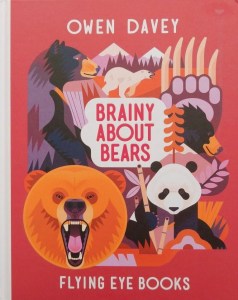
Ranger Hamza’s Eco Quest / Brown Bears

It’s great to be back in the company of Ranger Hamza and here he takes three children and readers on an important learning journey to discover how nature’s everyday heroes from the smallest seed to the tallest tree play a crucial role in our ecosystem, and how we also have a vital role to play. It’s not difficult and Ranger Hamza explains in straightforward steps some ways to help the planet, starting with the making of a mini water butt.
I loved the adjectives used to describe lichen, of which there are three types. In addition to providing food and shelter to tiny creatures, lichen acts as an indicator of the air quality in an area: lots of lichen indicates the likelihood of low pollution, so next time you walk with children keep a watch too see how much is growing.

One thing virtually everybody will notice is dandelions; rather that pulling them up (even from your garden), leave a place where some can grow. In so doing you will be helping several kinds of insects. I know from experience that children love to plant sunflower seeds and watch them grow: this is a great way to provide food for birds, so long as you keep the heads, let them dry out and then put them somewhere birds can access.
These are just some of the suggestions in this thoroughly engaging, inclusive book. It’s never too soon to start teaching children about ways they can help nature thrive so I suggest adding a copy to your family bookshelves, and foundation stage/ KS1 teachers, you need one in your classroom: it offers an abundance of forest school activities.
Another highly effective narrative non-fiction book is

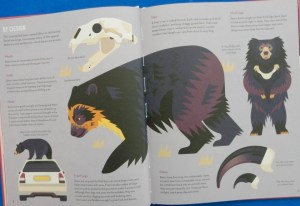
Set in Alaska, USA, this tells the story of a mother brown bear and her two cubs, one male, one female that we follow through a year in the forest. Therein lie dangers aplenty so, almost as soon as they are born, the mother bear starts teaching her offspring survival skills in order that they will be able to live and thrive alone in the wilderness.
The cubs learn to climb, to leave scents to inform other bears where they’ve been and to remove bugs from their skin. It’s dangerous for bears to stay too long in locations where people have left discarded food, as this can endanger both humans and the bears that have followed their noses. Much better is picking berries and foraging for nuts in the meadows and forest areas, which is what the cubs do come the autumn to build up a layer of fat to help protect them through the winter when hibernation prevents them from eating.

Come the snowfall, mother bear builds a new den wherein they will all spend the winter, in the warmth trapped by the tree branches covering the tunnel’s entrance.
After a whole seven months the mother wakens as do the cubs, the light hurting their eyes after so long. Then it’s out into the melting snow to start feeding again and come the summer part of their food will be salmon that have come to lay eggs in the gravelly rivers. Danger isn’t over however; indeed it comes in the form of a massive, very hungry male brown bear; but thanks to the cubs’ climbing skills and their mother’s warning sounds, the three remain safe and as autumn approaches again, the male cub will leave his family and go in search of a new home
Beautifully illustrated and captivatingly written, (with paragraphs of additional information to enjoy either during or after reading the main narrative), this is perfectly pitched for KS1 children.

Pages & Co: The Last Bookwanderer

All good things must come to an end: that oft used sentence is now sadly applied to the wondrous and wonderful Pages & Co. series. Sadly for its countless followers, but not necessarily so for Tilly, Milo, Oskar and Alessia as you will discover herein. They are still endeavouring to stop the Alchemist carrying out his final plan, as well as finding a way to untangle what he’s done thus far and to save Pages & Co and indeed save bookwandering and the imagination for everyone.

To begin with they venture into Arthurian legend to find the first bookwanderer, the wizard Merlin, keeper of The Book of Books. To succeed in this final quest and get everything they require and discover all they need to know, Milo and Alessia then have to separate from Oskar and Tilly as they travel into different aspects of stories and mythologies. By so doing, can they succeed and receive the help they require?

Milo and Alessia travel into Norse mythology to try and make a deal with Loki. Tilly and Oskar travel into Greek mythology and meet the Muses

Tilly and Oskar meet Calliope, chief of the muses

and the Fates: it’s through information thus acquired that Oskar asks Lachesis, “Bookwandering isn’t as old as imagination?” “Certainly not as you understand it,” comes her reply.

So, Bookwandering is not what they understood it to be ‘. but neither is it what some people desire it to be; Moreover, one character they meet is not what he leads the children to believe either.

The narrative twists and turns so many times that it’s well nigh impossible to recount all that happens but that would surely spoil the book for those who have long awaited its arrival.Let me reassure you though, that there’s a thrilling, satisfying finale, with friendship, imagination and the power of story being key throughout. Who could ask for more; certainly not this reviewer.

Beti and the Little Round House

Beti and baby Jac live in a cosy little round house built by their Mam and Tad in the woods beneath the mountains in Wales. Living close by are Mr Crouch; his house is a tumbledown round one, and in a ferny house live Beti’s friend, Billie, and her mother Fern.
The book follows Beti and the adventures she has presented in four stories, one for each season, starting in the spring when Beti celebrates her birthday with a party and receives a surprise present in the form of a goat to provide her with milk every day; make that a double surprise for along with the mother goat comes a tiny little baby one. Beti names them Goat and Naughty.

When summer comes, Beti enjoys collecting food from the garden – peas and strawberries but she’s not the only one eager to gobble them up: Naughty has her eyes on them too. Back indoors, the little girl has problems amusing her little brother so Tad sends her out and she goes to visit Billie and together the two friends, aided by another friend, Blue, spend the rest of the day endeavouring to fill up an enormous jar with water from the nearby waterfall.

Unsurprisingly there are spills aplenty but also magical seeming dragonflies to assist – fairies, so Beti tells Mam and Tad.

Autumn brings dark evenings and lots of berries to pick and make into pies before the birds gobble them all. There’s also fierce stormy weather that reminds Beti of a dragon with its roaring sounds and she falls asleep somewhere that isn’t her snuggly bed in the little round house. The day ends well though, with huge helpings of Mam’s delicious pie.

With winter comes the ice and snow, a poorly Mam, escaped horses and Beti overcomes her fear of the dark.

Sheer delight from cover to cover. With its gentle humour, Atinuke’s gorgeous descriptions of the natural world and Emily Hughes’ wonderful colour or black and white illustrations on every spread, and themes of family love, friendship and the power of believing in oneself, this is a lovely book to read aloud to foundation stage children. For most of them the portrayal of a simple way of life will be something entirely new.

No. 5 Bubblegum Street

Translated from the original Polish by Scotia Gilroy, this picture book takes readers inside the apartment building at No. 5 Bubblegum Street. It’s five pm we’re told by our tiny, friendly insect narrator, who lives in the top floor apartment, number 11.

One by one, we are introduced to the residents of each floor, the first being Mouse, a famous rapper preparing to go out. Mouse is frantically searching for his hat to complete his outfit. Apartment two is home to some monkeys and we join them in their kitchen as they bake a delicious “speckled orange orangutan cake” Apartment three, owl’s residence is currently empty; all we see is evidence that Owl enjoys games of different kinds.

There’s also Cat, lover of birdsong; Panther who is mad about house plants, a family of spiders, musicians all, a slumbering Hippo,

frogs, a sculptor dog and Bat ready and willing to share a twenty one move dance routine.

Come 6pm all these neighbours meet on the rooftop terrace where they each contribute their particular talent to a party and a great time is had by all.

This will appeal to children who enjoy poring over detailed illustrations, especially of the quirky kind. Full of movement and joyfulness, Gosia Herba’s, executed in bright pencil colours, are certainly that.

The Bravest Word / The Feeling Good Club: Believe in Yourself, Bella!

A powerful story of trust and love between a boy and a dog that addresses depression in youngsters, it will surely help readers who are struggling to recognise the symptoms in themselves. It will also reassure those readers that they aren’t alone and however confused and scared they might feel, there are ways to cope, so long as they seek help from somebody.

Eleven year old Matt, a soccer star is suddenly beset with thoughts of “I can’t do this” especially when it comes to playing his favourite game and he feels tired all the time. He’s way too scared to talk to his mum who clearly cares but puts his troubles down to hormones, and he won’t say anything to his dad for fear of upsetting him

Then, as he’s out walking with his dad, they come across an abandoned dog that has clearly been very badly treated. Matt is determined to save the creature and decides to call him Cliff after his grandad. He also finds a scrap of paper with the words UGLY, SAD DOG. HE’S YOURS close by. Off they go to the emergency vet and having followed the required procedures, and persuaded Mum, Cliff finally goes to live with the Brown family.

As Matt cares for the newcomer, we see that boy and dog exhibit similar emotions: Cliff recovers physically but remains withdrawn and anxious while Matt remains determined to restore the pooch’s faith in human beings as well as restoring his own zest for life. It’s an arduous slow process, the highs and lows of which Matt shares with his new canine buddy.

In doing so, Matt perceives his own situation with increasing clarity. Bit by bit, the boy begins to open up, sharing, his despair, his sickness, his hopes, through Cliff’s social media presence, which soon becomes viral. There’s enormous on-line support for the dog and by association Matt, from virtual strangers, which finally forces the boy to find the courage to ask for help. “I think I might be depressed,” he tells his Dad. Dad’s response is enormously understanding; he’s clearly proud of his son and feels great empathy towards him. Matt then discovers that he’s not the only person who has problems with their mental health. Then surrounded by love and support, he is allowed to rest and begin to heal.

A hugely important, beautifully written, honest book that shows children they are not alone in their struggles, and that as Matt’s Dad tells his son, asking for help is the bravest thing.

Bella, Archie and Shazmin are three friends who set up a mindfulness club to help them understand and handle their feelings. This has really boosted Bella’s self-confidence, until the three decide to enter the Muddy Assault Course Challenge in the hope of winning £50, which they intend donating to WaterWorks (a charity). They call themselves Ace Team but they’re one person short. Billy, a rather loud, over-confident boy offers not only to join their team but also to coach them. Training begins in earnest that weekend and after one session Bella wants to pull out of the event.

Things go from bad to terrible when the team hold a training session in Bella’s garden and end up wrecking Mum’s favourite plant pots and making a whacking great hole in Dad’s new fence panel and the only one who doesn’t straightway apologise to Bella’s parents is Billy.
Somehow Bella needs to find the courage to talk with Archie and Shazmin, Billy too, about how she really feels. Can she do so and set Ace Team back on the road to enjoying preparing for and participating in, that challenge?
She’s fortunate to have Jess, her older sister, to discuss everything with; among other things that really helps her get her feelings about Billy out in the open, though as events unfold she ends up with a much greater understanding of why he behaves in ways she doesn’t like and ends up calling him a friend.

This is Bella’s second turn of sharing her diary with readers: I wonder who will be next in this very enjoyable series. Make sure you check out the mindfulness activities at the end of the book.

Adnan

Ten year old Adnan and his mother had to flee their home country of Syria and are now safe in a new home in the UK. However, following the trauma, with both his Dad and sister having lost their lives in the war, Adnan’s mother is struggling with depression . Now though the boy embarks on a different kind of journey: to help his mother remember their lost loved ones and in so doing, gradually heal and start to build a happy new life together. He’s hopeful his plan will work as he begins collecting discarded materials from around the city and using them to recreate some of both the happiest and heartbreaking memories from their previous life – essentially story telling in three dimensions.

It’s not an easy undertaking but Adnan perseveres.

As he builds we learn of the traumatic boat crossing the two made and how his brave mother saved Adnan’s life when he tumbled overboard. We also perceive how much she means to him through the everyday things he dreams will soon become realities: all these things he puts in his notebook. A notebook that becomes a turning point for Adnan’s mother: a place from which to begin their life’s new adventure in a new home with a new purpose.

This is wonderfully portrayed in Diala Brisly’s illustrations.

I found this book particularly poignant as my partner and I befriended a family of refugees from Syria a few years back and then others from different parts of the world; but it’s equally pertinent now in the current climate with ever more people seeking refuge in our country and the less than positive reception many are sadly receiving. Happily however there are amazing people like the authors of this book who have given so much time, energy and love to helping refugees and other children lacking resources.

This story will one hopes, spark discussion and help to change negative attitudes towards asylum seekers. For every copy sold a donation of the book’s cover price will go to the charity Choose Love and the authors are both donating half of their royalties to the same charity.

Pearl and her Bunch

Pearl is a member of a very large family of grapes so she thinks, but one day a passing child stops and what he says, precipitates a revelation from Mama and Papa Grape. No, Pearl is not a grape, she’s a pea, albeit a much loved one, but what she’s been told makes her feel as if the grapes aren’t her real family; she’s the odd one out. Shock horror!

Off she dashes, tumbling to the floor where she finds Carlos carrot, her best friend who asks her what is wrong. As the two talk, there comes a loud sobbing and it’s coming from a large yellow fruit. Thinking Big Yellow Fruit must be lost, the friends take her to look for her family.

They hunt high and low till there comes a call, “Grace! Grace!” It’s her mama but to Pearl’s surprise Grace does not look like the others in her family.

Carlos then takes Pearl to meet his family and there, thanks to his responses when she’s astonished by their appearance, she reconsiders her ideas about what it means to be part of a family. “You don’t have to look the same … you can just feel it when you’re with family.”

Those were Carlos’s words but now they are ones that she too would endorse, especially when she receives a very special group hug from the Grapes on her return to ‘her bunch.”

Light-hearted in approach yes, but identity and celebrating family, the topics Momoko Abe explores are topics most of us feel deeply about.

Knowing the Score

Gemma knows very little about her family members other than her mum with whom she has lived for as long as she can remember. However despite their closeness, Gemma is keen to find out about the others – Gran and Uncle Jo(e) – whom she has included in her special people mind map drawn during the year six residential from which she’s just returned. She’s aware that following her return from the USA, Mum fell out with Gran and since then they seldom see one another. She also has hazy memories of visiting Gran’s house and her Uncle’s disastrous wedding, after which all contact stopped.

Then Mum is invited to join Terry and two other friends on a month long, adults only Caribbean cruise. With some persuasion, she agrees to let Gemma stay with Gran, something the girl sees as an opportunity to start healing the family rift. At the last minute though comes news that Gran has fallen and broken her hip. Mum’s initial reaction is to cancel her plans but finally she allows her daughter to stay with Uncle Joe instead.

It’s evident to his niece from the start that he’s friendly, fun and generous, clearly with much more money that Gemma’s mum, though it’s his qualities not his wealth that Gemma values. When she learns that Uncle Joe has work commitments during the first part of her stay and that he has enrolled her in a tennis camp, she’s more than a little worried, but agrees to give it a try. It’s thanks to the camp that Gemma eventually discovers a vital secret about her mum; she also finds that she’s a quick learner when it comes to tennis and has a lot of potential as a player. Now all she needs to do is to bring her fractured family back together. Can she do that without upsetting anyone?

Embracing some of the harsher realities of life, this sensitively written story of a complex family
with its themes of forgiveness, new beginnings, healing and risk taking will be especially enjoyed by older KS2 readers.

North and the Only One

Having woken fourteen days ago from a seemingly endless sleep, twelve year old Rose, has no memory of any life before, not even her name. What caused the scar on her head? Why does she feel lost in her own home? These are just two of the many questions she has. The only thing that feels familiar is North, her puppy. Yes, the woman she lives with, says she is Rose’s mother but despite the pleasant life the three have together, as the days pass something feels wrong. Fragments of her past come to Rose in dreams. She’s walking among the trees – there’s a forest: home perhaps? Nothing like the place she now finds herself in. Then one night Rose makes an unsettling discovery about this ‘Mother’ of hers and it drives her to leave the house, with North beside her. She runs towards the only thing that feels real to her – the forest: surely there she can find other humans.

What Rose finds is that she’s on a frightening journey through a city with a political set up based on control and fear wherein her very existence is both a threat and threatened; and where she doesn’t know whom to trust: the tour guide mouse or the charming fox and rabbit droids working for a travelling theatre. A journey that makes readers feel they’re part of the girl’s search for the truth.
Probably THE most important thing of all Rose discovers is the power of stories; stories that help us make sense of things, that connect us both to the past and one another. Stories make us human and reveal our truth.

With its STEM and environmental references, this is a compelling story for older readers that is highly thought-provoking, exploring as it does, what being human means and what makes a family.

Excuse Me, Are You a T-Rex?

Rather than a case of ‘Look out, he’s behind you, this is an instance of ‘Look out, it is you.’

Soon after a little dinosaur emerges from its egg, it meets a host of other tiny dinosaurs all huddled together. “Have you heard? There’s a T-Rex in town!” shouts one. Unlike most of the other little dinos. this one is not scared at all. Rather, it embarks on endeavouring to find this bus sized creature with its vicious jaws and claws.

How to go about this is not difficult; it merely requires asking anyone and everyone you meet: “Excuse me, are you a T-Rex?” This question is directed first at what we discover is a Chindesaurus.

Having asked almost a dozen others politely,

including one standing atop an enormous pile of poop,

and journeyed through millions of years, our determined little dinosaur still hasn’t met that which it seeks.
Why could that possibly be, I wonder.

In my experience, small humans can never have too many dinosaur books. Using a narrative non-fiction mode this one is cleverly and amusingly done, with delicious dino. expressions and timelines, and will surely appeal to young children. A fun read aloud that gently informs.

How It Works: Shark / Don’t Ever Laugh at a Ladybird

These are two new novelty board books from Little Tiger: thanks to the publisher for sending them for review.

Cleverly designed with strategically placed peep through parts of every page, this serves well as an introduction to sharks for preschoolers. They will be fascinated to learn that these powerful predators have super-strong tails that enable them to swim faster than a motorboat can move. They may well be surprised to hear that sharks were around before dinosaurs existed. I’m sure humans young and not so young are pleased not to have 300 teeth to clean, the number some sharks possess and having learned that, in contrast to humans, sharks very seldom sleep, young children might try that as an excuse not to go to bed at the proper time.
Playful, fun learning in bite-sized portions, with clearly labelled body parts and “Did you know? interjections from a deep-sea diving mouse that swims up on every spread.

You will probably decide to heed the titular warning of the furious faced ladybird, as well as the rhyming ones concerning the other four irate minibeast kinds that fly, spin forth, leap or slither from the pop-ups on Michael Slack’s wacky brightly coloured spreads. If not, you might easily end up in a honey covered mess after baking with a bee, dizzy from trying to out dance a disco crazy spider, lose your voice while endeavouring to emulate a ribbiting frog, or smothered in slime should you hug a shell-loving snail.
Minibeast madness to read aloud with the very young

Christopher’s Caterpillars / Maisy Goes for an Eye Test

While working in the garden with Posie, his best friend and fellow football lover, Christopher Nibble hears a strange munching crunching sound coming from his dandelions. It’s six hairy caterpillars feasting on his prize plants. What should he do? Certainly not let them continue eating his plants. Posie suggests they keep them as pets.They compile a list of possible needs and off they go to visit Mr Rosetti at his café. He amends the list and gives them some caterpillar keeping advice. The caterpillars munch and grow bigger and bigger until they’re no longer in their container.

The friends make some “LOST! ‘ posters and paste them all over Dandeville but nobody has seen the caterpillars. Then comes an email from Mr Rosetti, telling them to bring the jars that had housed the caterpillars to his cafe for inspection.

What do you think they discovered in those jars? Is it time to make some new celebratory posters.

With some lovely descriptions, this delightful story captures the wonder of nature and a life cycle especially well. Children who have already experienced the joys of keeping caterpillars may wonder why Christopher and Posie failed to notice the chrysalises in their jars.

The book concludes with two spreads of relevant information – Caterpillar Facts and How to Care for Caterpillars. If you missed it the first time around, (or if your original copy has been read to pieces) this book with its funky mixed media illustrations is one for sharing with young children either at home or in a foundation stage setting.

In this 23rd Maisy First Experiences story, young children join Maisy and her friend Ella when they attend the opticians to have their eyes tested for the first time. The reason for the visit is that Ella has trouble reading the number symbols written on the nursery blackboard. On arrival they sit in the waiting room until Flamingo, the optometrist is ready: Maisy goes first and is able to see everything whichever eye she uses. Not so Ella though; the optometrist uses her special machine to look right inside Ella’s eyes and promises to make some specs that will be just right for her eyes. Then with Maisy’s help Ella chooses some frames, the lenses are inserted, and she’s given a case to keep them in. Maisy selects a pair of sunglasses to wear in bright sunshine and with a promise to return for a check-up in a year, off they go , both sporting their new glasses.
This upbeat, reassuring story will help prepare little ones for their first visit to the optician.

Supersaurus: Total Tricera-Flop!

Supersaurus is something of a disaster when it comes to saving the day. Smalltown’s ice cream seller, Dan’s residence catches fire during the jamboree and with the assistance of his sidekick, Hatch, Supersaurus hurls the fossil-flinger at the roof extinguishing the flames but wrecking the roof. The duo then notice moggy, Mr Tiddles stuck in a tree. Chaos ensues as they rescue the cat but flatten Dan’s ice-cream van, leaving its contents wide open to thievery in the form of Burglar Gran.

Supersauarus attacks the burglar with his T.rex trap causing cake to fly every which way and ice cream from Dan’s van to squirt forth all over the place super speedily. Just as Supersaurus is about to clear up the mess with his Bronto-Broom, the town’s mayor calls a halt and sends the duo packing. Only Hatch is aware of the impending fate of Dan’s van but he’s caught in a torrent of ice cream.

Can Supersaurus finally save this whole sorry situation once and for all?

Totally daft, Angela Woolfe’s funny rhyming saga of a muddlesome dinosaur and his disasters, is illustrated in suitably silly scenes of the inept superhero at large in the community. With its combination of two of young children’s favourite topics – superheroes and dinosaurs – team Woolfe and Chambers are surely onto a winner with this one.

Dino Dad

Dinosaur daftness to delight comes in the form of a Dino-Dad-Day spent with six year old narrator, Ruby Thumb, her little sister Indiana (Little Indie for short) and their dad, who is a dinosaur expert. Mum, a rare animal photographer, is at work. The adventure takes place on a Saturday and is precipitated by Indie consuming some of Dad’s ‘prehistoric’ porridge then going into his study during a game of hide-and-seek and roaring while they waited for him to clear up a gooey porridgy mess.

When Ruby gives chase, she discovers that her little sibling has vanished. As a result Dad then reveals something he’s always kept quiet about : Ruby is a POOPA – A Protector Of Our Prehistoric Allies – so too are Dad, Mum and Indie. Dad suspects Indie touched his magical ammonite shell when in his study and has accidentally been transported to Dinnotropolis.

Time for Dad and Ruby to use their special POOPA powers and go to her rescue. So begins a madcap chase to discover Indie’s whereabouts before she creates too much havoc on that secret island

and get her safely home before Mum returns in the evening.

Penned by CBeebies host Andy Day, with terrific black and white illustrations by Steven Lenton at almost every turn of the page, this is ideal for younger newly confident readers as well as a fast moving read aloud for those around Ruby’s age.

Ferris

This story, set I think in the late 20th century, unfolds around ten year old Ferris (Emma Phineas Wilkey), so called because she was born beneath a ferris wheel at the fairground. Ferris is sensitive, serious and a lover of words, the last thanks to her 4th grade teacher.

It’s an eventful summer for certain. It was then that a ghost appeared to her grandmother Charisse, that Ferris’s six year old sister, Pinky, decided to become an outlaw and that her Uncle Ted left Aunt Shirley, his wife to live in the basemen of Ferris’s home, hoping to paint a masterpiece. Oh yes and it was the summer that Dad declared there was a racoon in the attic; moreover Charisse said she was unwell and agreed to see a doctor.

Add to the mix Ferris’s best friend, Billy Jackson a pianist who hears music in his head all the time, Boomer the dog, teacher Mrs Mielk, Billy’s dad Big Billy Jackson and Charisse’s oft quoted assertion that “every good story is a love story” and you realise that those words definitely apply to Kate DiCamillo’s moving, memorable, quirky tale. Assuredly there’s love in abundance, but there’s also reunion, plenty of humour supplied mainly due to Pinky’s misdemeanours, as well as loss and birth.

Until You Find The Sun

Debut author Maryam Hassan was inspired by her own experience and children she has taught to write this poignant, affecting story.

Aminah’s life is a happy one, made especially so by the evenings she spends with her grandfather, Da, who while snuggled together on his charpai, tells her tales of adventurers who visited new lands and made exciting discoveries. Then one day her parents tell her that they too are going to set off on an adventure. At first Aminah is excited but then Da tells her that he isn’t going with them.
Saying goodbye to her beloved grandfather, brings Aminah to the brink of tears as she urges him again to join then. “I am always with you. You will find sunshine wherever you go,” he tells his granddaughter.

When their plane lands at their destination though, there’s no brightness, only grey skies and rain. The next few days continue to be sunless, bitterly cold and despite wrapping in several layers, Aminah still feels numb both inside and out. She feels out of place in her new school too

and despite her parents’ best efforts to cheer her up, the only warmth she feels is when talking to Da on the phone. How she longs to go back. Understanding Da reminds his granddaughter that her adventure is just beginning and promises to light her way until she finds some sun once more.

That seems more unlikely than ever as the days grow even colder, but then as she trudges along clutching her Mama’s hand, she suddenly spots something bright mango yellow that reminds her of home. Mama and Aminah go and make a special purchase, one that brightens up the day considerably.


The following morning Aminah opens her curtains onto a sight that seems to herald that adventure Da had promised her. Outside in the snow she meets a new friend and at last the cold doesn’t have that same dismalness. When next she talks with Da on the phone, he knows that Aminah has at last found her sunshine once more.

Having spend most of my teaching life in schools close to Heathrow Airport, this beautiful story resonates powerfully with me. The author captures perfectly those feelings of overwhelming grey so many children are beset by when they first arrive from parts of the world so different from the UK. Anna Wilson’s scenes in the early part of the book radiate warmth – interpersonal and climatic – as well as portraying the contrasting grey dreariness of Aminah’s new environment where she’s never experienced such cold. An important story to share with KS1 classes especially.

Jawsome: Licence to Rock

There’s not one but two stories in this action-packed volume, the first being the titular Licence to Rock. Let me now introduce, as he says himself. ‘Finley – supernormal shark kid by day, totally famous rock star by night.’ His fellow band members are his best friends Hunter (Harriet Heartens), Gilleon (Greyson Glitter) and Gnash (Gnarly Nelson). Adult readers will find themselves smiling at these punning names,
As the first story opens the band are preparing to head off to participate in the Euro-fishin competition in Shellbania but then at the last minute Gnash fails to show up.

With just two days before the contest the clock is ticking if the other three are to find him in time. Off they go to Gnash’s home to look for a lead and there find a card with a fish symbol that sends them rushing to the Business District. Having managed to get themselves into FISH HQ, they learn that not only is Gnash there but that using his talent for rhythm, he’s helping a super-secret spy agency track down the evil organisation, A.B.B.A (Alliance of Brutally Bad Anglerfish)

and stop them from shrinking the sun; and it transpires, from taking over the entire ocean. Can Gnash crack the vital code and with his friends prevent ABBA causing crab-tastrophe? If so, is there any way that Jawsome can get to that competition in time to compete in Euro-fishin.

In the second adventure Zombie Sharks Attack! Finley is fearful about playing wrong notes in the Rhythm and Chews festival and becoming a laughing stock. The big problem though is the sudden arrival on the music scene of The Killer Wails, they’re even top of the popularity polls, stealing audiences from Jawsome by the minute. Come festival day, the four arrive on stage and find that they have no audience at all. Cancellations follow, but also something extremely seaspicious: the school is empty save for Principal Flotsam who has turned into a zombie. In fact every shark in Chumville is zombified. It seems that this is down to the sinister doings of Killer Wails. The only ones not under the mind control of the new group are Jawsome. They need to investigate pronto. Ear muffs on guys, if you’re to stand any chance of overcoming the dastardly Killer Wails; followed quickly by Jawsome’s performance of their lives.

The power of friendship and determination are crucial here, and Jawsome have those in abundance though none is flawless. For KS2 readers, liberally illustrated, this is super silly, fast paced punning fun with elements borrowed from tv shows and films. I wonder how many they will identify.

The Magic Garden Frog

Mamgu has a Magic Garden that she tends carefully. It’s a place her three grandchildren, Isabella, Elis and Macsen love to visit, especially enjoying all the different things that are round shaped.

One day while exploring, they find something new in the fountain; it’s a frog they name Suki. As the children watch her, the frog suddenly sticks out her long tongue and flicks it three times making something unexpected happen. The three children shrink and fall into the pond with a splash. The next thing they know is that they’ve become wiggly tadpoles, able to breathe under the water.

So begins a magical adventure during which as a seeming metamorphosis takes place, they learn lots of interesting facts about frogs, their lifecycle and their habitat, and sadly that frog numbers are declining.
After the story is a spread encouraging children to go outside and look carefully at the nature that is all around and perhaps create their own ‘Magic Garden’. It’s never too soon to start introducing young children to the wonders of the great outdoors and this story offers a good starting point.

Both the author and illustrator feel the book is a very personal project. The Magic Garden author Shann Jones writes about, is based on her own garden in Wales and the grandchildren characters are based on her own grandchildren, whose names she used for the story. Illustrator Hannah Rounding visited Shann’s garden and met the real Isabella, Elis and Macsen several times while creating her beautiful mixed media, layered artwork for the book.
Let’s hope their timely tale, seen in part from a frog’s perspective, encourages youngsters to become environmental activists in whatever way feels right for them.
(A proportion of the royalties from sales of the book will be given to the charity Froglife.)

Elf Dog and Owl Head

This weird magical novel is set during a covid lockdown. Clay O’Brian is tired of the virus that has forced him to stay home away from his friends. All he has to play with is a frisbee but nonetheless he enjoys the time he spends in the forest exploring, it’s far better than being cooped up indoors with his siblings. As he goes to retrieve his frisbee a dog suddenly bursts out of the bushes, a strange-looking dog with long ears, red inside – an elf-hound, Clay calls her. The creature – Clay thinks she’s saved him from a bear – follows him home and decides to stay.

Next day out walking with the dog, Clay overhears that her collar has a name, Elphinore, and that the two men speaking to one another think she’s a royal hunting dog belonging to the People Under the Mountain.

Time passes, the school term ends and Clay has even more time to spend with Elphinore, more time rambling in the forest. Allowed to lead the way, she takes Clay ‘on one of the paths that led through crooked elfin ways up the flank of the mountain.’ It’s thus that he meets the owl-head people, in particular an Owl Boy, Amos from a village full of such people.

One afternoon a while later after a strange incident with a shaker that Clay has acquired, his sisters decide to follow him and find out from where he got it. They creep after their brother and the dog, steered by the latter, so they stay on the right path. Along that same path, DiRossi (Clay’s angsty elder sister) also forms a strange friendship with a miserable giant Vud, that her brother accidentally woke from a deep sleep. Somehow her mood seems to improve as this happens. Clay meanwhile is having to spend time helping his Dad.

Come New Year’s Eve, the absorbing tale builds to a dramatic climax with an event – ‘a party between the worlds’ – on the slopes of Mount Norumbega, after which comes a final resolution with Clay having to decide where he, Amos and Elphinore really belong.

A brilliantly clever amalgam of fantasy and the everyday world, equally brilliantly illustrated with Junyi Wu’s black and white pencil art. A book that will leave readers with a feeling of wonderment.

A Better Best Friend

A red squirrel is thrilled to find a best friend while out for a walk in the woods one morning; it’s a mushroom named Pock and has a ‘real best friend face’. Despite not saying much, said mushroom seems willing to comply with the squirrel narrator’s desire to show him “things you wouldn’t show anyone except a best friend” : things such as puddles reflecting the sunlight and clearings with tall grass. Autumn and winter pass and the two stay close to one another doing seasonal things, but with the spring comes Moo.

Moo is a fly, a fly that knows some even better parts of the forest and now the three spend their time together, with Squirrel wondering whether perhaps Moo is a better best friend than Pock.
Now Squirrel has a dilemma. ‘I want ONE best friend. Not two!’ he declares. Then one morning along with the sun, Gunther (a mouse) appears. Again it’s a while before much is said.

I’m pretty sure a lot of thinking is going on though, especially by Squirrel before the declaration of ‘The (Better) End’ – I wonder: what do you think? It certainly works for playing cards as the final page shows but for a bestie? Hmm.

Translated from the French by Anthony Shugaar, Tallec’s playful, slightly surreal quirkiness, is evident in his scenes of the characters in this tale which is likely to leave many readers, including this reviewer pondering upon its open-ended nature – or perhaps that’s the creator’s intention.

Frida the Rock-and-Roll Moth

Frida is a moth: with her prowess at playing loud music on her purple guitar and her pointy boots she exudes funkiness. Despite constant encouragement from Auntie Edna, her number one fan, there comes a day when Frida feels anything but shiny. She even begins to think of giving up playing her purple guitar,

then suddenly there appears a big bright light and she sees a host of rock-and-roll moths that are dancing, singing and rocking. Eager to join them, Frida begins to approach them but as she gets closer, she starts to feel smaller. They all seem so much sparklier than her. Why can’t I be more like them, she thinks to herself.

Back in her room, Frida decides change is needed: boots, songs and purple guitar are all replaced. The following night at the Big Bright Light, Frida moves forwards again, but the same feelings start to worry her until she hears Auntie Edna’s words, “Go, Frida! You can do it! Your best self is always inside you!” So, she begins to play but to no avail: still nothing feels right. Alone again in the dark, she feels inadequate once more.

Returning to her bedroom, she is determined to change again and gives several possibilities careful consideration. Along comes Auntie Edna with a hug and some vital words of wisdom. Are those what is needed to empower Frida next time she visits the Big Bright Light?

With it’s delightfully quirky illustrations that show so well Frida’s feelings, and vital message about believing in yourself, Kim Hillyard’s tale will surely encourage young children to find their inner light and let it shine forth no matter what challenges they face: self belief is key.

Bad United: Just For Kicks

Delivered in graphic novel form, this must surely be soccer at its silliest. It’s also great fun.
Meet Hoof the unicorn who desperately wants to be part of a team, but his previous club, unable to appreciate his talents, has just kicked him out. Wither next he wonders, and then he spots a notice for BAD UNITED. Off he trots in the hope of being given an opportunity to show his prowess to mermaid manager cum coach, Serena Winmer and become part of the squad.

Having been accepted, it’s time to meet his new teammates: captain Bones, a skeleton who isn’t always able to keep her head on, ROARsome Rex, dino. defender, striker Bolt the cheetah who brings the thunder and lightning, Tinkerball the definitely not sweet fairy with her dazzling moves, and Annette the super-large arachnid goalie. All these, so their previous teams have deemed, are sub-standard soccer players.

After some pretty intensive training, team Bad United enter their first tournament. They’re up against The Blazing Dragons – a formidable bunch with some very nifty moves.

But can the newbies sporting brand new kits, with their combination of strength, speed and skill. not to mention some aromatic assistance, remember coach’s spirit lifting words, get their act together, surprise the commentators and emerge victorious, even when they’re 0-5 down at half time?

An enjoyable read, especially for those who prefer stories where the visuals are dominant.

Big Gorilla

Rarely I think, has so much artistry gone into a book of opposites as this one. From the cover, onto the title page and throughout the other spreads are show stopping portraits of primates. ‘What’s the opposite of old? asks the first sentence; turn over and there is the one word answer, ‘Young’ opposite which is a very small, pinkish coloured, thumb sucking infant gorilla. Sad, followed by happy are illustrated on the next two spreads, happy being portrayed by a blissful looking chimp holding a single flower. Then come heavy and its opposite, light, alone and together (observant readers will spot several intruders in the crowd.),

and BIG and small.

The next question is more tricky asking, ‘What’s the opposite of opposite?’ ’The same!’ comes the response with its illustration of a somewhat puzzled primate.

With a touch of the illustrator’s trademark surrealism, this is wonderful celebration of primates of all kinds, some of which followers of Anthony Browne might perhaps recognise from previous books of his. Exquisite illustrations of such wonders as orangutans and chimpanzees, not to mention the odd gorilla will delight readers of all ages.

Monti and Leo: A Newcomer in Pocketville

Pocketville as its sign says is, ‘a quiet little town’ and that’s just the way the animals living there want it. Like the others, Monti Mole dislikes change; he sticks to a daily routine but then one day, he discovers a stranger, Leo Lizard, sitting on his favourite rock. At a loss to know what to do, the mole goes home and has a sleepless night. Next morning there’s Leo again sitting on Monti’s rock, but this time the lizard’s genial greeting and ensuing kindness disarms the mole and a friendship starts to blossom.

At the bakery the following day it’s apparent that baker, Mrs Sheep is suspicious of the newcomer commenting, “These strangers! They never respect our ways.” and warning Monti against becoming Leo’s friend. The mole though speaks up for Leo and the two walk off together.

Later, as Monti and Leo are sitting on a log, they hear the sounds of music. It’s Mole’s friend Harriet strumming and singing and Monti introduces her to Leo. This leads them into deciding to hold a talent show that anyone can audition for. Off they go to the library to enlist the help of Carl Crow. Poecketville residents are at first interested but quickly turn reluctant thanks to Mrs Sheep’s crusty ways.

However Mole eventually succeeds in sweet-talking the curmudgeon into sharing her ‘gorgeous singing’ at the show; and just in the nick of time before the organisers call the whole thing off. Come show night, the entire Pocketville population is in attendance, either performing or watching and the show is a big success.

The book’s creator aptly dedicates this story to ‘anyone who has ever felt like a stranger’. With its themes of friendship and community building, it was so good to see Monti finding his own talent in the latter. Sylvie Kantorovitz effectively uses a muted colour palette, simple lines and patterning throughout presenting her tale in graphic novel format for younger readers, .

Earnest Sandpiper’s Great Ascent

In this deeply heartfelt story we meet three young members of the Sandpiper family on the day they are, so their parents expect, going to learn to fly for the first time. Spur and Rouse are full of confidence; not so Earnest. Under their parents’ tutelage: “BREATHE… TRY… JUMP… FLY!” Earnest’s siblings take to the air; Earnest however baulks at the edge of the dune. “I think my feathers are too heavy for me,” he tells his mother as he looks for a second time over the edge.

Using her wing tip, Mum draws a heart shape in the sand, adding the promise that “soon your heart will glow like the morning clouds. It will shine with desire and belief. ” This magical glow, she assures him, is a sign that magical things are going to happen. Other family members further encourage Earnest and then leave him wondering if he’ll ever feel the glow. He climbs carefully up a piece of wood, breathes in and tries a jump but … lands flat on his back. From his supine position, he spies a yellow balloon floating above him with that same heart decoration his mum drew. Earnest follows the balloon across the beach till it lands in the sea and he follows his curiosity into the water but as the tide comes in, he finds himself entangled in the balloon’s ribbon and thoroughly afraid.

Happily, his family returns just in time, and their loving concern triggers that magical glow his Mum had spoken of, as well as Earnest’s self-belief. With those basic instructions in his head and a powerful SNAP! Earnest takes flight.

The author’s naturalistic paintings are superb, brilliantly expressive, making that plastic-looking balloon stand out against the natural environment, a meaningful message indeed, helping to make this a cautionary tale about the dangers posed to wildlife by balloons floating free, as well as a powerful story of believing in oneself.

Explodapedia: Rewild

The latest topic biologist and neuroscientist Ben Martynoga turns his attention to in this cracking non-fiction series is that of rewilding. In the glossary, the author defines rewilding thus: ‘giving ecosystems the help and space they need to grow more biodiverse, resilient and able to look after themselves, and us too.’  There’s no doubt our planet is in a diversity crisis but, taking a positive stance, in his witty style, the author accentuates hope for the possibilities that rewilding offers.

Presenting such topics as the rules and intricacies of ecosystems and food chains, how the release of predatory wolves in Yellowstone National Park in Montana created opportunities for wildlife to thrive at every level so that with denser tree cover, healthier rivers and wetter habitats, the entire park has become more resilient if the climate crisis continues to escalate; as well as the way trees share and work together.

There’s even a plan by two biologists, Eriona Hysolli and George Church to use preserved mammoth DNA to create what they term, ‘mammophants’ to help tackle the biodiversity crisis. 

With a plethora of illustrations that have amusing speech bubbles, and an author whose love for his subject is electrifying, every spread is filled with accessible scientific information. This is an urgent rallying cry for individuals and environmental decision makers the world over. A powerful read indeed.    


The Spaceman

When the diminutive spaceman steps out of his spaceship on a mission to collect soil samples, his first impression is that the planet he’s landed on is pretty ordinary. That quickly proves otherwise however when he catches sight of a large red bloom. WOW! While he gazes at it, his spacecraft is stolen by a ‘thief that sprouted wings from its feathery sides’ (a bird). He gives chase but to no avail: he’s stranded alone and frightened on planet Earth, especially when he finds himself face to face with ‘a hideous beast’ as he stops to admire the next wonderful floral specimen. Off goes our explorer as fast as his feet will go until unable to flee further, he stops and sits atop a rock to ponder on his problematic situation.

In frustration at not being able to think of a solution, he stands up on the rock and is about to yell at the stars when he notices the night has ended, and with the coming of the daylight, the rich and diverse beauty of earth’s flora and fauna is revealed. Hitching a ride with a butterfly, the spaceman is totally enthralled by what he sees

but then he loses his hold and drops down into a pond where he floats gazing skywards. Along comes the ‘hideous beast’ causing the spaceman to realise that appearances in this instance were deceptive; he now describes his new canine friend as ‘a little unrefined perhaps, but charming nonetheless.’

Then as the two snuggle up together, the spaceman thinks of his responsibilities. A dilemma faces him: should he retrieve his spacecraft and return to his old life or make it impossible so to do?

A clever, rather formal, first person narration together with gently humorous, hatched illustrations that provide perspective, enriching the text, make this a book that when shared with children, will give and keep on giving. Initially they might merely enjoy it as a fun adventure for the little spaceman and then later come to appreciate the elation the traveller eventually feels at finding somewhere he feels he truly belongs.

Adventuring with Ivy Newt

These enchanting stories are set in the world of Miracula and in the Storm Witch, the first, Ivy Newt, daughter of the King and Queen of the Sand Witches is celebrating her birthday. However, due to inclement weather her friends are unable to come to her party and share the culinary treats such as scream cheese, lemon and slime cake with marsh maggots. No matter, her parents have prepared an extra special surprise for Ivy – a disappearing act; the trouble is that they really do vanish for good: a mistake or a sinister happening? It’s up to Ivy and her familiar, a shape-shifting wolf/boy Tom to discover what is behind this harrowing situation and bring back her parents. This means Ivy must fly way outside her comfort zone, but she and Tom are a great team and with the help of Felix, son of the Carpet Wizard King, determination and magic, they might just defeat the evil Queen Clawdelia.

New solo readers will delight in this charmer of a tale with its mix of frights and gentle humour, and Magda Brol’s fantastic black and white illustrations at every turn of the page; if you read this aloud to children make sure they see those.

The Time Thief takes place at Halloween when every year come sunrise, a spooky haunted house, appears near Newt Castle, only to disappear again at the stroke of midnight. Queen Fenella tells her daughter, the place is cursed and she’s to stay away and instead help with the preparations for the party in the castle.
However, Ivy’s disobedient streak wins out and off she goes with Tom to investigate and they hope, solve the disappearing house mystery. When they tumble in, the two discover an imprisoned witch in a sorry state, thanks to her own doing and that of sorcerer Thaddeus Creep from whom she stole a clock, a clock that is broken and needs to be fixed urgently, which means before the last stroke of midnight. With occasional tummy churning moments and some wonderful new characters all ends satisfactorily, and will leave readers eagerly anticipating further adventures.
Her latest being

Ivy has some unlikely adversaries in this story, they’re not the titular Swamp Dragons; rather a thoroughly nasty bullying character, Trouble Ivy who appears as the result of Ivy tipping a whole bottle of her Gran’s Double Trouble Bubble Bath into the tub before she takes a dip. Little does she know however that it’s so old the magic ingredients are well out of date and hence both she and Tom now have doubles – exceedingly troublesome ones as she’s soon to discover.

The purpose of Ivy’s stay at Gran’s is so she can see for the first time, the Swamp Dragons Gran is so excited about when they stop for a few days to rest on their way to their winter home in the Dragon Isles. Now with Trouble Ivy and some allies causing chaos, Ivy will have to use all her ingenuity and summon up her bravery to defeat her enemies, save The Book Wizard’s Library and prevent the kingdom of Miracula being incinerated. Can she do it? Possibly, with assistance from friends, be they established or new ones.

Readers will be rooting for eight year old Ivy as they’re whooshed along to the end, eager to discover how things turn out. It matters not whether they have met Ivy before or are new to this series thanks in no small part, to Magda Bro’s map of Miracula and potrait gallery of the characters. They are a great counterpart for Derek Keilty’s text with its satisfying mix of magic, mischief, drama and gentle humour.

I Really, Really Don’t Like Parties

When Dora discovers an envelope containing an invitation to Rashid’s birthday party at the bottom of her book bag, her heart sinks: she does not like parties at all. Mum insists it will be fun but Dora is creative thinking up all kinds of reasons why she can’t possibly go, even if her friends will all be there.

Mum is having no nonsense though and packs her off to the party.

Dora is right about it being a very noisy affair but does her best to participate in some of the games. Then comes the teatime announcement. Dora dives under the table and there to her surprise finds she’s not alone. Tom is already there and he’s tucking in to a plate of food which he shares with Dora: that’s two party haters and two new friends having a great time together.

Some time later Dora receives another party invitation. I wonder what her reaction will be to this one.
As a young child I would have been a Dora, though I probably wouldn’t have invented such wonderful excuses nor gone under the table and I know a number of children who feel the same about hectic noisy parties now.

Angie Morgan’s illustrations of Dora’s excuse sequence are both hilarious and heartfelt. She cleverly uses humour – visual and verbal – to convey a very important message: we are all different in our response to loud, busy situations and Dora’s feelings about them are perfectly valid.

Lenny Lemmon and the Alien Invasion / Cluedle: The Case of the Dumpleton Diamond

This is the third in the laugh-out-loud series starring Lenny whose daft doings delight younger solo readers. As this book begins, Lenny is complaining of boredom: it’s the school holidays and his two best mates, Sam and Jess are, so he believes, both away enjoying life in distant parts. His Dad meanwhile is busy inventing crazy contraptions that are doomed to fail. Lenny is sent to return something to his Grandma’s ice-cream shop but unexpectedly, he finds that she’s not her usual cheerful self when he arrives. Due to lack of customers, she realises it’s either do something to boost sales or close down the shop for good.

On his way home, Lenny discovers that Sam and his family are not away, indeed they too are worried about lack of customers, to their bookshop in the town. The boys determine not to let these once much loved shops close forever. On go their thinking caps for project SAVE THE TOWN. To boost sales at the local establishments, Sam reluctantly agrees to don a alien costume and participate in a pretend alien invasion; that will surely attract attention.

Inevitably, things don’t go quite to plan. Yes the town is constantly full of tourists but it becomes under intense scrutiny from the media. With business booming who should return to the scene but their other friend. If Sam and Lenny reveal their doings, will it be a case of game over? Sir Percival Hickenbottom representing the Enormomall, certainly wants it so. Time to take him on: the chaos is only just beginning but friendship is key.

Bursting with James Lancett’s’ crazy illustrations, this riotous romp is great for newly confident solo readers or as a class read aloud.

Murdle has already established itself as hugely popular with adults and now younger readers have the opportunity to get cracking on a case courtesy of the Hartigan Browne Detective Agency. Herein Dave the dog has been pup-napped and it is up to you, the reader as a newly recruited agent, to find out why and who the culprit is. This is the first of many puzzles that will, hopefully, lead you to the discovery of the Dumpleton Diamond.
To get those little grey cells all a-buzz, there’s a variety of puzzling tasks from codes to logic problems, picture puzzles to anagrams – probably something for everyone, including adults who want to stick their noses into the book. You might even want to make solving this case a joint family enterprise. Better that than cheat and look up the answers, which are given at the back of the book.
Aqua Boy

Islander Aaron lives by the sea with his parents and elder sister, Angel. Mum and Dad are ocean guardians, volunteers performing a vital role in trying to keep the beach clean. His sister is at home in the water as well as on land and loving to plunge into the waves, she calls herself Coral Girl. Aaron would dearly love to do the same but he’s frightened of going under water. When he shares his fear with his Mum, she tells him that it will happen one day, “when you least expect it.” Dad is equally reassuring when Aaron joins him in the boat as they head out to check on the sea creatures.

That night a huge storm blows up and the following morning the beach is littered with rubbish. The ocean guardians set to work clearing it up, Aaron and Angel imagining ways they might ‘clean up the ocean for good.’

All of a sudden, Aaron spots an octopus, stranded, so Dad says, on the sandy shore. Dad entices it with a length of wood. The children watch as gradually the creature wraps itself around the stick and Dad wades out into the sea. Grabbing his goggles, Aaron follows looking right at the octopus, the creature looking directly at him as it slowly releases its hold on the wood

and swims free below the surface.

The boy then puts on his goggles, breathes deeply and immerses himself, watching the movements of the octopus. Once his friend has swum away Aaron stands up and there, fear finally gone, he is really happy and ready to embrace a new way of being an ocean guardian. He learns about the creatures he sees underwater, helps care for them and never stops hoping his octopus friend will return.

This timely, gentle tale of environmental guardianship with Ken Wilson-Max’s vibrant scenes that portray both family love and the vital role ocean guardians play, will one hopes, highlight to young children the importance of caring for marine life and ensuring that they play their part by taking their rubbish home as well as helping to keep beaches clean. A final spread gives some octopus facts and underscores the outcomes of ocean pollution.

Marley’s Pride / You Are Brave

It’s June and for Marley and for Marley’s grandparent Zaza, that means Pride month with its parades and other celebratory activities. Marley really wants to join Zaza at the festivities when they’re to receive an award for transgender advocacy, but with sensory sensitivities noise and crowds making the child tense up at the very thought, it’s a no go for the young narrator.
Come the morning of the parade, the child decides to give it a go after all. Into a bag go noise-cancelling headphones a fidget spinner and favourite lavender bunny and off go Zaza and Marley, the latter feeling very uncertain.
At the venue, just as things threaten to overwhelm Marley, Zaza’s reminder, “Pride isn’t just a big ole party. It’s about celebrating who we are, about community, and love” gives the child a boost of courage to go among the crowds. By the end of the day, Marley feels a part of that community with new friends

and a personal delight at belonging.

Author, Joëlle Retener’s telling is a celebration of Pride’s communal spirit brought wonderfully to life with DeAnn Wiley’s inclusive, splendidly textured, bold digital illustrations.
Backmatter comprises double spreads entitled the History of Pride, that includes paragraphs about sensory sensitivities, the other, with lots of definitions and explanations is called More About Marley’s Pride. An invaluable resource for primary schools especially.

‘Being brave does not mean you are not afraid. It means you are afraid, but you do the scary thing anyway.’ Inspired by Sofia Sanchez, a young actress and model who happens to have Down syndrome, that is the vital life lesson contained in this book.
‘Every day, says author Margaret O’Hair, we meet people who inspire us – people who are amazing at the things they do.’ Sofia Cardoso illustrates a guitarist, a vet, a pilot, a baker, a gardener and several others. Before they became amazing though, they had to make the ‘tough decision’ to try something new, which likely meant they had to be brave. This is something that needs to be learned like everything else and no matter what ‘being brave means doing something you want to try.’ Of course, success seldom comes at the first try, but that’s no reason to give up;

Inclusive and optimistic in tone, this is surely an encouraging invitation to challenge yourself, have a go and try something new. With its important messages, this is a book to share and discuss in primary classrooms.

Shadow Fox

Set in the harsh environment of secret islands of the Great Lakes in Minnesota, this story is told from the viewpoint of a female fox mysteriously calling herself YAAAARRRRAAAWWWAAAARRR.
Pitifully thin, extremely hungry and cold in the snow, said fox is looking for Nan, only Nan; all other humans she hates but gentle fingered Nan, provider of tasty trout has gone missing. Suddenly a voice calls out, it’s not Nan but a girl wearing one of Nan’s jumpers, who appears to be missing someone too.

Feeling let down by the only human she trusts, the fox teams up with the girl, Beatrice or Bee for short and together they set out to search for Nan and put the world to rights once again. An adventure unfolds, which takes them to a mysterious island and unbeknownst to the fox, she possesses magical powers which the islanders are hoping to tap into. They find themselves battling to preserve the beauty and natural integrity of their surroundings. But can they together work to restore natural harmony; it’s either that or the magic of the place will be forever lost.

Slightly surreal, this is a wondrous fantasy story, at the heart of which is the power of friendship, that will draw you in from the start. It’s beautifully written with quirky details of the intelligent, intuitive fox and a potent sense of place that will ensure that readers pick up the subtle message about the vital need for us all to stop abusing our planet and look after it.

Words, Words and More Words

Baby Bee has to get safely to the hive and needs the help of little humans to do so. The same is true of some other baby minibeasts: baby ladybird wants help getting to a home log,; baby snail resides in a flower pot; and baby worm also needs guidance back home. There are plenty of things relating to the natural world to spot on each journey and each can only be completed with the help of a small human hand to guide the moving disc that depicts the named baby. Interactive fun that gives little children a sense of autonomy as well as delight at the brightly coloured spreads, each of which has the route on the recto and small, labelled images on the verso.

Little ones can learn and read more than three hundred words with friends Pip and Posy in this large format book. Its ten spreads have different themes each with flaps to lift and a multitude of labelled images both in and surrounding the scenes, the first being Garden Games. Here we see Pip busy planting seeds and Posy ready to entertain visitors by playing some musical instruments.
Next comes At the Shops where we find customer Posy, clutching a coin to buy a new toy. Sunny Seaside is the third destination and the two friends are enjoying a beach visit. Back at Posy’s Happy Home, Pip arrives bringing her a birthday present.

Christmas, Snow, Bubbles, Night Night follow and the final spread Learn with Pip and Posy presents colours, seasons, numbers (to 10)basic 2D shapes, and four examples of opposites.
Offering lots of potential for discussion, as well as vocabulary building and honing their visual skills, there’s a wealth of toddler learning possibilities between the sturdy covers of this book.
Also helping to enhance young children’s vocabulary are recent titles in a popular series:

In Our Bodies children can take the plunge and have a day at the swimming pool where they can learn a wealth of body-related words from the brain to bones and senses to growing.
Coding presents basic language such as commands, sequencing, chain reaction and inputs and outputs. Both books feature a diverse cast of child characters, are engaging both visually and verbally and are worth adding to home shelves or collections in early years settings.

Lola Loves Walks / Serena and the Little Blue Dog

Meet Lola, a furry creature with many loves, so author Jake Hope tells us: she loves kisses and cuddles, having fun with friends, snoozing in sunny places and her favourite of all, walkies, especially when her human takes her to the park.
She has a particular predilection for hide and seek. Paddling along beside the pond is another of her favoured activities and on reaching the bench, she hides to watch the ducks waddling past. Like pretty well, all pooches, Lula enjoys chasing and retrieving objects but thus far, we readers have yet to see Lola in her entirety.
This is revealed in a fun final twist that will amuse adult sharers (who may have guessed what’s afoot) as well as the children they read the story with.
Illustrator James Brown has done a splendid job creating thirteen richly hued scenes of the lively main character enjoying herself without giving the game away about her identity until the final spread.

‘Once upon a time a little girl called Serena lived in a cottage in the woods. She was friends with all the birds and animals of the forest. … But what she really wanted was a special friend of her own.’ : so begins a magic modern fairy tale. One day as she’s wandering in the woods surrounding her home, there suddenly appears a little blue dog. Not knowing at the time, that he’s magic, Serena names him Haiku. She takes him home with her and they become the best of friends. Haiku grows and grows until one day he’s grown too big for her house. Seeing her sadness, he asks what’s wrong. Surprised he’s able to talk, Serena tells the blue dog what is wrong and together they embark on an adventure that takes them over a mountain eastwards, over plains, into valleys and between fields to a distant castle to consult the wise woman. On the way Serena is given three stones – a green one from the mountain bird, a red one from a snake and a yellow one from a golden fish.
These, as per the sweet-voiced woman’s instructions, she places into her crown. What the woman tells her comes as a surprise,

but does it help Serena with Haiku and the size problem?

With its friendship theme Rosemary Clunie has created with striking illustrations and a longish text, a kind of modern fairy tale that can be enjoyed by solo readers as well as shared with young listeners, perhaps as a bedtime story read over several nights.

Blossom Origami

Clover Robin, surface pattern designer, illustrator and nature lover has created thirteen stunningly beautiful cut paper illustrations to accompany step-by-step instructions on how to use origami to make paper flowers, trees or parts thereof, and there’s also a cactus and a clover leaf. Each whole page illustration includes fauna as well as the flora that is to be made. So for instance, on one of the lily flowers is a hummingbird; a deer and a squirrel are visible in the bluebell filled beech wood and if you look carefully you’ll spot the insect atop one of the orchid flowers.

Alongside the instructions to make each of the origami flora is a related short poem, one or two being haiku and some well known poets including Christina Rossetti, Rachel Lindsay, W.H. Davies and William Shakespeare are there too.

There are 3 difficulty levels, so the book will suit complete beginners as well as more experienced origami enthusiasts, and on the index page is a QR code link to ‘how-to’ videos that beginners will find especially useful. Clover also designed the gorgeously coloured tear-out sheets of origami paper, one side of each being patterned, the other plain.

Published in collaboration with the National Trust, this would make a smashing present for a patient child, or an older craft enthusiast with an interest in the natural world.

Totally Chaotic History: Ancient Egypt Gets Unruly! / Be A Scribe!

Speaking directly to his audience using a chatty present tense style, writer, Horrible Histories consultant and presenter of the hit BBC history podcast ‘You’re dead to me’, takes readers on an action-packed, chaotic romp through the whole of Ancient Egyptian history. In this enterprise as he navigates this messy world, he’s aided and abetted by Egyptologist, Dr Campbell Price, curator of Egypt and Sudan at Manchester Museum with interjections in the margin, myth busters and ‘accuracy alarms’ that sometimes challenge Greg’s ‘facts’. Adding to the humour of the text and the reader’s enjoyment and perhaps understanding, are Rikin Parekh’s comical illustrations on every spread.

There’s a brief introduction and timeline, after which we are taken on a whistle-stop chronological tour of the key events in Ancient Egyptian history. Then follow short chapters devoted to important figures such as pharaohs and Alexander the Great (he with a mega ego), as well as other topics you would expect such as mummification and hieroglyphics; we also pay a visit to “Doctor Peseshet’s medical school to see how they treated such problems as toothache, headaches and tummy troubles.

This cracker of a book will be of huge appeal to children who are interested in history in general and Ancient Egypt especially. For KS2 readers I recommend adding it to home, classroom and library bookshelves. With Roman Britain Gets Rowdy! coming in October, this promises to be a brilliant series.

With nothing much to do during the covid-19 pandemic, Michael Hoffen, a teenager in New York spent his time learning about Ancient Egypt and with valuable help from Dr Jen Thum, an Egyptologist and curator at the Harvard Art Museums, and teacher and mentor Dr Christian Casey, a postdoc at the Freie Universität Berlin. During regular meetings over the course of three and a half years, under the guidance of Dr Casey, Michael translated a work of ancient Egyptian literature, called ‘The Satire of the Trades’ and inspired by all he learned, he wrote the book, together with Dr Jen Thum.

The narrative tells how a father, Khety, takes his son, Pepe, up the river Nile to a distant school so he can learn to read and write with the possibility of then being hired as a scribe in the royal court. The author uses photos of over a hundred real ancient Egyptian artefacts to help with the telling, giving readers fascinating information on such topics as the kinds of work people did and how this affects their lives – eighteen jobs are each given a detailed double spread.

In addition there’s a wealth of wisdom including such advice as ‘If you leave school at lunchtime and wander about in the street’s someone will punish you.’ The physical punishment of children was common in ancient Egyptian society.

Superbly produced, this is a book to add to primary collections and with the connection made to modern life throughout, it should appeal to history lovers as well as those studying ancient Egypt as a class history topic.

Big Bad Wolf Investigates Fairy Tales

Behind every fairy tale is a ‘what if ?‘. Behind all scientific discoveries also lies a ‘what if ?’. Bring the two together as author Catherine Cawthorne does here and the result is a really fun debunking of six of the most popular fairy tales by none other that the lupine villain of several of them.

First to come under his scrutiny is The Three Little Pigs and here, as with the others, he presents the story first and then on the next spread, proceeds to ask some somewhat crazy science questions. All this is illustrated in hilarious cartoon strip style by Sara Ogilvie. Readers learn that in fact, let alone not having hair on their chin chin chins, pigs don’t even have chins; it’s only we humans that actually have chins. As for a wolf huffing and puffing to blow down a house, even one made of straw: no chance there on account of having the wrong kind of lips. A whale would certainly do way better but then what would one of those be doing on land in the first place? Should little humans wish to test their own huffing and puffing, there’s a suggestion using a paper straw and a Malteser.

What about a gingerbread house: have you ever pondered upon what would happen to a gingerbread house in the rain? Probably not but courtesy of our scientifically minded wolf, you can try the gingerbread collapsibility test and find out.

As for that cunning pea test in The Princess and the Pea, the Queen devises to determine who is a real princess – it’s totally nonsensical: nobody could feel a single pea through all those mattresses. All you need to confirm this is a small Lego head (or a dried pea), all the pairs of pants you can find (don’t raid the dirty washing basket though) and a wooden chair. What fun – a Princess Bottom Pants Sensitivity Test.

Brilliantly quirky is the way Catherine and Sara have created this STEAM book that children will absolutely delight in. There are hours of investigative fun as well as hilarious retellings energetically illustrated by Sara.. Some of my family members tried out the huffing and puffing test and had great fun but came nowhere near the world record mentioned in the text.

A Sprinkle of Happiness

Told in rhyme by Lucy Rowland and pictures by David Litchfield, this story starts with a seed (nothing special at all) and a boy, kind, brave and smart. What should he do about such a seed, the lad wonders. A sprinkle of happiness, a pot together with ‘Some soil and some water. A bit. not a lot.’ That’s what he tells the seed and his Grandma, who is in agreement, so they do the necessary. Then each day they sit happily outside and before long, the seed grows a short stalk: ‘ … the best stalk I’ve seen.” Grandma says. As if encouraged by these words, the stalk continues to grow taller … and taller until it’s taller than the wall over which the boy and Gran see people walking miserably by. It’s clear, “A sprinkle of happiness. / That’s what they need!”

That happiness comes first to a lady who notices the stalk and sits down enjoying the boy’s smile and the view. Then, atop the stalk grows a bud. Kind words from Grandma and the boy make an old man and a little girl cheer up and so the two continue in this way. As a result the people and the seed grow happier, day by day until wow! That tiny seed has become a stunning sunflower.

A storm comes one night, snapping the sunflower stalk and scattering the petals far away. But seeds too have been scattered, all over town. Wise Grandma knows just what to say to cheer up the boy; but can happiness also grow anew? It surely can

and slowly, slowly sunflowers start to flourish everywhere in the town. Sunflowers that have grown ‘ … as a little reminder/ of how life can be when we’re all a little kinder. ’

A truly beautiful book to share at home and in classrooms, as well as any place where a little bit of happiness is needed.

The Hoys

ARRR! Me hearties! How many of you have ever wondered what a hoy is? No? Well, you are about to find out in this zany piratical tale.

When his friends call out ‘Ahoy There’ Pirate Jake is confused – what are these hoys and where can he find them?

His hoy hunt around the harbour proves unsuccessful so Pirate Jake goes on a very long and very miserable walk along the beach during which he argues with his parrot and having run out of beach, ends up at the bottom of a tall cliff. There, in the sand, he discovers a trail of strange- shaped footprints …

Now where might they lead, the two wonder and who do they belong to? They decide to follow them and see.

‘Ahoy there!” he calls on entering a well-concealed cave. Could this place contain the answer to Pirate Jake’s puzzlement; will he perhaps end up feeling like a true pirate at last?
Ho! Ho! Ho! To reveal the ending would make me a story-spoiler.

Mark Chambers’ bold bright art, some scenes bursting with fun piratical details, is perfect for Kes Gray’s crazy telling, which contains some smashing descriptive phrases. A thoroughly enjoyable read aloud and one to re-read come ‘talk like a pirate day’ this year’s being on 19th September.

Jack Splash / Stitched Up

Jack, whose parents have separated, lives with his dad and does his best to live up to the sporting expectations he thinks his father, a diving coach, has. To that end he joins the AquaDucks, a diving squad, despite having a fear of drowning and hating heights. he’d much rather be spending his time on his hobby – knitting. Unsurprisingly Jack (the story’s narrator) is the worst member of the diving team but then to his surprise he performs well in an event.

Fortunately for him, a rather unusual boy named Billy joins his year 5 class. Billy, a great swimmer, is more than willing to share some diving tips with Jack. Despite the new boy’s strangeness, Jack takes a liking to him.’He seemed to sparkle – like fun and joy just shone out of him. Maybe he was just what this dull, wet little town needed,’ he tells readers. With Billy as a motivational force, perhaps Jack’s luck is about to change. He certainly has an opportunity to improve his diving and thus please his dad, but more important, through his new friend, he comes to understand what being a member of a team really means. (Supporting fellow team members through their ups and downs is a vital life skill to learn whichever sport a child participates in.)
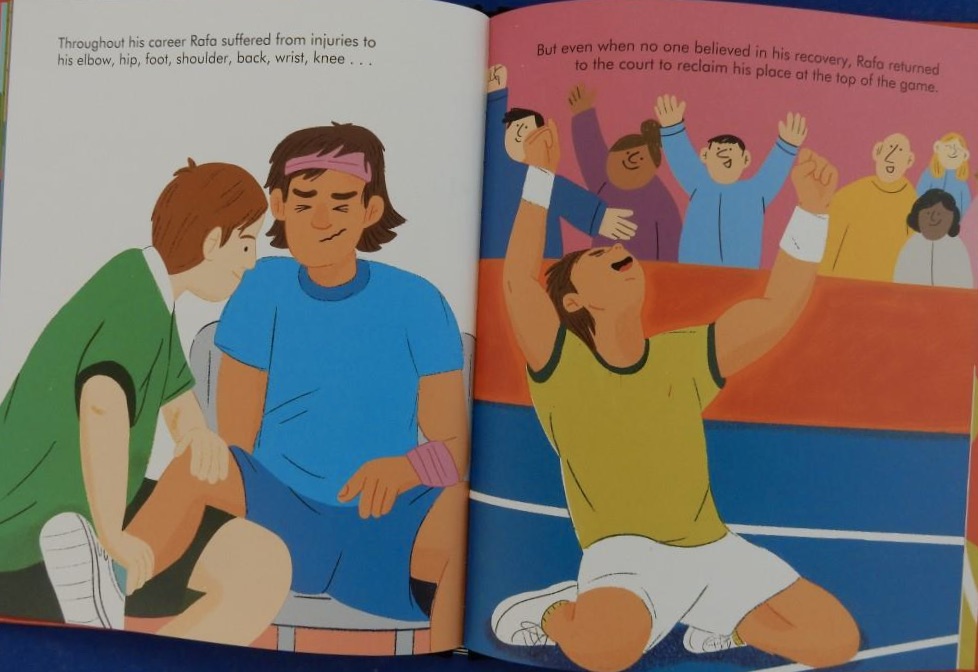
Then, with the important regionals competition for the AquaDucks looming, Billy is kidnapped.
With the fate of a secret underwater world hanging in the balance, can Jack and the rest of the diving crew save the day? What is the importance of a ring that so many people want to have in their clutches, or rather on a finger?

As Jack discovers, winning a golden trophy is not the most important thing. Being part of a team and giving fellow members a second chance feels a lot like winning. As does being a great friend, and having your dad recognise it. And you never know, some friendships might just last forever.

With themes of friendship, teamwork and perseverance, this wonderful, gently humorous tale with a touch of fantasy, written in collaboration with Simon James Green, is full of really important messages for child readers, not least about standing up to bullying.. Equally, the book would make a terrific read aloud to a KS2 class; make sure you share Luna Valentine’s occasional black and white illustrations. I love the fact that knitting plays an important role in the story.

Also featuring knitting as a pastime:

Cassie, the book’s narrator, loves vintage fashion but when she starts at Silverdale High School she makes friends with Azra, who is obsessive about fashion labels. Very quickly she feels under pressure to fit in, which means changing her interests to current trends rather than fashion history. Then, thanks to her neighbour, she joins a local knitting group, The Knitwits. There, in what feels more like a big family set up, she’s able to embrace her passion and be herself, while also keeping up appearances in school. (Anybody who is into knitting will enjoy the knitting element with the descriptions of patterns and stitches, and it may even encourage other readers to embrace a new hobby.)

When Cassie, eco-warrior Fern and Azra are tasked with redesigning the school uniform, Cassie feels conflicted, and finds that she’s having to lead a double life, particularly when Azra begins to ask questions. Torn between proclaiming her new passion and keeping it under wraps, things are far from easy. Can she keep this crazy double life from unravelling entirely?

With vital life lessons about being true to oneself and standing up for your beliefs and what is important to you, this is a story that will appeal to readers slightly below and above Cassie’s age particularly those who enjoy using second-hand clothing shops and believe strongly in upcycling, though the author uses a gently humorous style that never feels preachy.

Uprising

Set in Poland during World War 2, this book is based on the real life story of Lidia Durr – a girl whose life changed irrevocably when the Nazis invaded Poland. Lidia, a talented pianist, is just twelve in September 1939. She and her family went into hiding in their basement when the Nazis began bombing Warsaw as part of their house was smashed by bombs. When the German takeover was complete, Lidia and her family went back to living upstairs but then were forced out as the Germans took the house for themselves. Papa meanwhile has donned his uniform from WWI and gone to fight for Poland.

The Durr family – Lidia, her mother and brother, Ryszard, together with a Jewish woman their former maid, Doda, and Doda’s mother relocate to a tiny apartment adjacent to Warsaw’s Jewish quarter from where, at the mercy of their occupiers, Lidia helplessly watches family, friends, and countless strangers suffer terrible cruelty, starvation and injustice.

With life becoming ever more difficult, Lidia, desperate to fight back, seeks opportunities to play her part. She sneaks food into the ghetto and enrols in an underground school but as she gets older, with Ryszard having joined the resistance, she finds this isn’t enough. Always hoping for liberation, she begins to fear that the world has forgotten Warsaw.

Frustratingly, her brother doesn’t talk about his resistance work so Lidia finds her own ways to increase her participation. She begins by running messages for the resistance but soon becomes a crucial element taking on ever more dangerous assignments. Admitted into the circle of people planning Operation Tempest, Lidia (code name Cello) rapidly rises up the ranks.

This is a powerful story with Polish people who are not Jewish as its main characters that demonstrates just how very dangerous it was to speak out of turn, let alone be a pro-active member of the resistance movement. Lidia survived and was eventually reunited with her mother in Chicago, dying in 2011: her father and brother perished during the war.

Child readers and adults cannot fail to feel in awe of what she and others like her contributed to her country. (Some black and white photographs of Lidia and her family follow the main narrative.)

A Midsummer Night’s Drama

The whole story is presented in three acts and includes a performance of Shakespeare’s A Midsummer Night’s Dream unlike anything you’ve experienced before. It’s penned, so we’re led to believe by a clever bear, Bill, residing in a treehouse with his friends Sir Bun Bun, Foxy and Lady Bushytail. The friends love to act plays at their theatre, The Glade and these attract large audiences from all over the kingdom.

There’s great excitement as Bill and his pals are performing a brand new play. Its entire cast comprises a fairy queen, a fairy king, Puck the cheeky sprite and Bottom. Various insects perform the duties of stage manager, set designer, understudy, and one looks after lighting and another is responsible for props. Its opening night constitutes Act 1. It’s a wild success,

which leaves Bill thrilled but over-excited.

Act 11 shows he is just that, unable to sleep in his cosy bed, his brain all a-fizz with ideas. Up he leaps and against his friends’ advice, begins working on another play until that is, in buzzes Queen Bee who speaks thus, “I COMMAND you to zzzzzzzsleep!” and buzzes out again leaving the acting troupe to offer sleeping advice.

Act 111 opens with Bill trying out some of the ideas proffered, the first being to dance, but to no avail.

Perhaps Sir Bun Bun’s suggestion will induce that much-needed slumber …

With appropriately dramatic illustrations by Isobel Lundie and Louie Stowell’s clever word usage both hinting at the story’s Shakespearean origins and background, this is a pre bedtime treat. Equally it’s enormous fun to share with a class and you can enjoy investigating the book’s final spread that presents some information about the bard himself, William Shakespeare, and his work. Make sure you look closely at the front endpapers too. I wonder what Bill Bear et al would do with Twelfth Night, my favourite Shakespeare play.

The Time Machine Next Door: Rule Breakers and Kiwi Keepers / The Time Machine Next Door: Rebellions and Super Boots

In the first story, having failed at the first fraction in his maths test at school, Sunil runs into the toilets crying. His pretence at being ill results in his being sent home sick from school. Sunil is fed up: no cricket practice for him, insists Dad who asks Aunt Alex – she with the ‘Boring Machine’ – to babysit for the evening. Perhaps things won’t be so bad after all. However Alex refuses to let Sunil dabble with her potentially dangerous time machine. Creating a distraction, the determined boy sneaks next door into her house (although sneaks isn’t quite the right word for her creates a big disturbance with a ladder). Having located the Boring Machine and pressed the ON button, the next thing he knows is rather than going back a little bit to before his maths test as intended, the machine malfunctions and he’s talking to a girl who tells him her name is Rosa.

It’s Rosa Parks who becomes a leader in the civil rights movement in America.

This is only the first of his travels through time in Rule Breakers and Kiwi Keepers. Before the time machine is fixed, Sunil meets a very young Genghis Khan, so Alex tells him on his return; and then a young Lady Elizabeth who, despite what she says to Sunil, becomes the queen of England. All the while Wiki, the kiwi is annoyingly making his presence felt.

In Rebellions and Super Boots, the loss of his lucky T-shirt just as he’s about to go to his cousin’s house to watch the India v South Africa test match sets Sunil off on another crazy adventure whizzing back through time with Alex and the pesky Wiki. Confusingly for Sunil, there’s another Alex in this book who, except for her metal Doc Marten boots, looks exactly like his neighbour. Apparently she’s Alex-from-the-future. What begins as a search for Sunil’s T-shirt quickly turns into a visit to Roman Britain circa 31CE (time to polish up your Latin perhaps?) where Sunil is instrumental in saving the life of Caractacus but is in Alex’s bad books for being responsible for the loss of her Talk Torc.

Two further forays into the past see Sunil oddly clad in underwear and shirt delivering a message supposedly from Lord Stanley to the King, and trying to get back Alex’s Talk Torc. His third time trip takes him to the 17th century when he has to contend with a witch trial of his own. I learned a new word in that episode – pilgarlick. You’ll need to get a copy of the book to discover its meaning.
All’s well that ends well with Sunil back in the present concluding that he can cope with life without his lucky T-shirt.

Quirky assuredly but Iszi Lawrence’s fun books offer insights into many aspects of history that young readers can then delve further into. The time machine might be powered by boredom but children certainly won’t be bored by Sunil’s forays into the past amusingly illustrated by Rebecca Bagley.

For lower KS2 classrooms and home collections.

Bun on the Run

Starring Bernard the Bun, this is a delectably funny take on the traditional tale The Gingerbread Man. As the tale opens Bernard sits atop a display in the baker’s shop, a perfect confection of its kind. The thing is that Bernard has a yen to see life beyond the bakery and so down he jumps and off he sets only to be confronted with a drooling dog. Our quick thinking Bernard turns down the dog’s offer to tarry awhile with “You can chase, chase, chase, / you can run, run, run. / But you can’t catch me. / I’m Bernard the bun!” and dashes away. Almost immediately a moggy appears pondering on the possibility of a bun for tea.

As it pounces, Bernard dashes over the gate and into a sunny meadow repeating that same refrain.
His next potential consumers – two feathered creatures – receive similar treatment. Even when our adventurer is in terrible danger, he uses his wits to outsmart the black one,

lands safely and keeps running and running … and the story ends with a tasty final twist.

Child listeners to Smriti’s rhyming text will soon be rooting for Bernard and joining in with his repeat refrain as he hastens across the pages on his marathon dash. Chris Jevon’s use of a bright colour palette for the illustrations, together with the various background hues indicate the time of day as the tale progresses and readers will come to realise that our bun has been on the run for a whole day from early morning till sundown.

A nursery classic in the making this, methinks.