The Tiny Baker / I Took the Moon for a Walk

These are two books from Barefoot Books – thanks to the publisher for sending them for review

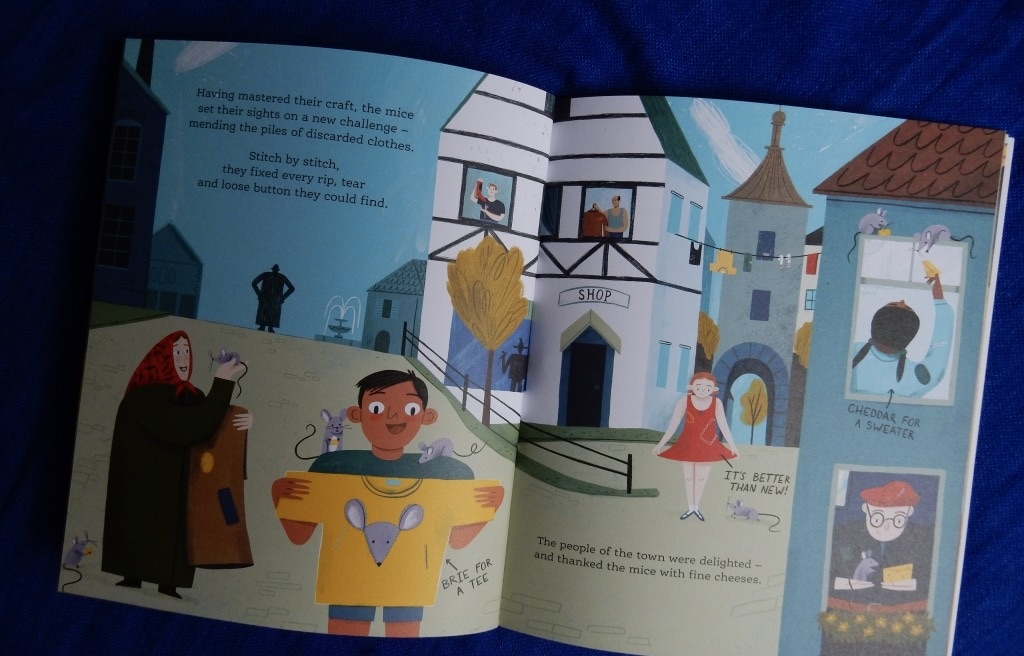
A wonderfully whimsical, tasty picture book told in rhyming couplets by Hayley Barrett and illustrated in oils by Alison Jay.

As the story begins the titular tiny baker is listing on a chalkboard the sweet treat she has on sale that day. Outside her establishment is a long line of ant customers elegantly dressed waiting to try her ‘lemon tarts, / Her sugar-sprinkled cookie hearts, / To sample her pecan pralines / And nibble lacy florentines.’ Meanwhile inside, the baker ensures all is ready and with her team of ladybirds busy whisking and mixing the clock approaches opening time.

At three on the dot, the door opens and in come the ants to be ushered to the table ready to enjoy a treat or two.

But in the kitchen the ladybirds have downed tools and are leaving the kitchen through an open window. Disaster! When the baker re-enters the kitchen she’s aghast at what she sees. Every single worker has flown away leaving chaos in their wake and a baker ‘slumped amidst the mess – / Bewildered, flummoxed, in distress’ …

Having heard the to do, cricket sounds a call to action and the ants respond by cleaning, moving, clearing and mending until very soon order and the tiny baker are restored. Overcome by the wonderful gesture of her customers, the baker is even more surprised to learn of the prime reason they make their daily visit to her establishment. As a way of showing her immense gratitude she offers them a tray of her goodies.

As endearing tale of kindness and community that will surely make readers’ mouths water at the yummy pastries and delight in the period flavour provided by Alison Jay’s portrayal of the customers in fashionable Victorian clothes in her detailed scenes created on a craquelure background.

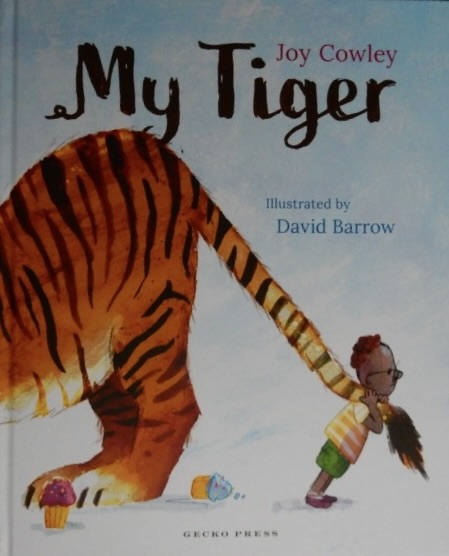
Mysterious and enchanting is this story of a nocturnal walk taken by a boy narrator. With the moon following behind him like ‘a still summer kite’ he has a variety of small but significant adventures. For instance, unused to accompanying a boy on a walk, the moon very nearly gets hooked on a church spire. It’s also serenaded by a canine chorus and later on hand in hand, the two tiptoe through the grass ‘where the night crawlers creep / when he rust-bellied / robins have all / gone to sleep.’ They enjoy a swing flying up high and more before crossing the bridge and returning to the narrator’s home where the Moon shows its thanks by providing a ‘sweet sleepy light’.

Lyrical and rhythmic, Carolyn Curtis’s text reads aloud well and complemented by Alison Jay’s gorgeous scenes of a world bathed in moonlight, would make a comforting pre bedtime tale.
At the back of the book, the author includes information about ‘The Mysterious Moon,’ and ‘The World at Night’, which gives facts about some fauna and flora.

There is a QR code on the back cover of each book: scan them to bring the stories to life with narrations by Teresa Gallagher.

A Tree For Everyone

Jake, Aiden and Pip absolutely love the tree they have discovered. Indeed they’ve made it their own through their creative play. First it’s a castle, reaching high into the summer sky. Thereafter it becomes a pirate ship sailing the high seas searching for lost treasure and then a rocket bound for space. No matter what, it’s a place to laugh, share dreams and do all the things best friends do together.
However, one morning to their surprise, their place of play is no longer theirs alone: three other children are there. Seeing them as a threat to their private world, Jake et al tell the newcomers to go away. Despite knowing it’s not a kind way to behave, things escalate and the tree house is broken into pieces and silence prevails in their special place.

The children disperse and begin finding other things to do and other children to play with. No so Jake though; he stays near to home and can’t stop his mind wandering back to his special friends and the exciting things they’d done together. Eventually he returns to the tree but he’s not the only one who has done so. Lily too has drifted back and, after apologising to one another, little by little a fresh understanding and friendship develops.. Finally, joy of joys, there’s a new treehouse that, as the title says, is for everyone.

This heartwarming tale celebrates children’s creativity but even more important, being willing to offer apologies and accept second chances. Kindness, empathy and inclusivity are key when it comes to resolving differences. Rosie Butcher’s detailed illustrations show how the natural world and the oak tree in particular inspire the children’s imaginations: would that all youngsters had easy access to nature.

Stop! Gangster Koala! / Barking Bake Off!

In the first of Jenny Moore’s Pawprint Productions series for younger readers, cuddly koala actor Archie has landed the role of gangster Hoodlum PIE Claw in the popular drama series Squeaky Minders. His big concern is that he won’t be sufficiently scary to give a convincing performance as the town’s meanest menace. However during the filming of the opening scene, Archie trips and knocks himself out. Upon waking, he believes he’s a real gangster and he rampages through the studios hurling squidgy lemon meringue pies at anyone crossing his path. Having stolen all the fresh pies from another series and sending patients leaping from their beds in fear on Emergency Vets, Archie ends up storming into a live recording of Beastly Buzzers. Will he stop at nothing to procure all the prizes?

Who doesn’t enjoy a baking show so Barking Bake Off! is sure to be loved. The contestants facing one another are Poppy Seedcake and Corgi Joe. Whatever the secret ingredient in Corgi Joe’s barkwell tarts is, it’s not what the contestant intended. Indeed it’s an absolute calamity. The same is true in the second round. Seems Joe has lost his touch: maybe not as week three sees a vast improvement and a score of ten barks. But then disaster strikes in the form of the poisoning. Something decidedly unsavoury is surely going on behind the scenes of Pawprint Productions. It’s a bizarre mystery but can Meek and Squeak in police guise discover a culprit and save the whole series? Now that would be telling …

Berta Maluenda’s amusing black and white illustrations are a vital ingredient in the stories, making them even tastier.

Kids Can Cook Around the World

With its enticing cover, this sturdy hardback introduces children to dishes both sweet and savoury from around the world.
Before the recipes there’s a short ‘Before You Begin’ section that talks about safety, equipment and basic techniques. Thereafter come the recipes themselves, the world in this book being divided into five areas: North and South America, Europe, Africa and the Middle East, Asia, and Australia and New Zealand, each of which has an introductory spread with interesting facts about the food. I was surprised to read that ‘Coca Cola was invented in North America, originally as a medicinal drink’, that there are over 350 different kinds of pasta and that there are more than 1,000 different types of cheese in France.

A fair few of the dishes will be familiar depending to some extent both on how open you are to trying cuisine from various parts of the globe and how well travelled you are. You will certainly find some mouth-watering selections including madeleines, a vegetable tagine

and I’m eager to try making koshari. All recipes have step-by-step instructions with visuals alongside each step and the number of servings each makes.

My only quibble about the book is that there aren’t many vegan recipes but that’s a personal thing and doesn’t stop me recommending it as a very useful one to help youngsters develop their cooking skills.

Hot Food: Nice!

This is Michael Rosen’s hugely popular poem ‘Hot Food’ to which a prelude has been added wherein the narrator tells readers, “When I was a boy I thought my dad knew everything.’ However the day dawns when a discovery destroys that belief. This is what happens: It’s dinner time and the family – mum, dad, the narrator and his brother are sitting around the kitchen table, plates piled high with dinner. It’s evident to the narrator that the potato’s a tad on the hot side and so with just a small amount on his fork, he blows on it – whooph whooph – ‘until it’s cool, / just cool, / then into the mouth: nice!’ His brother and mum do a similar thing. Dad however acts, let’s say, rather rashly. Into his mouth goes a large amount of potato:

YIKES! You can almost feel the skin inside his mouth blistering in Neal Layton’s scene of Dad as he flaps his hands, blows and puffs and a whole lot more until he ejects the potato in small pieces back onto his plate. His family are obviously dumbfounded, perhaps even more so when he states, “Watch out everybody – the potato’s very hot.”

A paragraph from the publisher at the back of the book includes a couple of amusing facts concerning ‘nice’ the meme in both China and the USA.

Neal Layton’s illustrations capture the potato incident splendidly so it becomes a scrumptious slapstick visual story too, full of fantastic facial expressions. A unmissable read aloud for class and family sharing.

Snow

This story is set in Mistmir, a kingdom which is empty save for the Princess Karina who spends all her time digging Snow. This snow is not the ordinary precipitation, rather it has been scientifically modified to be self-replenishing in response to her wish for ‘perfect’ snow on her thirteenth birthday. As a consequence the Princess has been continually labouring and now she and her father, the King, are the only ones who haven’t fled.

One day as she shovels, the Princess discovers her precious fluttery toy, made by the strangers who created the Snow. A sign of hope surely, but before she’s been able to show her father, she encounters a girl, Ela, who has accidentally entered Mistmir from our world. Ela can hardly believe that this is the Princess from the Snow Princess book that her mother used to read to her every night.

Princess Karina realises that the unexpected visitor is key to saving Mistmir and invites Ela to her castle. Ela travels with Karina, hoping that she will discover the truth that lies behind the Book and the strange mental memory-like images it conjured. As they travel on the look out for menacing hounds on the prowl, the girls form a bond of friendship and work together to find answers and save the snow-immersed kingdom.

Combining magic and science, Meera Trehan has crafted a story with themes of loneliness, belonging and forgiveness that is perfect for the chilly winter months. The world building is throughly convincing and the climax of the tale satisfying. Altogether a thoroughly enjoyable, haunting read.

Protecting the Planet: The Secret World of Seahorses

This immersive addition to the Protecting the Planet series is written in an accessible narrative style by zoologist,, Nicola Davies with impressive mixed media illustrations by Lou Baker Smith.

I’m fortunate to have seen live seahorses off the coast of Kerala but I doubt many readers of this book will have been so lucky as to see these graceful, fascinating, almost magical creatures. This is due in part to the 70+ million that are caught annually by humans who then make them into pills and potions or items such as key-rings to sell them as trinkets. Others of them meanwhile become the victims of pollution and dragnets. It’s still not too late however, to save these wonderful animals from becoming extinct: readers will discover how seahorses have adapted to their environment through movement and by means of camouflage and diet changes.

Furthermore on the positive side, they’ll read of innovative conservation schemes in the UK,

and in Malaysia and Cambodia to protect seahorse habitats.

Did you know that seahorses perform a ritual dance? You can discover why from the book and what makes paternal seahorses unique in the animal kingdom.

Certainly worth adding to family bookshelves and KS2 class collections; make sure children’s attention is drawn to the final spread ‘Seahorses and Climate Change’.

Molly, Olive and Dexter: Who’s Afraid of the Dark?

Friends Molly the hare, Dexter the fox and Olive the owl return in a tale of nighttime nerves. It begins with the three enjoying watching the sun setting, but as darkness descends, Molly hears a rustling sound that troubles her. It’s only Dexter cleaning his whiskers. Next Dexter feels something brushing against him and before long, Olive too is spooked though it’s merely shadow shapes. (They are made by Molly’s long leporine ears.)

Then comes rain whooshing down accompanied by thunder – another alarming experience – but eventually the friends realise that their sensory experiences are created by harmless things. The story ends with the three woodland pals enjoying something together before resting beneath their massive oak tree at the forest edge.

Young children too have night-time fears and this fun picture book, with Catherine Rayner’s watercolour scenes where the friends’ expressions – Molly’s in particular – show superbly their growing panic as the tale progresses, is perfect for sharing as a pre bedtime tale.

Molly, Dexter and Olive are endearing characters and their evening episode is ultimately reassuring. Add this book to early years collections and family bookshelves where there are young children.

Flember: The Golden Heart

Jamie Smart brings his superb Flember series to a close with a spell-binding adventure, full of inventiveness surprises at almost every turn of the page, as well as illustrations of characters and diagrams that add to the story.

On account of the heinous Iola Gray and her sinister plans, Flember Island is in grave danger. Can Dev P. Everdew and his lovable red giant robot bear, Boja possibly save the island and restore it to a place of peace and magic? Assuredly he will face numerous challenges, both physical and mental. Imagine having an angry wolf standing over you glaring with its red eyes, and baring its sharp black teeth with strings of spit glistening between them.

Yes there are scary moments aplenty but also lots of humour, not to mention a fair few farts courtesy of Boja. Add to all this, that the book is great for empathy building; and what Jamie Smart has done yet again is to create an unputdownable, thought-provoking book with a hugely satisfying conclusion that Flember fans will love.

Dev. his brother Santoro and Boja will be greatly missed but you can always go back and start reading the entire series over again.

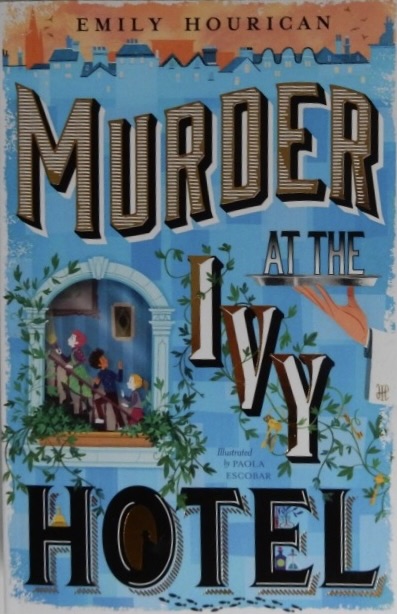
Murder At Christmas

Having been at boarding school in England while her mother (a diplomat), father and younger brother, Billy, have been living in Australia, Grace is excited to be spending Christmas in Bath, staying in her Aunt Mollie’s hotel with Mum and Billy. (Aunt Mollie is mum’s twin sister.)

Mum goes to visit their Gran who lives nearby in a residential care home but after several hours she hasn’t returned so Grace and Billy start worrying and their aunt isn’t around either so the siblings are left on their own. To add to their worries, a body is found on the hotel stairs: something is definitely wrong.
On the positive side, Grace and Billy make two new friends, Olive and Doug; but with each passing day, Grace suspects something terrible has happened to their mum, especially as Aunt Mollie is acting strangely.

Determined to find their mum as well as solving the murder before Christmas, the siblings, working with new friends,Doug and Olive, start searching for clues.

Eventually they discover where their mum is but getting her free safe and sound, plus finding out the truth behind her disappearance is a real challenge.

Superbly plotted with lots of twists and turns, several red herrings, suspense and two young protagonists who really prove themselves, this is a compelling seasonal adventure at the heart of which is family and its importance.

Snuggle up and read this as you drink a cup of hot chocolate in the run up to Christmas.


A Welly full of Christmas

I loved Attie’s Blue Jelly and Strawberries and so was eagerly anticipating her new seasonal offering, which is subtitled ‘Poems for Festive Fun’ and fun is what is contained herein.

There are forty poems, just over half of which actually contain the word Christmas; others focus on wintry weather, snow and there’s one, The Concert that took me way back to my very first reception class Christmas concert. This talks of a boy who wanted to ‘strum’, ‘hum’ and ‘drum pa-rum-pum-pum’ but was allocated a triangle to play. In my class two boys side by side were energetically playing maracas when one accidentally knocked the other’s instrument and the result is summed up in the delicious onomatopoeia of the final verse: ‘BASH CRASH THUMP and THWACK and SMASH … WALLOP, WHACK and CLASH … SMACK and BANG and THRASH’ that ensued as the boys started whacking one another with their maracas. Fortunately the audience thought it hilarious while I, thoroughly embarrassed, was endeavouring keep things going.

My two favourites don’t mention Christmas; both have a weather theme. There’s one describing a Sunday walk: I love the idea of sending ‘ pebbles skittering over ice clatter rattle, clatter rattle, clatter rattle’. I’ll try that at the next opportunity.

The other is Snowflakes, which describes these amazing forms as ‘sparkling icy glow-flakes / putting on a show-flakes’.

With a variety of poetic forms and moods, and an abundance of wit and warm-heartedness,.plus black and white illustrations by Nadine Licence, these offerings are a joy to read aloud to foundation stage/ KS1 children in the next few weeks.

Flipped!

This story takes inspiration from both the COVID pandemic and Charles Dickens’ Great Expectations. Set in 2020 during a COVID lockdown, its main protagonist is fifteen year old Flip. His mother is a nurse practitioner at the local hospital and after on-line lessons undertaken with no enthusiasm during the summer term on Flip’s part, the school holiday has begun. He can neither spend time with his friends, nor enjoy a week or two abroad with his mum. He’s not a keen reader and so with little else to occupy him, Flip has taken to walking out onto the nearby North Kent Marshes.

On one of those walks, he comes upon a derelict house and curious, he decides to investigate. He heads inside and to his surprise a strangely dressed girl, seemingly of a similar age to himself, speaks to him. She says this, “So here you are at last. It’s about time. I’ve been waiting for you for ages.” Flip learns that her name is Estella. Estella is bemused by the mask he has and Flip is concerned that she has no awareness of social distancing nor any of the other rules introduced to stop the spread of the pandemic, though she does mention that there’s no cholera where they are. Estella leads Flip to a room where he must work on listing and ordering a collection of books, a task set for him by a Miss H. However Flip causes some chaos, escapes and goes home. There he does an online search for the name Estella, a search that leads him to the book Great Expectations. Rejecting that the strange girl in the house is part of the story, Flip returns, only to discover that he too seems to be a character in the story.

Unintentionally, his actions start affecting Dickens’s narrative: Flip really needs to find a way to set things right and leave the book once and for all: either that or remain forever trapped within its pages.

In addition to coping with this problematic situation, Flip is at the same time coping with consequences of his parents’ break-up, so many readers will find plenty to relate to in his story. It matters not that most will be unfamiliar with Great Expectations as Philip Caveney’s explanations of the Dickens’ characters are so well done. So too is Flip’s character who is utterly believable and easy to empathise with. A mystery story, with witty touches; strongly recommended for upper KS2/KS3 readers

Dinosaur Dynasty

Countless children are dinosaur obsessed becoming so from an early age. Doubtless they will be thrilled to discover this amazing book from mega publishers Big Picture Press.

Author/illustrator Jack Tite’s Dinosaur Dynasty is quality non-fiction presented in a child-friendly, informative manner. He takes us back to the prehistoric world hundreds of millions of years ago to the Mesozoic Era when the planet was ruled by dinosaurs. This era comprising the Triassic, Jurassic and Cretaceous periods lasted 186 million years with the world changing constantly., the Triassic period beginning with the extinction of some 90% of living things including the ancestors of dinosaurs termed archosaurs. However, it’s thought that the earliest dinosaurs arrived about 240 millions years ago in the Middle Triassic period and these co-existed with the archosaurs.

Jack introduces us to an amazing selection of creatures from the terrifying Tyrannosaurus to the tiny super fast predator Compsognathus that was about the size of a chicken and had very sharp teeth and claws.

Dinosaurs are not the author’s only focus; we meet creatures that lived in the oceans such as the Mosasaurs that ranged between one and seventeen metres in length and had snake-like bodies and paddle-like flippers: imagine meeting a large one face to face. What a magnificent menagerie and we’ve not yet arrived at the Cretaceous Period.

So fast forward and discover one of the largest dinosaurs with its incredible armour, Ankylosaurus.

I wouldn’t fancy being thwacked by that ‘wrecking ball’ of a tail. Surely every bit as fascinating as the creatures of mythology are these prehistoric beasties.

With some richly textured, big fold-out scenes to excite youngsters this is a thoroughly immersive, fascinating book featuring some awe-inspiring, hugely diverse creatures and their habitats.

The Clean-Up Monster / My Dinosaur Shoes

These two board books feature happenings in the daily lives of neurodivergent siblings Roscoe and his elder sister, Ivy.

In the first, when their mother tells the children that it’s time to tidy up the job seems an overwhelming muddle of dough and toys. If only the ‘clean-up monster’ would come to their aid. Roscoe begins in completely the wrong way, getting more out, so he moves on to the dough but Ivy doesn’t like his way of tidying with container lids not matching the dough colours. The containers for the various toys all have visual signs indicating what goes where thus easing the process and then Mama appears in playful mood with the vacuum cleaner aka the clean-up monster.
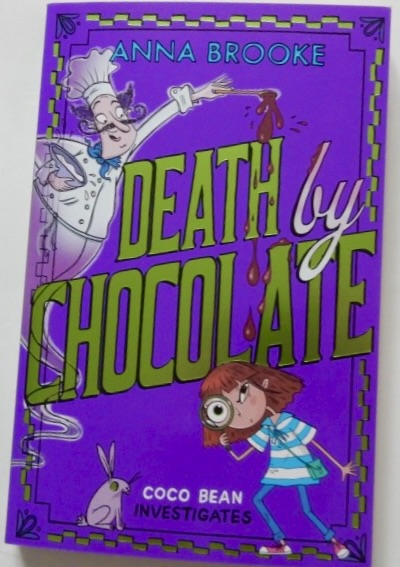
In My Dinosaur Shoes, Roscoe is out-growing his soft, comfortable puppy shoes, his sister certainly thinks so. However Roscoe maintains that they’re not much too small and he definitely doesn’t need new ones. Ivy shows him some dinosaur shoes in a larger size, as well as pictures of other possible options. Roscoe ponders on them all but decides that he wants none of them. Ivy places the dinosaur shoes where her brother can see them every day and become accustomed to so doing.

Then one day his puppy shoes no longer feel comfy and soft. It’s time to try the dinosaur ones and hurrah1 they are absolutely perfect. Of course, he’s become used to seeing them so they no longer seem new.

The author, who is neurodivergent, explains on the back covers of both books that she developed her own strategies to use with her young neurodivergent children when the usual ones failed to work for them. These are illustrated in the simple stories for which Danamarie Hosler (also neurodivergent) shows Eleni’s strategies in action. Any parent/caregiver could benefit from adding these ideas to those they use already and little children will enjoy the simple stories.

Baxter’s View

Herein we meet siblings, Rory the elder and his younger brother, Baxter. They see the world differently: ‘Baxter likes to bounce, and hum, and flap. Sometimes it can take a while to get wherever they’re going. Sometimes this makes Rory cross.’
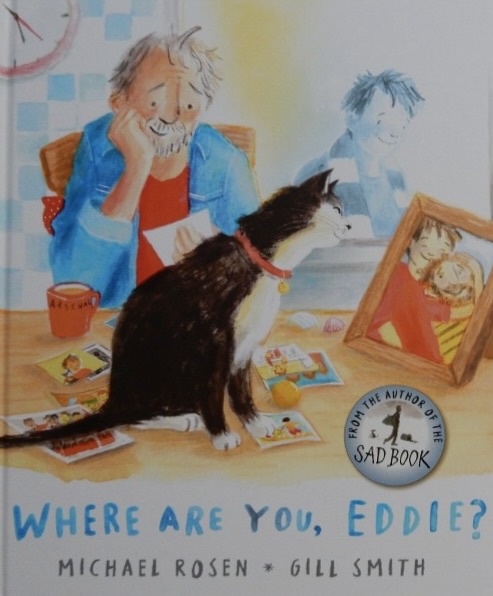
We join Baxter and Rory as they visit the park with their mum. On the way Baxter enjoys some puddle paddling, and Rory notices how the leaves dance beneath his brother’s wellies before joining him in some splashy fun.

At the park gate Baxter stops to feel the long grass tickling him, and having watched him, Rory runs his fingers through the blades, which made him feel calmer. By the pond Baxter emulates the ducks and his brother is amused at his actions. Very eager to reach the playground, Rory is getting grumpy but he does as Mum suggests and lies beneath the tree branches and watches creatures above in the flickering sunlight, appreciating its beauty from Baxter’s viewpoint.
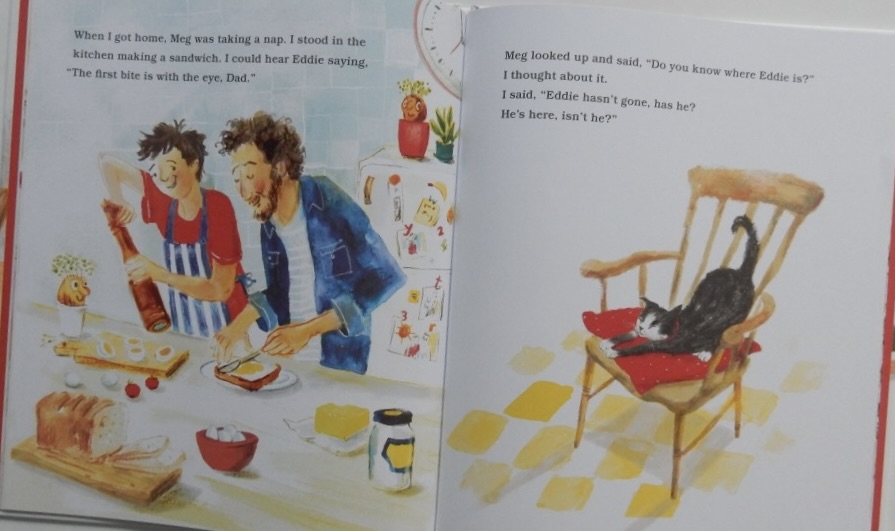
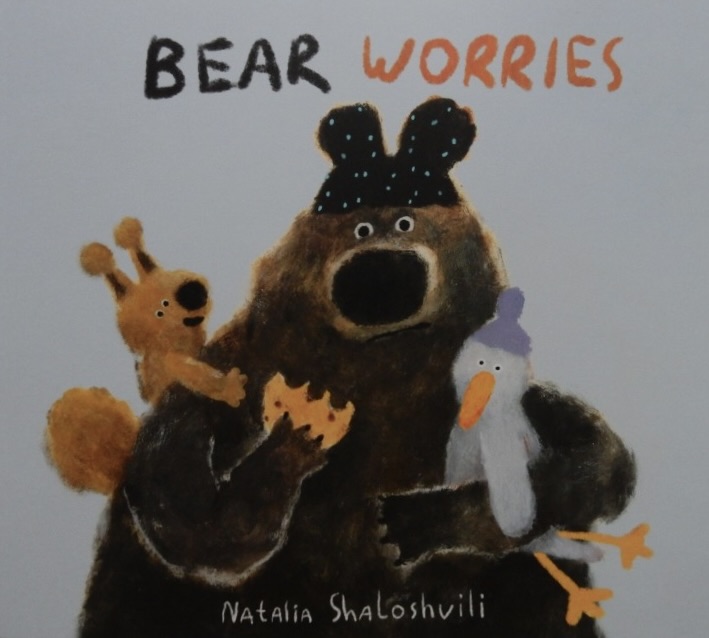
Of course they do eventually get to the playground and the brothers enjoy themselves.

The following week when it’s park visiting time again, it’s evident that Rory has learned that by slowing down, you can see exciting and wonderful things.

As well as celebrating neurodiversity, this sweet, earnest story gently encourages everyone to slow down and take time to see the beauty of the natural world. A book to share and discuss in EYFS and KS1 classrooms as well as with family members.

Lionborn

The story begins in London with two mysterious figures, Abigor and Baka standing over a sleeping infant attempting to extract its blood and becoming frustrated at being unable to do so because just prior to their arrival protective light entered his body. Their intended victim is Fionn Hurley and they have identified him as a Lionborn.

Fast forward to when Fionn is twelve. He has nightmares, vivid ones that seem ever more real when he wakes up with injuries that soon disappear. His parents don’t believe what he says about the dreams and his peers mock him, some calling him ‘monster boy’; however Fionn knows that these are more than mere nightmares.

When he talks to a classmate, Tiny, the boy is interested and suggests the two team up. His closest friend is Ella whose mother is missing, so the team becomes a threesome. Being with Ella and Tiny makes Fionn feel normal again, so he says. But far from normal is the appearance of a lion cub that nobody else can see. Strange things are also happening to Ella and it takes some persuasion but she reveals to Fionn that she’s been receiving riddles that she thinks are coming from her mother; but are they?

It’s not long before the three friends find themselves in the dangerous world of Arborea, not a dream but a world where monsters from Fionn’s dreams want his blood. With Tiny’s confidence, Ella’s determination and Fionn’s intelligence, the three must then work together to stay alive, a desperate task, but one during which they learn things about themselves and one another, things they never thought possible.

The author cleverly weaves together the human world and the fantasy world with its enchanted forests, labyrinths and menacing beasts immersing readers in an environment where boundaries are highly permeable. With Fionn emerging as a hero as the book ends, we’re left wondering what comes next.

Refuge: The Graphic Novel

This graphic novel version of the excellent Refuge book that was published in 2017 will bring the stories to a whole new audience particularly those who prefer to read predominantly visual tellings.

Set in 1938, 1994 and 2015 respectively, we follow three characters, Josef, a Jewish boy who is escaping Nazi Germany aboard a passenger ship full of German Jews in 1938-9, Isabel, a Cuban girl who in 1994 is fleeing from Havana together with a group of other Cubans on a leaky boat and Mahmoud, a Syrian boy escaping from Aleppo in 2015 hoping to reach the EU.

Although my reading preference is for textual stories, I can see how Syd Fini’s illustrations showing the expressions and body language of the characters really help bring the stories to life and the sounds such as the ‘SCREECH! RUSTLE RUSTLE of the forest trees and a boat signalling ‘BWEEP-BWEEP! add additional atmosphere to the settings of various parts of the stories.

The author cleverly weaves together the three story endings and then goes on to talk about and ponder upon their themes, inviting readers to do the same, for the themes are equally or even more pertinent today.

One Cherry, One Cheetah

Originally published as a smallish hardback, it’s great to see this available in board book format.

A dozen exquisite watercolour and gold leaf paintings, all except one of wild animals, are to be found in this super-stylish counting book. To start with there is just one cherry – it’s almost begging to be eaten immediately. Turn the page and there are two regal dogs face to face . and ‘two balls, one big, one small.’ Then follow three bears, three bowls, three silver spoons.’ The next spread gets one wondering: why ‘Four fine foxes, sharing strawberries’ but they have only three strawberries.

Next come five elephants, elegant for sure, walking nose to tail but one of the them is sans elegant Indian style regalia. why one wonders. The six cheetahs are clearly having fun playing pat-a-cake, each pair with tails entwined. The seven pandas – giant ones – have ‘pretty painted parasols,’ five of them: two are sharing and another has a fan. (Love the alliteration in that sentence.)

Eight clever otters, two sporting sunhats, juggle with small stones
The nine white mice, so we are told, are ‘happy as can be’ though I have to say that to me at least two look rather downcast as they partake of the tea served with a ladle from a large pot into tiny china teacups..
Then, we have the one cheetah again, only now it has ten cherries. What do you think it will do with those? The final spread reveals all, or rather, a cheetah, thoroughly sated, one imagines, beside a row of …

Make sure to peruse the endpapers, they too are lovely: the front depicts ornately decorated numerals plus the cheetah and a cherry; the final one is a chart of numbers 1 to 10 but there’s no cheetah in sight. Maybe it’s exhausted from orchestrating the numbers at the front.

Every illustration offers both a wealth of aesthetic possibilities and opportunities for speculative and extended talk with a young child.

The Cloud Kingdom

Nancy is a bibliophile and spends almost all her time reading. Then one summer’s day so engrossed was she in her book that she failed to notice a fox enter the garden with a faery on its back. The faery takes a cake from the plate beside Nancy and rides away into the woods. The following day a similar thing happens, but on the third day it’s her beloved cat, Pangur that is seized. Determined to retrieve her pet, Nancy gives chase and eventually comes upon the Faery King. Her initial requests for the return of Pangur are turned down but eventually she strikes a bargain with him and becomes the human storyteller to the Faery Kingdom.

What follows are seven further interconnecting tales featuring such wonders as Beyvinn, a dream-weaving giantess, a hat shop with magical hats crafted by wizards, a ghost dragon

and a mechanical jellyfish.

A charming combination of words and pictures: Máire Zepf’s inventive short tales that are perfectly pitched for reading aloud and Andrew Whitson’s illustrations which have an ethereal, whimsical look, make this an ideal pre-bedtime book or to share with a KS1 class over a couple of days. Great for stimulating children’s own imaginations.

Small Wonder

Tick, who is ten and his younger brother Leaf, (fivish) were cared for by their grandfather in a cottage on the farthest edge of the forest until he died. Thus far their life had been peaceful but then a fleet of black-sailed ships appeared on the horizon – the Drene warships – and what Tick calls a Hunter is on the prowl: it’s time to leave, destination the King’s Keep.Grandfather had warned that this day might come and now they have just six moons to reach the mighty fortress built by the previous ruler, Good King Avery, before the drawbridge is pulled up.

Readers follow the boys’ journey on their trusty steed, a dapple grey mare, Pebble, as they flee from all they’ve known. A terrifying and testing journey it truly is, full of adventure and with only a rough idea of how to reach King’s Keep, they travel through forest, grassland and around mountains. There’s snow to contend with, bandits, strangers who may not be what they seem, and more; but all the while Tick has in mind that he must honour his Grandfather’s last words,”If you have one chance, then you have to make it count.”

Can they both reach their destination in time or will the Hunter or the snow get them first? Assuredly it will take all Tick’s determination and courage, but eventually arrive, they do, in no small measure thanks to Pebble. By the time they get to the Keep, Tick has learned more than he ever imagined possible and is ready to face whatever comes next.

With the twist at the end, this is a truly brilliant adventure story, Ross’s best yet in my book. Thoroughly recommended for older readers and it would make a terrific read aloud to share with an upper KS2 class.

The Family Tree

What makes a family? That question is at the heart of this story.

As autumn turns to winter Mole realises that living alone, he’s beset by loneliness and embarks on a journey to search for his family tree. Before long, he spies an owl flying overhead and calls to him in the hope that he will assist in finding his family tree. Owl doesn’t know what is meant by this, but after Mole has explained, he realises that he too is lonely. Could he find his own family by accompanying Mole perhaps: at least it means he’s no longer alone.

The two continue together, chatting and telling stories as they walk, when suddenly they notice a squirrel watching them. She’s heard them mention ‘a family tree, where all looked the same, for the whole world to see. … and you build a home where you truly belong.’ Squirrel joins the other searchers and off they go together merrily. Their laughter is heard by a rabbit and so the three become four.

With winter now upon the enchanted wood, they reach the final tree. Sadly Mole declares that there isn’t a family tree, but Owl has a different understanding of what this means. “We’re not all the same – but that’s the best part, / it’s not what you look like, but what’s in your heart.” Already the four seekers have formed a loving bond

and Mole has to agree, so, no more searching, journey over, they build a home together.

Told in rhyme that reads aloud well, Yasmine Anane’s narrative, with its themes of acceptance, kindness and understanding in tandem with Mark Beech’s illustrations that bring the characters to life on the page, have created a thought-provoking fable to share and discuss with children at home or in a KS1 cl

The Day the Jungle-Net Broke

Having recently moved back to the London area I encounter many more adults out and about with small children, mostly in pushchairs. I’d say that over 80% are playing with screens. It’s a joy to see a few others engaging with a board book or picture book, but if only there were more so doing.

Marleen Lammers’ story has a jungle setting and its main character is Miles, a monkey. Miles relies on his screen for virtually everything. The early morning Beep! Beep! beeping of the alarm wakes him from his slumbers and informs him that it’s time to do his exercises. Having done these, the creature is hungry and so uses his Just Peel app to order some bananas before his daily ‘tree-time’ face-call with his cousin.

In the middle of their chat, Miles’s screen freezes and he tries everything to get it back working, but to no avail.The Jungle-Net is Broken: disastrous news.

In the middle of Miles expressing his worries about what he won’t be able to do sans screens, he hears a voice from the ground. It’s a tortoise that suggests he uses ‘snail mail’ to communicate with his cousin. With no other option, Miles writes a note to Manny and leaves his i-tree for the first time in ages and starts walking. Yes, it does take him considerable time but it also means he can engage with the rainforest differently. In so doing, his hunger is stated and he feels energised on reaching the post office..

His return journey is even more fruitful and Miles even makes some real friends,

friends that he discovers he loves to spend time with exploring the jungle and having adventures.

Helped by Ian Smith’s bright jungle illustrations that bring the wealth of jungle fauna to life, this is an amusing, playful story that doesn’t ban screens completely, rather it encourages children to set them aside fairly frequently and enjoy engaging with friends in person, as well one hopes, with the wealth of exciting books for young children with stories for their own sake: what they offer is a place from which to become aware, aware of new worlds and ideas that stimulate the imagination.

Scrap: Escape from Somewhere 513

With old rivals and some new foes to deal with, Scrap, Paige and Gnat undertake a hazardous journey to the Ocean Jungles in search of the Wigeon, the last rocket ship on Somewhere 513. But they face a desperate struggle to extricate the ship from frogbears. While these beings dislike the taste of metallic Scrap, they’ll most likely have a taste for human flesh and bones.

Then Paige manages to get the ship airborne but Gnat is beguiled by a baby frogbear calling it cute; that is before it attacks. Eventually the ship crashes, happily with no fatalities, but the Wigeon is in a terrible state. However, over the space radio come voices supposedly broadcasting from Somewhere Five One Four saying they need help.

During all this a kind of alliance with Newman is formed but is he to be trusted?

With Scrap doing his utmost to repair the Wigeon and Harmony Highshine’s forces moving ever closer, it seems that if Paige is to keep her promise to her mum to keep Gnat safe, there’s no option but to remain with the Moochfolk, while Gnat and Scrap leave in the airship bound for Somewhere 514.

This is the final story in Guy Bass’s wonderful trilogy and its end chapter and epilogue brought tears to my eyes.
If you’ve not read the first two books, Scrap and Scrap: The Good, the Bad and the Rusty, start with those: they’re all gripping stories and Alessia Trunfio’s illustrations are a powerful addition to the narrative each.

Ice Dancer

Dina and her younger brothers have bid a temporary farewell to the hills of Wales to stay with their Aunt JJ in Sheffield. However, they receive what Dina finds a very cool welcome by JJ who seems nothing like she’d remembered. Already struggling to cope with losing her older sister, Sasha, as well as her parents splitting up, Dina is feeling very edgy and isolated.

Soon after arriving at their aunt’s, Dina spies an old pair of ice skates that she recognises as belonging to her Great-Gran Kendra. After some harsh words between her and JJ, Dina feels the need to skate. She takes the skates and heads to the local rink. Skating gives her a sense of freedom and she feels passionate about it; however she has difficulty when it comes to mixing with other people, especially strangers, so Dina feels torn in this new situation but skate she must and soon her inside knots begin to loosen. She does though, pick up on the hostility among the other skaters but one girl, Rosie, a talented skater befriends her.

Rosie is not happy with the partner she has for the upcoming Winter Wonderland Showcase. Could Dina perhaps take his place? She’d dearly love to but that would mean staying with JJ another three weeks and attending a local school. Another skate with Rosie confirms that it would be worth it and despite coach Helena’s antagonism based on something from her mum’s past, Dina knows she must dig deep and find the courage to follow her dreams.

With things from her family’s past starting to emerge and true feelings not being discussed, family members must start to listen properly to one another; that will enable them to emerge stronger than before. Indeed family is central to the whole story, that and the power of friendship, not forgetting the satisfaction, Dina’s pursuit of skating brings.

The way the author captures Dina’s passion is superb, bringing out the joy of creativity and her willingness, (along with Rosie) to challenge skating’s long-held rules concerning appropriate roles for male and female skaters.

A terrific story for older readers – thought-provoking and full of adventure and mystery. You’ll find it had to put it down till you reach the final page.

Ming the Panda

When a young child is unable to sleep, Mama tells a story about a very special panda who brought love and hope to millions of people. It’s the real-life story of Ming, the first baby Giant Panda to be brought to London Zoo in 1938, who became a wartime symbol of courage and hope. The little panda began its life in the mountains of China. As she grew in size, she also grew in bravery and one day she began a journey that took her all the way to London Zoo. There she was looked after by a kindly zookeeper – his very first panda – that he named Ming (a Chinese name that means Brightness).

People came from near and far to visit the panda and they even wrote her messages and sang to her. One very special visitor was a young princess, who later became Queen Elizabeth. Ming’s fame spread all around the world but then war broke out and bombs fell on London. Despite this, brave Ming helped those who visited her until one day, transported in her mind to the snowy Chinese mountains. she died. However, her memory continued to act as a shining light bringing hope to the people.

Ming’s inspiration also brought hope at worrying times to the little child hearing her story and it is to be hoped to other children who need help to be resilient whatever trouble they face.

Jake Hope’s sensitively told narrative – a story within a story – reads aloud well and together with Yu Rong’s beautiful illustrations, a combination of Chinese folk art paper-cutting and pencil drawing, make this a child-friendly way to start discussing issues such as war and animals being kept in captivity.

Croaky: Escape From Crow Castle / Adventuremice: Mousehole to the Centre of the Earth

Croaky Hopper is different from other frogs; he loves having wild adventures and when he isn’t actually having one, he dreams of so doing. Becoming a member of the Woggle Scouts has unexpectedly helped him find these adventures and as he’s wondering what’s next, Winston reveals that their next trip is to Crow Castle. This super-creepy former home of Count Von Crow, is a place where his ghost still wanders searching for people to scare.

As he, Sheena and Winston discuss this, who should appear but Morag, the Grand Woggler and she insists on joining them on the visit to the castle. Indeed Winston’s leadership of the patrol is at stake and Croaky can’t allow that to happen. The task they face won’t be easy as they must keep under wraps their wild adventuring and act like regular scouts.

Then Croaky presses a crow-shaped mark on the wall and suddenly finds he’s in a secret passage with Morag. The passage leads them to a room with its walls covered in pictures of crows and a message is written beneath one of them. With puzzles not Croaky’s strength, how can they find their way back their friends? And if they do, then what?

With a murder of meddling crows, it turns out that this is an unforgettable adventure in more ways than one. It will certainly entertain readers who will enjoy the ghostly goings on and the change of heart by one of the cast of characters, and of course Matty Long’s colour illustrations are terrific fun.

The seventh adventure of Pedro et al begins when their breakfast is disturbed by the arrival of Uncle Bernie (aka Professor Quatermouse) with his new invention, the Mechanical Mole, a machine that will enable the Adventuremice to go exploring underground. After a discussion as to whether or not they should try out the invention, they take the Mechanical Mole for a test drive and with Juniper in the pilot’s seat off they go down and down, rather fast, burrowing through the rock far beneath the Mouse Islands.

Eventually they arrive in a cave and begin to look around. Almost at once they discover some very large footprints. Could they belong to a supposedly extinct Hamstersaurus? Then they hear a loud RAWR! and there before them is a very live Hamstersausus rex. However it’s quickly distracted by a small mouse with a bow and arrow firing at it. This friendly mouse invites Pedro and friends to follow her and she takes them to the treehouse of the other cavemice that live in fear of the Hamstersaurus.

Can the Adventuremice step in and save the day? Perhaps with imagination, creativity and especially vital, teamwork they can make not only the cavemice happy, but also the creature they fear.

Interestingly Pedro and friends are able to consider both viewpoints, an ability that is important for young readers to develop too.

Team Philip and Sarah have created another smashing story with lots to offer both verbally and visually.

Beastopia

Digby Griffin is devoted to his pet mouse, Cheddar, and has been ever since he discovered her making a nest in his sock drawer. However as Digby’s tenth birthday is fast approaching he is troubled by the thought of The Curse of the Tenth Birthday -that’s the day on which Cheddar will be struck and disappear just like Digby’s elder brother’s budgie and his older sister Mog’s snake. Determined to keep Cheddar safe, Digby decides to stay up all night on his tenth birthday eve and also invites his best friend Tai for a ‘sleepover’ or rather a ‘watchover’.

Suddenly Grandad calls from downstairs asking for assistance. Digby is surprised to see him standing in a smoke filled kitchen clutching what appears to be a duck-billed platypus. This, Grandad thrusts into Digby’s hands as he attempts to deal with the cake mess in the oven. However the creature wriggles free and disappears into the basement. Aware it’s not the first animal to have done so, Digby is puzzled about what happens to them and decides to investigate sometime later.
That happens during the sleepover when a small present and a note are left in his bedroom. The present is a simple phone on which are two messages. As he reads them, Cheddar starts wriggling, then disappears downstairs and seemingly into the washing machine wherein Digby is sure he sees a tunnel – a portal, he suggests. Grandad appears on the scene and thus begins for Digby, Mog and Tai an entry test to become apprentice guardians of Beastopia. Beastopia, Grandad tells them is a sanctuary for magical creatures who can no longer hide in the human world, and he is the guardian.

After a strange journey, Grandad finds Mani, (a kind of walking book) that’s to watch over them, then leaves the recruits and heads off on a mission concerning the Loch Ness Monster.
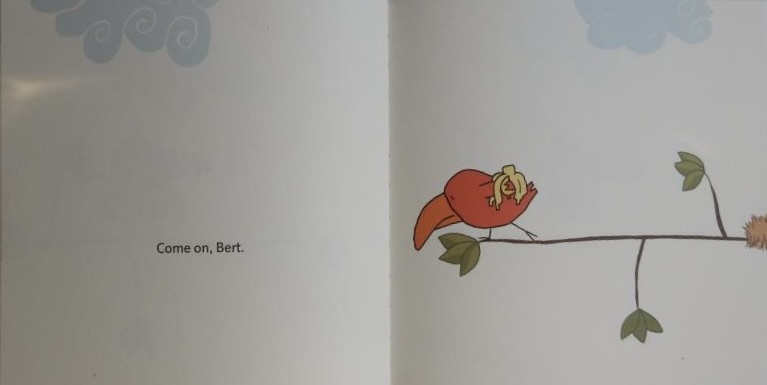
The trio must then face three challenges as part of their assessment. the first being to collect dragon smoke. The second is to harness a basilisk, the third is to feed the fairies and keep them contained; but these fairies are of the troublesome kind and have an unusual diet …

Can Digby, Mog and Tai possibly succeed in all three challenges and thus become apprentices; several times the odds are stacked against them and nothing is as it seems … They’ll certainly learn more about themselves.

The book ends on a lead in to the next adventure for Digby et al, Beastopia The Ice Phoenix.
Exciting reading for young readers who love adventures involving animals and magic, with humorous illustrations by Jenny Taylor adding to the fun.

Tomorrow’s Ghost

It’s the summer of 1976 and twelve year old Anna who is living with her Aunt Maggie, is to go and stay with Auntie Em, recently retired and moved into an isolated cottage in the countryside. Aunt Em tripped and fell over her new dog while the two were out walking, has badly sprained her ankle, is hardly able to walk and needs help. As a consequence, Anna packs a bag and sets off to somewhere she’s never been to stay with someone she barely knows: not a happy prospect, spending the summer far from her friends. However Peartree Cottage is a welcoming place and Anna likes her room.

Soon she starts having vivid dreams about a girl from 1919. The girl, Etty, lives with her harsh, unloving grandfather in a mansion surrounded by statues. This house, steeped in sadness, seemed to be calling to Anna. After five dreams, each more vivid, she is determined to find out what happened to Etty, even if it means telling lies about where she’s been to Aunt Em. Later on Colin from the village shop offers to take Anna swimming and strangely she finds herself being irritated by this.

Then at the library she learns from the librarian, of a terrible fire that destroyed much of Featherstone Manor with almost everyone getting out safely. But what of Lady Henrietta, who was twelve at the time? The only way Anna has a chance of saving her from a terrible and untimely demise is to find a way to communicate with her. A mirror she’d seen in Etty’s bedroom, perhaps …
Gripping, haunting and powerfully atmospheric, this story will have readers on edge until the final chapter reveal. I read it in a day, so bound up in the fate of both Etty and Anna had I become.
Linnet and the Periwinkle Flyer

Linnet, in her early teens, has grown up in Mount St.Marys, a convent with a cruel regime in Yorkshire. She longs to escape, so she’s both happy and fearful when the announcement is made: she’s to leave the convent’s confines and take up a position with Mrs Periwinkle in Periwinkle’s Bazaar. Her first thought is that she’ll now be able to search for her lost friend, Dove.

Mrs Periwinkle seems a rather harsh person but she has another skill aside from her shop business: she is an inventor. One night awakened by hammering sounds, Linnet creeps into the yard and comes upon a large book wherein she sees what she assumes is her boss’s latest invention. Weeks later she revisits the yard and there finds Mrs periwinkle working on what the woman tells her is The Periwinkle Flyer, a machine she hopes to get patented and to Linnet’s surprise Mrs P. agrees to allow her to have a go on the invention.

That night, wondering what she’s let herself in for, Linnet has a dream in which she and the machine crash. Soon after, it’s time for what she’s certain is the machine’s test flight and sure enough, the flying machine and Linnet become airborne. Linnet finds the experience exciting and doesn’t want it to end but then she begins to lose control …

Is this the end of Linnet’s flying hopes? Happily not; instead it’s the beginning of an exciting new partnership. But then comes news of an outbreak of smallpox. That there is a link between Linnet’s role with Mrs Periwinkle and the terrible illness is revealed near the end of the adventure; an adventure that has strong, determined characters, inventiveness and nail-biting flying sequences, and at the heart of which is the importance of feeling part of a family.

Loki: A Bad God’s Guide to Causing Chaos

In Loki’s latest month of diary entries, each one begins with a Loki Virtue Score card (virtue points are awarded for good deeds and taken away when as Loki says, ‘I do anything fun’.) This month we find Loki behaving in a very strange way and unusually it’s not for the most part of his own volition.

When newly appointed guardian, Freya, turns up, she’s wearing a necklace, one with magical powers and pretty soon things start turning chaotic. Friends Valerie and Georgina suddenly become enemies, Heimdall intends declaring his love for one of the teachers, Mrs Wiliams, The Giants suddenly love Thor and vice-versa, and Loki’s sworn enemy, Vinir, follows him everywhere offering him gifts and an invitation. Then Loki wonders if perhaps he does now like his new admirer after all. All the while Loki is endeavouring to break whatever spell is causing the chaos.

My head was spinning by the time I got to the end of this only to find the words, ‘TO BE CONTINUED … ’
Hilarity rules in this fifth story and it’s made even funnier by the liberal sprinkling of Louie Stowell’s drawings. Older primary readers will, like this reviewer, giggle their way from Day One where we see a drippy nosed Loki saying, ‘I card breade!’

A Rainy Dragon Day

The child narrator of this story starts by saying they love rainy days – just right for reading, playing, mucking around and daydreaming without being bothered by anyone. However, having just settled down for a bit of reading, ‘DrrrrrrrrrrrinG!’ the doorbell rings and standing at the entrance is a rather large dragon with a brolly.

In comes the dragon: it’s introduced as Fred, lover of sausages and coffee, lots of coffee, and starts making itself at home. The child then needs to use the loo and does so in full view of the dragon. Fred then asks if he can do so too.

However, the large creature won’t fit into the bathroom no matter how hard our host pushes and shoves. having drawn a large red loo outline on the wall to no avail, they head outside to search for the place ‘where dragons go’.

The next few spreads are particularly amusing as we watch the agitated, increasingly desperate dragon being led around the city – past a tree, a fountain, and other possible pee-ing places. Finally Fred flies the child to a watery dragon park full of elegant gazebos, some already occupied but Fred finds the perfect one, relieves himself with a golden jet stream

and then back they fly.

A hilarious story – droll bathroom humour with a difference – illustrated with beautifully drawn pencil images, painted in watercolour. What a different bedtime story this would make, but equally it would greatly amuse a class of under 7s at any time of the school day.

Sketch

Almost as soon he’s born the baby seems a little different, in appearance especially. His parents adore him and name him Sketch. They watch avidly as he does amusing things, a bit wild on occasion.

However the place where the family lives is a perfect town with straight streets and identical houses where everything has a place and everything works on time. Orthodoxy rules.

It’s when Sketch encounters other children that things get a bit challenging, though the boy isn’t bothered; he merely gets on with what he likes to do – investigate and invent. When he starts school, the headteacher looks with displeasure at his scruffiness and expects trouble from Sketch. His teachers look disapprovingly at his writing – a jumble of lowercase and capital letters – and tell him to write as the others do and they certainly don’t appreciate his active imagination. One member of staff, the art teacher . Miss Beauregard, does create an environment wherein Sketch is happy; she loves his work, which is so different from that of the other pupils and gives him words of encouragement, telling him to persevere.

At High School, Sketch bonds with some other artistic students – Flow, a dancer, dark, handsome Muddy who has an air of mystery about him

and Doodle who is forever changing his shape and form; these new friends give him strength as they become inseparable. Part of that strength enables him to turn down their idea of moving away, for Sketch has a rather different idea.

This whimsical picture book is an ode to divergent thinking and creativity that will appeal especially to imaginative readers, including those older than the usual picture book audience.

When I Feel Lonely

We all, adults and children, feel lonely from time to time and it can far too easily become overwhelming. Loneliness is the theme of Britta Teckentrup’s latest book. Herein we follow a young girl as she walks through a snowy forest: ‘My world feels lonely, cold and bare / with no one around and nothing to share’ she tells readers. Behind her however, is a wolf that has been on her trail as she traverses the grey landscape and after a while, the child narrator pauses and gives the creature a hug,

Then together they howl at the moon and the girl goes on to contemplate reaching out to others but says she’s frightened of being rejected if she approaches other children.
The wolf then shares some encouraging words of wisdom with her and strengthened by what she’s heard, the girl continues on her way and before long, she becomes aware of other children who are also searching for friends.

So, empowered by wolf’s words, can she take those vital first steps and reach out to another?
Britta’s empathetic, rhyming text shows readers that loneliness is a common feeling, but not usually a permanent one.This is brought out beautifully in the author’s powerful scenes of the walk wherein her colour changes indicate gradual improvement in the young girl’s mood.

A book to share and discuss with a class or group, some of whom might have felt lonely, perhaps on account of moving home or falling out with a special friend.

Time Travel is NOT My Superpower / The Appletree Animal Agency Collie Chaos

Sara, the young narrator of the second story set in the town of Walsham where special powers are part of everyday life, is working on improving her recently discovered superpower – teleporting. Thus far she is able to teleport herself but is unable to take any objects with her. However trouble starts when she accidentally teleports not only herself but her best friends, Georgie and Javier, as well as Jock her arch enemy, back in time to 2002. It’s crucial that they don’t interact with anybody, so nothing in the future is changed. However how is that possible when you find you’re at someone’s birthday party, a boy called Herman, someone that you don’t know. They eventually get away though, back to the present day, or is it? If it is, then why is Sara’s Mum wearing flip-flops and her Dad dressed in a parking warden’s uniform? They’re supposed to be superheroes. And as for being fed Brussels sprouts – don’t even mention the F__T word.

Something definitely is wrong, so how will Sara get herself and her companions in this muddle back into their proper universe.

With giggles aplenty both verbal and visual, this will go down well with KS2 readers who enjoy crazy adventures.

It’s winter and we’re back in the village of Mossdale where Appletree Agency have three new clients on their list – Algernon, a ten year old terrapin, Crumpet, a cat that’s something of a diva, and Domino, a dog with three legs. Domino is allocated to Mrs MacDonald but it’s not long before he escapes. The team load up with pet supplies, a compass, snacks and other useful equipment and off they set into the snow: Appletree Agency on the case.

They decide to follow a trail of threepaw prints and thanks to Luca, eventually track Domino down in a field belonging to the curmudgeonly farmer they’d already had a run it with. The dog makes it clear that the children should follow him and he leads them to discover a boy they’d seen earlier but now he’s injured.

Eventually having taken him to safety, the Appletree team learn that the boy, Finn, is staying with his grandpa, the very farmer they’d upset. Moreover he’s an animal lover. Finn was eager for a pet of his own and with Domino forming a bond with him it felt almost like he had one. Then the Appletree Agency members have an idea, an idea that will make everybody happy. But that’s not quite the end of this story …

A wonderfully heart-warming adventure that is perfect for pet lovers who like a touch of humour as well as passion in their stories.

Fear Files: Hide and Seek

Based on the Darkive (a secret database filled with testimony recovered from survivors of inexplicable phenomena), this story is really going to get your adrenalin pumping. From the outset readers discover that this is to be a Level 4 Rated File ie it’s in the ‘Beyond Fear’ category.

Sol and Adam (from whose viewpoint the story is told) are spending the weekend on a camping trip. Adam is not at all happy with things having expected some degree of luxury and has ended up in a muddy field.

After a restless night, they go exploring and come upon an abandoned ghost town where, against Sol’s wishes, they find themselves involved in a really scary game of hide and seek with rules they don’t know. Soon Adam is desperately searching for his friend among weird statues, uniform clad children and the eerie voice of the “Itter” filling his consciousness. Even so, he must find Sol and get out before the Itter finds him. Seemingly though there’s no end to this game but is it a dream, some sort of trick, Adam’s imagination or a horrific reality?

Full of suspense, this is truly gripping reading with a mix of witness accounts, interviewer notes and black and white illustrations, though I definitely wouldn’t recommend this to the faint-hearted or as a pre bedtime read.

The Experimenters: Luke and Ruby’s Scientific Sleepover

It’s the half-term holiday and Luke and Ruby are excited to be spending the week at their grandparents’ home, which is full of amazing treasures. Both grandparents had been scientists: Grandad studied animals and Nanny studied outer space, “We did all sorts of experiments along the way,” Grandad tells the siblings. Nanny explains the basics of scientific experiments and immediately the siblings are eager to start . There follow eight chapters that present different science topics the children do, the first being observations of birds in the garden.

Next they explore floating and sinking with a variety of objects when they are asked to predict first and then test, and a question from Ruby prompts Grandad to bring up density and how it makes something float or sink.

Thereafter they look at ways of making music; make telephones from two paper cups and some string, make and bake a sponge cake;

test reaction times; closely observe minibeasts and finally, plant some seeds in pots to take home so that they can watch them grow.

Throughout it’s evident that the children are thoroughly enjoying themselves; the grandparents in turn offer encouragement and sometimes make a suggestion but they never force, rather they allow the siblings to work things out for themselves.

Inserted into each experiment are pages called “You’re the Scientist’ wherein Dr Shane Bergin asks readers to do some scientific thinking too.

This is a fun, playful way of encouraging young children to be science learners and Sayani Mukherjee’s illustrations certainly show the characters enjoying their investigations.

One to add to both home and KS1 class collections.

The Bestest Big Brother, Ever

This is told from the viewpoint of Nano, the younger of two brothers. He and Felix are, so he tells readers, best friends who can read one another’s minds and have some ‘super secret code words’. Sometimes though Felix wants some space of his own, something their Mum agrees with after Nano is so upset at finding himself shut out of the treehouse having spoiled the picture Felix has drawn. However the message he gets when trying again to gain entry to the treehouse, ‘ … Now stop copying me. And stop following me. And just leave me alone!’ could’t be clearer.

Off sets Nano to build his own tree house but the one he makes is far from weatherproof. Nano’s shouts for help go unheeded and as a result, Felix has gone from being the bestest big brother to ‘the WORST big brother.’

Off goes Nano to sulk in his bedroom. Then after a while up comes Felix and what he shows Nano is something TOTALLY GRAPE! – convincing him that after all, he is the bestest brother and his best friend – most of the time.

Ben Mantle’s capturing of a common family situation is pitch perfect; told with gentle humour and some wonderfully whimsical wording such as ‘totally grape’ (really great) and ‘fancy-pants umbrella house!’ His scenes of the ups and downs of the relationship are full of fun details including Nano wearing one sock most of the time, two pigeons having a tug of war over a worm and the child-made boils hanging from a tree branch in the garden. Assuredly a story that will resonate with countless families.

Porridge Please!

This is a terrific fairy tale spin off featuring a host of favourite characters that visit a little bear who is trying his very best to read the last page of his new book. The poor bear has had a continuous stream of visitors each wanting some of his ‘sumptuous scrumptious porridge’

as the Little Pig calls it when he comes a KNOCK KNOCK KNOCK knocking.

Having kindly fed Goldilocks, Red Riding Hood and three pigs,

Bear’s feeling frazzled when there comes yet another visitor – Granny supposedly – telling a tale of woe. But suddenly a realisation dawns: ‘THAT WASN’T GRANNY. Red Riding Hood said she was eaten by the Big Bad Wolf’. Time for some quick thinking and a clever ploy from Bear.

There’s so much to love about this book: Bear’s problem solving, his love of story books, and the tastiness of porridge: three vital ingredients in Laura Mucha’s telling and Marc Boutavant’s hilarious scenes of of the dramatic events.

In case you’re wondering whether Bear ever did get to read that last page, you’ll have to get your own copy of their book to find out. One thing that is certain though is that young listeners will endorse the READ IT AGAIN! plea on the final endpapers.


Big Thoughts / Some Days I’m the Wind

We’re all beset with worries from time to time – ‘Big Thoughts’ as the child narrator of this books calls them. Such thoughts can’t be seen by others despite them being loud inside your head. They might be Big Thoughts about the future, the past or perhaps even make-believe (not telling the truth). Moreover the more one tries to ignore such thoughts, the louder and more all embracing they become.

So what can be done to alleviate a very worried mind? One way is to share them with a an older person who has learned some coping strategies. Strategies that can be passed on and will then stay with the sufferer henceforward. Another way is to talk with a friend who has suffered similarly, so neither person feels alone.

Laura Dockrill’s text is such that readers/listeners are made to feel the centre of attention – seen and heard – and together with Ashling Lindsay’s sensitive illustrations and the final spread entitled Tips and Techniques’ make this a very reassuring and helpful book.

Using metaphors relating to the weather and the natural world, the young narrator of this book tells us how her feelings and emotions can change from day to day or perhaps several times in a single day. “Some days I’m the sun, welcoming, warm /patient, pleasant, fair. // Some days I’m the sun, / stubborn, HOT! / A raging, blazing glare.’

Or, ‘Some days I’m a tree, / flourishing, strong, reaching for the sky/ // Some days I’m a tree / trembling, bare, / bidding leaves goodbye.’

The well chosen, child friendly metaphors combined with the repeat ‘Some days’ of the gently rhythmic text and the vibrant, boldly coloured illustrations, keep readers turning the pages as they, like the narrator come to understand that there are a whole multitude of ways to feel, to act and to be. This is reaffirmed in the final proclamation, “And just like the wind, / or the sun, / or the sea / on some days / I’m some ways, / but all days // I’m me.”

After the child’s narration is a spread entitled “Exploring Our Emotions’ written by a child development specialist. A book to share and talk about at home, or with an EYFS or KS1 class.

To Activate Space Portal Lift Here

This is an intergalactic romp of the metafictive kind; it’s also interactive.

On the first spread readers will find a small orange rectangle containing a smaller black circle and at the bottom of the right page are two little green dots, one labelled ‘power’, the other ‘auto translate’. A turn of the page shows a larger central rectangle within which is a large eye with a black pupil and orange iris. A couple of page turns on a portal opens up to reveal two extraterrestrial beings – Blrg, (with yellow skin) and Zrk (with orange skin). At first these two creatures are petrified concluding “Aliens are real!!!”

The two decide to engage readers in conversation to discover whether the alien being spoken to intends to eat them and ask to see its teeth. Having done so their concern disappears for the teeth are very tiny. “Alien, what is your planet called?” the two enquire. ‘Planeturth’ they hear in response, which of course they’ve never heard of.

The interaction continues and is mainly agreeable and an array of additional extraterrestrials appear to gaze at and greet the Alien.

They’ve just said “Hi!” when the power level of the book drops indicating the imminent closure of the portal before which farewells are exchanged and Blrg and Zrk deliver a final message to all planeturthlings. However by now the auto translate has turned red so they and we readers will never know what “SKF FLRBL GRNK!” means.

With its vibrantly coloured illustrations this weird, out of this world tale, will likely go down especially well with space fans.

The Monster in the Lake / The Kerfuffle

These are both recent Gecko Press titles – thanks to the publisher and Nicky Potter for sending them for review

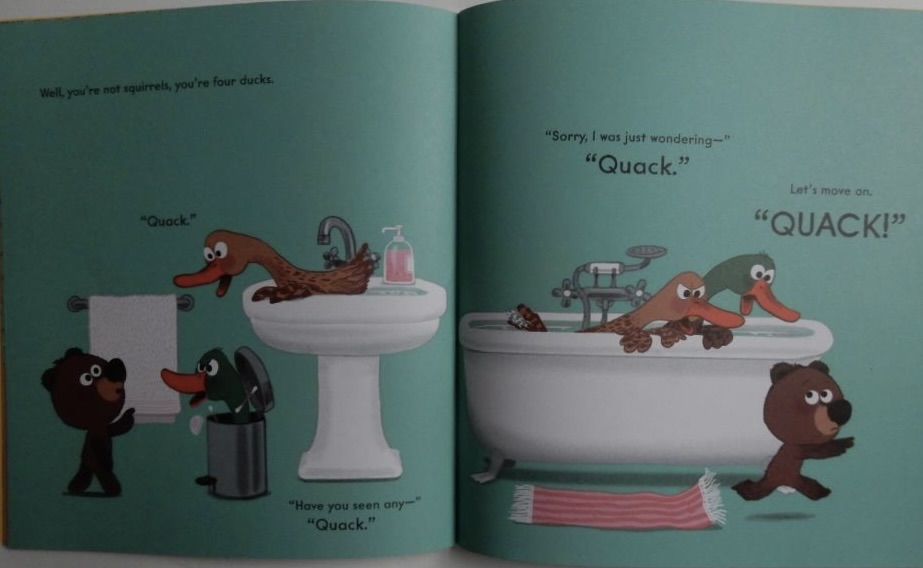
Following one duck’s suggestion, four ducks contemplate some fun in the lake. Another however, has concerns about the monster said to be in there, but the others insist there’s no need to worry. Off they go into the water, with three ducks urging the fourth, “Trust us!”. Eric trails reluctantly behind and perhaps this gives him a clearer idea of what is going on beneath the surface.

At each turn of the page readers and Eric see more of the subaquatic reality while his companions remain oblivious despite his loud, “MONSTER!”warning, even insisting that they are the only ones around other than frogs and small fish. It takes Eric’s disappearance to ruffle his friends’ feathers,

though his reappearance soon puts them at their ease again. For Eric, this whole swim has been a truly memorable adventure; as for the others, they certainly won’t know that the monster is far from threatening, rather it’s a playful beastie.

Young audiences will love sharing in Eric’s subterfuge. They’ll love too, Leo Timmers’ bold, bright, whimsical images of the marine characters and the their underwater accoutrements: why though did Eric keep all the fun part to himself?

Kitty and Pup are neighbours and the best of friends but suddenly everything changes. Kitty eats Pup’s fish, so in return Pup takes Kitty’s slipper. Now the two besties have become enemies and they decide not to see one another any more – ever. To that end they build a wall separating their abodes (the book’s flaps let readers see what is happening on either side.
With the wall complete, peace reigns but then a bunny rabbit appears on top of it. Dog and Kitty both want to make friends with the rabbit and they start fighting over the newcomer.

Now none of them is happy and Rabbit runs off. Eventually however Kitty decides it time to make peace with Dog and a lot of crashing and banging ensues that results in a solution that makes everyone happy.
Demonstrating the pointlessness of building walls, Clotilde Perrin’s clever amalgam of narrative and illustrations with those strategically placed flaps works really well. The illustrations deserve careful perusal as there is a lot going on between bit part players such as a pair of birds that start nesting, as well as a couple of mice.

The Bear Who Wanted to Dance

Follow your dreams no matter whoever or whatever you are, is the message that shines through this story of Rita the bear who was inspired by the very first ballet she saw and knew in her heart that she too wanted to become a dancer. She took lessons with Monsieur le Fox where she met Wanda and the two became firm friends dreaming of their lives in dance. Rita, our narrator tells how she practised daily, pushing herself ever harder until the day came when Monsieur le Fox tells the class that there’s to be an audition for the prima ballerina.

The night before the auditions, as the two friends browse through dance magazines, Rita begins to worry and her worry grows as she realises that none of the ballerinas depicted look at all like her – there’s not a single bear.

At the auditions the following day their teacher has worked them till they ached and come moonlight, he gives the instruction: “Everyone in arabesque!” Having taken up the pose, Rita loses her balance, falls, and is distraught.

Is that the end of her dance dream? Happily Monsieur le Fox’s response to her fall is unexpectedly positive and up she gets and on she goes and …

With a body-positivity theme, this story with its soft-hued illustrations and forest setting is a delight and will surely encourage those who dream big but don’t see themselves depicted in the media.

The Diary of Wiska Wildflower: The New School

Oozing with charm from cover to cover is Harriet Muncaster’s first book in her new series. It stars Wiska Wildflower, who has moved with her Mum and Dad from Twitching to Acorn, on the other side of Wiskling Wood. where they’ve bought a new business.

Wiska has to start at a new school, Inkcap’s Academy, and she’s very upset to be so far from her best friend, Luna. However, two of her classmates, Primrose and Cleobelle take her under their wing and they’re impressed at her talent for drawing and designing clothes. They don’t though, see why she spends time with a little ‘twigling ‘doll, thinking of adventures for her. Are these two really as welcoming and friendly as Wiska thinks? Could they have an ulterior motive in wanting her to do everything they do, especially working with them on a joint entry for the annual Spellbrooke fashion show for young wisklings?

Young readers will be delighted by the new miniature world of magic with its wonderful Wiskling lore, that Harriet Muncaster has conjured up. Magic it is, but Wiska has to deal with issues that confront real world inhabitants such as resisting being pressured into conforming, finding new friends and most importantly, remaining true to your real self. All these its creator cleverly weaves into Wiska’s story. Moreover, readers familiar with characters from other series by Harriet will be happy to see that Victoria Stitch is a bit part player herein.

Destined to be a great hit, the series opener has enchanted this reviewer and will enrapture countless children from around seven.

I’m Going To Eat A Polar Bear

Despite being very hungry, a little penguin turns down the offer of fish, declaring it boring and instead demanding ‘something new. Something soft … and fluffy!’ One of the older penguins recalls hearing of something matching that description called a ‘bolar pear’. Off sets the little penguin, full of bravado, on a mission to find and eat a bolar pear, despite not knowing what such a creature actually looks like.

After a long journey over land, sea and the occasional croc. and the dismissal of warnings about the bear’s enormity, the little penguin finally arrives at the North Pole, the place where polar bears live.

Our bear seeker has an extremely rumbly tum but apparently not much common sense, for the little penguin decides that there are no polar bears, not even a tiny one, anywhere. Back home to some fish is the only option, that, or remain hungry. Little does said penguin realise that an equally hungry polar bear has been following close behind all the time.

This is one of those books that is sure to have young listeners yelling, “it’s behind you” as the story progresses and the totally oblivious little penguin almost ends up becoming the next meal for a polar bear, rather than the other way round. Children will love being in the know with the author in this tongue-in-cheek tale, the drama of which is captured with aplomb in Nicola Kinnear’s story-telling sequences.

Squirrel and Bird

Squirrel and Bird are best friends and the external narrator introducing them emphasises their difference: ‘Squirrel is loud! Very LOUD!’ Bird, on the other hand, ‘hardly makes a sound at all.’ ‘Squirrel is busy. Busy, busy, busy!’ Bird though, ‘prefers to sit and do nothing.’ This way of describing them really annoys Bird as the comments are not the whole picture – far from it.

As the friends prepare for a concert to be held in front of the entire forest, tension mounts and eventually the feathered creature has heard enough and lets the narrator know in no uncertain terms. “ENOUGH!” comes the angry cry. ‘We are not only what you say we are. There’s so much more to us than that.’

Feeling the rebuke, the narrator shows a degree of surprise and has to agree ‘Bird is LOTS of things … and Squirrel is too!’

With Laura Baker’s very effective minimal text and Stacey Thomas’s charmingly detailed, muted sepia and grey scenes, the vital message comes through clearly: we are all an amalgam of different things at different times and hasty judgements are foolish.

A thought-provoking book to share and talk about with primary classes, possibly in a circle time session.

Gordon in the City / Huxley and Flapjack Wild West Escape

Gordon the erstwhile ‘meanest Goose on Earth’ is now, thanks to Anthony the Piglet, a reformed character. Indeed it’s been almost twelve months since he started trying to be good.
One day as he walks home feeling happy with his new self, he sees a letter pinned to his door. It’s an invitation to present the trophy for the Meanest Goose on Earth to this year’s winner. Hmm!
Being the great friend that he is, Anthony says he’ll disguise himself as a goose and accompany Gordon to the City for the presentation.

This he does and the two arrive expecting one of the four previous runners-up to receive the award. That however, is not what happens. Big surprise or rather, shock horror for Gordon when he discovers the winner. Moreover he and Anthony are invited to stay with her. Not a good idea at all as Gordon rapidly discovers.

Next morning Anthony has disappeared and Gordon starts reverting to his old wicked ways under his host’s influence. Fortunately he comes to his senses and having been told that something dangerous has happened to his friend, Gordon knows he must save him. Is there anyone or any goose, he can call upon to help and if so, what will be the outcome?

I know lots of young solo readers who will be honking their loudest for Gordon and Anthony in this their 4th adventure and looking forward to the next one.

Best friends Huxley the koala and Flapjack the penguin return in a third story and what an adventure they have when they sign up for a job as cowhands at Daisy Bank Farm. This is because Huxley wants a new guitar and has spent all his money. He even goes so far as to tell Dolly the farmer that they can horse ride but on their very first day things start going wrong. However they make it through to sundown when the cows are returned to their pen at Daisy Bank, safely behind a shut gate, so Huxley assures his friend.

Next morning, shock horror! The cattle pen is empty and after looking all over the farm, off they set to search further afield. Eventually they reach Bull Bottom Farm owned by Big Bull. The curmudgeonly fellow insists that all the cows on his land belong to him and are marked with a letter B. But is he telling the truth and if not can Huxley and Flapjack work out which are Dolly’s and get them back to their rightful owner? Could music be the solution?

With an abundance of daftness, this foray into the world of cattle farming is full of action, a bit of guitar strumming and Francesca Gambatesa’s fun colour illustrations. It’s just right for those ready for first fiction books.

Grimogen Darkstar: Bat-Cat-Tastrophe / Marv and the Funfare Fright

Young Grimogen Darkstar or Immi as she prefers to be called, desperately wants a pet, even more so when the team from Howler’s Rescue Centre bring animals into her school for a special day. “Maybe I’ll meet my future first pet,” she says. First though she has to prove to her parents that she is sufficiently responsible to care for one. So, when her class is called to the hall, she’s more than delighted to see all manner of magical creatures and she can hardly wait to feed some of them, declaring herself “ a bit of an expert at feeding animals.”

Pretty soon though things start to go wrong: Immi is certain she’s seen a bat-cat outside the window and refuses to accept the explanation that what she saw was just a bat. Almost immediately after, her classmates are running around as bats swoop in and get stuck in people’s hair. Fortunately for her though, things are quickly sorted out and an open day at Rescue Centre is announced, to be held the next day. Helping out offers another opportunity for Immi to prove she’s ready for her own pet. Can she do so without causing a catastrophe?

Impetuous, curious, brave and kind-hearted, Immi is a delight and young readers/listeners, especially animal-lovers, will enjoy meeting her. in this first story with its sprinkling of whimsical black and white illustrations.

Marv is excited when he hears that from the funfair has arrived at the local park for its annual visit and super-excited when he finds that he’s now tall enough to go on the Head Spinner roller coaster (rather him than me). Off he goes with his super-suit and sidekick, Pixel, in his backpack and Grandad at his side. It’s extremely crowded and noisy but it’s not long before while riding on the Spinning Teacups, Marv detects a supervillain – The Conjuror – with whom he’d had an unpleasant encounter before.

Time for Marv to don his super-suit and track down that Conjuror: assuredly she’ll be up to no good. And so she is. First a zombie is on the loose and then shortly after, there are seven cuddly toy pandas running riot in the Hall of Mirrors. Marv gives chase but his rocket boosters fail and the pandas escape causing chaos all around the funfair.

Can Marv put a stop to the panic and panda-monium and not only save his friends but all the other fair visitors. He’ll most certainly need to use every means at his disposal. Maybe he can change that Conjuror into an superhero instead of a supervillain too, or is that asking too much …

Dramatically illustrated by Paula Bowles, Marv’s ninth adventure – ideal for the upcoming spooky season – is every bit as exciting as his previous ones: established fans will love it and I’m sure he’ll gain plenty of new followers too.

Mallory Vayle and Maggoty Skull in The Beast from Beneath

This story is the sequel to Mallory Vayle and the Curse of Maggoty Skull. Mallory is now becoming accustomed to her recently discovered powers as a necromancer and this 2nd book is full of dark humour.

It begins with Mallory and Maggoty out together; Maggoty walks past the Les Wigs shop, the result being that Maggoty, who has a particular penchant for wigs, demands that she finds the money to purchase Eleganza, the hairpiece with ostrich feathers on display in the window. The problem is it’s way too expensive and he doesn’t want to take her ‘no’ for a answer.

Aunt Lilith (the fake medium) with whom Mallory now lives, suggests that they hold a Grand Séance and charge those attending to receive messages from the spirit world. Said aunt decides to try and boost her invented psychic powers beforehand and things go disastrously wrong. By accident, she summons an evil Nightmare that refuses to leave Carrion Castle; in addition it intends to terrorise humanity in its entirety. It’s going to take a lot of effort on Mallory’s part to sort that out.

With Pete Williamson’s dark creepy illustrations, this is a very funny book overflowing with gothic gruesomeness that older readers will relish.

Scarlet Morning

Since their bad-tempered caretaker, Hestur, disappeared, Viola (fourteen) and Wilmur (fifteen) have lived alone, scavenging, reading The Book and making up games on a dead island in Dickerson’s Sea. Hestur told the children about how the land was ravaged by salt after a terrible event – the Great Blow. This happened after Scarlet Morning, a bloodthirsty pirate had murdered the much-loved queen, Hail Meridian and taken her crown, so it was said.

When a pirate ship, the Calamary Rose arrives, its Captain, Cadence Chase, is searching for The Book that Viola and Wilmur have, they offer it in exchange for being allowed to go along with her.
Thus begins an epic, enormously dramatic adventure involving secret puzzles, revelry with a crew of pirates; possibly even the appearance of the aforementioned Scarlet Morning, and most challenging for the two youngsters, separation from one another.

The author’s cleverly constructed world building is superb and the story highly entertaining and sometimes creepy, made all the more so by his black and white illustrations, the diverse characters, and the cliff-hanger ending that leaves readers eager for what’s to follow.

Highly recommended for older readers who love enthralling magical fantasy adventures. Buy for individuals and for school collections.

Chicken in the Kitchen

Subtitled Neal Zetter’s Greatest Hits, this lively book contains the forty two most frequently requested poems by children during two decades of school visits, plus two bonus ones, and covers choices from the performance poet’s eight previously published books:

From his first, Bees in My Bananas, comes one of my favourites – Cool Addiction, the first verse of which goes thus: ‘My head is stuck inside this book / I only meant to take a look / Till I saw what was written / Instantly my mind was smitten / In a land of fascination / Sparking my imagination / Passions burning like a flame / Pictures dancing in my brain’. What more could a writer ask of their book?

I’d not come across Terrific Tot (from Here Come the Superheroes) before but it’s a fun example of Neal’s rapping style: here’s the opening verse: ‘he’s a hero in a nappy / But don’t let that put you off / He can tackle twenty rhinos / He can handle rough and tough / Though he nearly is a newborn / And still peeing in a pot / He’s a baby trained to save me / Shout his name / Terrific Tot!

I think though, that my favourite of all is the new offering, Just Be You. Here’s the 4th and final verse:
‘It’s the words that you speak / It’s the things that you do / So why be someone else / Just be you.’ This is a poem that every child needs to hear over and over and …

With occasional black and white illustrations by Emily Ford, this is a book for primary age children be they at home, or at school. Ideally wherever they read these poems, it should be aloud to get the best from the beat and liveliness, wordplay and rhyme.