Both books are published by Bloomsbury Education: thanks to the publisher for sending them for review.
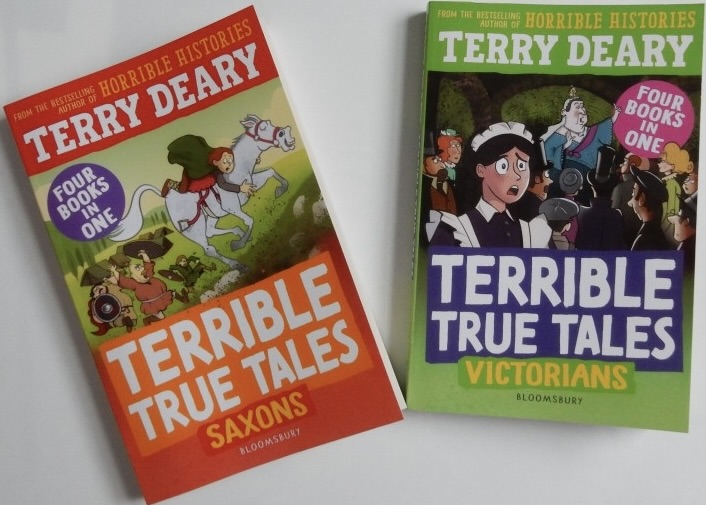
Terrible True Tales: Saxons
Terrible True Tales: Victorians
Terry Deary
Continuing the Terrible True Tales series, Horrible Histories author Terry Deary presents two new four in one titles, each accessibly written in his chatty style.
The four Saxon Tales are set in turn in Yorkshire, Maidstone (Kent) and the Kingdom of Mercia (the Midlands of today). The first is related by Ardith Hutton whose father, a tanner died from plague. Ardith, narrowly escaped being burnt alive in their home and was taken in by Wilfred a kind neighbour, became his apprentice and then almost got burnt alive again. Eventually after Wilfred died, Ardith took on his role and in turn found an apprentice.
Fictional children are the main focus in each of the other tales so readers are given a glimpse of what it was like to be a youngster in Anglo Saxon times. Figures from history include King Offa (of Mercia), King Athelstan (of England) and the foolish King Vortigern and topics mentioned are medicine, magic and healing, bandits and the work children did.
Following each story comes an afterword that puts the tale into a historical context and some ‘You Try’ activities for children.
With Tambo’s black and white illustrations further illuminating the text, this is a smashing way to encourage primary age children to engage with history that could otherwise perhaps be dull and dry.
Also told in Deary’s captivating style and bursting with information is Victorians wherein the focus is on travel during the Industrial Revolution.
The stories are about in turn, the first powered airship set in Paris invented by Henri Gifford, the first steamship the Sirius, to travel to America, the Staplehurst rail crash in Kent (Dickens features herein) and finally, the Big Stink that tells the story of the London sewers and related to it, the invention of the London Underground.
Like the previous book, children play an important role in each tale and this book is illustrated in an appropriately dramatic style, by Helen Flook
 Red Reading Hub - Jillrbennett's Reviews of Children's Books