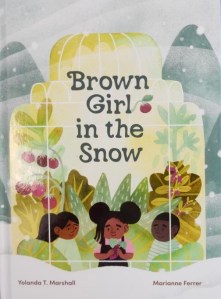
Brown Girl in the Snow
Yolanda T. Marshall and Marianne Ferrer
Greystone Kids
Amina, the narrator of the story has recently moved from the Caribbean where she was able to grown all kinds of plants, to a snowy city in a new country, and she’s not happy.
“There’s a brown girl in the
Tra la la la la,
where none of her plants will grow”
She sings as she watches the other children playing, then asks her elder brother how she can grown her garden in such an environment. He suggests she should wait for the spring to come. Hearing her song, her dad takes her to the library where she discovers a book about gardens. This cheers her somewhat and the following day her teacher asks why she’s not out playing with the other children. Having heard how Amina misses growing plants, she has an idea:

she sets up a class field trip to a greenhouse. When her classmates her about this, some of them start talking about the plants they are missing from their home countries such as The Republic of Congo and India. They also ask Amina to join them in their play outside next time. The weeks pass and at last it’s the field trip. Amina is a bit disappointed that she doesn’t see sweet potatoes growing in the greenhouse though there are lots of other tropical plants; nonetheless the trip is a success. Particularly when Mr Lokon discovers that she was hoping to find sweet potatoes and gives her some slips to plant.
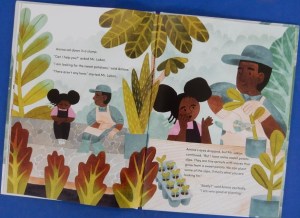
He also invites her and her new friends to return and watch their growth. This they do though it takes a long time and in the meantime, Amina becomes much more positive about her new home.
The refrain, “There’s a brown girl …” is repeated several times throughout the story, with different ending lines as events progress and young listeners will enjoy joining in each time. Aptly Marianne Ferrer’s stylised watercolour depictions of the plants and some clothing items are in various green hues, with a dark magenta for Amina’s sweet potatoes.
The author draws on her own experience for this story: it’s ideal for children who are moving to a different climate and those who feel homesick for a previous country as well as for a KS1 topic related to growing plants.
 Red Reading Hub - Jillrbennett's Reviews of Children's Books