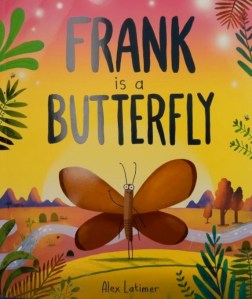
Frank is a Butterfly
Alex Latimer
Oxford Children’s Books
The story starts with ten caterpillars of various shapes and sizes all munching on a leaf for breakfast. There are caterpillars small, caterpillars large, caterpillars short, caterpillars long, hairy caterpillars and hairless ones and nine have a spotty and stripy pattern of some kind. The tenth one, Frank is brown and bears no distinctive marks. In between nibbles the nine talk of the kind of butterfly they will morph into. One says ‘magnificent’, another ‘handsome’, a third the prettiest … on Earth’, the fourth ‘fabulous’ and so on. Frank, in contrast says nothing; he’s ‘happy to be a plain, medium-sized caterpillar on a leaf in the sunshine.’it’s not long before the caterpillars turn into chrysalises to await their transformation.
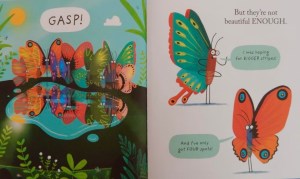
When they emerge from their chrysalises, despite looking gorgeous, nine of the butterflies are thoroughly dissatisfied with their appearance: they definitely do not live up to their expectations.
Finally Frank appears and he’s elated with his plain strong brown wings that will enable him to take to the air: he anticipates a world of flowers.
After some time, thanks to Frank’s positive example,
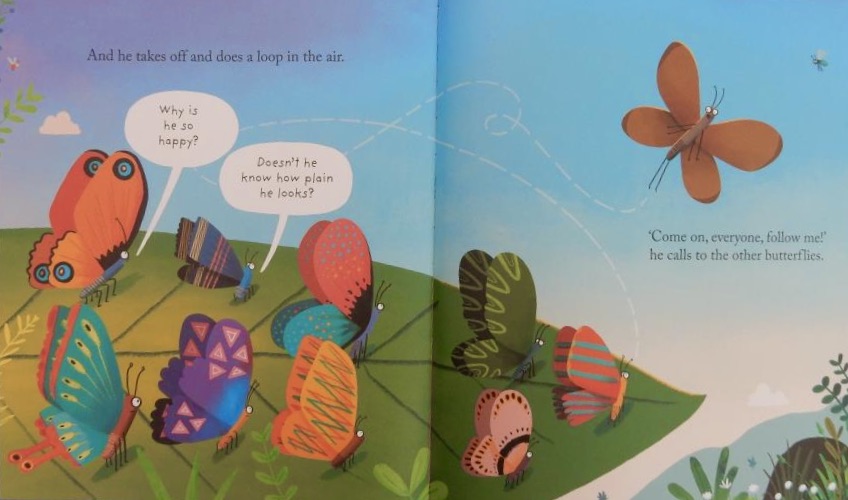
the other butterflies realise that what is more important than appearance is being free to explore the beauty around them without that nagging feeling that you’re not enough.
Alex’s richly hued scenes have a gentle humour about them that ensures that the important messages about self-acceptance and self-possession in his words don’t weigh heavy.
(After the story there’s a page showing Frank’s life cycle from egg to butterfly.)
A book for family bookshelves and KS1 class collections.
 Red Reading Hub - Jillrbennett's Reviews of Children's Books