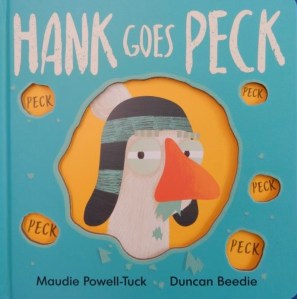
Hank Goes Peck
Maudie Powell-Tuck and Duncan Beedie
Little Tiger
If you’ve read anything about Hank, then you’ll already know that he likes to make trouble for others. Now he’s not honking but pecking and at the request of a small rodent, little humans are immediately involved in the story by keeping an eye – preferably both – on what he gets up to on the farm. Oh dear! The first thing he does is to stick his beak into the trampoline on which the chicks are bouncing. What a pesky creature. As you might expect though he just cannot keep that beak to himself: next he sticks it right into the limo holding a trio of pigs. Surely that’s enough sticking his beak where it’s not wanted so he’ll leave the old sheep in peace to get on with her knitting. Oh NO! spoke too soon, but Mouse has said he must take time out and consider the error of his ways. Apparently temptation gets the better of him however as he struts past the bull without heeding Mouse’s warning. Has he learned his lesson at long last? I wonder …
Hank’s preposterous behaviour is wryly depicted by Duncan Beedie and Maudie Powell-Tuck’s text offers plenty of opportunities for sound making and action from young listeners who will enjoy emulating Hank’s pecking and the sounds made by the animals he upsets.
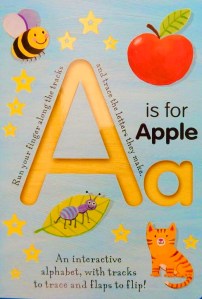
A is for Apple
illustrated by Georgie Burkett
Little Tiger
With flaps to lift and tracks to finger trace, this alphabet book clearly illustrated will immediately get little learners involved. They can trace the capital letters with the help of the arrows and then lift the flap on each page and discover something else starting with the same letter, this time written with a lower case starting letter. Better still, children can try to guess what is hidden before opening the flaps. Simple, playful interactive learning and on the back cover are some hints for parents/carers.
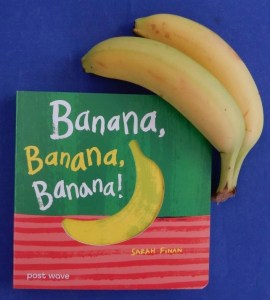
Banana, Banana, Banana!
Sarah Finan
Post Wave Publishing
This is the second in a series of board books encouraging healthy eating from new publisher Post Wave.
Sturdily built to stand up to numerous readings, it’s told through a simple, jaunty rhyme and bold, bright illustrations with a clever die-cut on each double spread. The small children we meet in the book love to eat bananas in various situations and forms including as a smoothie slurped through a straw, sliced up for breakfast or lunch, to fill a hungry tum during a car journey or as a pre-bedtime snack. It’s good to see that even such young children know that the skin from a banana needs to be disposed of properly – in the bin, not tossed aside onto the pavement as a potential slip-hazard.
 Red Reading Hub - Jillrbennett's Reviews of Children's Books