
Don’t Squish A Slug
Yussef Rafik, illustrated by Riley Samels
Words & Pictures
Following his general introduction, author, zoologist and wildlife presenter, Yussef Rafik, divides his bug information under five headings, Masters of Disguise, Amazing Evolution, Daring Defence, Record Breakers and All Sorts of Relationships (some of which are parasitic). The world of minibeasts is truly amazing, albeit on occasion pretty gruesome, so get ready to dive in.
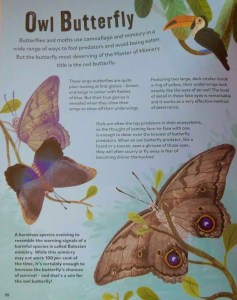
Have you ever wondered why the owl butterfly is so called; indeed were you aware there was such creature? It has earned itself the title ‘Master of Mimicry’ on account of the way the detailed fake eyes on the underwings look so like an owl’s eyes they act as a superb deterrent for potential predators.
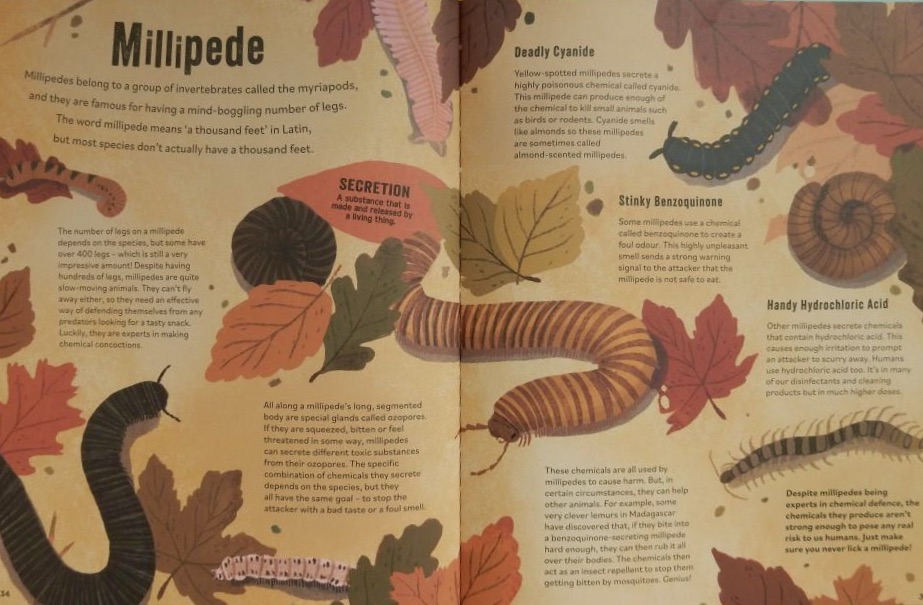
I was fascinated to learn that millipedes have special glands called ozogpores from which they secrete poisonous substances. The yellow-spotted kind secrete the highly toxic chemical cyanide in sufficient quantity to kill rodents or birds. Other kinds use the malodorous benzoquinone, which warns attackers not to eat them. Under certain circumstances though, these chemicals can be of help to other animals, an example being the lemurs in Madagascar. They’ve found out that if they bite a benzoquinone-secreting millipede sufficiently hard, then rub it over their bodies, the chemical acts as a mosquito repellent.
Every bug is either allocated a double spread or single page that includes a superbly detailed illustration the creature in its natural habitat along with the information that is just the right amount for KS2 readers. The author’s knowledge and enthusiasm shine through his text, indeed in his introduction he writes, ’It’s really important that we have empathy for bugs. We should appreciate what they do for our planet and learn to love living alongside them.’
Riley Samels’ illustrations are an ideal complement for the text, detailed but not overly so, and there’s a final glossary and index. Thoroughly recommended for school collections and for budding minibeast zoologists.
 Red Reading Hub - Jillrbennett's Reviews of Children's Books