Red Reading Hub is delighted to be a part of the blog tour for Dragons Love Underpants

Dragons Love Underpants
Claire Freedman and Ben Cort
Simon & Schuster
The latest in the pant-loving series features a group of monstrous marauders that flew around the countryside in bygone days sporting pants pinched from anyone and everyone. However being such fiery beasties, the dragons had a problem of the blazing kind, for no sooner had they donned their new undies, they accidentally set them on fire. OUCH!
More pants very soon, was the order of the day and where better to find replacements than the Kingdom of Pantasia ruled over by pants aficionado King Top-Bot. Off they set at top speed.
At this point Faith (4½) with whom I was sharing the story commented, “I have an assortment of pants. They’d better not come and take any from my bedroom.”
Once aware of the winged invaders, the king sent out his most loyal knight to do battle with the dragons, but the knight merely made a rapid dash for it. Meanwhile the poor king was airborne, gripped firmly by the seat of his pants by one of the dragons.
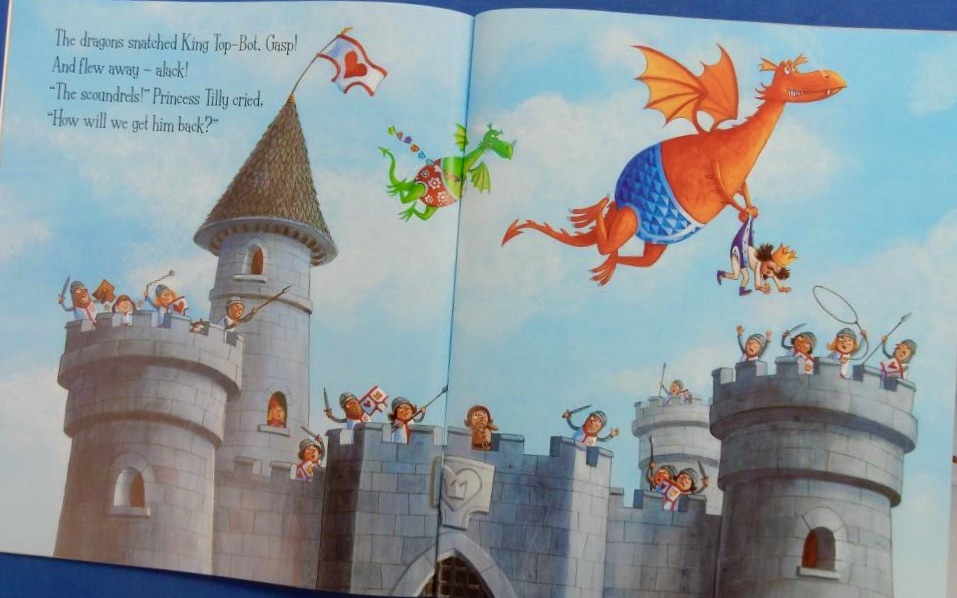
Soon after, a ransom note arrived at the palace demanding piles of pants in exchange for the monarch who otherwise would get his bum badly burnt. Young Princess Tilly cooked up a clever plan. She headed over to the forge, grabbed her hammer and fashioned some very special undergarments of the fireproof kind. (Faith wondered how the dragons managed to stay up in the air with such heavy pants. “They’d need to flap their wings really really hard,” she said.
Having received their new garments, the dragons stuck to their side of the deal, they set free the King and in true fairy tale fashion, everyone lived happily ever after.
Claire Freedman has woven a new and splendidly silly rhyming narrative for her seventh underwear yarn for which Ben Cort has conjured hilarious scenes of fearsome fliers, fearful fugitives and one smart young princess.
Now here are Claire Freedman’s Top 5 Tips for Writing in Rhyme
1) Get Used to Rhyme If you are a total beginner at writing in rhyme, keep things simple to start with. Nursery rhymes can be a quick and useful resource. Maybe try a couplet rhyme – two lines that rhyme together – such as ‘Humpty Dumpty sat on the wall, Humpty Dumpty had a great fall’. ‘Mary had a Little Lamb’ is a good example of a four-line verse where the second and last lines rhyme. Nursery rhymes generally have simple metres and memorable rhythms for a child to read. Plus, nursery rhymes are also easy to run through in your own head.
2) Let Your Mind Drift
Once you have your chosen rhyme metre in your head, try and take it with you as you go
through your day. I often find the best rhymes come to me whilst having a shower or walking to
the shops. I find it helps to continually count the syllables of each word, so they fit. If one word
doesn’t fit the rhythm of your rhyme, play around with other words in your head, perhaps with
fewer or more syllables. Sometimes you can get it right by just changing the order of the words.
Keep repeating the lines until you feel satisfied that they flow well.
3) Use a Rhyming Dictionary
This might feel a bit like cheating, but a lot of writers use them – including me! Sometimes just
flicking through the pages can give me an idea for a different rhyme that might work better. My
personal rhyming dictionary is also full of other rhymes of my own that I’ve scribbled down, so
it has become a brilliant reference book for when I’m stuck! A thesaurus is useful too. If I’m
trying to convey a particular feeling or atmosphere to my story, and I can’t get my chosen
descriptive words to rhyme or fit the metre, sometimes I’ll find an alternative (or better) word in
my thesaurus.
4) Map Out Your Story
I love writing in rhyme, but it is a challenge. I have to think – not only about the rhyme, rhythm
and metre, but also the pace of the story. Picture books usually have twelve spreads and, ideally,
each spread will be illustrated differently, to help the book move forward as much as the words
do. Sometimes it can help to map out your story in your head first, or write it down. Then you
know what you have to fit into each spread. Of course, write with manoeuvrability – your map
is a helpful guide, but you dictate the story!
5) Read Out Loud
Picture books are perfect for reading out loud, and for enjoying as a shared experience between
parent and child, family and friends, and also teachers and pupils. So, they MUST read well. It’s
important to read your own work out loud to yourself. Listen out for any clunky rhymes and
words that don’t flow as they should. When working on a rhyme, I can read it countless times,
and it seems fine to me. But when I pick it up a few days later and read it out loud, I’m
disappointed to find areas where the rhyme or rhythm clearly doesn’t work. Read out loud to
friends and family too. It really helps to identify areas that need more attention.
Enjoy a sublime time with rhyme!
Please visit the posts of the other blog tour participants too.
 Red Reading Hub - Jillrbennett's Reviews of Children's Books