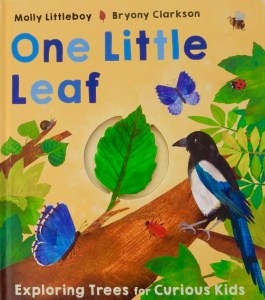
One Little Leaf
Molly Littleboy and Bryony Clarkson
Little Tiger
Trees are my favourite thing in nature and I think it’s never too early to introduce young children to their delights. This chunky, large format board book does just that, starting with a spread showing fifteen named leaves from different trees.Four are depicted on flaps, which when lifted reveal a brief paragraph of information about the respective trees on which they grow
Other spreads are devoted to in turn, sensory exploration of the surroundings,
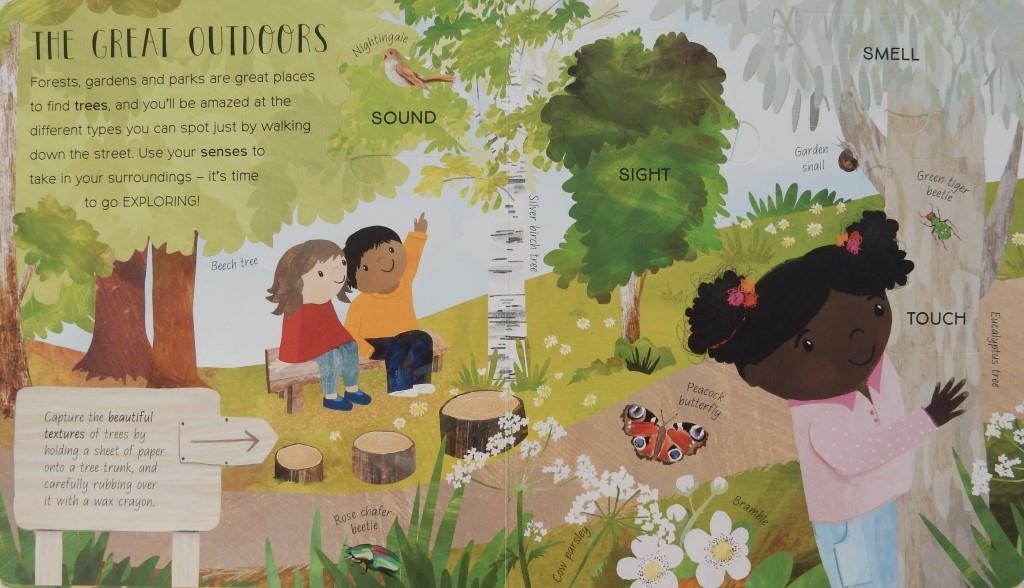
the growth of a tree, the tree as habitat for other wildlife, some of the uses of tree parts, seasonal changes of a tree and finally, on ‘Happily Ever After’ readers are encouraged to plant a new tree and to explore the themes included further.
A chatty, engaging narrative runs through the whole book, comprising on each page an introductory paragraph and a suggestion encouraging children to become actively involved with the natural world.
With clear, naturalistic illustrations this is a good starting point on things arboreal, to share with children in their early years.
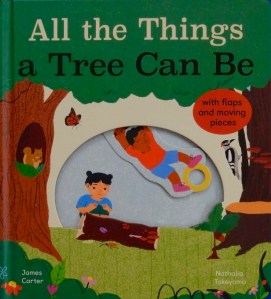
All the Things a Tree Can Be
James Carter and Nathalia Takeyama
Little Tiger
Presenting the wonderful things about trees is difficult in just six double spreads, but author James Carter includes the essentials in this little book. I love the description on the opening page, ‘Trees are ground-hugging / sky-nudging wonders!’ Indeed they are ,be they of the deciduous or evergreen kind, both of which are depicted in Nathalia Takeyama’s first illustration that also includes some woodland birds and animals, and humans.
Deciduous trees change with the seasons and this is the theme of the next spread, which has two flaps for little hands to lift and reveal simple sentences and a different visual.
The third spread takes us to visit a tropical rainforest, rich in both flora and fauna.

‘They are like nature’s tallest hotels!’ so we read on the spread depicting some of the animals that make their homes in trees, some of which benefit the trees in return. Continuing this idea, the final pages present some ways trees are vital to all manner of Earth’s life forms in that they provide food, shelter, warmth, wood, shade and most importantly, they clean the air that we all breathe.
With its integral moving parts, this is a simple introduction to a vast subject for adults and little ones to share.

The Odd One Out
Britta Teckentrup
Big Picture Press
This book offers a great opportunity for young children to develop their observation skills as they peruse the pages of this ‘spotting book’. The first fourteen spreads present all kinds of interesting animals, a different kind on each, including camels, bats, seals, tortoises, ostriches, pandas, monkeys, rhinos, flamingos, fish, lemurs, penguins and butterflies. In addition a pair of rhyming verses invite the reader to spot the difference on each spread, for example among the camel train, one of their number has a single hump, whereas all the others have two. Another spread asks, ‘Who gets the first fish? Can you spot the winner?’ and depicts a pod of hungry seals, ‘calling out for their dinner’, one of which depicted in the print-like pattern already has a fish in its mouth.
Some of the puzzles are much harder to spot than others; this reviewer found herself going cross-eyed trying to find the cross-eyed lemur looking at its own nose. Young children will certainly be challenged and entertained by most of the spreads.
On the final spread, a new animal is hidden among the melee comprising several representatives from each of the previous spreads.
 Red Reading Hub - Jillrbennett's Reviews of Children's Books