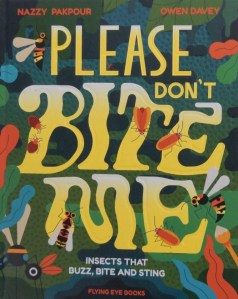
Please Don’t Bite Me!
Nazzy Pakpour and Owen Davey
Flying Eye Books
With a partner who can’t walk more than twenty metres without stopping to examine the vegetation for insects in various stages of metamorphosis – complete or incomplete – Nazzy Parker explains the difference – I was I suppose, predisposed to be interested in the contents of this book. It introduces readers to six varieties of insect pests, mosquitoes, lice, wasps, cockroaches, fleas and bedbugs; the very names, excluding wasps, make me want to squirm.
Pakpour starts by defining insects and the scientists who study them after which three or more spreads are devoted to each of the aforementioned pests. She describes their appearance including the difference between males and females, their impact on humans and how they find us, their habitat – I was intrigued to discover that mosquitoes are found everywhere except Antarctica and Iceland where it’s too cold for them to survive, and that it’s only the females that bite.
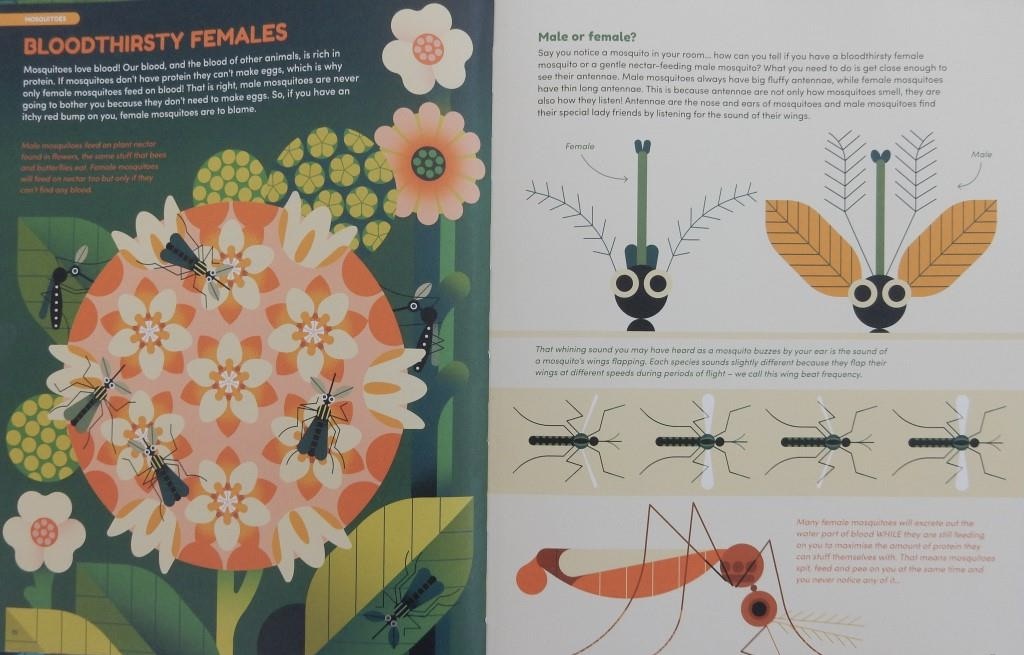
We also read about their habits and their development from egg to adult. Mosquitoes, wasps, and fleas undergo ‘complete’ ie four stage metamorphosis, whereas lice, cockroaches and bedbugs have a three stage, or incomplete metamorphosis.
Can you believe that there are more than 5,000 different kinds of lice, each kind being specific to the kind of animal it feeds on. Those that feed on humans spit saliva that can take as much as thirty days for us to develop an allergic response to. Weirdly though the very mention of a child in one of my classes having headlice has always made me start itching round my hairline straight away.
As for cockroaches, I will never forget the sight of an enormous one crawling across the pillow of our room in one of Jaipur’s five-star luxury palace hotels; it certainly didn’t get a five star review from me despite the fact that so we are reminded herein, the creatures don’t actually feed on human blood.
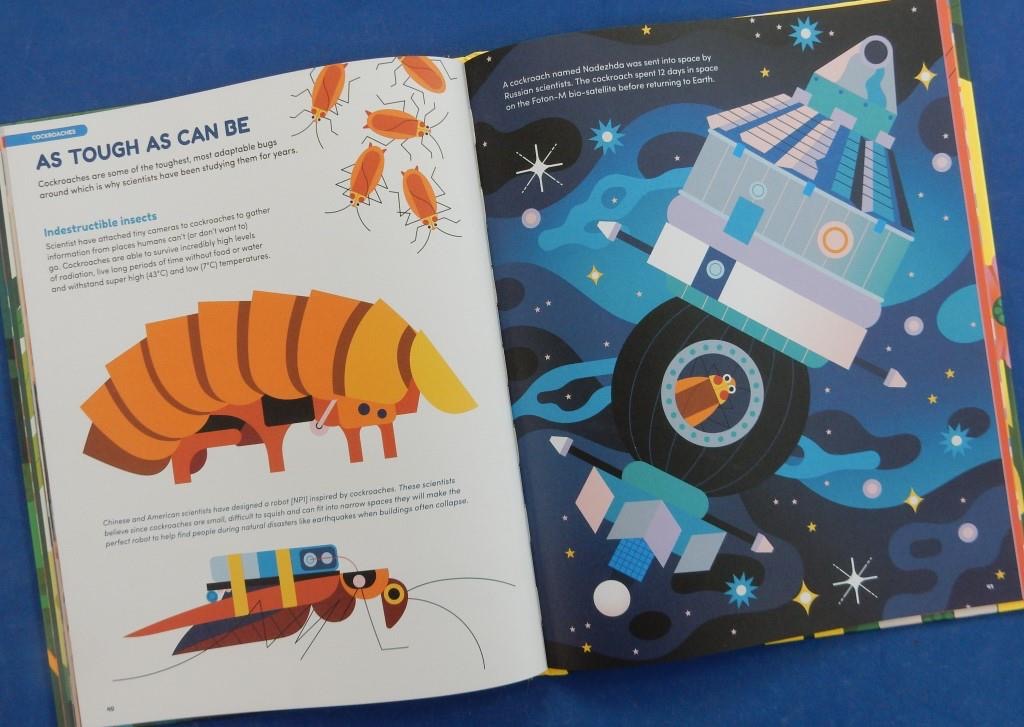
The author provides lots of fascinating snippets of information including that Chinese and American scientists have designed a robot inspired by cockroaches and that Russian scientists sent a cockroach into space for twelve days on a bio-satellite.
Probably though what is most important is the role of various insects in the world’s ecosystem; this is assigned the book’s final paragraph.
Owen Davey’s stylised, stylish illustrations work really well with biologist, Nazzy Pakpour’s text. Not the first book one would go to for general information about insects but a thoroughly engrossing one nonetheless.
 Red Reading Hub - Jillrbennett's Reviews of Children's Books