
Du Iz Tak?
Carson Ellis
Walker Books
Google translate often comes to the rescue when one is confronted with a piece of text in an unfamiliar language. I doubt it would be of help here though for the characters in this story speak ‘insect’. It’s delivered in dialogue – nonsense dialogue unless of course, you happen to be a damselfly or another insect.
“Du iz tak?” one asks the other as a pair of damselflies gaze upon an unfurling shoot. “Ma nazoot.” comes the reply. Now, as this brief exchange is contextualised by the picture we can take a guess at its meaning ‘What is that?’ and ‘I don’t know.’ in the same way somebody learning English as an additional language might.
Time passes: The shoot continues to grow and to the left, the dangling caterpillar has become a pupa. More bugs discuss the ‘thing’ -a plant, but what kind? They need something:“Ru badda unk ribble.” We need a ladder – context again.
They call on Icky who lives, conveniently, close by …

A ladder is produced, a cricket serenades the moon …

and work on building a ‘furt’ starts. Then danger presents itself in the form of an ominous arachnid
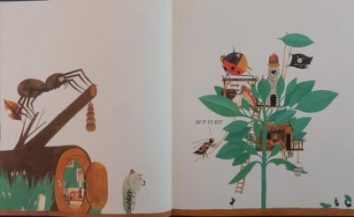
that soon starts enveloping their enterprise in a large web, until that is, along comes a large bird putting paid to that. Happily the gladdenboot remains intact and eventually, fully unfurled delights both the whole insect community and readers.

That however is not quite the end of the story for the cycle of nature must take its course with further transformations – plant and animal – so the whole thing can start over … and over and …
By this time readers will most likely be fluent readers of ‘insectspeak’, but whether or not this is so matters not: the superbly whimsical story visuals carry you through with their own spectacular grammar.
I do wonder whether despite being from the US, Carson Ellis could be having a satirical dig at the nonsense words six year olds are asked to read in that ridiculous phonics test they’re faced with towards the end of Y1; the one that many who read for meaning come unstuck with; the one the government insists is assessing reading. It’s not. At best, it’s merely assessing one aspect – decoding. Rant over: this extraordinary book is a total delight.
 Red Reading Hub - Jillrbennett's Reviews of Children's Books