
Yokki and the Parno Gry
Richard O’Neill, Katharine Quarmby and Marieke Nelissen
Child’s Play
Yokki’s family are Travellers who live under canvas and make their money by selling – it might be horses or things that they make when there’s no other work – things like carved wooden spoons or lovely paper flowers. At other times of the year, they might be found mending pots and pans, sharpening tools or picking fruit and vegetables.

Their evenings are spent around the camp fire when stories are told; and young Yokki is a particularly good story teller whose tales are a re-mix of those he’s already heard and things he adds of his own.
One year however, with work hard to come by the family is really down on their luck and Yokki’s father is worried about how they’ll cope with the coming winter. Phuri Dai (Grandma) suggests a place where they can set up camp and when they’ve done so, Yokki decides a story is just the thing to raise their spirits.
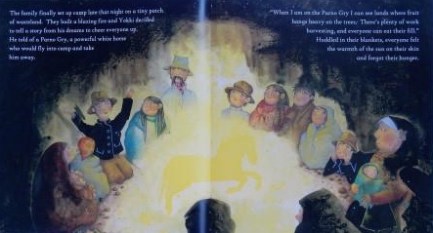
Look at the image in the centre …
It’s a mythical tale of a powerful white flying horse – a Parno Gry – that would take him to places where life would be everything they could wish.
Can that wonderful horse fly in and save Yoki’s family at their darkest time? That is the big question and one you will have to get yourself a copy of this wonderful book to answer.
Everything about this book is exciting: most importantly that the story is a real testament to the power of children’s imaginations and the valuing of same; Marieke Nelissen’s illustrations are delightfully dream-like in places, the different viewpoints and perspectives used …

add visual interest at every turn of the page and further enhance the telling.

Cool Mythology
Malcolm Croft
Pavilion Books
Prolific author Croft turns his attention to a subject popular with primary age readers, as well as a topic much studied in schools. In fact I became very interested in the whole area when studying at London University in the 80s and have continued to find the whole vast topic endlessly fascinating ever since. This book is, as it says “Filled with fantastic facts’ and encompasses the main world mythologies, Sumerian and Inca and Nubian, all of which and more are mentioned on a spread entitled Map of World Mythology.
Thereafter, logically, is a look at creation myths, the commonest forms of myths and these are broken down into five general classifications as shown here …

Examples of these are then explored in four spreads with the Greek Gaia, various sun-related myths, some fascinating African ideas and the Rainbow Serpent from the Aboriginal Dreamtime.
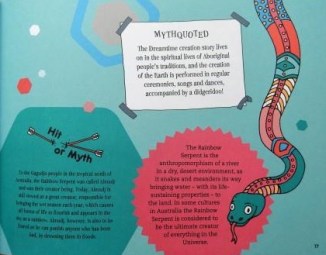
‘Myths and legends are a vital part of … what it means to be human’ we’re told and the author then goes on to look at the seven basic plots used in myths. There’s also an exploration of places such as Atlantis, as well as the more recent Bermuda Triangle; and the afterlife with a look at ancient Egypt; animals, monsters and part human, part animal beings, also have a place herein.
Indeed it’s amazing just how much is packed into this little book on a topic that has much to say to us, and societies the world over today. If you know a child who wants a quick but absorbing introduction to a vast subject, this is a very good starting point. It’s fun, attractively laid out and very readable.


 Red Reading Hub - Jillrbennett's Reviews of Children's Books