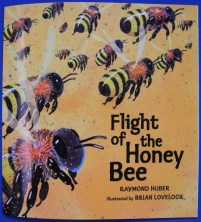
Flight of the Honey Bee
Raymond Huber and Brian Lovelock
Walker Books pbk
Did you know that ‘Bees can smell in “stereo,” each antenna smelling in a different direction.’ I certainly didn’t. Nor (despite having a partner who is a natural history fanatic) did I know that their eyeballs are furry; but these are just two of the fascinating details I learned from this absorbing book. Essentially it documents the story of a honeybee, ‘Scout’ from the time she leaves the safety of the hive and, as autumn approaches, flies out into the world in search of pollen and a nectar source.
One almost feels like a participant in Scout’s journey, such is the quality of the detail in Lovelock’s watercolour, pencil and acrylic ink illustrations
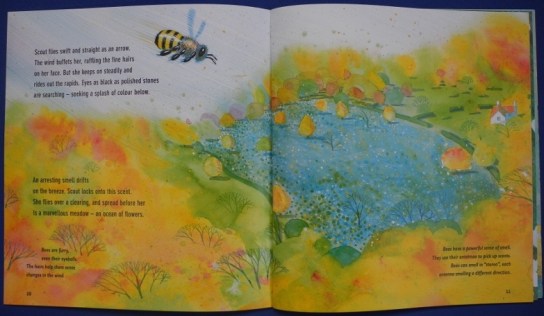
and the descriptions of Huber’s (himself a beekeeper) writing: ‘ Scout flies swift and straight as an arrow. The wind buffets her, ruffling her fine hairs on her face … Eyes as black as polished stones are searching – seeking a splash of colour below.’
Each stage of the search is vividly described using that present tense narrative voice: the narrow escape from a hungry blackbird, the nectar locating and sipping, pollen collecting in the ‘sea of flowers’. Then comes Scout’s battering by the hailstorm,
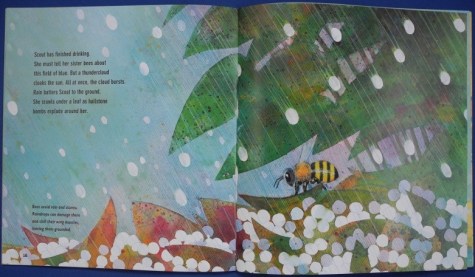
the encounter with a wasp and her re-entry to the hive where she communicates with her sister bees describing in her dance language the route to the meadow.

Next she passes her nectar to the house bees, transmits the pollen from her body to the ‘babysitter’ bees that mix it with honey to feed the babies, before settling down for a recuperative rest. A rest that will enable her to join her fellow bees for the autumn harvest in that ‘blue meadow’ she has located.
Sadly, here in the UK, honey bees are declining in numbers: the author ends by giving readers some brief tips on how they can play their part in helping these vitally important insects survive and thrive. An excellent, exciting and educative book.
Use your local bookshop 
 Red Reading Hub - Jillrbennett's Reviews of Children's Books