Minibeasts / What Can You See? In the Garden / We Love Fruit!

There are all new board books from Little Tiger – thanks to the publishers for sending them for review.
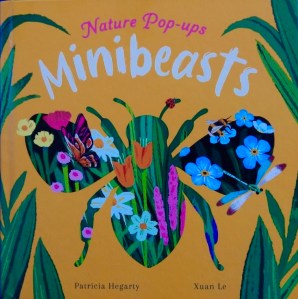
The first of a nature new series where the featured creatures almost leap out from among the plants growing in the flowerbeds. First comes a bumblebee that is busily collecting pollen from a composite flower; then there’s a ladybird that opens up its scarlet wing cases as though to take flight. Next not just one but – well maybe your little one can try counting them – the beautiful butterflies that, wings spread wide, take to the skies and flutter on the breeze. Meanwhile much closer to the ground, a shiny shelled snail climbs slowly, steadily amongst the grasses and ferns while, down by the pond darting among the lily pads, transparent wings shimmering is a dragonfly and finally, peeking from the foliage of blooming wisteria is a chirping grasshopper; but if you look very closely, there’s also one unnamed minibeast making its way along the branch.

Little ones will love watching all these small creatures as they peruse Xuan Le’s vibrant settings for Yoojin Kim’s cleverly engineered scenes.

More minibeasts appear in
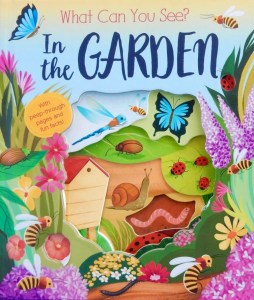
At Rosamund Lloyd’s suggestion, young children take a walk in the garden and discover minibeasts in flight, follow a butterfly through its various stages of metamorphosis, watch honey bees at work, see camouflage and other ways minibeasts keep themselves save from predators. If you take time to forage in the plant litter there are woodlice, millipedes and snails to discover whilst beneath the ground earthworms burrow and ants create colonies. Little humans will delight in such facts as “some millipedes eat their own poo’ and that unlike themselves who have a backbone, insects have a skeleton on the outside called an exoskeleton .
The cutaway pages are cleverly positioned to allow readers to peep through and see what awaits.

Spring is here so share the book and then see what awaits outside your front door.
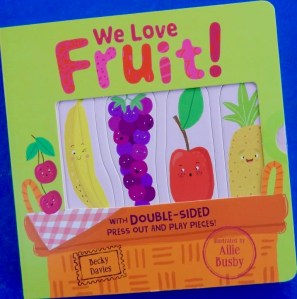
Don’t play with your tasty food. This is frequently said to little ones by parents or carers but now this book gives toddlers permission to do just that. Indeed they will love pulling out the double-sided fruit characters from the sliding tray inside the front cover and meeting the eight different fruity personalities. From these, little humans must follow the clues given on each page and choose the matching cardboard piece. Can they discover which fruit grows in bunches and when dried is called a raisin or which one might take as long as three years to grow?

A clever interactive guessing game, playfully illustrated by Ailie Busby with words by Becky Davies that offers opportunities for adult sharers of the book to talk about the importance of fruit in a healthy diet. I suspect several helpings will be desired by toddlers.

Wanna See A Penguin? / The Lost Leopard

Wanna See A Penguin?
Simon Philip and Ian Smith
Oxford Children’s Books

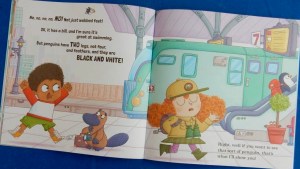
A self-declared penguin expert and friend search the city for penguins; they see all kinds of black and white creatures striped ones, furry ones,

animals with fins, horned ones, ones with hooves, four-legged animals and others but none of the eight fit all the penguin criteria. Is there actually a penguin anywhere around?

Yes indeed and that is what makes this book such fun. Hiding in plain sight in every scene is the animal the friends seek. Young listeners will love searching the pages to find its whereabouts as well as guessing the identity of the partially shown animal on each spread and laughing at the misidentifications of the so called penguin pundit.

The author’s manner of telling is gently humorous – the ending a hoot – and Ian Smith’s delightfully droll illustrations include lots of amusing details.
There’s a fact file after the story presenting a paragraph each on the zebra, puffin, duck-billed platypus, monkey, orca, goat and dog that appear in the story.,

The Lost Leopard
Jonny Marx and Xuan Le
Little Tiger

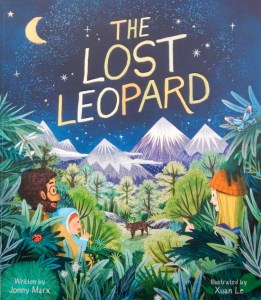
We join Flora and Fauna (dubbed the ‘world’s greatest explorers) and their baby, Bud, on their search for the elusive clouded leopard.

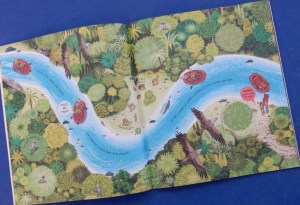
Their journey takes them to various habitats along a river,

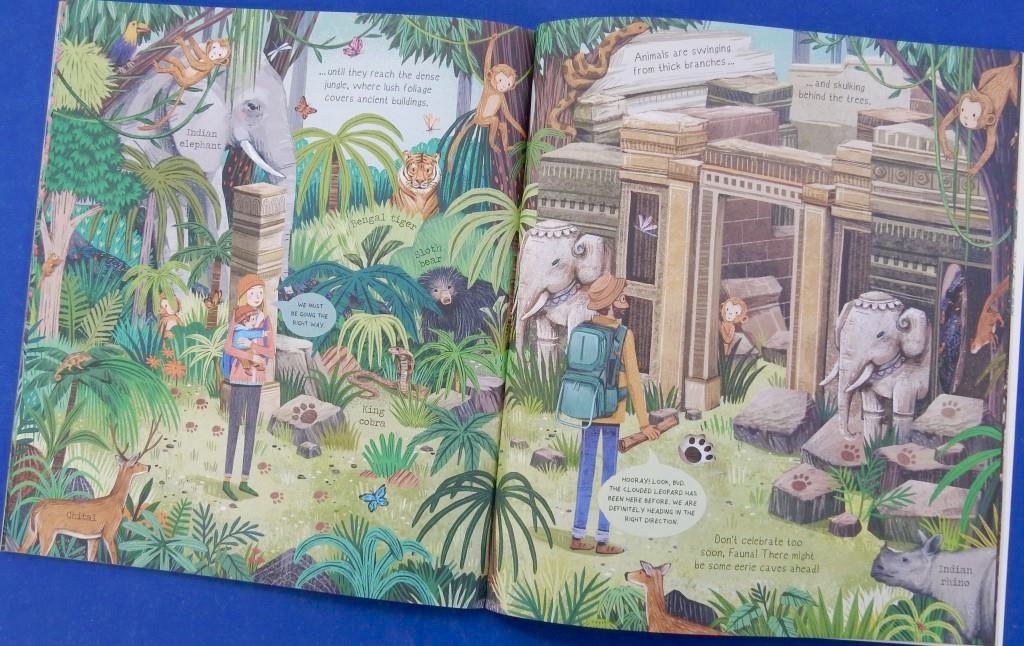
over foothills and up the Himalayan mountains, through forests and jungles and a rainforest; even down into caves. Needless to say there’s an awful lot of mud and not everywhere is accessible by road so their quest involves a lot of walking; walking through rain and snow, strong swirly winds and scorching heat until they finally arrive at a tropical forest location.

During their travels they encounter a wealth of amazing wildlife including yaks, langur monkeys, Bengal tigers,Indian elephants,

a King cobra, all labelled. Truly an epic journey but do they find what they have been searching for? Baby Bud has certainly learned a lot and so will youngsters who explore this exciting book.

Xuan Le’s vibrant detailed illustrations, which include lift the flap sections, cutaway pages, die cut surprises and a gate fold, extend Jonny Marx’s engaging, informative text making this a book that is probably best shared with an individual child or small group as there is so much to explore on every spread. Individual, more confident young solo readers will also love embarking on the adventure with Flora, Fauna and little Bud.

A Dinosaur A Day

A Dinosaur A Day
Miranda Smith, illustrated by Jenny Wren, Juan Calle, Xuan Le, Max Rambaldi and Olga Baumert
Red Shed

Imagine being able to encounter a different dinosaur, or other prehistoric animal, every day for a whole year. That’s what you can do if you plunge into this prehistoric extravaganza. Herein, after a general introductory spread, you will meet all your favourites such as the fearsome Tyrannosaurus, the club-tailed Ankylosaurus and the plant-eating Triceratops and Diplodocus. You’ll also encounter a great many unfamiliar creatures, some of which have only recently been discovered: I have to admit the majority were new names to me.

One such is Aquilops, one of the beaked dinosaurs. It was a herbivore about the size of a cat with a skull smaller than the hand of a human. Another small herbivore was the Nqwebasaurus (found in what is now Southern Africa) Amazingly so we read, ‘fossils have been found with gastroliths in the stomach – stones it swallowed to help grind up tough plant food,’

As well as dividing the contents by months, the author also uses dinosaur groups – examples are: ‘some of the smallest’, ‘duck-billed dinosaurs’, ‘horn-faced dinosaurs’ and ‘largest of them all’. Surprising to me was that all those included here were herbivorous. One such Antarctosaurus never chewed its food, rather it swallowed plants whole.

Key facts for each dinosaur featured include the period it lived, the family it belonged to, diet, length, weight anywhere remains have been found; and there is also a brief paragraph giving key information ; and helpfully, the backmatter includes a pronunciation guide.

If you have a dinosaur fanatic or a budding palaeontologist in your family then you should definitely get a copy of this book. It’s also one to add to school collections: I envisage it being in much demand especially with KS2 readers.

Turtle Rescue

Turtle Rescue
Jonny Marx and Xuan Le
Little Tiger

I suspect the burgeoning of picture books telling of the plastic pollution of the oceans is indicative that the problem is on many people’s minds. Sadly though, not those who continue to throw rubbish onto the beaches or in the sea. One can but hope that Jonny Marx and Xuan Le’s Turtle Rescue will help in this hugely important environmental cause.

Flora, marine biologist and ace underwater swimmer, Fauna, inventor and turtle lover, and their child, Baby Bud, are holidaying at the seaside intending to take it easy for a while. That isn’t what happens however.

Soon they find themselves helping with a rubbish collection during which they’re told it’s hoped it will help bring back the turtles to lay their eggs on the sandy beach once more. Before long the three of them have packed supplies, chartered a boat and are sailing off to investigate the lack of turtles.

As they sail towards the reef, Bud is excited to see all the different sea animals and plants and keeps pointing out what he calls ‘jellyfish’ – the floating plastic bags he insists on counting. Eventually Flora sights a turtle

and carefully follows it until she runs out of air. Back on board the boat again, it’s obvious a storm is looming but eventually it blows itself out and there ahead is an island. Just the place to stop and let Fauna’s queasiness subside. Imagine their delight when Bud notices tracks in the sand leading right across the dunes at the end of which are …

After an eventful and hugely exciting trip, with sail duly repaired, it’s time to head home.

There’s an amazing amount of information about turtles and other marine wildlife packed between the pages of this fascinating part fact, part fiction book.

On Sleepy Hill / I Love You Brighter than the Stars

On Sleepy Hill
Patricia Hegarty and Xuan Le
Caterpillar Books

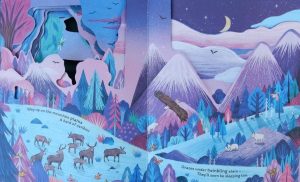
Layered scenes of the natural world as the day draws to a close and accompanying rhyming couplets give sleepy humans the opportunity to view and bid goodnight to the inhabitants of first a woodland where baby rabbits return to their burrows and a little wolf peers from a hollow. Then, the bank of a mountain stream whereon a black bear watches his cubs while otters take a last look at the evening and a mother duck gathers up her ducklings.

Further up, in a mountain clearing, deer and foxes make for home and the geese fly back to their nest, and even higher while caribou and boars are almost ready for sleep,

the owl swoops, watching and waiting.

The soporific narrative and cutaway pages of the fauna and flora of Sleepy Hill should work their magic on little humans when they too are almost ready for their slumbers.

I Love You Brighter than the Stars
Owen Hart and Sean Julian
Little Tiger

Books that celebrate the forever love between parent and child seem, like the sentiment they express, never ending. Indeed this is the second from Owen Hart and Sean Julian and rather than polar bears this one features a brown bear and its cub.

While they walk together as the evening sun gives way to moonlight and stars, the adult’s gentle heartfelt words to the cub promise lifelong guidance, companionship, support and the kind of love that is there no matter what, no matter where.

As they climb the hill, the two pause to gaze at the wonders of the natural world and at the star-filled sky

before taking a moonlit dip in the mountain stream.

Then it’s time to head home and sleep, the cub safe in the knowledge that as the wind sings a gentle lullaby it is loved ‘more than all the stars that sparkle through the night.’ Who could wish for more than that?

Soft spoken, rhyming reassurance and beautiful land- and sky-scapes make for a book that is ideal bedtime sharing for adults and their little ones.