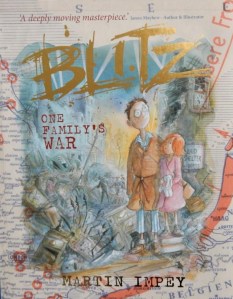
BLITZ One Family’s War

“Wow! Someone has taken a great deal of trouble over this,” commented our postman as he handed me a parcel containing this superb book. He was referring to the illustrated wrapping paper but it most definitely applies to the entire book too.

With consummate artistry, inspired by his childhood stories, Martin Impey has created a sequence of watercolour illustrations, which together with the storytelling presented from the perspective of a brother and sister, take readers through what happens to the family living at number 2 Dane Place, Bow.

We’re really given a sense of how the lives of the East End family change from before war broke out through to when two of the children were evacuated to somewhere safer; the feeling is one of instant and direct involvement with their fears, sadness

and their hopes as they carry on their daily existence in the midst of the chaos and unpredictability of the Blitz.

In addition to the family’s history there is a double spread about the impact of the Blitz on London and the rest of the country as well as extracts from letters and contemporary documents and radio broadcasts announcing the outbreak and the call for volunteers for the Dunkirk evacuation by the ‘little ships’.

With its evocative, engrossing storytelling both verbal and visual, this is a treasure of a book for individual readers, for family sharing and with my teacher’s hat on, an absolute must have for classroom exploration. It’s rich in opportunities of all kinds as I have no doubt will be the continuation of the story, Evacuees, which I eagerly await.

Rosie Raja: Undercover Codebreaker

Rosie Rajah’s third adventure is possibly even more exciting than her previous two. As the story starts, Rosie and her papa are parachuting over the Belgian countryside. On landing they are met by Brigitte, an American. The Americans have recently joined the war but it soon appears that Brigitte has her own agenda when it comes to the Nazis. Both of them though are involved in rescue missions; and there’s also a meeting up between Rosie’s papa and an old school friend.

Pretty soon, Papa announces that they need to head back to England, but first Rosie must change her appearance as the Nazis have issued an alert regarding her .
Once safely on English soil, Papa’s mission is to find the Nazi spy operating undercover at Station X aka Bletchley Park. His first stop though is at RAF Abingdon where he’s been asked to check out something and while so doing, Rosie meets Noor Inayat Khan. She’s working there as a radio operator deciphering messages and is a descendant of Tipu Sultan.

One of the amazing codebreakers Rosie encounters is Alan Turing who despite his genius, is a shy retiring character. But, there are also resistance fighters and double-crossers so Rosie has much to contend with and decide whom to trust especially when her father is in very serious danger. Can she keep her head and do something to save him?

Meanwhile back in pre-partition India, Rosie’s aunt, Rani-K is very involved in Gandhi’s Quit India Movement that is working to gain independence from British rule – another important piece of political history children will be made aware of.

Another truly gripping episode in the life of a girl who occasionally lets her emotions rather than her mind guide her actions. I was enthralled throughout.

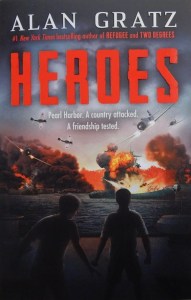
Heroes / I Survived The Battle of D-Day, 1944

This image has an empty alt attribute; its file name is dscn0030-1.jpg

In this gripping story we follow best friends Frank and his Japanese American buddy Stanley who live in Pearl Harbour Hawaii. Frank’s father is a Navy fighter pilot and Stanley’s works at the Naval Air Station, with both families living on the base. It’s December 1941 and the two boys are sailing across the harbour brainstorming their own superhero comic book character (Frank is the writer, Stanley the illustrator) as the book opens. Frank is hiding a secret anxiety of getting hurt as a result of what he calls ‘The Incident’ but it becomes evident when he avoids helping Stanley confront bullies, which prompts Stanley to ask, “How do you think you can write about heroes if you can’t be one yourself?” At this time the war in Europe seems distant to the boys until that is, Frank’s sister’s boyfriend, Brooks, who is in the navy is showing the boys around a battleship and suddenly planes start dropping bombs on all the battleships.. They realise this isn’t a drill, it’s an attack by the Japanese.


As a consequence, the boys witness horror after horror. Then there’s the issue that Stanley appears Japanese and has Japanese ancestry meaning that he is suddenly subjected to racism. This causes the Japanese Americans to start digging holes in the yard to bury any relics or heirlooms relating to their ancestry. However the situation does ultimately allow Frank to address the episode that has long haunted him relating to friendship, loyalty and his own mental health. Can he overcome his fears and stand by his best friend even when they have to part? Before so doing though they agree to continue working on the comic. And so they do: the final chapter of the novel is followed by the two boys’ ten page comic, The Arsenal of Democracy.


Well researched, totally gripping, albeit heartbreaking where we read of those who perished in the attack and the responses of those who help the injured. Back matter includes a map of Pearl Harbour December 7 1941 and an author’s note, both of which are important.


Equally affecting, with a French setting and presented in graphic novel form is:

This image has an empty alt attribute; its file name is dscn0065-1.jpg

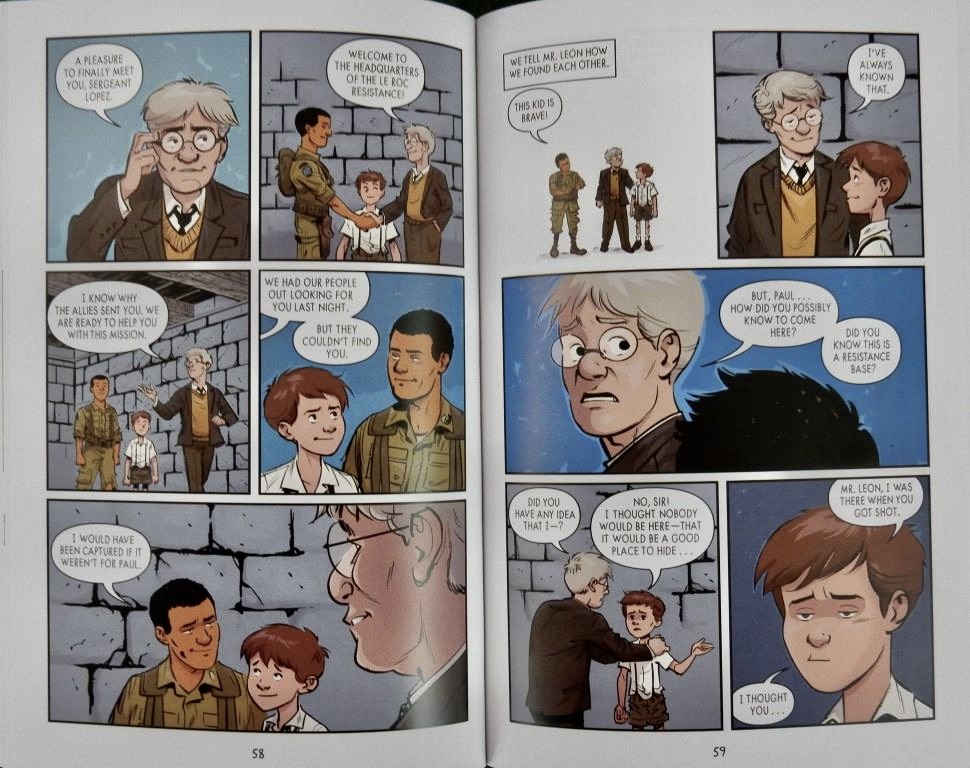
As the book opens Paul Colbert is walking in the rain through the Normandy village where he lives with his mother. It’s been under Nazi occupation for a long time but he’s trying to forget this and the fact that his Jewish best friend is missing and focus on his mother’s birthday. He follows a pigeon and discovers a US army paratrooper, Sergeant Victor Lopez, caught in a tree having jumped from his plane. Paul helps to free him and rather than let him fall into enemy hands, he leads the man to a nearby abandoned castle.

Or so he thinks, for the building is actually being used as a resistance hideout. And, to his joy there he discovers his old teacher, Mr Leon, whom he thought was dead.

This image has an empty alt attribute; its file name is dscn0063-1.jpg

Paul finds himself drawn into the underground organisation, playing a vital part in the Allies secret plans to cross the English Channel and land on the beaches of Normandy with the hope that France can be liberated.


Primary age readers, like this adult reviewer will be enthralled by this, especially the bravery shown by the Resistance and the military forces, and of course Paul. With the D-Day 80th anniversary this summer, this is a must for KS2/KS3 resources. (The author includes a timeline and other historical notes at the end of the book.)

An Elephant in the Garden

This image has an empty alt attribute; its file name is dscn9988-1.jpg

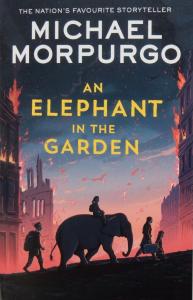
First published some ten years ago, it’s good to see this tale now made available to a new audience. It was inspired by a real life rescue of an elephant during World War 2.


From her bed a frail old lady named Lizzie, resident of a Canadian nursing home, relates her story to her nurse and the nurse’s son, Karl, who reminds Lizzie of her young brother.


During WW2, Lizzie, then sixteen, her pacifist mum, Mutti, and her younger brother Karli lived in Dresden. Their peace-loving Papi was called to fight, Mutti went to work at the Dresden Zoo with the elephants. She had seen a small elephant born and named him Marlene. Rather than have the creature subject to mercy killing like the other zoo animals, should Dresden be bombed, she had persuaded the zoo keeper to let her take the baby elephant home to her back garden and care for it.


When Dresden comes under heavy bombing in 1945 and the city is destroyed. Lizzie, her mum and Karli decide to escape into the country and head with the elephant, towards Uncle Manfred and Aunt Lotto’s farm. At first they think the place is empty but in a barn they come upon Peter, a Canadian flyer who has bailed out of his plane. What does one do when encountering an enemy combatant? Mutti is conflicted but Lizzie is immediately drawn to the young man. Together they all make their way on a perilous trek towards the American lines, helped at one point by a Countess who asks them to take a homeless school choir along with them. As they journey Lizzie becomes ever closer to Peter.


Eventually, despite Peter’s best efforts, Mutti and the children are sent to a camp along with other displaced Germans and Peter returns to Canada promising to come back and marry Lizzie. Is he able to keep that promise? And what of Lizzie’s Papi? Does he survive the war?


A gripping, enormously moving tale that offers an unusual perspective on what was a horrendous time for countless numbers of people. I read it in a single sitting.

Rosie Raja Mission To Cairo

Rosie Raja Mission To Cairo
Sufiya Ahmed
Bloomsbury Education

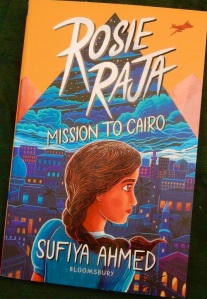
Rosie Raja returns in a new action-packed adventure, again set in World War 2. It’s autumn 1941 and this time she and her father are in Egypt. The purpose is to root out a traitor hiding in the company of the British agents who are working there – a challenging task, given the diversity of the people and personalities that inhabit Cairo. Rosie’s father’s cover story is that he is an Egyptologist who has come to work in the Museum of Antiquities and Rosie finds herself spending the mornings at the museum with her Papa. There she quickly becomes fascinated with the ancient hieroglyphics system of words and pictures.

However she meets with considerable hostility from Fatima, the daughter of Asim, one of their local allies. She wants to become an Egyptologist herself and is angry about the rumours that Rosie’s father is there to take the remains of Tutankhamun back to England. She also seems obsessed with ancient spells and curses. However as time passes the two girls become friends although Rosie finds it very difficult not to let anything slip about her Indian connections especially, that might reveal who she really is.

Just how good a friend Fatima proves to be is eventually revealed but as for others, it’s almost impossible to decide who is really who they say and can be trusted. Things become increasingly dangerous but eventually Rosie shows that she really deserves the recognition she already has and finally back in Downing Street to meet Churchill again she receives further praise when he remarks, “Carry on like this and you will end up being my favourite spy.”

I know a fair number of readers who’ve been eagerly awaiting this book; they won’t be disappointed.

The Hunt for David Berman

The Hunt for David Berman
Claire Mulligan
The Moth

This gripping thriller set during the early part of World War 2 is Claire Mulligan’s debut novel.
Eleven year old Robert, like many other children, has been evacuated and he’s now living with his grandparents on their farm on the coast of Scotland and missing his parents greatly. His father is fighting and his mother is serving in the WRENS. The boy finds it difficult to adjust to rural life after living in London but he’s keen to use the torch his Dad gave him before he left, suggesting he use it to explore the nearby caves: maybe he’ll even find that treasure his grandfather mentioned.

What he finds however, when he enters one of the caves near Tor Head Farm, is a boy who introduces himself as David. David is a Kindertransport child who has taken refuge in the cave after running away from the cruel farmer that he’d been sent to stay with. Now terrified that he’ll be recaptured and returned to Germany and the Nazi regime, the boy is trying to survive alone.

David has unknowingly carried from Germany in the lining of his suitcase something important. That secret something is an Enigma codebook that is likely to get him killed, for a Nazi secret agent sent to retrieve it is now hunting for him.

Robert feels somewhat conflicted however: Germans are the enemy surely, the people his father is fighting, so can he trust this boy? He provides him with basic necessities – food and warm blankets – while endeavouring to keep David a secret from his grandparents. The lives of the two boys become increasingly entwined and dangerous as little by little the trust between them builds, a friendship grows, and they discover that they have more in common that they first thought and are braver than they ever imagined they could be.

With parts set in the Gestapo HQ, this is a tremendously thrilling, powerfully moving story, rich in detail, exemplifying the incredible courage and resilience of people, children included, during the Second World War. Claire Mulligan has created two superb characters in Robert and David, around whom her superbly crafted tale is constructed. Now, as we witness through the media every day children fleeing from war in Ukraine, her book has an added poignancy.

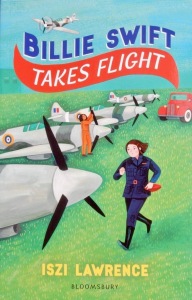
Billie Swift Takes Flight

Billie Swift Takes Flight
Iszi Lawrence
Bloomsbury Education

This story is set in 1942 and yes World War 2 is a period fairly often used in children’s fiction. but this is something altogether different.

Twelve-year old Billie Swift would much rather spend time in the company of her mum’s chickens than with other humans. She finds school boring, though she’s bright and a quick learner with an avid interest in planes.

One day when out cycling with her favourite chicken Susan, Billie suddenly sees a Spitfire crash in a field. Knowing better than to go close up and investigate in case of fire, she dashes home thinking to herself, “That is the second time you’ve murdered someone” and she’s not proud of herself. However she remains concerned about the fate of the pilot as well as her brother’s bike (which she needs to retrieve); but when she returns to the site, there’s no sign of the plane.

Before long she’s managed – not entirely honestly – to become a member of the ATA cadets, meeting lots of pilots – men and women – who against the odds, fly planes from factories to the front lines; and she too learns to fly. At the airfield she meets all kinds of people including the person she thinks was piloting the ‘crashed’ spitfire whom she begins to suspect is a Nazi spy.

On a mission to find out the truth and to clear her friend Nancy’s name,(accused of smuggling)) Billie finds herself in increasing danger and towards the end of the story there are some very frightening moments that left me with my heart in my mouth.

Truly inspiring, full of the spirit of the time and with so many real life people who were the inspiration for Iszi Lawrence’s characters, this is a book that brilliantly evokes a part of history where relatively little of the fictional focus has been on women. It helps to bring their contribution to the notice of today’s readers, many of whom won’t be much younger than Billie herself.

Definitely a book I recommend for anyone learning about WW2 at school, either as a class read aloud or a solo read; and for home reading by children who love an exciting tale.

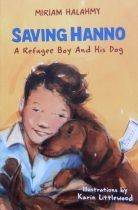
Saving Hanno

Saving Hanno
Miriam Halahmy, illustrated by Karin Littlewood
Otter-Barry Books

Rudi is a nine-year old Jewish boy who, as the story starts at the end of 1938, lives with his parents and older sister, Lotte in Frankfurt, Germany under Hitler’s rule.

When things get increasingly bad for Jewish people, Rudi’s parents take the decision to send the children to England on the Kindertransport, telling them that they will follow later on. Meanwhile Rudi and Lotte will live with an English family where they’ll be safe from the Nazis. Rudi is devastated as he won’t be able to take his beloved dachshund, Hanno with him. Amazingly though, Rudi’s family find a non-Jewish man who volunteers to take Hanno to England when he goes and then after a period of quarantine, Rudi hopes he can be reunited with his pet.
Once in England Rudi and Lotte are placed in different homes not far from one another: Rudi’s carers are kind and considerate;

not so those with whom Lotte is sent who force her to act as a maid.
After some time things in England get worse and Britain declares war on Germany. As a consequence, the children are to be evacuated to rural parts but then comes news that pets are to be put down before rationing starts. Now again, Rudi is faced with finding a way to keep Hanno safe before he relocates yet again …

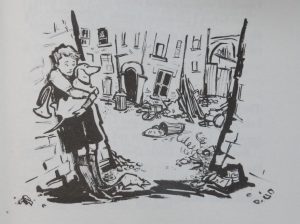
With empathetic illustrations by Karin Littlewood, this is a holocaust story with a difference, and told from Rudi’s viewpoint, it’s one that primary school age readers will certainly relate to. The author confirms in her after story note providing additional background information, that it’s based on fact. Many primary schools include WW2 as part of their history curriculum and while there are many stories about that terrible time, I would definitely advocate adding this one to the books to be shared.

Waiting for Anya

Waiting for Anya
Michael Morpurgo
Egmont

This month Egmont publishes Michael Morpurgo’s superbly plotted, totally gripping story Waiting for Anya with a film tie-in cover.

It’s set in France, in the mountain village of Lescun during World War 11.

A twelve year old shepherd boy, Jo whose father is a prisoner of war, is alerted by Rouf, his dog, to the presence of a bear. Now wide-awake, Jo dashes to warn the other villagers and the creature is hunted down and killed.

In search of Rouf, Jo returns to where he saw the bear;he encounters a man whom he discovers is reclusive Widow Horcarda’s son-in-law, Benjamin and that he’s in hiding.

Watching him through the widow’s home window, Jo recalls that he’s seen the man the previous summer holding tightly to the hand of a little girl.

He then learns that Benjamin has become separated from his daughter, Anya and that he believes that eventually they will be reunited.

As a trust grows between the widow and her son-in-law, and Jo, it’s revealed that Benjamin is Jewish and while he waits for that hoped for re-union, he is involved in a dangerous mission – leading other Jewish children away from the Nazis over the mountains, across the border to safety in Spain.

Jo is determined to help and starts bringing supplies to Benjamin’s hideout.
But then war makes itself well and truly felt in Lescun with the arrival of Nazi soldiers in the village: their eyes and ears are everywhere, and it’s announced that anyone helping fugitives will be shot. A curfew is imposed.

Jo is surprised to learn that not all the German soldiers are totally evil when he develops an unlikely friendship with a German Corporal through their shared interest in bird-watching.

Then despite the dire warnings the villagers plan to help another group of twelve children hidden away in a cave.

Just one slight slip up and lives will be lost …

There certainly isn’t a happy ever after ending to this tale; it’s tense, not everything goes well and there is one poignant final surprise. What for me resonates especially though, is the way the author shows the French villagers living alongside the Germans, not all of whom are bad. In the final pages we’re told, Jo ‘had come at last to see him (the Corporal) as a man in the uniform of the enemy, a good and kindly man … but nonetheless an enemy too’ – a ‘confusion he did not wish to confront.’

Primary Fiction Shelf

The Umbrella Mouse
Anna Fargher, illustrated by Sam Usher
Macmillan Children’s Books

Here’s a war story that’s altogether different. It’s set in London in 1944 and begins in Bloomsbury’s James Smith & Sons Umbrella Shop wherein we meet Pip Hanway and her family of umbrella mice.

When disaster strikes in the form of a bomb on the building, killing her parents, Pip is forced to begin a hazardous hunt for a new home, a home in the Italian hills where her family had its origins.

She is fortunate to meet rescue dog, Dickin, and thus begins a highly unusual tale that draws on true stories of animals caught in the WW2 conflict, a story of resistance, of courage, determination, treachery, sacrifice and bravery.

Anna Fargher’s debut is a powerful, compelling telling that will have readers and listeners charged with emotion as they root for these animals fighting the evil Nazi regime; and with occasional illustrations by Sam Usher of Rain, Sun, Snow and Storm fame to add to the pleasures, the book is strongly recommended for individuals and will also make a great KS2 class read aloud, particularly for those studying WW2.

Turns Out I’m an Alien
Lou Treleaven
Maverick Arts Publishing

The narrator of this zany tale is eleven-year-old Jasper who stands 4ft 6in tall and has green hair and eyes. A highly imaginative child so his teacher tells him, Jason lives with his extremely nice foster parents Mary and Bill Clarkson.
One day in order to bring in some extra cash. Mary and Bill decide to rent out one of the now unused bedrooms.

Before their guest has even arrived, Jasper is beginning to doubt whether his foster parents really are as predictably normal as he’d heretofore thought, especially when he notices Mary cooking what appears to be a kind of glowing green rock and Bill constantly checking the night sky through his binoculars.

Then out of the dark descends a weirdly spherical being with an orange skin uttering greetings from planet Snood and introducing himself as Flarp Moonchaser, “Slayer of the Multi-Headed Muck Monster of Murg” as he stretches forth his hand for Jasper to shake. Moreover, the thing has a strange bag stuffed full of weird and wonderful objects.

I’ll say no more other than that Jasper discovers his alien origins, the children are cascaded into a madcap space adventure to save a planet from the terrible Emperor Iko Iko Iko; there are secret agents, secret, secret agents and things get pretty Gloopy.

Entirely crazy, but readers will be swept along by the unfolding drama, which perhaps doesn’t actually end at The End.

Dennis in Jurassic Bark
Nigel Auchterlounie
Studio Press

Fans of the traditional Beano comic will certainly recognise the characters Minnie the Minx and Walter although this book is a novel, not a comic, albeit with a fair sprinkling of black and white illustrations.

It’s another madcap adventure for Dennis who is plunged back in time 65 million years. First though we find the boy visiting his gran watching a TV news reporter talking about ‘what seems to be a huge mutant, ice-cream stealing seagull’ that Dennis immediately identifies as a Pterodactyl. Dennis however isn’t the only child watching the news item; so too, among others, are his worst enemy Walter and Minnie the Minx.

Before you can say Pterodactyl Dennis finds himself on Duck Island determined to save Beanotown from dinosaur disaster.

There’s no need to be a Dennis fan to be entertained by this madcap romp with its interactive puzzles to enjoy along the way.
Seasonally Flavoured Fiction

Shifty McGifty and Slippery Sam: Jingle Bells!
Tracey Corderoy and Steven Lenton
Nosy Crow

If you’ve yet to meet comedic twosome, the wonderful baker dogs Shifty McGifty and Slippery Sam I urge you to do so with this book of three stories. Shifty’s the more industrious, of the pair; Sam means well but tends to lack his pal’s organisational skills.
In the first story, the dogs have been commissioned to create Santa’s Christmas cake and deliver it to him the same afternoon. No easy task especially with next-door neighbour Red Rocket determined to create mischief at every opportunity.

The other two tales, Sea-Monster Ahoy! and The Lucky Cat aren’t Christmassy but they are equally good fun and all are perfect for those just taking off as independent readers, who will particularly relish Steve Lenton’s lively scenes of the canine mystery solvers at work.

Harper and the Fire Star
Cerrie Burnell illustrated by Laura Ellen Anderson
Scholastic

Harper, the girl endowed with a rare musical gift, who resides in the City of Clouds and is able to play any instrument she picks up without learning a single note, returns in her 4th adventure and once again it’s full of music, magic, friendship and gentle humour.
In this story, the Circus of Dreams (Harper’s birthplace) is back in town and as well as seeing her parents, Harper has something important she wants to do and that is to help the Wild Conductor win back his place in the magical show. Why he wants to do so is a mystery to Harper and her friends, nevertheless they put on an amazing show but things don’t quite go according to plan.
Then they learn exactly why getting back into the circus is so important to the Wild Conductor: it’s on account of his love for a girl named Fire Star, so called because ‘whenever she heard music she began to shine like a star.’
Adding to the fun of the tale are Laura Ellen Andersen’s sparkly illustrations.
Always ready to help others, Harper is a delight.

The Storm Dog
Holly Webb
Stripes Publishing

Young Tilly and her mum are going to stay with her Grandma and Great-Gran over Christmas but when work delays her mum, Tilly travels ahead alone on the train.
Great-Gran (almost ninety) has sent Tilly a parcel to open on the train and inside she discovers a Christmas tree decoration and a photo.
Soon, lulled by the motion of the train, Tilly starts to doze and finds herself back in the time when it was her Great-Gran taking the journey as an evacuee more than seventy years back. (Tilly is learning about World War Two for a school project.) She then re-lives some of Great-Gran’s evacuation experiences along with her two younger brothers who also stayed at Mr Thomas’ farm on the Welsh borders, attended the village school, tended the farm animals, had their first experience of snow and sledging, and prepared for the Christmas season..
Tilly forms a special friendship with Tarran, Mr Thomas’ sheepdog and it’s he that plays an important role on more than one occasion.
Gently told, the twisting, turning adventure draws you in right away and keeps you entranced right through to the end. It’s great for giving young readers an insight into life in WW2, especially those who, like Tilly, are learning about the period at school. Line drawings by Artful Doodlers, several per chapter, are scattered throughout the story, further adding to the reader’s enjoyment.

Curse of the Werewolf Boy
Chris Priestley
Bloomsbury Children’s Books

This had me gripped from the start. Essentially it’s a boarding school parody of the Gothic kind and its stars, or rather heroes – neither seems to quite fit the bill – Arthur Mildew and Algernon Spongely-Partwork aka Mildew and Sponge are pupils at Maudlin Towers School, by all accounts a pretty awful establishment for the ‘Not Particularly Bright Sons of the Not Especially Wealthy’.
Returning after a half-term holiday, the pupils are informed that a terrible crime has occurred: the School Spoon (once owned by the school’s founder) has been stolen and the headmaster threatens terrible consequences for the culprit(s).
Who better for a spot of detectivating than Mildew and Sponge who are about to learn that crime solving isn’t as easy as they might have thought. Particularly when there’s a ghost in the attic, not to mention a Viking wandering around, a history teacher, one Mr Luckless who has a ‘temporo-trans-navigational-vehicular-engine’ (a time machine to you and me); even a werewolf boy (but you’d expect that from the title), and more.
It’s not only the lead crime solvers who are splendid; every single character is wonderful be they pupil or teacher – you can meet the whole cast at once via the role of honour board at the start of the story. With staff names such as Mr Particle actually newly deceased when the story opens; you can guess what subject he taught, Mr Stupendo and the Latin speaking Miss Livia; and Enderpenny and Furthermore numbering among the pupils.
Then there’s the narrative itself which is peppered with such deliciousness as:
I know what a ha-ha is, you nose hair,” said Kenningworth … ; and
… Mildew’s upper lip began to lose some of its structural integrity…”;
a brilliantly controlled plot that twists and turns while keeping readers totally engrossed throughout its mock scary entirety; and if that’s not enough, the book is chortle-makingly illustrated by none other than Chris Priestly himself.
Why am I including this story in a Christmas review, you might be wondering: that’s for me to know and for you to discover when you get hold of a copy of this cracker of a book.